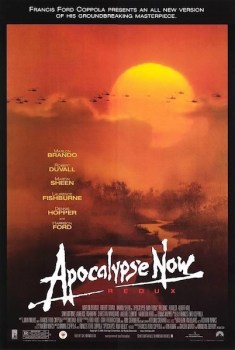
Apocalypse Now Redux (1979/2001)

100 Films’ 100 Favourites #3

Francis Ford Coppola presents an all new version of his groundbreaking masterpiece.

Original Title: Apocalypse Now (obviously)

Country: USA
Language: English, French & Vietnamese
Runtime: 202 minutes (theatrical/DVD) | 196 minutes (Blu-ray)*
BBFC: 15
MPAA: R

* This appears to be due to the Blu-ray removing the end credits, but the number of disc reviewers who haven’t even noticed the discrepancy is remarkable.

Original Release: 15th August 1979 (USA)
UK Release: 19th December 1979
Redux Release: 11th May 2001 (Cannes) | 23rd November 2001 (UK)
First Seen: DVD, c.2002

Stars
Martin Sheen (Badlands, The Departed)
Marlon Brando (A Streetcar Named Desire, The Godfather)
Robert Duvall (THX 1138, The Godfather)
Dennis Hopper (Easy Rider, Speed)

Director
Francis Ford Coppola (The Godfather, The Conversation)

Screenwriters
Francis Ford Coppola (Patton, The Godfather Part II)
John Milius (Conan the Barbarian, Red Dawn)

Based on
Heart of Darkness (loosely), a novella by Joseph Conrad.

The Story
In the middle of the Vietnam war, burnt out soldier Captain Willard is given a top-secret mission: locate US Army Colonel Kurtz, who’s gone renegade and is leading his own personal army in unauthorised attacks, and terminate his command. Travelling up the river on a Navy patrol boat, its crew unaware of Willard’s goal, they see snapshots of the war and the elements of human nature it exposes — the very horrors that drove Kurtz insane…

Our Hero
Martin Sheen is Captain Benjamin Willard — not exactly a hero, but certainly the narrator. Already mentally wracked by his experiences in Vietnam, he may not be the best person to send after another officer similarly mentally afflicted…

Our Villain
Marlon Brando — top billed, only on screen for minutes, and a nightmare to work with… but another performance for the ages as the rambling, insane, but insightful, Colonel Kurtz.

Best Supporting Character
A Golden Globe, a BAFTA, and an Oscar nomination rewarded Robert Duvall for his turn as the commander of a helicopter unit, Lt. Col. Kilgore. More than that, though, was true immortality in the form of the movie’s most famous quote: “I love the smell of napalm in the morning.”

Memorable Quote
Colonel Lucas: “When you find the Colonel, infiltrate his team by whatever means available and terminate the Colonel’s command.”
Willard: “Terminate the Colonel?”
General Corman: “He’s out there operating without any decent restraint, totally beyond the pale of any acceptable human conduct. And he is still in the field commanding troops.”
Civilian: “Terminate, with extreme prejudice.”

Memorable Scene
The sound of unseen helicopters circle. The Doors playing. A pretty forest… which explodes into flame, under the barrage of a napalm attack. One of the most iconic opening scenes.

Technical Wizardry
Apocalypse Now was one of the films that pioneered the creation of surround sound, now the industry standard. Nowhere is it better exemplified than in that opening scene, with the helicopters circling the room.

Making of
“My movie is not about Vietnam, my movie is Vietnam.” Apocalypse Now was a notoriously troubled shoot, for all kinds of reasons, from an uncooperative Brando, to Martin Sheen’s heart attack, to the cast and crew’s copious drug use… Originally scheduled to shoot for six weeks, it ended up filming for 16 months, and took nearly three years to edit.

Awards
The original version won 2 Oscars and 2 BAFTAs, and was nominated for 6 more Oscars and 7 more BAFTAs. In 2002, the Redux was nominated for 7 World Stunt Awards.

What the Critics Said
“this might be the most audience-friendly art-house film ever made, and that’s where the sheer majesty of Coppola’s daredevil balancing act comes into true focus. Coppola’s art is stripped of pretension; what lies on screen may as well be Coppola’s — and probably several other peoples’ — heart, laid bare for all to see, somehow expressed through arguably the most populist of all mediums. It may be messy, but it’s also vivaciously alive.” — Rob Humanick, Slant

Score: 93%

What the Public Say
“The most critically acclaimed movie of 2001 was made 22 years ago… The new material isn’t entirely necessary, and some may find it excessive… But Redux’s virtues far outweigh its flaws. Apocalypse Now in any version remains one of the richest, most extravagant moviegoing experiences of my life.” — Jeffrey Overstreet, Looking Closer

Verdict

The first (and, indeed, last) time I watched Apocalypse Now was shortly after the Redux version had been released, when Francis Ford Coppola was busy proclaiming it was the only version that would be made available ever again. That didn’t last, of course. Adding some 49 minutes of footage to the praised theatrical version, Redux divides viewers and critics on whether the extensions make a classic even better or just dilute it. If there’s a consensus, it’s that in either version this is a great movie. I’ve never got round to the original cut to compare for myself, so it’s the longer one that makes my list. My favourite quote about it comes from Danny Boyle: “It’s imperfect; which every film should be.”

#4 will be… the 13th.

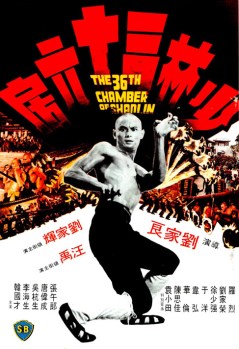
The 36th Chamber of Shaolin (1978)

aka Shao Lin san shi liu fang / Master Killer

2016 #6
Liu Chia-liang | 111 mins | streaming (HD) | 2.35:1 | Hong Kong / Mandarin | 15 / R

Widely regard as one of (if not the) greatest kung fu movies ever made, The 36th Chamber of Shaolin introduces us to San Te (Gordon Liu), a student whose hometown is oppressed by forces of the ruling Qing dynasty. He and his classmates join the underground resistance run by his teacher, only to wind up witnessing his friends and mentors be hunted, tortured, and killed. Faced with a similar fate, San Te escapes to the Shaolin Temple, widely known for being home to the best kung fu around. The temple’s monks refuse to teach martial arts to normal folk, nor help by joining the fight — they’re Buddhists, after all. Nonetheless, San Te manages to inveigle his way in to their company, and years of training begin.
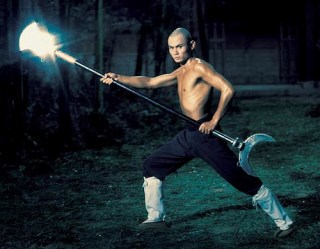
Said training — where San Te must progress through the Shaolin Temple’s 35 (not 36) chambers one by one — makes up the bulk of the film, though there are lengthy bookends dealing with the reason he goes there in the first place and what he later does with that training. If the notion of watching chamber after chamber after chamber (times 35) sounds dull, don’t worry, we only actually see ten of them, and several of those via an extended montage. The chambers take the form of challenges, which San Te must overcome by either puzzling them out or developing some kind of physical or mental acuity. Their content is varied and innovative, which makes them engrossing to watch even as they make the film episodic, but the nature of the challenges makes the movie different from the usual fight-after-fight-after-fight structure of kung fu flicks.

If it’s combat you want, though, never fear: everybody is kung fu fighting at regular intervals. Displays of physical skill and speed are de rigueur for these kind of films, but the combat here is as impressive as any. While the initial training takes the form of tangentially-related skills tests, San Te is eventually learning how to use weapons, and when he finally graduates from the 35th chamber he has to prove himself in combat, first against the temple’s justice, then when he returns to the outside world and seeks vengeance. Fights both with and without weapons are imaginatively choreographed and executed with the customary speed and precision.

Much as you won’t enjoy many a musical if you can’t accept people just bursting into song, you won’t enjoy many a kung fu movie if you can’t accept a story told primarily through back-to-back action sequences. The 36th Chamber of Shaolin is more-or-less that kind of movie, though the differing styles of the chambers’ challenges bring pleasing variety. Is it the greatest kung fu film of all time? I’m no expert, but it’s certainly inventive, masterfully performed, and suitably different from any such movie I’ve yet seen.

4 out of 5

The 36th Chamber of Shaolin is on Film4 tonight at 10:55pm. It kicks off a short season of martial arts movies — more details here.

Alan Rickman, 1946—2016

I rarely break from reviewing on this blog, but I think I can afford such a courtesy to Alan Rickman.

In part this is because, after I heard the news, I realised he’s been a constant presence throughout my film-loving life. I adored Robin Hood: Prince of Thieves as a kid, when the American accents didn’t matter and it was a glossy big-budget extravaganza. I watched it a few years ago, and it no longer looks glossy, big budget, or particularly extravaganza-y, but Alan Rickman shines as arguably the best Sheriff of Nottingham ever to grace the screen.

Then there’s the role that has obviously defined him for a generation: Professor Severus Snape in the Harry Potter series. I’m sure casting the Potter films must’ve been a tricky business, but Rickman as Snape was one of those choices where you just think, “well, obviously.” A pretty one-dimensional character to begin with (The Mean Teacher), Snape has a significant and complicated role as the series goes on, and is probably the most nuanced character in it by the end. Having an actor of Rickman’s ability involved was obviously beneficial.

And as I got older still, there was Die Hard. His film debut at age 42, and the film that will always define him for many, but (again) it’s a magnificent performance, a definitive villain. Pretty much every action-thriller villain for the next, what, decade? more? is really a rip-off of Hans Gruber, however all portrayed by whichever British actor was currently available.

Those are just three keystones in a sea (mixed metaphor much) of fantastic movies and excellent performances that have been scattered throughout my viewing life: the Spock-ish thespian in Galaxy Quest; the punk-y angel in Dogma; the voice of Marvin the Paranoid Android in The Hitchhiker’s Guide to the Galaxy film (another spot of perfect casting); the adulterous(?) husband in one of Love Actually’s strongest yet most divisive stories. Several of these films are to come on my 100 Favourites; several more were in contention; and, in every case, a significant reason for their presence was Alan Rickman’s performance.

And if you ever forget that life isn’t fair, remember this:

So we've lost 69-year-olds Bowie, Lemmy (ok 70-year-old) and now Alan Rickman – but Donald Trump is still with us.

Alien (1979)

100 Films’ 100 Favourites #2

In space, no one can hear you scream.

Country: USA & UK
Language: English
Runtime: 117 minutes | 116 minutes (director’s cut)
BBFC: X (1979) | 18 (1987) | 15 (director’s cut, 2003)
MPAA: R

Original Release: 25th May 1979 (USA)
UK Release: September 1979
First Seen: TV, c.2002

Stars
Tom Skerritt (Top Gun, Poison Ivy)
Sigourney Weaver (Ghostbusters, Galaxy Quest)
John Hurt (The Elephant Man, Nineteen Eighty-Four)
Ian Holm (Greystoke: The Legend of Tarzan, Lord of the Apes, The Lord of the Rings: The Fellowship of the Ring)

Director
Ridley Scott (Blade Runner, Prometheus)

Screenwriter
Dan O’Bannon (Dark Star, Total Recall)

Story by
Dan O’Bannon (see above)
Ronald Shusett (King Kong Lives, Total Recall)

The Story
The crew of the deep-space towing vessel Nostromo receive a distress call from an unexplored planet. Contractually obliged to respond, they find a derelict alien spaceship and a field of strange eggs. With one of the crew taken ill they return to their ship, but it soon becomes apparent something else has come with them…

Our Hero
Sigourney Weaver is second-billed as second-in-command Ellen Ripley, but it’s she who’s the voice of reason and, when ignored, the most capable to stand up to the alien threat.

Our Villain
The Alien, aka the Xenomorph, an ugly, dripping, phallic nightmare, that lurks in the shadows, strikes without warning, has the perfect defence system, and is nigh-on unbeatable.

Best Supporting Character
Ian Holm’s Ash is not all he appears to be… Holm made sacrifices for his art: he hates milk, but had to sit dribbling it from his mouth for take after take.

Memorable Quote
“I admire its purity. A survivor… unclouded by conscience, remorse, or delusions of morality.” — Ash

Memorable Scene
Dinner table. John Hurt not feeling well. You know the rest. And if you don’t, you don’t want me spoiling it for you.

Technical Wizardry
The Nostromo’s industrial-style production design is a world away from the slick, shiny spaceships of contemporary sci-fi like Star Trek. A lived-in sci-fi world wasn’t something new (Star Wars and the Millennium Falcon were two years earlier, for instance), but the notion of a spaceship that looks like a factory or an oil-rig or somesuch, and that is populated by the kind of people who would work in such an environment, continues to influence the genre today.

Truly Special Effect
The Alien, designed by H.R. Giger, built by Giger and Carlo Rambaldi, performed by Bolaji Badejo, is one of the most genuinely alien creatures the movies have ever generated. It’s terrifying, too, even after the initial disgust has been neutered by decades of over-exposure in increasingly-poor sequels and tie-ins.

Making of
The name of Weyland-Yutani, “the company” the crew work for, is actually “Weylan-Yutani”, as seen on monitors and Dallas’ beer can. It was changed to “Weyland-Yutani” for Aliens (and all subsequent films and media) because James Cameron thought it looked better with the D. It’s the little things, eh.

Next time…
Three direct sequels, two “vs Predator” spin-offs, a prequel (and a prequel-sequel), and a massive array of novels, comics, video games, and the rest. A new sequel is also in development.

Awards
1 Oscar (Visual Effects)
1 Oscar nomination (Art Direction-Set Decoration)
2 BAFTAs (Production Design, Sound Track)
5 BAFTA nominations (Supporting Actor (John Hurt), Film Music, Costume Design, Editing, Most Promising Newcomer to Leading Film Roles (Sigourney Weaver))
3 Saturn Awards (Science Fiction Film, Director, Supporting Actress (Veronica Cartwright))
4 Saturn nominations (Actress (Sigourney Weaver), Writing, Make-Up, Special Effects)
Won the Hugo for Best Dramatic Presentation.

What the Critics Said
“It’s tempting to describe the brilliantly staged scenes of horror and surprise but it would be a shame not to allow the film to reveal its own secrets. Enough to say that the tension is savage and you are held in suspense right up to the end frames.” — Ted Whitehead, The Spectator

Score: 97%

What the Public Say
“in some ways it doesn’t betray its age, and it does indeed largely still hold up, but in other ways its utterly unlike contemporary films. Its middle-aged cast, its slow, deliberate pace, the ‘real’ sets grounded in reality, how it leaves so many things unexplained — in these respects it’s obviously an older movie, and better for it.” — the ghost of 82

Elsewhere on 100 Films
I reviewed Ridley Scott’s 2003 Director’s Cut back in 2009, summarising that “to fans intimately familiar with the film, the number of trims (there are rather a lot apparently) and new scenes (just four) make a huge difference, but for a more casual viewer they don’t significantly change how it feels. That said… I’d call the original as the superior cut.”

Verdict

Ridley Scott’s “haunted house movie in space” is one of those works that an awful lot of what follows in the genre owes a debt to, from the production design to one of cinema’s most iconic heroines. “Iconic” is a good word for the film as a whole, be it the realisation of the creature or scenes like the chestburster. Quite beyond that, however, it’s a terrifying horror movie in its own right, where slowly-built tension gives way to proper scares. Being a great of one genre is an achievement, but to be great in two at the same time (horror and sci-fi, of course) is something else.

#3 is not about Vietnam… it is Vietnam.

Aladdin and the King of Thieves (1996)

2015 #196
Tad Stones | 82 mins | streaming (HD) | 16:9* | USA / English | U

For most of the ’90s and ’00s, Disney churned out direct-to-video sequels to many of their most beloved animated classics. They have a reputation for being unremittingly awful, hence why Pixar’s John Lasseter put a stop to their production after he became Disney’s Chief Creative Officer in 2006. Despite that reputation, however, there are those who say one or two are actually quite good. One of those (and the only one I’ve previously seen) is The Lion King 1½ (released as The Lion King 3 in the UK), which is a sort of a Rosencrantz and Guildenstern Are Dead to the original film’s Hamlet, re-telling the story from the perspective of Timon and Pumbaa. I saw it years ago but would vouch for its relative quality — when I first re-watched The Lion King after, I briefly thought some scenes were missing, which I guess is testament to how well it fits.

Another such-praised sequel is this follow-up to Disney’s 1992 Animated Classic. It’s actually the second sequel (the first was also the first of those Disney DTV sequels) and also follows an 86-episode TV series. Fortunately, the makers dropped an early idea to use one of the series’ main villains as the film’s antagonist, and so it functions perfectly as a direct sequel to the original movie. Which is nice, because that first sequel isn’t meant to be very good and I imagine the TV series is hard to come by nowadays. Plus, neither of those can claim an ever-so-important distinction that this can: it features the return of Robin Williams as the Genie.

The film begins on the wedding day of Aladdin (Scott Weinger) and Jasmine (Linda Larkin), which is interrupted by the mysterious Cassim, the King of Thieves (John Rhys-Davies), and his gang of forty thieves seeking to steal an oracle from among the wedding gifts. Although they fail, the oracle informs Aladdin that the answers he seeks about his long-departed father are to be found with the forty thieves… I expect you can guess where that’s going. Fortunately the film gets there pretty quickly, then transitions into a story about the possible redemption (or not) of Cassim alongside the quest for the Hand of Midas, capable of turning whatever it touches into gold (natch).

The King of Thieves has a few things in its favour. It’ll come as no surprise that the biggest and best is Williams reprising his iconic performance, and consequently being responsible for most of the film’s humour. There are a couple of fun nods to some of Williams’ other best-remembered roles, and plenty to other Disney films too. The rest of the film offers a fast-paced, action-packed narrative, with a few musical numbers to boot. The songs are certainly not as memorable as those found in proper Disney movies, but most are decent while they last. Jasmine gets somewhat short shrift, but this is really a story about father and son.

Those who dislike Disney’s Aladdin won’t find anything to enjoy here, but for fans of the original, Aladdin and the King of Thieves is a solid, fun follow-up.

4 out of 5

* The film was made for release on VHS, so it’s no surprise that the OAR is 1.33:1. The HD version is cropped for 16:9. It’s mostly alright, though anyone with an eye for composition will find it obvious at times. ^

What Dreams May Come (1998)

2015 #129
Vincent Ward | 114 mins | streaming (HD) | 2.35:1 | USA & New Zealand / English | 15 / PG-13

When What Dreams May Come first came out, the reviews seemed to conclude that it was rubbish, but at least visually splendid. Back in 1998, that put me off — “it’s not meant to be very good” was the takeaway thought there. As the years have gone on, for some reason those reviews (or possibly just one I extrapolated into a consensus, who knows?) stuck with me; and as my temperament as a film fan grew, that it was visually extraordinary (even if nothing else) began to seem reason enough to watch it. It lingered in the back of my mind, never quite becoming a “must see”, especially as the opportunity rarely (if ever) presented itself. So that’s more or less how I come to it now, 17 years since its release and those reviews — a long-awaited scratch of a long-lingering itch. (Perhaps this gives some insight into why/how it takes me so long to get round to watching recommendations/things I’m quite keen to see/etc.)

Adapted from a novel by Richard “I Am Legend” Matheson, the story concerns Dr Chris Nielsen (Robin Williams) and his wife Annie (Annabella Sciorra). Their perfectly lovely life is shattered when their two kids are killed in a car crash. Despite Annie suffering a mental breakdown, they hang in there… until Chris is killed in another car crash a few years later. He ascends to a kind of Heaven, a wondrous place controlled by his imagination — this is where those visuals come in. However, Chris learns that Annie has committed suicide, and so been condemned to Hell. He vows to do what has never been done, and travel to Hell to rescue her.

Hell, incidentally, also looks incredible, as do the various locales visited by Chris and his companions (played by Cuba Gooding Jr and Max von Sydow) on their way there. Director Vincent Ward and his team have created a rich, engrossing visual space here. It’s not just the Oscar-winning visual effects either, which create Chris’ initial realisation of Heaven as a kind of living painting, but also the locations, their decorations, and some fantastic sets. The design work is brilliant, and the vast majority of it still holds up today. Even the CGI doesn’t look glaringly like 17-year-old graphics, and in many cases what I presume is a mix of live action, models and some CGI is far more effective than the all-CG look it would likely have if made today.

However, the story is… problematic. Its logic comes and goes (the afterlife’s rules have to be obeyed or are able to be broken depending on the situation, for instance), it goes on too long, with too many asides, and there are needless twists, reveals, and reversals that are neither surprising (thanks to their ultimate predictability) nor illuminating (thanks to their unnecessariness). There were too many flashbacks and asides to real life, and I’d have liked it more if it stuck to the afterlife stuff — cut the flashbacks, limit the story to the afterlife quest, and stop mirroring it in the couple’s earlier real-life troubles. That would make the movie shorter, more streamlined, less wishy-washily sentimental, more focused, and therefore better.

Nonetheless, some will identify with the sentimental “love transcends death”-type message more than others, and there’s a chance those who like (or don’t mind) their films to be at the soppier end of the spectrum will genuinely love it. For the rest of us — for anyone who likes visual splendour in their movies, anyway — it does indeed merit a look for the imagery alone.

3 out of 5

Aladdin (1992)

100 Films’ 100 Favourites #1

Imagine if you had three wishes,
three hopes, three dreams
and they all could come true.

Country: USA
Language: English
Runtime: 90 minutes
BBFC: U
MPAA: G

Original Release: 25th November 1992 (USA)
UK Release: 18th November 1993
First Seen: VHS, c.1993

Stars
Scott Weinger (Aladdin and the King of Thieves, Shredder)
Robin Williams (Good Will Hunting, Insomnia)
Linda Larkin (The Return of Jafar, Joshua)
Jonathan Freeman (The Return of Jafar, The Ice Storm)

Directors
Ron Clements (Basil the Great Mouse Detective, Hercules)
John Musker (The Little Mermaid, The Princess and the Frog)

Screenwriters
Ron Clements (The Little Mermaid, The Princess and the Frog)
John Musker (Basil the Great Mouse Detective, Hercules)
Ted Elliott (The Mask of Zorro, Pirates of the Caribbean: The Curse of the Black Pearl)
Terry Rossio (Shrek, Pirates of the Caribbean: At World’s End)

Story by
Deep breath… Burny Mattinson and Roger Allers, Daan Jippes, Kevin Harkey, Sue Nichols, Francis Glebas, Darrell Rooney, Larry Leker, James Fujii, Kirk Hanson, Kevin Lima, Rebecca Rees, David S. Smith, Chris Sanders, Brian Pimental & Patrick A. Ventura.

Based on
The folktale of Aladdin and the magic lamp from One Thousand and One Nights, aka The Arabian Nights.

Music
Alan Menken (Little Shop of Horrors, Tangled)

Lyrics
Howard Ashman (Little Shop of Horrors, Beauty and the Beast)
Tim Rice (The Lion King, Evita)

The Story
Street urchin Aladdin falls for bored Princess Jasmine when she sneaks out of her palace one day, leading him to the clutches of evil vizier Jafar, who needs Aladdin to retrieve a magic lamp as part of his scheme to rule the land. When Aladdin accidentally discovers the lamp’s inhabitant, a wish-granting Genie, he uses his wishes to set about wooing the princess. Jafar, of course, has other ideas…

Our Hero
One jump ahead of the bread line, one swing ahead of the sword, steals only what he can’t afford (that’s everything). Riffraff, street rat, scoundrel. It’s Aladdin, of course.

Our Villain
Grand Vizier Jafar, a plotting underling — the kind of role that has strong precedent in fiction, I’m sure, though Conrad Veidt as villainous Grand Vizier Jaffar in The Thief of Bagdad is rather clearly the direct inspiration.

Best Supporting Character
Oh, I don’t know, maybe… the Genie! Fantastically voiced by a heavily-improvising Robin Williams, praise is also deserved for Eric Goldberg’s character animation, which matches him every step of the way. In fact, it was an animation Goldberg created using one of Williams’ stand-up routines that convinced the comic to take the part.

Memorable Quote
Aladdin: “You’re a prisoner?”
Genie: “It’s all part and parcel, the whole genie gig. Phenomenal cosmic powers! Itty bitty living space.”

Memorable Scene
Trapped in a desert cave, Aladdin accidentally rubs a lamp and unleashes the Genie — and with it, Robin Williams’ all-time-great hilarious performance.

Best Song
For me, it’s Prince Ali, the huge Genie-led number as a disguised Aladdin arrives back in town in grandiose style. The Genie’s big solo number, Friend Like Me, is an incredibly close second. Soppy A Whole New World won all the awards, because of course it did.

Truly Special Effect
Only the second time Disney used CGI with 2D character animation. In Beauty and the Beast, it built a room for the characters to dance in; here, there’s a character (the entrance to the cave) and a whole action sequence (the flying carpet escape from said cave). It earnt the team a BAFTA nomination. There’s no shame in what they lost to: Jurassic Park.

Making of
Robin Williams ad-libbed so much of his role as the Genie — generating almost 16 hours worth of material, in fact — that the film was rejected for a Best Adapted Screenplay Oscar nomination.

Previously on…
Aladdin is Disney’s 31st Animated Classic, their official canon of animated movies. It’s the fourth film in the “Disney Renaissance”, the decade-long period (starting with The Little Mermaid and ending with Tarzan) when they had a run of films that were critically and financially successful (unlike those before and after said period).

Next time…
Two direct-to-video sequels, the second of which is quite good; in between those, a TV series ran for 86 episodes(!); a Broadway adaptation debuted in 2014 (it’s coming to the West End in May); not to mention numerous video games and appearances in other works, almost all still voiced by the less-starry names among the original cast. The go-to new voice for the Genie? Dan “Homer Simpson” Castellaneta.

Awards
2 Oscars (Original Song (A Whole New World), Original Score)
3 Oscar nominations (Sound, Sound Effects Editing, Original Song (Friend Like Me))
2 BAFTA nominations (Score, Special Effects)
1 Annie Award (Animated Feature)
3 Saturn Awards (Fantasy Film, Supporting Actor (Robin Williams), Younger Actor (Scott Weinger))
1 Saturn nomination (Music)
Nominated for the Hugo for Best Dramatic Presentation.

What the Critics Said
“What will children make of a film whose main attraction — the Genie himself — has such obvious parent appeal? They needn’t know precisely what Mr. Williams is evoking to understand how funny he is. […] What will come through clearly to audiences of any age is the breathless euphoria of Mr. Williams’s free associations, in which no subject is off-limits, not even Disney itself.” — Janet Maslin, The New York Times

Score: 94%

What the Public Say
“the perfect Disney film, one that cleverly combines the sensibilities of classic and modern audiences, one that matches toe to toe with many of the studio’s greatest films. You may prefer the emotional heart-ache of The Lion King or the romantic magic from Beauty and the Beast, but I would always prefer the witty and charming Aladdin.” — feedingbrett @ Letterboxd

Verdict

Hailing from slap-bang in the middle of the Disney Renaissance, Aladdin may not be quite as strong as the films either side of it (Beauty and the Beast and The Lion King), but it’s the next best thing. Buoyed by Robin Williams’ top-drawer performance (have I mentioned that yet?), multiple toe-tapping musical numbers, and a dastardly villain who’s among Disney’s best — and is just one of several great supporting characters here, actually — Aladdin is an A-grade animated Arabian adventure.

In #2 no one can hear you scream.

Blindspot: What Do You Mean You Haven’t Seen…? 2016

If you read enough blogs, you’ve probably seen Blind Spot lists/projects/whatever manifesting on them over the last week. For readers who don’t know what this Blindspot* thing is, it’s essentially “What Do You Mean You Haven’t Seen” by another name. For readers who don’t know what “What Do You Mean You Haven’t Seen” is, it’s essentially Blindspot with a more idiosyncratic name.

And if you have no idea what any of these words mean, I shall explain: you pick 12 films you’ve never seen but really want to / feel you should have / etc, then spend the next year watching one per month.

First: my 12 picks, in order of must-see-ness. Then, a few interesting (maybe) facts about them. After that, I’ll tell you how I picked them.


One Flew Over the Cuckoo’s Nest


Grave of the Fireflies


The Pianist


12 Years a Slave


Barry Lyndon


Ben-Hur


The Maltese Falcon


Snatch.


The Sting


The Iron Giant


The Deer Hunter


Howl’s Moving Castle


A few facts about this year’s 12:

  • There’s a spread of 72 years between the oldest (The Maltese Falcon, 1941) and newest (12 Years a Slave, 2013). The latter is the most recent film I’ve yet included on WDYMYHS.
  • The 1970s make up 33% of the list. The 2000s are next with 25%. There’s one film apiece from the 1940s, 1950s, 1980s, 1990s, and 2010s.
  • The total listed running time is 27 hours and 3 minutes, making the average length of a film 2 hours and 15 minutes.
  • 58% of the list are over 2 hours long; 25% are over 3 hours! Only two are under 90 minutes.
  • The shortest is The Iron Giant (86 minutes), the longest is Ben-Hur (212 minutes).
  • Just one film this year is in black & white (it was 50/50 last year).
  • Just two aren’t originally in English… but as they’re anime, there’s a 50/50 chance I’ll watch them with the English dub anyhow.
  • This year features only the third animated film to make it in to WDYMYHS… and the fourth… and the fifth. Previously animation has made up 5.6% of WDYMYHS titles. This year it’s 25%.

Whereas other people just seem to choose their films, I have to turn it into A System. (I’m the guy who posts 3,000 words of statistics about his own viewing every year — what did you expect?) I must admit that I was feeling a bit uninspired this year though, so my system is nothing like as complicated as the last two years (which you can read about here and here, if you like).

Essentially, I decided I fancied achieving some more awards on iCheckMovies. So I looked at all the lists I was getting close on — “close” in this case being any with 12 or fewer films to the next award (because of the 12 films on this list, y’see). That came to 43 lists. 43! Going through them, I noted down any unseen films that I own or have ready access to. That came to 209 films, of which 110 were on more than one list. Even with 43 lists, the most prolific film (One Flew Over the Cuckoo’s Nest) was on just 9, which I guess is testament to the randomness and wide-ranging spread of lists I was using.

Such low ‘scores’ meant the films were all ranked quite close together, so I also threw in that grand arbiter of film quality popularity, the IMDb Top 250, to see if it shook out a top 12. And, with the implementation of some familiar WDYMYHS rules, it did. Said rules were: no repeat directors (ta-ra, Amadeus and Nausicaä of the Valley of the Wind!), and that a WDYMYHS film I failed to see isn’t allowed on the next year’s list (cheerio, Princess Mononoke and City of God!)

At first I wasn’t quite sure about these selections, but having sat with them for a bit I feel better about them. As a whole group, they’re perhaps a bit more… mainstream (for want of a better word), and less quirky (for want of a better word), than my systems have generated in the past few years. Maybe that’s just a matter of perspective, though: there are two anime movies on there, and, though they’re both Studio Ghibli, I don’t know that we can call anime “mainstream” even now.

Anyway, there they are. Hopefully I’ll do better than 75% this year. Even if I don’t, getting round to seeing some of these is better than not getting round to any.


* No one can seem to agree if it’s one word or two. Regular readers will know how much this bugs me. ^

100 Films’ 100 Favourites

As you may or may not have noticed, this is the 10th year that I’ll be doing 100 Films in a Year (the blog’s 10th birthday is in February 2017). I also (whisper it) turn 30 this year. Argh, the big three-oh! (“Oh, shut it,” says anyone over the age of 31.) To mark this confluence of momentousness, throughout 2016 I’ll be running a new series of posts covering my 100 favourite films.

Taking one film at a time, the series will run all year, hopefully biweekly (as in twice a week, not fortnightly), meaning I can just squeeze all 100 in by December 31st. The plan is to post every Wednesday and Sunday, regular as clockwork (fingers crossed…) All the posts will be collated on this page (not this page, that page).

I will say at the outset, these are not the 100 films I consider to be the greatest ever made (whatever that actually means). Far from it, actually. These are my personal favourites. I suppose to some people that’s one and the same, and of course there’s some overlap, but this list also includes the guilty pleasures (if you believe in such a thing); the films which you know aren’t ‘great’ but you love anyway; or even just films that aren’t as objectively fantastic as something else, but I personally prefer.

Now, there are some caveats to this announcement. (Of course there are — it’s me.) If you really don’t care about The Rules, or some of my thoughts on the selection process, or a few hints about what’s to come, then I’ll see you on Sunday for #1. Otherwise, read on…

I say “The Rules”, but there’s only one major caveat to the whole shebang: the only films eligible for inclusion were ones I’d watched before I started 100 Films. Is it cheating to flat-out exclude anything I’ve watched in the past nine years? Well, here’s the thing: all of those films have already been reviewed here, and while some would benefit from a deeper going-over, others have been thoroughly covered as it is — if I were to review The Dark Knight again, it would be the fourth time I’d covered it. So from a pure list-making perspective, yes, it’s a bit of a cheat; but in terms of what adds more interest and value to this blog and its archive, and therefore to you, my dear readers (well, hopefully), it’s this method.

Further to that, there are still some repeats, because down the years I’ve reviewed a handful of previously-seen titles — indeed, at least one that I’ve reviewed would’ve been a dead cert for this list, were it not for that very re-watch having an impact on my opinion (that’s Sin City, by-the-by). For anyone interested in a guessing game (or just generally curious), I’ve already reviewed 18 of my 100 picks. On the bright side, the posts in this favourites series won’t just be straight-up reviews, as you’ll see soon enough.

As anyone who’s ever tried to compile a list of their favourite movies will know, it’s hard. Doing a list this long relieves some of the pressure — my list of “absolutely must include”s was indeed long, but not close to filling all 100 places. Because of the length, there are films that would be genuine contenders for my all-time top ten best movies I’ve ever seen, and others that I liked very much but are ‘making up the numbers’. Which is a little harsh — it’s less that they’re padding the list, more that I’d know where to start cutting if I had to make room. Besides, that’s probably where the more unusual and surprising choices will be found.

Throughout the selection process, value judgements have to be made — some films lose out on the day that might’ve made it on another. The biggest losers (as it were) were a handful of films I remember loving but have never got round to re-watching. As I’d only seen them once, and over a decade ago at that, I didn’t feel qualified to include them instead of films I was more certain of my opinion on. So pity Battle Royale, Butch Cassidy and the Sundance Kid, A History of Violence, JFK, The Mark of Zorro, Munich, Philadelphia, Where the Truth Lies, and several more — if I’d made the time for their re-viewing (and I did do some, just not enough), things might have been different.

Nonetheless, eight films that I’ve only seen once did still make the list. Now I feel like I’ve made some silly choices…

What kind of films made the cut? Well, to be perfectly honest, there’s a lot of really obvious stuff on here. My even longer long-list contained a few more oddities, but the well-known classics (and modern classics) have that status for a reason, and they ultimately won out… most of the time. There will be a few surprising omissions, I’m sure, and hopefully a few surprises littered about too. If you’re wondering about specific inclusions/omissions, the films will be in alphabetical order, so you might spot omissions before the end… unless they begin with, y’know, Z. (Hint: there are no films beginning with Z.)

A certain kind of film makes up the majority of the list. “Juvenile” would be too strong a word; “mainstream” would not be far from the truth. Remember, this is a list compiled from films I first saw up to the age of about 20 (albeit selected from the perspective of being nearly 30). It was only at the very tail end of this time that my experience of cinema really began to broaden beyond what one might semi-pretentiously call the Anglospheric mainstream. That period of widening horizons overlapped with this blog’s birth, as you might observe from some of the films featured in my very earliest days. So films from those first tentative, sometimes faltering, steps into a greater appreciation of Cinema don’t really find a place on this particular list.

That said, don’t imagine things will be limited to Disney musicals and Spielbergian action-adventures. Indeed, some people would look at this list and think it fairly represents the breadth of cinema. Certainly, it could be worse. But I shan’t spoil anything by suggesting how many of them should be viewed with subtitles, or how many were produced before the year of my birth, or how high the percentage of American movies is — though I think we all know that such statistics will inevitably be trotted out when I reach the end.

A list of favourite movies is always a work in progress — there are always more classics to discover, or hidden gems that most people don’t adore but you do, not to mention all the new films they can’t stop making. You might argue most of the latter are dross, but there’s always something worth seeing, and every once in a while a genuine classic comes along.

The work-in-progress factor is even true of this list: it may be locked to films I first saw 10+ years ago, but re-watches and the shifting opinions of age can always bring change. By the end of this project (or the middle, or even the start), I might think I should’ve made some different choices. Even still, over the next year you’ll see an at-least-passable version of my 100 favourite films.

2015 In Retrospect

2015 was, as I’m sure you’ve gathered, the largest ever year of 100 Films — or 200 Films in a Year, as it’s currently known. For 2015 only, I think, because I have no intention of trying to replicate that feat next year (see here for more on that topic).

How better to finally wrap up a year than with a look at the best and worst, right? As always, my picks are not culled from films freshly released in 2015, but from this list of my personal viewing. (For what it’s worth, that list includes 22 releases from 2015, as well as 37 from 2014, some of which others would count as 2015 titles… and some of them have indeed made my best-of list.)

You can also vote for your favourites from my pick, and find out which 50 most noteworthy new films I didn’t see. There might be a few surprise along the way, too.

So without further ado…


The Five Worst Films I Saw For the First Time in 2015

In alphabetical order…

Avengers Confidential: Black Widow & Punisher
Marvel may dominate the live-action superhero arena right now, but DC has the edge in animation — and work like this is going to do nothing to change that. An uninteresting story that’s blandly told in every regard, this is a total waste of time.

Blitz
There are a lot of very, very good actors in this Jason Statham vehicle, but it’s a terrible film that’s even below standard for the star, let alone his supporting cast. So bad it feels like a spoof, there is no good reason for anyone to watch this movie.

Jack the Giant Slayer
X-Men’s Bryan Singer is the latest filmmaker to take a fairytale and give it the Lord of the Rings treatment. That formula doesn’t work here, unfortunately. The result is a flat, cheap-looking, overlong bore. Another waste of good talent.

Parabellum
Alfred Hitchcock once said that “movies are real life with the boring parts cut out.” I guess this isn’t a movie, then, because it’s not real life and it’s boring as can be. My least enjoyable viewing experience this year.

Runner Runner
Again, talented stars (Ben Affleck, Gemma Arterton) slum it in a poorly-constructed thriller with no thrills. That it’s from the director of The Lincoln Lawyer, an excellent thriller that made my top ten a couple of years ago, only makes matters worse.


The Ten 20 Best Films I Saw For the First Time in 2015

Given the extraordinary personal achievement in my viewing this year — doubling my titular goal — I’ve decided to also double my year-end top ten. It seemed appropriate.

Obviously I haven’t done such a percentage-related increase (or reduction) of my list before now, but then no previous year has seen quite so remarkable a change in my viewing total. In other (smaller) years, these additional films may well have made the cut, so this is a way of giving them their due. (Besides which, my list is numbered, so you can ignore #20 to #11 if you want.)

Final point: although this list isn’t limited to 2015 releases, there are six included, so I’ve noted their ‘2015 rank’ too.

2015 #6 After all the behind-the-scenes kerfuffle, Ant-Man probably had the lowest audience expectations for any Marvel Studios movie since Iron Man. Perhaps that’s what allowed it to become the mostly purely entertaining Marvel movie since Iron Man, too.

The Mission series here reconfigures itself as the modern equivalent to classic Bond, washing down espionage thrills with gadgets and humour. The result is fantastically enjoyable, and only so low on this list because of a certain other film a bit higher up…

John Cusack and Minnie Driver have never been more likeable as a guy and the prom date he jilted, brought back together by their high school reunion. Oh, and he’s now a hitman, in town on a job. Consitently funny, this is first-rate action-comedy entertainment.

An idiosyncratic crime drama from writer-director Jim Jarmusch, Ghost Dog stands alongside the otherwise-peerless Léon as a hitman movie that may not deliver enough action thrills for some, but is seeped in distinctive qualities of its own.

Martin Scorsese’s best-regarded works may hew towards the mainstream-intellectual, but here he sets his sights on genre material — specifically, a psychological mystery thriller — and produces a corker. Heavily Gothic in tone, it’s the first of several such films on this list.

A British-made India-set ‘Western’, this beautifully shot Boy’s Own adventure is rollicking old-fashioned entertainment from start to finish. It’s buoyed further by a cast of top-drawer British character actors, topped off with Kenneth More and Lauren Bacall. Magnificent.

One of the most acclaimed films of all time — if we’re talking “the history of cinema”, it’s certainly more important than anything else on this list. Almost 90 years old, it remains surprisingly accessible to modern eyes. An exceptionally affecting experience.

2015 #5 In a year overloaded with spy thrillers, this Bond pastiche stood out by, a) getting in early (it was released last January in the UK), and b) being a helluva lot of fun. Thematically questionable it may be, but the filmmaking verve is a joy to behold.

2015 #4 2015’s highest grossing film, this sequel/reboot of the beloved franchise has proved somewhat divisive. It certainly has flaws in characters and plot, but director Colin Trevorrow has bottled genuine Spielbergian awe and wonder, and that counts for a lot.

If this were only a top ten, I’d’ve slipped this in higher up, as much to recommend it as anything. In many respects it’s a familiar mismatched-people-fall-in-love rom-com (hence why its position dropped), but the uncommon melancholic tone makes it feel unique.

I’d wager it’s impossible to describe a Wes Anderson film without recourse to words like “quirky” and “unique”, both wholly apt epithets for The Grand Budapest Hotel, naturally. Others include hilarious, clever, inventive, controlled, and delightful. The last may be the most appropriate of all: this is a film full of delights, from the performances, to the dialogue, to the locations, to the design, to the camerawork. Anderson is the kind of filmmaker who has a cult following, which can sometimes be a bad omen. Based on this evidence, his fandom might just have the right idea.

2015 #3 There has been an awakening — have you felt it? Well, of course you have. Everyone outside of China has. Half of them twice. The J.J. Abrams-led return to a galaxy far, far away may have received a mixed reception, due to it essentially being the cinematic equivalent of a greatest-hits cover album, dealing in nostalgia more than it does originality… but it’s clearly been made by fans with an eye to crafting something that’s both enjoyable and recognisably Star Wars-y — two balls the prequel trilogy less dropped, more hurled to the ground. It’s a thrilling adventure with likeable new characters and, in my opinion, interesting new villains. There’s scope for the makers of Episodes VIII and IX to produce something even better off the back of this, and that’s exciting.

Terry Gilliam’s 1984 for 1985 is set in a dystopian Britain almost as bad as our current one, where mindless, faceless bureaucracy rules the day. It’s the kind of film where a typo can lead to a man’s death; where Jonathan Pryce fantasises about being a sword-wielding angel fighting a giant silver samurai; and where Robert De Niro turns up as a terrorist plumber. You know, if Wes Anderson is “quirky” and “unique”, I don’t think we’ve yet invented words to describe Terry Gilliam…

I promised you more Gothic and here it is. Director Chan-wook Park places 7th on my top ten for the second year in a row with this dark psychological thriller about a reclusive teenage girl who meets her uncle for the first time when he comes to stay following her father’s death. He’s charming, but mysterious — what are the secrets that everyone seems to know but her? Dripping with style and atmosphere, Stoker is a feast for the eyes and ears; a beguiling, sensuous, classically Gothic thriller.

2015 #2 Director George Miller returns to the Mad Max series after a 30-year hiatus for the stand-out action movie of… well, “the year” seems to undersell it. Once upon a time he was bold enough to make a chase the entire third act of a film; now, the chase is the entire movie. This is action filmmaking elevated to a genuine art form — literally, if the award season buzz is anything to go by. While the done-for-real stunts are busy boggling your mind, there slips by a story that’s surprisingly rich in theme and character. It gives added weight to a type of storytelling that could only be achieved on film — there’s a reason Miller started with a storyboard and only bothered to write a screenplay when the studio insisted.

A third dose of Gothic now, this time with a heavier dose of the “horror” element that’s so often attached to the term. Gemma Arterton and Saoirse Ronan are mother-and-daughter vampires on the run, hiding out in a seedy seaside town, where Ronan tries to lead some kind of normal life as a perma-teen while her mother’s busy doing what she’s always done: whoring. These vampires aren’t glamorous or sparkly, but damaged and discarded. Byzantium is not a very popular film, but its tarnished charms and fatalistic stylings, powered by two strong central performances and atmospheric direction, made me love it.

Selecting these 20 films was tough, then putting them in order was just as hard, but one thing was a lock from the start: these are my top four films I saw in 2015. The only question was the order they went in, which on another day may have been completely different — any one of them could’ve been #1. This little-seen documentary (Channel 4 premiered it in the middle of the night a few months ago, although it’s available on YouTube) takes us to a small, poor town in India where the locals make their own movies, and they’re a roaring success. It’s an inspirational film about living your dreams even when the world won’t let you, though undercurrents of reality stop it from becoming too tweely self-congratulatory. I’m not overstating it when I say I believe this is an absolute must-see for any lover of film, and probably a good many people besides.

I feel like I’m being in some way Awkward with many of this year’s choices, because there’s a notable strand of films that aren’t particularly well regarded by viewers en masse (see: #11, #7, #5, now #3). Well, I’m not being awkward, dear reader: I loved all of them, and I loved this one most of all. Like several of those others, it crafts a unique mood with lashings of style, in this case inspired by ’80s movies and music. Dan Stevens is a mysterious ex-soldier who enters a family’s life and brings a load of trouble in his wake, but is he (anti-)hero or villain? Even by the end, you might not be sure. Witty, exciting, stylish, idiosyncratic, this is one guest I want to stay forever. (Sorry — it seems I can’t end any piece about this film without a terrible pun.)

34 years before Fury Road, there was The Road Warrior. A post-apocalyptic Australian Western, it sees Mel Gibson’s titular drifter drafted into defending an oil-rich community from a violent gang of fetish-attired marauders. While the film has much to offer throughout, the real joy is the third act: a balls-to-the-wall multi-vehicle chase, as Max and co attempt to escape in a heavily-armoured oil tanker and the gang give chase in a fleet of vehicles. Maybe it’s not as slick or extravagant as Fury Road, but it was done without a lick of CGI (for all Fury Road’s “done for real” claims, there’s an awful lot of computer work across that movie) and that added tangibility gives it the edge for me. Not to mention that it did it first — without Mad Max 2, we wouldn’t even have Fury Road.

2015 #1 Not as life-affirming as Supermen of Malegaon. Not as stylish as The Guest. Not as groundbreaking as Mad Max 2. Certainly not as ‘significant’ as a host of films further down this list. But from the moment the familiar beats of the famous theme tune begin to pulse over the company idents at the top of the movie, Rogue Nation engages you in a perfectly-crafted entertainment. It delivers sequence after sequence of finely-tuned action-thriller excitement, both from Tom Cruise’s crazy stuntwork and writer-director Christopher McQuarrie’s Hitchcockian control of espionage scenes. The plot may only be solid rather than any great shakes, but it’s supported by likeable heroes, a menacing villain, and well-pitched humour. It’s all topped off with Rebecca Ferguson, who could hold her own in a stand-off with Daisy Ridley and Charlize Theron for 2015’s most kick-ass heroine. Mission perfected.


As ever, I welcome your opinion on my top ten — not just in the comments section, but also in the form of a lovely poll. Multiple selections are allowed, so feel free to pick several favourites.

And if you feel I’ve made an unforgivable omission, I welcome your scathing criticisms in the comments.


Despite doubling the size of my selection, this was still a really, really tough year for picking favourites. Competition was harder than ever, not just because I watched 200 films (47% more than even my next biggest year) but because I made a conscious effort to watch fewer time-killers and more things I’d really been intending to see. As a result, films that I enjoyed immensely or admired intensely fell by the wayside, leaving several big guns to duke it out for the limited slots.

As if doubling my top ten wasn’t enough, the tightly-fought race got stuck for a while at 30 titles. The closest to making it in was my 1,000th film, Mark Cousin’s epic 15-hour documentary The Story of Film: An Odyssey (so epic that my review draft is still in the form of 4,300 words of notes). It hurt to leave it out, but something had to go. The remainder of those 30 (which I guess would be #22 to #30, then) were, in alphabetical order, The Babadook, Gone Girl, High Noon, Looper, Paddington, Scanners, Spectre, Stranger by the Lake, and Wings. In most other years, any of those could’ve found themselves comfortably in my top ten.

I can’t end this without mentioning the 38 films that earned themselves 5-star ratings this year. 17 of them made it into the top 20 — I won’t list those again, so you can go find the three four-star imposters for yourself (clue: they’re right at the end… or start, in the order I’ve written it). The remaining 21 five-starers were Argo, The Babadook, Boyhood, Boyz n the Hood, Dreams of a Life, Filmed in Supermarionation, Fury, The General, The Girl with the Dragon Tattoo, Gone Girl, High Noon, Interstellar, Looper, The Philadelphia Story, sex, lies, and videotape, Shallow Grave, The Story of Film: An Odyssey, Stranger by the Lake, Whiplash, Wings, and The Wrestler. Reading through those again, there are several I feel should’ve been in my top 30… or 20… but what would I take out in their place? This year’s been too good, clearly.

Finally, on the same topic, there was one five-starer from each of my additional kinds of reviews (I love it when that happens — so neat). They were: non-list review 2001: A Space Odyssey, extended cut X-Men: Days of Future Past – The Rogue Cut, and short Feast.


Naturally, there were a considerable number of notable releases this year that I’ve yet to see. In my annual tradition, here’s an alphabetical list of 50 films — chosen for a variety of reasons, from box office success to critical acclaim via simple notoriety — that were released in 2015 and that I’ve not seen.

As is so often the case, it’s a funny old mix, because there were some films that seemed too ‘significant’ to leave out. This is why, despite recording my progress with these in my statistics every year, I’ll never, ever see 100% of them. For a current example, Minions is the 5th highest grossing film of 2015, so on the list it goes; but I didn’t really like Despicable Me and haven’t watched Despicable Me 2, so what are the chances I’ll ever decide to spend some of my time on Minions? Pretty darn slim, I reckon.

Anyway, the 50 I’ve chosen to highlight — some of which I do very much want to see — are…

Amy
Beasts of No Nation
The Big Short
Black Mass
Blackhat
Bridge of Spies
Brooklyn
Carol
Chappie
Cinderella
Creed
Crimson Peak
The Danish Girl
Everest
Ex Machina
Fantastic Four
Fifty Shades of Grey
Furious 7
The Good Dinosaur
The Hateful Eight
Home
Hotel Transylvania 2
The Hunger Games: Mockingjay – Part 2
In the Heart of the Sea
It Follows
Joy
Legend
Macbeth
The Man from U.N.C.L.E.
The Martian
Me and Earl and the Dying Girl
Minions
Pan
Pixels
The Revenant
Room
San Andreas
The Second Best Exotic Marigold Hotel
Sicario
Snoopy and Charlie Brown…
Spotlight
Spy
Steve Jobs
Straight Outta Compton
Suffragette
Taken 3
Ted 2
Testament of Youth
The Visit
The Walk


And so, after all that verbosity, the largest ever year of 100 Films comes to an end.

Apart from the 21 reviews I still have to post, of course. (In that respect, 2014 isn’t even finished yet.) But no matter, it will be done.

For now, all that remains is for me to thank you for reading, to wish you all the best with your own film-watching endeavours (having spent several days shut away in my own world of statistics and lists, I’ve a few people’s posts to catch up on!), and to say “see you soon” for 2016 — the 10th year of 100 Films! I have some stuff planned…