Sherlock (2002)

aka Case of Evil / Sherlock: Case of Evil

2009 #46
Graham Theakston | 89 mins | TV | R

Case of EvilSherlock Holmes is a character so well known in the international psyche that he is open to seemingly endless reinterpretation — a wartime spy in the Rathbone era, his younger self in a Temple of Doom remake, or cryogenically frozen to reawaken in the 22nd Century (no, really). Indeed, this year alone we can expect to see him re-imagined as both a wisecracking martial artist in a period-set action/adventure film from Guy Ritchie, and as a detective in the present day in a new TV series from Steven Moffat and Mark Gatiss. All of which are considerably more exciting than this lame Young Sherlock effort from 2002.

Here, writer Piers Ashworth — who would go on to pen the new St Trinian’s and Goal! III (for which be sure to read the review at The Big Whatsit) — creates a kind of Holmes Begins, showing a young and unknown Sherlock break his first case against renowned criminal Professor Moriarty, gaining a bit of fame before he joins the investigation of a serial killer. Ashworth makes sure to complete the Begins format with introductions for various iconic elements, like the deerstalker (though only in the final scene), the pipe (though, only in the final scene), and even his drug addiction (though Holmes seems to have already been cured of it).

More fundamentally, however, Holmes is recast as a kind of Victorian James Bond, both in terms of his character and the plot structure. It begins with the end of the previous mission (which, GoldenEye-style, will become relevant later), before progressing through various familiar beats, like the villain helpfully explaining his plan and a climactic big shoot-out a la You Only Live Twice or The Spy Who Loved Me, except on a much, much, much smaller scale. To add to the effect, Dr Watson is revealed to be “a bit of an inventor” — a Q in the making? Even Holmes himself is not immune: young, dashing, and womanising. Yes, womanising. He even has a threesome, shot and scored like soft porn, though with a US TV-friendly complete lack of nudity. Or sex. It does feature an unintentionally hilarious striptease though.

The story itself moves at a decent lick early on, complete with some genuine detective work that even, occasionally, displays Holmes’ genius. Most of this (at least, most of it that’s actually relevant to the plot) occurs during a couple of autopsies, which choose not to stint on the gore. (Incidentally, this makes it even easier to believe it was created with US TV in mind. Nudity? Nooo. Gore and violence? Hurrah!) Unfortunately, the longer the film goes on the more it slows and begins to drag, and the mystery-solving is replaced with running around, backstory exposition, and semi-decent sword fights. The best of these is fortunately at the climax, which takes place (amusingly, like Basil the Great Mouse Detective) atop the Palace of Westminster clock tower — or, at least, a poor computer-generated version of it (also like Basil the Great Mouse Detective). To be fair, the interior is a decent-enough set… though quite how the clock faces function when no workings whatsoever are attached to them is a mystery worthy of Holmes. Sherlock was shot in Romania, so such dodgy effects work rears its head any time they wish to depict a London landmark. Thankfully this isn’t often, because every such shot is appallingly realised.

Much the same could be said of the performances. James D’Arcy initially seems miscast as Holmes, but… well, he is — it’s just that everyone else is even worse. Roger Morlidge’s Dr Watson feels like he’s being portrayed by Ricky Gervais — no, worse, like James Corden’s version of Gervais from Horne & Corden — while Vincent D’Onofrio’s accent wavers all over the place and takes his performance with it. In what amounts to a cameo as Mycroft Holmes, Richard E. Grant is dreadful too. I’ve never been much of a fan of his, but this is weak work even by his standards. About the only passable performance among the major characters comes from Nicholas Gecks as Lestrade. There’s nothing exemplary about his role, but by simply doing nothing wrong he fares better than the rest.

Sherlock probably sounds irredeemably awful, and for some it will be (Sherlock Holmes has a threesome for Chrissake!), but despite the numerous flaws it remains largely watchable and even has its moments, particularly for more forgiving non-Sherlockians.

2 out of 5

Sherlock featured on my list of The Five Worst Films I Saw in 2009, which can be read in full here.

A Few Good Men (1992)

2009 #38
Rob Reiner | 138 mins | download | 15 / R

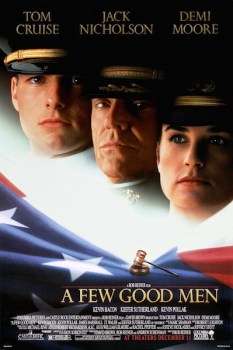
A Few Good MenSometimes you have to wonder where it all went wrong. I can only imagine how good things looked for Rob Reiner at the start of the ’90s, when he’d had an almost-interrupted near-decade-long run of acclaimed movies in the director’s chair: This is Spinal Tap, Stand By Me, The Princess Bride, When Harry Met Sally, Misery, and finally this. ‘Finally’ being the operative word however, as it all seems to have gone down hill from there, to the extent that I actually felt the need to look him up on IMDb to check if he was still working/alive. (He’s both, having recently directed The Bucket List, a bit of a hit if I recall correctly.) Reiner is a recognisable name, and if he’d stopped making films after A Few Good Men perhaps he’d find himself bandied about on lists of Great Directors (at least in certain circles/magazines), but the fact I had to check what he’s been up to (and had forgotten how many acclaimed films he’d made in the first place) shows what a 15-year run of nothingy films can do for your reputation. Even the career of Spinal Tap themselves seems to be in better condition.

All that said, A Few Good Men isn’t really Reiner’s show. It’s not that he does a bad job — far from it — but courtroom dramas primarily depend on two things, even more so than most films: the quality of the writing and the quality of the performances. When you have scene after scene in which a handful of people battle with words alone, often in one-on-one confrontations, then those two elements are virtually all you’ve got. Of course camerawork, editing, music and the rest still have their part to play, but without the underpinning of good writing and good performances the technical attributes are merely fighting to cover for significant shortcomings. Fortunately, A Few Good Men has those underpinnings.

In this case the screenplay is by Aaron Sorkin, adapting from his own play, who would go on to create and write a great deal of The West Wing (which, incidentally, was inspired by leftover ideas from a later Sorkin/Reiner collaboration, The American President). The seeds of that show’s influential style are in evidence here, although the sheer pace and famous ‘Walk and Talk’ scenes aren’t yet part of the formula. As in The West Wing, Sorkin’s writing is both intelligent and witty, a hallmark of high-quality writing that’s able to rise above the shackles of “it’s not real drama unless it’s all grimly serious”. His characters and their personal story arcs may be straight from the stock pile — Tom Cruise is the hot-shot young lawyer who’s actually trying to live up to his daddy (and comes through in the end); Demi Moore is the goody-two-shoes woman trying to make it in a man’s world (who learns to work with her colleagues); and so on — but the plotting of the central case remains undiminished, and Sorkin thankfully avoids such obvious subplots as a romance between Cruise and Moore’s initially-mismatched-but-ultimately-mutually-respectful good guys. Nonetheless, the occasional lapses into extreme, often patriotic, sentiment that would later mar the odd episode of The West Wing are also on show here, most notably at the climax, though they fail to do any serious damage.

It’s in the all-important court scenes that Sorkin’s writing really shines. Dialogue flies back and forth like bullets, full of protocol and technical jargon — like in The West Wing — that we either understand or, when we don’t, get enough of the gist to follow the key plot points — like in The West Wing. The biggie is the final confrontation between Lt. Kaffee and Col. Jessep, an interview that’s the courtroom equivalent of a high noon showdown. It’s true that Tom Cruise plays Tom Cruise and Jack Nicholson plays Jack Nicholson, just as they almost always do, but it makes for a grand act-off. It’s fair to say that Nicholson comes out the victor, gifted with material that guides him from cocksure commanding officer to angry thug in just a few minutes, but it’s the bravado of Cruise’s questioning — undercut with uncertainty and genuine surprise when he pulls it off — that pushes Jessep there.

There are plenty of other good performances — typically competent work from Kevin Pollak doing the best friend thing and Kevin Bacon doing the friend-turned-rival thing, while Kiefer Sutherland’s ‘head bully’ role is memorable and Demi Moore holds her own better than the rest of her career might suggest — but this is undoubtedly a showcase for Nicholson and Cruise, and through them Sorkin’s writing. Not to mention that there are some nice directorial flourishes from Reiner. I wonder what happened to him?

4 out of 5

A Few Good Men is showing on Five tonight at 10pm.

The X Files: I Want to Believe – Director’s Cut (2008)

2009 #44
Chris Carter | 104 mins | DVD | 15
Six years after the once-phenomenal TV series meandered to an inconclusive conclusion, Mulder and Scully were back at the cinema, a decade on from their previous between-seasons big screen outing. The big threat this time was not aliens, however; nor even something more Earthly supernatural; but rather, where they would find an audience? There are now kids old enough to watch this in a BBFC-endorsed fashion who weren’t even born when the series started, and that’s not to mention the misguided attempt to pitch this as a Summer blockbuster.

And if there’s one thing I Want to Believe isn’t it’s a Summer blockbuster, which its snowbound setting arguably gives away to even the most casual observer, while its lack of action sequences and focus on spooky goings-on and character relationships — not to mention that none of these characters are requisitely young enough to head up a typical Summer Movie — should have been the clue to studio execs. And, unsurprisingly, the release strategy failed, leaving audiences either disappointed or not even turning up. As with so many perceived flops these days, it seems to me, I Want to Believe didn’t actually flop: off a $30m budget it made $68m worldwide. Though as only $21m came from the US, where the consideration of box office stats is often highly self-centred, it’s easy to see why many believe it did. Such perception, coupled with poor reviews and that problem of finding an audience, may mean there’s not a third movie, which seems a shame with 2012 on the horizon — quite nice timing for a (last-ever, I should think) instalment.

But let’s return to the issue of how this film was perceived, because I think that’s key to why it was so poorly received. The problem here is that it’s an X Files movie; not because there’s anything wrong with another film for that series, and not because it’s a bad version of The X Files, but because that title carries certain expectations — not only from fans but, with greater relevance to any widespread success, from the general public. Witness the IMDb thread entitled “Where the F were the aliens”, for example. Were this just an entirely standalone supernatural-tinged thriller — and consequently released in a sensible non-Summer slot — it probably would’ve gone down a bit better.

As it actually stands, I Want to Believe is not the kind of X Files most people were expecting — i.e. Something To Do With Aliens, and it’s no spoiler to say that there’s not a single one to be seen — forgetting that the series was never just about extraterrestrials. The idea that I Want to Believe was a bit rubbish and thoroughly disappointing is consequently as much (if not more) the fault of those viewers and reviewers who expected a different kind of film and didn’t get it. That said, it’s a shame that I Want to Believe isn’t wholly successful as the kind of film it’s trying to be either: on the surface, a standalone low-key supernatural thriller — though it fails to explore or explain its fantastical and scientific ideas as fully as one would like, particularly during its lacklustre (anti-)climax — but one that also tackles issues of moving on, obsession and belief, and how they can impact on a relationship — though with all the weight you’d expect in the belated sequel to a sci-fi TV spin-off.

Mainly, however, it’s about belief. The examples of this are too numerous to mention, but a clear one is the subplot involving Scully’s fight to treat a terminally ill boy. The thread bears little relation to the main supernatural plot, which was another point of confusion for many viewers, but if you consider the film as a commentary on and examination of the various forms and merits of belief it begins to slot in a lot better. Perhaps this is another case of a filmmaker attempting something beyond what audiences were expecting to invest in terms of intelligence, although if one accepts it’s there and a significant part of the film it probably begins to pale as a relatively light and underdone exercise. Still, it’s hard to deny that belief is the film’s central theme, which pleasantly turns the title from a generic catchphrase from the series, as it initially appeared, to a none-more-appropriate moniker.

Perhaps distracted by his thematic intents, writer-director Carter rushes some plot points, though he may also be limited by budget constraints and the need to make a distinctly R-flavoured movie hit PG-13. While the Director’s Cut adds three-and-a-half minutes of material, which Duchovny asserts is mainly gore that was cut to avoid an R certificate in cinemas (full details of which can be found here), there’s still nothing that looks as if it would’ve been out of place on conservative US network television, and obviously no effort has been made to give the main plot some breathing space.

The same goes for the guest cast, most of whom are thoroughly underused. Billy Connelly makes a good show of it, but Amanda Peet’s FBI agent has much unfulfilled potential. Yet at other points Carter lets things spool out comfortably — too comfortably, some might argue. One of these places is the relationship scenes between the two leads. The amount of attention lavished on this might lend credence to a theory that the film is as much about a pair of ostensibly retired paranormal investigators as it is this particular case, and through that again a consideration of obsession and belief.

The large amount of time spent on Mulder and Scully’s relationship fortunately doesn’t turn the film into an effort solely for the benefit of ‘shippers’. There’s definite space here for a portrait of two people in a relationship who have tried to move on from their old life but just can’t, and at times I Want to Believe does achieve such lofty aims. Little nuggets of information — such as the fact they’re even in a relationship, or that they once had a child together — drop in almost from nowhere in a way that undoubtedly sounds just like dialogue to a knowledgeable fan, but to a more casual viewer works as a slow uncovering of these two characters. Unfortunately such quality is fitful, especially as the movie goes on, and while the nine-seasons-and-one-movie of backstory initially just add depth if you know about them, it’s some time before the sudden and underwhelming climax that it feels they’re dictating events a little too much. What was shaping up to be a workably standalone depiction of two characters almost becomes just a status update on Mulder and Scully.

And here lies the rub: at times, the Second X Files Movie gets too caught up in being just that. There’s nothing wrong with that per se, but it could do with remembering it’s a Movie and not just another X File — especially if it wants to find any new (or even lapsed) viewers. When Assistant Director Skinner turns up it’s the final nail in the coffin for any shot at independence. As a fan, it’s impossible to begrudge a brief but heroic last-minute appearance from Mulder and Scully’s long-time ally, but as an objective viewer, he’s just some bloke who turns up with no introduction just in time to play a major role in the climax. It’s a misstep that, along with an accumulation of others, seriously damages the film.

But does an X Files movie need to be independent? Should nine seasons (and one movie) of backstory be ignored? Well, yes and no. There’s nothing wrong with making a “where are they now?” fan-pleasing reunion, but that would belong on TV with the bulk of the thing being commemorated. In the cinema, six years distant and billed as a standalone tale (note that it’s not even The X Files 2: I Want to Believe, never mind The X Files 204: I Want to Believe), it ought to stand on its own two feet and work entirely as a self-contained piece of drama. That it fails in this is perhaps the most disappointing aspect of all for me: it makes it infinitely harder to defend this as a supernatural thriller that deserves to be judged entirely on its own terms, rather than with some established knowledge of what The X Files ‘is’, when the makers are relying on those self-same established notions to tell their story.

Never mind finding an allusive audience, this is the film’s real battle: when Carter gets too caught up in making The Second X Files Movie, shifting what’s working well as both The X Files and A Movie into straight-up An X Files Movie territory. It’s this failure to be independent — not to the point of ignoring the series’ backstory, I should clarify, but to a point where this film can be wholly appreciated without ever seeing The X Files — that ultimately holds I Want to Believe back from becoming a great horror/thriller/drama movie in its own right. It’s frustrating because so often Carter comes tantalisingly close to fulfilling such ambitions, and if he had I’d have no qualms about defending this movie as an underrated (though, it is), misunderstood (though, it is) and independent supernatural-flavoured drama. Sadly, however, I think I just want to believe it is.

3 out of 5

The X Files: I Want to Believe premieres on Sky Movies Premiere tonight at 9:45pm, then at various times throughout the week. It’s probably the theatrical cut, but who can say?

The Lady from Shanghai (1947)

2009 #37
Orson Welles | 84 mins | TV | PG

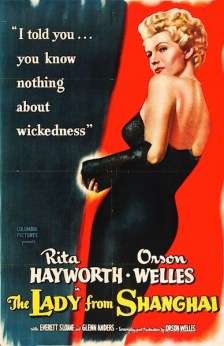
The Lady from ShanghaiThe Lady from Shanghai is an Orson Welles film… which means his original 155-minute cut was forcibly cut down by over an hour, the studio insisted he include more beauty shots of Rita Hayworth, as well as a song for her to sing, and the temp score he provided to the composer was ignored in favour of something Welles hated. Yet for all that — not to mention Welles’ distractingly atrocious Irish accent — it’s still a highly enjoyable film.
The plot is thoroughly noirish and offers up its fair share of twists along the way, while the performances are able if largely not particularly memorable. The exception to this is Glenn Anders, giving a gloriously unhinged performance as Grisby, drawling his vowels with high-pitched lunacy. Though Welles was heavily criticised for cutting and dying Hayworth’s hair — to the extent that some blamed it for the film’s box office failure — it hardly matters (I thought she looked better anyway), and the enforced beauty shots actually work thematically toward the conclusion.

Even more attractive are the skills Welles brings directorially, on display throughout. Every key sequence provides something genuinely worth looking at while still relating the intricate plot, though the cruise offers many of the best bits — the hot, sweaty foreign climes are conveyed brilliantly, aided by sumptuous location photography, and these sunny scenes contrast nicely with the noir plot. Mention must also be made of the the famous finale in the Hall of Mirrors, a precisely shot sequence that provides a fitting close. Elsewhere, Welles’ sense of humour is pleasingly present, lending the trial scenes in particular a distinctive style that brings some ever-welcome variety.

Brisk (at under an hour-and-a-half) but engagingly complex, and rarely less than beautifully shot, The Lady from Shanghai may be a compromised version of Welles’ intentions, but his undeniable ability (at directing, not accents) means it remains a compelling film noir.

4 out of 5

The Lady from Shanghai is showing on BBC Four at 10pm on Saturday 22nd August as part of a Film Noir Weekend. See this post at From the Cheap Seats for more details.

Lethal Weapon (1987)

2009 #8
Richard Donner | 110 mins | download | 18 / R

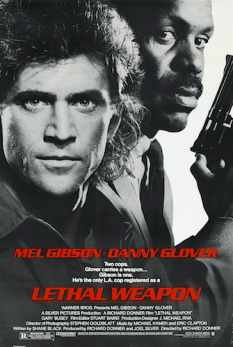
Lethal WeaponLethal Weapon comes from another era — an era in which R-rated films were still allowed to be blockbusters. One only needs to look at the classifications attached to the most recent instalments of formerly-R-rated ’80s franchises — primarily, Terminator 3: Rise of the Machines and Die Hard 4.0, both PG-13 — to see how things have changed. Of course, maybe they have just cause: Watchmen, the first proper R-rated blockbuster for a while, has been labelled a box office disappointment (because that’s what $150m worldwide in two weeks is these days).
I digress. Though, my mind frequently wandered during Lethal Weapon — often to Die Hard. This may predate the Bruce Willis franchise by several years, but it’s a testament to the fame of that film’s Christmas setting that my first thought was they’d ripped it off (Lethal Weapon, like Die Hard, begins with a classic Christmas song over an urban setting). And my next thought was, did they not have a costume budget? The film opens with a young girl, lazing provocatively with one tit out… at first, before Donner makes sure to show them both off thoroughly before she hurls herself from a building; and then we find Danny Glover’s Murtaugh in the bath and Mel Gibson’s Riggs wandering around showing his arse off. Nudity is fine in its place, of course, but here it’s so gratuitous that it sets a low tone — to be fair, one the film does little to belie.

More seriously then: the plot is full of holes with great gaps in its logic, especially as it heads towards the climax. There’s also no mystery — the investigation is just an excuse to string together action set pieces and comedic buddy scenes, neither of which are much cop, and most of the story is conveyed in a couple of info-dumps that supporting characters volunteer for no definite reason. The dialogue and performances are appalling — “may I remind you of some stuff you already know, that’s convenient exposition for the audience, thoroughly explaining the troubles of the main character and the scene you just saw”. I’ve seen better episodes of Murder, She Wrote. Their motivation makes about as much sense too — “tell me the truth!” “But they’ll kill my daughter!” “We can protect her!” “No you can’t!” “Tell me!” “Oh OK then.”

The villains aren’t just poorly drawn, they’re barely sketched at all. There’s an early scene where we see how Hard they are, then they just turn up in time for the climax and do little more than get chased around and die explosively, and in the wrong order to boot. At the very end, our heroes capture the one remaining bad guy… and then have a fight. Why? Because they do. And then all the police turn up and just watch this punch-up going on. It’s the thinnest excuse for a final fight ever put on film, and consequently the least tense — none of those officers are going to let the villain kill Riggs, and even if he did beat or kill him he’s not going to escape. There is literally no point to it. It’s appalling writing, and dire filmmaking to have left it in.

Oh, and Murtaugh smashes a car into his own front room for no reason.

Lethal Weapon probably wants to be a lot better than it is. Was it supposed to be a drama about these two cops with any old investigation plot stuck on, or a standard action-thriller with too much time spent on character? At best, it falls somewhere between the two — they’re not real characters (i.e. it wouldn’t pass as a drama if you cut out the thriller), each being made up of several stock Action-Thriller Hero traits; but nor is the plot the main focus, what with it being rather generic and not especially interesting or at all complex. The leads’ repartee and bonding is more interesting than the actual plot, and is surely the explanation for the film’s enduring popularity and three sequels, though to be honest I didn’t get it.

I’d always thought Lethal Weapon must be alright — after all, as I said, it’s had an enduring popularity and was written by Shane Black, who went on to both write and direct the thoroughly wonderful (and underrated) Kiss Kiss Bang Bang (with Robert Downey Jr being fantastic a good few years before his popularity resurgence in Iron Man) — but having seen it, I struggle to see why people like it to any significant degree.

2 out of 5

ITV1 are showing Lethal Weapon tonight at 10:15pm.
Lethal Weapon is on Watch tonight, Tuesday 23rd September 2014, at 10pm.

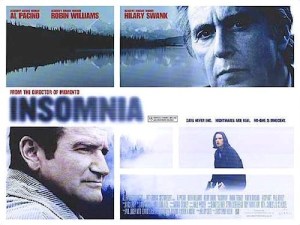
Insomnia (2002)

2009 #33
Christopher Nolan | 113 mins | DVD | 15 / R

This review contains minor spoilers.

The Dark KnightBetween becoming a Geek God with Batman Begins and The Dark Knight and coming to everyone’s attention with a stunning more-or-less-debut that managed to elbow itself right up into the IMDb Top 10 (that’d be Memento — obviously, it’s slipped since), Christopher Nolan directed this: an American remake of a Norwegian police thriller, and the only one of Nolan’s five major films not to be on that be-all of film quality, the IMDb Top 250 (the fifth is of course The Prestige, while Begins is the lowest at #106.) So is Insomnia a forgotten classic robbed of a spot, or just a footnote to the rest of Nolan’s superb career?

These days, there’s a murder mystery/thriller on the TV most weeks — heck, most days thanks to the abundance of repeat-laden digital channels — and so a film attempting one can’t just settle for the usual array of clues, suspects, interviews and twists. Insomnia looks like it’s heading down this road early on — an interview with the victim’s boyfriend in particular could easily slot into any episode of Midsomer Murders or what have you — but soon does what’s required of any film entering this territory these days: it provides more. Most obviously, despite the early plot and stylistic conventions, this is not a “whodunnit”: the killer’s identity is revealed around the halfway mark (assuming you haven’t already guessed it from the opening credits) and from then on the film gradually moves into murky moral territory, quickly leaving behind those early trappings for a set of more complex noir-ish moral conundrums.

Al Pacino’s detective, for example, is a man under pressure — not just from the case, nor the usual clichés of a messy divorce or alcoholism, but from a pending Internal Affairs investigation that may or may not be justified, and an incurable bout of insomnia brought on by the Alaskan summer’s lack of night. The pressure mounts, he makes bad decisions (which I won’t spoil here), and even if the use of these plot points was merely that they occurred it would have offered something above the norm. Hillary Seitz’s screenplay pushes it further however, digging far deeper than usual for the genre into debates about the morals of police work, what seems acceptable and what is acceptable, and perhaps even what should be acceptable. The ending may seem to offer a Hollywoodised “everything’s set right then” denouement, but while it’s true that the plot is neatly resolved the considerations raised are not so easily ignored.

Cast-wise Insomnia fares pretty well. When it was released, around the same time as the excellent One Hour Photo, everyone was amazed at Robin Williams turning in a pair of non-comedic performances. The quality of them both makes it seem only natural now however, leaving that amazement as a distant memory. His turn as novelist Walter Finch here may owe something to Kevin Spacey’s John Doe in Se7en — indeed, Nolan seems to explicitly reference that film in locations such as the corridor of Finch’s apartment building — but isn’t as lowly as an impersonation. Hilary Swank offers able support as wide-eyed young cop Ellie Burr, while Pacino does a good job portraying the confusion induced by lack of sleep, aided by some effective camerawork, editing and sound design.

In the end, the main damage done to Insomnia is inadvertently by its director: while it is undoubtedly above average for a murder mystery/thriller, its relative straightforwardness pales in comparison to the work Nolan’s done before and since. However, as with every Nolan film so far, I found my perceived enjoyment increase the more I’ve thought about it since. It may not be objectionable that Insomnia hasn’t made it onto that IMDb list then, but if it is a footnote to Nolan’s career it’s a significant and enjoyable one.

4 out of 5

BBC One are showing Insomnia tonight at 10:45pm.

In Bruges (2008)

2009 #22
Martin McDonagh | 102 mins | TV | 18 / R

This review contains minor spoilers.

In BrugesIn Bruges has gathered quite a bit of indie-level praise and acclaim, culminating in wider recognition at the Oscars and other awards ceremonies at the start of this year. For those like me, finally getting round to seeing it in the wake of all this, it comes with quite a burden of expectation on its shoulders. Can it possibly be the modern classic many make it out to be? I mean, it is set in, y’know, Bruges…
First and (perhaps) foremost, In Bruges is hilariously funny, much more so than most by-the-numbers ‘comedy’ films can manage. The easily-offended might disagree, and some jokes are a tad too obvious (Americans are fat! Fat people can’t climb tight stairs!), but it’s nice to genuinely laugh at a film rather than force the odd smirk so as to at least get something from an otherwise wasted 90 minutes. It’s also dark and occasionally tragic though, and in this respect it’s unsurprising that writer/director McDonagh started out as an acclaimed and award-winning playwright, as stage plays mix humour and darkness more frequently (and with wider extremes) than films ever dare to. His theatrical roots also go some way to explaining the amount and ferocity of the swearing (again, something plays are more prepared to indulge in), but so too the brilliance of the dialogue. That it takes a playwright to craft such a good film is perhaps an irony, but not a troubling one.

Good dialogue is wasted without a good cast however, and thankfully everyone here gives a fantastic performance. The standout is Colin Farrell as hitman Ray. He initially seems a confident, cocky, experienced young hitman, and therefore verges dangerously close to stereotype, but we soon realise he’s actually twitchy, nervous, insecure, and genuinely sorry for the sole act of violence he committed. It might look like a Black Comedy With Nasty Violence to some — certainly, there are reviews that suggest some viewers are incapable of seeing anything beyond that — but there’s a lot more depth in the characters than the surface would suggest. Brendan Gleeson and Ralph Fiennes give consummate supporting performances, like Farrell chipping away at the stereotyped facades to find the hidden facets that the script is kind enough to reveal.

The quality of McDonagh’s writing (and direction) doesn’t stop with character and dialogue. The story is thematically considered, with a variety of paintings and associated imagery to occupy those who might be interested. Events are beautifully tied together and, best of all, none of the early scenes feel oddly inserted or have that nagging sense that they’re merely an excuse for something to be there later — everything works first time, and then has a seamless payoff too. Some viewers have criticised the ending, but I suspect they’re largely more used to mainstream fare and viewers who have ever enjoyed an indie film won’t bat an eyelid. All in, it’s easy to see why the screenplay has become the film’s prime awards nominee and winner.

Nominations, wins and buzz weigh heavy, but In Bruges has shoulders broad enough to carry such expectation with ease. “There’s never been a classic movie made in Bruges,” one character truthfully espouses, “until now.” It seems she couldn’t’ve been more right.

5 out of 5

In Bruges placed 2nd on my list of The Ten Best Films I Saw For the First Time in 2009, which can be read in full here.

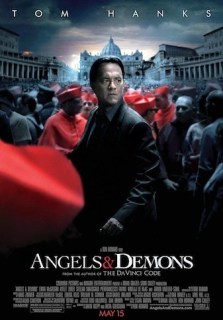
Angels & Demons (2009)

2009 #25
Ron Howard | 138 mins | cinema | 12A / PG-13

This review contains minor spoilers.

Three years ago, I found myself at a packed midnight first-screening of The Da Vinci Code, the Tom Hanks-starring Ron Howard-directed adaptation of the Dan Brown-written novel that’s probably only second-most-read to The Bible by now. I liked the book — its prose is a long way from great, that’s true, but the storytelling is fantastic, helped in no small part by its undermining of the Christian church so thoroughly and consistently that it can only be described as wish fulfillment (well, it fulfilled my wishes). I liked the film too — again, it’s not great, but it was an entertaining adaptation.
Despite this, I’ve never read another Dan Brown book. Not even Angels & Demons, which also stars Robert Langdon (that’s Hanks’ character, in case you’ve somehow missed this entire phenomenon) but was written first. Rather than being yet another prequel, however, Howard and co. have chosen to make it as a sequel — entirely logical in the past, though these days it almost makes them seem behind trend. In spite of my unfamiliarity with the source, I once again found myself at the film’s first screening here — though it says something about how well The Da Vinci Code was received (i.e. not very) that Angels & Demons made its bow on a damp Thursday afternoon in a barely-attended screening.

It may come as a surprise that Angels & Demons has a subtly different feel to its predecessor. It still concerns itself with Hanks’ Langdon dashing about trying to solve insanely cryptic clues in a limited timeframe, surrounded by irritating policeman, suspicious friendly characters, and a girl who is almost pointless. However, it’s a lot less talky — there are few grand theories to be explained, and while there are still a few exposition-dense monologues they aren’t the focus in the same way. Instead, with just an hour to solve each set of puzzles, our intrepid symbologist hares around Rome, desperately trying to save lives. Unfortunately, the trail he’s following doesn’t seem as well thought out as the previous tale’s mysteries, and the speed at which they must be solved seems designed to gloss over this — there’s no time for the viewer to consider everything Langdon’s telling us, we just have to accept it.

If that wasn’t enough, the film comes with a moderately hefty sci-fi element — yes, really — which makes a huge change tonally. While The Da Vinci Code is patently not based in much truth, both Brown’s novel and the adaptation mixed in enough facts, half-truths and very plausible lies to give it a real-world believability. The abundance of tie-in books and documentaries proving or disproving its theories show that people bought it. There’ll be no such thing here though: from the beginning the use of CERN and the Large Hadron Collider (y’know, the thing that’s going to end the world) and a theoretical bomb adds a science fiction feel, and while it’s really no more than “a very big bomb” for most of the film the damage is already done. To cap it off, the CGI-decked finale — which is further bogged down with feats of logic and physics that require at least a little suspension of disbelief — brings the film more in line with science fiction blockbusters than thriller blockbusters.

All this does nothing for the central villains either. When judged independently, the Illuminati are actually more believable than the Priory of Sion — they’re certainly more based in fact — but they come across as less so because no one’s bothered to construct that web of facts required to sell the half-truths, and in turn to sell the lies. Nonetheless, the film does a good job of hiding the Secret Villain’s identity. Well, sort of. Those not paying any attention may guess it relatively early and turn out to be right; those following it only slightly more closely may be lured astray by a couple of clear red herrings; while those indulging in an intelligent game of guess-the-twist will flip around a bit more as various characters show slight ambitions or potential motivations that suggest they may be the subject of a Shocking Twist. That it eventually comes back round to where you always thought it would is not necessarily a bad thing, but neither is it as surprising as the makers wished we thought.

Howard does his best to ring tension and excitement out of all this, but the problem is fundamentally the screenplay — as with The Da Vinci Code, adapted by an overpaid Akiva Goldsman, this time with David Koepp credited too. Of course, they’re lumbered with Brown’s novel, but that doesn’t excuse some truly clunking dialogue. It’s also their fault that the cast are so underused. Ayelet Zurer has perhaps the most thankless part as Token Female with minimal relation to the plot, though one of the screenplay’s wisest decisions is in modifying her backstory — based on summaries I’ve read, in the novel it’s near identical to that of Sophie’s from Da Vinci Code. (That’s Audrey Tautou’s character. Yes, I’d forgotten her name too.)

Despite being the lead, Tom Hanks has little more to do than look concerned and explain the reasons for all the running around. On the positive side, as silly hairstyles are only allowed if you’re Australian this Summer, at least Langdon’s ludicrous lengthy locks have been lopped off. Few among the rest of the cast fare any better, with Stellan Skarsgard being particularly underused — his primary function seems to be Quite Famous so we’ll consider him a decent contender to be the Secret Villain. The other star name, Ewan McGregor, does the best he can with perhaps the film’s best character — his Irish Camerlengo is more interestingly conflicted than the film deserves or can manage, and as such is underwritten. That said, he’s stuck with an Irish accent that comes and goes and is still lumbered with at least one dire speech. Only Armin Mueller-Stahl emerges with much dignity left, in the medium-sized role of fellow Secret Villain possibility Cardinal Strauss.

In another misstep, Angels & Demons exhibits an overuse of special effects. It may not seem like the sort of film that would need them, but the sci-fi side of things brings plenty of CGI along whenever it rears its head. These include some elements at the climax that may have been literally copy-and-pasted from Watchmen’s graphics department, though to say much more would spoil the sheer lunacy of how the film finishes. Suffice to say, most will absolutely hate it; I almost do, but at the same time almost respect it for being so bonkers. On top of this, that the crew were denied permission to film in many of Rome’s famous locales means there’s an abundance of computer-aided locations. They probably look perfectly real to your average movie goer, but for me they all had that slight indefinable oddness that’s present too often these days — think Quantum of Solace’s Siena chase and bell-tower-to-art-gallery tumble for an example of what I mean.

Angels & Demons makes for an occasionally entertaining run around, though there’s less meat on its bones than The Da Vinci Code, and the comparative lack of believability makes for less fun than its predecessor’s “well, maybe…” plot. Those who disliked the first film may prefer this for being less talky, more pacey, and, perhaps, being aware of its own silliness. Those who actually liked the first film may disagree.

3 out of 5

My review of the extended version of Angels & Demons can now be read here.

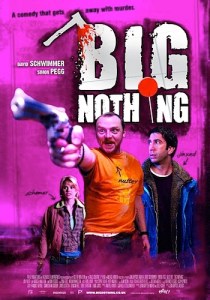
Big Nothing (2006)

2009 #12
Jean-Baptiste Andrea | 82 mins | TV | 15 / R

Big NothingBig Nothing was co-funded by the Isle of Man and Welsh film boards; it’s therefore unsurprising that it was filmed in those locations; and there’s a bunch of British actors in it… but they’re all playing Yanks and it’s set in Oregon.

And it’s as schizophrenic as this would suggest. Across its running time — and mostly in the opening half-hour — Big Nothing jumps wildly from mundane comedy to confidence scam thriller to black comedy to geeky spoof. Early on there’s a nice bit referencing The Matrix, for example; a brief moment which feels like it belongs in another film — as do many others. This flitting around makes for a showy opening, Andrea’s direction screaming “look what I can do!” in a way few films have since Guy Ritchie showed off everything he could do in Lock, Stock. It might help Andrea’s showreel, but the downside for viewers is it makes for taxing viewing and a sense that the film lacks its own identity. In short, it’s trying far too hard.

It does settle down however, improving immensely once it gets on with telling its (still loopy) story and stops trying to impress with flashy tricks. It becomes a lot funnier and a lot more enjoyable, slowly fulfilling any hopes the viewer may’ve had.

But it can’t keep it up, despite the brief running time. A long time before the credits roll it degenerates into a grab-bag of random incidents and twists strung together until the made-up-as-it-goes-along script hits something approaching a produceable page count. On the one hand this randomness at least makes it feel different, but on the other it pushes it too far — the array of twists don’t feel like natural occurrences, just plot points that are completely unforeseeable due to being equally nonsensical.

For a good stretch in the middle Big Nothing does more or less what you want it to, leaving the showy opening and desperate series of endings as unfortunate asides to a watchable film struggling to reach feature length.

3 out of 5

Runaway Train (1985)

2009 #11
Andrei Konchalovsky | 106 mins | TV | 15 / R

This review contains major spoilers.

Runaway TrainRunaway Train bagged itself three Oscar nominations and one for the Palme d’Or back in 1986, which rather begs the question, how?

On the awards-worthy side, it’s based on an Akira Kurosawa script and features grittier-than-average direction and performances. On the other, the majority of its story and supporting characters feel closer to other ’80s actioners like Lethal Weapon or Die Hard. The focus on a high concept (the title says it all), emphasis on exciting action sequences, the way the plot is structured, the faintly pantomime villains, comical supporting characters, and occasional slips into fantasy (one character was welded into his cell, the state the prison has degraded to, the whole concept of the runaway train and its computer control centre) — none of these elements suggest your typical Oscar nominee, but instead a half-forgotten minor action flick.

The lead characters and their performances, by Jon Voight and Eric Roberts, are above average for the genre — this is where two of the Oscar nods come from — but they’re not notably superior to other outstanding examples (see Bruce Willis and Alan Rickman in Die Hard). Praising the acting can only cover the two leads, at best, because the villains and supporting roles are as one-dimensional and clichéd as you’d expect from the genre. The other Oscar nomination was for editing, one that’s more obviously deserved. Visually, the sequences of the train smashing through the countryside are fairly impressive. Perhaps the camerawork deserved a nod in this respect too, as it lends the film a gritty real-world feel that may be explain some’s distraction from the otherwise familiar values. It can’t mask them all though — for example, the occasionally brutal violence is still denied any real-world punch thanks to the fantastical sheen created by some plot points.

The notable exception to most of this is the ending, where Voight’s anti-hero stands atop a train engine we — and he — know to be doomed, his prison warden nemesis handcuffed inside, and rides it out of sight into the fog. It’s a classy finale that flirts with the downbeat ending, though doesn’t quite succumb to it because we also know the young sidekick and girl have survived. Nonetheless, there’s pleasingly no postscript, simply fading to black after the engine disappears into the mist. The titular train, one might theorise, is like some mythic beast — it arrives through snow-mist, leaves devastation in its wake, and then disappears back into it. But that might be getting a bit too pretentious…

In focusing on these lofty pretensions (which may have been forced on it by nominations and some reviews), one can become distracted from the fact that, taken as a straight-up high-concept action-adventure, Runaway Train has an awful lot going for it. And if you want to get pretentious about it, well, it might just support that too.

As a final aside: one of the film’s most memorable moments, in retrospect, is down to an accident of fate. Near the end a character looks at a space shuttle on TV and muses, “with all this high technology, why couldn’t we stop it?” Just 11 days after Runaway Train’s US release, Space Shuttle Challenger disintegrated 73 seconds after launch, killing its seven crew members. For anyone aware of this correlation, it’s an incredibly poignant moment.

4 out of 5

Though the Radio Times review I’ve linked to says Runaway Train is an 18, it was reclassified in 2008. [It has since been updated.]