State of Play (2009)

2009 #20
Kevin Macdonald | 127 mins | cinema | 12A / PG-13

This review contains minor spoilers.

State of PlayState of Play is one of my favourite TV series of all time, a densely plotted thriller that packs every minute of its six-hour length with clues, characters, twists, revelations, humour and moments of sheer brilliance. It introduced me to James McAvoy and Marc Warren, both of whom are now leading men to one degree or another (and their appearance together in Wanted gave me a bizarre frisson of fanboy delight that’s unusual outside the realm of sci-fi/fantasy), and Bill Nighy, who was surely known before but has since gone on to even more. And that’s to ignore the fantastic performances of John Simm and David Morrissey, two of our finest actors, carrying Paul Abbott’s beautifully convulted plot through all its intricate twists to an inevitable but powerful conclusion.

Much imitated, though the imitators have either fallen short (The State Within) or been flat-out dismal (The Last Enemy), it therefore seems inevitable that State of Play has followed in the footsteps of Traffik and headed for the US big screen. In the process, it squishes six hours down to two and replaces the Simm/Morrissey dynamic with the filmfan-pleasing reunion of Brad Pitt as brilliant-but-troubled reporter Cal McAffrey and Edward Norton as wunderkind politician Stephen Collins. Y’know, in their hands, it might just work!

Except Pitt walked and Norton followed, hastily replaced by the unwaveringly grumpy Russell Crowe as Cal and the offensively inoffensive Ben Affleck as Collins. Oh dear, it’s not off to a good start…

Fortunately, State of Play: The Movie quickly turns out to be a good case for not judging a book by its cover — or, literally, a film by its cast. To be blunt, none are as good as in the original, but that’s the nature of the beast here — even a Pitt/Norton pairing would have struggled to achieve in two hours what Simm/Morrissey could in six. Helen Mirren fares best as editor Cameron, the Nighy role, though doesn’t have the screentime to make it her own. Crowe, Affleck and Rachel McAdams (in a beefed-up role as young reporter Della Frye) are all above average, but none come really close to the originators. Jason Bateman’s appearance as Dominic Foy is probably more than decent — certainly, other reviewers clearly unfamiliar with the original have hailed him as Best Supporting Oscar-worthy — but is as nothing compared to Warren’s creepy wimp in the series. When Collins breaks his cool and attacks Foy, the Affleck/Bateman version packs none of the punch of the Morrissey/Warren original.

But the real focus of this screen-to-bigger-screen translation is that complex six-hour story, condensed from 340 minutes to just 127. This three-fold reduction has been well handled by a trio of screenwriters, and perhaps their most noteworthy achievement is crafting a film that feels entirely like its own entity without sacrificing anything significant from the primary conspiracy plot. The relocation to the politics of Washington is unobtrusive, apparently not encountering issues like the Law & Order: UK writers did in converting across justice systems; as is the focus of Collins’ investigation, switched here from an oil giant to an arms contractor. Both quickly help give the film its own identity, while the latter also makes some plot points more straightforward — with such a shortened running time and so much plot to cram in, this is completely forgivable and works seamlessly. Unsurprisingly some of the depth and nuance of the six-hour version is lost in such an abbreviation, the adaptors choosing to cut characters (Cameron’s son, as played by McAvoy on TV, is a glaring omission for fans) and subplots (Collins’ wife barely features, but again only by comparison) rather than significantly abridge or rush the main narrative. It moves fast, but in a pleasant way — this is not an under-plotted or ponderous thriller.

In all this talk of the plot, original writer Abbott should not be forgotten. While the film’s writers have naturally changed things substantially, much of it is surprisingly cosmetic: the essential cut and thrust of the main conspiracy plot remains, and that’s all from Abbott’s brain. Some of the series’ most memorable moments are intact too, though naturally they don’t quite stand up to comparison — the already-mentioned Collins/Foy beating, for example. Others are sadly lost entirely — my favourite bit of the whole series is when Cameron stops the presses to publish the best opening half-dozen pages of a newspaper ever (so good you would never see something so bold in reality), but that’s nowhere to be seen here. Equally humour is light on the ground, but a few intended laughs do stick through. Their number is quite well-balanced, and all pleasantly natural — aside from a few of Cameron’s one-liners there are no enforced “comedy scenes”, just amusing lines and moments that would be equally unobtrusive in real life.

Macdonald adds his own flourishes to the tale beyond the relocation and business focus. Aside from a slightly unusual obsession with shots of helicopters over the city, his most significant addition is a thematic strand on the potential demise of the newspaper in the face of TV and the Internet. As the story breaks, the explosion of news snippets — from TV, blogs, YouTube — are wonderfully handled, indicating the countless ways we consume news today — and how quickly a lie can spread once someone’s reported it as fact. Sadly these montages fall by the wayside as Cal and Della get deeper into uncovering the complex truth, the movie no longer having the time to indulge them. It’s a shame, because continuing this through every plot twist would’ve helped raise the film’s quality and individuality that little bit extra. Instead, some of the mood and tone they served to create slips a little as the story moves on.

Some reviews have criticised the ending, many going so far as to say it loses all its quality in the last 10 minutes with a dodgy final revelation. This worried me going in, but in fact it remains true to the series’ plot throughout. Perhaps some reviewers need reminding that they’re watching a thriller — you can’t really end with someone confirming what we’ve known for the past half hour, you need a twist. The one that State of Play provides is possibly surprising (I say “possibly” because there will always be those ready to cry “I knew it all along!”) and makes more than enough sense to justify itself. It doesn’t undermine what’s gone before in the slightest; in fact, if anything, it makes it that bit more plausible (unless you really believe huge 24-esque conspiracies are plausible) and casts new light on everything that we’ve seen. Just like the TV series did. It’s not going to be remembered as one of the great twists of all time, but it’s fit for purpose.

For me, the biggest misstep was an incredibly trivial one: the closing credits sequence. Shot in a bright style with relatively jolly music, it totally jars with the increasingly dark thriller just witnessed. The basic conceit of it — the printing of a paper — ties perfectly to the “death of the paper” theme, but its execution is lacking. Of course, when the credits sequence is the only major flaw in a movie (well, aside from the odd spot of clichéd dialogue, and a few moments when Crowe’s hair seems to be auditioning for a L’Oréal advert), you can’t complain too much.

As a fan of the original series, my thoughts ultimately come back to that. It’s a comparison the movie version would always have suffered under, and it’s to the credit of all involved that they’ve managed to create something that exists independently. Even to someone who loves the TV series, watching the film doesn’t feel like a highlights reel or awkward plot summary — it’s the best abridgment one could hope for, uncompromising in not dumbing down the plot, and still managing to add significant elements all of its own. If you remove the TV series from the equation, State of Play stands by itself as an above-average, intelligent and compelling thriller.

Just like the original series, it’s exactly the sort of thing I wish they made more of. Perhaps, if we’re lucky, Abbott will be inspired to revive State of Play 2

4 out of 5

Sherlock Holmes in Washington (1943)

2009 #1
Roy William Neill | 68 mins | DVD | U

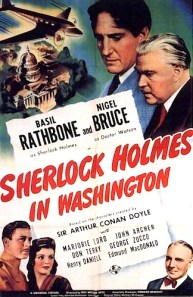
Sherlock Holmes in WashingtonThe last of three World War 2-concerned films in the Rathbone/Bruce series (the previous two being The Voice of Terror and The Secret Weapon), and once again more a spy thriller than a traditional detective tale. That’s not to say Holmes’ abilities as a detective aren’t present — in fact, he does a very reasonable amount — but if you switched him for a generic British Intelligence agent the plot would be unlikely to suffer and the dialogue probably wouldn’t need much work.

Certainly, the quality of Holmes’ detection is a bit of a mixed bag. Some scenes do demonstrate his brilliant reasoning, but others stretch credibility to the limit, for example when he manages to work out what’s been transported in a blanket. Another disappointing moment sees Holmes in awe of and “forget” about modern scientific methods, which seems rather at odds with the highly intelligent detective at the forefront of his field that we see in the original tales. It’s more than a little like the filmmakers have taken the character and methods from his 19th Century setting and dropped (rather than adapted) him into the present day. It’s these little inconsistencies that are arguably most bothersome when such a spy thriller claims to be a Holmes film.

Other deduction scenes do work, however, such as when Holmes enjoyably reasons the hiding place of the matchbook, the film’s MacGuffin. Unfortunately, this sequence suffers from a total lack of tension as we already know where it is. This leaves us watching Holmes play catch-up, and there’s no sense of a race-to-the-prize because we don’t see how the villains’ hunt is progressing. Said matchbook is put to good use in another sequence where it is unwittingly passed around at a party. This is perhaps the most simple and obvious thing to do with such a MacGuffin, but at the same time it’s an always-effective idea. On the other hand, when the matchbook ends up back where it started one has to conclude that this sequence is no more than padding.

One of the more striking elements of the film is it being Holmes’ first trip to the States (on screen in this series, at least). It’s highly praiseful of America, of course, and spends a good bit of time on a travelogue-style showcasing of sights, continuing with Watson remarking on US papers, trying out gum, and more. It makes a change of scene for the series, but also feels a bit self-congratulatory on the part of the American production team, which can be more sickening than the British patriotism of the previous two entries. While that may be national bias on my part, it seems a bit unlike Holmes too. There’s also the prerequisite patriotic closing quote, though at least this time it’s from a British character about US-UK relations. Still, intentional or not, Rathbone delivers it with an almost unwilling flatness.

Elsewhere, Watson’s bumbling comedy is occasionally unobtrusive, occasionally grating, but occasionally raises a smile. Best is the scene where Holmes has him play various characters in a reconstruction, although there’s more mileage in that than the film manages. In complete contrast to this, the film’s villains are a particularly brutal bunch, murdering for no real reason and torturing women.

By the time the film limps to a sudden conclusion at an antiques shop, the quality of the film has become reminiscent of the quality of Holmes’ detection: a mixed bag.

3 out of 5

This review was written over three months after seeing the film, based entirely on notes made at the time and my rather poor memory. Apologies if it is therefore a bit unfocussed or, God forbid, inaccurate in the odd minor fact.

Die Hard 2 (1990)

aka Die Hard 2: Die Harder

2008 #95
Renny Harlin | 118 mins | DVD | 18 / R

Die Hard 2Good guides to how to write always advise that your hero is only as good as the villain. This is one of the reasons Die Hard is such an endlessly enjoyable film — as well as a great high-concept setup, excellent action sequences, and amusing one-liners, Alan Rickman’s villain, Hans Gruber, is one of the best ever committed to celluloid. Dry witted and clearly more educated than his opponent, Bruce Willis’ John McClane, he’s nonetheless defeated by that everyman spanner-in-the-works. Yippee-kay-aye indeed.

So how do you top that? Well, not like this. The generic Traitor General character offered here isn’t a patch on Gruber, meaning the hero/nemesis relationship between him and McClane never kicks off in quite the same way. The final act even tries to introduce a new villain, probably aware that the first one wasn’t quite working, though it’s to little avail. Their final duel — on the wing of a moving plane — is exciting enough, but doesn’t pack the same punch as the first film’s verbal sparring.

Arguably the other main reason Die Hard worked so well — the confined office block setting — is also discarded, giving McClane a whole airport to run around. We have to be grateful that this isn’t just a straightforward rehash of the first film — probably the advantage of being adapted from an unrelated novel, 58 Minutes, rather than a committee considering how to recycle the same idea — but it doesn’t have the same brilliant simplicity. That said, the line acknowledging similarities between the scenarios is a highlight, and good use is made of McClane’s fame following the events of the first film.

Die Hard 2 is by no means a bad action film — there are several sequences that are above par for the genre, an acceptable degree of silliness, and the odd spectacular explosion too — but the unavoidable comparison to one of the genre’s all-time classics is to its detriment. If only the villain was someone like Gruber’s brother…

4 out of 5

(Originally posted on 25th January 2009.)

Snakes on a Plane (2006)

2008 #94
David R. Ellis | 101 mins | DVD | 15 / R

Snakes on a PlaneYou don’t get much more high-concept than “snakes on a plane”, a mission statement of a title if ever there was one. It certainly captured the imagination of online geekdom, who knew everything they wanted just from those four words and famously launched a viral marketing campaign for a film they’d not seen. Ultimately, it’s for that reason it will be remembered, because without the evocative title and the reaction it provoked this would be forgotten quicker than Samuel L. Jackson can utter his Oedipal expletive-laden catchphrase.
The best thing one can say about Snakes… is that it lives up to its B-movie title. Once it gets going it throws lots of gory fun at the audience, like a snake in a microwave, or entirely gratuitous shots of people trampled in panic (which sounds distasteful, but in the context of the film is more amusingly squelchy). It even manages the horror movie’s obligatory gratuitous sex/nudity — courtesy of the Mile High Club, naturally. That’s not to mention the plot, in which a gang release snakes onto a plane (did you guess?) in order to kill an FBI-escorted witness. As assassination plans go, it may just be the barmiest ever, and delightfully so.

However, the plan is flawed — in storytelling terms at least — because snakes don’t actually do much. They drop from ceilings, they slither, they bite… and then you’re pretty much done. When the legless beasties eventually turn up it’s quite good… for a couple of minutes. But a couple of minutes do not a feature film make, so every length-inflating trick is whipped out to boost the running time. The first crime is an irritatingly long opening: a seemingly endless preamble reveals what crime the witness witnessed, why he’s being transported, and how villainous the villain is — but all the average audience member wants is to get on that plane!

But when they finally board there’s a series of establishing scenes to get through. There’s even a full version of the safety demonstration — no one likes the safety demo normally, never mind in a film! This bit at least serves to introduce an array of characters ready to be killed, but as few of their stories go anywhere most should have remained faceless victims. These scenes on the plane feel like the opening, and may have been less interminable if they weren’t preceded by all that needless preamble. It’s especially pointless because, by the time the plane inevitably lands, the makers seem to have forgotten they introduced a villain in the first place.

In between, those snake ideas (drop! slither! bite!) run their course sharpish, so the viewer is treated to an array of stock Plane Disaster Movie scenarios. An investigation on the ground! Something needs fixing in the hold! A non-pilot has to land the plane! Chopping 10 to 20 minutes wouldn’t hurt any — it should be short and efficient — or, instead, putting the same screen time to better use by bringing a resolution to the villain. Normally the plane landing would be a perfect point to end — you want snake-based slaughter, and then you want out — but after the persistence in setting other stories in motion those really ought to be finished.

Snakes on a Plane is as much of a B-movie as the title implies. This seems to be what disappointed some when it was finally released, yet at the same time is clearly the vibe the makers were going for all along. Perhaps a greater problem is that it still sounds like such a good — snakes released on a plane to kill someone? That’s utterly loopy! It should be crazy and great! But it’s treated with too much seriousness, as if the makers are struggling to convince us this is actually a plausible notion in the real world — which it patently isn’t.

Nowhere near bad enough for the infamous “so bad it’s good” classification, nor good enough to rise up on genuine merits, it is instead largely unremarkable though passably entertaining. Perhaps it should’ve been left as just a title.

3 out of 5

Channel 4 are premiering Snakes on a Plane tonight at 10pm (hence why it rises above the eight other still-unreviewed films from 2008 today).

(Originally posted on 17th January 2009.)

24: Redemption (2008)

Extended Edition

2008 #86
Jon Cassar | 98 mins | DVD | 15

24: RedemptionRemember the ubiquitous Writer’s Strike in the US? It must be about a year ago now, but its effects are still being felt — Dr Horrible’s Sing-Along Blog, Joss Whedon’s rule-breaing internet musical, made during the strike, is about to hit region-free DVD in the US (albeit on DVD-R and only from Amazon.com); plenty of second-year shows are getting canned, probably because their truncated first years didn’t allow time to get decent audiences (that’s one excuse anyway); and 24’s seventh season, kicking off in January 2009, is a year late. Which allowed them to make this in the meantime.

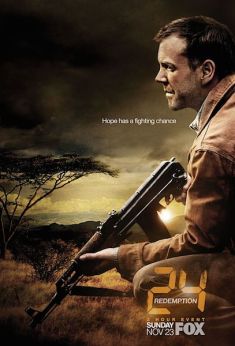
The setup is simple: Jack Bauer’s trekking round the world, currently holed up with an ex-army buddy (played by the ever-excellent Robert Carlyle) in the African nation of Sangal where said buddy has set up a school. Yes, Jack Bauer is living a life of peace. But then Bad Men turn up wanting the kids for child soldiers, and within the hour they’re attempting a military coup — this is still 24 remember, the action all takes place “in real time”. What’s Jack to do? Why, return to his old One Man Army self, of course — if he can’t stop the coup, he sure as hell can save those kids! Meanwhile, it’s inauguration day for America’s new female (black? 24’s been there and done that — twice) President…

For a Fox action series, off screens for almost 18 months and undoubtedly designed as a starting point for new viewers, Redemption (not that that title’s seen on screen) has a surprisingly slow build up. That’s no bad thing — this is a story after all, not a 90-minute shoot-out — but there are times when one feels it should get a wriggle on. This is likely where most, if not all, of this extended version’s new material was added. There’s almost 15 minutes added to the running time here, though some is surely due to a 5-minute credit crawl that must be much longer than the TV version’s. Having not seen the broadcast edit I can’t comment on what new scenes, shots or lines are added, but there’s no greater violence or thematic density than 24 usually produces so I imagine what was cut was cut for time alone.

That said, Redemption certainly tackles its fair share of issues — primarily, the use of child soldiers, and the US involvement (or lack of) in African genocides. It’s certainly admirable and worthwhile for such a popular series to bring these important issues to the attention of a mass audience who might otherwise ignore, or at least not be aware, of them, but they’re still included in a “mainstream American action series” way — that’s to say, they’re ultimately a reason for a shoot-out. There’s also some subtle political commentary, such as the UN Peacekeeper stationed at the school being a coward who runs away at the first sign of violence… and then betrays them to boot! Of course, just because it’s unsubtle doesn’t make it wrong, but Blood Diamond this is not. Whatever the politics, the action sequences — and, once things get going, there are a few — are all carried out with 24’s usual panache.

Is this a suitable jumping-on point for newcomers? Yes, quite simply. It’s several years since the last season and Jack’s in a very new part of this life. Some old faces crop up and there are some backstory references, but these are more nods for returning fans than anything important. Everything you need to know for this story is contained herein, and fortunately that doesn’t involve great slabs of exposition about previous seasons. On the other hand, it fails as a standalone movie. While the main plot — Jack defends school — is kicked off and wrapped up in the space between the title and the credits, there are several US-based plot threads that aren’t even close to being resolved. These are clearly designed to flow on into season seven — presumably they’re either elements bumped from the early episodes up into the movie, or a fleshing out of information that would’ve just been exposition before.

It’s hard not to conclude that Redemption would’ve been better without the US scenes. They add nothing to the main action in Africa and they’re all quite flatly directed, forcibly reminding you that this is just a TV movie by being worse than most TV these days. Their one true benefit is an ending that juxtaposes the new President’s inauguration speech with the civil war beginning in Sangal, which, consciously or not, underlines the hypocrisy at the heart of America.

As a standard season-opening episode of 24, coming on the back of the weakest-yet sixth season, it may well have earned itself an extra star. Judged as a standalone film, however, I fear it has to be just

3 out of 5

Thinking “but that’s not a film”? Then please have a read of this.

The Cable Guy (1996)

2008 #79
Ben Stiller | 88 mins | download | 12 / PG-13

The Cable GuyThe best thing I have to say about The Cable Guy is that the opening titles were very well done.

The second-best thing I have to say is that a subplot featuring director Ben Stiller as a faded-child-star twin-killer is very neatly integrated into the film, seeming utterly pointless until it has a near-vital role in the climax. That’s a pleasing piece of writing/editing right there. Unfortunately, the point this seems to be aiming at — that TV rules our life too much, that we’re too addicted to it, etc etc — is not only old hat, but also rendered meaningless in this instance by the lack of impact: TV goes off for the night, and one guy picks up a book. Oh, wow. And to top it off, thanks to an unnecessary final beat, it seems Jim Carrey’s titular character hasn’t actually learnt the lesson we thought he had.

Incidentally, The Cable Guy is a comedy, though at times it seems to wish you’d forget that so it could be a psychological stalker thriller. Perhaps that’s what it had wanted to be — for one thing, there are surprisingly accurate predictions for the future of telecommunications, although their coming true may simply have killed another joke (“play Mortal Kombat with a friend in Vietnam!”) — until someone realised the idea was too silly to be taken completely seriously. How funny you find the end product will depend on whether you like the style of comedy Carrey employed in the early & mid-’90s, and whether you can stomach pointless asides that don’t do anything for the plot (final act freaky nightmare, step forward). There’s little else to engage interest — Matthew Broderick’s pseudo-protagonist is, perhaps, too nice and too eager to please, and the go-nowhere romantic subplot — his main action aside from being Carrey’s straight man — has all the depth and shape of something from a cookie cutter.

More fun than the jokes, actually, is playing Spot The Pre-Fame Comedy Star. Eyes open for young-looking turns from (in ease-of-identification order) Jack Black, Ben Stiller, Owen Wilson, Janeane Garofalo, and Kyle Gass. And Eric Roberts randomly shows his face too, not that that’s relevant to anything.

The Cable Guy is rated 12, or PG-13 in the US, which may also be the last ages you’d enjoy it at.

2 out of 5

In case anyone’s wondering what’s happened to #77 & #78… Despite spending 23 months carefully posting reviews in order (well, the first two months are actually a bit of a muddle), it’s now December and I’m a few behind, so I’ve decided to throw numerical sequence to the wind and just post reviews as & when I get round to completing them. The main reason for this is to help drive things forward so that I can actually end 2008’s posting by December 31st, rather than having it drag on into 2009 and overlap with Year 3. I’m sure no one will really mind. Or care.

Sherlock Holmes and the Secret Weapon (1943)

2008 #75
Roy William Neill | 66 mins | DVD | PG

The name’s Holmes, Sherlock Holmes, as Universal’s loose adaptations of Britain’s Greatest Detective deliver a low-key proto-Bond, 22 years before Goldfinger applied the same tricks to Britain’s Greatest Spy.
“How so?”, you might ask. Well, Holmes has been employed as a spy for His Majesty’s Government; it begins with an ‘end of the previous adventure’ almost-action sequence that would undoubtedly take place before the opening credits now; there’s a war-winning weapon at stake; a bit of globetrotting (albeit just from Switzerland to London); some double-crossing and side-switching; even a surprisingly nasty torture sequence; a nice race-against-time final act; and an equally-matched villain, with a secret lair, who has devised a clever death for our hero. So the lair is just a house with soundproofing and unbreakable glass, but that’s not a bad effort — I don’t think there are many volcanoes to hollow out in the London area. It may be Bond on a World War Two London scale, but the feeling is there.

I discussed the controversy (for a modern audience, at least) of this updated setting in my last Holmes review, and it’s even more abundant here — seeing Baker Street as a victim of the Blitz, and 221B surrounded by sandbags, is very odd indeed — but at least it employs several elements from a variety of Conan Doyle’s plots, and it’s not unreasonable to assume that, given his skills of deduction and disguise, Holmes would’ve been employed as a spy had he been ‘alive’ during the war. In fact, Holmes actually does some detecting this time, whereas in Voice of Terror he seemed to meander around a bit, and employs several disguises, even if some of them are about as much cop as one of those glasses-nose-and-moustache masks. Of course, it would help the mystery if its solution wasn’t revealed before Tobel (the inventor of the titular war-winning weapon) was even kidnapped, but you can’t have everything.

What lets the film down more is Lionel Atwill as a weak Moriarty, supposedly the film’s grand villain. It’s not all his fault — for one example of poor writing, Holmes deduces the final code after an accidental clue from Watson, while Moriarty gets it by clumsily spilling water over a copy, hardly displaying great powers of deduction — but he doesn’t compare to the scheming, cunning Moriarty we saw played by George Zucco in The Adventures of Sherlock Holmes. On the plus side, the ease with each Moriarty outwitted Holmes in that earlier outing made our hero look a bit ridiculous, whereas here Holmes gets to outwit his nemesis a couple of times, including a particularly nice denouement.

As with Voice of Terror, I enjoyed a lot of Secret Weapon in spite of its distinct un-Holmes-ness — it’s another pacey, exciting World War Two spy thriller. It’s better than its immediate predecessor on the whole, though a spot of miscasting nearly persuaded me to remove another star.

4 out of 5

Sherlock Holmes and the Voice of Terror (1942)

2008 #74
John Rawlins | 63 mins | DVD | U

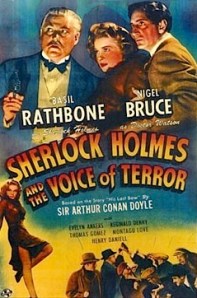
Despite the success of their two Sherlock Holmes films (The Hound of the Baskervilles and The Adventures of Sherlock Holmes, both 1939), Fox decided the character was outdated and resolved not to make any more. Universal clearly disagreed, and the popular pairing of Basil Rathbone and Nigel Bruce reprised their roles three years later for this, the first of twelve Holmes films the studio would make with the duo in just five years.

There’s more change afoot than just the logo at the start, however, as Holmes and Watson are dragged from their typical Victorian setting to London in the midst of World War Two. For a modern audience, who definitively associate Holmes with the Victorian era, this move seems virtually incomprehensible and sacrilegious; but Conan Doyle’s original Holmes stories take him as far as the start of World War One, so bringing the character another 28 years forward is little worse than, say, relocating the 1980 novel The Bourne Identity to 2002. Nonetheless, the filmmakers were aware of the problem even at the time, choosing to open the film with a title card that asserts Holmes to be “immortal… ageless, invincible and unchanging” in the hope that audiences would accept a then-present-day setting.

Whether the setting bothers you or not, the story itself might. The basic concept is a nice idea for a war-set spy-thriller, but not really for a Sherlock Holmes mystery. There are plenty of audience-pleasing applications of his ‘impossible’ deduction skills, such as the moment when Holmes concludes someone dislikes him based on the depth of footprints left in a carpet (never mind that the character huffily ignored Holmes when he came in), but the main plot involves a minimal use of these abilities. It’s also loaded with implausible elements — why would the Nazis waste bombs on empty fields (to disguise one plane going a different route) when they could have used them on genuine targets? Why are recordings shipped to Germany and broadcast back, rather than just broadcast from England? Worst of all, what’s going on with Rathbone’s haircut? The final twist is either genius or ludicrous, I’m not sure which; and the misguided reference to Holmes’ deerstalker (he’s promised not to wear it — why?) is, well, misguided.

It’s not all bad. As mentioned, the basic storyline is a good one, providing decent entertainment once it gets going; Holmes gets plenty of amusing lines, which manage to provide more genuine laughs than Watson’s incompetence; and there’s some lovely shadow-drenched photography — though the film’s even more drenched in patriotism, to the point of propaganda at times.

The consensus seems to be against me, but by the end I was quite enjoying Voice of Terror. It may be a Sherlock Holmes film in name only, but taken instead as a cheap spy thriller it makes for passable entertainment.

3 out of 5

Quantum of Solace (2008)

2008 #73
Marc Forster | 106 mins | cinema | 12A / PG-13

This review contains spoilers.
For a spoiler-free view, see my initial thoughts.

Quantum of SolaceQuantum of Solace is to Casino Royale what Tomorrow Never Dies was to GoldenEye: it’s the second film of a new Bond, tasked with revitalising a flagging franchise (this time creatively rather than monetarily); it’s been promoted as shorter (though by 38 minutes, not TND’s mere 11) and more action-packed; and it’s got to follow a huge success, both critically (94% on Rotten Tomatoes) and commercially ($588m worldwide). It’s a tall order — one many believe TND failed to live up to (personally, I’ve always liked it). Does QoS do any better?

Well, it’s certainly action-packed. Bond hurtles from budget-blowing sequence to budget-blowing sequence with alarming fervour, the camera literally struggling to keep up. It’s this zoomed-in, over-cut, handheld style that most grates with me during these sequences. I quite like it in the Bourne films — it’s part of their style; it fits — but I was incredibly glad to not find it in Casino Royale, and therefore disappointed to see it showing up here. Compare Royale’s early free running chase to the early rooftop one in QoS and you’ll quickly see not only which is better staged, but which is better shot. There are some good moments action-wise — for every disappointing boat or plane battle there’s an effective duel (swinging from scaffolding) or a destructive car chase — but I do wish someone would put the camera on a tripod. The frequency of such sequences, plus an abundance of other common action/spy movie tropes (a rogue agent, shadowy organisations, moles — in fact, trust has never been more of an issue), suggest that this is very much the Action Movie on director Marc Forster’s increasingly eclectic CV. His true strengths show up elsewhere however, as the most memorable parts of the film aren’t the headache-inducing punch-ups, but any scene that involved Bond and M or Bond and Mathis.

The acting, you see, is of a high standard, certainly above the requirements of the genre. While Craig may be lumbered with a very focussed, almost one-note Bond, the flashes of drama and dark humour allow him the odd chance to stretch. He may not get the variety that Casino Royale offered in this department, but he does enough with what’s there. Never more so than in the scenes with Giancarlo Giannini’s Mathis — the action pauses for breath when Bond seeks him out, and we’re treated to some of the film’s very best bits. Some fans wondered how the character could be brought back after Casino Royale, and the trick is to transform his role: what was previously a minor part designed to facilitate the plot here becomes one of unique significance, an injection of emotion and humour that makes his unfortunate death the film’s most heartbreaking moment — in fact, I might go so far as to argue it’s the saddest moment in a Bond film since the end of On Her Majesty’s Secret Service. It’s these scenes that allow Forster’s dramatic directorial abilities to come to the fore, confirming that this is where his true talent lies.

Best of all is Dame Judi Dench, unsurprisingly excellent as ever. She’s aided considerably by M having a much bigger part this time out — not in an obvious The World Is Not Enough-style “have her kidnapped” kind of way, but just by giving her a lot more to do as James’ boss. In the old days the boss sending an agent out into the field and not hearing from him again until the mission was over may have made sense, but in our world of easy telecommunication it would be ridiculous if M wasn’t closely monitoring and commanding Bond every step of the way. So she does, and it’s great for the viewer to be treated to so much of Dench and her relationship with Craig. Not only that, but M has a spot of governmental and inter-agency politics to deal with too, increasing her role still further. If they retain any element of QoS for Bond 23, I hope it’s this.

As for the other Bond girls, Olga Kurylenko is fine but unmemorable, perhaps most significant for being the only major Bond girl who doesn’t sleep with our hero. (Incidentally, this is the third action film in two years in which Kurylenko plays a major part and doesn’t sleep with the hero. That’s quite a niche to be carving.) Back-up girl Gemma Arterton is disappointingly underused, existing primarily for the sake of being another girl in an otherwise masculine film. Her Goldfinger-tribute death, a nice nod in a franchise that has almost entirely excised its past, is an effective touch in and of itself (aficionados will surely note that, this time, there’s no conveniently-placed cushion), but considering the substance at stake turns out to be water rather than oil, it’s either Quantum playing some misplaced guessing game or an ill-considered plot hole. More annoying is her name, however. I don’t care that she’s named Strawberry Fields — it’s either an appropriately silly Bond girl name or, in this day and age, depressingly believable — but much is made of her first name going unrevealed, only to be rewarded with no pay-off. It’s not revealed on screen (only in the end credits), and Bond doesn’t even have an (admittedly clichéd) “I never even knew her first name” line on finding her body. Only a minor misstep, to be sure, but a nagging one.

As the scheming villain-by-proxy, Dominic Greene, Mathieu Amalric feels underused. He’s not as non-present as some Bond villains (The Spy Who Loved Me comes to mind, where Bond shares all of three lines with his nemesis before shooting him), but there’s a definite sense that the military coup/water hoarding storyline is a perfunctory element around Bond’s hunt for the men behind Vesper, in the process establishing Quantum so they can be dealt with in a later film. While I like having a Big Bad Organisation to cross over the films, much as SPECTRE did in the early days, the downside to their first real appearance here is that this particular scheme — a coup in a relatively inconsequential country, it must be said — is a bit lightweight for such a powerful, important organisation. This, plus Greene being more of a civil servant-type figure than an evil megalomaniac, leaves the climax feeling rather anticlimactic, lacking both the grandeur of the old Bond and the emotional weight of Casino Royale (as if a sinking building wasn’t quite grand!) It’s been touted in interviews that Greene’s fighting style is that of “a man who can’t fight”, but that’s no reasonable excuse for his final duel with Bond being so brief. Try harder next time.

Which, it seems, has been the closing impression of QoS for many fans. In this vein, placing the famous gunbarrel at the film’s close is surely highly symbolic, in the same way that saving the equally famous theme music for the end of Casino Royale was: Bond has now completed his evolution, excised his Vesper-demons, and is now the character we all know. Where at the start of the film he merrily kills everyone he comes across, at the end, face to face with the man mostly directly responsible for Vesper’s suicide, who he’s spent most of the film tracking down, he questions him before handing him over to MI6. For all those who dislike QoS’s style, this closing gunbarrel is hopefully an indication that, come 2011, the Bond they know will be back.

So does QoS do any better than Tomorrow Never Dies? Critically, yes, actually — although it’s received mixed reviews, they’ve been positive overall. At the box office, very much so, including the franchise’s best-ever US opening weekend (in this case topping the widely-disliked Die Another Day, something Casino Royale didn’t even manage). As for me, the opinion that opened my initial thoughts on the film still stands: it’s not as good as Casino Royale, but that was a far above average piece of entertainment. QoS isn’t a great Bond film, and it certainly doesn’t have the cross-fandom appeal that Brosnan at his best managed — and it certainly does have more than its fair share of detractors — but it’s a solid entry in the series. When the preceding instalment was possibly the best the franchise has produced in its 46-year history, that can make things seem worse than they are.

4 out of 5

My initial thoughts also offer additional comments on the level of humour, the title sequence, and more.

Casino Royale (2006)

2008 #72a
Martin Campbell | 139 mins | DVD | 12 / PG-13

Casino RoyaleI’ve seen Casino Royale four times in the two years since its release (twice on opening weekend, in fact), which is an unusually high number of viewings for me. Normally I’ll see a film once and, even if I really like it, might not bother again for years; even films I’d name among my most-favourites fall into this category.

The reason I share this upsettingly trivial bit of information about my film watching habits is because, after two years and four viewings, I don’t really have much to say about Casino Royale. It’s a damn fine Bond film, returning to Fleming and resetting the character without losing anything truly essential about the franchise. The action sequences are great because they’re not only exciting but also drive the plot forward and reveal character — when Bond runs through the wall at the building site is a prime example of this.

In Daniel Craig and Eva Green the franchise has probably the best two leads it’s ever had, in terms of acting ability, and they put it to good use. There are many more pitch-perfect things about this film — not least making a poker game engrossing — and, yes, a few flaws, though for me they’re so minor as to not matter; but I don’t feel the need to expound on them a great deal because the film really speaks for itself. And, looking at the UK box office and DVD/Blu-ray sales, I’m not sure there’s anyone who hasn’t seen it.

In summary, Casino Royale is possibly the best Bond film of all time — though when you have a series that has encompassed so many disparate styles (directly compare From Russia With Love to Moonraker and one might even struggle to believe they’re from the same series), it makes for an incredibly hard selection to pick a sole winner from. Still, this one’s up there with the very best, not just of Bond but of action-spy-thrillers in general.

Now, I just wonder what happened next…

5 out of 5