Eastern Promises (2007)

2009 #32
David Cronenberg | 97 mins | DVD | 18 / R

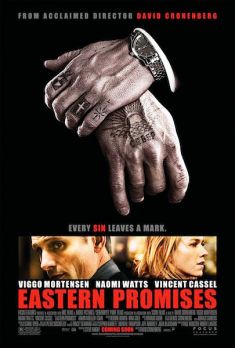
Eastern PromisesArguably most famous for his horror films of the ’80s (though a couple of his ’90s efforts could stake a claim), director David Cronenberg widened his appeal somewhat with the excellent crime thriller A History of Violence. Here he reunites with star Viggo Mortensen for another grim tale, switching the bright searing heat of the American Midwest for the rain-drenched nighttime streets of our fair capital.

Despite some similarities in plot and theme, Eastern Promises failed to engage me in the same way as the earlier effort. Perhaps this is because it plays tag with its central character, beginning with Naomi Watts’ do-gooder nurse before shifting focus to Mortensen’s mafia chauffeur with nary a blink. It’s an unusual transition, and consequently it’s hard to tell whether it’s skillful writing or a fortuitous accident that it comes off seamlessly. One theoretical screenwriting argument would have it that the film is actually all about Christine, the baby, and that’s why it works, but that feels a little too pretentious to engage with now.

Tied around the baby’s fate, screenwriter Steven Knight factors in some appropriately dark elements, like white slavery or the relocated criminal underworld that currently operates in the UK. Though these are handled with a certain amount of care, they’ve been covered in greater depth elsewhere (the excellent miniseries Sex Traffic, for example) and here are reduced to pawns in a different tale. This isn’t necessarily inappropriate, but remembering the detail from other such dramas can leave the topics’ inclusion here feeling lightweight.

Elsewhere, the screenplay suffers from some awkward dialogue exchanges and barely credible logic contrivances being used to jump-start the plot. Most of these come from Watts’ character, who seems too competent for much of the film to pass off as a naïve fool at its start. This may be Watts’ fault, playing her as intelligent when a naïve approach might render her actions more believable, but it seems cruel to lay the blame with her as she’s very strong all round. Armin Mueller-Stahl also gives his typically accomplished turn in his typically key supporting role.

Mortensen’s Oscar-nominated performance is the focus, however. Apparently thoroughly immersed in the role, he gives a distinguished performance throughout and is central to what are by far the film’s most memorable moments: a nude steam baths fight, which has become justifiably infamous (I suspect for the “nude” part, but it’s the “fight” that deserves it), and a game-changing twist, that I sadly had ruined in advance, though there are plenty of clues scattered along the way.

By its end, Eastern Promises has the feel of the first part of something bigger: while the story of the baby is resolved, many others are left open. Unresolved threads aren’t always a problem, but it feels like Cronenberg has more to say in this world. So it’s nice to know a sequel is possibly in the works, because Eastern Promises has the potential to be a Hobbit to some Russian mafia epic’s Lord of the Rings. On the other hand, a similarly low-key follow-up would be just as appropriate.

Though it failed to capture me as much as A History of Violence, possibly due to too-raised expectations, Eastern Promises has the potential to grow with repeated viewings. And either type of continuation would be most welcome.

4 out of 5

Unfortunately, plans for a sequel ultimately fell apart in 2012. Some more details can be read here.

Saw IV (2007)

2009 #62
Darren Lynn Bousman | 92 mins | DVD | 18 / R

This review contains minor spoilers.

Saw IVSaw IV is the final film in the series directed by Bousman, and will also be my jumping off point (for the time being). According to IMDb (which I presume is sourced from a commentary or something), Bousman had been intending to depart after Saw III, but was persuaded to stay when a twist in the fourth film’s script managed to surprise him, something he thought the franchise was by then incapable of. But do not let this get your hopes up, dear reader, because Saw IV lacks any twists that even come close to those in the preceding films. What caused Bousman to continue is a mystery, and some viewers will inevitably feel the same way about continuing with the series themselves.

After the overly gory third film, Saw IV returns to the franchise’s roots by playing more like a thriller than a horror film — even more so than the previous instalments, one might argue, as aside from a couple of jumps and a few instances of gore, the story and its key sequences move forward via police investigation, endless flashbacks and copious twists. The Saw franchise should be applauded for trying to be more than just another slasher series, but needs to learn the value of restraint in other areas.

The plot, for example, is incredibly complicated. This could be a good thing — it’s rare for the fourth film in a franchise, especially a horror one, to demand so much from its audience — and the viewer not only has to pay attention to the events on screen, but have a pretty good awareness of those from the last two films as well. Despite its complications, such connectedness is actually a reason to retain hope for the franchise, because it really tries to be about more than just how graphically it can slaughter people.

Unfortunately, any effort on the part of the viewer isn’t rewarded. Saw IV is too complex, ultimately descending into the realms of incomprehensibility. There are around four different plot threads, at least two of them jumping around in time like a TARDIS with ADD. Goodness knows how many different time zones are included, how many of them progress in a linear fashion, and whether or not they actually have any bearing on each other. Even references to previous films are confused: while this clearly begins some time after the end of Saw III, it then jumps back before Saw III, and then during Saw III, and then with Saw III, and then after Saw III again… but not as far after it as that opening scene. And that’s just the main plot.

A lot of the complexity is in aid of answering hanging questions from Saw II and, especially, III, but the mass of backstory leaves you wishing for a standalone ‘Test of the Film’ plot, which the first three essentially are. As already expressed, such an intricate array of stories is not necessarily a problem, but neither new writers Patrick Melton and Marcus Dunstan nor director Bousman have the required skill to guide the audience through such dense material. Nor the experience to know when less can be more, clearly.

Fortunately, Bousman seems to have learnt that “less is more” with the deaths. After the excess of Saw III, the gore feels pared back here. The one notable exception is an entirely extraneous autopsy that opens the film, which goes beyond the last entry’s brain surgery in the gruesome stakes. Apparently it’s to prove Jigsaw is unquestionably dead, but it does it with more glee and explicit medical detail than necessary.

Elsewhere, however, the savagery shortage is welcome — except that, in the process, Bousman seems to have misplaced the tension present in the first two films. The only real suspense is an opening trap that is, again, almost entirely extraneous to the rest of the plot, although one trap later on — featuring an abusive husband pinned to his wife — is moderately ingenious, achieving Jigsaw’s proclaimed ideas of apt justice in ways many previous traps failed to.

And what of Jigsaw this time? He may be dead, but instead we’re treated to flashbacks of John Kramer’s pre-Jigsaw life. As you may remember from my complaints in Saw III, revealing more about our villain is, in this case, not a good idea. Seeing Kramer before he was an Evil Bad Guy is clearly an attempt to make him a real person, one inspired to engage in a killing spree by every-day, real-life events. As with the other thriller elements, grounding the villain in the real world — and trying to give him plausible, relatable motivation — sets the Saw series apart from the vast majority of other horror franchises. But there’s no need to understand Jigsaw, and the more we learn about him the less impact he has. His soul is laid bare here, but by trying to make his actions plausible it continues to strip away the mystery and highlights how ludicrous his traps are in reality — they work fine in the conceit of a horror movie, but trying to imply it’s a real person doing these in the real world is one suspension of disbelief too far.

Which kind of sums up the film, really. Saw III went too far with its gore, and now Saw IV goes too far with its plot. As the series rattles on to its fifth instalment (and this year’s sixth, and next year’s seventh, and at least an eighth beyond that), its only hope for regaining a decent level of quality — in my opinion, of course — is to keep the gore at a manageable level, and keep the storytelling at one too.

2 out of 5

Technically I watched the Unrated/Extreme extended cut of Saw IV. The differences are numerous but ultimately minimal. Those desiring a full list of alterations can find one here.

Saw III (2006)

2009 #61
Darren Lynn Bousman | 109 mins | TV | 18 / R

This review could be seen to contain some spoilers.
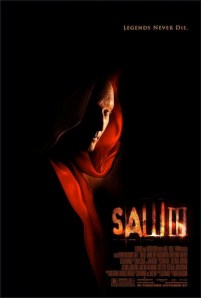
Saw IIII’m reliably informed that, in the UK, we do our best not to allow people with psychopathic tendencies into the armed forces. In the US, on the other hand, they let them all in. And they also let them make movies like this.

Saw III is the point at which the franchise finally tips over into the justly reviled “torture porn” category. That’s not to say it’s solely focused on its gruesome deaths — as with the previous two films, there’s a thriller-ish plot to work through as well — but Jigsaw’s traps this time round are shown in excruciating detail. Perhaps the filmmakers are deliberately trying to shock their audience, increasingly desensitised by Saw wannabes, or perhaps they’ve just let their increased budget run rampant. Whatever the reason, it’s not welcome.

Along with it, the gore feels less justified. The traps have an element of invention about them, but the punishment doesn’t fit the crime in the same way it did in the first two films. There is arguably an explanation for this (to share it would be to spoil some of the plot), but that seems a thin excuse for a lack of intelligence on the part of the writers. In fact, one of the most gratuitously gory scenes is a brain surgery sequence that’s almost entirely unrelated to anyone’s test. It’s shown in unrelenting, unnecessary detail, coming across as the makers using some kind of “but it’s a medical procedure” excuse for showing more grisly detail than they might otherwise be allowed.

The story that links the monstrous set pieces together is a bit of a mixed bag, continuing dangling threads from the previous films while producing a few of its own that seem unconnected. It lacks the focus and straightforward drive of the first two instalments, but leaves the viewer longing for such a thing. The main test, once it gets underway, is quite a good idea, and different again to its predecessors. Here we have one man facing those he holds responsible for the death of his son, and it’s up to him whether they survive their traps. The traps may not be as clever as before, but the storyline is different enough to engage the audience’s interest.

But before the worthwhile bit can begin, we have a section that just feels like housekeeping — where Detective Matthews has got to, what happened next to Detective Kerry, what Amanda is up to now. Worse, woven around the main test is another story thread — one that finds Jigsaw on his deathbed (perhaps) and deems it necessary to fill us in on Amanda’s backstory. Unfortunately, this latter part is incredibly dull. That the film’s final moments reveal it was more relevant than previously expected does invite a re-watch, but the prospect of sitting through the sadistic mutilation — and nonetheless boring expository scenes — for a second time is just as off-putting.

Not only is the Jigsaw subplot dull, it’s also too revealing. One of the many things that marks Saw out from its horror stablemates is that Jigsaw is a real man, not a supernaturally-powered being, but he still works best as an enigmatic figure, menacing characters in occasional scenes that offer no more than a handful of tidbits about his past. Here, he’s both over-central and over-revealed. The more we learn the more his mystery is removed, he becomes less interesting and, worse, less threatening. Tobin Bell’s performance is as good as ever, but the character works better in fewer, more condensed doses.

As well as endless backstory, the screenplay also offers another final array of twists. The closing revelations were some of the best bits of the last two films, so are naturally loaded with expectation here. Personally, I didn’t find them to be much of a surprise, most of it guessable from too far in advance. Rather, the final round of frame-long flashbacks are desperate to make the viewer think it’s more of a twist than it is, kind of like the filmmakers explaining why something’s so clever in spite of it being a bit obvious. To be fair, these ‘twists’ aren’t stupid — in fact, they’re quite good — but I wasn’t surprised by them. As if Bousman and co were trying to redeem themselves, the scene that follows is quite tense, and one very final twist — just when you thought they were all twisted out — does manage to surprise. And it’s a cliffhanger to boot.

Indeed, despite a certain finality at the end, Saw III is ready-made for at least one further sequel (of course, as we now know, it’s got four and counting). There are all kinds of little bits that go unexplained here, from characters to blink-and-you’ll-miss-them plot-points-in-waiting, not to mention that it ends on that fairly substantial cliffhanger-twist. That it’s so brazen in its lack of comprehensive answers will irritate some, while others will delight in the knowledge there are still more mysteries to ponder.

Visually, Saw III is overcooked. The cinematography is too stylised, heavily filtered to offer a single-colour-saturated look for each location. Such a technique can be beneficial in certain contexts — Traffic, for example, lucratively uses an even more extreme example — but here feels like someone was let loose in the grading toolbox. Equally, the trickery with scene transitions — where different locations have been built on the same set so as to move between them without any editing or digital effects* — may have looked clever in 1940, but now seems needless. Worse, it confuses the storytelling and the audience’s sense of geography. It’s one thing tricking your viewer with plot twists, another entirely to needlessly mislead their understanding of filmic space. These wannabe-flashy transitions are inspired by similar ones in the preceding films, but there they were neatly subtle and surprisingly effective, while here they don’t look as cool as someone clearly thinks, as well as initiating moments of befuddlement.

Despite my ever-growing catalogue of complaints, there is a bright side for Saw III. What could have been just another rehash of the same basic plot conceit ramped up a bit more — from two people trapped in a room, to half a dozen trapped in a house, this could’ve just been a dozen trapped in an office block — instead chooses to come up with a new narrative structure. Yes, it’s still based around defeating a series of traps/tests, but in a genre where some franchise entries are merely distinguished by the different modes of death — if that — it’s tantamount to a revelatory change of style. It also holds the distinction of being the only Saw film so far I want to rewatch to better consider events (and, from a filmmaking standpoint, its narrative structure and balance), even if other elements put me off.

Though it’s Jigsaw’s story that merits this feeling, I’d still rather have less of him and more of the test he’s got on the go. Sadly, I think the franchise is headed in the exact opposite direction.

2 out of 5

* This technique was definitely used in Saw IV (according to IMDb), but I don’t know if it was also applied here or if it just looks like it was.

Saw II (2005)

2009 #60
Darren Lynn Bousman | 89 mins | TV (HD) | 18 / R

Saw IIThe games-playing slaughterfest returns in what I’m told is many fans’ favourite entry in the series. Maybe they’ve never seen Cube

Saw II is a horror sequel, which means it can’t help but take the same basic premise as its originator: serial killer Jigsaw locks a number of people in a room with a series of games/traps, which they can escape only if they can work out the clues to defeat them; and if not, they’ll be brutally murdered and/or disfigured. Where Saw II comes into its own is that it dares to do something a bit different with this premise, usually the hallmark of a worthwhile sequel.

Instead of two victims locked in a dingy bathroom we have too many to reasonably count locked in a whole house. Instead of the killer being largely unseen he’s a constant presence, in conversation with a police detective while events in the house unfold on monitors nearby. The film’s raison d’être is the same — people get injured/killed in nastily inventive ways — but someone (co-writer/director Bousman, in fact) actually bothered to come up with a story that’s more than superficially different.

Despite the terror and gore — and there’s a healthy (a word I use very, very loosely) dose of each — Saw II is arguably even more like a thriller than its predecessor. The police are more heavily involved this time, actually catching up with Jigsaw, and as much time is devoted to Detective Matthews’ negotiation/chat as it is to the predicament of the victims. Here we get a chance to see what a great villain Tobin Bell makes — subtly so, not the typically OTT psychopath killer designed to show off an actor’s ‘skill’. He’s not quite Spacey’s John Doe, but his quiet, determined, reasoned killer is a cut above the average. That he’s afforded a moderately reasonable motive and some character development is certainly more in line with thrillers than horror movies.

Meanwhile, in the house, Bousman seems to be going for a Cube-like atmosphere: a disparate group of people wake up together and must find a way out of a strange, booby-trapped location. This starts out well enough, unravelling both questions and answers at a pleasing speed, but unfortunately is unable to sustain it convincingly. Few of the victims achieve the level of distinct characterisation that Cube managed, suggesting there are more people locked in the house than the writers could comfortably handle or the story could really support.

Indeed, even the primary selling point is abandoned surprisingly quickly — it seems the writers don’t have enough ways to kill people. At least one just drops dead from the virus-that’s-there-from-the-start, which feels unsatisfactory, while another happens to wander into a trap when it’s time to dispatch someone else. Considering the amount of planning we know Jigsaw gives to his games, we should at least see that there are enough ways to kill everyone, even if some are then subverted through escape or avoidance.

There’s some redemption to be found at the climax, which produces a final round of twists that are almost equal to the first film’s triumphant reveal. Again I won’t give it away, but I’m sure some have called the biggest twist a cheat, on a par with “and they woke up and it was all a dream”. If they have, they’re wrong: it’s entirely in keeping with both the games Jigsaw might play and the flashback-driven style of the first film, not to mention that — as the insistent concluding recap shows — there are clues seeded all the way along. If it’s not as audaciously memorable as the twist in Saw, that’s through no fault of it’s own.

Saw II doesn’t just rehash the original, which is something to be thankful for in a horror sequel. There’s something close to character development, a nice opening setup, and an enjoyably twist-stacked ending. Unfortunately it can’t quite connect that opening to that ending, in spite of its brief running time, which means it fails to equal its predecessor’s overall quality. Fair effort though.

3 out of 5

Saw III premieres on Channel 4 tomorrow. Saw VI is in cinemas from Friday.

Saw (2004)

2009 #59
James Wan | 99 mins | DVD | 18 / R

SawWith Saw VI about to subject cinema screens and captured audiences to another round of gruesome brutalisation, Channel 4 have seen fit to treat viewers to a similar experience in their own home, screening the first three films in the now-annual cinematic occurrence this week. Except I’ve had the original Saw sat in my DVD collection for years, so I watched that instead.

Despite being credited with birthing the entirely risible ‘gorno’ genre (for those blissfully unaware, ‘gorno’ is an amalgamation of “gore” and “porno”; its other common name, “torture porn”, is a thoroughly descriptive moniker), Saw isn’t really a good example of it. There are nasty, vicious murders — or, technically, deaths — but there’s no serious sexual element and it’s all underpinned by a half-decent plot.

In fact, I’ve heard it called “a thriller with sadism” rather than a horror movie. There’s a point to that, and the Guardian’s comparison with Se7en (as misquoted on the DVD cover) isn’t misplaced (in certain surface elements anyway). The killer has a motive that’s not supernatural, there’s an intricate array of flashbacks as well as the unfolding events, with a gradual unravelling of the truth via investigation, complete with a thriller-sized collection of twists.

But just because it’s not a slasher movie doesn’t mean it’s not horror. The sheer vileness of the killings — their tortuous methods, graphic results, and tense build-ups — put paid to any notion that this is just a nasty-minded thriller. The setup is more thriller-like, with Dr Gordon’s recollection of a police investigation, but once underway it’s all played as a horror movie — the sequence leading up to Adam’s capture, for instance, where he stalks his darkened apartment with only a camera’s flash for illumination, is pure horror — and the overriding impression is of a movie primarily attempting to scare you, not engage your mind with a mystery-fuelled plot.

Not that the story should be ignored, because it’s this that raises Saw above its gorno compatriots and makes it a worthwhile film. Wan and screenwriter Leigh Whannell juggle flashbacks and multiple timelines with consummate ease, using them to uncover backstory that advances the tale they’re telling rather than provide padding to an otherwise slight conceit. It’s not as intricate as, say, The Prestige, but is complex enough that in lesser hands they could’ve been the film’s undoing. Wan and Whannell never lose sight of what purpose every scene serves, where they occur in the film’s chronology, and where the story’s going. Consequently it all flows seamlessly.

It all contributes to a final twist that is truly wonderful. Even if you know it’s coming (as I unfortunately did), it’s so beautifully executed in every respect that it’s awesome to behold. It wouldn’t be enough to overcome the horrors of the film that precede it for those of a squeamish nature, but it’s certainly the best bit. I wouldn’t dream of giving it away here (though have probably oversold it).

It isn’t perfect. The dialogue is frequently awkward, the acting occasionally variable, but those things are hardly the point in this genre and here are never so bad as to interrupt proceedings (unless you’re looking to pick holes, in which case they’re ripe for it). The low budget occasionally shows through too, but that’s not necessarily a barrier to success — do we need to see a car chase on roads when a black backdrop and smoke can convey the same information adequately for the story? I think not. (Unless you happen to have Garth Marenghi’s Darkplace pop into your head at the time…)

The annual sequels apparently conform to the law of diminishing returns, but it’s plain to see what sparked the craze in the first place. Sickly inventive, well constructed and rarely less than gripping — and with a killer sting in its tale — if you haven’t already, and think you can stomach it, you really ought to see Saw.

(Sorry.)

4 out of 5

There seem to be three versions of Saw doing the rounds, though the difference between the longest and shortest is little more than 30 seconds, apparently due to the odd extended shot and different opening logos. If anyone cares, the version I watched ran 1:38:31 (PAL).

Saw II is on Channel 4 and 4HD tonight, while Saw III premieres there on Thursday. Saw VI is in cinemas from Friday.

Predator 2 (1990)

2009 #17
Stephen Hopkins | 104 mins | DVD | 15 / R

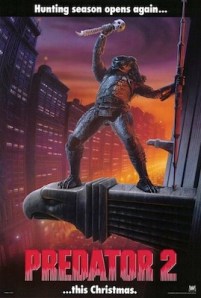
Predator 2I’ve been looking forward to Predator 2 for a number of years after a friend told me that, despite its poor critical standing, it’s actually a jolly good film. (“A number of years” is the average time it takes me to act on such a recommendation; and, knowing this particular friend, “jolly” was probably not the word he used.)
Here, action director extraordinaire John McTiernan hands the reigns over to Brit Stephen Hopkins (probably best to be remembered for helming half of 24’s phenomenal first season, though you can recall the Lost in Space film and A Nightmare on Elm Street 5 instead if you like) and the action is moved from a jungle to the concrete jungle (see what they did there?) of LA, in the near-future year of 1997. Made in 1990, Predator 2 is set in the future for no good reason — sure, there’s a big gang problem, but this is fiction, you can set it now and still make up things like a huge city-affecting change in the status quo; and that way you don’t have to have silly semi-sci-fi guns either. Not to mention the fact that before too long it seems like they’d rather forget this is the ‘future’ and just get on with things. In the end, all it does is seriously date the film: in almost every facet, from screenplay to costumes to direction, it feels more like 1987 than 1997.

Sadly, this isn’t where the problems end. Out of four Aliens and two Predators, this has to be the only one that doesn’t bother in the slightest with a slow build up of tension. Sure, Alien Resurrection gives us the actual aliens much earlier than the others, but they’re not really in force for a fair old while. Predator 2, on the other hand, opens in the middle of a gunfight that lasts for the next ten minutes, and there’s a second before the half hour. This isn’t necessarily a problem in itself but there’s nothing inspired about any of it, especially the gang drug war plot that provides most of the focus.

It’s a shame this fails so miserably, because the franchise re-location is actually a commendable thing. I’ve talked a few times about the Alien sequels dramatically switching genres, but Predator 2 leaves them looking as if they couldn’t be more alike. Where Predator is a behind-enemy-lines/covert mission/jungle/war actioner, Predator 2 is an urban drugs crime police, erm, actioner… though both with a sci-fi twist, obviously. But the vastly different settings and setups mean that, even with the involvement of the same sneaky alien hunter, the films have a vastly different feel too. It’s just a shame Predator 2’s “urban jungle” concept is so poorly executed… for a while anyway, because when it finally reaches the 30-minute climax things suddenly get quite good.

It’s a bit like all the time, effort and money went on creating a good lengthy climax, then any-old hour-long urban crime movie was bolted on the front to create something feature-length. In fairness there are some good bits earlier on, but the final half-hour (or so) feel like it’s from a slightly different, slightly better movie. The dialogue improves, suddenly filled with some decent lines, and it centres on a mano-a-mano (or mano-a-alien, really) fight that’s nicely reminiscent of the first film while being totally different, sprawling through locations and using lots of high technology. There are still flaws — it nicks the government agents’ motivation from Alien wholesale (they want to capture the alien for its weapons technology, which they admire it for) — but they’re largely forgivable.

Perhaps best of all is that throughout the climax it expands what we know of the Predator, rather than just rehashing what we learnt in the previous film, as in so many weaker sequels. There’s more of its weaponry and its medical kit, what amounts to a tour of its ship, hints of its society and culture, and it’s given a nice balance of fallibility — not so indestructible that it’s stupid when the hero wins, but not so weak as to be undramatic or inconsistent. There’s one especially good moment where the Predator discovers a character is pregnant and so spares her, a nice touch both in terms of how it reveals the previously-unknown pregnancy (through the Predator’s heat vision) and in revealing the creature’s morals. It’s this sense of honour and a heightened mental capacity that marks the Predator out from other such creature movies, especially the Aliens, who are essentially animals (it would seem), albeit cunning ones.

Predator 2 is a dire film rescued by an excellent finale. As well as a decent chase and fight, it also builds on the first film’s mythology, revealing a decent amount about the Predators and hinting at more, without going too far or spelling it out too bluntly. If only such qualities could have extended into the opening hour, this could have been a sequel on par with the original.

3 out of 5

Tomorrow, AVP: Alien vs. Predator.

Red Riding: 1983 (2009)

aka Red Riding: In the Year of Our Lord 1983

2009 #52
Anand Tucker | 100 mins | TV (HD) | 15

Red Riding: 1983The Red Riding Trilogy draws to a close with its finest instalment, a superior work in just about every respect.

From the off, 1983 returns to the story of the previous films, showing events from different perspectives. It’s dominated by a new story — the search for a child kidnapper in the titular year — but even this harks back to the past, the actual kidnapping closely resembling the one that kick-started 1974. Indeed, it’s 1974 that’s primarily drawn upon, confirming 1980 as little more than an aside in the scope of the trilogy.

1983 doesn’t just reiterate, however, but builds on previously-seen events and characters, both overtly — showing the police investigation into Clare Kemplay, which was the story of 1974 — and more subtly — Hunter’s apparent sidekick being present at secret meetings of the Evil Policemen in 1974. Despite clear links to the past, 1983 may also work well enough on its own. It’s undeniable that there’s more depth when viewed in light of the first two films, but most (perhaps all) of it would be comprehensible simply from what’s presented here.

Tucker’s film bests its predecessors in almost every assessable value. The story and characters have more genuine surprises and suspense than ever, while the performances are at the very least the equal of what’s gone before. Unlike the other two films, where the corrupt cops were little more than cartoon villains despite claims to the contrary, 1983 makes their brutality really felt; here, for the first time in the trilogy, their disregard for the law and their vicious methods made me feel sickened and angry, just as they should.

But best of all is the stunning sepia-tinged cinematography, which uses the popular RED cameras to amazing effect. The instances of beauty are too numerous to mention, from obvious moments such as the final scenes of white feathers drifting in slow motion through shards of sunlight as part of a heroic closing image (even if one finds it tonally incongruous, which some surely will, it looks gorgeous), to low-key scenes like Jobson lost in contemplation, the sepia-toned foreground standing out from the blues of the background. The omnipresence of lens flare, an idea that was so annoying when liberally sprinkled across Star Trek, seems to work perfectly here. Perhaps it’s due to consistency: every light source seems to cast streaks across the frame, not just the occasional flourish. The trilogy isn’t yet available on Blu-ray, but for some of the images in this film alone it really should be.

Sadly, 1983 still isn’t perfect. Many plot threads are tied off, or we can infer our own explanations for the missing bits, but significant others are left hanging, not least what happened to the numerous corrupt police officers. We don’t necessarily need to see them come to justice — though that might be nice, obviously — or even a summary of the rest of their life, but some nod of a conclusion to their stories would be appreciated. Elsewhere, BJ’s narration is slightly twee, which is a shame because his story is both compelling and one of very few that is actually told across all three films, even though he’s barely noticed at first, rather than just starring in one and cameoing in the others.

I enjoyed 1983 immensely, much more so than either of the preceding films, so it’s only minor flaws like these that hold it back from full marks.

4 out of 5

Red Riding: 1980 (2009)

aka Red Riding: In the Year of Our Lord 1980

2009 #51
James Marsh | 93 mins | TV (HD) | 15

This review contains major spoilers.

Red Riding: 1980The second instalment of the Red Riding Trilogy sets out its stall with a stunning opening montage, covering six years of the Yorkshire Ripper case in as many minutes through news footage and faux news footage. In one fell swoop this establishes its own storyline, fills in some of what’s happened since 1974, and sets itself apart from its predecessor: this one’s based on fact. Well, a bit.

Unfortunately, a factual grounding hasn’t helped the story one jot. Where the first idled, this meanders, flitting between the Yorkshire Ripper, the investigation into the Karachi Club shooting (which closed 1974), and the private life of lead character Peter Hunter. It’s the cover up surrounding the middle of these that’s the most interesting, but that’s also the bit with the least time devoted to it. Most is spent on Hunter’s investigation into the investigation of the Ripper case, though by the end it becomes apparent this exists to cover the ‘real’ story — which is, of course, the Karachi Club cover up. Consequently neither are covered with the appropriate depth: the Ripper investigation is never a serious thread, the team we follow uncovering nothing significant and the Ripper himself captured by chance, off-screen, by a previously-unseen regular constable; and the incidents at the Karachi Club, and their lasting impact, are just about clarified but given no serious weight before a last-minute explanation.

If that sounds complicated, it isn’t. As in 1974, it’s all too straightforward: the people you suspect did it actually did, as it turns out, and there’s no serious attempt to conceal that. In fairness, it just about manages one surprise, right at the end, and the moment after this — where Hunter’s murderer shows remorse with one brief, subtle facial expression — is by far the best bit of the film. Worse than the lack of suspense, 1980 seems to forget its own plot all too often. Hunter is employed by the Home Office, for example, and told to report directly to them and them alone. But then we never see those characters again, not even when he’s later dismissed by lower-ranked officers — why not return to the men he was, supposedly, actually employed by? Other plot points are pushed aside too soon, forgotten about or just abandoned.

Characters and locations resurface from the first film — an unsurprising continuity, but pleasingly almost all appear in a context that’s actually relevant to the plot, rather than a mere catch-up on a previously-known person. Some of them have great import now, their role in the trilogy apparently fulfilled, while others remain little more than cameos with no bearing on the story, suggesting an even bigger part still to play. This works quite well, creating a real world where characters come and go rather than one that is obsessively — and unrealistically — interconnected.

The same can be said of the cinematography. Marsh frequently finds a beautiful or unusual shot, enlivening proceedings considerably. The 35mm glossiness doesn’t evoke the feel of a grimy past quite so thoroughly as Jarrold’s hazy 16mm, but as this is now the ’80s perhaps that’s the point. Nonetheless, the setting conveyed is still a drab, dreary — and constantly damp — North.

Underscored by a plot that doesn’t really come together, and largely bears little relation to the other two films, 1980 is the weakest entry in the trilogy.

3 out of 5

Red Riding: 1974 (2009)

aka Red Riding: In the Year of Our Lord 1974

2009 #50
Julian Jarrold | 102 mins | TV (HD*) | 18

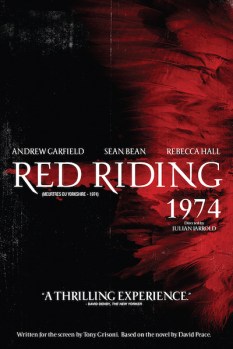
Red Riding: 1974The Red Riding Trilogy covers nine years of police corruption and child kidnap/murder in Yorkshire, amongst one or two other things, and begins here with a very film noir tale, courtesy of author David Peace and screenwriter Tony Grisoni, slathered in neo-noir stylings, courtesy of director Julian Jarrold.

Jarrold is most recently responsible for Kinky Boots, Becoming Jane and Brideshead Revisited, all of which stand in a sharp juxtaposition to the style and content of Red Riding. But turning from his lovely English-as-they-come costume dramas to something altogether nastier should come as no great surprise, for Jarrold is merely returning to his TV roots: in the mid ’90s he directed episodes of Cracker, Silent Witness and Touching Evil.

He certainly seems to know his territory, but perhaps he knows it too well — though this is also the fault of Grisoni and, perhaps, Peace — as the plot that he unfolds is not only familiar but told as if he’s all too aware we know what’s coming. The feeling one gets is of a British James Ellroy, albeit a low-rent, less complex version. (The same is true of 1980, though for me 1983 manages to escape such comparisons.) The story idles along, not exactly slow so much as in no hurry, full of near-clichéd plot points and an unrelentingly standard structure. These things aren’t necessarily a problem, but when you’ve got as big and bold a reality claim as the Red Riding Trilogy they feel out of place.

Another recent point of comparison would be David Fincher’s Zodiac — young newspaperman on the hunt for a serial killer in an inspired-by-fact ’70s setting — though this does 1974 no favours. It may be grittier than Fincher’s film, but it lacks the polish, the originality, and manages to feel slower, despite being a whole 50 minutes shorter. However much arty photography, disjointed storytelling, relatively dense accents and ‘gritty reality’ is plastered over the barebones of the tale, the familiarity of it — to both viewers and the makers, who don’t even seem to be trying — means there’s not an ounce of suspense or surprise to be had.

The cast is made up of established names, familiar faces and rising stars, many of them unfortunately stuck in familiar roles or otherwise left stranded by the unrewarding material. If they’re not quite stereotypes it’s because they’re too bland, lacking enough discernible character traits to reach such lofty heights. Occasionally this is because, with two films to come, some minor parts here have a major role later, but this can’t be said of them all. As the lead, Andrew Garfield’s journalist is as much of a stock character as the plot he finds himself in: a young reporter type, idealistic among journalists who no longer care (if they ever did), hunting to expose The Truth. Again, it could work, but is belied by the insistence — in both promotion and filmmaking style — that Red Riding is something more than Another Murder Mystery. Only Rebecca Hall, as a mother whose young daughter went missing years earlier, is granted the material to give an outstanding performance — which she does, easily justifying her recent BAFTA Rising Star nomination.

Besides Hall, the best thing about 1974 is its dull, desaturated photographing of grimy, desolate locations, where any colour that isn’t beige desperately wants to be. It suits the story and era perfectly, and the choice of 16mm seems to add a level of haziness that is equally appropriate. It’s perhaps indicative of everything this is aiming for that the most beautiful imagery is of an incinerated gypsy camp. Rendered almost black and white by the soot and desaturisation, ash floats through the air like snowflakes as Garfield stumbles through it, the whole picture a vision of Hell. It’s a kind of perverse beauty, true, but that’s also entirely in keeping with Red Riding.

1974 is a stock noir tale, dressed up with fancy filmmaking techniques and claims of realism to look like something more truthful, more real, more Important. And it makes me a little bit angry because of it. Maybe the violence is more realistically depicted than your average genre entry, maybe the police corruption is a little more plausible — then again, maybe it isn’t — but the real story here is so familiar they haven’t even bothered to hide the plot beats and twists properly, no doubt assuming a “gritty” veneer plastered over the top would do the job for them. It doesn’t. Maybe 1974’s grimy setting, brutal violence and unbeatable police corruption are all true to life, but the familiar and predictable plot leaves the realism feeling like no more than a pretence.

I was enjoying 1974 a lot more by the time the unexpectedly satisfying conclusion came around, but the sense that it had tried to pull the wool over my eyes throughout — and not in the good way a thriller should — just leaves a bitter taste.

3 out of 5

* Though I watched Red Riding: 1974 on 4HD, it’s my understanding that it was upscaled. ^

The Red Riding Trilogy

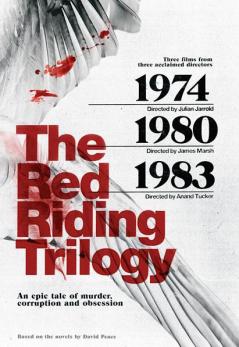
Red Riding Trilogy UKYou’d think Red Riding was a TV miniseries, wouldn’t you? After all, it was on Channel 4 on the same day for three consecutive weeks (recently repeated over three consecutive nights).
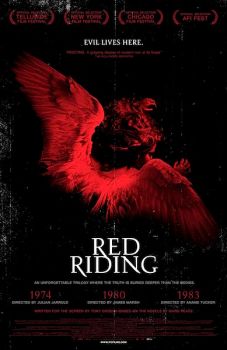
But the promotion — on iTunes, for example, or of Silva Screen’s soundtrack releases — is very keen to make reference not to “Red Riding” — as in, the title of a TV series — but “The Red Riding Trilogy” — as in, a series of films. Indeed, they are frequently referred to as “the films” (and similar variations thereof) in promotion and press, have received screenings at various film festivals and cinema releases in much of the rest of the world, including the US, and several other production and style points could also be rallied to confirm them as a film trilogy rather than miniseries.

As that’s how the makers would most like them to be regarded, then, it seems only fair to treat them as such. And so:


“The feeling one gets is of a British James Ellroy, albeit a low-rent, less complex version. The story idles along, not exactly slow so much as in no hurry, full of near-clichéd plot points and an unrelentingly standard structure. These things aren’t necessarily a problem, but when you’ve got as big and bold a reality claim as the Red Riding Trilogy they feel out of place.” More…

3 out of 5


“Where the first idled this meanders, flitting between the Yorkshire Ripper, the investigation into the Karachi Club shooting, and the private life of lead character Peter Hunter. Most time is spent on Hunter’s investigation into the investigation of the Ripper case, though by the end it becomes apparent this exists to cover the ‘real’ story — which is, of course, the Karachi Club cover up. Consequently neither are covered with the appropriate depth.” More…

3 out of 5


“Tucker’s film bests its predecessors in almost every assessable value. The story and characters have more genuine surprises and suspense than ever, while the performances are at the very least the equal of what’s gone before. Unlike the other two films, where the corrupt cops were little more than cartoon villains despite claims to the contrary, 1983 makes their brutality really felt.” More…

4 out of 5


Red Riding Trilogy USMy final thoughts about Red Riding — other than “that was disappointing” — are stuck on the reality (or not) of the police corruption it portrays. It’s difficult to know whether anyone who believes our police were never so nasty as this is naive, or whether anyone who believes they were quite this bad is paranoid. The truth no doubt lies somewhere in between.

Despite my disappointment with the majority of the Red Riding Trilogy, I intend to return to it some day: considering my enjoyment of the third instalment and the adjusted expectations that come from being disappointed first time round, the potential inherent in the trilogy means it certainly merits revisiting.