Fantastic Four (2015)

2016 #110
Josh Trank | 96 mins | streaming (HD) | 2.35:1 | USA / English | 12 / PG-13
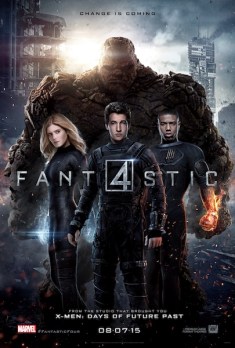
Fantastic FourSometimes you just have to see what all the fuss is about, even if that fuss is overwhelmingly negative. Obviously that’s the case with the most recent attempt to bring Marvel’s popular “first family” to the big screen. The behind-the-scenes stories are already the stuff of movieland legend, so I won’t repeat them here, but what of the film itself? Or the version that ended up available for public consumption, anyway.

Reimagining the group’s origins, the film sees young genius scientist Reed Richards (Miles Teller) recruited to a research institute where he works with Sue Storm (Kate Mara), her adoptive brother Johnny (Michael B. Jordan), and the precocious and rebellious Victor Von Doom (Toby Kebbell) to develop a teleport to another world, Planet Zero. When the device is proven to work, the institute’s supervisor rules astronauts will get to take the maiden voyage. Annoyed, the scientists rope in Reed’s childhood friend Ben (Jamie Bell) to help them use it first. But things go horrendously awry, leaving the gang with new abilities…

That chunk of the story takes most of the first hour. Other than being a little slow getting to the point, considering most viewers know where it’s all going, and perhaps not building the characters’ relationships as thoroughly as it could have, I thought it was shaping up as a pretty decent film. It’s not a mind-blowing masterpiece, and it’s certainly not faithful to the original comic, but as a sci-fi movie? It’s good. Not incredible, but good. Well, aside from one truly terrible reshoot wig.

Then the story suddenly jumps forward a whole year, and things go to pot. From that point the film’s ideas aren’t bad, but it feels like the movie was ripped apart and put back together awkwardly, with parts missing, some out of order, and other bits added to cover gaps Awkwardly assembledand serve as new pieces — like a shattered mug that’s been reassembled with lashings of superglue and using a handle from another vessel, which has inexplicably wound up a slightly different size and shape to how it used to be. Considering the studio got cold feet and insisted on massive reshoots, this is quite possibly exactly what happened.

It climaxes with a rushed action sequence on Planet Zero, which was clearly constructed entirely during reshoots (the constant presence of Reshoot Wig gives that away, if nothing else). The speed with which it’s dispatched makes it feel anticlimactic, despite the alleged world-destroying scale, and mainly leaves you wondering how the film originally ended. When it’s done, the heroes return to Earth and triumphant music swells… as they survey a scene of total devastation. It’s clear this hasn’t been thought through. There are still more signs of a rushed production: the CGI used to realise the Thing is pretty good for most of the film, but an unbearably cheesy final scene looks like a poorly-composited unfinished draft. Allowing such a rushed, underfunded, and heavily reshot final act to be released feels amateurish on Fox’s part.

While the studio are obviously keen to blame director Josh Trank for all the film’s problems, and possibly sink his career in the process, I can’t help but think it’s their own fault. It was they who chose to commission a “dark and serious” take on the Four, at odds with their usual depiction, but then wimp out and not follow through on the directorial vision they’d chosen. Despite what some fans would say, it’s this lack of commitment that’s the actual problem. Even in the face of the success of the lighter-toned Marvel Studios movie universe, Too cool for superhero schoolFox like to keep their superhero movies Serious and Dark — and why not? Before this, it had worked pretty well for them across seven X-Men movies, while their colourful-and-cheery earlier attempts at bringing Marvel’s first family to the big screen met with unwavering derision and diminishing box office. It was not an illogical choice to try something different tonally.

In the end, however, this version crashed and burned even harder than those earlier films, both with fans and at the box office. Meanwhile, the latest X-Men movie was similarly ripped asunder by critics and has only performed acceptably; and concurrently, superhero comedy Deadpool took the world by storm. Perhaps this will create a sea-change in the way Fox approach their superhero properties? Only time will tell — though with Deadpool 2 set to offer more of the same and a Wolverine threequel following in its R-rated footsteps, while another X-Men movie is surely in development but not officially announced and the planned Fantastic Four sequels have been quietly cancelled, perhaps it already is.

Fantastic Four’s real problems are twofold: deviating so heavily from the original comic book, which meant from the outset that an awful lot of fanboys were always going to hate it; and then not having the confidence to see that vision through, titting about with things in post. The latter results in a mess of a second half where the whole thing unravels. It’s not perfect before that, but it’s a decent sci-fi movie. I’d love to see Trank’s original cut — I’m not sure it would be a great film, and I’m damn sure it still wouldn’t properly resemble the Fantastic Four of Marvel’s comics, but I bet it would be a lot more consistent than this, and consequently better.
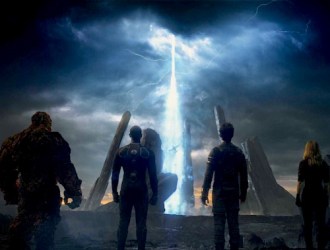
Beam of blue light shooting into the sky? Never seen that before...What could have been a comfortable 3-star movie, maybe even 4 if it followed through well enough, is dragged down to 2 by studio meddling. Will they never learn? Nonetheless, I actually enjoyed enough of Fantastic Four that, while it won’t be going on the long-list of contenders for the best movies I’ve seen this year, I won’t be putting it on the list for the worst either.

2 out of 5

Spy Game (2001)

100 Films’ 100 Favourites #87

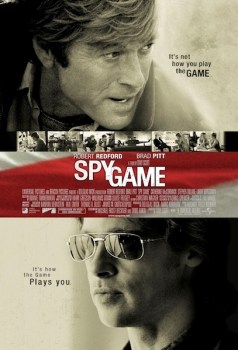
It’s not how you play the game.
It’s how the game plays you.

Country: USA, Germany, Japan & France
Language: English, German, Arabic, French & Cantonese
Runtime: 126 minutes
BBFC: 15
MPAA: R

Original Release: 21st November 2001 (USA)
UK Release: 23rd November 2001
First Seen: DVD, c.2002

Stars
Robert Redford (The Sting, All is Lost)
Brad Pitt (Twelve Monkeys, Ocean’s Eleven)
Catherine McCormack (Braveheart, 28 Weeks Later)
Stephen Dillane (Welcome to Sarajevo, The Hours)

Director
Tony Scott (Crimson Tide, Man on Fire)

Screenwriters
Michael Frost Beckner (Sniper, To Appomattox)
David Arata (Brokedown Palace, Children of Men)

Story by
Michael Frost Beckner (Cutthroat Island, Prince Valiant)

The Story
When a retiring CIA agent’s one-time protégé is captured by the Chinese, he recalls their years training and working together, while battling internal agency politics to free his former friend.

Our Heroes
Nathan Muir is on the cusp of retirement, a former CIA field agent who’s now desk-bound and disregarded by his superiors. Previously, he recruited sniper Tom Bishop into the agency, training him to be a spy with Muir’s own values — which Bishop didn’t necessarily share, and his reaction against has ultimately led him into the hands of the Chinese. But how? Well, that’s what flashbacks are for.

Our Villains
Lots of Johnny Foreigners — but also some factions within the CIA itself…

Best Supporting Character
One of the CIA agents handling Bishop’s capture, and so attempting to handle Muir, is his oleaginous colleague Charles Harker. He’s played by the always-excellent Stephen “Stannis Baratheon” Dillane, who is perfectly snide in the role.

Memorable Quote
Bishop: “You don’t just trade these people like they’re baseball cards! It’s not a fucking game!”
Muir: “Oh, yes it is. It’s exactly what it is. And it’s no kid’s game either. This is a whole other game. And it’s serious and it’s dangerous. And it’s not one you want to lose.”

Memorable Scene
After an asset is killed, Bishop confronts Muir on a rooftop about the morals of what they do and why they do it. See also: Memorable Quote; Making of.

Technical Wizardry
The cinematography and editing haven’t yet reached the crazed heights Tony Scott would later display in Man on Fire and Domino, but it’s not without its affects. The flashbacks occur in a few different eras, so Scott decided to give each period a distinct look to remind the viewer of that time. For example, Vietnam is desaturated to a “strange sepia green”, while the colours in Beirut are heightened to mimic news clips from 1985. Conversely, Scott found the talky scenes within the CIA to be the “most challenging part of the movie” — without all his usual tricks, he had to rely on the quality of his actors to bring the scenes to life.

Making of
For the Berlin rooftop confrontation between Muir and Bishop, Tony Scott asked for more money to rent a helicopter. The producers refused — not unreasonably, when you consider it’s a dialogue scene. But Scott believed it was important and so rented the helicopter with his own money. Robert Redford was reportedly baffled by Scott’s use of a helicopter to film such an intimate conversation, but when he saw the final result he was impressed by how dynamic it made the scene.

What the Critics Said
“beneath the film’s nostalgic veneer and tooth-rattling visual and aural effects lies a mature ambiguity that’s unusual for a holiday blockbuster — and all but unheard of in a Tony Scott movie. […] the portrayal of Muir, Bishop, and their employers as significantly less than moral beacons makes the film surprisingly demanding as a whole. Rather than requiring us to take its desperate heroes and their dubious redemption entirely at face value, Spy Game slips in a refreshing dose of uncertainty with its cinematic jolts.” — Mark Holcomb, The Village Voice

Score: 66%

What the Public Say
“I have seen it three times now, and I still don’t have a full grasp of all the phone calls and cutaways and violent edits. This aspect, rather than being a distraction, is one of the film’s virtues. The idea is that Redford’s Nathan Muir is so smart that he is hoodwinking the CIA. Part of the game that the movie plays is that we the viewers are given just enough of a hint that we can appreciate his cleverness, but even we aren’t intended to fully ‘get it’. Tony Scott’s hectic, pulse-pounding visual style is largely responsible for this mesmerizing and confusing effect. Similar to (but far superior to) Guy Ritchie’s penchant for seemingly random visual tampering, Scott hits more often than he misses in Spy Game” — Ian Kay, Taking a Look

Verdict

Spy Game is not normally considered the pinnacle in the careers of anyone involved, but there’s something about it that really works for me. In part it’s the chemistry between Redford and Pitt, a pair of actors who look like they could be father and son and exude a similar level of connection. The dual timeline structure keeps things rattling along, with Redford entertainingly running rings round the CIA in the present, while the flashbacks consider “the greater good” — how far should they go, and is it ever worth it? Possibly such questions weren’t appreciated on the film’s immediately-after-9/11 initial release, but they’ve since become more relevant than ever.

That’s no moon… it’s #88.

Cool World (1992)

2016 #70
Ralph Bakshi | 102 mins | streaming (HD) | 16:9 | USA / English | 15 / PG-13

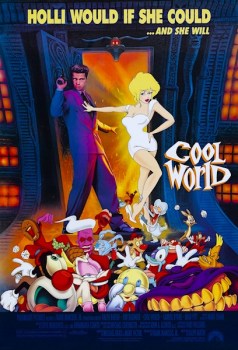
Cool WorldSometime recently, I said I was making more of an effort to avoid watching movies I know are going to be bad — when there’s so much good stuff to see, why knowingly waste time on bad stuff? But then sometimes something just catches your attention and you have to see for yourself. It sounds as if no one had anything good to say about Cool World when it came out back in 1992, and no one’s had anything good to say about it since either, but after spotting it on Netflix (I’m not sure I’d even heard of it before that) my curiosity was piqued.
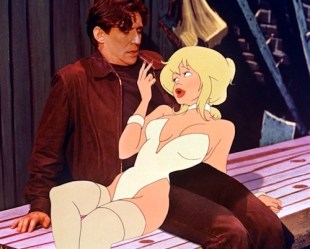
Directed by Ralph Bakshi, who’s probably best known for the animated Lord of the Rings, it’s the story of cartoonist Jack Deebs (Gabriel Byrne) who’s created the zany, surreal ‘Cool World’. But Cool World is actually a real place (a real cartoon place, as it were), which Jack ends up getting transported to. He meets femme fatale Holli Would (voiced by Kim Basinger) who wants to escape to the real world, but is being prevented from doing so by Frank (Brad Pitt), another real human who was transported to Cool World decades earlier.

If this all sounds a bit of a mess, it is. It’s not a fundamentally bad story at a conceptual level, but its execution is a jumble, and the twisted Cool World is an unpleasant place to have to spend time. The darkness of the story is actually toned down from Bakshi’s original concept (which had an underground cartoonist fathering a half-real / half-cartoon daughter who tries to kill him), but only so much: it’s still full of sex, references to sex, Holli Would, and she willand general depraved behaviour. It’s clear it got caught in the crossfire between a creator/director who wanted to make a hard-R adults-only animated/live-action movie, and a star and producer who wanted to make something they could show to sick kiddies in hospital. The end result surely satisfies neither, because it pulls some punches to not get that R, but there’s no way this is kid-friendly.

It came out a few years after Who Framed Roger Rabbit, and suffers from the comparison. It’s not just that Cool World is a less successful riff on the same concept, or that its storytelling is more muddled, but it’s less technically proficient too. The animation and live-action elements never gel as well as in Roger Rabbit, with plenty of lazy eye-lines and actions not quite lining up. This probably explains why Byrne and Pitt both give lacklustre performances, not that Basinger fares any better.

There’s some interesting stuff in Cool World, which is why I haven’t sunk it to the irredeemable depths of a single star, but the merits are slight and not worth the effort. Apparently it does have something of a cult following, though, so the adventurous may still feel it’s worth a visit.

2 out of 5

Cool World featured on my list of The Five Worst Films I Saw in 2016, which can be read in full here.

Spider-Man 2 (2004)

100 Films’ 100 Favourites #86

A man will face his destiny.
A hero will be revealed.

Country: USA
Language: English
Runtime: 127 minutes | 135 minutes (2.1 extended cut)
BBFC: PG (cut, 2004) | 12A (2004) | PG (uncut, 2009)
MPAA: PG-13

Original Release: 25th June 2004 (Lithuania)
US Release: 30th June 2004
UK Release: 16th July 2004
First Seen: cinema, July 2004

Stars
Tobey Maguire (Pleasantville, The Great Gatsby)
Kirsten Dunst (Interview with the Vampire, Melancholia)
James Franco (City by the Sea, 127 Hours)
Alfred Molina (Frida, An Education)

Director
Sam Raimi (The Evil Dead, Drag Me to Hell)

Screenwriter
Alvin Sargent (Gambit, Ordinary People)

Story by
Alfred Gough (Lethal Weapon 4, The Mummy: Tomb of the Dragon Emperor)
Miles Millar (Shanghai Noon, Herbie Fully Loaded)
Michael Chabon (John Carter)

Based on
Spider-Man, a comic book superhero created by Stan Lee and Steve Ditko; in particular the story Spider-Man No More! by Stan Lee and John Romita, Sr.

The Story
Peter Parker battles problems in his personal life while his superhero alter ego Spider-Man battles the machinations of evil scientist Dr Otto Octavius.

Our Hero
Spider-Man! Spider-Man does whatever a spider can — spins a web any size, catches thieves just like flies. Is he strong? Listen bud, he’s got genetically-modified blood. Wealth and fame he’s ignored, action is his reward… though he’s having doubts about if it’s worth it. With great power comes great responsibility, and neither sit well with a kid who wants a normal life.

Our Villain
Doc Ock! Guy named Otto Octavius winds up with eight limbs, four mechanical arms welded right onto his body — what are the odds?

Best Supporting Character
Before he won an Oscar for Whiplash, or posted photos of his insanely ripped body on social media, J.K. Simmons brought himself to everyone’s attention as the hilariously irascible editor of The Daily Bugle newspaper, J. Jonah Jameson. He was so good, they haven’t even bothered to recast the character for any of the three live-action Spidey films that have come since the first reboot.

Memorable Quote
“So here I am, standing in your doorway. I have always been standing in your doorway.” — Mary Jane

Quote Most Likely To Be Used in Everyday Conversation
“With great power comes great responsibility.” — Uncle Ben may be dead, but they manage to have him say it in this one too.

Memorable Scene
The elevated train fight between Spidey and Doc Ock. It was the first major sequence filmed, before the screenplay was completed, but Raimi had dreamt it up personally. It was shot in Chicago because New York no longer has an elevated railway, but Raimi was seeking to create an idealised version of the city.

Technical Wizardry
The sound effects for Doc Ock’s tentacles were created using motorcycle chains and piano wires, while the sound of him ripping open the bank vault was a hubcap scraping along the floor. The designers consciously didn’t include the noise of servomotors, to enhance the idea that the tentacles have become a part of Ock’s body.

Truly Special Effect
Doc Ock’s tentacles were built practically. Each one was 13ft long, made up of 76 pieces, fully articulated, and controlled by four people. Obviously some of their appearances are CGI, especially when Ock’s using them to move around, but every scene was first filmed using the real props to see if CGI was truly necessary

Making of
Tobey Maguire injured his back before filming began, to the extent that Jake Gyllenhaal (at the time only really known for Donnie Darko) was tapped to replace him, and even began preparing for the shoot. Ultimately Maguire recovered enough to participate (obviously). A couple of years later Gyllenhaal was one of the final contenders for Batman in Batman Begins, but didn’t get to do that either. I’m sure Marvel will find a superhero for him eventually — they do for most people.

Previously on…
Ignoring the many and various animated series and failed attempts to bring Spidey to the screen, there was the first Sam Raimi-directed Spider-Man, which was the first film to gross over $100 million on its opening weekend. Also, MTV animated series Spider-Man: The New Animated Series is technically set after Spider-Man and therefore before Spider-Man 2, but I don’t think anyone remembers it…

Next time…
Spider-Man 3 concluded the trilogy with a whimper thanks to behind-the-scenes clashes, which also scuppered plans for Spider-Man 4. The series was rebooted with the unpopular The Amazing Spider-Man, which was followed by the even-more-unpopular The Amazing Spider-Man 2, leading to the character being rebooted again and integrated into the Marvel Cinematic Universe. The latest version debuted in Captain America: Civil War before starring in a solo movie, Spider-Man: Homecoming, next summer.

Awards
1 Oscar (Visual Effects)
2 Oscar nominations (Sound Mixing, Sound Editing)
2 BAFTA nominations (Sound, Visual Effects)
5 Saturn Awards (Fantasy Film, Actor (Tobey Maguire), Director, Writer, Special Effects)
3 Saturn nominations (Supporting Actor (Alfred Molina), Music, DVD Special Edition Release)
Nominated for the Hugo for Best Dramatic Presentation Long Form
1 World Stunt Award (Best Overall Stunt by a Stunt Man (Peter Parker falling into clothes lines))
2 World Stunt Awards nominations (Best Work with a Vehicle, Best Speciality Stunt (Doc Ock waking up))

What the Critics Said Then
“a sequel that not only outstrips its predecessor but has a perversity and quick-wittedness that hardly seem to belong in a comic-book movie. […] It’s unusual and gratifying to find a multimillion dollar movie that’s been put together with some thoughtfulness, that doesn’t neglect subtlety in between delivering the smash-bang-wallop. […] It’s the interest in human fallibility that sets this movie apart. The superhero who bridles at his own responsibility may not sound an especially gripping prospect, but his dilemma is explored with a conviction that, within the fantasy genre, feels almost groundbreaking.” — Anthony Quinn, The Independent

Score: 93%

What the Critics Say Now
On placing the film in his top ten for BBC Culture’s 100 Greatest Films of the 21st Century: “First of all, the 21st century is the century of superheroes. To approach the history of this era without acknowledging that is to miss the story. Many of my peers opted to make The Dark Knight the film that represented superheroes for them, but while I like that movie it’s a crime film in superhero drag. Spider-Man 2 is an unabashedly comic book superhero movie, a film that is pulsing with the vibrant four color life of the best comic book panels and that is soaked in the sudsy soap opera of the best comic book word balloons. It’s a movie that is a perfect fusion between filmmaker and material, and it is, without a doubt, the best example of superhero filmmaking ever attempted.” — Devin Faraci, Birth. Movies. Death.

What the Public Say
“The most interesting relationship that gets explored in Spider-Man 2, however, is with Spider-Man himself. In the first Spider-Man, Peter basically became Spider-Man the instant he decided to live his life by Uncle Ben’s last few words and donned on the Spidey suit, and that was that. Here, Peter Parker basically breaks up with Spider-Man and with Uncle Ben, as he says he is “Spider-Man, no more,” and has to start over and re-bond with the hero inside of him. [The] movie makes use of this psychological relationship to refine its definition of a hero as established in the first film. It isn’t just about responsibility. It argues that the hero is inherently sacrificial. They give up even their dreams to salvage yours. This definition is much more mature and sophisticated […] It goes to show that a big budget doesn’t have to translate into senselessness. Spider-Man 2 is the intellectual experience I was looking for in a Spider-Man film with all the action that I always imagined was possible.” — Kevin Tae, Taestful Reviews

Elsewhere on 100 Films
Just before Spider-Man 3 came out they released an extended cut of the first sequel on DVD, dubbed Spider-Man 2.1 (remember when they briefly called extended cuts things like that?) At the time I concluded “it’s still a 5-star film because it doesn’t ruin the original — but it’s not at all essential”, though I later added a postscript to note that “I probably should have rated this lower. It may still be a good film, but the fact is the original cut’s better — even if just for the superior version of The Lift Scene. I rather doubt I’ll ever watch it again.”

Verdict

In a simpler time before every superhero movie was connected to every other superhero movie, filmmakers were free to only have to tell one story and develop the ongoing life of their lead characters (rather than juggle everyone else’s lead characters for cameos, too). Spider-Man 2 is a pinnacle of this. It takes the seeds sown by the first movie and nurtures them into more interesting and complex emotional dilemmas, without losing sight of the fact it’s a movie based on a comic book about a man who swings around the city in a red-and-blue onesie fighting crime. Nonetheless, it’s as memorable for Peter and MJ’s up-and-down relationship as it is for the stunning action sequences, which become icing on the cake rather than the raison d’être.

#87 is… no kid’s game.

The Twilight Saga: New Moon (2009)

2016 #170
Chris Weitz | 131 mins | download (HD) | 2.35:1 | USA / English | 12 / PG-13

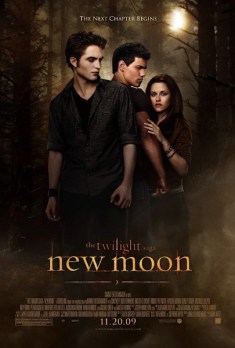
The Twilight Saga: New MoonLast Halloween, I reviewed one of the most horrifying movies of all time: Twilight. This Halloween, at the risk of establishing a terrible tradition that could potentially run for another three years, I’m turning my attention to its first sequel, New Moon.*

If you watched the first movie and thought things couldn’t get any worse… well, you clearly didn’t watch New Moon. I don’t blame you. My original plan had been to watch all five and review them over the course of a week last Halloween, like I did for George A. Romero’s zombie movies in 2013 (plug!), but after the first I couldn’t stomach any more straightaway. Or for an entire year, apparently.

Anyway, the film. New Moon picks up more or less where Twilight left off, with human teen Bella (Kristen Stewart) and 109-year-old vampire Edward (Robert Pattinson) deeply in love. Their relationship is complicated by the slightest sign of Bella’s blood making members of Edward’s vampire pseudo-family want to kill her, but he refuses to turn her. Then Edward’s family have to leave the area and he decides it would be better if she didn’t come. Bella goes into extreme mourning — OK, teens over-feel break-ups, but Bella goes fucking mental, screaming in her sleep like a junkie going cold turkey. Her father confronts her: “It’s just not normal, this behaviour.” Bang on, daddy-o!

So, Bella discovers that doing crazy adrenaline-generating things — like riding on motorbikes with strangers — gives her visions of Edward. It’s unclear if she’s imagining these or if he’s actually manifesting to her. In most movies you’d know it was the former, but this is a supernatural flick about vampires and werewolves, for crying out loud — make yourself clear, moviemakers! Anyway, to replicate this rush Bella salvages some bikes from a tip or something and gets her chum Jacob (Taylor Lautner) to rebuild them. She still can think of nothing but Edward… until Jacob takes his top off. My face is up here, BellaAnd they accuse teenage guys of being shallowly obsessed with the opposite sex’s chests. But then Jacob starts acting aggressively, and hanging out with a gang, and there are stories about beasts in the woods killing people, and his tribe leader type guy looks shifty whenever all that’s mentioned, and… wait, could there be a connection between Jacob and his friends and the wolf-like attacks in the woods?! Gasp!

New Moon is a terribly slow, terribly mopey movie, which takes forever to get to really obvious ‘reveals’ — like, yes, Jacob and co are werewolves (after a fashion). That’s when it’s not trying to build a love triangle that we all know can only end one way. I mean, Bella tells Jacob “it will always be Edward”. Not subtextually — she tells him literally, with words. Those exact words. And when it’s not doing that, it’s slowly building up some form of mythology, presumably to use properly in future instalments. Then it ends with what I think is meant to be a cliffhanger and/or surprise ending, but it’s so ridiculously unsurprising or cliffhanger-y that it’s almost insulting. Bella’s forced Edward’s hand, making him agree to turn her into a vampire because they can’t bear to be apart and want to spend forever together, so why should it be such a surprise that he wants to marry her?!

Then there’s the pathetically hand-holding direction — a shot that shows the changing seasons conveys the passage of time perfectly decently, so why superimpose the names of the months on top as if we’re all 5 year olds who can’t understand it hasn’t literally turned from late summer to autumn to winter in 90 seconds? The CGI is uniformly terrible, We feel your pain, Bellaso that even bits that aren’t bad in isolation (the wolves, for instance) are poorly integrated into the live-action. And at one point the characters go to the cinema to see an action movie… called Face Punch. At this point New Moon slips from ineptitude into genius. It’s the best worst fake action movie title ever. The scene where they discuss it is so hilarious, I actually had to pause the movie to finish laughing.

Though it may contain the funniest thing I’ve seen in any movie this year, it’s not enough to save New Moon. It’s even worse than the first one, because it’s boring. Some bits and bobs may actually be improved (some of the direction is slicker; Bella’s terrible voice over is reduced), but goddamn, it’s so dull. So little actually happens. It feels like it’s probably setting things in place for whatever’s to come next for an entire movie.

On the bright side, that might mean the series improves from here. I can but hope.

1 out of 5

New Moon featured on my list of The Five Worst Films I Saw in 2016, which can be read in full here.

* Here’s a thing: the film has two title cards: the first says New Moon, the second says Twilight Saga: New Moon — no “The”. But as all the posters and, y’know, everyone else uses the “the”, I am too. Fighting my urge to use the accurate on-screen nomenclature here, people. ^

The Sixth Sense (1999)

100 Films’ 100 Favourites #85

Not every gift is a blessing.

Country: USA
Language: English
Runtime: 107 minutes
BBFC: 15
MPAA: PG-13

Original Release: 6th August 1999 (USA)
UK Release: 5th November 1999
First Seen: DVD, c.2000

Stars
Bruce Willis (Pulp Fiction, Sin City)
Haley Joel Osment (Bogus, A.I. Artificial Intelligence)
Toni Collette (Muriel’s Wedding, Little Miss Sunshine)
Olivia Williams (Rushmore, The Ghost)

Director
M. Night Shyamalan (Unbreakable, Signs)

Screenwriter
M. Night Shyamalan (Wide Awake, The Village)

The Story
Child psychiatrist Dr Malcolm Crowe tries to help a new patient, Cole Sear, who claims he can see ghosts.

Our Heroes
Dr Malcolm Crowe doubts his abilities to help people after a former patient shot him before committing suicide, an event which has also left him distanced from his wife. But he may be the only person who’ll believe young Cole Sear, a reclusive child who’s struggling with delusions of seeing dead people… unless they’re not delusions…

Our Villains
Are the dead dangerous, or do they just need help?

Best Supporting Character
Cole’s mom, Lynn, who loves him a great deal and worries about him just as much, but has no idea what’s really wrong or how to help her son.

Memorable Quote
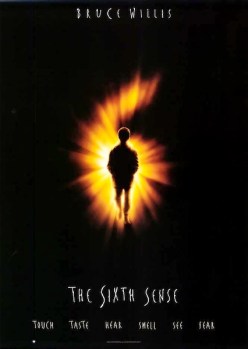
“I see dead people… Walking around like regular people. They don’t see each other. They only see what they want to see. They don’t know they’re dead.” — Cole

Memorable Scene
Stuck in traffic, Cole reveals his ability to his mother for the first time — that there’s been an accident ahead and someone died, which he knows because they’re stood at his window. Naturally Lynn doesn’t believe her son, but then he begins to talk about his grandmother…

Technical Wizardry
The twist ending is immaculately constructed. There are clues throughout the film, but, like all the best twist-ending clues, the vast majority of viewers will completely miss them first time through, even though they seem almost blatant when revisited.

Making of
The colour red is used only to indicate times and items where the worlds of the living and the dead have connected; if something red was present in a scene where this wasn’t relevant, Shyamalan had it changed. There’s a massive list of these moments here, but if you somehow haven’t seen The Sixth Sense yet, do beware of spoilers.

Next time…
There are no actual sequels to The Sixth Sense, but it kicked off M. Night Shyamalan as a kind of one-man genre, making supernatural thrillers with a twist ending — and decreasing critical acclaim with each new movie. It seemed to end with The Happening and he transitioned to be a director-for-hire, but he’s coming back somewhat with The Visit and next year’s Split.

Awards
6 Oscar nominations (Picture, Supporting Actor (Haley Joel Osment), Supporting Actress (Toni Collette), Director, Original Screenplay, Editing)
4 BAFTA nominations (Film, Director, Original Screenplay, Editing)
2 Saturn Awards (Horror Film, Performance by a Younger Actor/Actress (Haley Joel Osment))
2 Saturn nominations (Actor (Bruce Willis), Writer)
2 Teen Choice Awards (Choice Drama, Choice Breakout Performance (Haley Joel Osment))
1 Teen Choice nomination (Choice Sleazebag (Trevor Morgan))
Nominated for the Hugo for Best Dramatic Presentation

What the Critics Said
“the film eventually abandons the heroic-therapist model and ventures toward other ground, ever so gently tightening its squeeze. It seems really to achieve something that Stanley Kubrick was possibly groping after in Eyes Wide Shut, or that Nicolas Roeg achieved in Don’t Look Now, which might be called an extreme sense of the bizarre, not as invented by special-effects wizards with unlimited space on the hard drive but in the subtler ways of film craftsmanship. […] The movie is a maximum creep-out. It’s invasive. It’s like an enema to the soul as it probes the ways of death – some especially grotesque in a family setting. You leave slightly asquirm. You know it will linger. It becomes a clammy, chilly movie building toward a revelation that you cannot predict. As I say: I cannot tell you. You’d hate me if I did. I can only say, don’t look now, but look sometime.” — Stephen Hunter, Washington Post

Score: 85%

What the Public Say
“The film is rich in symbolism, and colour plays a large part in signifying spirits invading the real world. This is what makes The Sixth Sense so captivating. Watching the film for the first time, you don’t expect the ending, and so the shock of it tends to overshadow the subtlety of the beginning. It is only once you have re-watched the film, that you begin to notice little suggestions of what is to come. A success from start to end, this is at once an exercise in potent suspense, and a carefully crafted tale of child psychology.” — Cat Barnard, Screen Muse

Verdict

M. Night Shyamalan gets such a bad rep these days, it’s easy to forget how great his breakthrough movie was. It flew completely under the radar back in 1999: the guy at Disney who bought the screenplay was fired for doing so without permission; Bruce Willis starred in it because he owed Disney two films, and was paid half his normal salary; Entertainment Weekly’s extensive summer preview detailed over 140 films, but The Sixth Sense wasn’t even mentioned. By coming out of the blue, and in an era before the internet was dominant (these days there’d be plot dissections and spoiler-filled director interviews online by the Monday after release, wouldn’t there?), the film obviously had surprise on its side, which is particularly effective when it has such a memorable twist. But even before that ending, it manages to mix plausible emotional drama with scenes of chilling everyday horror, crafting something that is undoubtedly a genre movie but also not out of place in a list of Best Picture nominees.

The Sixth Sense is on Film4 tomorrow night at 1am.

#86 will do… whatever a spider can.

The Big Short (2015)

2016 #161
Adam McKay | 130 mins | streaming (HD) | 2.35:1 | USA / English | 15 / R

The Big ShortYou wouldn’t think the 2008 financial crisis would make good fodder for a comedy-drama — it’s both too complicated and too grim — but Anchorman writer-director Adam McKay clearly felt differently. With co-writer Charles Randolph, he adapted the non-fiction bestseller by Michael Lewis (the author of the books that became awards season contenders The Blind Side and Moneyball) and turned it into… well, an awards season contender — but a funny one.

Specifically, it’s the story of the handful of men who saw the financial crisis coming, and arranged their finances to bet on it, too. It’s not a completely true account but, as it’s presented here, Michael Burry (Christian Bale) is the only one who actually spots it. He takes out insurance policies or something — look, the whole film is full of really complicated financial stuff and this was right at the start, OK? Here’s the Wikipedia plot description of what he does: “his plan is to create a credit-default swap market, allowing him to bet against market-based mortgage-backed securities.” So, he does that, the investment banks gladly accept his money because they think he’s mad, but a handful of others (including Ryan Gosling, Steve Carell, and Brad Pitt) stumble across his research one way or another, believe he’s right, and begin to make similar investments.

Christian Bale tries to understand the screenplayThe narrative is laden with concepts that are so complicated even people within the industry don’t properly understand all of them (however did the market fail?!), but the movie nonetheless attempts to explain them in an accessible way. It’s half successful: you kind of understand them at the time, about enough to follow along, but the chances of remembering them later are next to naught. One of McKay’s tricks to engage us with these explanations is to wheel in random celebrities to deliver analogies. It’s a fun idea, though it’s success is debatable — I mean, I’ve just about heard of Selena Gomez, and I guess the “famous chef” that turns up must have a TV show in America, or something, maybe? Yeah, the ‘names’ he’s chosen are going to date this movie far more than its 2008 setting ever will.

Indeed, on the whole I could’ve done without McKay’s jittery directorial style, amped up through ADD editing by Hank Corwin. Both were Oscar nominated and I’ve read other reviews that praise the style, but to me it just felt needlessly hyperactive, like the film is so afraid of being dull that it has to constantly dance around in the hope you won’t notice. I did notice — not that the film was dull, just that it thought it was. I guess that’s what happens when a guy more at home making movies like Anchorman and The Other Guys instead makes one about the world of real-life high finance.

Not very impressedThough the conceptual explanations may fade almost as soon as you’ve heard them, what does stick with you is how it all ends. Essentially, the financial industry that destroyed peoples’ lives in pursuit of never-ending profit not only got away with it, but they actually started doing the same stuff all over again, just with new acronyms. What’s even more sickening is that people are clearly aware it’s going on — I mean, we’ve been told as much in an Oscar-winning movie — but they’re still doing nothing about it.

How’s that for a scary thought this Halloween weekend, eh?

4 out of 5

The Rocky Horror Picture Show: Let’s Do the Time Warp Again (2016)

2016 #165
Kenny Ortega | 88 mins | download (HD) | 16:9 | USA / English

The Rocky Horror Picture Show: Let's Do the Time Warp AgainWhen this TV movie kicks off with Ivy Levan sashaying her way around a cinema while she mimes to a pre-recorded and over-produced backing track of Science Fiction/Double Feature, full of licks and runs and finding four notes to hit where there used to be one, like a desperate X Factor wannabe who has no concept of the meaning of the lyrics she’s warbling but is ever so desperate to show she can saaang (that’s like singing but with added Cool), you get a pretty fair idea of the terrible experience about to be unleashed upon you by the not-so-catchily titled The Rocky Horror Picture Show: Let’s Do the Time Warp Again. That’s to say it’s been modernised, Americanised, and sanitised.

If you know the original then you know the plot, and if you don’t know the original then you have no business watching this so-called tribute version, which premiered on Fox in the US last week and makes its way to the UK on Sky Cinema from today. “Tribute” is the latest word someone has co-opted to avoid saying “remake”, a marketing strategy that was presumably settled upon after they realised they’d produced a witless, regressive clone of material that, though over 40 years old, is still more subversive and boundary-pushing than this plastic Disneyfied tosh.

Sweet transgender womanThe interpretation of the songs is appalling. The recordings are all overworked, full of needless warbles and added “oohs”. They’ve been modernised in such a way that, when current popular fads for over-singing things (“licks” or “runs” or whatever else they call them) have passed — as they surely will — these new versions will sound even more dated than the already-40-year-old originals, which have a certain timelessness. The lyrics are sung with the same amount of attention to what they mean as you get from a computer’s text-to-speech function, including or echoing parts of the original without understanding why they’re there or what function they perform; or if it does know the function, it doesn’t know how to replicate it.
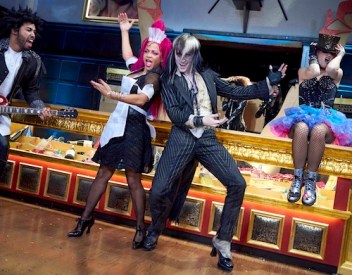
To say its performances are like a bad am-dram production would be an insult to am-drammers everywhere. Almost everyone is miscast. It was, perhaps, a nice touch to include Tim Curry, but his limited scenes are uncomfortable to watch because it’s painfully obvious that the poor man is still labouring under the aftereffects of his stroke. As Brad, Ryan McCartan overacts as if he thinks that’s the whole point. Reeve Carney makes Riff Raff a leering creep, and his needless affected British accent is awful. As Magenta, Christina Miian’s is worse. As Frank, Laverne Cox’s imitative mid-Atlantic twang is even worse again. Why did they do it?! Presumably because, as I said, it’s all a thoughtless copy of the original.

The casting of a transgender woman as a transvestite is its own kettle of worms — either she’s a woman doing radical things like fancying men and being jealous of another woman stealing her guy, or you’re saying she’s not actually a woman but still a man and… well, like I say, it’s a mess. A commenter on the A.V. Club’s review summed up the cumulative effect quite succinctly: “Fox was actually able to pull off a pretty conservative casting choice while appearing uber progressive… By casting Cox, who identifies as female, in the role of Frank-N-Furter the seduction scenes actually became far less risqué”.

Well, it's certainly been warpedEverything is blunted further by Kenny Ortega’s ineffective direction. The camerawork is flat and uninteresting, the shot choices unimaginative. Some of the choreography looks interesting — it’s certainly more elaborate than in the original film — but the camerawork seems to be actively trying to obscure it. The editor must have struggled, unable to generate any additional excitement due to a shortage of options. At times it looks as if it was filmed live, under which circumstances its weaknesses might be understandable, if not excusable… but it wasn’t.

Occasionally there are cutaways to a cinema audience — not a real one, but a gaggle of extras, sat in a theatre watching what we’re watching. These moments are pathetic and pointless. I get that it’s meant to be a nod to the interactive midnight showings that have made Rocky Horror the phenomenon it is, but they demonstrate none of the wit or verve that make those screenings so popular. Plus the original film is good entertainment even without such intrusions; this isn’t. You might think that makes the asides necessary to liven it up, but there are so few of them, and they’re so lacking in imagination, or any discernible content whatsoever, that they just feel like they’re dragging the experience out even further.

Believe it or not, it’s not all bad. There’s one new gag in the dinner scene that’s actually pretty funny. It’s delivered by Faye Marsay lookalike Annaleigh Ashford, who makes a good fist of Columbia. Rounding out the leads, Victoria Justice has all the necessary charms to make a pretty fair Janet. Victoria Justice's omnipresent cleavage. May also be omnipotent.I refer partly to her omnipresent cleavage, but also her acting. It’s not great by any means, but she’s suitably sweet and twee at the start, then manages to sell Janet’s near-instantaneous transformation from uptight goody-two-shoes to sex-mad strumpet using just a handful of expressions and line deliveries in the slight gap her character has between Over at the Frankenstein Place and Touch-a Touch-a Touch Me. The latter is one of the film’s rare highlights, for various reasons. One of those is actually Staz Nair as Rocky — undoubtedly the least challenging role in the piece, but at least he gets it right, and his musclebound chest counterbalances Justice’s for those of the other persuasion. The only downside are his tattoos: he was supposedly just grown in a tank, how does he have tattoos?!
More than the ’75 film, Let’s Do the Time Warp Again brings to mind the 2010 episode of Glee that essayed the same musical. If you suffered through The Rocky Horror Glee Show, as I did, you’ll know it was a travesty. Is this even worse? Well, that’s a bit like someone forcing you to eat a dog shit and a cat shit before asking you which tasted nicer. That’s a little unfair: the Glee version was meritless; this one has a couple of minor plus points — so maybe it’s like someone making you eat a very small shit while occasionally showing you a picture of a sexy half-naked person. But unless someone forces you to choose between only this and Glee, there’s no earthly reason to do this particular Time Warp again.

1 out of 5

The Rocky Horror Picture Show: Let’s Do the Time Warp Again is available on Sky Cinema from today, screening on Premiere at 12:25pm and 8pm.

It featured on my list of The Five Worst Films I Saw in 2016, which can be read in full here.

Doctor Strange (2016)

2016 #169
Scott Derrickson | 115 mins | cinema | 2.35:1 | USA / English | 12A / PG-13

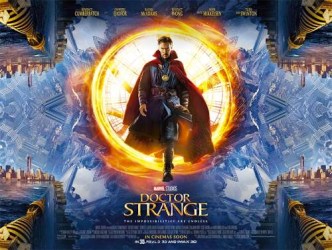
Doctor StrangeThe latest from Marvel (or Marvel Studios, as they’re now branded, presumably in a bid to differentiate themselves from the properties owned by other studios that have been only too keen to use the Marvel logo and blur the line for the casual moviegoer) opens the door on a new facet of their shared cinematic universe, though does so in a movie whose plot follows the familiar “superhero origin story” rulebook. On the bright side, Doctor Strange has several other qualities to recommend it.
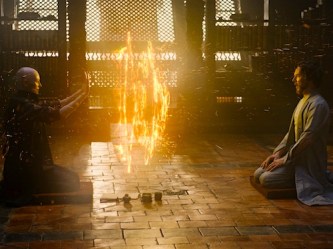
It’s the story of Dr Stephen Strange (Benedict Cumberbatch), a brilliant but cocky New York neurosurgeon, whose hands are ruined in an accident, taking his career — the sole focus of his life — with them. In search of groundbreaking healing, he travels to Nepal, where he meets the Ancient One (Tilda Swinton) — not a doctor, but a mystic, who introduces him to the world of magic. Which in this case is real and not just, like, some Derren Brown stuff, because that wouldn’t make a very good superhero movie. Then there’s some stuff about evil sorcerer Kaecilius (Mads Mikkelsen), who wants to destroy the world, blah blah blah.

So yes, the story is familiar — but you can say that about most superhero movies, especially origin films. It’s only a problem if you think movies are entirely about their plot. What Strange offers to accompany this through-the-motions narrative is its visuals, and oh, what visuals they are. You’ve likely seen some of it in the trailers — the folding cities, which look like Inception run through a kaleidoscope. Certainly, their complicated detail and intricacy leaves Nolan’s movie in the shade. The old idea of “an effects movie” — Wowzerswhere the incredible effects are half the point — seemed dead in an era where every movie has CGI and every blockbuster has its share of once-impossible visuals. Strange demonstrates the form can be alive and well. The way the effects are created — with green screen and pixels — is the same as any other movie, but the designs and the visual imagination are exciting.

The action scenes that are choreographed around and through these effects are suitably imaginative also, making use of the concepts and ideas of the magic, rather than just having people punch each other in front of swirly backgrounds. To say too much would be to spoil the movie, but the Inception-y stuff is not the film’s climax — it has several other tricks up its sleeve. There’s one bit where time flows backwards, which I specifically mention because at that point the music does a bit too, which is primarily notable because the rest of the score is your typical bland, generic, forgettable Marvel music. On the other hand, I’ve read others praise the music for being more memorable than Marvel’s usual temp-tracked output, so maybe I’m wrong.

When the film isn’t tickling your adrenal glands, it at least has the courtesy to sweeten the pill of its Superhero 101 storyline. For one thing it’s very funny, though in a way that doesn’t steal from the drama. This lightness of touch has become Marvel’s forte, and Strange handles it as well as any, without going all-out like Guardians of the Galaxy or half of anything starring Tony Stark.

Practical magicThen there’s the cast. Obviously keen to avoid being typecast after playing an arrogant British genius in both Sherlock and The Imitation Game, Benedict Cumberbatch here plays an arrogant American genius. Strange doesn’t have the charm of Cumberbatch’s Sherlock, nor of some of his Marvel stablemates, like Tony Stark or Peter Quill, but his character arc takes that arrogance and transforms it into a kind of caring aloofness that, with flashes of dry wit, makes him an appealing character — even if it may take further films for that appeal to be fully realised.
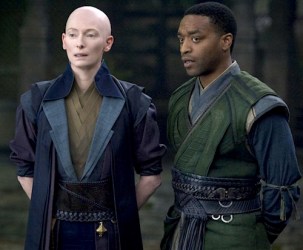
Mads Mikkelsen is somewhat wasted as Marvel’s typically lightweight villain, though his inherent skill as an actor allows him to flesh out the few speeches he is given. You could expand that assessment out to most of the cast: they’re all above this — four of them are Oscar nominees or winners (clearly Mikkelsen has been overlooked by the Academy) — but the fact that quality flows through their veins helps elevate some of the material. You could argue their talent is wasted with this stuff, but what do you expect? It’s an action-adventure blockbuster from a company known for their consistently light tone — that’s never going to dig into proper emotive character drama. Suffice to say that such top-tier actors effortlessly add resonance to their roles, however little they had to work with on the page.

More controversial was Tilda Swinton’s casting. You could see it as whitewashing, or you could see it as dodging a racial stereotype — there’s a visual gag to that effect, in fact. “Oscar winners get bigger parts than Oscar nominees, okay?”Besides, one of the film’s best characters is of Asian ethnicity, so it kinda balances out. That’s Benedict Wong as the sorcerers’ librarian, who’s likely to emerge as the film’s most popular character. It helps that viewers aren’t likely to expect much of him. Conversely, Chiwetel Ejiofor and Rachel McAdams are seriously underserved, perhaps hoping for more meat in the no-doubt-intended sequel(s).
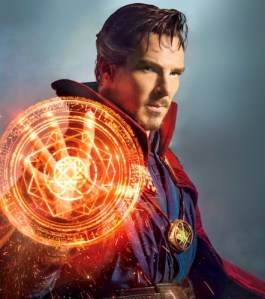
Actually, that’s an understatement, isn’t it? This is a Marvel movie, and one that’s garnered positive reviews thus far to boot — it’s going to be a box office success, and sequels will inevitably follow. Nonetheless, some reviews have been bizarrely keen to frame Strange as “Marvel’s greatest risk yet” and “a radical departure for the studio”. That’s all empty hyperbole at this point and I don’t know why they do it. Guardians of the Galaxy already proved that no change of genre is a risk for the studio — and Guardians was a much bigger change of form for Marvel than Strange is. Plus, the way Strange handles magic is no more out-there than the way it handled gods ‘n’ that in two Thor films. Indeed, if anything Strange should look like a moderately safe bet: it’s following in Thor’s footsteps with the whole magic/other worlds/dimensions thing, but married to a fairly standard superhero origin arc. It’s no riskier a proposition for Marvel than any other new property. Nonetheless, it does open up some tantalising possibilities, especially when it comes to teaming Strange with the Avengers… though they’ll have to find a way to remove some of his abilities, otherwise he’ll be far too powerful.

To further those connections, there are two end credits scenes. I shan’t spoil their contents, of course, but in my opinion they’re the wrong way round. One is basically Magic toucha teaser for another Marvel film, the other relates to the plot of the movie we’ve just seen. The former is first (and about 10% of my screening walked out before it came on) and the latter is, obviously, second (by which time about 90% had left). Those percentages ‘matter’ because, a) how do people not know Marvel’s rep for these scenes by this point?, and b) I think the scene related to the film you’ve just watched is the one that should be more attached to it, with the ‘teaser trailer’ being a fun bonus for those dedicated to stick around to the bitter end. But maybe that’s just me.

Much earlier in the movie, shortly after encountering the Ancient One, Strange is offered tea. He drinks it, then something amazing happens, and he asks what was in the tea. The Ancient One answers, “Just tea. With honey.” That line struck me because it rather sums up Doctor Strange as a movie. In its well-rehearsed superhero-origin-story-ness, it’s just tea; but the quality cast, the genuine laughs, the imaginatively choreographed action, and, most of all, the mind-bending visuals add a very pleasurable sweetness.

4 out of 5

Doctor Strange is in UK cinemas now, and is released in the US next month.

Sideways (2004)

100 Films’ 100 Favourites #84

In search of wine.
In search of women.
In search of themselves.

Country: USA & Hungary
Language: English
Runtime: 127 minutes
BBFC: 15
MPAA: R

Original Release: 22nd October 2004 (USA)
UK Release: 28th January 2005
First Seen: cinema, 2005

Stars
Paul Giamatti (Big Fat Liar, Shoot ‘Em Up)
Thomas Haden Church (George of the Jungle, Spider-Man 3)
Virginia Madsen (Candyman, The Number 23)
Sandra Oh (Under the Tuscan Sun, Hard Candy)

Director
Alexander Payne (About Schmidt, Nebraska)

Screenwriters
Alexander Payne (Jurassic Park III, The Descendants)
Jim Taylor (Election, I Now Pronounce You Chuck & Larry)

Based on
Sideways, a novel by Rex Pickett.

The Story
Middle-aged wine lover Miles takes his friend, groom-to-be Jack, up to California wine country for a more mature kind of bachelor trip, but Jack’s lascivious ways lead them to become involved with a pair of women — while keeping Jack’s impending nuptials a secret…

Our Hero
Miles Raymond is a divorcee, a teacher, and an unpublished novelist, depressed at the state of his life. His one love is wine appreciation, though when Jack goads him into getting closer to a waitress he casually knows, Maya, things begin to look up.

Our Villain
Jack, a has-been actor and Miles’ college roommate. Not really interested in wine; very interested in women — even though he’s engaged, he hooks up with Maya’s friend Stephanie, not telling her about his imminent marriage. Not strictly a villain, but his antics bring Miles little but misery.

Best Supporting Character
Maya is a waitress at Miles’ favourite restaurant, and they bond over a shared appreciation of wine. Unfortunately, her friendship with Stephanie and the secret of Jack’s engagement poses a threat to her burgeoning relationship with Miles…

Memorable Quote
“If anyone orders Merlot, I’m leaving. I am not drinking any fucking Merlot!” — Miles

Quote Most Likely To Be Used in Everyday Conversation
See above.

Memorable Scene
Jack hooks up with a random waitress but has to flee when her husband comes home, leaving his wallet behind with the wedding rings inside. He gets Miles to take him back to her house, where Jack convinces his friend to sneak in to find the wallet. Inside, the waitress and her hubby are having sex, but they spot Miles grabbing the wallet — so he’s chased back to the car by a very angry naked man. (It’s not exactly the film’s cleverest bit, but it is memorable.)

Making of
Sideways was so popular, it actually had an effect on the wine market. Miles is famously critical of Merlot (see above), which actually caused its sales to drop in the US and UK. However, there was a bigger impact on Pinot Noir, which he expresses a love for. After the film’s release, sales of Pinot Noir wines increased by over 20% compared to the year before. The effect lasted, too: a 2009 study found that sales volume of Merlot had slowed and its price had dropped, while sales and prices of Pinot Noir were still up.

Next time…
Author Rex Pickett has penned two sequel novels, Vertical and Sideways 3 Chile, but Alexander Payne has said he has no interest in adapting them and, though Fox owns the rights to the characters, they have no interest in making sequels without Payne. Of gossipy interest, however, is that Pickett deliberately wrote Sandra Oh’s character out of the sequels, because the actress made script changes he disliked and he didn’t want to work with her if they did make a sequel.

Awards
1 Oscar (Adapted Screenplay)
4 Oscar nominations (Picture, Supporting Actor (Thomas Haden Church), Supporting Actress (Virginia Madsen), Director)
1 BAFTA (Adapted Screenplay)

What the Critics Said
“how different these two characters are: the crass actor and the sensitive writer, linked by being roommates at college, but by little else these days. Viewers will probably identify with one or the other, but the beauty of the script is that these are rounded, believable people with recognisable failings and strengths — one is not superior than the other. So, while Jack is a bit dim, crude, and thinks largely with his crotch, he’s also enthusiastic, loyal and embraces life. And while Miles is funny, clever, and knowledgeable, he is also timid, drink-dependent, and crippled by insecurity” — Nev Pierce, BBC Movies

Score: 96%

What the Public Say
“This performance made [Thomas Haden Church] a star, earning him roles in everything from Spider-Man 3 to Easy A. By turns charming and crass, his laconic man-child is a perfect foil to the tightly-wound Miles, and their chalk-and cheese riffing is minded to fine comedic effect at times, most notably in Miles’ horrified discovery that Jack has been chewing gum throughout his detailed tutorial into wine tasting. It’s Giamatti’s picture though. He makes Miles vulnerable, sarcastic, grouchy and tender – sometimes all at the same time. He’s capable of expressing a depth of emotion with nothing more than a flicker in his eyes or furrowing of his brow. It’s a performance he’s never bettered.” — Rob D, Random Movie Guy

Verdict

Do you ever watch a film, like it well enough, but then find that, without re-watching or consciously re-evaluating, it sneakily grows in your estimation? That was Sideways for me, after I saw it on its original release. I’ve watched it a few more times since which have cemented my opinion. It’s a pretty perfect example of the comedy-drama, being both very funny but with a core story based in characters going through emotional crises, whether they know it or not. It’s a deceptively gentle film, the kind of movie where it can seem like nothing’s happening, but the cumulative effect builds to a nice, complicated aftertaste. Like a fine wine, then.

I see #85 walking around like regular movies.