
Denis Villeneuve | 87 mins | streaming (HD) | 2.35:1 | Canada & Spain / English | 15 / R
 Between his popular English-language debut Prisoners and his apparently-not-quite-as-popular-but-definitely-better-in-my-opinion drugs thriller Sicario (its IMDb score is a whole 0.5 points lower, which is more than it sounds), French-Canadian director Denis Villeneuve made this less-widely-seen psychological thriller. I think it may’ve struggled to find distribution (here in the UK it definitely went either straight to digital or was a day-and-date cinema-and-digital release), which, once you’ve seen it, is unsurprising: it’s considerably less accessible than any of Villeneuve’s other English-language features.
The film stars Jake Gyllenhaal as Adam, a discontented university lecturer, who one day spots a bit player in a movie, Daniel St. Claire, who looks exactly like him. Discovering the actor’s real name is Anthony, Adam tracks him down and discovers… well, that’s getting into spoiler territory. Let’s just say things get more than a bit weird at times.
There’s no denying that Enemy is atmospheric, but the actual story was a bit too elliptical for my taste. It was all going fairly swimmingly until it suddenly stopped just before it appeared to be going to offer answers. That naturally suggests you need to go back and reconsider/deconstruct what you’ve already seen, but it nonetheless makes it feel a bit frustrating, at least initially, and makes reading theories online a virtual necessity for deciphering the movie’s meaning (unless you want to try to work it all out by yourself, of course). I’ve read a few of those theories, and I’m not sure any have won me over 100%, but they did enhance my understanding. Nonetheless, I find myself sticking with my initial assessment.
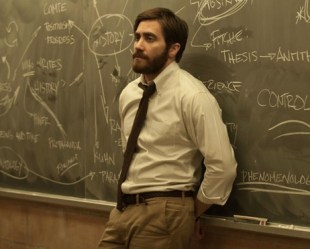 While looking up those various explanations, I read at least one review that asserted it’s a good thing that the film doesn’t provide a clear answer at the end. Well, I think that’s a debatable point. I mean, there is an answer — Villeneuve & co clearly know what they’re doing, to the point where they made the actors sign contracts that forbade them from revealing too much to the press. So why is it “a good thing” that they choose to not explain that answer in the film? This isn’t just a point about Enemy, it’s one we can apply more widely. There’s a certain kind of film critic/fan who seems to look down on any movie that ends with an explanation for all the mysteries you’ve seen, but if you give them a movie where those mysteries do have a definite answer but it’s not actually provided as part of the film, they’re in seventh heaven. (And no one likes a movie where there are mysteries but no one has an answer for them, do they? That’d just be being mysterious for precisely no purpose.) But why is this a good thing? Why is it good for there to be answers but not to give them, and bad for there to be answers and to provide them too? If the answers the filmmakers intended are too simplistic or too pat or too well-worn or too familiar, then they’re poor for that reason, and surely they’re still just as poor if you don’t readily provide them? I rather like films that have mysteries and also give me the answers to those mysteries. Is that laziness on my part? Could be. But I come back to this: if, as a filmmaker (or novelist or whatever) you have an answer for your mystery and you don’t give it in the text itself, what is your reason for not giving it in the text? Because I think perhaps you need one.
 Fortunately, Enemy has much to commend aside from its confounding plot. Gyllenhaal’s dual performance is great, making Adam and Anthony distinct in more ways than just their clothing (which is a help for the viewer, but not for the whole film), and conveying the pair’s mental unease really well. It would seem he errs towards this kind of role, from his name-making turn in Donnie Darko on out, which does make it all the odder that he once did Prince of Persia and was very nearly almost Spider-Man. I guess everyone likes money, right? As Anthony’s wife, Sarah Gadon also gets to offer a lot of generally very subtle acting. Her character’s evolving thoughts and feelings are not to be found in her minimal dialogue, but are clearly conveyed through her expressions and actions. On the other hand, Mélanie Laurent feels wasted, her role as Adam’s girlfriend requiring little more than being an object of desire — a part she’s completely qualified for, but also one she’s overqualified for.
Some find Nicolas Bolduc’s yellow-soaked cinematography too much, but I thought it was highly effective. Especially when mixed with the location of Toronto, a city we’re not so familiar with seeing on screen (or I’m not, anyway), it lends the setting a foreign, alien, unfamiliar feel, which is at once modern, even futuristic, but also dated, or rundown. The dystopian sensation is only emphasised by the distant yellow smog that seems to permanently hang over the city. It’s pleasantly creepy, but not the creepiest thing: the use of spiders is scary as fuck. I’m not properly arachnophobic, but I don’t like the buggers, and some of their surprise appearances are more effective at delivering chills (and potentially nightmares) than many a dedicated horror movie. (Incidentally, there’s a bit in 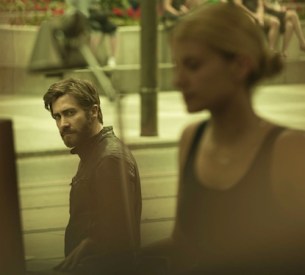 Arrival that instantly called this to mind. I don’t know if it was a deliberate self-reference or just Villeneuve recycling techniques.)
For a certain kind of film fan, I imagine Enemy is Villeneuve’s masterpiece (at least among his English language features; I’m not au fait with his earlier work). For the rest of us, I’d guess it slips in behind his other movies as an interesting but frustratingly arty also-ran.


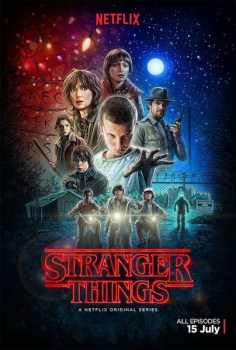 Hype — it’s a funny old business. It’s hard to have avoided hearing something about Stranger Things, Netflix’s summer hit that went down like gangbusters, its ’80s nostalgia perfectly calibrated to target the kind of people who run entertainment news websites these days — just to be cynical about it. Or truthful. Then there came the backlash, which attested there was nothing more to the show than those callbacks and tributes; a hollow experience of copying and “hey, remember this? That was good, wasn’t it?”
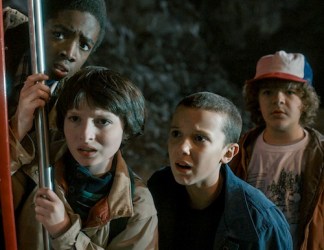 Without wanting to get into spoiler territory (despite what the media would have you believe, not everyone has Netflix all the time and not everyone watches every new zeitgeisty series immediately. Apologies if you write for an entertainment site and I’ve just given you palpitations), everything comes together nicely for a barnstorming pair of climactic episodes. For my money, the penultimate chapter is the best one: with a bunch of revelations out of the way (some of them easily guessed but finally confirmed), the series kicks off a run of long-awaited fan-pleasing events (as in many a drama, it takes this long for everyone to finally start talking to each other; also, the bit with the van!) The finale is less accomplished, with some characters wandering around for a bit in a way that feels designed to pad the running time. Still, it’s a satisfying conclusion… to season one, anyway.
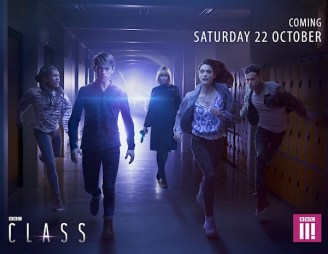 Ten years to the very day since the launch of the original dark, sexy BBC Three Doctor Who spin-off,
  The CW’s raft of superhero shows restarted on UK TV this month. I’ve given up on Legends of Tomorrow and am still not joining Supergirl (though I got hold of the opening episodes, co-starring Superman, to maybe make time for at some point); but, five seasons in, Arrow has me suckered for the long-haul, and The Flash tempted me back with the intrigue of adapting Flashpoint. I’ve never got on the bandwagon with Flash, which attracted a lot of praise during its first season that I simply didn’t agree with, leading it to outshine Arrow in ratings and people’s affections. Arrow has long been off the boil, and season five certainly hasn’t got it back up to temperature so far, but The Flash had plenty of issues of its own. It’s not problem free now, but I actually really liked the first couple of episodes of the new season. It’s still a long way from the top tier of TV superheroes (Netflix have that sewn up), but it’s likeable.
 This month, I have mostly been missing the most expensive TV show ever made*, Netflix’s much-discussed The Crown. I don’t know if they’ve been pushing it as much in the rest of the world as they did in the UK, but it certainly felt like it was everywhere… for about a week, as is usually the way with Netflix series. Also missed: the equally-discussed Netflix-exclusive new run of Black Mirror. Both of these are because I don’t keep up a permanent Netflix subscription, but between them, the forthcoming Gilmore Girls revival, and the Series of Unfortunate Events remake in January, I will be signing up again late in December (using the free month voucher they had in the Radio Times, hurrah!)
 Score:



 A squire fakes being a knight to win a jousting contest, and a lady’s affection, in this medieval comedy-adventure.

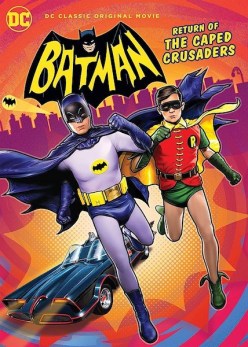 Holy nostalgia hit, Batman! This animated movie reunites the surviving stars of the enduringly popular
 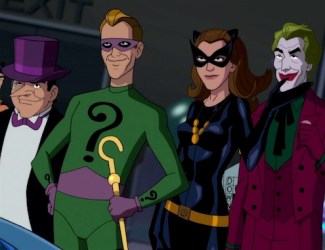 fundamentally, a comedy. Conversely, Ward still sounds pretty spry, and is gifted plenty of those “Holy [insert something here], Batman!” catchphrases that never cease to be fun. Unfortunately, Newmar also sounds her age, but doesn’t seem to quite have the liveliness that West retains. In the behind-the-scenes featurettes she seems a delightfully kooky old bird (at the recording she’s wearing cat ears, for one thing), so it’s hard to resent her, but the portrayal of Catwoman as slinky and sexy feels a little… odd. On the bright side, it means you don’t get the uncomfortableness of West flirting with a much younger actress, even in animated form.
 On the whole, Return of the Caped Crusaders is a resounding success. It’s a fun return to a beloved incarnation of arguably the most popular superhero; a version who’d been somewhat left out in the cold for a couple of decades by a world that grew up a bit too much, but is now being re-embraced and held in deserved esteem. And, even better, there’s already a follow-up in the works. Holy must-see sequel, Batman!
 After a sidestep into big-budget director-for-hire movies that brought him even less acclaim than his last couple of self-penned efforts, once-fêted director M. Night Shyamalan goes back to basics with this low-key found-footage horror.
 Of course, there’s a big reveal to explain everything that’s been going. People call it a “twist” because it’s a Shyamalan movie, but it’s more of an explanation. I mean, what was going on had to be explained somehow, and the explanation comes at the point where you’d expect the explanation to be. I’m not saying it’s not a twist, because it does change what you think you’ve been seeing, but it’s also not a be-all-and-end-all kind of failed-rug-pull, which Shyamalan’s worst twist-obsessed efforts have been. This one works. Or, it did for me.
 ’70s self-sufficiency sitcom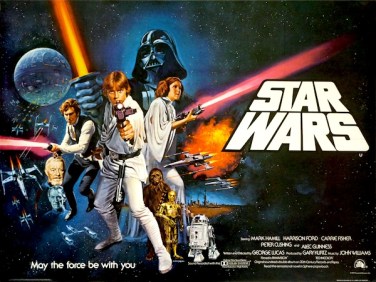


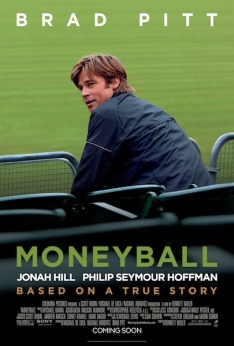 Based on a true story, Moneyball concerns the management of baseball team Oakland Athletics during the 2002 season. General manager Billy Beane (Brad Pitt) struggles to put a squad together due to a comparatively low budget for players, which has seen all his best ones drift off to richer contracts elsewhere. Fed up with the traditional scouting system, he recruits Peter Brand (Jonah Hill) to use statistical analysis to select a cheap team of quality players. The rest of his staff despair, including coach Art Howe (Philip Seymour Hoffman), who refuses to play the team as Beane and Brand suggest, which unsurprisingly leads to self-vindicating failure — until they force his hand…
 Problems extend beyond the sporting specifics. It’s quite some way into the movie before it gets stuck into the meat of the plan working, and before that it often throws in asides that meander around through Beane’s earlier playing career and current family life. The former has some bearing on the plot, though feels inadequately integrated — as one flashback it might work, but as a series of them it’s not enough to constitute a parallel story. The latter, his family life, provides character texture, but it’s slight, uninformative, and ultimately unnecessary. You could cut it and the film would lose nothing.
 and didn’t need any work, which probably explains why it’s not so Sorkin-y. Zaillian is not a bad writer — his credits include
