aka The Conqueror Worm
2010 #104
Michael Reeves | 83 mins | TV | 18
 Notorious for having numerous cuts forced upon it by censors, over 40 years after its initial release Witchfinder General — now uncut — seems almost tame. But gore and sadistic violence certainly aren’t the main attractions — there’s a lot more to the film than that.
Though I’m sure it was quite horrific in its day, there’s nothing here to rival the gore or gruesomeness of today’s horror movies; or, indeed, of horror movies being produced in other countries around the same period. Not that I’m advocating censorship, but one advantage to the previous cutting of the film is that it’s been restored from vastly inferior sources (it looks about VHS quality to me), making it possible to note what the censors felt needed removing. It’s interesting that, with only one brief exception, all the cuts are of violence to women, while similar violence towards men remains intact. Very moral.
(There are two ‘complete’ versions available now, often labelled the Director’s Cut and the Export Cut. As usual, Movie-Censorship.com has more details, but there seems to be no difference in violence (despite what IMDb may claim) — the latter merely uses some alternate takes, 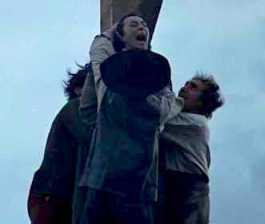 shot against Reeves’ wishes, featuring needlessly topless wenches. This is the cut shown by the BBC.)
If the violence isn’t disgustingly gory, what’s truly horrific is how real it is. I have no idea if the torture and execution methods are historically accurate (the lead characters were real people but the plot is far from historically accurate), but the opening hanging is nasty due to the woman’s distress, the later burning tortuous because we know that, at some point in history, for whatever reason, this kind of death penalty was dolled out… If it’s horrific or scary it’s down to the threat of violence, or the cynical sadism with which people are tortured, rather than gory special effects (indeed, the blood on display is marvellously fake) or supernatural goings-on (of which there are resolutely none).
In fact, if we’re discussing genre, it’s more like an historical action-adventure, with soldiers dashing around the countryside, horseback chases, bar brawls, ambushes, and the occasional sword fight. If you changed the villain from a witchhunter who tortures and murders in Very Nasty Ways for money, to a dastardly chap who just stabbed people for money, the film would still function and the controversy would instantly evaporate. I’m not saying they should have, because that’s not the point; just that, in structure and (in many places) tone,  Witchfinder General is more action-adventure than horror.
Tom Baker (not that one) and director Reeves’ screenplay (adapted from Ronald Bassett’s novel and nothing to do with the inspiration for its US title, Edgar Allan Poe’s poem The Conqueror Worm) adds a surprising amount of depth for either genre. It largely eschews the politics of the era — both the good and bad characters are on the side of Cromwell, the civil war only cropping up to provide period detail or motivation for characters’ movements — instead developing character and thematic interest.
Take hero Richard Marshall’s relationship with his beloved Sara’s guardian uncle, John Lowes. Lowes dislikes both Richard’s cause and his prospects, but is prepared to condone their marriage so Sara can escape the witchfinder’s path. Or the myriad minor characters who are well prepared to do as they’re told, or report people as witches just to get rid of them, often in silent agreement with the witchfinder and/or magistrate that everyone knows these people aren’t guilty of any real crime, but are still prepared to say or do whatever because someone wants rid of them. Thematically, one can read points about the corruption power can bring, in particular abuse of political situations.
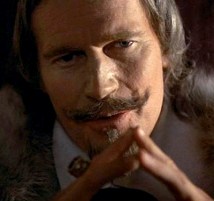
 Best of all is the witchfinder himself, excellently portrayed by horror stalwart Vincent Price. Indeed, all the credit may lay with him, because it’s his line deliveries and uncertain looks that make the character conflicted early on, a man who may believe he is genuinely doing good for Christian values, but is seduced down darker paths by money, power, lust, and the prospect of revenge. When he allows himself to be lured to Sara’s bedroom as payment for leniency on her uncle, we’re uncertain if he’ll take what’s intended or use her loose ways as proof of witchery. That it’s the former quickly indicates how seriously he takes his espoused Christianity.
In the rest of the cast, Ian Ogilvy makes for a suitably dashing, morally centred hero as Richard, while Robert Russell is equally suited to the part of brutish, loutish, but insightful torturer Stearne.
The picture is nicely shot, with a suitable realism to the locations. Though one of the most horrific things about the whole movie is some of the most dire day-for-night footage I’ve ever seen — it seems to consist of leaving the sky rather bright while everything else is darkened  to near-silhouette levels of blackness. It’s even less convincing than that fake blood. I enjoyed the score too. A completely new one was written for the US release, but I presume this was the original because it was slightly calmer and more haunting than one might expect from an action-adventure-horror movie (which I presume was the reasoning for the replacement).
Despite the controversy, Witchfinder General will no longer please the gore-seeking brigade of certain horror fans — no bad thing. While it’s undeniably sadistic in places, it’s appropriate for the dark, realistic theme of the story. It may not be factually accurate, but it conveys well the sense of a dangerous, violent, morally bankrupt era. Its place as a British horror classic is well earnt.
Witchfinder General is on BBC Four tonight at 10:10pm.
Witchfinder General is on BBC Two tonight, Friday 31st October 2014, at 12:05am.

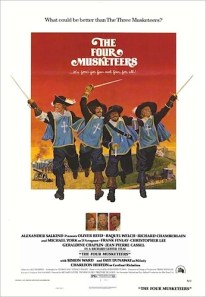 Richard Lester’s Four Musketeers was shot at the same time as the previous year’s Three Musketeers, because it was originally meant to be one film that was split in two when someone realised how darn long it was. This split led to a legal battle over actors’ fees and, eventually, a new standard clause in actors’ contracts to prevent such two-for-one ‘cheats’ by producers in future.
 the murder of Constance; the cold-blooded execution of Milady; and ending up with Richelieu still in power too — none of it sits well with the jolly swashbuckling tone that still dominates. There are some good action sequences nonetheless — for instance, the ice-covered lake; breakfast/siege in the ruined fort; and the burning-building finale — which go some way to make up for the shortcomings.
 I like a good swashbuckler. I don’t know exactly what it is about sword fights, but they’re probably my most favourite kind of action sequence. The 1973 Three Musketeers, then, is a film I’m slightly amazed I’ve not seen before. Especially as I absolutely loved it.
 Thanks to this most of the fights aren’t strictly sword fights, I suppose. Indeed, Oliver Reed seems to dispense with his blade at the earliest opportunity and turn instead to sticks, wet towels, whatever else happens to be at hand. It lends a certain kind of organised chaos to proceedings; the kind that elevates a technically proficient duel into a funny, exciting, memorable segment of cinema. I would list standouts, but instead may I recommend you watch the film and, every time an action sequence starts, count it as one I mentioned. But particularly the one in the laundry and d’Artagnan and Rochefort’s lightbox-lit nighttime duel. And also— Now, this is why I said I wasn’t going to list any.
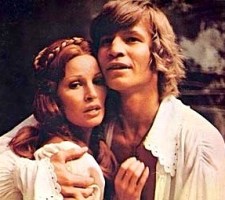 Constance and Faye Dunaway as the conniving Milady de Winter. York earns his place as the lead amongst such company, though, making a d’Artagnan who is by turns athletic, clumsy, hot-headed, loyal, and funny. As I said, everyone pitches the lightness just right, but York perhaps most of all — he doesn’t send up the youngest musketeer, doesn’t make him a pun-dispensing action hero, but finds all the humour in his actions and dialogue.
 It also means the film ends with a sort of “Next Time” trailer, which feels very bizarre indeed, but is also a tantalising glimpse of what’s still to come.
 Much was written about Toy Story 3 when it was released this summer, so I’m not sure how much I have to add, but here we go. It’s no surprise either — that’s what happens when a preeminent and popular studio releases a sequel to a beloved and acclaimed film franchise 11 years after the last instalment. High expectations abounded. For once, they weren’t necessarily unrealistic: if anyone could pull off such a feat, it’s Pixar.
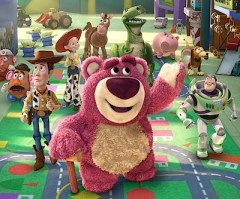 who’ve grown up with these films and these characters and, in a way, are letting them go along with Andy; and for adults, who may have left childish things behind but can hopefully still appreciate the thematic sentiment.
 even more emotional seeing them go through what they do here. Similarly, it pays to be aware of events and jokes in the preceding films. You don’t need to know intricate plot details, but there are plenty of pleasing references to catchphrases and moments.
 As I mentioned in my review of the
 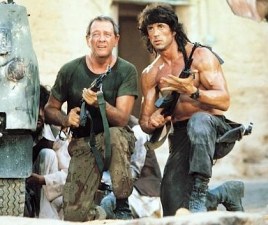 now occupy almost the same position the Russians did back then, for instance — but I’ll leave the specifics of such things to reviewers more versed in the last 25 years of Western intervention in the Middle East.
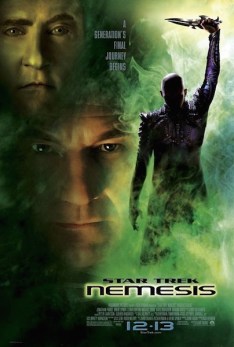 After the widespread disappointment with
  though the knowledge of better things to come means his presence somehow lifts his scenes a notch.
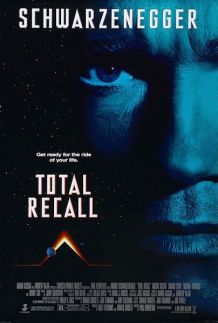 Post
Post  depending on your point of view, either supports the “it was all a dream” reading or is just a case of artistic licence, hardly uncommon in SF cinema.
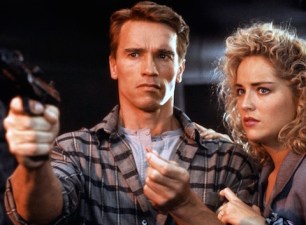 Perhaps it’s ultimately destined for an afterlife as a film representative of its era; the kind of thing that comes up as a footnote or personal favourite in texts & documentaries specifically discussing things like The Sci-fi Cinema of the ’90s. Or perhaps I’m doing it a disservice. We shouldn’t really try to predict these things too much, it’ll only lead to embarrassment when the opposite happens.
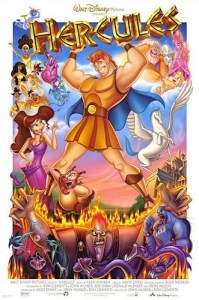 Hercules is the first post-me Disney; the point where, for whatever reason, I stopped watching their output. But, of course, Disneys — good Disneys, at any rate — are suited to every age group.
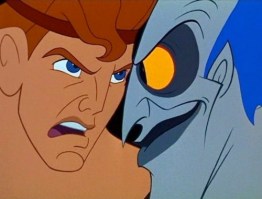 animal-sidekicks-with-no-dialogue-who-can-still-convey-their-thoughts-and-feelings-perfectly (I feel this tradition needs a snappier name.) Love interest Meg, meanwhile, starts out intensely irritating but is gradually redeemed. Good work, I say to the film’s
 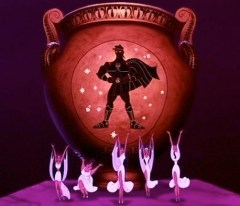 (though even mentioning it in the same sentence as that number makes it sound better than it is). Only love interest Meg gets a passable song, not that I could remember it within hours of watching the film. Maybe it’s not all that bad really, but when early-’90s Disneys could produce several unforgettable tunes per film, it feels like a weak album from a band you usually enjoy.
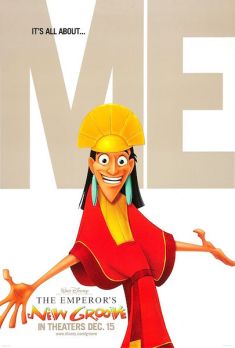 Disney’s 40th (canonical) animated film had a very troubled production, which, from what I can tell, turned it from a derivative riff on The Prince and the Pauper into this load of tosh.
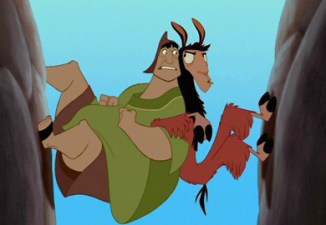 In reality it doesn’t suffer from that too much, and again looked nice and crisp in HD. I usually ignore image quality when it comes to reviews — not that I don’t care, but in these reviews I’m aiming to look at the content of the film rather than the particular copy I watched — but HD has such noticeable benefits for animation (when done well).
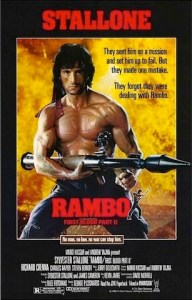 Part II, eh? A continuation of the same story from Part I, theoretically; like
 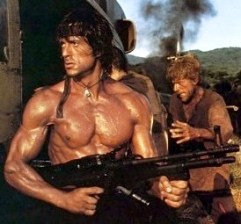 The screenplay is by James Cameron (yes, that one) and Stallone. Cameron says he wrote the action and Stallone added the politics. I don’t know who wrote the dialogue, but on the whole it’s typically straightforward and/or laughably weak. You can see why these days people get hired to do a “dialogue polish”.
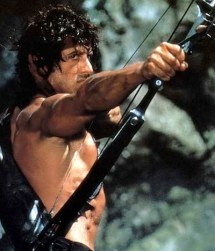 if the film is vilifying those who didn’t care about soldiers who fought in Vietnam (which it is), the characters who abandon Rambo and the other PoWs are an embodiment for this disdain.
 100Films.co.uk