Blade Runner: The Final Cut (1982/2007)

2009 #58
Ridley Scott | 118 mins | Blu-ray | 15 / R
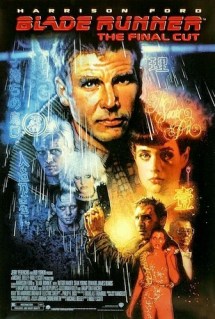
Blade Runner: The Final CutYou don’t need me to tell you about Blade Runner. It’s one of the most popular movies ever, if not with a mass audience then with a significantly-sized cult following and even wider-spread respect. Still, I’m going to go on about it for a bit anyway.

First off let me say that I have seen it before, in the guise of its 1992 Director’s Cut, the only cut available on Home Entertainment/TV since I’ve been old enough to know the film exists, and which is surely to blame for almost every blockbuster getting a Director’s/Extended/Unrated/Ultimate/Complete/etc Cut on DVD these days. Ironic, really, considering it’s a slight misnomer as Ridley Scott wasn’t properly involved with its creation. The Final Cut isn’t fundamentally different to that Director’s Cut, however. Yes, there are an array of editing tweaks and myriad effects fixes, but the meat-and-bones of the story and the content of the scenes — including the removal of the voiceover and the foreshortened ending — remain the same as the Director’s Cut. (If you’re interested in a blow-by-blow account of all the differences between the five cuts now available, try here.)

Normally such minor surface changes wouldn’t warrant a new number on this blog. But this is Blade Runner — or should that be Blade Runner, undeniably one of the most significant films of the last quarter-century thanks to its enduring influence. Yes, it is heavily influenced itself — by the likes of Metropolis and the whole of film noir, primarily — but its dystopian future — all constant night-and-rain, busy streets, neon advertising, canyon-like decrepit skyscrapers towering over dirty streets, high technology rubbing with the everyday detritus of humanity — has been copied everywhere. Without this there’d probably be no Ghost in the Shell, no Dark City, no Matrix, no re-imagined Battlestar Galactica, no thousand other things that have nothing close to the brains but do have the look, the style, the feel. Not to mention Red Dwarf: Back to Earth, of course (he says, as if that has greater significance than the rest!), which sits somewhere between homage and rip-off, surprisingly large chunks of it making almost no sense without at least a passing familiarity with Blade Runner. And the whole thing’s cyclical, because look how The Matrix has gone on to influence countless other lesser efforts. But that discussion is for another time.

In fact, the film can also be seen all over the real world, in what is doubtless the skill of those who predicted its future rather than a genuine influence on Real Life (though you can never be sure). It’s not all true, obviously, but for all the outdated technology (look at the computer displays!) or never-likely technology (flying cars!) there’s an example of the way the world’s headed or already gone. Video phones? Look at Skype, or video inboxes on the iPhone. LA’s skyscrapers, gaudy neon signs, huge video-screen advertisements, rundown areas of the city that are so unrestored they seem to be from decades ago (because they are), the increasingly widespread integration of Eastern culture, photo manipulation available in the home to anyone… it, and more, is all already here, or just around the corner.

But being Surprisingly Accurate does not a popular film make (well, not necessarily), and so of course Blade Runner has a lot more to offer than “ooh, I can do that too!” Putting the future setting aside for a moment, it’s plain to see that the film is as shaped by film noir as by other sci-fi, if not more so. The dark cinematography is perhaps the most obvious area of influence: shafts of light breaking up shadows; imposing cityscapes; constant rain, constant night (with any daytime scenes stuck indoors, often with blinds drawn and/or the light made hazy by smoke). There’s the plot too: it’s packed to bursting with sci-fi concepts underpinned by metaphysical discussions (who is God? what does it mean to be human?), but these are driven by a pure noir narrative, complete with beaten-down reluctant detective (who even loses the final fight), a femme fatale, a questionable moral perspective and a storyline that is predicated on an investigation/manhunt.

That this tale unfurls at a relatively slow pace is surely not to everyone’s taste, but it suits the film’s somewhat intellectual bent. The pacing renders it majestic, stately, both thoughtful and thought-provoking. Even the action sequences tend toward this. This overall languidness frequently allows moments of beauty to leap out, from the visuals, the ideas, the dialogue — Batty’s dying words, for example, are beguiling, elegant and meaningful, mixing the fantastical with an identifiable reality to memorable effect.

The image that most stands out is, appropriately, eyes: the V.K. test, the occasional orange glint in Replicants’ pupils, Batty squeezing out Tyrell’s eyes, the latter’s huge glasses, Pris’ spray-painted eyeliner, Gaff’s odd-looking eyes, and so on. It succinctly reflects the themes of what things seem to be and what they actually are — “seeing is believing”, if you will, although in Blade Runner’s world that clearly isn’t true. The famous photo manipulation scene also feeds into this. One of the great things about the eye motif is that you can’t exactly miss it — the very first thing seen is an extreme close-up of an eye — but it’s obvious not in a batter-you-round-the-head-so-even-the-most-simple-simpleton-will-notice way, but the if-you’re-an-intelligent-viewer-you-shouldn’t-fail-to-spot-it-on-a-repeat-viewing kind of way.

Elsewhere in the filmmaking pantheon, the specials effects are astounding. They look brilliant today, easily besting most of the still-obvious CGI we’re bombarded with. Yes, they’re now aided by some digital clean-up, wire removal and that kind of thing, but the basic models and composites remain untouched and are beautiful. Similarly, Vangelis’ score should by all rights sound dated and discordant, filled as it is with early-80s synths. Fortunately, it has a kind of unusual beauty that matches the visuals it drifts over, complementing as it should rather than providing an uncomfortable reminder of exactly which decade produced the film.

Blade Runner is by any count an incredible piece of work (something the extensive making-of documentary on The Final Cut DVD/BD only emphasises, incidentally). Not everyone will (or does) like it, but I should imagine even they find it hard not to admire (an altogether different thing to “like”). Either way, I think it’s safe to say it can lay claim to a place on the relatively select list of films everyone really must see.

5 out of 5

BBC Two are showing Blade Runner: The Final Cut tonight at 9pm.
Blade Runner: The Final Cut is on BBC Four tonight, 26th September 2013, at 10pm.

I covered the 1992 Director’s Cut as part of my 100 Favourites series, here.
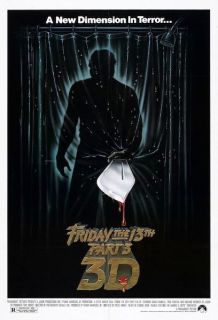
Friday the 13th Part III [3D] (1982)

2009 #77
Steve Miner | 91 mins | TV | 15 / R

Friday the 13th Part IIIJason’s back!

Oh, forget it — I can’t get excited about that. I’ve never even seen a Friday the 13th film, and had no intention to ’til Channel 4 showed this in 3D. Fortunately, general cultural awareness of who Jason is and what he does is all that’s required to understand this third entry in the never-ending franchise.

It’s pretty much your stereotypical horror movie: a group of teenagers just waiting to be slaughtered, a remote cabin-like location, lots of jump scares over nothing, a supernaturally-powered killer stalking them for no apparent reason, lots of gory deaths which have more thought put into them than the plot, characters and dialogue put together… The acting’s all at the level of a high school play, which probably does a disservice to most high school plays. There’s no point wondering who’ll die, because inevitably they almost all will. All this considered, it’s a passably entertaining genre entry.

The good bit here, however, is the 3D. They have a whale of a time shoving stuff out into the audience for almost no reason — just like the stereotype of 3D films, of course. That’s part of the fun of trashy 3D movies so I’m not criticising it, but what sadly doesn’t work is the ColorCode 3D system chosen by C4. It provides lovely depth to normal scenes, but as soon as something’s attempting to come out at you it fails. It could be the age of the film producing flaws in the process as newer things shown during 3D Week have been better, but most do come a cropper as soon as something attempts to come out of the TV as opposed to go deeper into it. Oh well.

Friday the 13th Part III is what it is, and if that’s what you’re after that’s fine. At least the 3D silliness adds an extra dimension of enjoyment. Pun very much intended.

2 out of 5

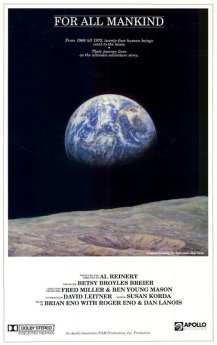
For All Mankind (1989)

2009 #42
Al Reinert | 77 mins | TV (HD)

For All MankindFor All Mankind tells the story of NASA’s Apollo missions to the Moon using only NASA’s own footage of the real missions.
It’s not a documentary in the sense that most people perceive the form — i.e. a highly realistic presentation of the facts — but instead something a little more interpretive, aiming to recreate the feeling and experience of travelling to the moon, not the hard facts of who went when and how it was done. As such it is both beautiful and artistic, featuring stunning photography that has been sensitively edited and scored.

In this regard, it makes In the Shadow of the Moon look like a Hollywood remake. While they follow the same tack — telling the tale of the Moon missions with just the testimony of the astronauts, treating it as one big mission rather than taking them all in strict chronological order — For All Mankind does it with a greater sense of artistry. Where Shadow feels like a typical documentary, with talking heads and onscreen identification of who’s speaking, Mankind just uses original footage and astronaut’s narration, never bothering to identify the speaker. Both styles have their place, and Shadow adds a great deal to the story with its retrospective comments by the astronauts, but the glorious footage and skilled editing of Mankind — and the added wonder of seeing it in HD, it must be said — leaves one with a sense of awe that isn’t as present in the more informative Shadow.

These two films make an excellent pair then, but For All Mankind’s beauty provides the superior experience.

5 out of 5

For All Mankind placed 5th on my list of The Ten Best Films I Saw For the First Time in 2009, which can be read in full here.

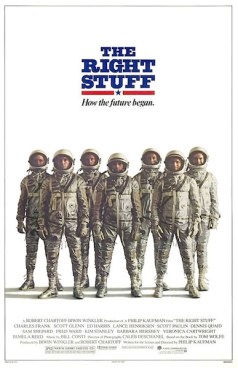
The Right Stuff (1983)

2009 #49
Philip Kaufman | 181 mins | TV | 15 / PG

The Right StuffThe Right Stuff ostensibly dramatises the story of the ‘Mercury 7’, America’s first group of astronauts, but in fact equally concerns itself with the tale of test pilot Chuck Yeager. But I’ll get to him.

I’ve recently steeped myself in dramas and documentaries relating to the US space program, from For All Mankind’s contemporary footage to In the Shadow of the Moon’s retrospective interviews, from Moonshot’s earnest docudrama account of Apollo 11 to From the Earth to the Moon’s thorough chronicling of events. But all of these have one thing in common: they cover the Apollo missions alone. Mercury came first, America’s initial attempts to put men into space before Apollo’s grand mission to the Moon.

In this context it’s nice to actually get some coverage of these earlier, vital missions, though such an in-depth knowledge of what was to follow has its problems for The Right Stuff’s narrative, just as knowing the facts always does for a historical movie. Equally, it gives the emotional resonance a helping hand — knowing Gus Grissom’s tragic fate lends the poor treatment he received following his unfortunate splashdown an extra poignancy; or when Alan Shepard asserts he’s going to the Moon you know he’ll make it (eventually).

Exposure to other such works makes quality comparisons inevitable too, though the only one of serious relevance here is From the Earth to the Moon. It’s an unfair one, of course: despite The Right Stuff’s epic running time, it’s nothing to the twelve hours afforded to an HBO miniseries. Conversely, where the miniseries is effectively twelve one-hour plays, shifting focus every episode, director Philip Kaufman’s film does follow a more linear — albeit wide-reaching — progression. While Yeager may disappear for long stretches, for example, his story is revisited and continued; while Gordon Cooper isn’t introduced until after we’ve had plenty of Yeager, the film closes on his first spaceflight. Flitting from character to character could make the film feel fragmented — and the brevity in dealing with many of the supporting characters, especially the wives, does suggest this — but the missions move ever on and take the narrative with them.

The other effect of having seen so much about the space program of late is that the trips to space lose some of their wonder. The handful of spaceflights actually depicted here are often praised, both for their special effects and their pure effect on the viewer, but having seen many others recently does tarnish the sense of wonder somewhat. The effects work is faultless however, as is the integration of footage of the real missions, and the unique qualities of John Glenn’s flight make it stand out regardless of how many other real spaceflights one’s seen recreated on screen.

A handful of these sequences aside, Kaufman leaves the technical aspect of proceedings alone. The various test flights and rocket launches we do see are undoubtedly important set pieces, but they’re not a thorough catalogue of events. Attention is only lavished on the scientific and engineering challenges when it has some direct impact on the characters, and just as often Kaufman is concerned with the family — specifically, the wife — behind the astronaut. These touches of family drama are well played, most affectingly with Glenn and his shy, stuttering wife, but each astronaut’s tale comes and goes, not even one relationship going through an arc that lasts more than two or three scenes. Even when powerfully portrayed, these are portraits not stories.

There are some injections of humour and symbolism too, but again in keeping with the piecemeal style. A pair of NASA recruitment officers, played by Jeff Goldblum and Harry Shearer, provide some comic relief early on for quite a sustained stretch, but then more or less disappear — excepting a recurring motif of Goldblum telling a room of Important Men news they already know. Similarly, the film opens with a fantastic image of Death, a black-clad preacher arriving to inform a wife and child of their husband/father’s fiery death. He crops up again, demonstrating his presence as symbol and not character, but is too often forgotten about. Plaudits are due for not overusing him, naturally, but a few more appearances wouldn’t have gone amiss.

And so what of Yeager? Why so much of a test pilot who was denied the chance to apply to be an astronaut, even if he’d wanted to? It’s hard to disagree with the assessment of screenwriter William Goldman, who left the project over disagreements with the director: it seems Kaufman, for whatever reason, is set in a belief that Yeager had ‘the right stuff’ pumping through his veins, while those chosen to be astronauts were just ordinary guys who got lucky; that Yeager was a pilot proper, brave and skilled, while the Mercury 7 were little more than living computers to perform a handful of tasks atop a huge rocket. If this is Kaufman’s belief it isn’t overbearing, but you can see where Goldman’s coming from. After all, if this is purely the story of the Mercury 7 and their trips into space, why is Yeager there at all, never mind so prominently?

By eschewing a straight trotting out of facts and incidents, even a dramatised one, for a selection of events and experiences, Kaufman made a film that is perhaps less about the real-life story and more thematic — that theme being, primarily, heroism. If he winds up uncertain whether or not the Mercury 7 were heroes, perhaps that’s the point: these were just ordinary men, thrust into an extraordinary situation. Except Yeager, of course, who is never anything less than the flawless embodiment of the titular virtue.

4 out of 5

The Right Stuff is on ITV4 tonight at 10:35pm.

Stand By Me (1986)

2009 #29
Rob Reiner | 89 mins | download | 15 / R

Stand By MeStand By Me is a film an awful lot of people love an awful lot, which it always seemed to me was down to first seeing it at the right age (more or less the age of the main characters, I think) and possibly to being part of a certain generation — would it have the same effect for kids today, when the relative innocence and freedom of the ’50s is arguably lost? As I say, “seemed”, because now I’m not sure either of these factors really matter.

Irrespective of age, generation, or being able to remember the kinds of experiences suggested by the film, Stand By Me is still an effective and affecting little film. The level of enjoyment for some may depend on how much they can stomach child actors, though as kids go they’re mostly very good. River Phoenix in particular is brilliant, highly natural while bringing a lot of depth to perhaps the most important role. Wil Wheaton also makes a good account of himself, just one year before attracting derision as Wesley Crusher in Star Trek: The Next Generation. (Phoenix, of course, went on to have a tragically short-lived career.) Kiefer Sutherland is as effective a villain as he ever would be, though that aspect of the plot is almost an aside.

An aside, because the film isn’t about the fights between the young heroes and a group of older bullies. Rather, it’s a paean for childhood, with the adult perspective and the ‘lost age’ setting of the ’50s succinctly highlighting the nostalgic spirit. To be precise, it’s not so much reflecting on “childhood” as on “growing up” — the choices that are open when young that either disappear with time or, for whatever reason, become closed off. The whole film is arguably about choice: choice of friends, choice of social class, Ace’s constant listing of choices (the subtext breaking into the text, as many a film teacher would point out), even the obvious choice whether to follow the tracks or take shortcuts (surely symbolic). Thematically, it’s the choice to be put down or stand up for yourself; the choice to stick around and wind up a nobody or work hard and get out, also underlined in the present-day bookends.

Perhaps being the right age is helpful to a love for Stand By Me, but at any stage in life it’s easy to relate to its depiction of the experiences and choices of childhood, be they now lost, taken, or never even had.

4 out of 5

Stand By Me is on Channel 5 today, Sunday 12th October 2014, at 2pm.

Alien vs Predator – Part 2

Five weeks ago (crikey, time flies) I began my series of reviews of the Alien, Predator and Alien vs Predator franchises with my thoughts on Alien: The Director’s Cut and the original Predator, both of which I’d seen before. Over the past few days I’ve moved on to the remaining Alien films, all of which I viewed in their original theatrical cuts and all of which were new to me.

Here’s a handy summary of what you may’ve missed, then, if you somehow had something better to do on a sunny summer weekend than check blogs every day.

2009 #14
Aliens

“Where Alien is a Horror Movie — but in space — Aliens is a War Movie — but in space. The central characters are a team of marines, as opposed to the original’s ordinary guys; where the first film’s design was dark, shadowy and oppressive, here it’s all gleaming tech, tanks and guns and spaceships and the like; and, just to underline the point, the score is full of military drums.” Read more…

2009 #15
Alien³

“Even if in some ways 3 combines the first two — single Alien, claustrophobia, unarmed heroes; but there are lots of them, most with experience of killing — it adds enough variety, especially stylistically… it soon turns dark, dirty and decrepit, abandoning both the the military sheen of Aliens and the old tanker grime of Alien.” Read more…

2009 #16
Alien Resurrection

“the most notable differences are its black humour, where the tastes of both [writer] Whedon and director Jeunet make their mark, and how grotesque it is — almost two extremes walking hand-in-hand. The deformed, perverted Ripley clones; the Hybrid; the Ripley-Alien sex scene — there’s nothing like this in the other films, and that’s a grand thing.” Read more…


In the third and final part of this series I’ll be setting my sights on the allegedly-underrated Predator 2 and the much-hated pair of AVP and AVPR.

Aliens (1986)

2009 #14
James Cameron | 132 mins | DVD | 18 / R

Once upon a time, sequels were universally regarded as Bad — the inferior product of a great original; most frequently a remake in continuation’s clothing. These days we regularly see sequels that continue and expand on their predecessor, frequently leading to higher praise and a better reputation. It’s almost become expected, in fact — look at the number of reviews of Star Trek that express more anticipation for the inevitable sequel than the one just released (my own included). The archetypical “sequel that betters the original” was always James Cameron’s Terminator 2: Judgment Day — though currently critics often seem to pick X2 — but long before either of these Cameron was ahead of even himself with this sequel to Ridley Scott’s acclaimed sci-fi/horror.
The difference here, perhaps, is that Scott’s movie was so well-regarded and well-known in the first place. But Cameron cannily marks his sequel out by making it totally different, much more so than X2 to X-Men or even T2 to The Terminator. Where Alien is a Horror Movie — but in space — Aliens is a War Movie — but in space. The story structure is somewhat reminiscent of Apocalypse Now, for example; the central characters are a team of marines, as opposed to the original’s ordinary guys; where the first film’s design was dark, shadowy and oppressive, here it’s all gleaming tech, tanks and guns and spaceships and the like; and, just to underline the point, the score is full of military drums. If Scott’s could have been translated to any modern-day industrial setting, Cameron’s could be in any modern-day war zone. It works because Cameron builds on the original without ignoring it, and it succeeds because he then makes a fine war movie in its own right.

The elements Cameron chooses to retain from the first film aren’t necessarily obvious, but all are very wise. He continues its believable, realist aesthetic: businessmen wear suits, for example, and while some of the military outfits and weaponry are clearly grounded in sci-fi, it’s all only one step removed from what we see in reality. He’s also not afraid of a slow build-up — thirty minutes passes before they even arrive at the planet, and, just like Scott, he keeps the Aliens off screen for almost an hour. Nor is he afraid of acknowledging the first film, something a less assured filmmakers might shy away from in the hope it would be forgotten and no comparisons would be made. There are many references back to it, but especially the first ten minutes, which are effectively a coda to Scott’s movie before Cameron’s can properly begin.

When it does, the title is apt: Scott’s film had one monster stalking his crew, Cameron has an army of them. Their first appearance is in a brilliantly directed epic skirmish, a solid burst of action that decimates the cast within minutes and helps pay off the slow build. Again learning from Scott, Cameron keeps the creatures in shadow, showing just enough to convey their horror but not enough to make them look silly or ineffectively realised. However, he ensures that when we do see more of them — such as the attack on the base, or the climax with the Queen — what we manage to glimpse still hides any technical shortcomings, resulting in a truly alien enemy that is flawlessly executed. In fact, despite the greater volume of Aliens surely creating a bigger effects challenge, they look even better than in Alien, shorn of such weakness as glove-like hands and keeping the awkward legs (nearly always a shortcoming of creature design) out of shot.

Are the Aliens even creepier and more menacing here? Maybe — there are more of them, which naturally increases the stakes, but we’re also shown even more of they’re capabilities. Despite the all-out battles, Cameron still relies on building tension. As Doctor Who fans will certainly be aware, the film becomes a classic Base Under Siege story once the remaining marines are holed up in the abandoned base, and most of the siege is done without any direct attacks — it’s all preparation, build up, waiting for the big moments. When it comes, it’s one huge attack that then leads straight into the climax — appropriately, the best bit of all. The Alien Queen is a clever invention, creating a Ripley vs Alien finale that mirrors the first film, but ups the ante in line with the new genre by making said Alien bigger and badder. The resulting Power Loader vs Queen battle is justly famous, a flawless marriage of writing (plot, dialogue, seeded elements), effects (without a pixel of CGI, of course), direction and choreography to create a perfect finale.

It’s easy to see why opinions are divided over which of the first two Alien films is better. Both are near-flawless sci-fi masterpieces, but for different reasons. It interests me that Scott’s original comes out top on lists like IMDb’s (though only by 15 places), because on the surface the action movie antics of Aliens would seem more crowd-pleasing. Personally, I’m going to cop out of a decision and merely reiterate that both are excellent and, by being so different but doing what they each do so well, make for a great pair.

5 out of 5

Tomorrow, Alien³.

Lethal Weapon (1987)

2009 #8
Richard Donner | 110 mins | download | 18 / R

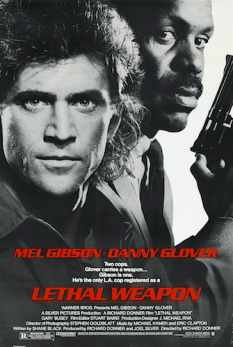
Lethal WeaponLethal Weapon comes from another era — an era in which R-rated films were still allowed to be blockbusters. One only needs to look at the classifications attached to the most recent instalments of formerly-R-rated ’80s franchises — primarily, Terminator 3: Rise of the Machines and Die Hard 4.0, both PG-13 — to see how things have changed. Of course, maybe they have just cause: Watchmen, the first proper R-rated blockbuster for a while, has been labelled a box office disappointment (because that’s what $150m worldwide in two weeks is these days).

I digress. Though, my mind frequently wandered during Lethal Weapon — often to Die Hard. This may predate the Bruce Willis franchise by several years, but it’s a testament to the fame of that film’s Christmas setting that my first thought was they’d ripped it off (Lethal Weapon, like Die Hard, begins with a classic Christmas song over an urban setting). And my next thought was, did they not have a costume budget? The film opens with a young girl, lazing provocatively with one tit out… at first, before Donner makes sure to show them both off thoroughly before she hurls herself from a building; and then we find Danny Glover’s Murtaugh in the bath and Mel Gibson’s Riggs wandering around showing his arse off. Nudity is fine in its place, of course, but here it’s so gratuitous that it sets a low tone — to be fair, one the film does little to belie.

More seriously then: the plot is full of holes with great gaps in its logic, especially as it heads towards the climax. There’s also no mystery — the investigation is just an excuse to string together action set pieces and comedic buddy scenes, neither of which are much cop, and most of the story is conveyed in a couple of info-dumps that supporting characters volunteer for no definite reason. The dialogue and performances are appalling — “may I remind you of some stuff you already know, that’s convenient exposition for the audience, thoroughly explaining the troubles of the main character and the scene you just saw”. I’ve seen better episodes of Murder, She Wrote. Their motivation makes about as much sense too — “tell me the truth!” “But they’ll kill my daughter!” “We can protect her!” “No you can’t!” “Tell me!” “Oh OK then.”

The villains aren’t just poorly drawn, they’re barely sketched at all. There’s an early scene where we see how Hard they are, then they just turn up in time for the climax and do little more than get chased around and die explosively, and in the wrong order to boot. At the very end, our heroes capture the one remaining bad guy… and then have a fight. Why? Because they do. And then all the police turn up and just watch this punch-up going on. It’s the thinnest excuse for a final fight ever put on film, and consequently the least tense — none of those officers are going to let the villain kill Riggs, and even if he did beat or kill him he’s not going to escape. There is literally no point to it. It’s appalling writing, and dire filmmaking to have left it in.

Oh, and Murtaugh smashes a car into his own front room for no reason.

Lethal Weapon probably wants to be a lot better than it is. Was it supposed to be a drama about these two cops with any old investigation plot stuck on, or a standard action-thriller with too much time spent on character? At best, it falls somewhere between the two — they’re not real characters (i.e. it wouldn’t pass as a drama if you cut out the thriller), each being made up of several stock Action-Thriller Hero traits; but nor is the plot the main focus, what with it being rather generic and not especially interesting or at all complex. The leads’ repartee and bonding is more interesting than the actual plot, and is surely the explanation for the film’s enduring popularity and three sequels, though to be honest I didn’t get it.

I’d always thought Lethal Weapon must be alright — after all, as I said, it’s had an enduring popularity and was written by Shane Black, who went on to both write and direct the thoroughly wonderful (and underrated) Kiss Kiss Bang Bang (with Robert Downey Jr being fantastic a good few years before his popularity resurgence in Iron Man) — but having seen it, I struggle to see why people like it to any significant degree.

2 out of 5

ITV1 are showing Lethal Weapon tonight at 10:15pm.
Lethal Weapon is on Watch tonight, Tuesday 23rd September 2014, at 10pm.

Glory (1989)

2009 #28
Edward Zwick | 117 mins | DVD | 15 / R

GloryEd Zwick seems to like war. More accurately, Zwick likes making films about war, but clearly isn’t a fan of the act itself. Since gaining attention with multi Oscar-winner Glory, about the first black regiment during the American Civil War, he’s directed a number of films concerned with wars and those that fight them: Courage Under Fire (“Army officer investigates female chopper commander’s worthiness for the Medal of Honor”), The Siege (“a wave of terrorist attacks in New York lead to the declaration of martial law”), The Last Samurai (“American military advisor embraces the Samurai culture he was hired to destroy”), Blood Diamond (a group of people battle for a diamond during the war in Sierra Leone), and most recently Defiance (“Jewish brothers in Nazi-occupied Eastern Europe escape into the forests”). Whatever the reasons for Zwick’s preoccupation, he certainly has a talent for it.
In Glory, Zwick is helped by a story that’s definitely worth telling, one which I imagine seemed even more pertinent on its original release, when Nelson Mandela was still in prison and the state of race relations in the US would contribute to riots in Los Angeles inside of 18 months. Still, it would be easy to slide into Issue of the Week melodrama in handling such a tale, but Zwick manages it without undue sentiment — there’s an appropriate realisation of the importance of events, perhaps even occasional reverence, but time is taken to show doubts and prejudices. It may get too sentimental for some tastes toward the end, but considering the importance of the story I don’t think it’s unwarranted or overplayed.

Similarly, most of the hero characters are less than perfect, with Matthew Broderick’s Colonel of particular note as a conflicted and initially cowardly commanding officer, more concerned with propriety than what is right — until he’s led to a change of heart, of course. His is just one of several excellent performances: Morgan Freeman does what Morgan Freeman does best as the Authoritative Elder, while Denzel Washington’s angry young man justifiably earnt him his first Oscar. The wider supporting cast hold their own against these leads, particularly Andre Braugher as the idealistic but ultimately unsuited volunteer Thomas Searles.

The handful of battle sequences are effectively staged, suitably tense and brutal, though these are really ancillary — the regiment only engaged in conflict a couple of times and so, appropriately, actual fighting makes up a relatively slender portion of the film. The unfamiliarity of the story helps keep things tense both in and out of battle — for obvious reasons, the majority of battles depicted on film are famous ones, often because of their outcome, so it makes for an agreeable change to not know where events will lead.

These elements all blend to create a film that is, at the very least, the sum of its parts: a significant historical story with strong performances and a convincing depiction of war, which negotiates the thin lines that surround sentiment and reverence. Zwick may not be a fan of war, but he certainly knows how to put its stories on film.

5 out of 5

Flash Gordon (1980)

2009 #27a
Mike Hodges | 107 mins | DVD | PG / PG

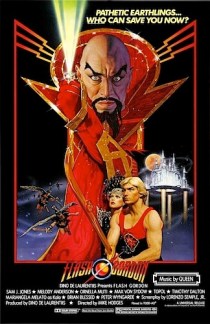
Flash GordonI hadn’t been intending to review Flash Gordon — it’s not as if I don’t have enough new films to review — but though I have seen it before it was a long time ago and I was very young, so watching it again now I wasn’t quite prepared for just how good it is.

Flash often seems to be dismissed as an unintentionally campy load of nonsense, perhaps with some ironic appeal. What this assessment misses is how knowing it is. Yes, it’s ridiculously camp, the dialogue is cheesy, the performances equally so, and it’s brighter and more colourful than any under-5s TV show ever produced. But it knows it is, and because it does it with nary a nod nor a wink I think that passes some viewers by.

The sheer volume of things there are to love in this film makes them hard to list without watching it and pointing them out as they appear, but I’m sure I can manage a few. For one, there’s the design work — the sets, the costumes, the spaceships — all huge, vibrant, retro and often ridiculous, and all wonderful for it. The special effects are truly special, creating skies full of swirling rainbow colours, rainbow clouds for the spaceships to float through, platforms that tilt over a rainbow vortex… Do some of them look primitive? Well, a bit — but they have more charm than CGI ever will, and they don’t get in the way either.

The plot is ludicrous, built from B-movie elements and predicated on cliffhangers — which is exactly as it should be. The dialogue is packed with quotable lines, many so patently ridiculous that it can only have been deliberate. There’s not a single bad performance — everyone’s either in on the joke or playing the straight man to it. Of particular note are Max von Sydow’s properly villainous villain (who, to be quite honest, still has more depth than too many nemeses we see today); Peter Wyngarde as his scheming right-hand-man, granted a fantastic death; Mariangela Melato as his right-hand-woman, granted some of the very best ‘bad’ lines; Topol as a somewhat loopy Dr Zarkov; and, of course, Brian Blessed — no more need be said.

The fights and assorted other action scenes are exciting, frequently epic, and tinged — like so much of the film — with a perfectly judged level of humour. Arguably the best is a harem-set tussle between between Dale Arden and Princess Aura, watched by sniggering servants as they wrestle on a giant bed. It’s beyond knowingly handled by Hodges, the brief cutaways to the servants indicating the deliberate commentary on such voyeuristic lesbian-lite wrestling matches in other films.

Then there’s the score by Queen. As with Brian Blessed, what more needs to be said? (Incidentally, I got a big laugh when Blessed screams, “who wants to live forever anyway?”, forgetting that Highlander was still six years off when this was made.)

So, in all that, what’s wrong with Flash Gordon? When I noticed how much I was enjoying it — about five minutes in — I began keeping my eyes open for flaws, any niggling thing that detracted from the experience Hodges created. I couldn’t find a single thing. Not one.

Which means I can now become known far and wide as the blog that only awarded Star Wars four stars, but gave Flash Gordon a perfect

5 out of 5