
Carl Boese & Paul Wegener | 85 mins | streaming | 4:3 | Germany / silent (English) | PG
 The word “prequel” was first coined in the ’50s, arguably entered the mainstream in the ’70s, and was firmly established as a term everyone knew and used in the ’90s by the Star Wars prequel trilogy. Works that can be defined as prequels predate their naming, however, and surely one of the earliest examples in the movies must be this silent German horror.
Now lost, 1915’s Der Golem was set in the present day, when “an antiques dealer (Henrik Galeen) finds a golem (Paul Wegener), a clay statue brought to life by a rabbi four centuries earlier. The dealer resurrects the golem as a servant, but the golem falls in love with the dealer’s wife. As she does not return his love, the golem commits a series of murders.” The film was written and directed by both Galeen and Wegener, but the latter was reportedly unhappy with the film due to compromises he’d made during production. So, after a sequel (also lost), Wegener tried to more directly convey the legend as he’d first heard it — hence Der Golem, wie er in die Welt kam, translated as The Golem: How He Came into the World, and commonly abbreviated to just The Golem, what with the original The Golem being lost. (Got it? Good.)
Set in 16th Century Prague (not that there’s any way to know that from the film itself), The Golem 3 tells the story of that rabbi who brought the clay statue to life in the first place. When the Roman Emperor decrees that Jews must vacate their ghetto, a rabbi builds a monster out of clay then summons a spirit to bring it to life. Meanwhile, one of the Emperor’s knights has fallen in love with the rabbi’s daughter, who is also the object of the rabbi’s assistant’s affections, and this love triangle — combined with access to control of the Golem — will eventually spell “climax”.
 Regarded as one of the first horror films, The Golem is more of a moderately-dark fantasy, or a fairytale-type myth. There are clear similarities to Frankenstein, though I don’t know if either influenced the other. However, it does feature what I presume is one of first instances of that most daft of horror tropes: running upstairs to escape the monster. It goes as well here as it ever does, i.e. not very. Said monster looks a bit comical by today’s standards. Built by the rabbi to defend the Jewish people, he immediately uses the hulking chap to chop wood and run errands — he doesn’t want a defender, he wants a servant! A terrifying beast nonetheless, it’s ultimately defeated because it picks up a little girl for a cuddle and she casually removes its magic life-giving amulet.
Golem aside, there are some good special effects, like the ring of fire that summons a smoke-breathing demon; composer Aljoscha Zimmerman’s score is largely atmospheric; and there are some nice shots, like when the rabbi walks up to camera, does something with his hands (in what is effectively now a close-up), then walks back to the Golem at the rear of the set. These are the exception, though: it’s mostly a mix of flat long and medium shots. Oddly, the credits on the version currently available note that it adds computer graphics and animation. Presumably this is the English text that’s been digitally pasted into the film on letters, decrees, books, and the like. It also means that the judder, grain, and print damage on the English intertitles is utterly fake. How silly.
Revered for its place in film history, The Golem has elements to commend it still, but doesn’t hold up as well as other films of the era.


 Score:



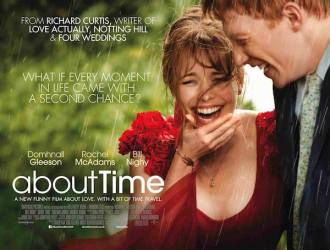 After Tim (Domhnall Gleeson) learns he can time travel back through his own life, his father (Bill Nighy) cautions him not to attempt anything too drastic — so he sets about finding love.
 Hated by Americans and loved (well, ok, “liked”) by everyone else (well, ok, “by lots, but by no means all, of people who reside outside America”), Disney’s attempt to pull a
  I know some people complain about simplistic stories that are used to just string action sequences together, and that’s a perfectly valid thing to get annoyed about, but The Lone Ranger swings to the other extreme and uses an over-complicated story to string together its action sequences. All it actually needs is a little streamlining, because the film is allowed to swing off into too many sideplots. This makes the middle of the film a slog, and you feel every minute of its excessive two-and-a-half-hour running time.
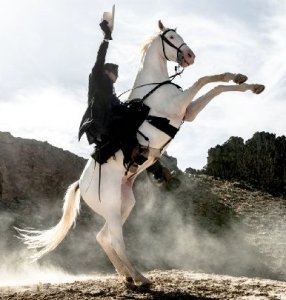 a recurring problem for Disney at the minute. To be frank, I’m not convinced anyone made a truly concerted effort to stem the overspend. When a gaggle of CG rabbits hopped on screen, all I could think was, “who allowed this?!” You’ve got a massively over-budgeted film that the studio want cut back, and one reason for that is CG bunnies that have almost no bearing on anything whatsoever! The amount of time and effort that must’ve gone into creating those fairly-realistic rabbits for such a short amount of screen time… it cost millions, surely. Millions that could’ve been saved with a simple snip during the writing stage if only someone had said, “well, those bunnies don’t add anything and they’ll be bloody expensive, so let’s lose them.”
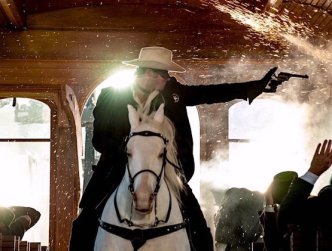 I’m not quite as effusive as Hughes, but The Lone Ranger is worth the time of anyone who enjoys an action-adventure blockbuster. It’s a three-star adventure-comedy bookended by a pair of five-star railroad action sequences, which make the trudge through the film’s middle hour-or-so feel worthwhile. There was a better movie to be made here — one that was half-an-hour shorter, more focused, and probably several tens of millions of dollars cheaper to make — but that doesn’t mean the one we got is meritless.
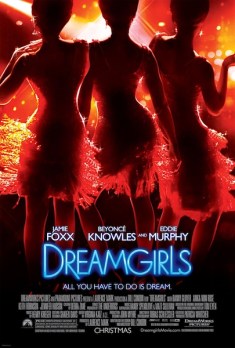 Oscar-winning adaptation of the stage musical that doesn’t tell the story of the Supremes in fictionalised form, no sir.

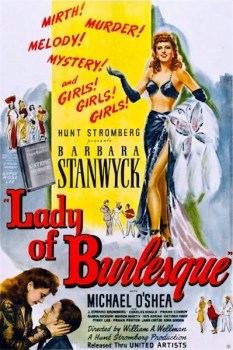 Based on the novel The G-String Murders by Gypsy Rose Lee (as in
  Stanwyck carries the film, both on stage and off. Her “will they/won’t they (of course they will)” romance with Michael O’Shea’s comic is kept aloft by her biting ripostes to his advances, and when a comedy sketch is interrupted by backstage noises she saves the day by breaking into song, doing the splits, a cartwheel, and the Cossack dance in quick succession. Not bad for a 36-year-old!
 Adapted from the classic young adult sci-fi novel by Orson Scott “bigoted idiot” Card, Ender’s Game is the story of Andrew “Ender” Wiggin (Asa Butterfield), who displays uncommon aptitude in a military programme to train children to fight against an alien race that attacked Earth decades earlier. Sent to a training centre in space, Ender must battle his fellow candidates to prove their worth to their hardened commander, Colonel Hyrum Graff (Harrison Ford), ready for the real battle to come.
 It tips its hat to things like drone warfare, child soldiers, and understanding our enemy, but that’s all it does: acknowledge those parallels exist, then refuse to explore them. Conversely, the music is too heavy-handed, taking on the burden of providing emotion that’s lacking from the screenplay.
 Sadly, after all that training fun, once the cadets jet off to the other side of the galaxy for a rushed third act, interest evaporates speedily. It even has to work hard to sell its own twist as a twist! (Spoilers follow in this paragraph.) In a simulation for a war, Ender does what he’d do to win that war. Then he’s told it wasn’t a simulation, it was the actual war… and he’s all cross. I mean, okay, the fella kinda has a point when he gets angry afterwards: they’ve lied to him, and maybe he would’ve behaved differently if he’d known. But the point of the training was to teach them what they needed to do to win, and it taught them that, and he did it. Maybe this twist works in the book, but in the film it felt somehow unearned.

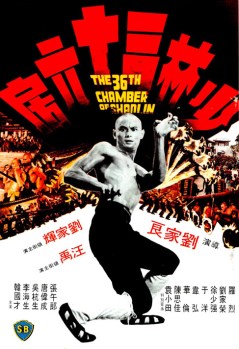 Widely regard as one of (if not the) greatest kung fu movies ever made, The 36th Chamber of Shaolin introduces us to San Te (Gordon Liu), a student whose hometown is oppressed by forces of the ruling Qing dynasty. He and his classmates join the underground resistance run by his teacher, only to wind up witnessing his friends and mentors be hunted, tortured, and killed. Faced with a similar fate, San Te escapes to the Shaolin Temple, widely known for being home to the best kung fu around. The temple’s monks refuse to teach martial arts to normal folk, nor help by joining the fight — they’re Buddhists, after all. Nonetheless, San Te manages to inveigle his way in to their company, and years of training begin.
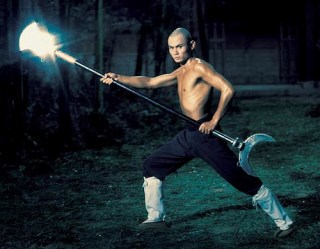 San Te is eventually learning how to use weapons, and when he finally graduates from the 35th chamber he has to prove himself in combat, first against the temple’s justice, then when he returns to the outside world and seeks vengeance. Fights both with and without weapons are imaginatively choreographed and executed with the customary speed and precision.
 100Films.co.uk