
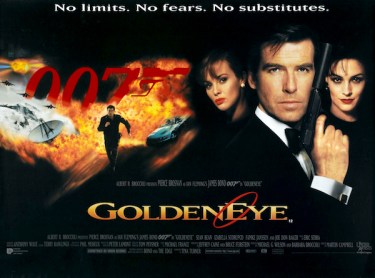
You know the number.
Country: UK & USA
Language: English, Russian & Spanish
Runtime: 130 minutes
BBFC: 12 (cut, 1995) | 15 (uncut, 2006)
MPAA: PG-13

Original Release: 16th November 1995 (Canada)
US Release: 17th November 1995
UK Release: 24th November 1995
First Seen: VHS, 1996
Stars
Pierce Brosnan (Mrs. Doubtfire, Mamma Mia)
Sean Bean (Patriot Games, The Lord of the Rings: The Fellowship of the Ring)
Izabella Scorupco (Reign of Fire, Exorcist: The Beginning)
Famke Janssen (X-Men, Taken)
Judi Dench (A Room with a View, Notes on a Scandal)
Director
Martin Campbell (The Mask of Zorro, Casino Royale)
Screenwriters
Jeffrey Caine (The Constant Gardner, Exodus: Gods and Kings)
Bruce Feirstein (Tomorrow Never Dies, The World is Not Enough)
Story by
Michael France (Cliffhanger, The Punisher)
Based on
James Bond, a character created by Ian Fleming.
The Story
When Russian crime syndicate Janus steal the activation codes for a new satellite weapons system called “Goldeneye”, there’s only one man who can stop them using it for nefarious ends: Jack Bauer. Only kidding — it’s Jason Bourne. No, ‘course not — it’s Bond, James Bond.
Our Hero
Pierce Brosnan is Bond, James Bond, for the first time. After the almost-franchise-killing seriousness of Timothy Dalton, Brosnan nails Bond for the nostalgic ’90s: a dash of Sean Connery’s grit, a dash of Roger Moore’s raised-eyebrow humour, a whole lot of suaveness. For a while, the old “Connery or Moore?” question became “Connery, Moore or Brosnan?”
Our Villain
The mysterious Janus, who (spoiler alert!) turns out to be former MI6 agent and Bond’s chum Alec Trevelyan, out for revenge against the British Empire for betraying his family after World War 2, and against Bond for setting the bombs’ timers for three minutes instead of six.
Best Supporting Character
It was a bold choice to cast a woman as M back in 1995, even though she was inspired by the real director of MI6 at the time. Fortunately they cast the inestimable Dame Judi Dench, who naturally made the role her own — so much so that she survived the otherwise series-wide reboot in 2006, and having a male in the part now feels kinda odd.
Memorable Quote
“I think you’re a sexist, misogynist dinosaur. A relic of the Cold War” — M
(If a single line saved the Bond series, it’s this. In one fell swoop Dame Judi proves that a female M will work, and that this is a franchise aware of the need to drag itself into the present day.)
Memorable Scene
The villains are driving off with the kidnapped love interest. There’s no Aston Martin in sight. Does Bond take another car? Of course not — he takes a bloody tank.
Write the Theme Tune…
Bono and The Edge of U2, hired after…
Sing the Theme Tune…
Tina Turner. According to Wikipedia, “the producers did not collaborate with Bono or The Edge,” hence why (unlike previous Bonds) there’s nothing in the main score that references the title theme. That would rather become the Bond M.O. as the ’90s went on.
Truly Special Effect
The bungee jump off the damn — because it’s not a special effect, it’s real. The Bond series’ legacy of incredible, groundbreaking stunts continues with considerable style.
Letting the Side Down
Éric Serra’s score. Hiring someone to write a very modern (for the early ’90s) score for the newly-relaunched Bond must’ve seemed like a good idea at the time… but it wasn’t. It hasn’t improved any with age, either. Tellingly, after the score was finished the producers had someone else re-score the film’s big action sequence, the St. Petersburg tank chase, with music that sounds far more classically Bondian. Bonus problem: if you had an N64 (like I did), chances are you played GoldenEye the game far more than you watched the film. It too used Serra’s score, meaning I can’t hear it without being transported back to an idyllic adolescence playing blocky video games.
Making of
Pierce Brosnan was originally cast as Bond in 1986, but was forced to pull out when his TV series, Remington Steele, was unexpectedly renewed (according to one telling, that was purely to prevent him playing Bond — they only made six more episodes). Previously, Timothy Dalton had almost been cast when Roger Moore became Bond, and Moore had almost been cast before Sean Connery. Don’t be too surprised if Henry “Superman” Cavill — who was almost cast before the producers settled on Daniel Craig — is taking his martinis shaken not stirred in a few years’ time.
Previously on…
16 previous Bond films (which are all technically in the same continuity). The last was six years earlier, and the least financially successful for 15 years in the US (did alright worldwide, though).
Next time…
Brosnan played Bond thrice more, to increasing box office (if not critical) acclaim. He was due to do a fifth, but then the producers won back the rights to Casino Royale and the rest is history.
Awards
2 BAFTA nominations (Special Effects, Sound)
2 Saturn nominations (Action/Adventure Film, Best Actor (Pierce Brosnan))
2 MTV Movie Awards nominations (including Best Sandwich in a Movie for the submarine sandwich with tomatoes and provolone. It lost to the ham and cheese sandwich in Smoke).
What the Critics Said
“James Bond, the British spy with a taste for the high life and a licen[c]e to kill, comes back in surprisingly hardy and supple form. Gadgets firing, quips racing, libido unfurling, surrounded by a top-notch supporting crew of actors, designers and demolition experts, the new Agent 007 (now played by Pierce Brosnan) delivers whatever Bond devotees could reasonably want, or what newcomers anticipate. […] So much familiarity may lead to contempt in some quarters. But Bond, like Sherlock Holmes, Jeeves, Tarzan, Frankenstein or Dracula, is one of those mythical British pop figures who seem ageless, infinitely adaptable. […] Perhaps the reason is that Bond — as his detractors have always noted — is an adolescent fantasy figure, a Peter Pan popped onto the stage of international espionage. Like Peter, he can’t — won’t — grow up. [He has] caught the world’s imagination because he played out its darker dreams with fairy-tale lightness.” — Michael Wilmington, Chicago Tribune
 Score:
 78%
78%What the Public Say
“Rarely in the Bond franchise have directing, acting, cinematography, action, and music come together to create such a stylishly sublime experience. GoldenEye has undeniably earned its now-solidified status as a classic.” — Lukas, Lukas + Film

After diminishing box office in the Dalton years, a long gap forced by legal battles, and the Cold War ending in the interim, bringing Bond back for the ’90s was perhaps a bit of a long shot. Fortunately, this fact didn’t escape the makers: there are numerous nods to Bond’s somewhat old-fashioned values (see also: memorable quote), and a whole heap of effort was expended on large-scale action sequences and stunts. Couple that with a solid storyline, several memorable villains, and a “greatest hits”-style leading performance from Brosnan, and you have a series that wasn’t just revived but was set to reach new heights (of box office, if nothing else).

Frankly my dear, #41 doesn’t give… a damn.
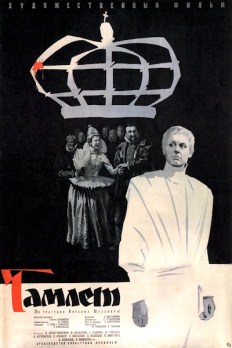 A black-and-white, two-and-a-half hour Shakespeare adaptation in subtitled Russian? No, wait, come back! Actually, don’t bother, because if you’re turned off by any or all of that description then, yeah, this isn’t for you. If you don’t object, however, then you’ll find a film that the likes of Sir Laurence Olivier, Sir John Gielgud, and Sir Kenneth Branagh have hailed as the greatest film adaptation of arguably the Bard’s most revered play.
 In the famously complex lead role, Innokenty Smoktunovsky gives a Hamlet who you really feel is more intelligent than everyone else around him — like a student fresh home from his studies, who has surpassed his parents and old acquaintances in sheer learning and attentiveness to philosophical topics, but doesn’t yet have a firm handle on his swirling thoughts. It’s possible he’s going genuinely mad with it, too, rather than the playfulness some choose to interpret in the part. Anastasiya Vertinskaya embodies sweet innocence as Ophelia, who Hamlet seems to genuinely care for, but has a poor way of showing it. Conversely, Mikhail Nazvanov makes for a somewhat neutered Claudius — he’s almost bumbling, outwitted by Hamlet but with enough innate power (he’s King, after all) to mask it. I suppose that emphasises the “student who’s outstripped his parents” point, but it doesn’t exactly make for a powerful villain. Still, different interpretations are always interesting.
 The visitation of Hamlet’s father’s ghost is another tour de force moment, the kind of visual impact that benefits not a jot from being described in text.
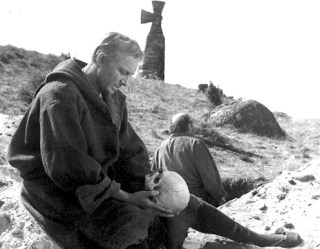 Even with the subtitle issue feeling like an obstacle to engagement, this was perhaps the most enjoyable Hamlet film I’ve seen. Maybe that’s because it has an advantage in that I’m now more familiar with the play (something which hindered Branagh’s version, as that was the first time I’d seen it), but it speaks to the film’s overall quality that it has more to offer than just Shakespeare’s words.


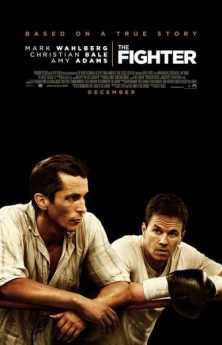 Oscar-winning true-story drama that relates the early career of boxer Micky Ward (Mark Wahlberg), a coulda-been-a-contender type held back by the training of his half-brother, ex-boxer turned drug addict Dicky (Christian Bale), and the management of his controlling mother (Melissa Leo), not to mention the cadre of harpy-ish sisters. Micky gains some confidence after entering a relationship with barmaid Charlene (Amy Adams), who’s prepared to stand up to his family. He breaks away from them and gets better opportunities, but soon realises that to win he’ll need to combine the best of both worlds.
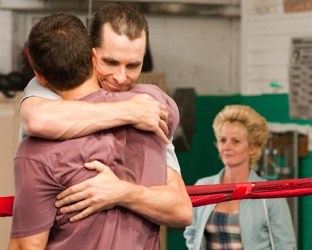 Although this is technically Ward’s story, it’s as much about his older half-brother, washed-up fighter turned part-time trainer and full-time crack addict Dicky Eklund. It’s another of Christian Bale’s extreme weight gain/loss roles (in this case, loss), but there’s more to it than such physical exertion. Bale inhabits the character, and a brief clip of the real Dicky during the credits suggests he’s done so very accurately. His performance is mesmeric and definitely worthy of that Oscar. For the rest of the cast, Amy Adams holds attention equally in a less showy role, and even Marky Mark isn’t half bad. Melissa Leo also won an Oscar for her performance, which I forgot until I read so after — it was the one she controversially funded her own ad campaign for. I guess that paid off.
 The Fighter isn’t without its faults, though. There’s a certain element of cliché to the story arc — whether that’s just fact emulating fiction, or the screenwriters imposing familiar shapes on to what really happened, I don’t know. It could also stand to lose a few minutes here and there, especially when it goes round in circles about whether Micky should be trusting his family or not. And talking of movie clichés and comparisons to other films about fighting, watching it in close proximity to
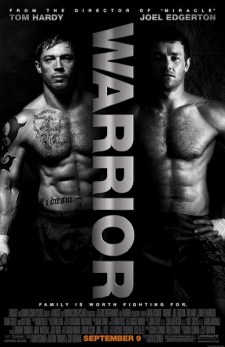 Two estranged brothers (Tom Hardy and Joel Edgerton), who’ve taken very different paths in life to escape their alcoholic and abusive father (Nick Nolte), wind up entering the mixed martial arts tournament to end all mixed martial arts tournaments, their eyes on the unprecedentedly massive cash prize — one to save his house and family, the other to help the widow of his Army chum. As they separately go up against an array of more experienced opponents, who could possibly end up in the final bout? Hm, I wonder…
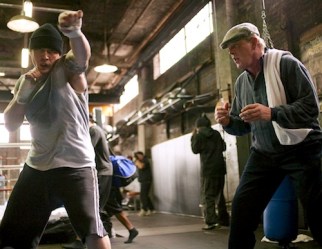 I think they’re being a bit harsh but I can see where they’re coming from. Now, I’m almost loath to give it 4 because I don’t agree with the consensus. And it’s a particularly strange consensus: everyone seems to acknowledge it’s terribly clichéd, but then give it a pass on that. Why? Why don’t you show the same leniency to the tonnes of other movies you rip to shreds for their clichés?
 though I’m not sure his character arc actually reaches any kind of ending. The rest of the cast are adequate: Joel Edgerton is decent as an upstanding family man; Jennifer Morrison has little to do as his wife; Frank Grillo is convincing as a trainer who bases his philosophy on classical music; Kevin Dunn gets some amusing moments as Edgerton’s school principal. Other people sometimes say words.
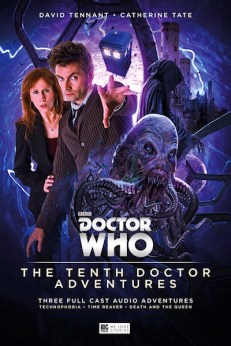 One of Doctor Who’s most popular eras is revived this week, as David Tennant returns to the headline role for the first time since
  The first is Technophobia by Matt Fitton, which is set in our recent past (and therefore Donna’s near-future) when the new M-Pad tablet computer seems to be causing the populace to forget how to use technology. Tennant and Tate hit the ground running — it’s a cliché, but it really does sound like they’ve never been away. Their sprightly performances contain little of the stilted “I’m reading this script aloud for the first time” acting that sometimes plagues audio drama. Fitton captures the style and tone of their single TV season to a tee — if they’d done a second year together, you can well believe this as its first episode. Even Howard Carter’s incidental music is a mostly-fitting substitute for Murray Gold’s iconic work.
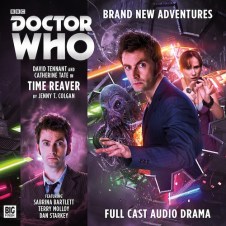 The middle tale is sci-fi adventure Time Reaver by Jenny T. Colgan, a best-selling romantic novelist who’s turned her hand to multiple Who projects (including a 10th Doctor and Donna novel published last week to tie-in with these dramas). For me, this was the weak link of the trilogy, though it’s by no means bad. There are some fantastic ideas, but at times their inspirations show through too clearly, and the execution is sometimes lacking. This was Colgan’s first audio drama, and dare I say it shows. Sequences like an action-packed barroom brawl are a little too ambitious to convey in an audio-only medium, and the dialogue is regularly forced to describe what’s going on. On the bright side, Mr Carter offers more magnificent sound design — the noises made by cephalopod villain Gully are immensely evocative.
 The final episode is the group’s historical outing, Death and the Queen by James Goss, and it may be the best of the lot. Our intrepid duo find themselves in the kingdom of Goritania in 1780, when it comes under siege from a destructive cloud that contains Death himself. Goss mixes comedy with peril in just the right quantities to create a story that is an entertaining romp but also manages to expose different facets of the Doctor and Donna’s relationship. If Fitton has bottled the essence of RTD, here Goss evokes Steven Moffat, with a time-jumping opening ten minutes that you can well imagine on TV, but which also work perfectly in audio. Things slow a bit later on, with the dialogue sometimes going in circles — a fault of all three of these plays, actually. They could’ve benefited from a trim to fit within the TV series’ 45-minute slot, rather than allowing the freedom of not having to conform to a schedule let them to slide to 55-ish.
 Ah, love a bit of Eurovision, even if the songs weren’t as good this year. Ok, you might say they never are, but there’s often one or two half-decent ones (I still listen to Conchita Wurst’s Rise Like a Phoenix sometimes, mainly because it’s the best Bond theme released in the last decade). Even then, the winner wasn’t the best of that middling bunch, though it probably had the best message. In fact, the best song of the night was the Swedish hosts’ half-time number, Eurovision-spoofing Love Love Peace Peace (watch it
 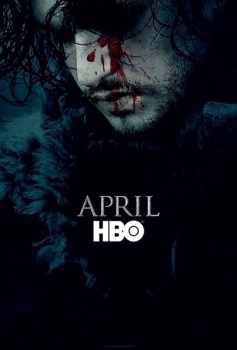 Good luck to you if you’re not watching Game of Thrones but still trying to avoid spoilers this year, with the huge and widely-covered news that [REDACTED] was [REDACTED], or that [REDACTED] killed [REDACTED], or when [REDACTED] and [REDACTED] were [REDACTED] for the first time since [REDACTED], or when [REDACTED] was [REDACTED] but [REDACTED] the [REDACTED] and [REDACTED] of [REDACTED] in the process — even if more people seemed interested in discussing her [REDACTED]s.
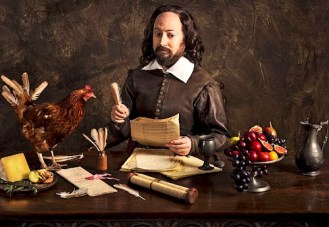 I can’t remember the last time I saw a new multi-camera sitcom that wasn’t either, a) a bit meta (like Miranda or Mrs Brown’s Boys), or b) a revival (like Red Dwarf X). I don’t know if that says more about the current TV landscape or the kind of things I watch, but either way it surprised me when that was the form Upstart Crow took. It’s just one element that gives it the feel of Blackadder, which I don’t mean as a criticism. Even if it feels a little dated in its execution, there are plenty of laughs — some easy, some clever — and, really, what more do you want from a comedy than to laugh? It may not be up to Blackadder’s highest highs (yet — there’s still time; you never know), but I’d wager it stands fair comparison to the classic’s comparatively-lesser instalments… which I mean to be a less critical assessment than it sounds.
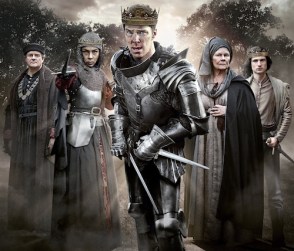 This month, I have mostly been missing the second run of The Hollow Crown, the BBC’s all-star adaptation of Shakespeare’s War of the Roses plays… though as I still haven’t got round to watching the first run from 2012, that’s no real surprise. In fact, Upstart Crow aside, I’ve not yet watched any of their still-running

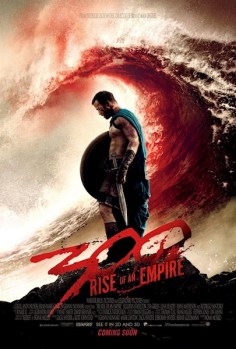 Taking place before, during, and after the events of Zack Snyder’s surprise-hit graphic novel adaptation
 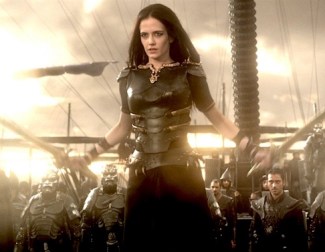 It’s also terribly obvious that it was shot for 3D. I’m not normally one to criticise a film for that — I think when some critics know a film is being released in 3D they see that in its shot choices, even if they’re perfectly valid choices for 2D. But Rise of an Empire screams that it was made for 3D from the start, with all manner of things thrust towards the camera, usually in slow motion, and the constant explosions of blood (to call them squirts or sprays implies a more liquid-like quality than they actually possess) which go nowhere else but camerawards. Presumably the only reason it’s not an 18 for violence is because it’s all so bloody silly.

 We’re now on to the 13th film in the Marvel Cinematic Universe, and while you don’t need to have seen all 12 preceding movies to follow the events of Civil War, you do need at least four — and, to get everything, a further four or five beyond that. (Don’t worry about the four TV series — it’s increasingly clear that they’re only notionally connected to the movies.) So the Marvel model for a “shared universe” is not discrete stories that take place in the same world, but a series of ever-more-connected narratives. It’s working for them, though, as the continually stellar box office totals prove.
 As complicated as the plot sounds once you start trying to succinctly summarise it, Civil War is easy to follow as it unfurls. In fact, it’s to its credit that it can’t be readily summarised in any more detail than “Cap and Iron Man disagree; fight” without really getting into it. Screenwriters Christopher Markus and Stephen McFeely have followed up the political thriller of Winter Soldier with another global thriller storyline, again bringing different genre textures to the superheroics that are nonetheless present and correct. The film’s style mixes in just the right amount of realism — no one’s pretending this isn’t a comic book movie, with some elements of comic book logic and a casual acceptance of people having world-changing powers; but if such people did exist, this is the kind of way they would be handled by the authorities.
 Well, maybe. But the debate is partially stalled by the fact this is a Captain America movie rather than an Avengers one. Yeah, you can side with Tony Stark & co, but you know Cap’s going to come out to the good, one way or another. As it pans out, it’s not a total victory (Team Cap are all now fugitives, presumably until
  On that visceral level, there are a couple of stunning action sequences. The car/foot chase between Cap, Bucky and Black Panther is fantastic, casually throwing in cool moments like the way Bucky steals a motorbike. The climactic two-on-one fight is also a sight, throwing in strong choreography and seamless effects work to create a battle that has a real ebb and flow, a back and forth over who has the upper hand. And the centrepiece of it all, of course, is the two teams facing off at the airport. For fans of superheroes, this is pretty much the ultimate expression of the genre yet brought to live-action moviemaking. For my money, the antics of Ant-Man — and Giant-Man — are by and large (pun very much intended) the best bit of it, but maybe I’m just
  “hey, remember that foreign prince who was Black Panther? He lives in a foreign country… where he’s Black Panther!” Other than that, it’s kinda important to answer the question of “hey, what happened to Bucky?” next time Cap turns up. So why isn’t the scene just in the film? Well, it is in the film — just after a few of the credits — so what does it matter, right?
 In the end, Civil War leaves plenty open for future Marvel movies. Well, of course it does — half the time MCU movies are feature-length trailers for the next MCU movie. Where Civil War is really clever, however, is that it does that stage-setting while also feeling conclusory. As the third part in the Captain America trilogy, it actually makes a pretty satisfying end to that narrative. As the third part in the “trilogy in five parts” that is The Avengers trilogy, well, it’s clearly not the end, but it’s a fairly discrete segment.
 100Films.co.uk