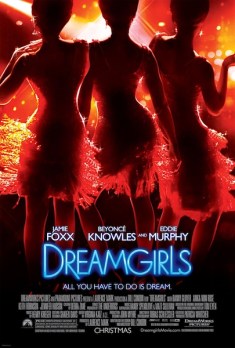
Dreamgirls (2006)

2015 #195
Bill Condon | 130 mins | streaming (HD) | 2.35:1 | USA / English | 12 / PG-13

Oscar-winning adaptation of the stage musical that doesn’t tell the story of the Supremes in fictionalised form, no sir.

Jamie Foxx is the ambitious car salesman who transforms a trio of black soul singers into a crossover hit by replacing chunky lead Jennifer Hudson with sexy Beyoncé Knowles. Personal issues dog the girls’ career, as Foxx becomes megalomaniacal, leaving early successes like R&B star Eddie Murphy in his wake.

Despite oddities, like diegetic performances being replaced part way by characters breaking into song, and questions over the story’s adherence to fact, the film is a compelling (if heightened) character drama.

4 out of 5

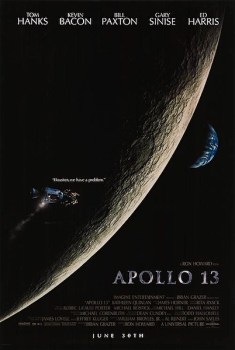
Apollo 13 (1995)

100 Films’ 100 Favourites #4

“Houston, we have a problem.”

Country: USA
Language: English
Runtime: 140 minutes
BBFC: PG
MPAA: PG

Original Release: 30th June 1995 (USA)
UK Release: 22nd September 1995
First Seen: cinema, 1995

Stars
Tom Hanks (Philadelphia, Saving Private Ryan)
Bill Paxton (Tombstone, Twister)
Kevin Bacon (Footloose, The Woodsman)
Gary Sinise (Forrest Gump, Snake Eyes)
Ed Harris (The Right Stuff, The Truman Show)

Director
Ron Howard (Willow, A Beautiful Mind)

Screenwriter
William Broyles Jr. (Cast Away, Flags of Our Fathers)
Al Reinert (For All Mankind, Final Fantasy: The Spirits Within)

Based on
Lost Moon, a true-story book by Jim Lovell & Jeffrey Kluger.

The Story
The third manned mission to land on the Moon launches to little public interest… but that all changes when an accident cripples the spacecraft. Not only will the three astronauts on board not be landing on the Moon, but they might not be able to make it back to Earth…

Our Hero
Everybody — from the three men who may die in space, to the spurned astronaut who locks himself in the simulator to find a solution, to the dozens of mission commanders and tech guys who work round the clock to keep the astronauts alive and bring them home.

Best Supporting Character
The whole cast are pretty great, but Ed Harris really earnt his Oscar nomination as the commander in Mission Control, Gene Kranz. (See also: memorable quote, below.)

Memorable Quote
NASA Director: “This could be the worst disaster NASA’s ever faced.”
Gene Kranz: “With all due respect, sir, I believe this is gonna be our finest hour.”

Memorable Scene
After surviving days in space on dwindling power, slingshotting the craft round the moon, and adjusting course last-minute to actually aim at Earth, the crippled remains of Apollo 13 enter the atmosphere. There will be three minutes of radio silence before they know if the astronauts have survived reentry. Everyone watches and waits. Silence. Three minutes is reached. Silence. Three minutes thirty seconds passes… In the command center, at the astronauts’ home, at Jay Lovell’s school, everyone waits. Four minutes passes… Goodness, it’s shamelessly manipulative filmmaking, but if your hair isn’t on end and you aren’t practically on your feet cheering with everyone else, you truly are immune.

Technical Wizardry
Gravity used a shedload of groundbreaking tech and computer graphics to simulate zero-G. 20 years earlier, Apollo 13 wasn’t so lucky, so how did they do it? In part, for real. Sets were built inside NASA’s (in)famous ‘Vomit Comet’, an airplane that flies in parabolic arcs to give astronauts an experience of zero-G, but only for 23 seconds at a time. With such a small window, shots to be achieved were carefully planned out, and cast and crew endured over 500 arcs in 13 days to film the necessary footage.

Truly Special Effect
The lift-off sequence, a combination of models and CGI without a single frame of stock footage, is iconic. For me, at least, the shot tracking down the side of the craft as the supports pull away is as indelible an image of an Apollo launch as any documentary footage.

Letting the Side Down
Two decades on, some of the CG effects (especially on Earth) are beginning to show their age. (The model work still looks grand, though.)

Making of
According to Ron Howard in a 20th anniversary interview, Tom Hanks was cast because they thought he was the actor the world would most want to save.

Next time…
The film was followed by 12-part HBO series From the Earth to the Moon, which tells the entire story of the US’s quest to put a man on the moon, from the creation of NASA to the end of the Apollo programme. It’s really good.

Awards
2 Oscars (Sound, Film Editing)
7 Oscar nominations (Picture, Supporting Actor (Ed Harris), Supporting Actress (Kathleen Quinlan), Adapted Screenplay, Art Direction-Set Decoration, Visual Effects, Original Score)
2 BAFTAs (Special Effects, Production Design)
3 BAFTA nominations (Cinematography, Editing, Sound)
1 Saturn nomination (Action/Adventure Film)
Nominated for the Hugo for Best Dramatic Presentation.

What the Critics Said
“In the end, this failed mission seems like the most impressive achievement of the entire space program: a triumph not of planning but of inspired improvisation.” — Terrence Rafferty, The New Yorker

Score: 95%

What the Public Say
“filmmakers combined elements most go to the movies for — drama, comedy, suspense, thrills, and tug of the heart. After reading Lost Moon I’ve come to appreciate the William Broyles Jr. and Al Reinert screenplay the more. Given the archival detail Lovell and Kluger documented, getting a good portion of it into a 140-minute movie was its own remarkable feat.” — le0pard13, It Rains… You Get Wet

Verdict

What could have been one of the US space program’s greatest tragedies turned out to be one of its greatest successes, a sensation that is conveyed by Ron Howard’s thrilling rendition of events. The film is too emotionally manipulative for some palates, but by and large it works magnificently for me. Bonus points are earnt for rejecting sycophancy in favour of depicting the people involved as human beings who endured and triumphed in extraordinary circumstances.

#5 will be… reached at 88mph.

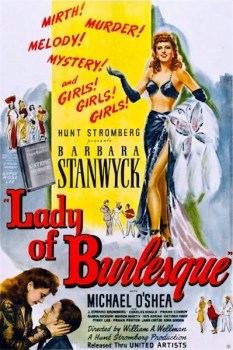
Lady of Burlesque (1943)

2016 #5
William A. Wellman | 89 mins | streaming | 4:3 | USA / English | PG

Based on the novel The G-String Murders by Gypsy Rose Lee (as in Gypsy), Lady of Burlesque stars Barbara Stanwyck as Gypsy surrogate Dixie Daisy, a performer in a burlesque show in New York where the backstage arguments turn murderous.

The story unfurls in the traditional Christie-esque shape of a murder mystery: we find out all the different reasons why everyone hates a particular character, then that person dies and they all have motive. For set dressing, instead of the English country houses and other upper-middle-class establishments of Christie, we have the slightly seedy, slightly risqué world of ’40s burlesque… tempered by the strictures of the production code, of course. Stanwyck may get out on stage and wiggle around, but she’s largely shot from the waist up; and it may’ve been released as Striptease Lady in the UK (allegedly), but the clothes remain on (I can’t imagine anyone expected anything else, then or now).

Nonetheless, the world of the story adds some sparkle to proceedings. The investigations are largely confined to a couple of lengthy scenes when the cops turn up, led by Charles Dingle’s meticulous Inspector Harrigan (“This is my first experience with burlesque. It’s a surprising profession.”), and question everyone in one room. These bits have their moments, but feel a little heavy-handed. Around them, the world of burlesque, and the relationships between its performers, rolls on.

Stanwyck carries the film, both on stage and off. Her “will they/won’t they (of course they will)” romance with Michael O’Shea’s comic is kept aloft by her biting ripostes to his advances, and when a comedy sketch is interrupted by backstage noises she saves the day by breaking into song, doing the splits, a cartwheel, and the Cossack dance in quick succession. Not bad for a 36-year-old!

Ostensibly a murder mystery, in practice Lady of Burlesque plays as all-round entertainment with a bit of everything: comedy, romance, songs, shoot-outs, and, yes, both mystery and murders. It’s not the kind of film that will linger long in the memory (apart from Stanwyck’s gymnastics, that is), but it’s entertaining while it lasts.

3 out of 5

This review is part of the Remembering Barbara Stanwyck Blogathon. Be sure to check out the many other fantastic contributions collated by host In the Good Old Days of Classic Hollywood.

Ender’s Game (2013)

2015 #146
Gavin Hood | 114 mins | streaming (HD) | 2.35:1 | USA / English | 12 / PG-13

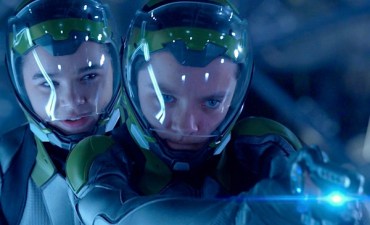
Adapted from the classic young adult sci-fi novel by Orson Scott “bigoted idiot” Card, Ender’s Game is the story of Andrew “Ender” Wiggin (Asa Butterfield), who displays uncommon aptitude in a military programme to train children to fight against an alien race that attacked Earth decades earlier. Sent to a training centre in space, Ender must battle his fellow candidates to prove their worth to their hardened commander, Colonel Hyrum Graff (Harrison Ford), ready for the real battle to come.

Ender’s Game endured a pretty mixed reception a couple of years ago (not helped by the media exposure given to Card’s less-than-savoury personal views), and it’s quite a mixed film: for every positive, a negative follows close behind. It’s not helped by its first act, where the film seems to struggle with its own setup. After that, however, it’s a fairly well structured story, in which you can actually believe Ender is learning to be a better leader. Normally when a movie features “an excellent military strategist” we’re told that and never shown it, but here we see how Ender’s skills as a strategist develop and are exhibited.

The rest of writer-director Gavin Hood’s screenplay is, again, a mixed bag. The dialogue is frequently clunky, particularly struggling with exposition — there are utterly dead scenes where characters just explain the plot to each other — but, while it is at no point strong, it’s often serviceable. There are strong themes, however, several of which have relevance to our modern world. Unfortunately, none feel fully developed or explored. It tips its hat to things like drone warfare, child soldiers, and understanding our enemy, but that’s all it does: acknowledge those parallels exist, then refuse to explore them. Conversely, the music is too heavy-handed, taking on the burden of providing emotion that’s lacking from the screenplay.

Most of the cast are very good. Asa Butterfield well conveys a moderately complex character, though I can believe others’ comments that Ender is more fully developed in the book. Hailee Steinfeld and Abigail Breslin offer able support; Harrison Ford proves he’s still awesome; Ben Kingsley battles what turns out to be a New Zealand accent (I’d assumed it was South African) in a cameo-sized turn; Viola Davis is ludicrously underused — she does basically nothing, then walks into Ford’s office and essentially declares, “I am no longer needed by the plot, I quit.”

At least there are solid action/sci-fi thrills on offer. The inter-student practice fights in the Danger Room (or whatever it was called) are really good — suitably exciting and fun, with impressive effects work. There are many good visuals in the film, but then strong CGI is par for the course these days. That’s why the space station stuff is best: the alien race and their planet are well-realised but also feel like nothing new; and the space station’s corridors, offices, and bunk room sets are well done, though as derived from familiar real-life and/or near-future styles as much as many other SF movies; but the station’s giant glass-walled zero-G training arena is stunning.

Sadly, after all that training fun, once the cadets jet off to the other side of the galaxy for a rushed third act, interest evaporates speedily. It even has to work hard to sell its own twist as a twist! (Spoilers follow in this paragraph.) In a simulation for a war, Ender does what he’d do to win that war. Then he’s told it wasn’t a simulation, it was the actual war… and he’s all cross. I mean, okay, the fella kinda has a point when he gets angry afterwards: they’ve lied to him, and maybe he would’ve behaved differently if he’d known. But the point of the training was to teach them what they needed to do to win, and it taught them that, and he did it. Maybe this twist works in the book, but in the film it felt somehow unearned.

Ender’s Game is not all it could be, but as a straightforward young-adult sci-fi action-adventure, I really rather enjoyed the majority of it.

4 out of 5

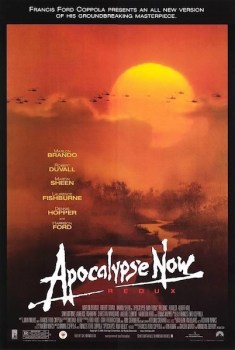
Apocalypse Now Redux (1979/2001)

100 Films’ 100 Favourites #3

Francis Ford Coppola presents an all new version of his groundbreaking masterpiece.

Original Title: Apocalypse Now (obviously)

Country: USA
Language: English, French & Vietnamese
Runtime: 202 minutes (theatrical/DVD) | 196 minutes (Blu-ray)*
BBFC: 15
MPAA: R

* This appears to be due to the Blu-ray removing the end credits, but the number of disc reviewers who haven’t even noticed the discrepancy is remarkable.

Original Release: 15th August 1979 (USA)
UK Release: 19th December 1979
Redux Release: 11th May 2001 (Cannes) | 23rd November 2001 (UK)
First Seen: DVD, c.2002

Stars
Martin Sheen (Badlands, The Departed)
Marlon Brando (A Streetcar Named Desire, The Godfather)
Robert Duvall (THX 1138, The Godfather)
Dennis Hopper (Easy Rider, Speed)

Director
Francis Ford Coppola (The Godfather, The Conversation)

Screenwriters
Francis Ford Coppola (Patton, The Godfather Part II)
John Milius (Conan the Barbarian, Red Dawn)

Based on
Heart of Darkness (loosely), a novella by Joseph Conrad.

The Story
In the middle of the Vietnam war, burnt out soldier Captain Willard is given a top-secret mission: locate US Army Colonel Kurtz, who’s gone renegade and is leading his own personal army in unauthorised attacks, and terminate his command. Travelling up the river on a Navy patrol boat, its crew unaware of Willard’s goal, they see snapshots of the war and the elements of human nature it exposes — the very horrors that drove Kurtz insane…

Our Hero
Martin Sheen is Captain Benjamin Willard — not exactly a hero, but certainly the narrator. Already mentally wracked by his experiences in Vietnam, he may not be the best person to send after another officer similarly mentally afflicted…

Our Villain
Marlon Brando — top billed, only on screen for minutes, and a nightmare to work with… but another performance for the ages as the rambling, insane, but insightful, Colonel Kurtz.

Best Supporting Character
A Golden Globe, a BAFTA, and an Oscar nomination rewarded Robert Duvall for his turn as the commander of a helicopter unit, Lt. Col. Kilgore. More than that, though, was true immortality in the form of the movie’s most famous quote: “I love the smell of napalm in the morning.”

Memorable Quote
Colonel Lucas: “When you find the Colonel, infiltrate his team by whatever means available and terminate the Colonel’s command.”
Willard: “Terminate the Colonel?”
General Corman: “He’s out there operating without any decent restraint, totally beyond the pale of any acceptable human conduct. And he is still in the field commanding troops.”
Civilian: “Terminate, with extreme prejudice.”

Memorable Scene
The sound of unseen helicopters circle. The Doors playing. A pretty forest… which explodes into flame, under the barrage of a napalm attack. One of the most iconic opening scenes.

Technical Wizardry
Apocalypse Now was one of the films that pioneered the creation of surround sound, now the industry standard. Nowhere is it better exemplified than in that opening scene, with the helicopters circling the room.

Making of
“My movie is not about Vietnam, my movie is Vietnam.” Apocalypse Now was a notoriously troubled shoot, for all kinds of reasons, from an uncooperative Brando, to Martin Sheen’s heart attack, to the cast and crew’s copious drug use… Originally scheduled to shoot for six weeks, it ended up filming for 16 months, and took nearly three years to edit.

Awards
The original version won 2 Oscars and 2 BAFTAs, and was nominated for 6 more Oscars and 7 more BAFTAs. In 2002, the Redux was nominated for 7 World Stunt Awards.

What the Critics Said
“this might be the most audience-friendly art-house film ever made, and that’s where the sheer majesty of Coppola’s daredevil balancing act comes into true focus. Coppola’s art is stripped of pretension; what lies on screen may as well be Coppola’s — and probably several other peoples’ — heart, laid bare for all to see, somehow expressed through arguably the most populist of all mediums. It may be messy, but it’s also vivaciously alive.” — Rob Humanick, Slant

Score: 93%

What the Public Say
“The most critically acclaimed movie of 2001 was made 22 years ago… The new material isn’t entirely necessary, and some may find it excessive… But Redux’s virtues far outweigh its flaws. Apocalypse Now in any version remains one of the richest, most extravagant moviegoing experiences of my life.” — Jeffrey Overstreet, Looking Closer

Verdict

The first (and, indeed, last) time I watched Apocalypse Now was shortly after the Redux version had been released, when Francis Ford Coppola was busy proclaiming it was the only version that would be made available ever again. That didn’t last, of course. Adding some 49 minutes of footage to the praised theatrical version, Redux divides viewers and critics on whether the extensions make a classic even better or just dilute it. If there’s a consensus, it’s that in either version this is a great movie. I’ve never got round to the original cut to compare for myself, so it’s the longer one that makes my list. My favourite quote about it comes from Danny Boyle: “It’s imperfect; which every film should be.”

#4 will be… the 13th.

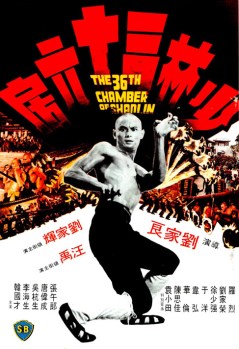
The 36th Chamber of Shaolin (1978)

aka Shao Lin san shi liu fang / Master Killer

2016 #6
Liu Chia-liang | 111 mins | streaming (HD) | 2.35:1 | Hong Kong / Mandarin | 15 / R

Widely regard as one of (if not the) greatest kung fu movies ever made, The 36th Chamber of Shaolin introduces us to San Te (Gordon Liu), a student whose hometown is oppressed by forces of the ruling Qing dynasty. He and his classmates join the underground resistance run by his teacher, only to wind up witnessing his friends and mentors be hunted, tortured, and killed. Faced with a similar fate, San Te escapes to the Shaolin Temple, widely known for being home to the best kung fu around. The temple’s monks refuse to teach martial arts to normal folk, nor help by joining the fight — they’re Buddhists, after all. Nonetheless, San Te manages to inveigle his way in to their company, and years of training begin.

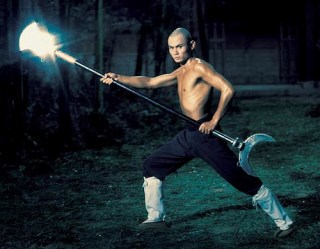
Said training — where San Te must progress through the Shaolin Temple’s 35 (not 36) chambers one by one — makes up the bulk of the film, though there are lengthy bookends dealing with the reason he goes there in the first place and what he later does with that training. If the notion of watching chamber after chamber after chamber (times 35) sounds dull, don’t worry, we only actually see ten of them, and several of those via an extended montage. The chambers take the form of challenges, which San Te must overcome by either puzzling them out or developing some kind of physical or mental acuity. Their content is varied and innovative, which makes them engrossing to watch even as they make the film episodic, but the nature of the challenges makes the movie different from the usual fight-after-fight-after-fight structure of kung fu flicks.

If it’s combat you want, though, never fear: everybody is kung fu fighting at regular intervals. Displays of physical skill and speed are de rigueur for these kind of films, but the combat here is as impressive as any. While the initial training takes the form of tangentially-related skills tests, San Te is eventually learning how to use weapons, and when he finally graduates from the 35th chamber he has to prove himself in combat, first against the temple’s justice, then when he returns to the outside world and seeks vengeance. Fights both with and without weapons are imaginatively choreographed and executed with the customary speed and precision.

Much as you won’t enjoy many a musical if you can’t accept people just bursting into song, you won’t enjoy many a kung fu movie if you can’t accept a story told primarily through back-to-back action sequences. The 36th Chamber of Shaolin is more-or-less that kind of movie, though the differing styles of the chambers’ challenges bring pleasing variety. Is it the greatest kung fu film of all time? I’m no expert, but it’s certainly inventive, masterfully performed, and suitably different from any such movie I’ve yet seen.

4 out of 5

The 36th Chamber of Shaolin is on Film4 tonight at 10:55pm. It kicks off a short season of martial arts movies — more details here.

Alan Rickman, 1946—2016

I rarely break from reviewing on this blog, but I think I can afford such a courtesy to Alan Rickman.

In part this is because, after I heard the news, I realised he’s been a constant presence throughout my film-loving life. I adored Robin Hood: Prince of Thieves as a kid, when the American accents didn’t matter and it was a glossy big-budget extravaganza. I watched it a few years ago, and it no longer looks glossy, big budget, or particularly extravaganza-y, but Alan Rickman shines as arguably the best Sheriff of Nottingham ever to grace the screen.

Then there’s the role that has obviously defined him for a generation: Professor Severus Snape in the Harry Potter series. I’m sure casting the Potter films must’ve been a tricky business, but Rickman as Snape was one of those choices where you just think, “well, obviously.” A pretty one-dimensional character to begin with (The Mean Teacher), Snape has a significant and complicated role as the series goes on, and is probably the most nuanced character in it by the end. Having an actor of Rickman’s ability involved was obviously beneficial.

And as I got older still, there was Die Hard. His film debut at age 42, and the film that will always define him for many, but (again) it’s a magnificent performance, a definitive villain. Pretty much every action-thriller villain for the next, what, decade? more? is really a rip-off of Hans Gruber, however all portrayed by whichever British actor was currently available.

Those are just three keystones in a sea (mixed metaphor much) of fantastic movies and excellent performances that have been scattered throughout my viewing life: the Spock-ish thespian in Galaxy Quest; the punk-y angel in Dogma; the voice of Marvin the Paranoid Android in The Hitchhiker’s Guide to the Galaxy film (another spot of perfect casting); the adulterous(?) husband in one of Love Actually’s strongest yet most divisive stories. Several of these films are to come on my 100 Favourites; several more were in contention; and, in every case, a significant reason for their presence was Alan Rickman’s performance.

And if you ever forget that life isn’t fair, remember this:

So we've lost 69-year-olds Bowie, Lemmy (ok 70-year-old) and now Alan Rickman – but Donald Trump is still with us.

Alien (1979)

100 Films’ 100 Favourites #2

In space, no one can hear you scream.

Country: USA & UK
Language: English
Runtime: 117 minutes | 116 minutes (director’s cut)
BBFC: X (1979) | 18 (1987) | 15 (director’s cut, 2003)
MPAA: R

Original Release: 25th May 1979 (USA)
UK Release: September 1979
First Seen: TV, c.2002

Stars
Tom Skerritt (Top Gun, Poison Ivy)
Sigourney Weaver (Ghostbusters, Galaxy Quest)
John Hurt (The Elephant Man, Nineteen Eighty-Four)
Ian Holm (Greystoke: The Legend of Tarzan, Lord of the Apes, The Lord of the Rings: The Fellowship of the Ring)

Director
Ridley Scott (Blade Runner, Prometheus)

Screenwriter
Dan O’Bannon (Dark Star, Total Recall)

Story by
Dan O’Bannon (see above)
Ronald Shusett (King Kong Lives, Total Recall)

The Story
The crew of the deep-space towing vessel Nostromo receive a distress call from an unexplored planet. Contractually obliged to respond, they find a derelict alien spaceship and a field of strange eggs. With one of the crew taken ill they return to their ship, but it soon becomes apparent something else has come with them…

Our Hero
Sigourney Weaver is second-billed as second-in-command Ellen Ripley, but it’s she who’s the voice of reason and, when ignored, the most capable to stand up to the alien threat.

Our Villain
The Alien, aka the Xenomorph, an ugly, dripping, phallic nightmare, that lurks in the shadows, strikes without warning, has the perfect defence system, and is nigh-on unbeatable.

Best Supporting Character
Ian Holm’s Ash is not all he appears to be… Holm made sacrifices for his art: he hates milk, but had to sit dribbling it from his mouth for take after take.

Memorable Quote
“I admire its purity. A survivor… unclouded by conscience, remorse, or delusions of morality.” — Ash

Memorable Scene
Dinner table. John Hurt not feeling well. You know the rest. And if you don’t, you don’t want me spoiling it for you.

Technical Wizardry
The Nostromo’s industrial-style production design is a world away from the slick, shiny spaceships of contemporary sci-fi like Star Trek. A lived-in sci-fi world wasn’t something new (Star Wars and the Millennium Falcon were two years earlier, for instance), but the notion of a spaceship that looks like a factory or an oil-rig or somesuch, and that is populated by the kind of people who would work in such an environment, continues to influence the genre today.

Truly Special Effect
The Alien, designed by H.R. Giger, built by Giger and Carlo Rambaldi, performed by Bolaji Badejo, is one of the most genuinely alien creatures the movies have ever generated. It’s terrifying, too, even after the initial disgust has been neutered by decades of over-exposure in increasingly-poor sequels and tie-ins.

Making of
The name of Weyland-Yutani, “the company” the crew work for, is actually “Weylan-Yutani”, as seen on monitors and Dallas’ beer can. It was changed to “Weyland-Yutani” for Aliens (and all subsequent films and media) because James Cameron thought it looked better with the D. It’s the little things, eh.

Next time…
Three direct sequels, two “vs Predator” spin-offs, a prequel (and a prequel-sequel), and a massive array of novels, comics, video games, and the rest. A new sequel is also in development.

Awards
1 Oscar (Visual Effects)
1 Oscar nomination (Art Direction-Set Decoration)
2 BAFTAs (Production Design, Sound Track)
5 BAFTA nominations (Supporting Actor (John Hurt), Film Music, Costume Design, Editing, Most Promising Newcomer to Leading Film Roles (Sigourney Weaver))
3 Saturn Awards (Science Fiction Film, Director, Supporting Actress (Veronica Cartwright))
4 Saturn nominations (Actress (Sigourney Weaver), Writing, Make-Up, Special Effects)
Won the Hugo for Best Dramatic Presentation.

What the Critics Said
“It’s tempting to describe the brilliantly staged scenes of horror and surprise but it would be a shame not to allow the film to reveal its own secrets. Enough to say that the tension is savage and you are held in suspense right up to the end frames.” — Ted Whitehead, The Spectator

Score: 97%

What the Public Say
“in some ways it doesn’t betray its age, and it does indeed largely still hold up, but in other ways its utterly unlike contemporary films. Its middle-aged cast, its slow, deliberate pace, the ‘real’ sets grounded in reality, how it leaves so many things unexplained — in these respects it’s obviously an older movie, and better for it.” — the ghost of 82

Elsewhere on 100 Films
I reviewed Ridley Scott’s 2003 Director’s Cut back in 2009, summarising that “to fans intimately familiar with the film, the number of trims (there are rather a lot apparently) and new scenes (just four) make a huge difference, but for a more casual viewer they don’t significantly change how it feels. That said… I’d call the original as the superior cut.”

Verdict

Ridley Scott’s “haunted house movie in space” is one of those works that an awful lot of what follows in the genre owes a debt to, from the production design to one of cinema’s most iconic heroines. “Iconic” is a good word for the film as a whole, be it the realisation of the creature or scenes like the chestburster. Quite beyond that, however, it’s a terrifying horror movie in its own right, where slowly-built tension gives way to proper scares. Being a great of one genre is an achievement, but to be great in two at the same time (horror and sci-fi, of course) is something else.

#3 is not about Vietnam… it is Vietnam.

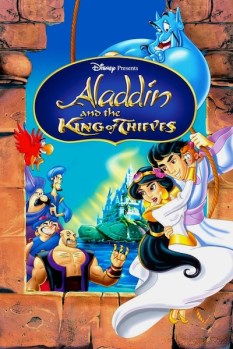
Aladdin and the King of Thieves (1996)

2015 #196
Tad Stones | 82 mins | streaming (HD) | 16:9* | USA / English | U

For most of the ’90s and ’00s, Disney churned out direct-to-video sequels to many of their most beloved animated classics. They have a reputation for being unremittingly awful, hence why Pixar’s John Lasseter put a stop to their production after he became Disney’s Chief Creative Officer in 2006. Despite that reputation, however, there are those who say one or two are actually quite good. One of those (and the only one I’ve previously seen) is The Lion King 1½ (released as The Lion King 3 in the UK), which is a sort of a Rosencrantz and Guildenstern Are Dead to the original film’s Hamlet, re-telling the story from the perspective of Timon and Pumbaa. I saw it years ago but would vouch for its relative quality — when I first re-watched The Lion King after, I briefly thought some scenes were missing, which I guess is testament to how well it fits.

Another such-praised sequel is this follow-up to Disney’s 1992 Animated Classic. It’s actually the second sequel (the first was also the first of those Disney DTV sequels) and also follows an 86-episode TV series. Fortunately, the makers dropped an early idea to use one of the series’ main villains as the film’s antagonist, and so it functions perfectly as a direct sequel to the original movie. Which is nice, because that first sequel isn’t meant to be very good and I imagine the TV series is hard to come by nowadays. Plus, neither of those can claim an ever-so-important distinction that this can: it features the return of Robin Williams as the Genie.

The film begins on the wedding day of Aladdin (Scott Weinger) and Jasmine (Linda Larkin), which is interrupted by the mysterious Cassim, the King of Thieves (John Rhys-Davies), and his gang of forty thieves seeking to steal an oracle from among the wedding gifts. Although they fail, the oracle informs Aladdin that the answers he seeks about his long-departed father are to be found with the forty thieves… I expect you can guess where that’s going. Fortunately the film gets there pretty quickly, then transitions into a story about the possible redemption (or not) of Cassim alongside the quest for the Hand of Midas, capable of turning whatever it touches into gold (natch).
The King of Thieves has a few things in its favour. It’ll come as no surprise that the biggest and best is Williams reprising his iconic performance, and consequently being responsible for most of the film’s humour. There are a couple of fun nods to some of Williams’ other best-remembered roles, and plenty to other Disney films too. The rest of the film offers a fast-paced, action-packed narrative, with a few musical numbers to boot. The songs are certainly not as memorable as those found in proper Disney movies, but most are decent while they last. Jasmine gets somewhat short shrift, but this is really a story about father and son.

Those who dislike Disney’s Aladdin won’t find anything to enjoy here, but for fans of the original, Aladdin and the King of Thieves is a solid, fun follow-up.

4 out of 5

* The film was made for release on VHS, so it’s no surprise that the OAR is 1.33:1. The HD version is cropped for 16:9. It’s mostly alright, though anyone with an eye for composition will find it obvious at times. ^

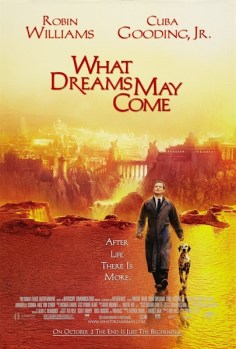
What Dreams May Come (1998)

2015 #129
Vincent Ward | 114 mins | streaming (HD) | 2.35:1 | USA & New Zealand / English | 15 / PG-13

When What Dreams May Come first came out, the reviews seemed to conclude that it was rubbish, but at least visually splendid. Back in 1998, that put me off — “it’s not meant to be very good” was the takeaway thought there. As the years have gone on, for some reason those reviews (or possibly just one I extrapolated into a consensus, who knows?) stuck with me; and as my temperament as a film fan grew, that it was visually extraordinary (even if nothing else) began to seem reason enough to watch it. It lingered in the back of my mind, never quite becoming a “must see”, especially as the opportunity rarely (if ever) presented itself. So that’s more or less how I come to it now, 17 years since its release and those reviews — a long-awaited scratch of a long-lingering itch. (Perhaps this gives some insight into why/how it takes me so long to get round to watching recommendations/things I’m quite keen to see/etc.)
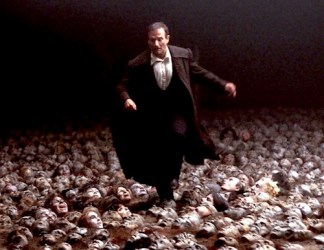
Adapted from a novel by Richard “I Am Legend” Matheson, the story concerns Dr Chris Nielsen (Robin Williams) and his wife Annie (Annabella Sciorra). Their perfectly lovely life is shattered when their two kids are killed in a car crash. Despite Annie suffering a mental breakdown, they hang in there… until Chris is killed in another car crash a few years later. He ascends to a kind of Heaven, a wondrous place controlled by his imagination — this is where those visuals come in. However, Chris learns that Annie has committed suicide, and so been condemned to Hell. He vows to do what has never been done, and travel to Hell to rescue her.

Hell, incidentally, also looks incredible, as do the various locales visited by Chris and his companions (played by Cuba Gooding Jr and Max von Sydow) on their way there. Director Vincent Ward and his team have created a rich, engrossing visual space here. It’s not just the Oscar-winning visual effects either, which create Chris’ initial realisation of Heaven as a kind of living painting, but also the locations, their decorations, and some fantastic sets. The design work is brilliant, and the vast majority of it still holds up today. Even the CGI doesn’t look glaringly like 17-year-old graphics, and in many cases what I presume is a mix of live action, models and some CGI is far more effective than the all-CG look it would likely have if made today.
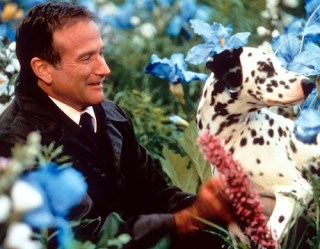
However, the story is… problematic. Its logic comes and goes (the afterlife’s rules have to be obeyed or are able to be broken depending on the situation, for instance), it goes on too long, with too many asides, and there are needless twists, reveals, and reversals that are neither surprising (thanks to their ultimate predictability) nor illuminating (thanks to their unnecessariness). There were too many flashbacks and asides to real life, and I’d have liked it more if it stuck to the afterlife stuff — cut the flashbacks, limit the story to the afterlife quest, and stop mirroring it in the couple’s earlier real-life troubles. That would make the movie shorter, more streamlined, less wishy-washily sentimental, more focused, and therefore better.

Nonetheless, some will identify with the sentimental “love transcends death”-type message more than others, and there’s a chance those who like (or don’t mind) their films to be at the soppier end of the spectrum will genuinely love it. For the rest of us — for anyone who likes visual splendour in their movies, anyway — it does indeed merit a look for the imagery alone.

3 out of 5