David Ayer | 135 mins | Blu-ray | 2.40:1 | USA, UK & China / English & German | 15 / R
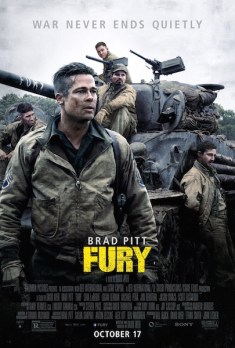 I don’t believe there are very many movies about tanks — there’s Kelly’s Heroes (which, I must admit, I only know of thanks to ghostof82’s review of the film currently under discussion), and I’ve heard Lebanon’s very good, but no others spring readily to mind. I suppose there are sound production reasons for this, to do with getting bulky movie cameras into tiny spaces and the logistics of choreographing tank battles. The dearth of other films on the same topic automatically gives Fury, about an American tank crew in the closing months of World War 2, something of a leg up in the memorableness stakes.
Specifically, we follow the crew of a tank nicknamed ‘Fury’, commanded by ‘Wardaddy’ (Brad Pitt), driven by ‘Gordo’ (Michael Peña), the cannon manned by ‘Bible’ (Shia LaBeouf), and Grady (Jon Bernthal) is the mechanic or something (I’m not really au fait with what jobs there were in a tank, this is just what I managed to glean from the film itself). After the co-driver is killed, this team who have been together for years are forced to accept a new member, Norman (Logan Lerman), who was trained to type 60-words-per-minute and, apparently, not much else. What follows is a mix of exciting action, men-at-war character drama, war-is-hell imagery, and something of a battle for the soul of the innocent new kid.
In some respects, then, Fury is a bit “seen it all before”. The desaturated photography, muddy landscape and slightly-ramshackle military campaign are all very post-Saving Private Ryan, though writer-director David Ayer lends enough of his own directorial flair that it feels more visually distinctive than most Ryan rip-offs. The “battle for the soul” story dates back at least as far as Platoon, but the thing is, it’s fertile ground. Here you’re contrasting men who’ve been fighting this tough war for years, who are accustomed to its brutality, with someone fresh to the fight, whose ideals haven’t yet been replaced by the practicalities of conflict.
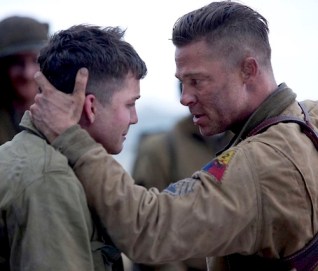 Most of the characters exist in a moral grey area, something which some reviewers seem to struggle with. From the off, our ostensible heroes are not shown in a particularly pleasant light, committing or encouraging acts we would view as unconscionable. As the film goes on, it seems like we’re being invited to bond with them, to respect or admire them. I’m not sure that’s a wholly accurate reading of it, though. I think we’re being shown different sides to them — much as Norman is, in fact. At first you see the depths they have reached; then, as you get to know them, you see a little more of their true (or at least their pre-corrupted-by-war) characters. Does this redeem them or excuse their actions? Well, that’s your decision. I don’t think the film is predicated on you coming round to their way of thinking. Without meaning to spoil anything, it’s not as if the meta/karmic world of plot construction lets them off scot-free by the end. Of course, whether we need our focus characters to be clean-cut heroes or whether complex morally-grey/black characters are preferable is another debate.
One of the advantages is that you can never be sure what the characters are going to do. Arguably the film’s strongest sequence comes after the tank column Fury leads has captured a town. The men are given some time off before they advance, which naturally means drinking, destroying German property, and whoring. While Bible reads and Gordo and Grady persuade a woman back to the tank to ‘share’, Wardaddy spies a woman (Anamaria Marinca) hiding at an upstairs window and drags Norman up with him. Inside, they find the woman and her pretty younger cousin (Alicia von Rittberg). As Wardaddy settles in, you have no idea what he’s going to do. He’s being nice, but does he mean it? Where is this going? No spoilers, but the unfolding scenes are among the film’s strongest; and as Wardaddy, Norman and the two women sit down to a meal, the rest of Fury’s crew arrive, kicking off one of the most uncomfortable mealtime scenes outside of a Tarantino movie. 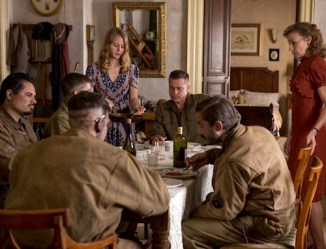 This is a scene most reviews seem to single out, I’ve since realised, but that’s for good reason: even watching it cold, the powerful writing, direction and performances mark it out as a sequence that transcends the movie it’s in. Again, it’s the unpredictability of what these men might do; the grey area of the guys we’re meant to think are the heroes not always being heroic.
For the viscerally inclined, Fury has much to commend it also. The aforementioned scarcity of tank battles on screen means almost every action sequence feels fresh and unpredictable, and Ayer stages them with requisite excitement and tension, too. The highlight is probably a three-on-one tanks-vs-tank fight that shows the might of the German opposition. The climax, in which the five men hole up in their mine-scuttled tank to take on literally a whole battalion of SS troops, is possibly too over-the-top for a movie that’s otherwise pretty realist in its aims, though even this is reportedly inspired by a real incident. Ayer again makes a fair fist of it seeming plausible, at least.
Beyond that, this is a very brutal depiction of war, to an almost horror movie level at times. Instructed to clean the tank on his arrival, Norman finds half the previous driver’s face lying inside; a man burning alive chooses to shoot himself in the head; various other limbs and faces explode as the movie goes on. Do we need to see such graphic detail? The old fashioned “get hit and fall over” style of being shot has clearly had its day, but do we need more than, say, a spurt of blood? Some would argue not. Some would argue part of the point is this ugliness, this inhumanity — it happens, or happened, and so it should be there; we shouldn’t be glorifying it by sanitising it. Nonetheless, at times Fury is a particularly extreme example of depicting the realism of violence, and some won’t feel up to stomaching it.
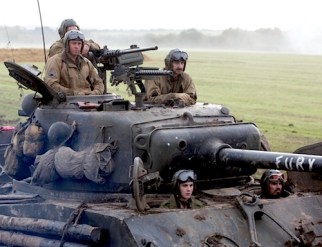 I think Fury is a rather rewarding movie for those that can, though. The fact it provokes debate is no bad thing — I think it’s a misinterpretation to read the film, as some online commenters clearly have, as “these guys do horrible things, but they’re the main characters and the not-Nazis, so I must be meant to like them, so the film is bad”. Well, I suppose it’s not news that some people struggle with cognitive dissonance. On the flipside, I don’t think you’re meant to outright hate them — there’s an element of “the Allies did bad things too, y’know” about the film, but that’s not its sole aim. I think it’s more complicated than that, and, naturally, all the better for it. Even on a more surface level, though, there’s adrenaline-pumping excitement to be had from the well-realised action scenes. It’s a combination that worked very well indeed for me, and if my score errs on the side of generosity then, well, consider it redressing the balance.

Fury debuts on Sky Movies Premiere today at 3:45pm and 8pm.
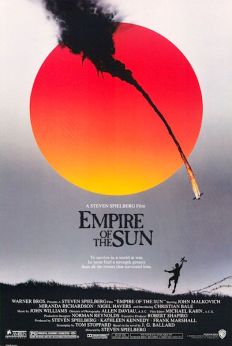 Steven Spielberg’s adaptation of J.G. Ballard’s semi-autobiographical novel stars a 13-year-old Christian Bale as Jim, the son of British ex-pats in China when the Japanese invade during World War II. Separated from his family as they try to flee, Jim encounters born survivor Basie (John Malkovich) and, when they wind up in an internment camp for the rest of the war, a cross-section of the rest of the left-behind. To Jim, a somewhat naïve but capable, confident and determined endurer, the whole thing is a big adventure; we can see the truth, though: that it’s a grim slog of life and death, and most succumb to the latter. The reality of the situation gets to Jim in the end, too… but maybe I’m getting ahead of myself.
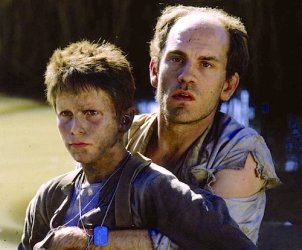 As it stands, the film is a fascinating insight into a less-often-covered aspect of the war. Even in small roles, the quality cast keep it watchable and relatable. Bale’s performance comes in just the right side of annoying — quite an achievement for a character who seems inherently brattish and prone to irritate.
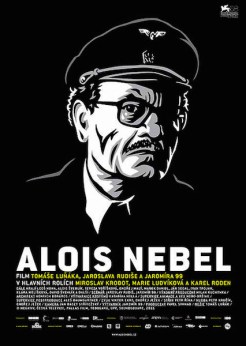 A Czech noir animation, set around Christmas 1989 to the backdrop of the country’s Velvet Revolution. Eponymous character Alois Nebel is a train station guard whose flashbacks to an event at the end of World War 2 see him sectioned, though possibly for other nefarious purposes. Having lost his job, he travels to head office in Prague to try to reclaim it, where he meets a ragtag gang of social misfits. Finally returning home, the mystery of what happened 44 years earlier may be resolved…
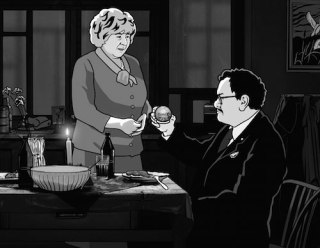 Perhaps the whole film is Deeply Thematic, then? It may be to do with the country moving on and making peace with its past, seen in a microcosm in the actions of Nebel (moving past the flashbacks, having new experiences, finding love, etc) and the people around him (finally getting revenge for something that happened nearly half a century ago). Maybe that’s all more clear if you know the Czech mindset, or the history of the Velvet Revolution. The second post in
 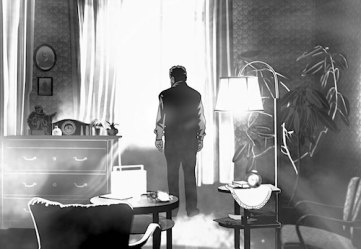 With some attractive black-and-white animation and a sporadically engaging mystery plot, Alois Nebel is far from meritless. However, its firm grounding in a wide spread of Czech history and attitudes suggests it may be best suited to those already well-versed in that country’s history and culture.
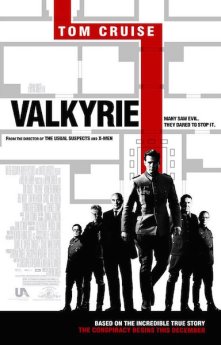 After abandoning the X-Men franchise for a
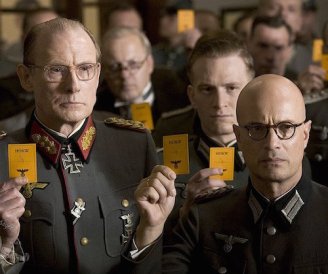
 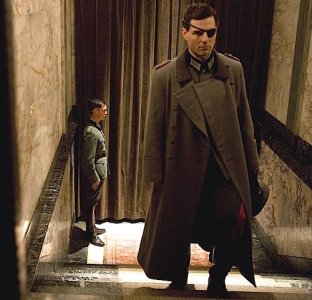 One of the stated aims of the conspiracy is to show the rest of the world that not everyone in Germany believed in what Hitler and his inner circle were doing. It may have taken us a long time to realise that, for fairly understandable reasons, but quality films like this help get the message out. Singer has crafted a proper thriller here, replete with scenes of edge-of-your-seat tension. Many a filmmaker can’t manage that with a fictional storyline, never mind one where we know exactly how it turns out.
 but nor is he in simplistic action hero mode.
 the visual, audio, acting and plot styles of the era, why not ensure the dialogue and action follow suit? There’s no need for the violence, sex and swearing in this particular tale; at least, no need for it in a way that couldn’t be conveyed as effectively using Production Code-friendly methods. I’m uncertain if I like the film less for failing on this measure, but it does add to its inherent oddness.
 But how much do we get to know them, really? It’s easy to see why critics said “not very well”, because they’re too busy uncovering the conspiracies and revealing their part to actually show us much about themselves. But then why should that be a problem? It’s a noir thriller, not a character drama. Surely it’s about the mysteries and, if you like, the themes, rather than letting us understand the people caught up in them?
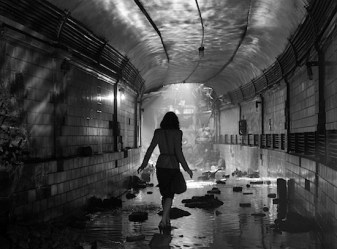 production intentions rather than being invented to slot into them — provides meat on the stylistic bones.
 Alternate histories are always fun, and nothing seems to have provoked more than the Second World War. Which, as a defining event in modern history for a good chunk of the world, is understandable. It Happened Here is perhaps one of the earliest examples, depicting a 1940s Britain under Nazi occupation.
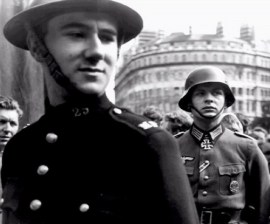 namely, the quiet but methodical enacting of The Final Solution in an occupied territory. The whole film builds to this point, gradually showing the darker and deeper levels of cooperation — which starts out almost harmless and ends with organised mass murder — meaning it never feels like Brownlow and Mollo are pushing an agenda too hard, but still confront us with the reality: that we’d probably succumb too, and this is where we’d end up.
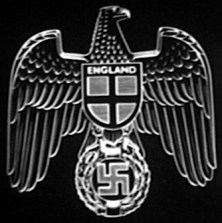 Another controversy arose over the villains being British collaborators — few German Nazis are seen — and the ease with which many agreed. But this is based in the facts of what occurred in other occupied territories; maybe Britain’s plucky spirit would’ve shown through, as many like to believe, or maybe many would have caved for the easier life — or, indeed, life at all. The film is examining several perspectives of occupation, and using the fictional context to good effect: this could have happened, the film says, however much we like to believe we wouldn’t have collaborated like (and/or resisted better than), say, the French.
 Nonetheless, It Happened Here is more anti-Nazi than pro-Nazi propaganda, in my opinion, though it’s easy to see why any material critical of the Allies could have outweighed the overall bias when the film was first released, just 20 years after victory in Europe. Generally, and viewed from a much more removed perspective, Brownlow and Mollo do a good job of offering conflicting perspectives with minimal comment, allowing the viewer to decide how ridiculous certain newsreels or opinions are, or how weak or misguided characters may or may not be — on both sides.
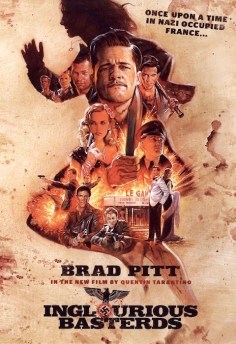 Watching almost any film a second time can affect your opinion of it. It could reveal deeper levels of character or theme; it could allow you to see how the writer(s) subtly foreshadowed events, or built up to the big twist; it could be you spot jokes you were too busy laughing during last time; it could let you look at the imagery now you don’t have to concentrate so hard on the subtitles. Or it could reveal shallowness, that there’s nothing to be gleaned that you didn’t get the first time; or highlight the holes in a plot that seemed so well constructed before; or jokes that were hilarious fall flat when heard more than once; or the action sequences aren’t exciting when robbed of their freshness. A second viewing can reveal that you were too young to get it the first time, or that you’re now too grown up to enjoy it; it can reveal a bad movie isn’t so bad, or that without the hype it’s actually quite good; it can raise a favourite even higher in your estimations, or it can tear it down. And even if a second viewing just reaffirms exactly what you felt the first time, well, when there’s such a chance for change and it doesn’t occur, that’s an effect in itself.
 — and, today, a year since its UK release —, having watched it a second time to refresh my memory. But has it changed my opinion?
 only instead of being one thing once he does it again and again, with any trick he fancies, throughout the film.
 The ending (and skip this paragraph if you haven’t seen the film) is the key to that, as I’m sure you either noticed or have read in other coverage. The power of cinema literally destroys the Nazis, changing the course of the war. Killing Hitler — and the rest — is one of those barmy notions that at first seems wrong, and then seems completely right. “If my characters had existed, this is what would have happened” is one of those genius notions that seems so inescapably obvious you wonder why no one’s done it sooner. Why do you necessarily need to obey history if the rest of your story is fiction anyway?
 (I believe more of the film is subtitled than in English), did little to endear it to the complaining masses who thought they were getting “
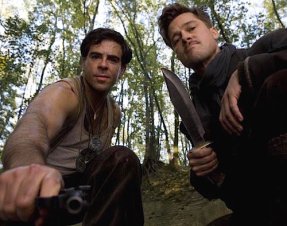
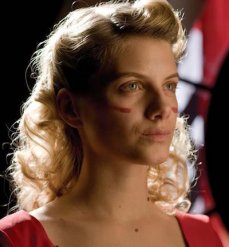 And for all those constantly-introduced characters, the acting is top notch. Christoph Waltz easily deserved the huge pile of awards he garnered, his quirky persona following in a long tradition of calm psychopaths in movies. You always know his pleasantries hide something far nastier; every scene he appears in is instantly tense. Mélanie Laurent is an instant one-to-watch as the film’s real central character, Shosanna, though she seems to have been sadly sidelined by all the praise heaped on Waltz. It doesn’t hurt that she’s the kind of woman you’d happily decorate a whole review with pictures of (though you’ll note I resisted). Michael Fassbender is the very definition of Englishness, without quite slipping into an irritating stereotype. It’s difficult to imagine the originally-cast Simon Pegg in the role, though I’m sure he would’ve brought something… shall we say, different… to it. Brad Pitt’s much-criticised heavily-accented performance is fine. While not as memorable as the others mentioned, I don’t see why some have had such a problem with it.
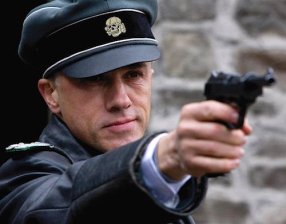 Til Schweiger’s vicious German basterd; Diane Kruger’s glamorous, calm actress-spy; Daniel Brühl’s apparently sweet accidental hero and movie star-to-be; Martin Wuttke’s raving loony Hitler; and others too. Perhaps the only duff note for me was Mike Myers as an English General. I liked the
  every once in a while, but it also proves they work, that he was right to employ them.
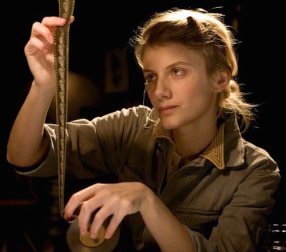 care-free deployment of an abundance of film-specific techniques, and, both through this and also directly in its narrative, its love of film as a medium — Inglourious Basterds isn’t just “a Quentin Tarantino film”, it is Quentin Tarantino. His choice of final line — “You know something, Ultivich? I think this just might be my masterpiece” — is clearly about more than Aldo Raine’s swastika-carving abilities.
 Is 1945-1998 actually a film? Or is it a piece of video Art? Or just another online video?
 attention didn’t already wander, that is). There are ultimately so many flashes and bleeps, and the effect is so lulling, that I had to force myself to remember these represented Big Nasty Bombs that were Not A Good Thing. Perhaps something more aurally grating would’ve been appropriate; the counter argument going that this would cause even more viewers to abandon the work.
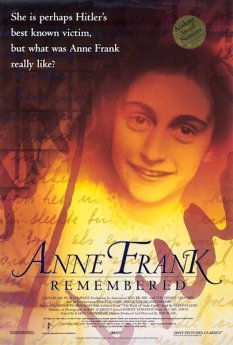 Anne Frank’s is arguably the best-known individual story of the Holocaust, perhaps because the diary of a 13-year-old girl in hiding from the Nazis — and, sadly, eventually captured by them — makes a perfect gateway for young people into learning about those atrocities.
 What if the Americans made a movie of Winston Churchill’s life, prone as they are to re-write World War 2 history to show they won it all by themselves?
 100Films.co.uk