The Past Month on TV #60

I suppose lockdown is officially over now, for good or ill, but we begin this month’s TV review by reliving those heady days…

Staged  Series 1
StagedThis filmed-in-lockdown comedy stars David Tennant and Michael Sheen as they attempt to rehearse a play over the internet, the goal being they’ll be ready to put it on as soon as theatres reopen. Naturally, there’s much more to it than two actors practising a play — indeed, I’m not sure they ever actually get round to any proper rehearsing. Conflicts abound, both broadly relatable (Sheen is blackmailed into helping look after his elderly neighbour, but develops genuine concern for her) and actorly (a running debate/gag about which of the pair should get top billing), and there are a couple of big-name surprise cameos along the way (no spoilers — the surprises are worth it). With all episodes in the 15- to 20-minute range, the series is hardly a big time commitment (it runs well under two hours in total), but it’s well worth it and consistently funny. Indeed, I wish there was going to be more. Well, a second lockdown isn’t out of the question yet, is it…

Lockdown may be over, but Staged is still available on iPlayer.

Hamilton’s America
Hamilton's AmericaThis documentary first aired back in 2016, in the wake of Hamilton’s success on stage. I’m not sure if it’s ever been screened in the UK, but I tracked down a copy after watching Hamilton on Disney+. So, firstly, I’m glad I didn’t watch this before seeing the film — I feel like it would’ve somehow ruined, or at least tarnished, the experience of seeing the full production, because this contains extensive-but-far-from-complete clips from the show. I guess, back in 2016, when the only way to actually see Hamilton was by securing hard-to-come-by, insanely-expensive Broadway tickets, getting to see those clips was probably great for fans.
Aside from that, the documentary is part making-of (it follows lyricist, composer, and leading man Lin-Manuel Miranda starting in 2014, when he’s writing the musical with an impending rehearsal deadline, and then continues on to cover the show’s opening and success) and part history lesson (various cast members and experts discuss the real events and visit relevant historical locations to learn more about their characters). Rather than half-arse either of these aspects, the feature-length running time allows the doc to offer genuine insights into both. For just one example, there’s a bit where they discuss the issue of the Founding Fathers being slave owners, and although it’s only a couple of minutes long, it contains more intelligent commentary than the entire bloody social media debate about it that the film’s release provoked.

It’s a real shame this isn’t on Disney+ to accompany the film, because I think a lot of people who’ve enjoyed that would enjoy this as a chaser. It’s definitely worth a watch if you can track it down.

Star Trek: Picard  Season 1 Episodes 9-10
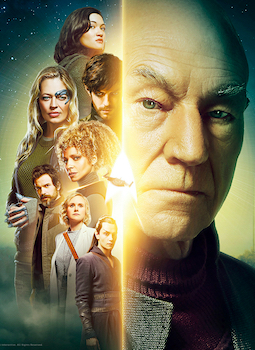
Star Trek: PicardI started this when it began in January, and have been slowly trekking through it ever since — it’s taken me six whole months to get through just ten episodes. That’s a commentary in itself as to what I thought of it, I suppose, though if you asked me I’d say it’s “not bad”.

From what I’ve seen of other people’s reactions, Picard seems to be a real “love it or hate it” show. A lot of people I read and/or whose opinion I respect either can’t stand it or find it thoroughly mediocre, but there are definitely people out there — more than an odd handful, apparently — who think it’s fantastic. As often seems to be the case with something so divisive, I find myself somewhere in the middle. After a rocky start (the first three episodes should’ve been condensed into one feature-length opener, at most), I felt the series settled down reasonably well, with a couple of almost-standalone episodes of varying quality eventually giving way entirely to its arc plot, which from then was executed with a relative consistency of pace — a major problem with many “one long story” streaming series nowadays. The quality of the dialogue and acting remained somewhat turbulent, which perhaps belies the franchise’s roots as predating “prestige TV” — what’s acceptable for Star Trek doesn’t necessarily wash with the modern sophisticated non-die-hard-fan viewer.

That said, for every scene or plot development that worked well, there was something truly ridiculous or implausible just around the corner, with the finale being one of the worst offenders. Some might say “it’s sci-fi — implausible is its stock in trade”, but even sci-fi has rules, and Picard seemed to merrily flout them, often in the name of fan service. And that’s why I end up somewhere in the middle, because overall I thought it was a solid-enough space adventure, undermined by frequent blips in quality and sense. I believe the writing team is undergoing some significant changes ahead of the already-commissioned second season, so maybe they’ll iron out the kinks.

Fleabag
Fleabag (the play)I’ve never got round to Phoebe Waller-Bridge’s much-acclaimed sitcom, but, during lockdown, Amazon offered the original one-woman-show stage version (recorded last year during a live cinema broadcast) as a charity rental, so I thought I’d see what the fuss was about. My reaction was… muted, to be honest. I can certainly see how it pushes at boundaries, both of the depiction of women in fiction and of taste in general, and for that reason it’s significant, but I only found it sporadically funny, which makes it somewhat unsatisfying as a comedy. Also, I wasn’t expecting it to get so dark — if you’re a lover of small furry animals, beware.
James Acaster: Repertoire
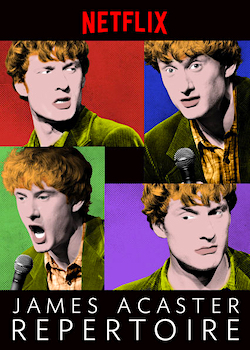
James Acaster: RepertoireAnother filmed stage comedy that left me somewhat underwhelmed. This is more straightforward stand-up, however, and as that it was more often amusing — whether you find Acaster’s “wacky” style (his word) to your taste will dictate exactly how funny. For me, he’s not the most consistently hilarious standup I’ve seen, but provoked laughs regularly enough. The real selling point here, however, is that it’s a four-parter. Ever heard of a multi-part stand-up gig before? Me either. These aren’t just four entirely independent gigs box-set-ed up either, but were conceived and shot as four connected sets.
Despite that high-concept pitch, it turns out the four-part structure isn’t particularly clever after all. The cross-episode callbacks are sometimes good and clever, but sometimes just elicit recognition (accompanied by an “I got that reference!” laugh from the audience). It’s not anything unique to the four-part structure — plenty of other comedians structure their standalone shows in the same way. The only differences are (a) if you watch it in four sittings then some of the callback are to a different episode rather than something earlier in the same set, and (b) it’s three-and-a-half hours of material, all of which were all performed on the same day, which is a remarkable feat. Otherwise, the connectivity is basically limited to episode 4 ending in such a way as to imply it’s ‘set’ before episode 1, including a cleverly staged final shot. But, unless I missed something, the other episodes don’t line up in such a way that 2 must follow 3 and 4 must follow 3, so it doesn’t create some kind of ouroboros loop, which I guess was the kind of structural inventiveness I was looking for.

Overall, Acaster is whimsically amusing — not my favourite standup, but solid with some excellent bits — and the sheer volume of material at a sustained quality level is impressive. But I don’t buy that this miniseries structure is innovative In any way except volume. And I can’t help but wonder if, had he condensed these 205 minutes into a normal 60- to 90-minute set, it might’ve felt like a higher density of pure gold.

The Twilight Zone  ‘Best Of’
After a few months spent scraping the bottom of what the original Twilight Zone has to offer, it’s back to the cream of the crop. (At this point you may be wondering “how many episodes can he reasonably class as ‘the best’?!” My final answer is: the top third. Yes, that’s quite a broad definition, but I like to be generous. For what it’s worth, today’s selection gets me to 20.5% on my consensus ranking.)

Where is Everybody?This month’s selection begins at the very beginning: the first-ever Twilight Zone episode, Where is Everybody? The title alone is a pretty succinct pitch of the episode’s theme, and the episode is as one-note as its premise. This is an exciting story in which a bloke… gets himself coffee, and… talks to a mannequin, and… tries to phone the operator but can’t get through, and… has an ice cream, and… yeeeaaah. The twist ending isn’t much cop either, 50% “it was all a dream”, 50% a thin moral about humans’ need for companionship. It could’ve been better: Rod Serling’s original pitch for episode one was a tale about a society where people were executed when they turned 60, which I think is a better concept, but it was deemed too depressing (imagine what they would’ve made of Logan’s Run, where the executions happen at 30!) That said, “everybody’s gone” is a reasonable starting idea, but the episode needs (a) more places to go with it, and (b) a more interesting reveal. (See The Quiet Earth for essentially the same premise being more thoroughly explored.)

Next is one of the very few Twilight Zone episodes that doesn’t have a sci-fi or fantastical element (apparently there are only four such instalments). The Silence concerns a wager between an old rich dude and a talkative guy at his club: if the latter can manage to stay silent for a whole year (while under constant observation, natch), the former will pay him $500,000 (equivalent to over $4 million in today’s money). What the episode really asks is how far would — could; should — you go to win (or keep) half-a-million dollars? Whatever your answer, the episode gives us a very dark version, primarily because of the ending — in traditional TZ fashion, there’s a twist (or two) and no one comes out of it well. Although it’s less allegorical than the series’ usual fantastical episodes, there’s no less of a lesson to be learned.

Conversely, some Twilight Zone episodes feel like a concept without a plot, and The Odyssey of Flight 33 is one of them. It concerns a transatlantic flight that finds itself in some weird midair phenomena, and to say where it goes would be to spoil the only card this episode has up its sleeve — as Oktay Ege Kozak of Paste puts it, the episode is “a light sci-fi rollercoaster ride” without “a clear sociocultural theme or complex existential narrative”. To be less kind, it’s a nice idea but the story doesn’t have anywhere to go with it — it doesn’t even end, just sort of peters out. Conversely, Matt Singer at ScreenCrush argues the ending is “an unsolved mystery [with] total ambiguity, which makes it … that much more disturbing.” Despite that, I actually think is one of those rare episodes that would’ve worked better with season four’s extended running time. Most of the story is set in the plane’s cockpit with its crew, but we meet a couple of the passengers, only for the episode to do nothing with them. At least if their reactions had been fleshed out, maybe there would’ve been more meat here.

Nightmare as a ChildI’ve written before that some episodes suffer from the series’ own influence, or just from an ensuing 60 years of sophistication on the part of the viewer, and Nightmare as a Child is a case in point. It has two reveals, and they’re both not so much guessable as obvious and inevitable. There’s even a bit of a coda to thoroughly explain it all again in case you didn’t get it. Maybe that was necessary back in 1960, when stories like this were breaking new ground in the audience’s minds, but today it feels like overkill. However, I wouldn’t say it’s a bad episode — indeed, the story of a woman meeting a strange little girl who seems to know an impossible amount about her life is still suitably eerie and tense in places — but it is one that plays less effectively today. That said, if you engage with it not as a mystery with a surprise but as simply a story, it has more to offer — Kozak compares it to “a tightly wound Hitchcockian thriller/murder mystery”, while Scott Beggs of Thrillist reckons it “replaces the usual slow burn of horrifying realization with tense, immediate danger” while it “confronts memory and PTSD in a fascinating way”. They’re not wrong.
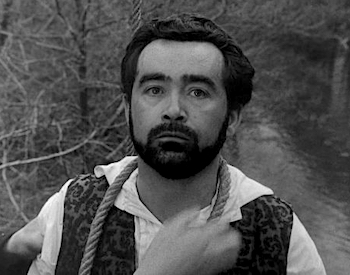
Another episode with a tricky-to-parse twist is Third from the Sun. It’s a famous one — I won’t directly spoil it here, but I feel like the title gives it away rather. But, a bit like Nightmare as a Child, the episode is saved by being rather good even without the ironic final note (indeed, Kozak reckons the twist is “unnecessary… cheap and immediately predictable”). It’s about two families who, aware that nuclear annihilation might be imminent, try to escape, but a suspicious government figure potentially stands in their way. It’s a decent little tale of Cold War paranoia, but the twist probably is a little distracting. It reshapes what we’ve already seen, and explains some of the deliberate oddities in direction and set dressing, but it sort of doubles back on itself because the characters are now heading into the situation we thought they were in in the first place…

More successful, for my money, is And When the Sky Was Opened, about a pair of pilots of an experimental spaceship that crashed on its return to Earth — except one of the pilots maintains there used to be three of them, but no one else can remember him. A bit like Flight 33, there are no overt morals or explanations to be found here, just a lot of mystery and madness. Unlike Flight 33, I thought it had enough of that to fuel the narrative, leaning in to how the unexplainable phenomena affects the characters. It’s a neat little sci-fi tale — and, incidentally, is based on a story by Richard Matheson, making this his first credit on the series. I know in some circles Matheson is rightly exalted, but I feel like he’s not as widely known as he deserves — Serling gets much of the credit for TZ’s success, but several of the very best episodes are by Matheson.

An Occurrence at Owl Creek BridgeHaving begun today with Twilight Zone’s first episode, we end with the last one produced — although they didn’t actually produce it. An Occurrence at Owl Creek Bridge is an award-winning French short film that Serling saw and liked so much he bought the TV rights (saving so much money on the cost of producing another episode that he brought season five in on budget). Even if Serling didn’t point out its alternate origin in his introduction, it’s immediately clear this came from somewhere else, because it doesn’t look or feel at all like a normal TZ episode. So what made Serling think it would fit the show? Why, it has an ironic last-minute twist, of course! This is regularly one of the best-regarded episodes of the series, and the short film itself has a pretty strong rep too, but I don’t get it. There’s some pretty photography and the beginning is fairly atmospheric, but it quickly starts to drag — the story is thin and slow, ending with a twist that I found inevitable from early on.

I feel like I’ve been quite negative on this month’s selection of episodes, but that’s only because I have very high standards for The Twilight Zone. Owl Creek Bridge was the only one I truly disliked, while The Silence and And When the Sky Was Opened are definitely deserving of their higher reputation.

Also watched…
  • Elementary Season 6 Episodes 15-21 — I guess the threat of cancellation hung over Elementary’s head as this season ended, because it very much gets to a place they could’ve left it if necessary. It’s one of those “that’ll do”-type endings, though, so I hope to find the final, foreshortened seventh run does a better job.
  • Jonathan Creek Series 2 — I didn’t remember this second series as vividly as I did the first, but it still has some very fine and baffling mysteries. Particular highlights include a man seen on two continents at the same time, and a priceless painting stolen from a closely-watched empty room.

    Things to Catch Up On
    CursedLast month, I didn’t include this section because I couldn’t think of anything to put in it. Naturally I then spent the next couple of days remembering things, like the recent re-adaptations of Alex Rider on Amazon and Snowpiercer on Netflix. Obviously, I still haven’t watched either of those. More recently, Netflix launched Cursed, a young adult (I think) take on Arthurian legend from the point of view of the Lady of the Lake. I’m not wholly convinced by the trailers or buzz, but I do love a bit of Arthurian whatnot so it’s on my radar. Also passingly of note is that Amazon just released season three of Absentia. I started out moderately enjoying the first season, but by the end was not at all impressed. I was surprised when it got a second run, so I’m even more flabbergasted to see it back for a third. I guess someone must be watching it. Each to their own.

    Next month… the second season of Netflix’s superhero show The Umbrella Academy is out soon, but as I never got round to season one, I doubt I’ll do season two next month. Elsewise, more of the best of The Twilight Zone, and I really should get round to The Mandalorian (how long’s it been now?!)

  • Searching (2018)

    2019 #51
    Aneesh Chaganty | 102 mins | digital (HD) | 16:9 | USA & Russia / English |
    12 / PG-13

    Searching

    When his 16-year-old daughter Margot goes missing, David Kim (John Cho) does the most logical thing in this day and age: he turns to her computer and social media to try to work out where she’s gone. What Searching does to really sell this concept is place us inside the tech: everything we see takes place on the screen of computers, be it searching the internet, chasing leads via video chat, or compiling evidence in spreadsheets.

    It’s a conceit that is clearly innovative, but also feels like it has the potential to grow old fast. After all, it’s inherently limiting, and if the filmmakers tried to coast on the novelty factor, you’d probably grow bored within the first half-hour. Fortunately, Searching has more to offer. Indeed, long before you’ve had a chance to become fed up with the unique storytelling method, you’re absorbed in the narrative.

    It works on two fronts. There’s a degree of commentary on modern society and parent/child relationships, as David begins to discover all the things Margot has been hiding from him, realising he didn’t know his daughter as well as he thought he did. In some respects this is nothing new — we’ve had decades of films and TV dramas where parents discover their perfect little darling isn’t who they thought — but here it’s cannily updated for the social media era.

    Searching the web

    Secondly, it’s an engrossing mystery. Director Aneesh Chaganty uses the visual concept perfectly to help craft a storyline with compelling characters that keeps us thoroughly engaged. Pleasingly, the film never breaks its own rules, instead finding new ways to use the limitations to tell the story. The only possible misstep comes in the final act, when some developments begin to succumb to Movie Logic and get a bit grandiose for the previously-grounded film. But the array of twists here actually had me on the edge of my seat, and, really, what more do you want from a thriller than that?

    Searching is the kind of film you come to thanks to its USP, your interest piqued by seeing how they can tell a story under such limitations; but what makes you stay, and want to come back, is how well it tells that story. It’s not unconventional for the sake of it, but a new and very timely way of viewing a narrative.

    5 out of 5

    Searching is available on Netflix in the UK from today.

    It placed 6th on my list of The 15 Best Films I Saw For the First Time in 2019.

    The Old Guard (2020)

    2020 #162
    Gina Prince-Bythewood | 125 mins | digital (UHD) | 2.35:1 | USA / English | 15 / R

    The Old Guard

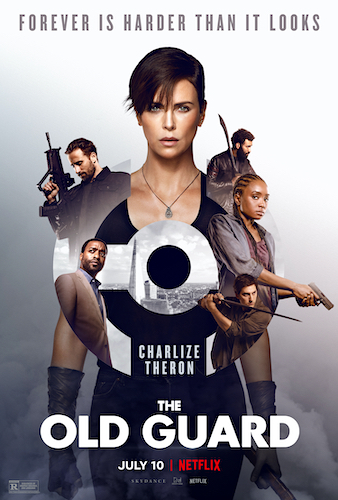
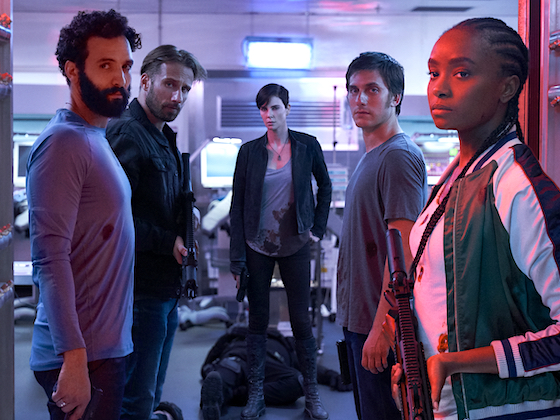
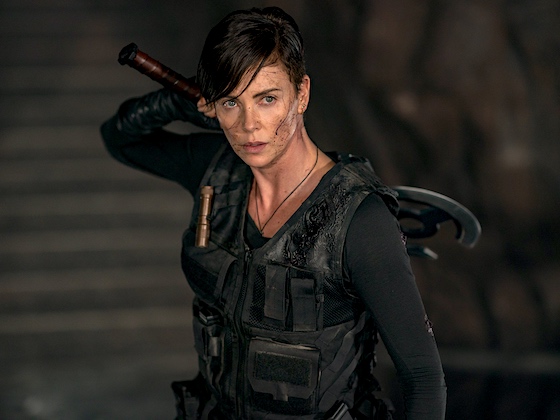
    Netflix’s latest attempt to launch a blockbuster film franchise is a comic book adaptation about a group of immortal warriors, led by Charlize Theron, who’ve been secretly fighting to help the rest of humanity down the centuries. Despite their efforts to remain hidden, someone shady has picked up their trail. At the same time, a new immortal (If Beale Street Could Talk’s KiKi Layne) has appeared for the first time in 200 years.

    If you’re looking to start an action/fantasy franchise nowadays, what better bet than superheroes? The Old Guard is sort of a superhero movie, but also not really. Their only superpower, which they all share, is a Wolverine-esque healing ability. They can die, they just get better (most of the time). So whether you class this as a “superhero movie” probably depends on your personal definition. I think some critics have just seen “based on a comic book” and gone “superheroes!”, and it’s a shame we haven’t got past that attitude by now. Equally, yeah, the characters do have a superpower, so fair enough. But the film itself plays more like an action-thriller, with the team relying mostly on guns and military tactics in combat rather than special abilities.

    Bearing that in mind, the concept has fundamental similarities to another recent big-budget Netflix actioner, Michael Bay’s 6 Underground (which I’ve seen but not reviewed yet, fyi). Whereas that was about a band of off-the-grid mercenaries working in secret to try to influence the course of human history for the better by going around shooting bad guys, The Old Guard is about a band of people who can’t die working in secret to try to influence the course of human history for the better by going around shooting bad guys. Obviously the set dressing is different — The Old Guard has a lot more mythology to explain, and the heroes occasionally whip out swords and axes and stuff; and it lacks (for good or ill) the unique storytelling style of Bayhem — but, honestly, at heart it’s the same deal.

    5 overground

    They’re also equally badly written. It’s what we expect from Michael Bay at this point — a plot that might hang together if he ever stopped to let it be explained, but instead he’s more concerned with amping every single scene up to 11 with hyperactive editing and gonzo action sequences. The Old Guard, on the other hand, does stop to explain stuff. All. The. Time. Half the dialogue is characters speaking in infodumps to fill us in on this world. Or not fill us in, because there are gaps. It’s hard to tell if those are deliberate mysteries meant for a sequel (there’s a definite sequel tease at the end, naturally) or if the filmmakers just got bored of world-building and decided the characters don’t know how it works either.

    On the bright side, it has some nice grace notes, like a betrayal I actually didn’t see coming, or Chiwetel Ejiofor injecting genuine emotion into his character’s motivations. Two of the immortals are a gay couple, played by Luca Marinelli and Marwan Kenzari, the latter of whom was Jafar in Disney’s live-action Aladdin (another one I’ve seen but not yet reviewed). He’s much better here, to the extent you wonder how he was such a limp Jafar. Anyway, the pair get a nice scene when they’re captured by a van full of enemy soldiers: a “what is he, your boyfriend?” taunt receives an epically romantic answer that’s an even better putdown than just “yes”. They also get a couple of beats of welcome humour later on. Not laugh-out-loud stuff, but this is quite a dour film otherwise. Most of the action is well staged if unremarkable, although the finale is a rather good assault on the villain’s HQ, ending with a couple of cool deaths.

    Immortal badass

    Despite the poor dialogue and certain familiarities of concept, The Old Guard is more blandly acceptable than 6 Underground. And yet it never swings as big as Bay’s films — for all his many faults, his “go big or go home” style has its merits as blockbuster entertainment. Nothing here is going to stick in the memory as much as 6 Underground’s opening car chase, or midway apartment assault, or madly overblown yacht climax. All told, I’d rather have 7 Underground than 2 Old 2 Guard, please Netflix. Both would be fine.

    3 out of 5

    The Old Guard is available on Netflix now.

    The Equalizer 2 (2018)

    2020 #25
    Antoine Fuqua | 116 mins | digital (HD) | 2.39:1 | USA / English, Turkish & French | 15 / R

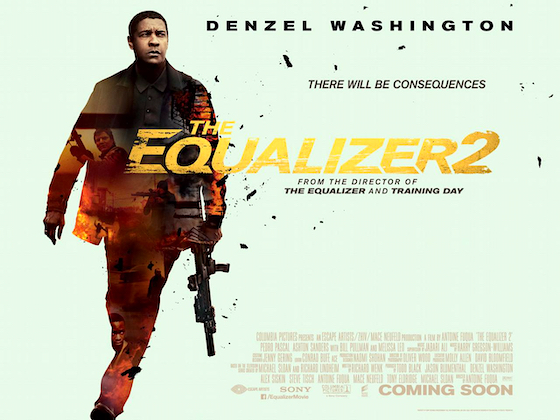
    The Equalizer 2

    “Now we’re equalised, bitch.”

    Sadly, that is not a line Denzel actually says in this movie. The film would be about 50% better if he did. Instead, what we get is an action-thriller where both the action and thrills are, literally, few and far between.

    For those who skipped the first film, Denzel is playing Robert McCall, a former Marine and intelligence agent who retired to a life of inconspicuous normality, but has been tempted back into righting some of the wrongs of the world — or “equalizing” them, I guess. This time, an array of subplots eventually gives way to a story in which McCall sets out to avenge the murder of a friend.

    I mention the subplots there because they’re the film’s biggest problem. As a result of them, it’s… so… slow… To start with, the subplots are a couple of small ‘cases’ introduced in the first half-hour, presumably to try to liven the film up because the main storyline is crawling along. Neither works. I’m not here for a pleasant drama about a Lyft driver who does kindly things for others — I want to see Denzel Washington kicking the asses of nasty buggers. The first film was noteworthy for investing more time in its supporting characters than is typical for the action-thriller genre, but this one takes that notion to extremes.

    Even when the main plot does get moving, it takes over an hour to get to a ‘twist’ that’s obvious just from reading the cast list. At least it doesn’t try to save it for the end, I guess. That reveal leads to a wannabe-Taken-phone-speech declaration from Denzel, which should’ve come a lot earlier. It’s not as memorable as the Taken one (though the final line lands), but at least it’s a moment of drama and the film perks up after it — but by then we’re well over an hour in to a less-than-two-hours movie.

    A rare moment of almost-action

    From there it’s a short hop, skip and jump to a climax set amidst a horrendous storm in an abandoned seaside town. It’s a nice concept and it’s solidly executed, but it’s an at-most 20-minute sequence and it’s not exceptional, just a lot more engaging than the film’s other 100 minutes, so it doesn’t really justify sitting through the rest of the movie. However, I did not realise that flour could be explosive, but turns out it can, so in that sense at least this was educational for me.

    (FYI, the film was cut in the UK to get a 15 certificate, removing some of the more extreme gore (insides hanging out, a spine being severed, etc). The 4K Blu-ray release is uncut and rated 18 (presumably so they could just port the disc rather than having to faff with edits/a new transfer). On Netflix it has an 18 icon, so I guess it’s also the uncut version, should that concern you either way.)

    The Equalizer 2 isn’t a terrible film, but it is quite a boring one. Not just slow paced — genuinely boring. A raft of subplots don’t really go anywhere or serve any purpose, the main story is incredibly thin, and the limited action sequences do little to balance the books.

    2 out of 5

    The Equalizer 2 is available on Netflix in the UK from today.

    Eurovision Song Contest: The Story of Fire Saga (2020)

    2020 #153
    David Dobkin | 123 mins | streaming (UHD) | 1.85:1 | USA / English & Icelandic | 12 / PG-13

    Eurovision Song Contest: The Story of Fire Saga

    The Eurovision Song Contest: if you’re from Europe or Australia, or one of the other countries that competes but isn’t really in Europe, it needs no introduction. If you’re from somewhere that hasn’t been enjoying/subjected to it every year for the past seven decades… well, it’s hard to explain. Actually, the basics are easy: it’s a continent-wide song competition, where each participating country submits one artist performing one song, and everyone votes for the winner. But, oh, the cultural connotations and ramifications are so, so much more! For some countries, it’s deadly serious — it’s a way to get noticed on the world stage; it may even make the artist famous. For others, like us Brits, it’s a big campy silly joke… except we’re also rather fond of it (some of us), and we’re terribly annoyed that we don’t win it every year (or at least on a regular basis. Like, once a decade or so would probably keep us happy). And that’s just scratching the surface — it would probably take a book (or, at least, a reasonably long article) to fully explain every nuance.

    Will Ferrell’s latest comedy attempts to distill all that history into a globally-friendly movie-length spoof. It’s a big ask, not just because there’s so much background information to assimilate, but because us Brits have been ripping the piss out of Eurovision for decades. And not just sometimes, but constantly: each country provides a local commentary over the live broadcast, and each year ours is basically a roast. (Notoriously so: some countries are not impressed by the sarcastic, piss-taking attitude being our ‘official’ stance on the contest.) We’re not alone, either: a few years ago when Sweden hosted the contest, they did a pitch-perfect sketch about creating the perfect Eurovision song. If you want to get a feel for the entire Eurovision experience in just six minutes, watch Love Love Peace Peace.

    And so with all that in mind, Ferrell and co are on a hiding to nothing; especially as the film has been made with the cooperation and endorsement of Eurovision’s producer, the EBU (they even get a credit right up front), so it was never going to be able to truly get stuck in for fear of offending its subject. So I guess that’s why they barely even bothered. Oh, there are certainly references to and riffs on Eurovision-y things, so viewers in the know can pick up on them and not feel like it’s about Generic Foreign Singing Contest; but this isn’t really a comedy about Eurovision, it’s about a small-town music duo wanting to make it big. Their chosen method is Eurovision, but it could just as well be The X Factor or The Voice or, well, anything, and it wouldn’t change the core narrative.

    And a man in a hamster wheel

    Said narrative goes through all the motions you’d expect. About the only thing that could be described as a twist is that the smarmy “bad buy” isn’t actually up to anything evil after all, he’s genuinely quite nice. As he’s another contestant, you do wonder if that was an EBU stipulation… The man in question is the Russian entry, Alexander Lemtov (Dan Stevens, who’s excellent as usual), renowned as a “sex player” and the subject of an overlong bit about how he probably has a massive penis. “Overlong” is the watchword for most of the comedic routines in the movie. It’s a form of self indulgence that plagues many a comedy nowadays, and here it helps contribute to a running time that’s simply too long. I always feel like the best comedies are within sight of 90 minutes, but this runs a full two hours. Of course, a comedy made for a famously hands-off studio like Netflix is hardly likely to be exempt from indulgence. Maybe a more interfering one would’ve questioned the wisdom of letting Ferrell include a bit where his character criticises American tourists for coming to Europe and ruining it. Um… It could work in a meta way, but it feels like it’s lacking any kind of knowing wink, beyond it’s very existence.

    One thing that does often work are the songs. You may well have heard Volcano Man when Netflix released it as the first promo for the film, but Fire Saga themselves get two or three more numbers, all of which are varying degrees of “surprisingly catchy”. The one they sing as the climax even made me feel a little emotional. I expect it’s the manipulation of the key changes or whatever (I’m no musician), because I didn’t really feel invested in the characters’ relationship before that point, but hey, if it works it works. Then there are the other contestants… where, unfortunately, the film drops the ball again. Lemtov’s number, Lion of Love, clearly had the most effort put into it — it’s quite fun and very Eurovisiony. But a montage of other acts is weird because it feels like it’s been edited to emphasise the jokes, only there aren’t any. I’m not even being clever, saying “there aren’t any” because I didn’t find them funny — the lyrics aren’t humorous, the staging isn’t particularly laughable… they’re just mediocre songs. It’s a wasted opportunity to provide some quick-fire riffs on Eurovision staples. The best it can do is the first of the montage, a rock song by guys in monster costumes — a reference to Lordi, who won in 2006. As far as I remember, no one has tried the same trick in the intervening 14 years.

    Lion of Love

    The weirdest musical number comes halfway through: at a party Lemtov is hosting for all the contestants, a “song-along” breaks out. Not a singalong, a “song-along”. Suddenly, a bunch of previous real Eurovision contestants show up (much to the bafflement of viewers who’ve never seen the real thing, I suspect) to sing a medley of… songs. Not Eurovision songs, just… songs. Well, Waterloo is in there, but I think that was the only one. It sort of almost works as a kind of mid-film celebration of the real Eurovision, but it’s all so random. Why isn’t it a medley of previous Eurovision tracks? Who even are some of the singers? (I recognised most but not all.) Do people who aren’t fans even get what’s going on during that sequence? It’s a cheesy but potentially fun idea, which I’d embrace wholeheartedly if I felt they’d nailed it. Or even if they’d just had them all cover Love Love Peace Peace.

    Yet for all the film’s faults, I’d be lying if I said I didn’t enjoy it. By sticking to tried and tested plot beats and gags, it has an unchallenging comfortableness. There are laughs along the way — some are just echoes of better versions, yeah (most notably, a bit that’s almost jumping through hoops to avoid Rachel McAdams repeating her iconic line from Game Night. It would’ve been better if they’d just leaned into it and let it be a meta-gag), but there were a couple that caught me with a genuine chuckle.

    Sporadically funny; often dated; with tired and rehashed routines; longer than Alexander Lemtov’s penis; and surprisingly emotional at the end… Actually, maybe The Story of Fire Saga is like Eurovision after all.

    3 out of 5

    Eurovision Song Contest: The Story of Fire Saga is available on Netflix now.

    Extraction (2020)

    2020 #88
    Sam Hargrave | 116 mins | streaming (UHD) | 2.35:1 | USA / English, Hindi & Bengali | 18 / R

    Extraction

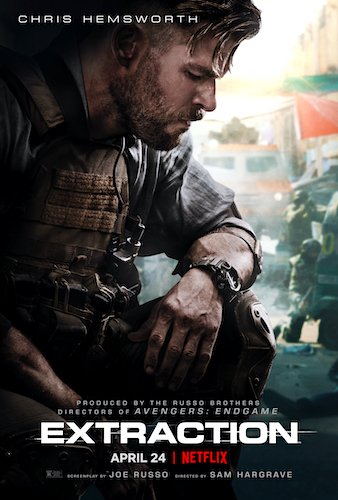
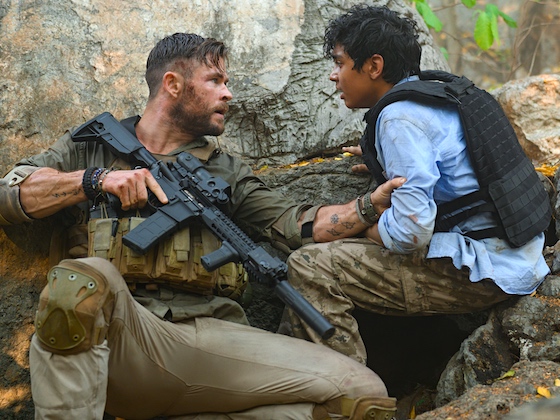
    Chris “Thor” Hemsworth stars in this action-thriller masterminded by the Russo brothers (directors of Avengers: Infinity War and Endgame) and directed by Sam Hargrave, who has dozens of stunt coordinating credits to his name, including three Hunger Games, Atomic Blonde, and work on six Marvel Studios movies. But don’t take all those MCU connections to heart — this is not a Marvel-style PG-13 action-comedy. Oh no.

    We first meet mercenary Tyler Rake (Hemsworth) engaged in a gunfight on a bridge. He’s covered in wounds, spitting up blood, looks like he’s about to die. Cut to two days earlier! No, really, it’s one of those openings. They just won’t bloody die. Never mind “skip titles” or “watch credits”, Netflix needs to add a “skip pointless in media res prologue” button. It would improve almost any film/TV episode where it was featured.

    Anyway, two days earlier we’re introduced to Ovi (Rudhraksh Jaiswal). Just an ordinary, well-to-do schoolboy in India… except his dad’s an imprisoned drug kingpin, and when Ovi slips out to a club one evening he’s kidnapped by goons from the competition, run by the thoroughly ruthless Amir Asif (Priyanshu Painyuli). With daddy behind bars, it falls to Saju (Randeep Hooda) to get the kid back, for which he hires some organisation, I guess — the film is incredibly light on specifics here. Basically, it involves Nik (Golshifteh Farahani) sending in Mr Rake and a support team to extract the kid. Naturally the mission goes sideways, leaving it up to Rake alone to get Ovi and himself out of a city crawling with henchman and corrupt cops who are all out to get them.

    School's out

    Of course, Rake has issues in his backstory, and rescuing the kid becomes more than just a job, etc, etc. The “Man on Fire Lite” plot is as predictable as this sentence ending with a simile. When David Harbour turns up halfway through as an old mate of Rake’s who lives in the city and agrees to help him out, I’ll be surprised if you can’t guess what inevitably happens a couple of scenes later. Though it is amusingly bold of the film to try to make us believe David “dad bod” Harbour could hold his own in a fight against Chris “literally a Norse God” Hemsworth.

    That minor brawl aside, the action sequences are great, more than making up for the lightweight plot mechanics. Letting stunt coordinators move into full-on directing has been the saviour of the action movie genre in recent years, working wonders for the John Wick series in particular, but also several other movies that have followed suit. Hargrave is the latest to suggest he might have a bright career ahead of him on the basis of his ability to stage electrifyingly choreographed combat scenes. The action is fast and hard-hitting; not unnecessarily horror-movie gory like it was in fellow Netflix actioner 6 Underground, but certainly not PG-13 material either. Clearly Netflix don’t force the makers of their expensive movies to hit that PG-13, presumably tied to not having to worry about box office takings. One advantage of going direct to streaming.

    The highlight of the film is undoubtedly an already-much-discussed 11½-minute single-take action sequence. We’ve seen plenty of these trick shots in the past few years (Atomic Blonde and, obviously, 1917 particularly come to mind), but Extraction offers another belter. It starts as a full-blown car chase, which transitions into a game of cat-and-mouse around a warren-like apartment block, then tumbles into a mano-a-mano knife duel on a busy street, before ending in a second car chase. Obviously there are myriad hidden cuts in there, but that’s almost beside the point: it’s not physically doing it in one long shot that’s impressive, it’s the design and choreography and planning and execution to make it feel like one. It pays off handsomely.

    Street fighter

    You wonder if Netflix might look to turn Extraction into a franchise — in many non-English-speaking countries it’s been titled Tyler Rake, which might suggest that’s what they’re thinking. But then, they could’ve retitled it that in English if they wanted, so maybe not. It’s not the most sophisticated thriller ever made, and it doesn’t reach the giddy heights of John Wick in the action department, but it’s nonetheless entertaining at what it sets out to achieve. If they do decide to make more, I’ll definitely be there.

    4 out of 5

    Extraction is available on Netflix now.

    Laputa: Castle in the Sky (1986)

    aka Tenkû no shiro Rapyuta

    2020 #12
    Hayao Miyazaki | 125 mins | Blu-ray | 1.85:1 | Japan / English | PG / PG

    Laputa: Castle in the Sky

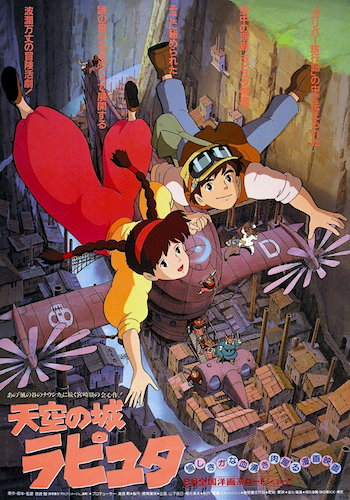
    The names Hayao Miyazaki and Studio Ghibli go hand-in-hand (I wouldn’t be a bit surprised if quite a few people think they’re synonymous, i.e. that all Ghibli films are directed by Miyazaki), but his first two features (The Castle of Cagliostro and Nausicaä of the Valley of the Wind) were produced before Ghibli’s formation. So it’s Laputa, his third film, that is actually Ghibli’s first — which makes it appropriate to look at today, as it’s also one of the first titles being made available under Netflix’s new deal with Ghibli.* (Though if you search Netflix for “Laputa”, you won’t find it.)

    Acclaimed as one of the first major works in the steampunk subgenre, Laputa takes place in a Mitteleuropean alternate past — the architecture is inspired by Welsh mining villages; the uniforms and hardware by historical German military; there are steam-powered automobiles and flying machines; but there’s also magic-like stuff, so it’s not just tech-based. In this world we meet Sheeta (voiced in Disney’s English dub by Anna Paquin, retaining her New Zealand accent), a young girl wanted by both the military and sky pirates for a necklace she wears. When she falls from an aircraft, the necklace glows and lowers her gently to the ground — and into the life of Pazu (James “Dawson’s Creek” Van Der Beek), a young orphan who immediately resolves to help her. And so off they go on an adventure to find out just what’s so desirable about Sheeta’s necklace, and what it has to do with the legendary flying city of Laputa.

    If you watched Miyazaki’s first three movies ignorant of the knowledge they came from the same writer-director, I’m sure you’d work it out for yourself. It’s an action-packed adventure laced with humour and morally grey characters, like Cagliostro, with a well-imagined fantasy world populated by flying machines and brave young heroines, like Nausicaä. But it’s no act of self-plagiarism — Miyazaki is too inventive for that. His world-building is first rate, sketching in the details of this alternate reality in between character building scenes and thrilling action sequences. If this were live-action, it would make an exemplary action/adventure blockbuster, so well paced and structured is it.

    The castle in the sky

    That’s why it immediately clicked with me as an instant favourite among both Miyazaki’s and Ghibli’s oeuvre. It’s unquestionably an adventure movie, so it lacks the heartfelt depths of something like My Neighbour Totoro, but it’s at least the equal of Cagliostro in terms of how wildly exciting the set pieces are. And it’s not as if it’s totally empty headed, touching on longstanding universal themes like the corruption of power, and with a minor-key ecological message too (another Miyazaki staple).

    I always feel like I should watch anime in Japanese, and I often do, but when the English voice cast includes Mark Hamill, well, that’s good enough for me. He’s the villain, channeling a certain amount of his Joker (but not too much) into a government secret agent in pursuit of Sheeta and in search of Laputa. He’s just one of a memorable cast of characters — I mean, did I mention there were sky pirates? They’re as awesome as they sound, bringing both broad humour and fuelling several action scenes (you’d expect nothing less of frickin’ sky pirates, right?) One of the most memorable characters transcends the language barrier: a giant speechless robot, questionably friend or foe, who leaves a mark almost as great as the Iron Giant’s but in considerably less screen time. (Considering how much Pixar are renowned fans of Miyazaki, and that Brad Bird made Iron Giant over a decade after Laputa’s debut, I wouldn’t be surprised if there was at least a little cross-pollination.)

    Like any good blockbuster, Laputa has it all: thrills, humour, emotion, wonder… It’s the complete package. Plus, that level of broad familiarity (it wouldn’t take too many steps to imagine this remade as a Hollywood blockbuster, although they’d inevitably mess it up somehow) probably makes it the perfect starting point for any newbies to anime or Ghibli.

    5 out of 5

    Laputa: Castle in the Sky is available on Netflix from today. It placed 11th on my list of The Best Films I Saw in 2020.

    * If the news passed you by: Netflix have acquired the rights to 21 Studio Ghibli films (that is, their whole back catalogue of features except Grave of the Fireflies, which has separate rights issues, plus Nausicaä) for most of the world (the USA, Canada, and Japan are excluded). They’re being released in three batches of seven — the first lot today, the next on March 1st, and the final ones on April 1st. As well as Laputa, today’s selection includes My Neighbour Totoro, which I reviewed here, plus Kiki’s Delivery Service, Only Yesterday, Porco Rosso, Ocean Waves, and Tales from Earthsea. ^

    The Past Christmas on TV

    Continuing the spirit of publishing things about ten days late, here’s my Christmas TV review, about ten days after the season ended. (And if you’re thinking, “um, Christmas was 18 days ago,” well, the TV ‘Christmas’ season goes on until at least January 1st here, so there.)

    Santa Goes Wrong
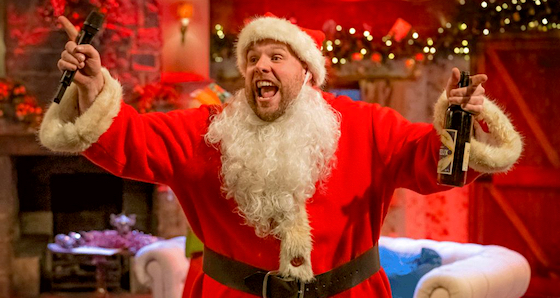
    Here’s Santa to rekindle your festive spirit.
    With alcohol.

    This is now my fourth annual Christmas TV post, would you believe. I still feel like TV reviews are a fairly recent addition to this blog, but nope, it’s been four years. And this is, in a way, a vintage year, what with the Gavin & Stacey revival becoming the most-watched Christmas Day broadcast in something like 17 years; and, even more impressively, it was the only scripted programme to make the top ten TV broadcasts of the decade (the rest going to sporting events and one random episode of The X Factor).

    As for whether it was any good, and what I thought of other stuff that was on… well, read on…

    Doctor Who  Spyfall
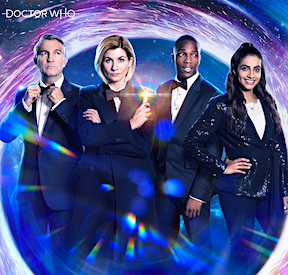
    Doctor Who: SpyfallFor the first time in 14 years, since the series returned, there was no Doctor Who Christmas/New Year special. Gasp! At least we got the first episodes of a new series, though — two slightly-longer-than-normal instalments (at 60 minutes each, which doesn’t feel that special when regular episodes are 50 minutes now). And a two-parter, too — the first of those since 2017. And a big two-parter at that, with big-name guest stars and big action sequences and big overseas locations.
    Yep, this is Doctor Who with a bang — a marked contrast to last series, which mostly went for understated. Well, as understated as modern Doctor Who gets, anyway. But whereas series 11 had no two parters and no returning monsters and, as I say, a markedly calmer pace and tone, series 12 begins with the antithesis of all of that. In case you’ve not seen it I shan’t spoil the end-of-part-one reveal, which was a massive delight that I did not see coming (I guess someone learnt a lesson from last time that villain returned, when the production team basically spoiled it themselves before anyone else could). That was the highlight of an episode that moved at a mile a minute, not pausing to let you consider the logic of what was going on (which, yeah, was not faultless). But while it may not have been perfect, I’m glad to see a return for this fun, exciting version of the show. I didn’t find series 11 a total washout (I think my reviews as it was airing were mostly positive, even), but overall I felt like something wasn’t quite working.

    Well, let’s be honest, what wasn’t working is showrunner Chris Chibnall. His episodes under previous showrunners Russell T Davies and Steven Moffat were never the very best (and I say that as someone who likes them more than most), but without their oversight to guide him, he seemed a bit lost. He’s a long-time fanboy of the show (somewhat famously, he appeared on a viewer feedback show in the ’80s to slag off the quality of the writing), and at times last series it felt like he was writing for the show as he’d loved it as a kid (that is to say, a bit slow-paced and old-fashioned). Now, possibly taking some of the criticism on board (or possibly just trying to mix it up), he’s attempting to emulate the whoosh-bang blockbuster-but-quirky style of RTD and Moffat. What he can’t grasp is their effortless-seeming slickness — when they rushed over something it was usually because “it makes sense if you think about it”, whereas Chibnall is trying to cover a logic gap; conversely, when there’s no gap to be hidden, he has characters mercilessly over-explain everything, I guess for the sake of anyone who’s just walked in.

    So, not perfect, but I thought Part 1 was a blast nonetheless. Sadly, I was much less enamoured with Part 2 — a virtually nonsensical runaround through time, which didn’t seem to know what to do with everything that had been put in play, just throwing “more” at us until the Doctor basically said “time for the story to end now”, and so the baddies disappeared and that was that. Apart from an epilogue, which was quite intriguing — and dove head first into full-on mythology territory, something the series studiously avoided last year. Whether Chibnall’s got anywhere good to go with what he’s teasing, God only knows (I fear not, based on the evidence), but it’s a welcome bit of business that will hopefully jazz up the season to come.

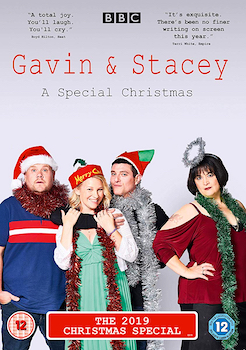
    Gavin & Stacey  A Special Christmas
    Gavin & Stacey: A Special ChristmasI won’t recap Gavin & Stacey’s ratings success (what with already having mentioned it at the start), nor will I touch on the controversy around its use of Fairytale of New York (I kind of get why people complained, but also, the song is the song). As for the episode itself, well, I thought it was masterful. It may be nine years since the last episode, but it was like they hadn’t been away. Not that they tried to ignore the passage of time — clearly, the best part of a decade had passed in the characters’ lives, and naturally changes had come with that — but the characters and performances felt true to their old selves, as if they’d never stopped playing them, with the rhythms and comedic style of the show fully intact. Some decade-later revivals feel like new shows — the writers have forgotten how to write it properly; the cast have forgotten how to play it right — but not this one. This was bang on what it should be. Tidy.
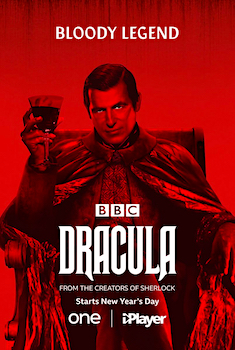
    Dracula
    Dracula“From the makers of Sherlock”, declared the publicity for this new adaptation of the Victorian novel — so you’d be forgiven for thinking it was a present-day reimagining. But it wasn’t. Well, until it was.

    This new Dracula is very much a tale of three parts, and not just because it was in three 90-minute episodes. While undoubtedly a serial, each episode was almost a standalone instalment, which was a structural trick I quite liked — it doesn’t feel like you’re watching one four-and-a-half-hour work broken into three by the necessities of the schedule, but rather three separate-but-connected works. And I really, really liked the first two.

    The Rules of the Beast is what you most expect of Dracula: a spooky Transylvanian castle; “I don’t drink… wine”; mild little Englishman Jonathan Harker discovering terrible secrets… Of course, writers Steven Moffat and Mark Gatiss didn’t shy away from bringing a few affectations and twists to the piece, but I thought they all worked well. Claes Bang makes for a fantastic Dracula (a comment that holds true throughout the series), the rest of the cast were very good as well, and there were some proper horror bits — this adaptation was not, ahem, toothless.

    The second instalment, Blood Vessel, dealt with Dracula’s voyage to England aboard the Demeter — a part usually more or less glossed over in other adaptations, as far as I know. But here Moffat and Gatiss spin it out into a full 90-minutes, kind of like a slasher movie set in a confined location, albeit we know whodunnit — so, naturally, there are other twists to be found. Again, I liked this a lot — the way it felt respectful to the source while also expanding and refreshing it; the interesting supporting cast; some very impressive production work (they built the entire ship on a soundstage!)

    Then we get to episode three, The Dark Compass. There’s no way to talk about what happens here without spoiling it, so if you haven’t watched the series yet and are intending to, look away now. If you have watched it, you’ll know this episode jumps the action forward 123 years to 2020. And you also probably hated it, because it seems almost everyone did. My feelings were slightly more nuanced. In my opinion, its biggest mistake is that it’s a completely different show. Sure, we still have Claes Bang playing Dracula (and he’s still excellent), and we still have Moffat and Gatiss’s recognisable stylings in the dialogue and whatnot, but the entire setup has shifted. Judged in isolation, as a present-day-set reworking of the Dracula story as told in the novel, I don’t think it’s that bad. Maybe it’s a tad too cheesy (the scenes in nightclubs and whatnot do have a feel of “how do you do, fellow kids”), but it’s workable as a modern-day adaptation of the character and plot. The problem, as I say, comes from placing it as part of a whole alongside the reenvisioned-but-fundamentally-faithful adaptation we got in the first two episodes. In doing so, Moffat and Gatiss undermine the whole enterprise — it robs the first two-thirds of a fitting finale; and, by being so radically different to the style we’ve spent three hours getting used to, it doesn’t give itself a fair shake either.

    And so many have judged the overall result to be a failure. Personally, I enjoyed enough of it that I was still entertained, but if they’d given us a ‘proper’ third episode to round it out then I think I may’ve loved it.

    The Goes Wrong Show  Series 1 Episodes 1-2
    The Goes Wrong Show - The Pilot (Not the Pilot)Oh my, what a treat! Regular readers will remember how much I loved Peter Pan Goes Wrong at Christmas 2016 (“the best thing that was on TV during the festive season”) and its 2017 followup, A Christmas Carol Goes Wrong. When the gang missed Christmas 2018 I feared we wouldn’t be getting any more, possibly thanks to the negative-nelly reception in some quarters. But oh no, for 2019 they’re back with a vengeance: not a one-off hour, but a whole series of half-hour Plays Gone Wrong. Reader, I am cock-a-hoop with delight!
    The first episode was another Christmas special; the second a historically-inaccurate WW2 thriller (set in 1961); the third aired on Friday but I’m currently saving it. It’s a half-hour parade of utter silliness — slapstick, wordplay, entirely predictable tomfoolery… but sometimes the total predictability of what’s about to go wrong is part of the fun (episode one begins with a blatant setup for a joke that isn’t paid off until the very end of the episode). And it’s exactly the kind of thing the whole family can watch and enjoy, whether you’re 6 or 66. I genuinely can’t remember the last time I was driven to tears of laughter. Actually, I can — it was Peter Pan Goes Wrong. Long live the Cornley Polytechnic Drama Society!

    Also watched…

    A mix of Christmas scheduling and non-Christmas stuff we just happened to catch up on.

  • Criminal: United Kingdom Season 1 — Netflix’s high-concept cop show wasn’t quite as classy as the publicity would have you believe (it still indulged in the old staples of office politics, breaking from the tension of the interrogation to faff around with romance subplots and whatnot), but the guest stars still gave it their all — I don’t think I’ve ever seen Hayley Atwell like that before, and David Tennant was superb as always. Good enough that I’ll check out some of the international versions.
  • In Search of Dracula with Mark Gatiss — This felt like it was planned as a promo for the BBC’s new Dracula, but aired after it. Weird. Anyway, Gatiss has fronted several great documentaries on horror before, and while this wasn’t quite in their league (the others are exceptionally good) it was still a solid and interesting look at the history of the Count. And it made me want to see a load of previous Dracula films, which I always think is the mark of a good movie documentary.
  • Miranda My Such Fun Celebration — I know the sitcom Miranda wasn’t to everyone’s taste, but I loved it, as did lots of others, hence this one-off special to mark its tenth anniversary. It’s a bit of an oddity — a mix of cast reunions, sketches, clip montages, and song and dance. Yes, song and dance. It was well-meaning but, well, I found it a little strange. But for those people whose lives have been positively impacted by the series (and, genuinely, hurrah to it and them for that), I’m sure it was a delight.
  • Vienna Blood Series 1 — A new crime series from “that other guy who wrote some episodes of Sherlock”, this adaptation of a series of novels set in Vienna c.1907 did feel a bit like Sherlock Lite, with its Freud-influenced genius consulting detective and some stylish visuals. But it lacked the innovation that marked out Sherlock, especially in its early days. You can tell this has half an eye on being an easy sell to international markets, able to sit comfortably alongside all the other 90-minute crime dramas the UK TV industry churns out. So, it was a bit predictable and formulaic, but decently done and reasonably entertaining. This Guardian article echoes my feelings on it pretty well.

    Things to Catch Up On
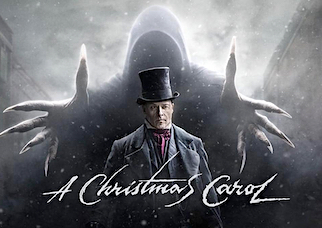
    A Christmas CarolThis month, I have mostly been missing the BBC’s new adaptation of A Christmas Carol, written by Peaky Blinders creator Steven Knight. I know it went down with some degree of controversy, but its revisionist, horror-tinged style looked right up my alley. Unfortunately, it was stripped over three nights, and because I knew I was going to be away for the third evening I didn’t start it. By the point I had enough time to make room for it, it was so long after Christmas that I wasn’t sure it was appropriate. Now, it’s January 12th and it’s definitely too late. Guess I’ll have to try to remember to watch it next year, then.
    Next month… it’s a new year, so I’m sure there must be plenty of new TV. Although I kind of hope not, because I’ve still got tonnes and tonnes from last year to catch up on.

  • 2019 Statistics

    It’s the most wonderful time of the year. No, not Christmas — that’s well and truly over now, isn’t it? I mean, it’s not even really the new year anymore, it’s just the year now. This post is kinda late.

    No, by “most wonderful time of the year” I mean this — the day I publish my annual statistics post! As the guy who does the introductions to films at Odeon might say, “ooh, yeah, the statistics. I love the statistics. Specially chosen for this post, actually.” Except they’re not really specially chosen, I do the same ones every year. But then the trailers aren’t really specially chosen for the film, are they? That Odeon guy’s just a liar.

    Anyway, it’s time for the main event. So, turn off your phones, finish your conversations, and get ready — it’s about to begin…

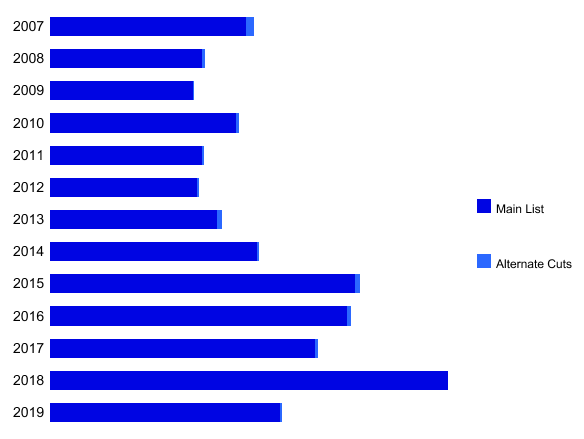
    I watched 151 new feature films in 2019. That ranks 5th in the history of 100 Films — it’s the lowest of the past five years, but beats every one from 2007 to 2014. It’s 11% beyond 6th place (2014) and 15% short of 4th place (2017). And it’s down a massive 110 films (42%) on last year.

    I also watched one extended or altered cut of a feature I’d seen before — namely, Deadpool 2’s Super Duper $@%!#& Cut. (I know it’s only my own rules I’m butting up against, but I haven’t settled on a way to count alternate cuts like this now that I have my Rewatchathon. I mean, it’s not strictly a rewatch because it’s a different cut, but it’s also not a new film because it’s not that different to the version I’d already seen. Anyway, it’s included in the following graph, but I haven’t counted it towards the other stats.)

    As just alluded to, in 2019 I also undertook my Rewatchathon for the third year. My target was 50 films, but I only made it to 29. Still, that’s 29 more than I might’ve managed otherwise. Add all of those together and my overall total is 181 films. I’d love to tell you how that compares to previous years, but I’ve still not put together a proper history of rewatches for that comparison. Maybe I’ll finally get it sorted for 2020’s stats.

    I also watched 20 short films in 2019, which more than doubles the next nearest — second place is a tie between 2007 and 2018 with just eight each. As with the alternate cut, these only count towards one stat, which I’ll mention in a moment.

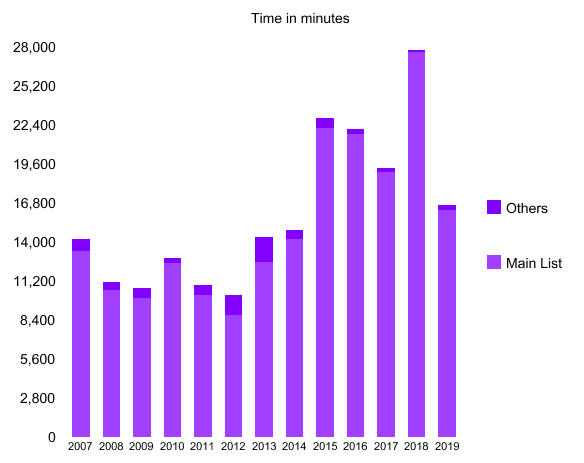
    So, the total running time of the 151 new films was 271 hours and 56 minutes. That’s down a whopping 41% on last year… but then the number of films I watched was down 42%, so fair enough. Add in the Deadpool 2 alternate cut and all those shorts and the total running time of my new 2019 viewing was 277 hours and 47 minutes — that’s just over 3½ hours of shorts, FYI. (Last year I said “maybe next year I’ll start counting my Rewatchathon here too”. I haven’t, obviously. Maybe next year…)

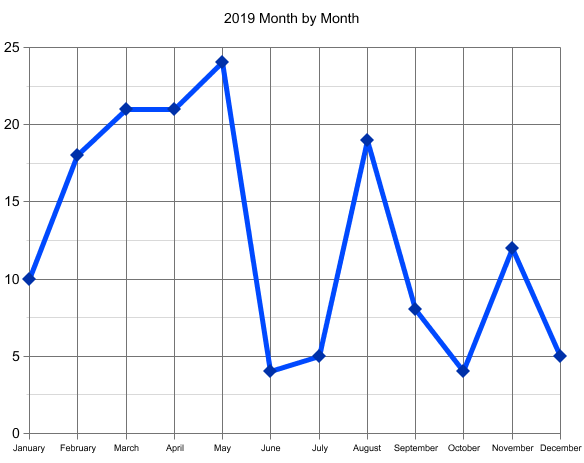
    Here’s how that viewing played out across the year, month by month. It’s a particularly interesting year to have this graph (I only added it for the first time in 2018’s stats), because my viewing patterns have been so variable. I imagine if a lot of people bothered to plot a graph like this they’d end up with a broadly flat line, because I’d presume they watch roughly the same amount of stuff (whether that’s a lot or a little) month in, month out. Or maybe they’d all be as variable as mine, I dunno. Either way, my one is anything but flat…

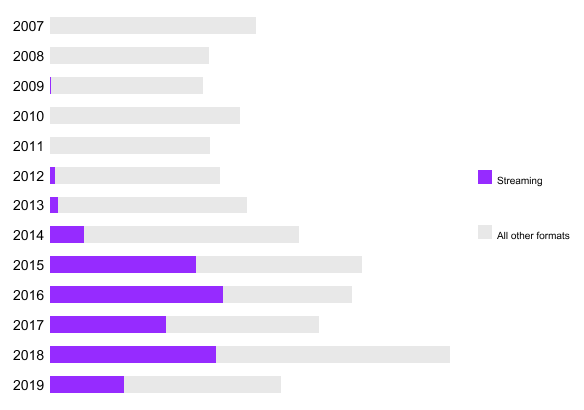
    Now, how I watched those films. Most people may be pivoting to streaming, and dedicated cinephiles of course see a lot on the big screen, but I still love my physical media. Nonetheless, for the fifth year in a row this year’s most prolific viewing format was streaming. I guess I’m one of those people too. Or not — I buy more than my fair share of Blu-rays, I just don’t get round to watching as many as I should. Anyway, streaming accounted for 49 films, or 32.5% of my viewing. The raw number is less than half what it was last year (109), but then I did watch 110 fewer films overall too. More interestingly, the percentage is also down significantly, continuing a trend that’s been going on for a few years now — it was 57% in 2016, 43.2% in 2017, 41.8% in 2018, and now just 32.5%. Maybe I’m bucking the trend after all.

    Those streaming numbers can be broken down across five services: Netflix, Amazon (a mix of Prime and paid-for rentals), Now TV (aka Sky Cinema), BBC iPlayer, and Rakuten. This year, it was Netflix in first place (it’s been Amazon the last two years) with 21 films (42.9% of streams). Mind, Amazon were close behind on 19 (38.8%). Way down in third was Now TV, with just five films (10.2%) — I only subscribe for a month so I can watch the Oscars, but I clearly didn’t get very good value for money this year (for comparison, last year I used it to watch 25 films). That said, keep reading to downloads for more on this… Rounding out the streamers were iPlayer with three (6.1%) and Rakuten with just one (2%).

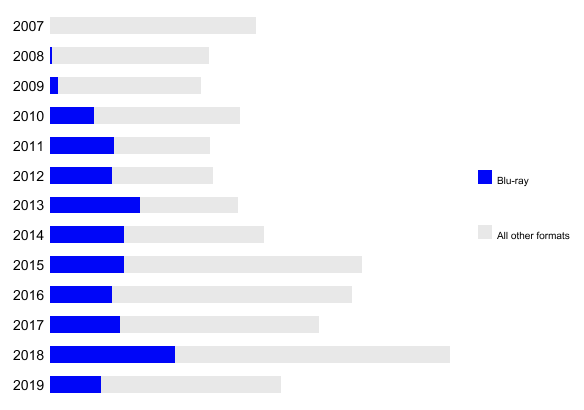
    In second place was Blu-ray, represented by 34 films (22.5%). Sadly, that is also a much reduced percentage from last year (when it was 31.4%). As I said, I buy loads of the darn things, so I should do better here.

    So, where are those percentage points going? Well, in third we find downloads, with 22 films (14.6%). In real terms that’s a drop from last year (when it was 25), but if we compare percentages it’s up by around 50%. See, statistics are fun, aren’t they? (Although Now TV only gets credited with five films, a few download viewings were, shall we say, morally justified by their presence on Now TV… by which I mean I acquired better-quality copies than Now TV’s outdated 720p and watched those instead, but it’s okay because I’d paid for those films via a Now TV subscription.)

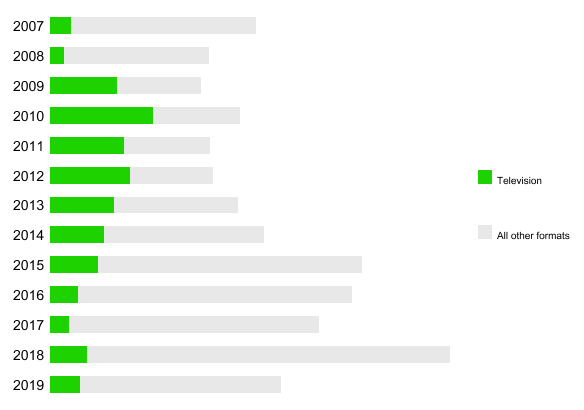
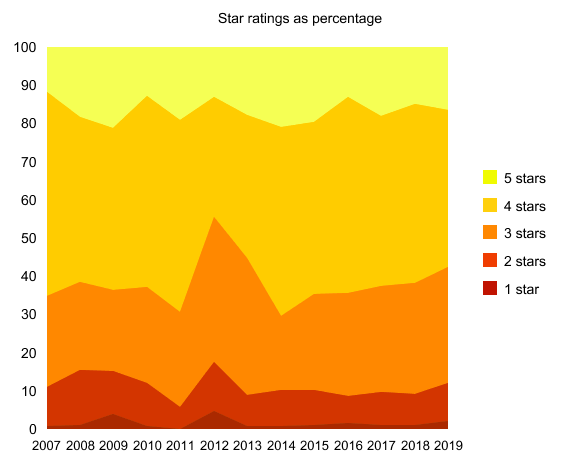
    Close behind is TV, on 20 films (13.2%) — again, a drop in real terms but a rise in percentage. Still, nowhere near where it once was — check out the drop since 2010 in this graph.

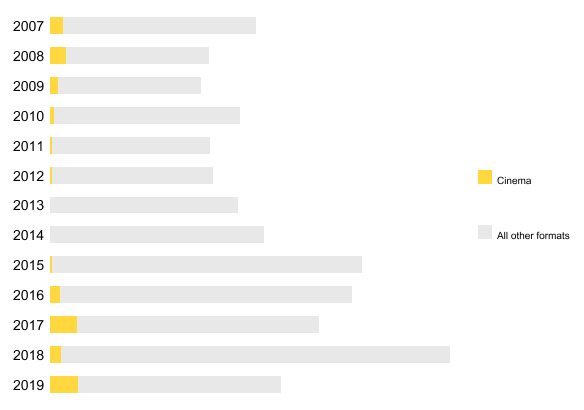
    In fifth place is cinema, whose lowly position masks something of an achievement: it’s the most cinema visits I’ve made in one year since this blog began. My total was 19 films (12.6%), besting 2017’s tally by just one. It’s also the only format number that’s bigger than last year. Mostly it’s thanks to FilmBath Festival — without that, it’d only be eight (mind you, that would still be more than most years of this blog’s life — only 4 out of 12 other years would be higher.)

    Finally, in sixth and last place, is DVD. Oh, poor DVD. Some people still love you, but the industry’s failure to get Blu-ray to catch on is a rant for another day. Anyway, this year I watched seven films (4.6%) on digital versatile disc, which is its lowest number since 2012. It’s impressive it’s still toddling on at all, really, but sometimes it’s easier just to watch the DVD I already have than source an HD copy.

    In amongst all that, I watched seven films in 3D (4.6%), down 11 from last year (which was up 11 from the year before!), and 15 in 4K UHD (9.9%), up just one from last year. Considering I own a 3D-capable 4K TV, their combined percentage of 14.6% is a bit disappointing — especially as I didn’t have a UHD Blu-ray player last year, so that new bit of kit has made very little net impact. Though, again, it depends how you do your comparison: going from 14 to 15 may not be much, but as a percentage of my viewing UHD has increased from 5.4% to that 9.9%.

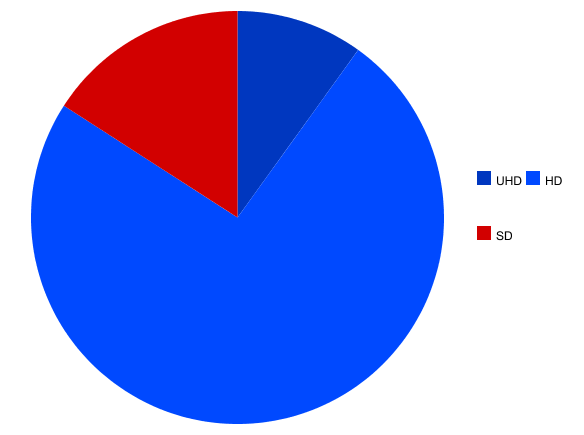
    So, with that said, how did my viewing split up in terms of UHD vs. HD vs. SD? Contributing to the UHD number is a cocktail of Blu-ray discs, streams, and downloads. For HD, it’s the same mix, plus cinema trips (you’d think big cinema screens would be keen to go for 4K instead of 2K, but nope — apparently there are shockingly few 4K cinemas out there). And in SD, well, it’s of course a similar blend again, but with DVDs instead of BDs. The final result is 112 films in HD (74.2%). Add the aforementioned 15 (9.9%) in UHD and I’ve got a total of 84.1% in HD formats. That’s down a bit from last year, which nearly hit 90% HD, but hey-ho.

    Picture quality shouldn’t really be an indicator of the age of films I watched — old films can be HD too, of course (is everyone aware of this by now? I had to explain to someone once how even silent films could be HD. But, in fairness, they weren’t the kind of person who’s likely to be reading a film blog). Nonetheless, my viewing did skew newer, as usual: the most popular decade was the 2010s, with 90 films. That’s 59.6% of my viewing, a higher percentage than last year, but not as high as the year before that. The 2010s have been my highest decade ever year since 2012 — now it’ll be interesting to see how soon the 2020s take over.

    The 2000s have come second since 2012 too… but not this year! Thanks primarily to Quentin Tarantino’s Swinging Sixties Move Marathon, in 2019 second place went to the 1960s (obviously). It’s a distant second, mind, with just 13 films (8.6%). In fact, only seven of the ten films in QT’s marathon were from the ’60s themselves, but without those it would be much lower in the rankings.

    So, the 2000s are pushed into third, with 11 films (7.3%). In fourth we find the 1970s with nine (5.96%), also helped slightly by the Tarantino marathon (though, in this case, only by one extra film). It’s back to the ’90s for fifth, with eight (5.3%), followed closely by the ’50s on seven (4.6%), including the final two films from the “sixties” marathon.

    Rounding things out, the 1920s and ’40s had four (2.6%) apiece; the ’80s is uncommonly low on just three (1.99%); and finally there’s the oldest decade for this year, the 1920s, with two (1.3%).

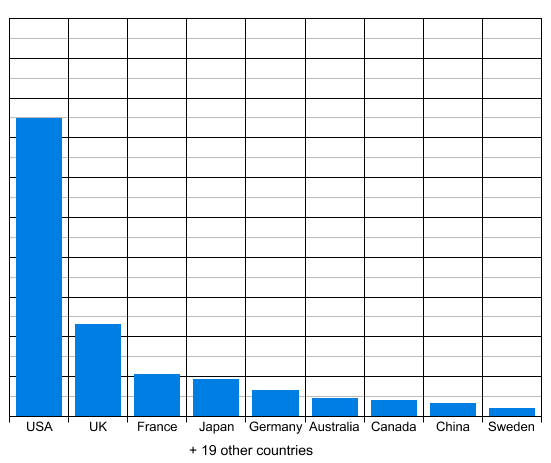
    From “when” to “where” — countries of production. And it’s another “business as usual” situation, because once again the USA dominated with a hand in 113 films (74.8%, which is up a couple of points from last year). Also as usual, second place belongs to the UK, with 35 films (23.2%, also an increase from last year). Also in double figures were France (16 films, 10.6%), Japan (14 films, 9.3%), and Germany (10 films, 6.6%). In all, 28 countries were involved in the production of at least one film. That’s a marginally lower number than it’s been the last few years, but I also watched a much lower total of films, so it’s not too bad overall.

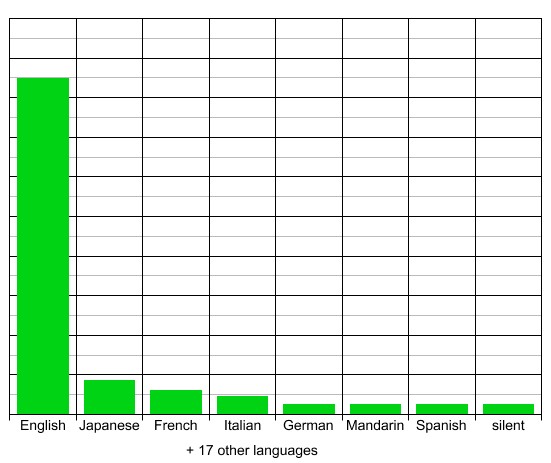
    You might think less variety in countries would mean less variety in languages spoken, but not so. Now, English was still thoroughly dominant, being spoken in 128 films — but that works out as 84.8%, the lowest it’s ever been. In second place for the third year in a row was Japanese, its tally of 13 films being the only other language to make double figures this year. Although it totals fewer films than last year, its percentage of 8.6% is similar. In total, there were 24 languages, plus four silent films. American Sign Language cropped up in one film, as it seems to every year, while other more unusual (for my viewing) languages included Burmese, Mixtec, and Punjabi.

    A total of 134 directors plus 10 directing partnerships appear on 2019’s main list. Only six of those were responsible for multiple films, the lowest that figure’s been since 2012. Most prolific of these was Kenji Misumi with three, all Zatoichi films. The other five directors, with two apiece, were Bill Condon, Alfred Hitchcock, Phil Karlson (both from Tarantino’s sixties marathon), Fritz Lang (arguably — some would say Dr Mabuse, der Spieler is a single film), and Kimiyoshi Yasuda (also both Zatoichi films).

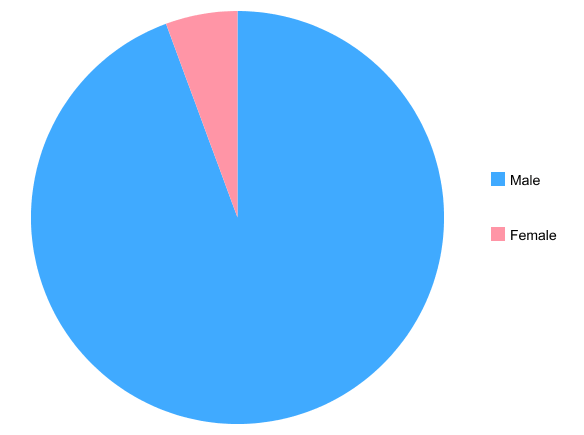
    For the past few years I’ve charted the number of female directors whose work I’ve watched. There were ten female directors represented among 2019’s feature film viewing — seven as sole director, three as part of a directing partnership with a bloke. Counting the co-directors as half a film each, this represents 5.63% of my viewing — better than last year (which was better than the two years before it), but, as this graph ably demonstrates, still a disappointingly low figure. I mean, I watched more films directing by someone called “John”.

    At the time of writing, 12 films from 2019’s list appear on the IMDb Top 250 (or “Top Rated Movies: Top 250 as rated by IMDb Users”, as it’s less-catchily technically known nowadays). However, because that list is ever-changing, the number I have left to see has only gone down by four, to 45. The current positions of this year’s checks range from 22nd (Life is Beautiful) to 225th (The Red Shoes).

    At the end of my annual “top ten” post I always include a list of 50 notable films I missed from that year’s releases, and continue to track my progress at watching those ‘misses’. For the past few years I’ve managed to watch some more from every one of these lists, but I let that slip in 2019. The overall number I watched dropped too, totalling 37 (the lowest it’s been since 2014, when obviously there were fewer films to choose from). Well, that’s the kind of year it’s been. Anyway, the ones I did watch included two each from 2008, 2012, and 2016; and one each from 2010, 2011, and 2017.

    Finally, in the first year of watching 2018’s 50, I saw 28 of them. That’s no record, but it’s still over 50% (to be precise, 56%), so I can’t complain.

    In total, I’ve now seen 422 out of 600 of those ‘missed’ movies. That’s 70.3%, up a teeny tiny amount from last year’s 70.0%. If I don’t pick up the pace again next year, I may be looking at a percentage drop. (As ever, the 50 for 2019 will be listed in my “best & worst” post.)

    And lo, just like that, we’re coming to the end. To conclude 2019’s statistics, it’s the climax of every review: the scores.

    As always, this includes every film, meaning some don’t have published reviews yet — and, therefore, some I was still mulling over my exact score for; the kind of films I’d happily award 3.5 or 4.5 on Letterboxd, but which here I always round up or down to a whole star. Maybe I should start giving half stars. (I feel like I say that every year…) Anyway, I’ve had to go ahead and pick a rating for everything to get this part of the stats done, and maybe I’ve been too generous in places, or too harsh in others. We shouldn’t really take such a simplistic rating system too seriously, anyway (he says, as he goes on to make it the final thing in this post as if it’s a definitive statement on the quality of the films I saw this year…)

    Barrelling on regardless: at the top end of the spectrum, this year I awarded 25 five-star ratings, which means I have 16.6% of films full marks. That’s a slightly higher percentage than last year, but lower than the year before that, but higher than the year before that, but lower than the year before that… and so on. In other words, I’ve not suddenly got harsher or more generous, or suddenly watched a lot more or lot fewer good films.

    Indeed, it was also business as usual with the score I handed out most often: four-stars, which I awarded to 62 films. Out of 13 years of this blog, four-stars has been my highest-scoring score 12 times (the exception is 2012, which saw more three-star films). That said, at 41.1% it’s the lowest percentage of four-stars-ers since 2013. That loss was spread out across the rest of the board, with slightly higher than normal percentages for the remaining three ratings. For example, there were 46 three-star films, which at 30.5% is its third highest ever percentage.

    Fortunately, the “bad” end of the scores continue to bring up the rear, with 15 two-star films (9.9%) and three films meriting just one-star (1.99%). That’s technically the highest percentage of one-star films since 2012, but as the other intervening years range between 0.7% and 1.5%, I don’t think it’s a cause for concern. It’s barely even cause for comment.

    Finally, that brings us to the average score — the single figure that arguably asserts 2019’s quality compared to other years. The short version is 3.6 out of 5, the first time it’s been below 3.7 since 2013. In fact, if we go to three decimal places, it comes out as 3.604, which is the second lowest ever (beaten by 2012’s exceptionally poor 3.352). Now, it doesn’t feel like I’ve had particularly poor viewing this year — indeed, I was worried I was handing out five-star ratings too easily at one point — so it’s something of a surprise to find it so low. But maybe I’m just getting more discerning. I mean, it’s not a sharp drop (unlike that 2012 anomaly), more a slight decline.

    And that’s the statistics over for another year, I’m afraid. But if you’re a junkie like me and still after more, check out my Letterboxd 2019 stats — that site tracks different stuff (like directors and actors), and includes different films (i.e. my Rewatchathon viewing, plus a few TV things), so it’s a bit different. That’s exciting, eh?


    If you thought it was getting a bit far into 2020 to still be thinking about 2019, oh ho ho, no! Still to come: my picks for the best and worst of my viewing from last year.

    My Most-Read Posts of 2019

    2019 may’ve given us the highest grossing film of all time, amongst numerous other big events, but TV reviews once again dominate my most-viewed posts of the year — in the rankings of new posts, there’s no film until 8th (if we widen that to include older posts, it’s all TV until 14th).

    But this is still theoretically a film blog, so — as usual — I’ve compiled my five most-read TV posts (which, obviously, is the same as my outright five most-read posts) and then my five most-read film reviews.

    My Top 5 Most-Viewed New TV Posts in 2019

    5) The Past Month on TV #45
    including Game of Thrones season 8 episodes 1-2, Thronecast specials and series 8 episodes 1-2, Deadwood season 3, and The Twilight Zone ‘best of’ selection 2.

    4) The Past Month on TV #43
    including The Punisher season 2, Russian Doll season 1, Hanna episode 1, Les Misérables episodes 4-6, the 91st Academy Awards, the British Academy Film Awards 2019, Great News season 2 episodes 8-13, and Mark Kermode’s Oscar Winners: A Secrets of Cinema Special.

    3) The Past Christmas on TV 2018
    including Doctor Who: Resolution, The ABC Murders, Watership Down, Not Going Out: Ding Dong Merrily on Live, Upstart Crow Christmas special, Click & Collect, Goodness Gracious Me: 20 Years Innit!, Mock the Week, Have I Got News for You, Insert Name Here, Mrs Brown’s Boys, Simon Callow’s A Christmas Carol, The Dead Room, Mark Kermode’s Christmas Cinema Secrets, and Les Misérables episode 1.

    2) The Past Fortnight on TV #46
    This attracted almost three times as many views as the post in 3rd (that graph in the header image is accurate — the top two were out well ahead of everything else). What attracted such attention? Nothing less than the final season of the biggest TV show of the decade: Game of Thrones. This post included Game of Thrones season 8 episodes 3-4, Ghosts series 1 episodes 1-3, Columbo: Murder by the Book, The Twilight Zone ‘best of’ selection 3, Mark Kermode’s Secrets of Cinema: Disaster Movies, and Thronecast series 8 episodes 3-4.

    1) The Past Fortnight on TV #47
    My comments about IMDb voters of the Game of Thrones finale attracted some degree of ire, which helps lead this one to first place. In fact, it’s already my 4th most-viewed post of all time. It only included Game of Thrones season 8 episodes 5-6, The Twilight Zone ‘best of’ selection 4, Eurovision 2019, and Thronecast series 8 episodes 5-7.

    My Top 5 Most-Viewed New Film Posts in 2019

    5) Star Wars: The Rise of Skywalker
    Jumping in here in the final days of the year, the much-anticipated conclusion of the 42-year nine-film Skywalker Saga. Shame it was such a load of rubbish.

    4) The Highwaymen
    Netflix films often do well in these rankings, especially if I review them promptly, and that applies to both this and the film in 3rd. There were also Netflix films in 6th, 8th, and 9th places, and a Sky Cinema debut in 7th.

    3) The Silence
    Mind, there are better Netflix films people could’ve chosen to read about than this.

    2) Glass
    That said, a promptly-reviewed big theatrical release can top even Netflix titles, as these next two show. Alternatively, they say something about the continued dominance of superhero movies.

    1) Avengers: Endgame
    Well, it is the biggest film of all time.