Enough about my shiny new look (although, if you missed all that, you can read about it here) — let’s go back to digging through the remains of 2021. And we begin (or, rather, resume) with one of my personal highlights of the entire year: the statistics. Regular readers will know what this is all about, but if you’re new to these parts and enjoy things like percentages and graphs… oh boy, you’re in for a treat!
Before we begin, a quick word that, because I’m a Letterboxd Pro member, I also get a yearly stats page over there. My 2021 stats can be found here. I don’t only log new watches on Letterboxd, so any overlapping statistics will be slightly different, but they mainly have different categories (like repeat cast & crew members — so you can, for example, find out which actor appeared in the most films I watched last year).
And now…
I watched 207 new feature films in 2021. That means it ranks 3rd all-time, passing 2015’s 200 by a solid seven films, but coming far shy of the top two: 2018’s 261 and last year’s 264.
I also ran my Rewatchathon for the fifth year in 2021. I’ve spent all of that time thinking I ought to include it in the statistics properly, and all of that time not getting round to deciding how exactly to incorporate it, and now it’s over — I’m doing something slightly different next year. Well, maybe that will finally compel me to square the circle. Anyway, I rewatched 33 films — short of my target of 50, but not that bad else wise. That makes a combined total of 240 films, which is another distant 3rd place finish, behind last year’s 310 and 2018’s 311.
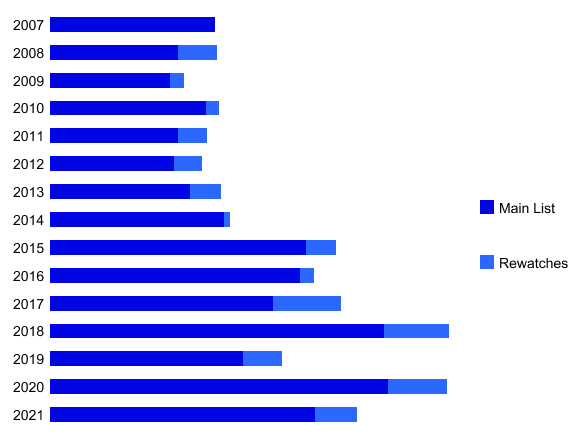
NB: I have no rewatch data for 2007 and only incomplete numbers for 2008.
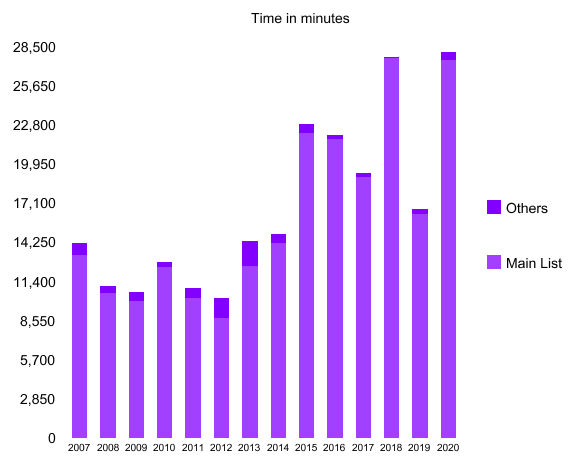
I also watched four short films last year, which is my lowest total for those since 2016. A shame after the past two years saw me set new records each year, but then I’ve never made a concerted effort to watch shorts. Maybe I should. As always, the only stat they count towards is the total running time, and they barely make a dent there. To wit: the total running time of new features was 357 hours and 12 minutes, while adding the shorts bumps it to 357 hours and 58 minutes — just a 46-minute increase. That’s my smallest “others” total ever, barely even visible on the graph below (it’s 1 pixel high).

Here’s how that viewing played out across the year, month by month. The dark blue line is new feature films and the pale blue line is my Rewatchathon. Last year I included a pale green line for shorts, but that seemed a bit pointless this year. Last year I noted that, while the precise values of the graph changed each year I’d been running it (since 2018), the rough shape stayed the same: quickly climbing to a peak in April or May, then lower and bumpier to the end of the year. 2021 bucks that trend entirely, with the high point coming in February, before it almost tapers off, but spikes up dramatically in August and December, traditionally two of my weaker months. What does this tell us? Maybe not to rely too much on precedent.

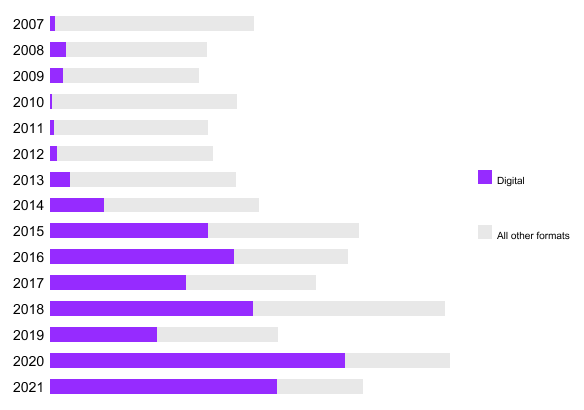
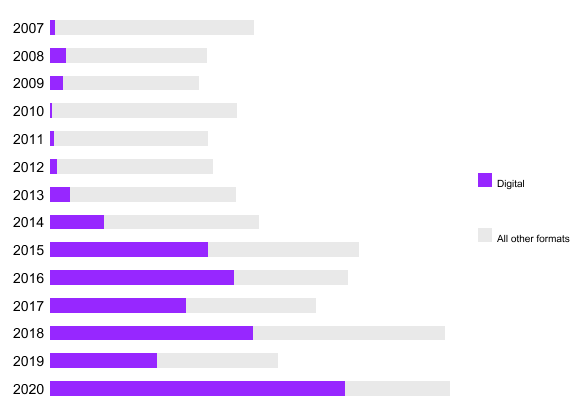
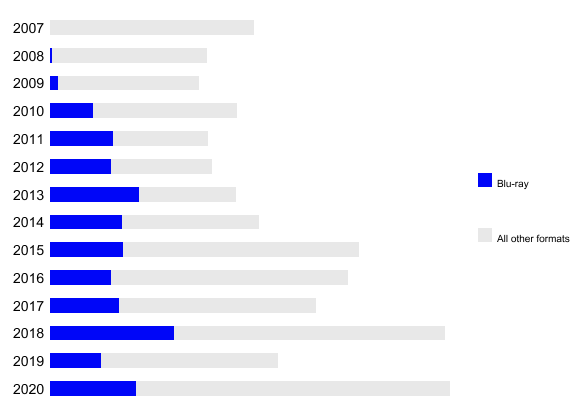
Next up, the formats on which I watched those films. Despite my continued advocacy (and purchasing of) physical media, it’s digital that once again romps away with the crown here, accounting for 150 films, or 72.46% of my viewing. That’s down slightly from last year’s 73.9%, but is still above the 2015–2021 average, which is 58.5%. I’d definitely like to get it down closer to 50%; or, even better, to see Blu-ray beating it, considering I buy so many of the darn things.
Of course, a lot of individual formats and services contribute to that digital total. The top spot therein is a tie between Amazon, topping the list for the fourth time in five years, and downloads, each with 35 films (23.3% of digital). Downloading was second last year, so that isn’t actually a huge change. The same could be said of the next few places on the chart: last year Netflix and Now tied for third, while this year Netflix is there by itself, with 26 films (17.3%), and Now is just behind, on 22 (14.7%); and iPlayer comes fifth, with 16 (10.7%). Last year there were three other services to mention: AMPLIFY!, which didn’t occur this year; YouTube, which I didn’t watch anything on this year; and Disney+, which retains that position kinda by default, with seven films (4.7%). Rounding out the digital services were MUBI on five (3.3%), All 4 on three (2%), and Apple TV+ managing a solitary one (0.7%). Most of their original content seems to be TV, although they did have a couple of other films that interested me, so that really should’ve been higher — but then I could say that about all the streamers (I mean, just look at my failures list each month).
A very distant second place in the format war goes to Blu-ray with 51 films (24.6%) — just a third of digital’s tally, I’m ashamed to point out. It’s the format’s 14th year on this list and its 4th highest total, which doesn’t sound too bad, but as a percentage it pales besides the 40% I was hitting a decade ago.
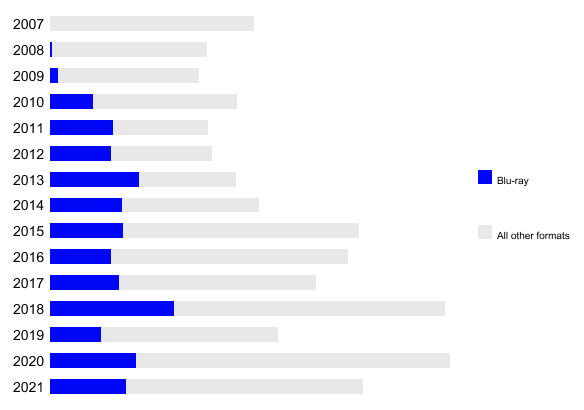
Between them, digital and Blu-ray accounted for a staggering 97.1% of my viewing in 2021, up on the 95.5% they represented last year. To be precise, that’s 201 out of 207 films. The remaining six were split equally between three other formats — again, to be precise, that means DVD, TV, and cinema each clocked just two films (0.97% each). Here’s a graph showing how much DVD has fallen — something that should improve next year, at least a bit. (If you want an idea of how much it might grow, 2018 had exactly 12 DVD watches.)

A similar “once mighty, now not” slump has befallen TV across the decades, its place in my viewing schedule now definitively overtaken by streaming.
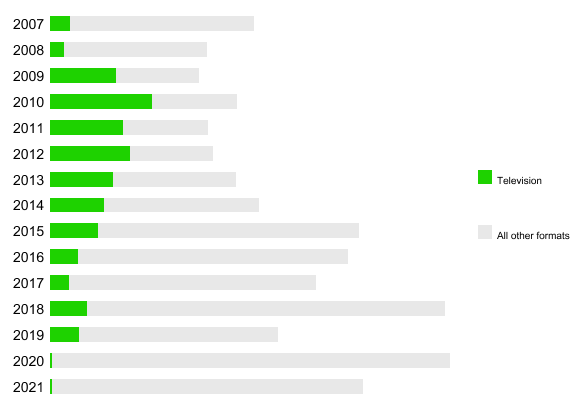
And finally, the cinema, brought low by Covid for the second year in a row. More films that I was interested in were screening, but is it worth the risk? And we’re all hoping 2022 will be better, but how much is still a question mark. We’ll see in a year’s time…

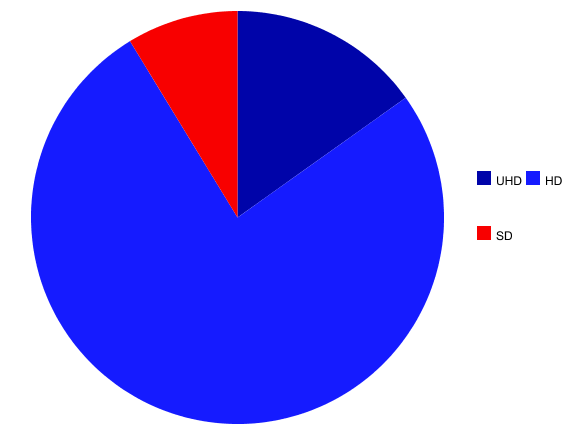
In amongst all that, I watched 24 films in 4K — a drop from last year’s 40, but still above any year before that (2019’s total was 15, for example). On the other hand, I watched just three in 3D, my lowest total there since I got my 3D TV back in 2017. New releases on the format are dwindling (even Disney, who were previously reliable with Marvel and Pixar titles, now only release the former on 3D BD in Japan, with no sign of the latter), but I’ve still got a not-insignificant pile of 3D discs I’ve bought and not watched yet. It’s somewhat ironic, then, that all of my 2021 3D watches were films I don’t own or can’t get on disc, so were downloaded by other means (wink wink, nudge nudge).
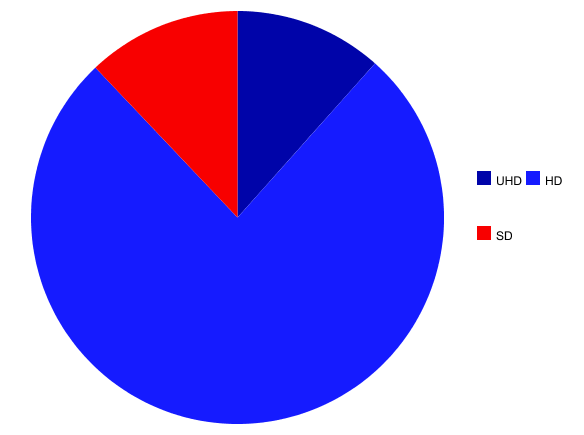
Topping both of those this year was the number of films I watched in SD. Yep, really. Between some downloads, some streams, and those couple of DVDs, I watched 25 films in SD in 2021. At 12.1% of my total viewing, that’s actually the second highest percentage since 2016. What’s more interesting is that, although it means the percentage fluctuates somewhat, the actual number of SD titles I’ve watched has been pretty consistent for years: the average for the past six years is 23.6, most falling in the 23–25 range. While it’s nice to watch as much in HD (or even UHD) as possible, there are some titles that are just so hard-to-come-by that one has to settle for lower quality. While “SD” might make many of us think of DVD-level quality, several of this year’s SD titles were more “recorded off TV to VHS then ripped to digital”-level. Yeah, they looked and sounded awful, but when that’s the only way to see the film at all…
Of course, it tends to be older films that only exist in such low quality, and my viewing on the whole skews newer (though don’t get me started on the fact some brand-new productions still receive DVD-only releases). But as the new decade continues to get underway, the question is: how new? It took the 2010s until 2012 to usurp the 2000s at the top of my decade chart. Could the 2020s manage it a year earlier? In short, no — but it’s close! The 2010s are still in first place, but with only 46 films — that’s their lowest since 2012, coincidentally. It represents 22.2% of my viewing this year, the lowest-ever percentage for a top decade (at the same point, i.e. in 2011, the 2000s still had 35.2%). And the 2020s are snapping at their heels, just three films behind on 43 (20.8%). The margin between these two decades was 33% last year, but this year it’s just 1.45%.
In third place comes the ’90s with 22 films (10.6% — exactly double their percentage in the last two years). That’s their best total ever, their highest placing since 2017, and their best percentage since 2010. Why did they do so well? Oh, don’t ask silly questions (i.e. I have no idea. Chance, I guess). There’s an even bigger surprise in fourth place, though: the 1930s with 18 films (8.7%). Their previous best showing was last year, with just six films (2.3%), and their previous best percentage was way back in 2008, at 3.8%. And with the 1940s coming in fifth with 16 films (7.7%), also their best-ever result, could this be a preview of years to come? Well, I have set myself the task of watching at least 12 films noir next year…
Things continue to ping back and forth in time as we move down the chart. Next is the ’80s on 15 (7.2%), followed closely by the 2000s on 13 (6.3%), followed even more closely by the ’70s on 12 (5.8%), and right behind them are the the ’50s on 11 (5.3%) — far down the chart though it may be, it’s still their highest ever total. Indeed, never before have so many decades reached double-figure tallies in a single year.
Rounding out the list, the ’60s have an uncommonly low five (2.4%), while bringing up the rear are the 1920s on four (1.9%) and the 1910s on two (0.97%) — not their best result (2007 and 2010 were both higher), but only the sixth time they’ve featured at all in 15 years. Finally, no features for the 1900s & earlier, but they were represented by a single short film, for only the third time ever (the previous occasions being 2013 and 2020).

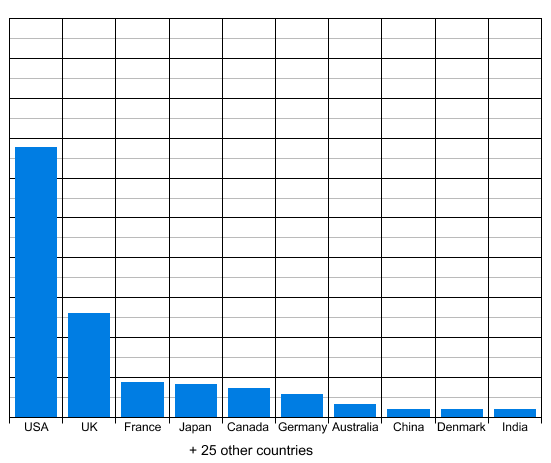
There’s somewhat less variety in where films came from, with the USA once again dominating countries of production, having a hand in producing 140 films. However, at just 67.6% of my total viewing, it’s their lowest percentage ever (down from last year’s 68.6%, the first time it had been below 70%). There’s nothing wrong with US movies, but there’s a whole world out there and it’s nice to spread one’s viewing around a bit. To wit: there were a total of 35 production countries represented in my viewing this year, the second best ever (behind last year’s 40, when there were almost 28% more films, so, y’know, fair enough). Some of the more unusual ones (in terms of my own viewing) included Latvia, Estonia, Ethiopia, Lebanon, Peru, and Romania.
Back at the top end of the chart, the UK took its usual second place, with 54 films (26.1%). France returned to third place, a position it’s held for six of the ten years I’ve been monitoring this stat, with 18 films (8.7%). Hot on their tail was Japan on 17 (8.2%). Also in double figures were Canada (15, 7.2%) and Germany (12, 5.8%), and coming seventh with seven was Australia (3.4%). China, Denmark, and India were tied on four (1.9%) each, while four countries each had three, eight countries had two apiece, and the remaining 13 had one film each.
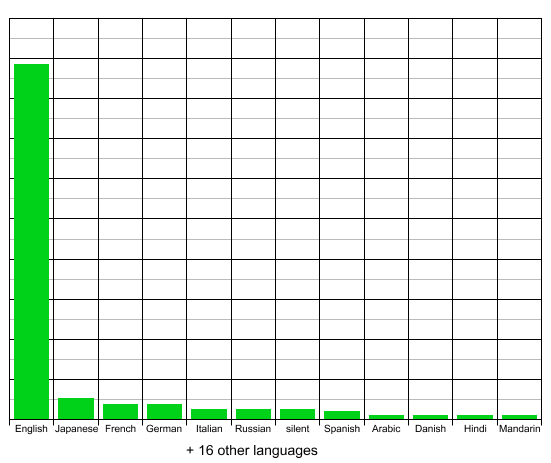
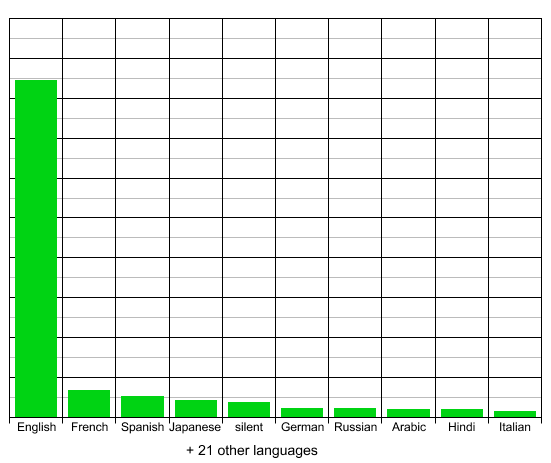
All those US and UK films mean that English was the most dominant language, as always. It was spoken to at least some degree in 183 films, or 88.4% of my viewing, a percentage that’s up from the last three years. As I say, this count includes all films where it was spoken enough to merit listing, even if it wasn’t the primary language. Perhaps I should start making a note of just the main spoken tongue for the sake of the statistic… Also as usual, the language in second was a long way off. This year it was Japanese in just 11 films (5.3%). No others made double figures. But overall there were 27 spoken languages (plus five silent films), which isn’t bad. Some more rarely-heard languages this year included Amharic, Estonian, Kiowa, Somali, Tupi… and Klingon.
A total of 178 directors and eight directing partnerships were responsible for the films on 2021’s main list. 16 of them helmed multiple films, led by Leo McCarey with five. Second place is shared, with three apiece from David Hare (the Worricker trilogy) and Reginald Le Borg (all among the Inner Sanctum Mysteries series), while Ishirô Honda helmed two plus one film in a ‘partnership’ (that would be the US cut of King Kong vs. Godzilla, where Honda’s original work was supplemented with US material by Thomas Montgomery). The remaining 12 had two films each, and they were: Jack Bernhard, Bob Clark, Cameron Crowe, George Cukor, Joe Dante, Paul Greengrass, Tom Hooper, Ben Lewin, Anthony Minghella, Mike Nichols, George Stevens, and James Whale.
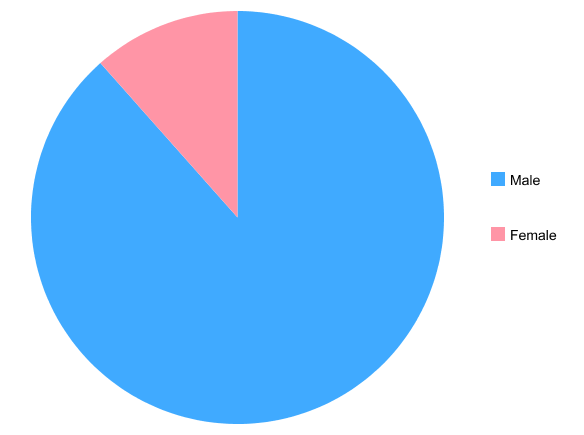
For a few years now I’ve specifically charted the number of female directors whose work I’ve watched. 2020 saw a new high reached, but sadly 2021 sees it slip back again — although it’s still above 2019, just, so there’s that. My viewing this year included 13 films with a female director (12 solo; one as part of a trio with two men), which comes out as a measly 5.94% of my viewing. As I put it last year, it’s debatable whether the onus should be on me to seek out more films directed by women or on the industry to give more directing gigs to women, but ultimately it’s a bit of both — though I’d argue with more weight on the latter, because I just watch the films I watch; I neither avoid nor seek out female directors especially. Anyway, I do hope this graph will continue to improve in the future, though I’m not sure it will ever approach 50/50 (considering all the older films I watch, which are predominantly directed by men to a farcical degree).

We’re approaching the end now — broadly speaking, because before I dig into 2021’s star ratings, it’s time for an update on a couple of viewing projects I vaguely have on the go. First, the IMDb Top 250: at the time of writing, seven films from my 2021 viewing appear on that famed list. However, because that list is ever-changing, the number I have left to see has only gone down by two, to 28. That’s my poorest showing since 2012. I feel so close to the end now (just 11.2% to go) that I really would like to get it finished off. Of course, new releases ping on all the time (there are currently four 2021 releases on there), but that’s life — if I finish the rest of the list, I can bop them on the head as and when they pop up. Anyway, the current positions of the seven I saw this year range from 52nd (Cinema Paradiso) to 222nd (La Haine).

My next viewing project is the one I call my “50 Unseen”. As regular readers will know, at the end of my annual “top ten” post I always include a list of 50 notable films I missed from that year’s releases. I’ve continued to track my progress at watching those ‘misses’ down the years — which is how I know that 2021 was a particularly poor year for this particular mission. Where previously I would watch at least one film from every list, this year I only managed to hit eight of the 14; and from most I only watched one film, leaving my with a total of 21 films across all 14 lists. That’s the lowest since 2010 (when I only had three lists to work from!) In fact, the last time I watched that few films from even just the newest list was in 2014. And speaking of the newest list, in the first year of watching 2020’s 50, I watched 12 of them — the lowest ‘first year’ since 2010 (again), when I only watched eight films from 2009’s list. You might think this is because 2020 was a poor year for new films, thanks to the pandemic, but there are plenty in that 50 I very much want to see, I just… haven’t. Maybe I’ll finally catch up on them in 2022.
For what it’s worth, the other nine I watched came from 2007, 2009, 2011, 2012, 2013, 2019 (all one film each), and 2015 (three films — why so many more, I don’t know).

All of which means that, in total, I’ve now seen 497 out of 700 of those ‘missed’ movies. That’s exactly 71%, the first time this percentage has dropped year-on-year since 2009 (it was 73.2% last year). On the bright side, that’s still above where it was the year before last (70.3%), so it’s not a total disaster. (As usual, my new list of 50 misses from 2021 will be in my “top ten” post, sometime soon.)
And so, to conclude the statistics for 2021, it’s the climax of every review: the scores.
Now, I need to provide a similar caveat to last year: this stat factors in every new film I watched in 2021, even those for which I’ve yet to publish a review — which, this year, is 98% of them. That means there are some where I’m still flexible on my precise score — those films I’d award, say, 3.5 or 4.5 on Letterboxd, but which I insist on rounding to a whole star on here. For the sake of completing these stats, I’ve assigned a whole-star rating to every film, but it’s possible I’ll change my mind when I eventually post a review (it’s happened before). Still, this section should remain broadly accurate.
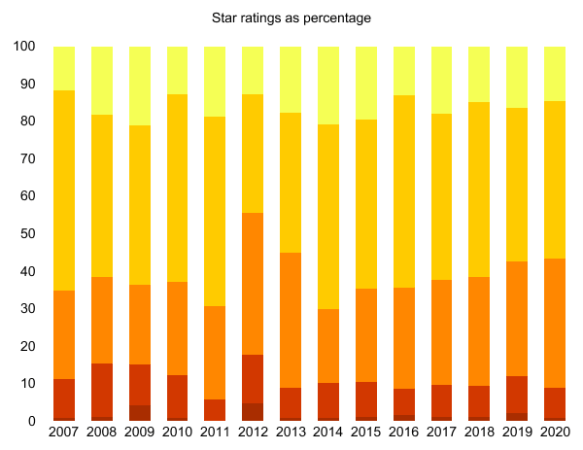
Starting at the top end, then, in 2021 I awarded 25 five-star ratings, which means 12.1% of the films I watched got full marks. That’s at the lower end of my range, which historically spans from 11.9% to 21.2%. I’d put that down to harsher marking rather than poor quality: there were quite a few 4.5-type films where I eventually erred towards the lower score.
As usual, the most prolific rating was four stars, which I gave to 88 films. At 42.5%, that’s a sliver up on last year’s percentage (which was 42.1%), which rather suggests the lower number of five-star films wasn’t all that much due to those 4.5s after all… unless a lot of 3.5s got the rounded-down treatment too, of course.
Well, there were 63 three-star films, which is the third highest tally ever, behind 2018 and 2020 — both years in which I watched more films. So, really, that’s only appropriate. The historic range of my three-star ratings spans all the way from 19.6% up to 38.0%, so 2021 coming in at 30.4% actually puts it somewhere in the middle.
Indeed, the real gains are to be found among the two-star films, which number 29 — the highest-ever for one year, and the first time there I’ve given out more two-stars than five-stars (although they did draw back in 2012). It comes to 14.01%, which isn’t actually the highest ever… but it is close, because 2008 reached 14.4%. Again, this brings up the usual debate: was this a weak year, or is my scoring getting harsher? I think, at this point in my life, the latter is definitely a factor.
Last, and most definitely least, I handed out just two one-star ratings, which is only 0.97% of my viewing. That’s very typical: I’ve awarded two or fewer single-star scores in 10 out of 15 years, and only three years have pushed its percentage above 1.5%
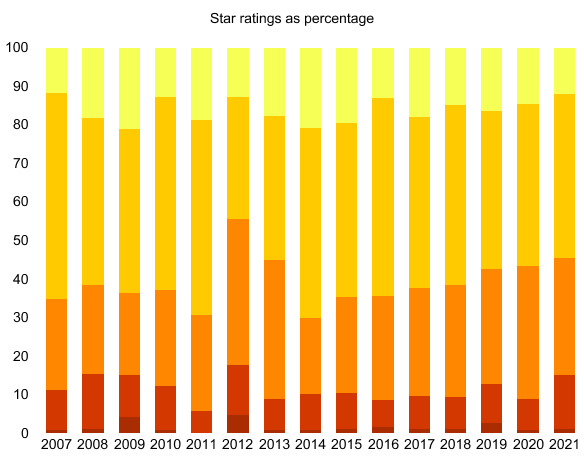
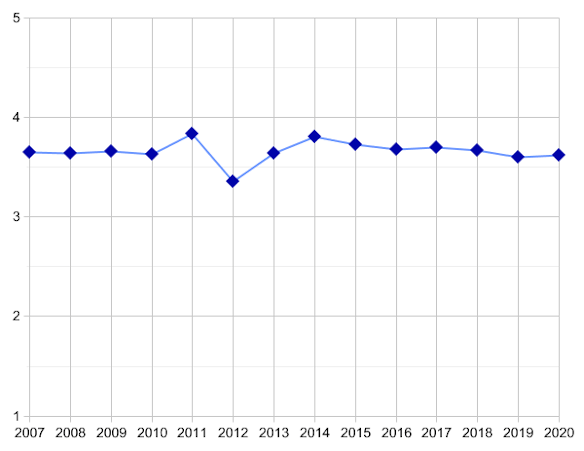
Finally, the average score for the year — a single figure with which to judge 2021 against other years, for good or ill. The short version is 3.5 out of 5 — that’s the first time it’s dropped below 3.6 since 2012, when it was an anomalous 3.4. Indeed, that’s the first 3.5 score in 15 years (there are five 3.6s, six 3.7s, and two 3.8s). To go to a few more decimal places, it’s 3.507 — still my second-lowest scoring year ever, but it doesn’t stick out quite as egregiously as 2012’s 3.352. Still, it’s only the third time the score’s been below 3.600 (2019 was the other, on 3.589), so it is a low one, whichever way you cut it. Again we ask: was it a weak year, or is my scoring getting harsher? As I said before, I am beginning to feel it’s the latter.
All of which said, let’s not forget: it’s still a pretty good average overall. I mean, it’s well above 3.0, and 3 is a positive score. A ‘true average’ might be 2.5, but then I’d have to watch a lot more bad movies, and who wants to do that? Maybe I could try to watch even more very good / great films, and then maybe the average would rise again… or maybe I’d just worry I was being too lenient. No, at this point I feel I’ve demonstrated a degree of consistency in my marking — so long as the average is in the 3.5–3.7 range, I feel like I’m getting things about right.

And so, I’m sorry to say, the stats are over for another year. I know I’m changing things up from 2022, so will this post look significantly different next year? Y’know, probably not: I love this stuff too much to stop working it all out.

My picks for the best and worst films I saw in 2021. And then my review of 2021 will be over, and you’ll have seen these blue-ish stripey mid-post graphics for the last time!













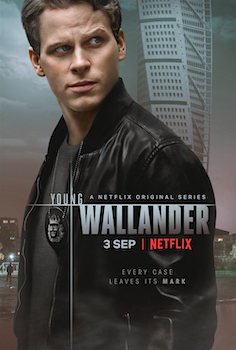 I think that Swedish detective Kurt Wallander’s USP, if he has one, was that he wasn’t some young hotshot maverick genius, like so many fictional detectives, but rather a middle-aged, somewhat disillusioned, almost workaday cop who got the job done. So a series about his younger days already seems like it might be missing half the point. But it’s worked for other TV detectives (most notably Morse in the acclaimed Endeavour), so why not? After all, seeing what police work in 1970s Sweden was like might be interesting — it’s certainly a different setting, anyway.
 I noted
  This month, I have mostly been missing His Dark Materials, the second series of the BBC/HBO adaptation of Philip Pullman’s acclaimed trilogy. Of course, I’ve been missing lots of stuff (that was kind of the theme of my introduction, remember?), but that’s one of the most pressing to me personally. You might argue The Mandalorian, also on its second season, is even more pertinent, what with it regularly being thoroughly discussed online, but I’ve not even started that yet. His Dark Materials, on the other hand, I do expect to watch soon.
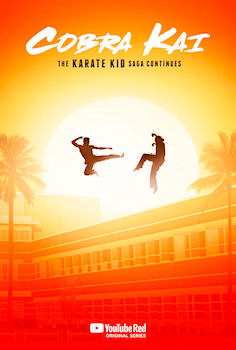 A belated sequel/spin-off to the Karate Kid movies, Cobra Kai was one of the first series to be released when YouTube decided to get in on the Netflix game. It was a hit for them, too, attracting tens of millions of viewers and very strong reviews. And yet it feels like no one talked about it, so where those 90 million people were hiding, who knows. Anyway, with YouTube wrapping up their series production (they were a bit late to a market already saturated by Netflix, Amazon, and a dozen other TV and film studios), existing and future seasons of Cobra Kai have been passed onto Netflix — and now everyone’s talking about it. Are more people watching it, or is the Venn diagram between “people who primarily watch stuff via Netflix” and “people who use social media” just a perfect circle? We’ll never know. I guess I’m one of those people who only started talking about the show after it moved to Netflix. I did mean to get to it sooner, but no way was I paying for YouTube, and I missed the couple of times they made it all available for free.
 A four-part adaptation of the fourth Cormoran Strike novel by
 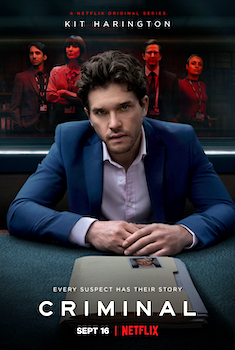 Remember when Netflix first launched Criminal and made a big deal of how it was one format filmed by four different countries? Does no one else remember that? Because I swear it was one of the key USPs, but it’s gone entirely unmentioned in the (surprisingly large amount of) press about the second season — which I presume suits Netflix just fine, because three of the countries have been quietly dropped, so only the UK version remains. (What’s the betting the UK one did better simply because its anglophone cast are more widely known around the world?)
 I’d found the last few Derren Brown live shows relatively underwhelming (not to mention his
 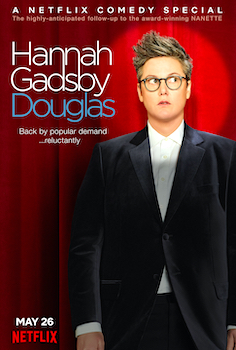 Recently, I’ve been unwinding with some of Netflix’s standup specials. The most noteworthy / widely discussed of those is certainly Hannah Gadsby’s Douglas, her followup show to the massively successful Nanette (which I commented on
 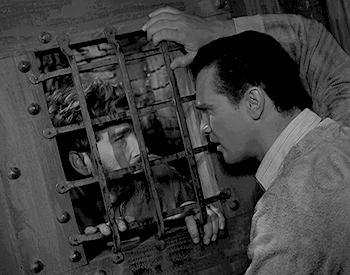 This is my tenth and final selection of the best episodes of the original Twilight Zone, which gets me to the end of the top third of episodes on
 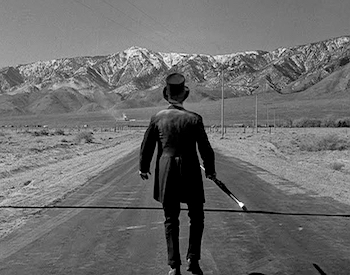 On the other hand, a common feature of The Twilight Zone is “man out of time” stories. The show did a lot of those, and A Hundred Yards Over the Rim is certainly one of them. In 1847, a pioneer at the head of a wagon train heads over a nearby rim to scout for water, and finds himself in 1961. There’s reasonable potential in that, but what follows offers no remarkable features or moral messages. If the pioneer was on the verge of giving up, and seeing that people like him did bring civilisation to those barren places motivated him to carry on, that would be effective. In fact, he’s pretty much the only one in his party who’s already certain they’re on the right path, so all his trip through time represents is a brief obstacle in his path. Similarly, he discovers evidence that his dying son will actually survive and achieve great things, but he didn’t seem to doubt his son’s chances before that, so what did he really gain? Apparently this is JJ Abrams’ favourite episode, which I feel explains a few things…
 One for the Angels is another feel-good episode, in which a two-bit street salesman manages to outwit Death… twice! Once for himself, once for a little girl who lives in his block. Ed Wynn embodies the friend-to-children type persona most familiar from his later appearance in
 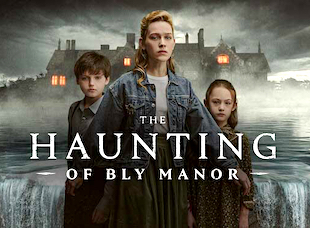 This month, I have mostly been missing The Haunting of Bly Manor, the followup to The Haunting of Hill House, which I also never got round to watching. This is the perfect month for that kind of thing, obviously, so I ought to make the effort. Not sure I will, mind. Same goes for Lovecraft Country, which I heard a lot of good things about, and then heard less good things about, and now I’m just not sure. I mean, there’s so much TV to watch nowadays, you gotta be careful not to waste that precious viewing time. And I’m sure there’s been a bunch of other stuff, but God, never mind watching it, I can’t even keep up with remembering it all.


 The
The  When I
  After being less ambivalent about Archer’s fifth season experiment, Archer Vice, I was delighted to see it return to its original espionage trappings for
  This particular batch of Creek episodes begins with Christmas special Black Canary, which aired between series 2 and 3. It’s one of the series’ very best episodes (indeed, it’s the top-rated on IMDb), a great mystery with an atmospheric snowbound Christmastime setting. Unfortunately, things then go off the boil a bit in series 3. Every single episode is written by David Renwick, and you wonder if he was beginning to run out of fresh, clever ideas. Nonetheless, there are some highlights here: a missing alien corpse; a mystery where a missing apostrophe may be a vital clue; and creepy one where a man apparently crawled up some steps after being shot in the head.
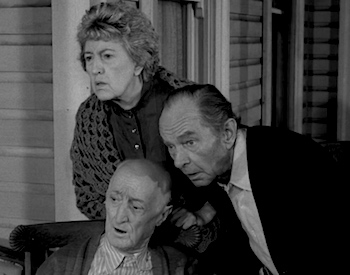 This month’s penultimate selection of the original Twilight Zone‘s best episodes begins with one that was remade by Steven Spielberg for
  Conversely, there’s a typical Twilight Zone parable to be found in People Are Alike All Over. Unfortunately, it’s one of those episodes that only comes into its own at the final reveal — the journey there seems padded out to fill the requisite amount of screen time. Some of the pulp-SF stuff seems a bit dated now (the idea that Mars might be inhabited by an entire race of human-like beings is, obviously, daft), but it’s all in aid of an accurately cynical critique of mankind and our attitude to new discoveries.
 Finally, Jack Klugman makes his fourth and final TZ appearance as the lead of In Praise of Pip. He plays a bookkeeper and failed father, now worried about his grown son who’s been injured in Vietnam (this is before the full-on Vietnam war, by-the-by — it’s speculated that this might be the first time the country was mentioned in a US drama). What plays out is the story of a man realising he’s wasted his chance to enjoy his kid’s childhood. It’s a good theme, and one fit to be given a fantastical Twilight Zone spin (it makes a change for a TZ episode to be about a man revisiting someone else’s childhood), but I wasn’t convinced by how it played out. In part, he makes a deal with God that thousands, millions, of other parents have tried to make, without success, because they don’t live in the Twilight Zone. I’m not sure how this would play with them… That aside,
  This month, I have mostly been missing the second season of The Umbrella Academy, which I’ve heard fantastic things about. I never got round to watching season one (although I meant to), so I really should catch up. And talking of “second seasons of superhero shows I never got round to the first season of”, Amazon just started The Boys season two. I want to catch up on that, too.
