2019 Statistics

It’s the most wonderful time of the year. No, not Christmas — that’s well and truly over now, isn’t it? I mean, it’s not even really the new year anymore, it’s just the year now. This post is kinda late.

No, by “most wonderful time of the year” I mean this — the day I publish my annual statistics post! As the guy who does the introductions to films at Odeon might say, “ooh, yeah, the statistics. I love the statistics. Specially chosen for this post, actually.” Except they’re not really specially chosen, I do the same ones every year. But then the trailers aren’t really specially chosen for the film, are they? That Odeon guy’s just a liar.

Anyway, it’s time for the main event. So, turn off your phones, finish your conversations, and get ready — it’s about to begin…

I watched 151 new feature films in 2019. That ranks 5th in the history of 100 Films — it’s the lowest of the past five years, but beats every one from 2007 to 2014. It’s 11% beyond 6th place (2014) and 15% short of 4th place (2017). And it’s down a massive 110 films (42%) on last year.

I also watched one extended or altered cut of a feature I’d seen before — namely, Deadpool 2’s Super Duper $@%!#& Cut. (I know it’s only my own rules I’m butting up against, but I haven’t settled on a way to count alternate cuts like this now that I have my Rewatchathon. I mean, it’s not strictly a rewatch because it’s a different cut, but it’s also not a new film because it’s not that different to the version I’d already seen. Anyway, it’s included in the following graph, but I haven’t counted it towards the other stats.)
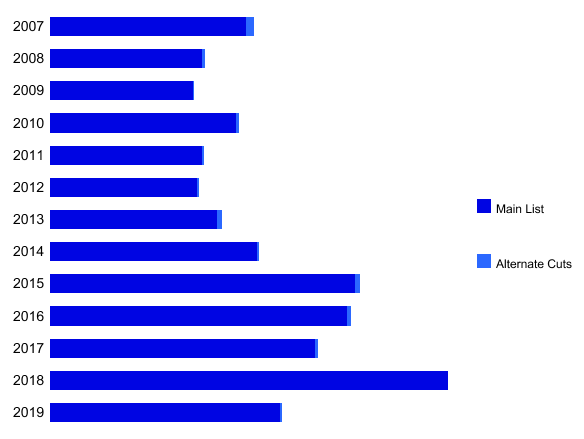
As just alluded to, in 2019 I also undertook my Rewatchathon for the third year. My target was 50 films, but I only made it to 29. Still, that’s 29 more than I might’ve managed otherwise. Add all of those together and my overall total is 181 films. I’d love to tell you how that compares to previous years, but I’ve still not put together a proper history of rewatches for that comparison. Maybe I’ll finally get it sorted for 2020’s stats.

I also watched 20 short films in 2019, which more than doubles the next nearest — second place is a tie between 2007 and 2018 with just eight each. As with the alternate cut, these only count towards one stat, which I’ll mention in a moment.

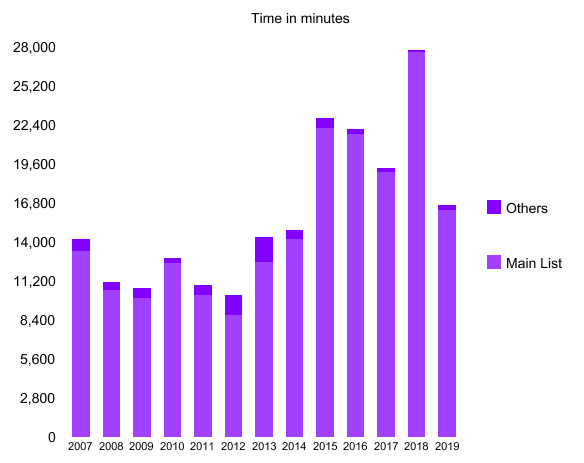
So, the total running time of the 151 new films was 271 hours and 56 minutes. That’s down a whopping 41% on last year… but then the number of films I watched was down 42%, so fair enough. Add in the Deadpool 2 alternate cut and all those shorts and the total running time of my new 2019 viewing was 277 hours and 47 minutes — that’s just over 3½ hours of shorts, FYI. (Last year I said “maybe next year I’ll start counting my Rewatchathon here too”. I haven’t, obviously. Maybe next year…)
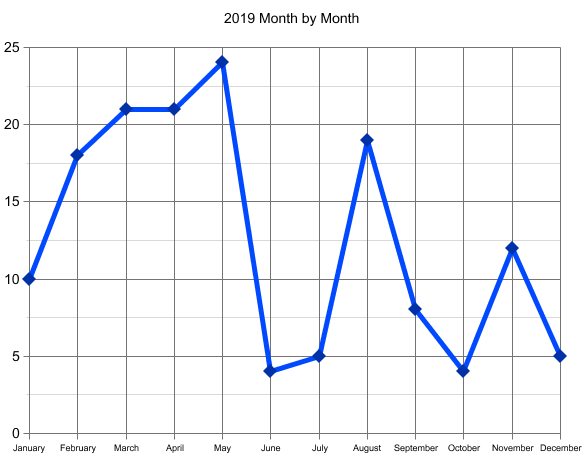
Here’s how that viewing played out across the year, month by month. It’s a particularly interesting year to have this graph (I only added it for the first time in 2018’s stats), because my viewing patterns have been so variable. I imagine if a lot of people bothered to plot a graph like this they’d end up with a broadly flat line, because I’d presume they watch roughly the same amount of stuff (whether that’s a lot or a little) month in, month out. Or maybe they’d all be as variable as mine, I dunno. Either way, my one is anything but flat…
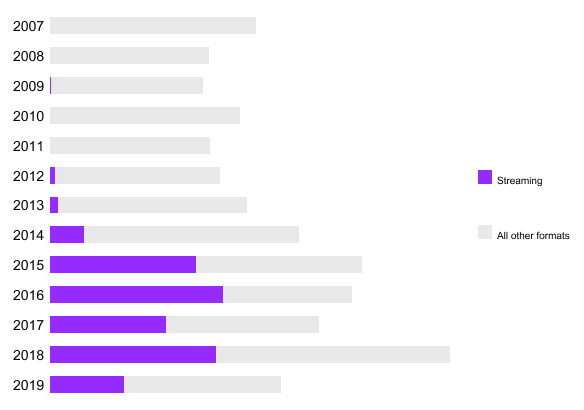
Now, how I watched those films. Most people may be pivoting to streaming, and dedicated cinephiles of course see a lot on the big screen, but I still love my physical media. Nonetheless, for the fifth year in a row this year’s most prolific viewing format was streaming. I guess I’m one of those people too. Or not — I buy more than my fair share of Blu-rays, I just don’t get round to watching as many as I should. Anyway, streaming accounted for 49 films, or 32.5% of my viewing. The raw number is less than half what it was last year (109), but then I did watch 110 fewer films overall too. More interestingly, the percentage is also down significantly, continuing a trend that’s been going on for a few years now — it was 57% in 2016, 43.2% in 2017, 41.8% in 2018, and now just 32.5%. Maybe I’m bucking the trend after all.
Those streaming numbers can be broken down across five services: Netflix, Amazon (a mix of Prime and paid-for rentals), Now TV (aka Sky Cinema), BBC iPlayer, and Rakuten. This year, it was Netflix in first place (it’s been Amazon the last two years) with 21 films (42.9% of streams). Mind, Amazon were close behind on 19 (38.8%). Way down in third was Now TV, with just five films (10.2%) — I only subscribe for a month so I can watch the Oscars, but I clearly didn’t get very good value for money this year (for comparison, last year I used it to watch 25 films). That said, keep reading to downloads for more on this… Rounding out the streamers were iPlayer with three (6.1%) and Rakuten with just one (2%).

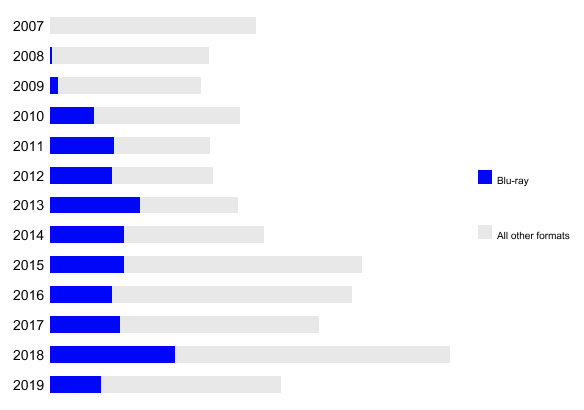
In second place was Blu-ray, represented by 34 films (22.5%). Sadly, that is also a much reduced percentage from last year (when it was 31.4%). As I said, I buy loads of the darn things, so I should do better here.
So, where are those percentage points going? Well, in third we find downloads, with 22 films (14.6%). In real terms that’s a drop from last year (when it was 25), but if we compare percentages it’s up by around 50%. See, statistics are fun, aren’t they? (Although Now TV only gets credited with five films, a few download viewings were, shall we say, morally justified by their presence on Now TV… by which I mean I acquired better-quality copies than Now TV’s outdated 720p and watched those instead, but it’s okay because I’d paid for those films via a Now TV subscription.)

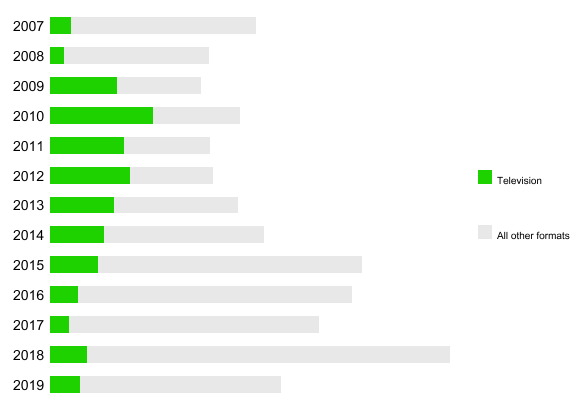
Close behind is TV, on 20 films (13.2%) — again, a drop in real terms but a rise in percentage. Still, nowhere near where it once was — check out the drop since 2010 in this graph.
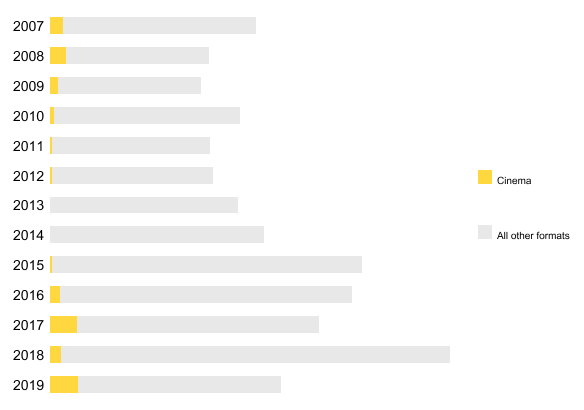
In fifth place is cinema, whose lowly position masks something of an achievement: it’s the most cinema visits I’ve made in one year since this blog began. My total was 19 films (12.6%), besting 2017’s tally by just one. It’s also the only format number that’s bigger than last year. Mostly it’s thanks to FilmBath Festival — without that, it’d only be eight (mind you, that would still be more than most years of this blog’s life — only 4 out of 12 other years would be higher.)
Finally, in sixth and last place, is DVD. Oh, poor DVD. Some people still love you, but the industry’s failure to get Blu-ray to catch on is a rant for another day. Anyway, this year I watched seven films (4.6%) on digital versatile disc, which is its lowest number since 2012. It’s impressive it’s still toddling on at all, really, but sometimes it’s easier just to watch the DVD I already have than source an HD copy.

In amongst all that, I watched seven films in 3D (4.6%), down 11 from last year (which was up 11 from the year before!), and 15 in 4K UHD (9.9%), up just one from last year. Considering I own a 3D-capable 4K TV, their combined percentage of 14.6% is a bit disappointing — especially as I didn’t have a UHD Blu-ray player last year, so that new bit of kit has made very little net impact. Though, again, it depends how you do your comparison: going from 14 to 15 may not be much, but as a percentage of my viewing UHD has increased from 5.4% to that 9.9%.

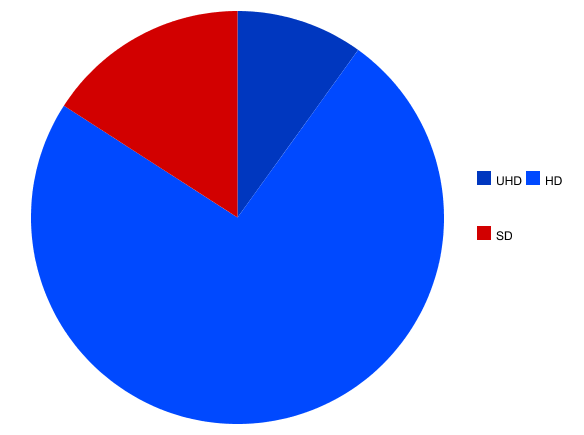
So, with that said, how did my viewing split up in terms of UHD vs. HD vs. SD? Contributing to the UHD number is a cocktail of Blu-ray discs, streams, and downloads. For HD, it’s the same mix, plus cinema trips (you’d think big cinema screens would be keen to go for 4K instead of 2K, but nope — apparently there are shockingly few 4K cinemas out there). And in SD, well, it’s of course a similar blend again, but with DVDs instead of BDs. The final result is 112 films in HD (74.2%). Add the aforementioned 15 (9.9%) in UHD and I’ve got a total of 84.1% in HD formats. That’s down a bit from last year, which nearly hit 90% HD, but hey-ho.
Picture quality shouldn’t really be an indicator of the age of films I watched — old films can be HD too, of course (is everyone aware of this by now? I had to explain to someone once how even silent films could be HD. But, in fairness, they weren’t the kind of person who’s likely to be reading a film blog). Nonetheless, my viewing did skew newer, as usual: the most popular decade was the 2010s, with 90 films. That’s 59.6% of my viewing, a higher percentage than last year, but not as high as the year before that. The 2010s have been my highest decade ever year since 2012 — now it’ll be interesting to see how soon the 2020s take over.

The 2000s have come second since 2012 too… but not this year! Thanks primarily to Quentin Tarantino’s Swinging Sixties Move Marathon, in 2019 second place went to the 1960s (obviously). It’s a distant second, mind, with just 13 films (8.6%). In fact, only seven of the ten films in QT’s marathon were from the ’60s themselves, but without those it would be much lower in the rankings.

So, the 2000s are pushed into third, with 11 films (7.3%). In fourth we find the 1970s with nine (5.96%), also helped slightly by the Tarantino marathon (though, in this case, only by one extra film). It’s back to the ’90s for fifth, with eight (5.3%), followed closely by the ’50s on seven (4.6%), including the final two films from the “sixties” marathon.

Rounding things out, the 1920s and ’40s had four (2.6%) apiece; the ’80s is uncommonly low on just three (1.99%); and finally there’s the oldest decade for this year, the 1920s, with two (1.3%).

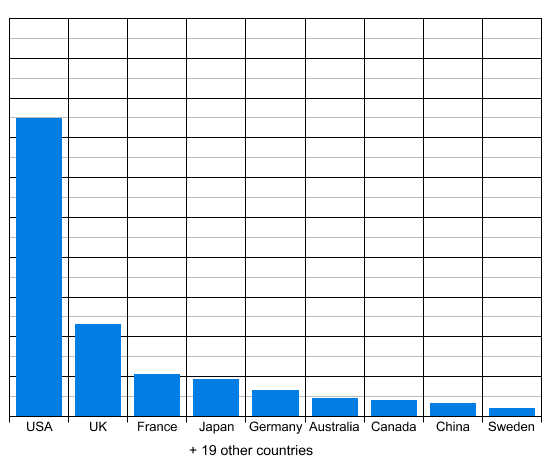
From “when” to “where” — countries of production. And it’s another “business as usual” situation, because once again the USA dominated with a hand in 113 films (74.8%, which is up a couple of points from last year). Also as usual, second place belongs to the UK, with 35 films (23.2%, also an increase from last year). Also in double figures were France (16 films, 10.6%), Japan (14 films, 9.3%), and Germany (10 films, 6.6%). In all, 28 countries were involved in the production of at least one film. That’s a marginally lower number than it’s been the last few years, but I also watched a much lower total of films, so it’s not too bad overall.
You might think less variety in countries would mean less variety in languages spoken, but not so. Now, English was still thoroughly dominant, being spoken in 128 films — but that works out as 84.8%, the lowest it’s ever been. In second place for the third year in a row was Japanese, its tally of 13 films being the only other language to make double figures this year. Although it totals fewer films than last year, its percentage of 8.6% is similar. In total, there were 24 languages, plus four silent films. American Sign Language cropped up in one film, as it seems to every year, while other more unusual (for my viewing) languages included Burmese, Mixtec, and Punjabi.
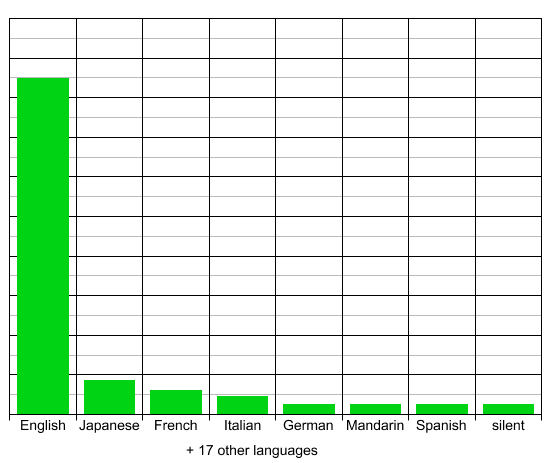
A total of 134 directors plus 10 directing partnerships appear on 2019’s main list. Only six of those were responsible for multiple films, the lowest that figure’s been since 2012. Most prolific of these was Kenji Misumi with three, all Zatoichi films. The other five directors, with two apiece, were Bill Condon, Alfred Hitchcock, Phil Karlson (both from Tarantino’s sixties marathon), Fritz Lang (arguably — some would say Dr Mabuse, der Spieler is a single film), and Kimiyoshi Yasuda (also both Zatoichi films).

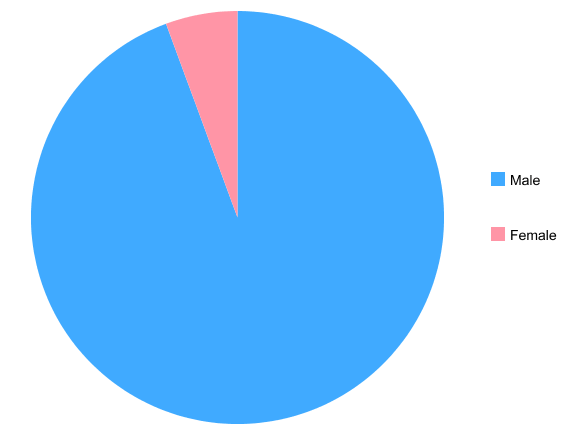
For the past few years I’ve charted the number of female directors whose work I’ve watched. There were ten female directors represented among 2019’s feature film viewing — seven as sole director, three as part of a directing partnership with a bloke. Counting the co-directors as half a film each, this represents 5.63% of my viewing — better than last year (which was better than the two years before it), but, as this graph ably demonstrates, still a disappointingly low figure. I mean, I watched more films directing by someone called “John”.
At the time of writing, 12 films from 2019’s list appear on the IMDb Top 250 (or “Top Rated Movies: Top 250 as rated by IMDb Users”, as it’s less-catchily technically known nowadays). However, because that list is ever-changing, the number I have left to see has only gone down by four, to 45. The current positions of this year’s checks range from 22nd (Life is Beautiful) to 225th (The Red Shoes).

At the end of my annual “top ten” post I always include a list of 50 notable films I missed from that year’s releases, and continue to track my progress at watching those ‘misses’. For the past few years I’ve managed to watch some more from every one of these lists, but I let that slip in 2019. The overall number I watched dropped too, totalling 37 (the lowest it’s been since 2014, when obviously there were fewer films to choose from). Well, that’s the kind of year it’s been. Anyway, the ones I did watch included two each from 2008, 2012, and 2016; and one each from 2010, 2011, and 2017.

Finally, in the first year of watching 2018’s 50, I saw 28 of them. That’s no record, but it’s still over 50% (to be precise, 56%), so I can’t complain.

In total, I’ve now seen 422 out of 600 of those ‘missed’ movies. That’s 70.3%, up a teeny tiny amount from last year’s 70.0%. If I don’t pick up the pace again next year, I may be looking at a percentage drop. (As ever, the 50 for 2019 will be listed in my “best & worst” post.)

And lo, just like that, we’re coming to the end. To conclude 2019’s statistics, it’s the climax of every review: the scores.

As always, this includes every film, meaning some don’t have published reviews yet — and, therefore, some I was still mulling over my exact score for; the kind of films I’d happily award 3.5 or 4.5 on Letterboxd, but which here I always round up or down to a whole star. Maybe I should start giving half stars. (I feel like I say that every year…) Anyway, I’ve had to go ahead and pick a rating for everything to get this part of the stats done, and maybe I’ve been too generous in places, or too harsh in others. We shouldn’t really take such a simplistic rating system too seriously, anyway (he says, as he goes on to make it the final thing in this post as if it’s a definitive statement on the quality of the films I saw this year…)

Barrelling on regardless: at the top end of the spectrum, this year I awarded 25 five-star ratings, which means I have 16.6% of films full marks. That’s a slightly higher percentage than last year, but lower than the year before that, but higher than the year before that, but lower than the year before that… and so on. In other words, I’ve not suddenly got harsher or more generous, or suddenly watched a lot more or lot fewer good films.

Indeed, it was also business as usual with the score I handed out most often: four-stars, which I awarded to 62 films. Out of 13 years of this blog, four-stars has been my highest-scoring score 12 times (the exception is 2012, which saw more three-star films). That said, at 41.1% it’s the lowest percentage of four-stars-ers since 2013. That loss was spread out across the rest of the board, with slightly higher than normal percentages for the remaining three ratings. For example, there were 46 three-star films, which at 30.5% is its third highest ever percentage.

Fortunately, the “bad” end of the scores continue to bring up the rear, with 15 two-star films (9.9%) and three films meriting just one-star (1.99%). That’s technically the highest percentage of one-star films since 2012, but as the other intervening years range between 0.7% and 1.5%, I don’t think it’s a cause for concern. It’s barely even cause for comment.
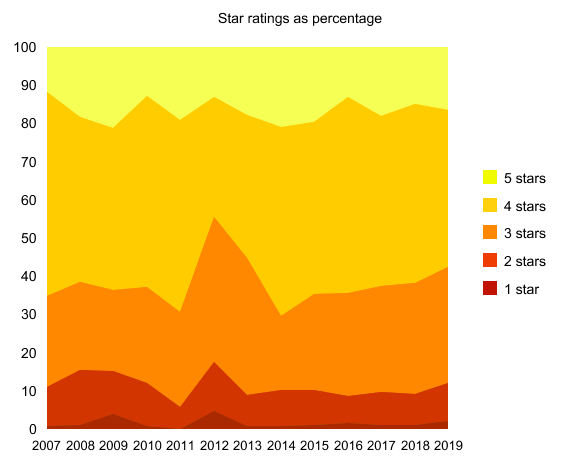
Finally, that brings us to the average score — the single figure that arguably asserts 2019’s quality compared to other years. The short version is 3.6 out of 5, the first time it’s been below 3.7 since 2013. In fact, if we go to three decimal places, it comes out as 3.604, which is the second lowest ever (beaten by 2012’s exceptionally poor 3.352). Now, it doesn’t feel like I’ve had particularly poor viewing this year — indeed, I was worried I was handing out five-star ratings too easily at one point — so it’s something of a surprise to find it so low. But maybe I’m just getting more discerning. I mean, it’s not a sharp drop (unlike that 2012 anomaly), more a slight decline.

And that’s the statistics over for another year, I’m afraid. But if you’re a junkie like me and still after more, check out my Letterboxd 2019 stats — that site tracks different stuff (like directors and actors), and includes different films (i.e. my Rewatchathon viewing, plus a few TV things), so it’s a bit different. That’s exciting, eh?


If you thought it was getting a bit far into 2020 to still be thinking about 2019, oh ho ho, no! Still to come: my picks for the best and worst of my viewing from last year.

My Most-Read Posts of 2019

2019 may’ve given us the highest grossing film of all time, amongst numerous other big events, but TV reviews once again dominate my most-viewed posts of the year — in the rankings of new posts, there’s no film until 8th (if we widen that to include older posts, it’s all TV until 14th).

But this is still theoretically a film blog, so — as usual — I’ve compiled my five most-read TV posts (which, obviously, is the same as my outright five most-read posts) and then my five most-read film reviews.

My Top 5 Most-Viewed New TV Posts in 2019

5) The Past Month on TV #45
including Game of Thrones season 8 episodes 1-2, Thronecast specials and series 8 episodes 1-2, Deadwood season 3, and The Twilight Zone ‘best of’ selection 2.

4) The Past Month on TV #43
including The Punisher season 2, Russian Doll season 1, Hanna episode 1, Les Misérables episodes 4-6, the 91st Academy Awards, the British Academy Film Awards 2019, Great News season 2 episodes 8-13, and Mark Kermode’s Oscar Winners: A Secrets of Cinema Special.

3) The Past Christmas on TV 2018
including Doctor Who: Resolution, The ABC Murders, Watership Down, Not Going Out: Ding Dong Merrily on Live, Upstart Crow Christmas special, Click & Collect, Goodness Gracious Me: 20 Years Innit!, Mock the Week, Have I Got News for You, Insert Name Here, Mrs Brown’s Boys, Simon Callow’s A Christmas Carol, The Dead Room, Mark Kermode’s Christmas Cinema Secrets, and Les Misérables episode 1.

2) The Past Fortnight on TV #46
This attracted almost three times as many views as the post in 3rd (that graph in the header image is accurate — the top two were out well ahead of everything else). What attracted such attention? Nothing less than the final season of the biggest TV show of the decade: Game of Thrones. This post included Game of Thrones season 8 episodes 3-4, Ghosts series 1 episodes 1-3, Columbo: Murder by the Book, The Twilight Zone ‘best of’ selection 3, Mark Kermode’s Secrets of Cinema: Disaster Movies, and Thronecast series 8 episodes 3-4.

1) The Past Fortnight on TV #47
My comments about IMDb voters of the Game of Thrones finale attracted some degree of ire, which helps lead this one to first place. In fact, it’s already my 4th most-viewed post of all time. It only included Game of Thrones season 8 episodes 5-6, The Twilight Zone ‘best of’ selection 4, Eurovision 2019, and Thronecast series 8 episodes 5-7.

My Top 5 Most-Viewed New Film Posts in 2019

5) Star Wars: The Rise of Skywalker
Jumping in here in the final days of the year, the much-anticipated conclusion of the 42-year nine-film Skywalker Saga. Shame it was such a load of rubbish.

4) The Highwaymen
Netflix films often do well in these rankings, especially if I review them promptly, and that applies to both this and the film in 3rd. There were also Netflix films in 6th, 8th, and 9th places, and a Sky Cinema debut in 7th.

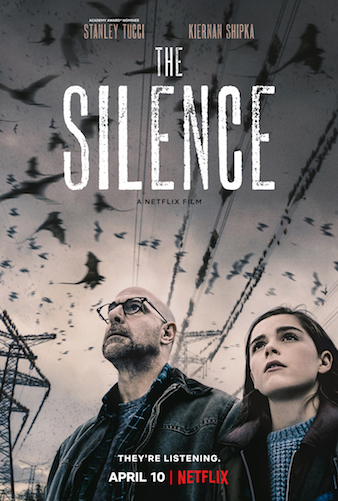
3) The Silence
Mind, there are better Netflix films people could’ve chosen to read about than this.

2) Glass
That said, a promptly-reviewed big theatrical release can top even Netflix titles, as these next two show. Alternatively, they say something about the continued dominance of superhero movies.

1) Avengers: Endgame
Well, it is the biggest film of all time.

Shaft (2019)

2019 #98
Tim Story | 111 mins | streaming (HD) | 2.39:1 | USA / English | 15 / R

Shaft (2019)

I wrote recently about Shaft 2000 (I’m gonna start calling it that, even if nobody else does), the turn-of-the-millennium attempt to reboot the ’70s blaxploitation classic. It didn’t really take off, for various reasons, but I think it’s a pretty solid thriller in its own right. Now, 19 years later, they’ve decided to try again, only this time they’ve thrown away the spirit of the original in favour of an intergenerational buddy comedy.

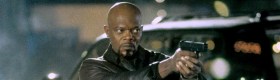
John Shaft Jr (Jessie T. Usher) is a bookish FBI data analyst whose dad, John Shaft (Samuel L. Jackson), abandoned him when he was a baby so he could go off galavanting with other women and solving crime while looking cool. Down the years he’s sent Jr presents like condoms and a box of porn mags — he’s that kind of dad. (Is that a kind of dad, or is it just a caricature of one?) Anyway, after Jr’s former-junkie best friend dies of an apparent overdose, everyone else believes it was a relapse, but Jr isn’t convinced. Struggling to investigate on his own, he turns to his estranged father for help.

Where Jackson’s Shaft was once a cool dude kicking ass and taking names (or whatever it is cool dude PIs did in the early ’00s), here they’ve turned him into a bit of a throwback dinosaur, spouting politically incorrect opinions with every other line of dialogue. This film does acknowledge the existence of the 2000 movie (an opening montage covering the last 30 years of the Shafts’ lives includes shots from that film to show Shaft Sr quitting the police), but it doesn’t feel like the same character we saw back then — he’s much more of a caricature of an outdated sex-obsessed oldie here. At times it’s like someone adapted one of those facile “millennials are to blame for everything” articles into a movie; or at least copy-pasted it into Shaft Sr’s dialogue.

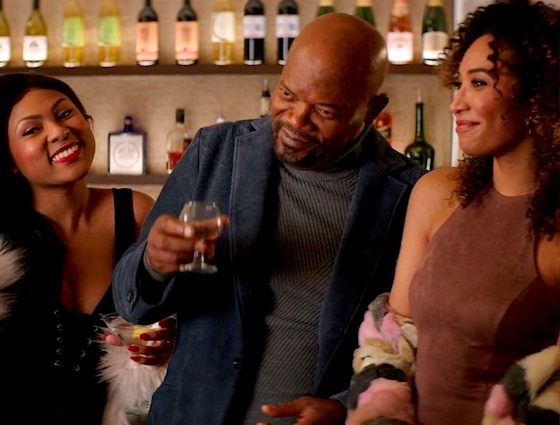
Still a sex machine to all the chicks

This aspect has come in for much consternation among the film’s wider critical reception, but, eh, I dunno — the crap Shaft comes out with is definitely being played for laughs, with other characters eye-rolling (and similar) at most of what he says and does. At the same time, Jr’s character arc still comes down to “manning up” in the way his father wants him to. For instance: he hates guns, but when assassins attack at a restaurant, he borrows his date’s handbag-sized pistol and takes them out with expert marksmanship, before throwing the gun down in disgust. Put another way, the film is having its cake and eating it — it knows these old-fashioned ideals are, well, old-fashioned, but it’s gonna let them play out anyway. Even the plot pretends to be kinda modern by suggesting it might all have something to do with terrorism and radicalising Muslims — though as that’s been a plot driver for nigh on 20 years now, maybe it stretches the idea of “modern”. But it doesn’t matter anyway, because really that’s a red herring to cover up a standard drug smuggling affair.

The film’s best bit comes at the end, when Richard Roundtree’s OG Shaft gets roped into things for no particularly good reason. But it doesn’t matter, because granddad Shaft’s antics, and the banter between all three generations, is the most entertaining part of the movie. It certainly helps cover for the TV-movie-esque quality of the action scenes. It’s a shame the film waited so long to get him involved.

Shaft cubed

So Shaft 2019 is antiquated in myriad different ways, be it the values espoused by its co-lead or the general tone and content of its story. It didn’t need to be like that — Shaft may’ve been born in the ’70s, but I don’t think the very nature of the character requires him to still embody ’70 values. Nonetheless, if you don’t let that stuff bother you too much, the result is a moderately entertaining watch — nothing special (the other two films with the same title are both better), but a passably humorous 110 minutes.

3 out of 5

Shaft is available on Netflix everywhere (except the US) now.

The Puny Monthly Review of June 2019

All good things must come to an end, and so a half-decade-long streak has concluded… well, we now know said streak ended last month, but it was this month that actually put a stop to it.


#95 Deadwood (2019)
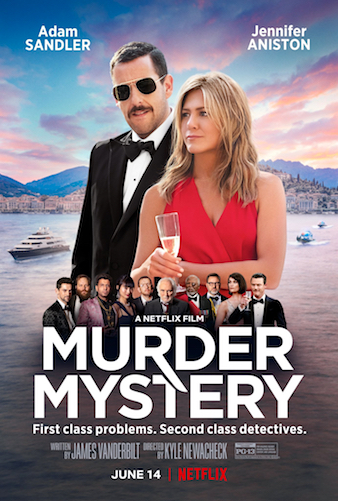
#96 Murder Mystery (2019)
#97 Untouchable (2011), aka Intouchables
#98 Shaft (2019)

(That poster was so pathetically small, I almost felt I shouldn’t bother… but then I wrote this note, meaning I could embiggen the image to go alongside here too, at which point it became much more satisfactory. Yay formatting!)

Deadwood: The Movie
.


  • So, I only watched 4 new feature films in June.
  • On the downside, that ends a five-year streak of watching at least 10 films every month. (A streak that lasted exactly five years, by-the-way — I forgot to mention that last month.)
  • On the bright side, it means there’s some slightly different stuff to talk about in these stats. Like, for example, that June 2019 is the lowest-totalling month since June 2013, which was six whole years ago.
  • It’s the 150th month of 100 Films, by-the-by, but also the 15th with 4 or fewer films. That means it’s in the bottom 10% of all months, which is its own kind of achievement.
  • It takes the average for June down from 10.5 to 10.0, meaning it just keeps its head above the waterline for something I’ve been working on for a while now, i.e. getting every month’s average above 10. (The only remaining outlier is July, which is on 9.9, so that’ll be fun next month…)
  • It also takes the average for 2019 so far down from 18.8 to 16.3, and the rolling average of the last 12 months down from 19.3 to 17.8.
  • This month’s WDYMYHS film: true-story French comedy-drama Untouchable, aka Intouchables in its original language, aka The Intouchables in the US. It’s amusing and heartwarming, but its elevated position on lists like the IMDb Top 250 oversells it somewhat.
  • There’s no Blindspot film this month. If I hadn’t upped my goal to 12 films on both lists that’d be fine, but now I’ve got one to catch up.
  • I also watched nothing from last month’s “failures”, so I guess that makes them a double failure. Oh dear.


The 49th Monthly Arbitrary Awards

Favourite Film of the Month
Not much to choose from this month, obviously, so the belated TV movie revival/finale of Deadwood walks away with this one easily.

Least Favourite Film of the Month

It’s come in for a pasting from critics and box office figures alike, but I thought the new Shaft was passably entertaining, but as it’s fuelled by outdated gags and a buddy-movie tone that sits awkwardly with the franchise, it’s certainly the weakest of this meagre selection.

Ranking All the Shaft Films I’ve Seen
1) Shaft
2) Shaft
3) Shaft

Look, I’m Struggling To Think of Categories For This Because I Only Watched 4 Films This Month, Okay?
Er, I think that ‘award’ title just about covers it…

The Audience Award for Most-Viewed New Post of the Month
Adam Sandler’s latest film generated Netflix’s biggest ever ‘opening weekend’ viewership this month, being watched by almost 31 million accounts over its first three days. So it’s no surprise to see Murder Mystery easily top this month’s list of my most-visited new posts — it had almost 15 times as many views as the post in second place.


Considering I couldn’t even keep up with my main list goals, it should come as no surprise that my Rewatchathon suffered — and suffered worse, too, as I didn’t rewatch a single film this month. Oh well.


In a month where I watched so little, it should come as no surprise that I failed to watch plenty of stuff in particular. On the big screen, I missed the finale for this iteration of the X-Men, Dark Phoenix, as well as attempted franchise revival Men in Black: International (based on the poor reviews, I expect said revival will be short-lived), and the seemingly-unnecessary but now acclaimed Toy Story 4. That last one looks like it’ll be playing for a while, so maybe I’ll catch it yet.

At home, a couple of things I missed at the cinema in February have now made it to disc, where I failed to watch them again — namely, How to Train Your Dragon: The Hidden World (which I bought) and The Kid Who Would Be King (which I didn’t, mainly because I couldn’t tell if its UK 4K release was actually happening or not (I suspect it’s not)). Other recent purchases fall into the Rewatchathon bracket: Glass, Annihilation, Schindler’s List, and the Mummy trilogy… although I never got round to seeing the third one, Tomb of the Dragon Emperor, so, er, that’s not a rewatch.

Actually, between sales and limited edition new releases, I also added a bunch of older films to my unseen pile, including The Blood on Satan’s Claw; The Holy Mountain; John Woo’s Last Hurrah for Chivalry and Hand of Death; and Arrow box sets presenting trios of early Brian De Palma works (The Wedding Party, Greetings, and Hi, Mom!) and Jia Zhangke films (24 City, A Touch of Sin, and Mountains May Depart). I really ought to get on with watching some of them…


I’m away on holiday for half of next month, so, along with everything else going on, there’s a very real chance July will continue this fewer-than-10-films streak — though hopefully it won’t be as disastrous as July 2009…

Murder Mystery (2019)

2019 #96
Kyle Newacheck | 97 mins | streaming (UHD) | 2.00:1 | USA / English | 12 / PG-13

Murder Mystery

Murder Mystery is a murder mystery in which there is a murder under mysterious circumstances, and it falls to vacationing NY cop Nick Spitz (Adam Sandler) and his murder-mystery-loving wife Audrey (Jennifer Aniston) to solve these mysterious murders.

I’m no great fan of Sandler, and he’s probably the least funny person in this film, but I also didn’t find him outright objectionable. His character — an underachieving middle-aged beat cop who pretends to be a detective to his long-suffering wife — seems like the kind of guy who’d think he’s funnier than he is, so Sandler’s attempts at humour mostly come off as in-character. Put another way, it works in spite of itself. Of the two leads, Aniston is definitely the one doing the most work for the film, both in terms of actually being amusing and giving it some kind of emotional character arc.

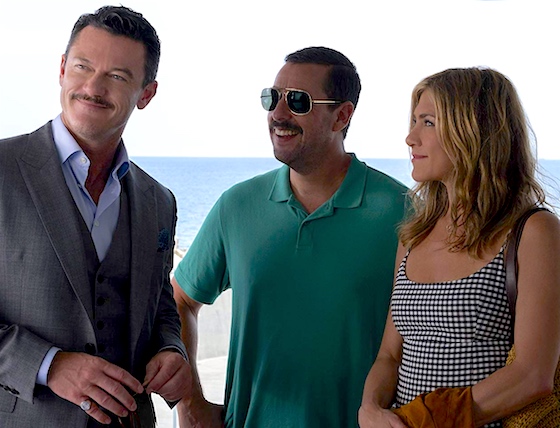
Detectives or suspects?

The actual mystery plot is no great shakes — there are two glaring clues early on that give most of the game away, especially if you’re well-versed in watching murder mysteries and spotting such hints. That’s somewhat beside the point, though, because there’s enough fun to be had along the way to make up for it, and there are still some reasonable red herrings. The fact the cast is staffed by an array of experienced mostly-British thesps, many of whom have no doubt appeared in their share of ‘real’ murder mysteries — the likes of Luke Evans, Gemma Arterton, Adeel Akhtar, David Walliams, and Terence Stamp — definitely helps keep proceedings afloat.

There are a few of action-y scenes — a shoot-out, some hijinks on a hotel ledge, a decent car chase for the finale — that keep the momentum up too. Plus it mostly looks suitably luxuriant and exotic (the odd bout of iffy green screen aside), matching its high-class backdrop and French Riviera setting. Altogether, it makes for a suitably easy-watching 90-minutes in front of Netflix.

3 out of 5

Murder Mystery is available on Netflix everywhere now.

The Silence (2019)

2019 #58
John R. Leonetti | 90 mins | streaming (HD) | 2.35:1 | Germany & USA / English & American Sign Language | 15 / PG-13

The Silence

A 15- / PG-13-rated horror movie in which the world is under attack from creatures who hunt and kill via sound, and we follow a family who attempts to survive by hiding in a remote farmhouse, aided by the fact they’ve all learnt sign language to communicate with their deaf teenage daughter.

If you’re thinking “wait a minute, that’s a description of A Quiet Place,” you’re right, it is. It’s also a wholly accurate summary of this new direct-to-Netflix film.* Yes, really, they are that similar. At first glance it seems utterly ludicrous that Netflix would release such a blatant rip-off, especially just one year after the previous film; but, as ever, there’s a little more to it than meets the eye: The Silence is based on a novel published in 2015, and filming began back in September 2017. It seems it got unlucky, and is now doomed to be dismissed as no more than a shameless rip-off. But while it’s not The Silence’s fault that A Quiet Place beat it to the punch, it is the film’s own fault that it’s not very good.

The real problem here seems to be the screenplay. John R. Leonetti’s direction is fine, if unremarkable, and there are decent performances, particularly from leads Kiernan Shipka and Stanley Tucci, but they’re all saddled with a poorly rendered narrative. Early on, backstory is dumped via some random teenage-diary-level voiceover narration, making sure to shoehorn in some information that we then never actually need to know. One part of that asserts something along the lines of “everyone has a story of where they were when it happened; this is our story,” and then just minutes later we cut away to an event happening that’s completely unconnected to the main story. To make matters worse, it only does that once. It’s like they could only come up with one other idea for what might be going on during this disaster.

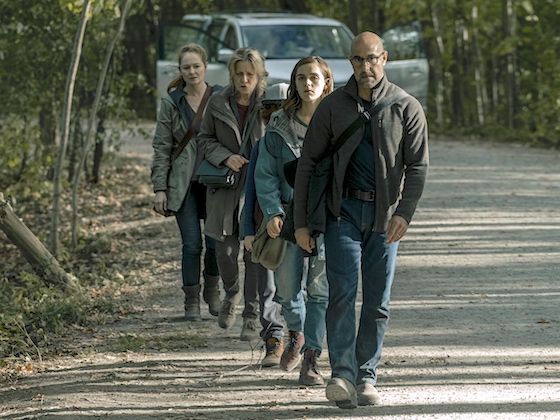
Just going for a nice family walk

The way The Silence handles its deaf character is another case in point, especially when contrasted with A Quiet Place. The latter embraced its deaf character and the family’s sign language communication (far more of the dialogue was signed than spoken), whereas The Silence sees to be doing its best to avoid or cover for that fact: she only went deaf when she was 13, so she still speaks, and she can lip-read so well people that other people don’t always bother signing to her either. There’s a bunch of little moments that undermine it as well. For example, at one point she has a video call conversation with her boyfriend, when for reasons of both situation (she’s sat in the back of the car with her family) and character (she’s deaf) it would make more sense for them to be texting. But later, the film flips all this on its head: once they full accept they need to stay as quiet as possible, they start mouthing things and signing all over the place, but the film doesn’t bother to subtitle it… although, ironically, if you turn on the hard-of-hearing subtitle track, it is subtitled. What a mess.

Even coming in the wake of A Quiet Place, The Silence had a chance to mark itself out by telling a slightly different story: here the event is just beginning, so we’re witnessing the stuff the other film skipped over. Except A Quiet Place skipped it for good reason: we’ve seen this “the apocalypse begins” rigmarole in many films before. The Silence doesn’t have any significantly new perspectives on it. Eventually it introduces a cult of religious nutters to threaten the family, but it does so with less than half-an-hour of the film left, consequently racing through to a conclusion at breakneck speed. It’s weirdly rushed after the almost methodical hour that preceded it.

It’s not an unmitigated disaster — there are moments that work, and Shipka and Tucci are both very watchable — but the overall concoction is poor, with shortcomings that are only emphasised by how well it was done in A Quiet Place.

2 out of 5

The Silence is available on Netflix now.

* Unless you’re in Germany, where it’s instead getting a theatrical release next month. ^

The Highwaymen (2019)

2019 #48
John Lee Hancock | 132 mins | streaming (UHD) | 2.35:1 | USA / English | 15 / R

The Highwaymen

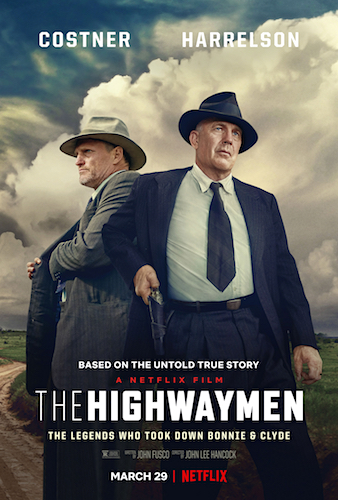
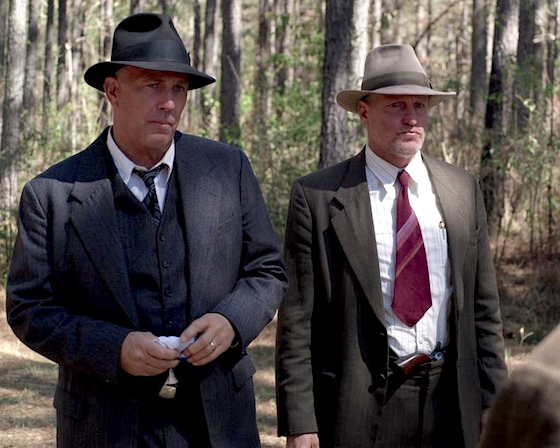
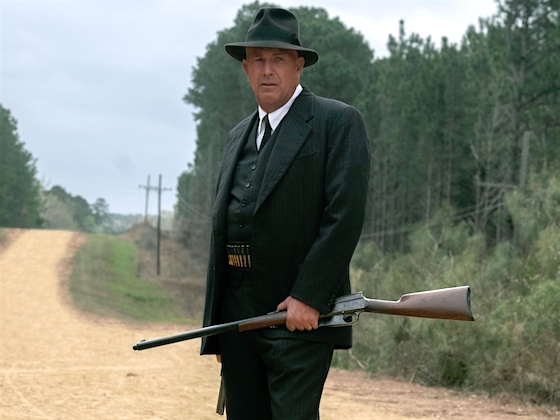
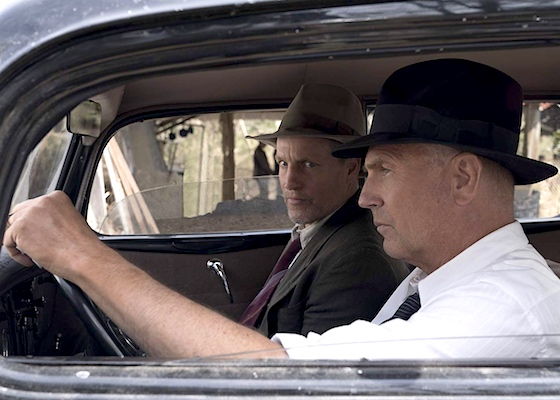
There’s a fair chance you know the story of Bonnie and Clyde thanks to the acclaimed 1967 movie (or the 2013 miniseries, or one of the other fictional depictions, or just their general notoriety), but what about the story of the guys who got ’em? For all the Robin Hood-esque heroism that was conveyed upon them by the media at the time and then cemented in subsequent fictional retellings, they were still murder-happy criminals. The Highwaymen sets out to do its part in rectifying this by introducing us to Frank Hamer (Kevin Costner) and Maney Gault (Woody Harrelson), a pair of retired Texas Rangers who were reinstated in early 1934 to track down Bonnie and Clyde and put an end to their crime spree.

Netflix has self-described the film as “The Untouchables meets Public Enemies” (they’re doing the job of reviewers for us!), and, while I’ve only seen one of those movies, I don’t think they’re far wrong. Netflix are well known for commissioning projects that are similar to other stuff people like (reportedly their first-ever original, House of Cards starring Kevin Spacey and produced/directed by David Fincher, came about because statistics showed viewers liked to watch the original BBC series, movies starring Spacey, and movies directed by Fincher), but this feels like one of the most blatant examples I’ve personally seen. Movies like Live by Night and Road to Perdition also came to my mind whilst watching, but it’s not limited to specific examples — it just feels like other movies set in about the same period about the same kind of thing. Well, we might blame Netflix’s data-centric thinking for that, but it’s actually nothing new in Hollywood.

Men of the highway

As a work in its own right, The Highwaymen is a solid period investigative thriller. It’s distinctly lacking the youthful verve and excitement of the ’67 film, which matched the youthfulness of its killer couple, replacing it instead with a slow-ish, world-weary methodicalness, which again matches its central pairing. That could be deliberate, or it could just be another instance of the recurring problem that Netflix-originated content is slower than it needs to be. When police procedurals are slow because they’re focusing on the exacting, gradual accumulation of evidence and data that leads to the downfall of the bad guys, that can be a good thing, and there’s an element of that here; but at other times it just feels a bit tardy. What it lacks is a sense of urgency, which you’d think the hunt for ceaseless murderers would have. We’re told these villains need to be stopped ASAP, and we see them continue to commit crimes as our heroes are still hunting for them, but we never really feel any sense of desperation to get the job done. Hamer and Gault kinda toddle along, as if they know it’s going to take two hours of movie-time to complete their mission so why rush?

It’s not helped by a seeming indecisiveness about what the movie wants to focus on. It’s torn between being a portrait of aged lawmen who may be past their time and a straight-up recounting of the hunt for Bonnie and Clyde. The former is a theme it only touches on in fits and spurts, often in scenes that feel shoehorned in just to address that subject. I’m not sure it had much to say about it either. It doesn’t come to the conclusion that the old ways are the best, or that they’re not relevant anymore; or that these guys still have their skills, or that they don’t anymore (early on there’s a scene where Costner realises he isn’t as accurate with a pistol as he used to be; that never comes up again) — they’re old, they’re tired, and… that’s it. As for the investigation, I presume it’s been depicted fairly accurately — the film has the feel of a story that’s been structured and paced this way because it’s based on truth. Of course, as we know from many other “true story” films, that’s a foolhardy assumption to make. Still, the final ambush was staged exactly where it really occurred out of a desire for historical accuracy, so it’s not wholly unreasonable to suggest that extends to the rest of the film.

Gunning for Bonnie and Clyde

One fascinating aspect of this particular case is how much the public were on the side of the criminals, and have been since (when The Highwaymen’s trailer debuted, I saw plenty of comments from disgruntled viewers hoping the film would acknowledge how underhanded the cops were in how they finally got Bonnie and Clyde! As if it somehow wasn’t fair to just shoot dead these crooks who had killed multiple other law enforcement officers, and innocent civilians, without similar fair warning). Perhaps unavoidably, the outlaws’ celebrity is another theme the film touches on, but only loosely. The populous should probably have been terrified of this viciously violent gang, but that they instead exalted them had a lot to do with the social situation at the time, i.e. the Great Depression, where the banks were the enemy, and Bonnie and Clyde did rob banks. Unfortunately, it’s again a thread that’s not fully unravelled; another facet the film notes is interesting but doesn’t bother to do a whole lot with.

Visually, there’s nothing to complain about here. It’s handsomely shot by John Schwartzman, with suitably open vistas that in themselves evoke a less urbanised time, where outlaws might still be hiding in the back of beyond. There are also scenes in towns and cities that clearly had enough budget to create a large-scale feel for the period. The film reportedly cost just under $50 million, the kind of budget movie studios don’t assign anymore, but it shows why it can pay off: this doesn’t need to be a $100 million blockbuster, but it does need enough cash to dress streets and extras for the setting. Netflix are one of the few still prepared to put money into such endeavours, and it is welcome.

Elsewhere, the film’s musical score was one of the main things that reminded me of Road to Perdition, so I was amused when I saw it credited to Thomas Newman, who also composed Perdition. I’ve commented before how I sometimes like his music but other times think he sounds a bit to similar to, well, himself (his work on Skyfall distracted me by sounding like what he did for A Series of Unfortunate Events), so maybe this shouldn’t be a surprise.

On the road to somewhere. Probably Perdition.

Despite all those niggles I’ve listed, The Highwaymen is actually a solid viewing experience. It may not do anything original or execute elements as well as it could have, but Costner and Harrelson are engaging performers to follow around, and the story is inherently interesting enough to hold attention — it may’ve been slower than necessary, but I was never bored. The film has been described in some circles as a “dad movie”, a phrase that was also bandied around about another Netflix original earlier this month, Triple Frontier. I guess it’s being used in a reductive and dismissive sense, but, well, so what? I’m not a dad, nor of the age range being intimated by the expression, but I don’t think there’s anything wrong with a decent men-on-a-mission movie either.

3 out of 5

The Highwaymen is available on Netflix now.

Triple Frontier (2019)

2019 #39
J.C. Chandor | 125 mins | streaming (UHD) | 2.11:1 | USA / English, Spanish & Portuguese | 15 / R

Triple Frontier

Former US soldier Santiago ‘Pope’ Garcia (Oscar Isaac) is struggling to make a difference as a consultant to a South American police force when his informant (Adria Arjona) finally gives him the location of powerful drug lord Gabriel Lorea (Reynaldo Gallegos), who’s hiding deep in the jungle surrounded by ill-gotten gains to the tune of many millions of dollars. Deciding the cops are too corrupt to handle this, Pope reaches out to his old military buddies — commander and strategist Tom ‘Redfly’ Davis (Ben Affleck), pilot Francisco ‘Catfish’ Morales (Pedro Pascal), and brothers Ben and William ‘Ironhead’ Miller (Garrett Hedlund and Charlie Hunnam) — to take on one last ‘off the books’ mission: kill Lorea and pocket the money for themselves. But they decide it’s too immoral so stay at home and do nothing.

Not really! Of course they agree to do it, risking their lives and their moral code for a big payday they all desperately need.

On the one hand Triple Frontier is a standard men-on-a-heist actioner, and a lot of people seem to have dismissed it as such. On the other, however, there’s quite a lot of different things going on here. Almost too many, in fact, as arguably the film doesn’t have time to explore them all. There’s a distinct thread about the treatment of veterans in the US — that these guys have been used up and spat out, and now struggle with their mental health and/or to even make a living in regular society. It also ties this into some “warrior code” mentality, which I’ve heard said is quite a realistic depiction of the mindset these kinds of guys have in real life, but does come across as a bit macho bullshit at times here (there’s a scene where they’re camping in the jungle, bemoaning that they’re the last of their kind, etc).

Men mid-mission

As well as these themes, there’s some surprise genre mash-ups going on, too. Nothing too radical, but the film doesn’t play out as I expected (vague-ish spoilers follow). At the start, it’s has almost a Sicario vibe, particularly in a sequence where Pope leads a violent raid on a gang hideout. Then it gets stuck into what the trailers promised: a bunch of military professionals pulling off a heist. Naturally, it doesn’t all go according to plan (no good heist movie has everything go according to plan!), and as the guys struggle to make their escape the film makes a hard turn into Treasure of the Sierra Madre territory, which I did not see coming. It doesn’t dig into the psychology of greed anything like as much as that film, but as the team trek through the jungle and feud amongst themselves, the film takes on a “jungle adventure” aspect I wasn’t expecting. This is where I think those claims of it being just a “standard” kinda military-men-on-a-mission movie are particularly wide of the mark.

Apparently the film has been struggling through development since 2010, presumably after screenwriter Mark Boal won his Oscar for The Hurt Locker. That film’s director, Kathryn Bigelow, was originally attached (she’s still credited as a producer), and the film also bounced around a couple of different studios (before winding up at Netflix) and churned through a long list of possible cast members (according to IMDb, they include the likes of Tom Hanks, Johnny Depp, Denzel Washington, Sean Penn, Leonardo DiCaprio, Mark Wahlberg, Will Smith, Tom Hardy, Channing Tatum, Mahershala Ali, and Casey Affleck).

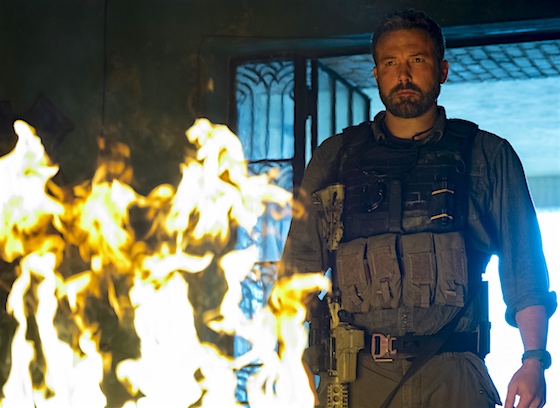
Ben Affleck, pictured with his ties to the DC Universe

I feel like it ended up in a pretty decent place, however. The five guys are believable as ex comrades, and it’s all very well put together, with slick but not flashy direction from J.C. Chandor, helmer of the excellent All is Lost, plus Margin Call and A Most Violent Year, neither of which I’ve seen but I’ve heard are good. Triple Frontier does nothing to besmirch his rep. It’s crisply shot by DP Roman Vasyanov — like the direction, not excessively flashy but still strong, including some great aerial stuff. Apparently this is the first film to use the full 6.5K resolution of the ARRI Alexa 65 camera, which is why it retains the camera’s unique aspect ratio of 2.11:1. In truth, it doesn’t make much difference, because it’s near as dammit the 2:1 that’s so popular among other Netflix productions, but that works for me.

Triple Frontier doesn’t reinvent the wheel, but I think some of the commentary dismissing it as mere standard fare has done it some disservice. As a heist/action movie it’s more than competent, with some turns and developments that keep it surprising and fresh, and visuals that reward seeing it on the best-quality screen you can.

4 out of 5

Triple Frontier is available on Netflix now.

The Past Month on TV #43

Between trips away and rotten colds, my posting (and viewing) this month has been in rather short supply. That explains both why this TV column is later than normal and why it covers series that the constantly-churning “Netflix new releases” discussion cycle has already moved on from. (Next month: belated commentary on The Umbrella Academy, maybe.)

As well as Netflix shows that came out a while ago, there’s a BBC show that finished a while ago, an Amazon series that isn’t really out yet, and some thoughts on last weekend’s Academy Awards.

The Punisher  Season 2
The Punisher season 2Earlier this month the news everyone had been expecting was finally made official: Netflix was cancelling The Punisher and Jessica Jones, thereby bringing to an end the era of the MCU on the streamer. Altogether it will have produced 13 seasons and 161 hours of television, ending with the release of Jessica Jones season three sometime later this year — which will be a more appropriate time to get into this, I guess. For now, there’s just the second — and, as it turned out, final — season of The Punisher.

Picking up a year after the first season, initially it seems like this will be an all-new tale for the eponymous antihero (Jon Bernthal) when he finds himself protecting an ungrateful teenager, Rachel (Giorgia Whigham), from a group of highly-trained assassins who want to kill her for reasons she and they won’t divulge. There’s plenty of mystery around the girl, the villain hunting her (a religious fundamentalist type who goes by the name Pilgrim (Josh Stewart)), what everyone’s motives are, and what the bigger picture might be. At one point our heroes get arrested by small-town sheriffs and the series gives over a whole episode to an Assault on Precinct 13 homage. It’s all good.

But then stuff left hanging from season one begins to creep in. No surprise, really: that first run did the usual Marvel/Netflix thing of introducing us to a character destined to become a more famous character, then spent the whole season getting there. In this case its Punisher nemesis Jigsaw (also the villain of Punisher: War Zone, FYI), aka Billy Russo (Ben Barnes), Frank Castle’s friend-turned-enemy whose face he lacerated in the season one finale. So, they were due a rematch. Unfortunately, here Russo’s storyline plays out with that other regular fault of Marvel/Netflix series: it… takes… ages… to… get… anywhere… And as we keep cutting away from Frank and his new ward to spend time on Russo, it’s slow pace is even more distracting.

Frank and RachelThe two plots do converge somewhat, naturally, with Frank having to deal with the machinations of Russo/Jigsaw at the same time as Pilgrim is coming after him. That means the series has to juggle the two stories as well, and it does that less than effectively, swinging back and forth between which it wants to focus on. For me, the problem remained the same: the new plot is interesting with a lot of potential, while the season one hangovers feel like little more than unfinished business. The latter become stretched out to fill the season, going round in circles, rather than being dealt with succinctly. Conversely, with that stealing so much space, the Pilgrim and Rachel story doesn’t get the screen time it needs or deserves. It seems like there’s a half decent balance at first, but that ultimately goes awry, and the ins and outs of the new storyline (I keep wanting to call it the “main” story, but that’s only true in a couple of early episodes) aren’t as explored as much as they should be. Considering there’s some interesting potential in there (Frank and Rachel have great chemistry, and the plot shapes up as a kind of political thriller, in a 24-esque way), it’s a shame it goes under utilised. It also comes to a great conclusion, showing it’s the real star element of the season. That said, the ending to the Russo story is good too (and so, combined, they make for an exciting finale), it just shouldn’t‘ve taken up so much time.

I wouldn’t go so far as to call The Punisher’s second season a disappointment — there’s a lot to like here for fans of the character and the series — but its lack of focus is a drawback. On the bright side, it wraps things up enough that this is an okay place to leave it. It’s open-ended for more adventures, of course (the across-the-board cancellations came so late in the day that none of the shows had planned for them), but there aren’t direct “what happens next?” questions like in Luke Cage or Iron Fist. Considering the chances of a revival on a Disney-owned platform seem to be 50/50 at best, at least there’s that.

Russian Doll  Season 1
Russian DollYou spend years wondering if anyone could re-do the premise behind Groundhog Day in a different way (well, maybe you don’t, but the thought has crossed my mind), and then several come along… not exactly at once, but in relatively close succession. So, following Happy Death Day, which saw a college student having to repeatedly relive her birthday which was also the day of her murder, now we have Russian Doll, which casts co-creator Natasha Lyonne as a thirtysomething New Yorker having to repeatedly relive her birthday which is also the day she dies. Well, she’s not being murdered, at least. Indeed, the series has a few tweaks and additions to the basic premise up its sleeve, but to say too much would spoil it — although the trailer gives away at least one biggie. Of course, as this is a streaming series, it takes three whole episodes before it reaches that major game-changer.

Fortunately, the show has other things to commend it, primarily the characters. Well, one character, and a bunch of quirky funny types. But hey, this is a comedy, so we can let that slide. And as for that one actually fleshed-out character, Lyonne’s heroine, the series really makes itself about her, her attitude to life, and how the situation affects her. It’s all good stuff. Plus, if you’re here for the plot, although it takes a little while to reveal its unique twists on the formula, once they’re out in the open they build up into an intriguing mystery. And, though it starts out looking like just a comedy in the vein of those other films that have used this concept before, it actually evolves into something more psychological, darker and more complex.

Frankly, one of the main reasons I started watching Russian Doll was because I expected it to be just Groundhog Day / Happy Death Day rehashed as a TV series — that’s what it looked like from the trailers, and I was partly expecting to be able to justifiably complain about that if I’d actually watched it. But, at the same time, I do like both those films, and Russian Doll’s trailer promised at least one new twist on the formula, so I was prepared to give it a fair shout to prove itself. In the end, it deserved the latter. Sure, of course the basic premise is similar to those previous films, but it reimagines it with a dark and foul-mouthed wit that’s distinctly its own, plus it takes the concept down some entirely new avenues. I don’t know how they’d do future seasons (it was originally pitched as three seasons, but it sounds like that evolved during production, so maybe they don’t have as clear an idea as they once did), but I’ll be here for them if they come along.

Hanna  Season 1 Episode 1
Hanna the seriesAmazon are adapting Joe Wright’s 2011 film Hanna into a TV series. Apparently that was commissioned back in 2017, which I don’t recall hearing about, and I feel like I would’ve remembered because I loved the film (never did get round to writing a fuller review, though). Anyway, the first I did hear of it was when they made the first episode available for 24 hours as a preview (the whole first season will be released at the end of March).
Unsurprisingly, the story has been extended to fit its new TV format — this first hour only covers the first act of the film. At this pace, it’s very plausible it’ll take the rest of the season to get through the rest of the movie’s plot (and I’m sure they’ve got some tricks up their sleeve to extended it beyond that). But, surprisingly, it doesn’t feel horrendously slow or artificially drawn-out. This isn’t a mile-a-minute action show, but its pacing is no worse than most other streaming series, here with the added excuse that it’s setting the scene. Indeed, that’s arguably the episode’s biggest problem when viewed in isolation: it feels a bit like the real plot will kick off in episode two, and this is all prologue. On the other hand, in that sense it works all the better when released as tease ahead of the main series. Either way, it grabbed my attention enough that I’ll continue with it when the rest is released.

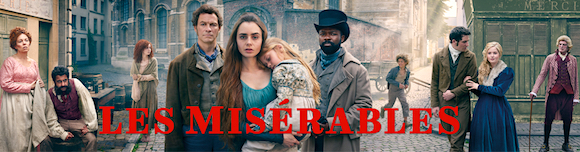
Les Misérables  Episodes 4-6
Les Misérables
The second half of the BBC’s new adaptation of Victor Hugo’s novel (gotta be careful to be clear about that, apparently) is all set in the story’s final time period — Cosette is now a young woman, desperate to see the outside world; Marius is now a young man, whose friends seem desperate to die for a revolution; and Javert is still Javert, still desperate to catch Valjean, presumably out of sheer spite and/or pride. All the characters, connected as much by coincidence and chance as by choice or action, come together around the June Rebellion of 1832, and… well, you either know the plot or you don’t want me to spoil it for you. This remains a handsomely mounted production until the last, however, including pulling off the action at the barricades with suitable scale and impact.

That stuff always feels like it should be the climax to me. In a literal sense, it’s the big action set piece, and is the end of the road for several major characters. But no, there’s plenty left after it, for good (the final confrontations between Javert and Valjean) or ill (Thenardier in the sewers; the unearned redemption of Marius’ grandfather). I rewatched the film of the musical when I was exactly halfway through this series, and by comparison most of the movie felt like a long “previously on” montage. The exception is this post-barricade stuff, where the BBC version, conversely, feels drawn-out compared to the economy of the musical’s telling. The final part was almost quarter-of-an-hour longer than the first five, and I couldn’t help but feel a little more streamlining would’ve helped. Still, it’s a relatively minor complaint amidst what has been a typically excellent adaptation by the Beeb.

In the UK, the whole series remains available on iPlayer for the foreseeable future, while in the US it will air on PBS from April 14th.

The 91st Academy Awards
The 91st Academy AwardsThe run-up to this year’s Oscars seemed to be mired in a mix of controversy and disinterest. The former was provoked by a variety of poor decisions by the Academy, including fiascoes around a Best Popular Film award, over who would host (it was Kevin Hart, then it wasn’t, then it was no one), and over the decision to present some awards during the ad breaks (which was scrapped, thankfully). This whole palaver is part of what fed the disinterest, along with a slate of nominees that was regarded to be generally uninspiring. As it turned out, plenty of people still tuned in (US viewing figures were slightly up from last year) and plenty of conversation was sparked. Other people can dig into it in more depth than me (and have, of course, considering the ceremony was days ago), but I will say I was overjoyed for Olivia Colman (definitely the best speech, although a couple of others were quite good too) and Spider-Verse, was quite pleased Black Panther won Best Score (I don’t know if it was actually the best overall, but I really liked it), and its other two victories (costumes and production design) were also welcome, and Spike Lee’s ecstatic win was another top moment. It wasn’t all sunshine and roses, obviously, with Best Picture in particular being an underwhelming result; though I’m not as miffed about Bohemian Rhapsody’s multiple wins as some people (even if its awards for sound editing and mixing were more about “most” than “best”).

The big takeaway from the night should probably be that going host-less worked. Queen’s opening performance was great (because Queen), and the non-monologue monologue from Maya Rudolph, Tina Fey, and Amy Poehler was another highlight of the ceremony. Things still ran smoothly, and there were no stupid asides like bringing normal people into the auditorium or whatever — cutting those time wasters was a much better idea than cutting actual awards. Maybe being host-free is the way forward, though I think they’ll need to continue finding ways to handle the monologue section going forward — the show needs some kind of intro, and a gentle ribbing of the nominees is an appropriate way to do it, I think.

Also watched…
  • The British Academy Film Awards 2019 — The BAFTAs also happened. We gave a better Best Film, but further evidence that maybe a host-less ceremony is a good idea: Joanna Lumley is a national treasure, but her opening monologue was excruciating.
  • Great News Season 2 Episodes 8-13 — The series finale of this cancelled-too-soon newsroom sitcom is titled Early Retirement. So, that’s a nice meta gag to console ourselves with, at least.
  • Mark Kermode’s Oscar Winners A Secrets of Cinema Special — Kermode dissects the formula to make an Oscar winner in this special of his excellent series. It’s available on iPlayer for a few weeks yet.

    Things to Catch Up On
    The Umbrella AcademyThis month, I have mostly been missing The Umbrella Academy, as I mentioned at the start. The trailers look good (love a bit of Hazy Shade of Winter), and it seems like critical and audience reaction has been positive, so it’s definitely on my watchlist. I’m also yet to start the new series of Scottish crime drama Shetland, or The Missing’s much-anticipated spin-off Baptiste. I expect I’ll be saving those up for a little while yet.

    Next month… HBO have set the Deadwood revival/finale movie to air this spring, which is, y’know, soon. I watched season one when it first aired, thought it was great, but when season two came around I found myself thoroughly lost and eventually gave up. I imported the US Blu-ray box set years ago (it’s bursting with special features vs. the UK’s completely bare bones release), and it’s been sat on my shelf waiting ever since, like so many non-pressing TV series nowadays. Well, I guess now is its time…

  • Roma (2018)

    2019 #25
    Alfonso Cuarón | 135 mins | streaming (UHD) | 2.39:1 | Mexico & USA / Spanish & Mixtec | 15 / R

    Roma

    Oscar statue2019 Academy Awards
    10 nominations

    Nominated: Best Picture, Best Foreign Language Film, Best Director, Best Actress (Yalitza Aparicio), Best Supporting Actress (Marina de Tavira), Best Original Screenplay, Best Cinematography, Best Production Design, Best Sound Editing, Best Sound Mixing.

    Drawn from writer-director Alfonso Cuarón’s memories of growing up in the Colonia Roma neighbourhood of Mexico City, Roma is the story of what happens to a middle-class family’s housemaid, Cleo (played by newcomer Yalitza Aparicio), over the course of ten months in 1970 and 1971. It’s also one of the best-reviewed films of the year, winner of BAFTA’s Best Film award (amongst others), and a frontrunner for the same at tonight’s Oscars. No pressure, then.

    Roma has already attracted a reputation for being slow and difficult to engage with for ordinary viewers — the very definition of an arthouse movie; and it’s in black and white with subtitles, just to compound the stereotype. There’s no doubting it has a measured pace, and the viewer needs to be prepared for that. It sets its stall with the opening credits, which fade in and out slowly over a static shot of paved flooring being washed by soapy water that flows across it like waves on a shore — and that’s all we see, for several minutes. From there, much of the move unfurls in wide shots, with slow pans or no movement at all, inviting the viewer to search the frame for details and significance. Note that it’s not nominated for Best Editing…

    Cleo the maid

    At first it’s difficult to see the point of all this, which is where accusations of it being boring stem from. Nothing seems to be happening, just people going about their lives and jobs; a “slice of life” narrative taken to the extreme. What’s missing from that view is context, and as the film goes on we get that — looking back at earlier scenes with the knowledge of what happens later, it’s more possible to see what Cuarón was going for. For example, there are two scenes side-by-side which are barely notable in themselves and certainly have no immediate connection — the father of the family going away on a business trip, and Cleo going to the cinema with the guy she’s been seeing — but when you know what happens later, these scenes are clearly back-to-back for a reason, with a clear connection. One might say juxtaposed, but they’re less being contrasted, more mirrored. There’s quite a lot of that kind of subtle, often exclusively visual mirroring throughout the film — it’s no coincidence the opening shot looks like waves.

    This is a film that rewards perseverance, then. It doesn’t work for everyone, but for some the way it slowly inducts us into this family’s life builds to great emotional payoffs come the events of the final act. After a whole lot of very little, it suddenly gets very dramatic and heart-wrenching. You’d have to be pretty cold not to feel anything for the characters given some of the things that transpire, but how much of a connection is developed between them and the viewer is, I think, very much a matter of personal experience. Based on online comments, some find the finale emotionally cathartic, and end up sobbing their heart out; others find Cleo’s silence to be distancing, making her true character and feelings inaccessible, and by turn neutering the film. I find myself sympathetic to both points of view. The film, and the characters, are certainly understated, but I don’t think they’re wholly shut off. Put another way, I wasn’t in tears by the end, but I felt I understood something of these people and their reactions to what had occurred.

    Departures

    One thing I wasn’t prepared for by anything else I’ve read about the film (which, admittedly, wasn’t much) was how much… slightly odd stuff there was. Not full-blown Lynchian weirdness, just things you don’t really expect to see. A surprising focus on dog shit, for example. A martial arts display with some very, er, jiggly full frontal male nudity. A Norwegian New Year’s Eve song performed in front of a blazing forest fire. Walls of pet dogs’ heads mounted like hunting trophies in a macabre display of affection, but with the sheer disturbingness of that seeming to go uncommented on. Cuarón has said 90% of the movie comes from his own childhood memories, so I guess he had an interesting time of it…

    At the very least, Roma is a technical masterpiece. Shot by Cuarón himself (because Chivo was unavailable), it looks thoroughly gorgeous — crisp, textured, always perfectly lit, be that by the nighttime glow of a city or misty morning air, with some shots that look like molten silver caressing the screen. Cuarón is the frontrunner for the cinematography Oscar, marking the first time it will have gone to a director lensing his own film (assuming he does win, of course), and it seems to be very much deserved (in fairness, I’ve not yet seen any of the other nominees to compare).

    But while everyone talks about the photography, very few people seem to mention the immersive sound design, and I think that’s just as worthy of attention. Roma is also nominated tonight for Sound Mixing and Sound Editing, categories that are often dominated by blockbuster-type films due to their energetic soundscapes — its competitors include the likes of Black Panther, Bohemian Rhapsody, First Man, and (somewhat ironically) A Quiet Place. I doubt Roma will overcome their bombast, but in its own way it’s just as effective, generating a world around you with its enveloping audio. I guess this is partly the problem of it going direct to Netflix, though — most people who see the film will listen to it through TV speakers, or, at best, a stereo sound bar. However, it’s proof that surround sound isn’t just for action movies, and that it’s worth having a system in your home, if you can.

    Journeys

    On the whole, Roma exudes the feel of a quality piece of Art, with a capital ‘A’ — it’s beautiful to look at, slow and heavy and opaque in its storytelling, with (perhaps) some deep message about human experience that’s left for the viewer to discern. Is it the best picture of 2018? Well, I mean, if you like that kind of thing… Should it win tonight? That depends what you think the Oscars should be rewarding, I guess. It’s not an unworthy champion in an artistic sense, but is something else — something artistic in a different way, and also more accessible — even more deserving of being crowned The Best? That’s always the tug-of-war when it comes to Best Picture, I suppose. It’s certainly not my favourite movie from last year (and I wouldn’t necessarily expect it to make 2019’s list either), but I still admire much of it.

    5 out of 5

    The 91st Academy Awards are handed out this evening. In the UK, they’re on Sky Cinema Oscars from 12:30am, with highlights on Sky One tomorrow at 9pm.