Tokyo Tribe (2014)

2016 #149
Sion Sono | 112 mins | streaming (HD) | 2.35:1 | Japan / Japanese | 18

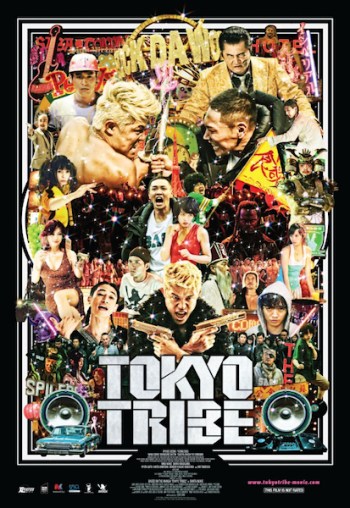
Tokyo Tribe

Adapted from the manga Tokyo Tribe 2, the film version is a hip-hop musical, sung (or rapped) through by an expansive cast who make up the titular tribes — gangs who rule the streets of a divided near-future (or possibly alternate reality; or possibly it doesn’t matter that much) Tokyo. The world of the story is pretty barmy, and much of the plot follows suit — I’m not going to attempt to describe it, but suffice to say it involves kidnapped girls, rescue attempts, and brewing gang warfare.

Much of the film does feel like a cartoon brought to life, with the ultra-heightened scenario and larger-than-life scenery-chewing villains — as the big bad, Riki Takeuchi hams it up so ludicrously his performance circles back round into genius. It’d definitely be an adult cartoon, though, because director Sion Sono brings a kind of trash-art, exploitation vibe, with gratuitous helpings of nudity and violence. Indeed, that direction is indicated early on when a young female police officer ventures into gang territory and is grabbed by one of the villains who, in front of a baying crowd, rips open her shirt and begins to trace a knife around her naked breasts to explain the various gang factions. It’s kind of kinky, kind of nasty, kind of distasteful, kind of not (I mean, he is a bad guy) — if you wanted to summarise the feel of the whole film in one sequence, it’s actually not a bad start.

When too many tribes to keep track of go to war

I watched Tokyo Tribe out of pure curiosity (a rap musical isn’t exactly my usual kind of thing) but I ended up rather loving it, which is why it made my 2016 top 20. There I summarised that its mix of “battle rap, comic grotesques, ultra violence, gratuitous nudity, more barmy notions than you can shake a stick at, and probably the kitchen sink too, [made it] possibly the most batshit-crazy movie I’ve ever seen.” So those extremes don’t bother me per se (other than to the extent they should bother me), but there’s an undoubted not-for-everyone-ness to a lot of it. That, plus some rough edges, are all that hold me back from giving it 5 stars.

4 out of 5

Tokyo Tribe placed 19th on my list of The 20 Best Films I Saw For the First Time in 2016, which can be read in full here.

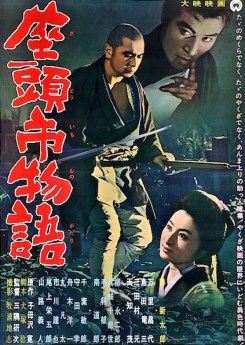
The Tale of Zatoichi Continues (1962)

aka Zoku Zatôichi monogatari

2016 #194
Kazuo Mori | 73 mins | Blu-ray | 2.35:1 | Japan / Japanese

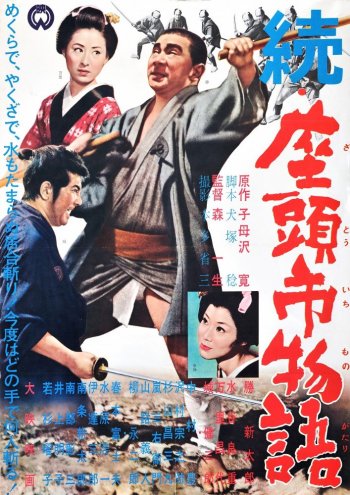
The Tale of Zatoichi Continues

Back in 2014, when I reviewed the debut Zatoichi movie a year after first watching it, I promised that reviews of the series’ future instalments would follow in 2015. Well, it’s 2017, and here’s Film #2. Yeah, this is going to be the new Rathbone Holmes, isn’t it?

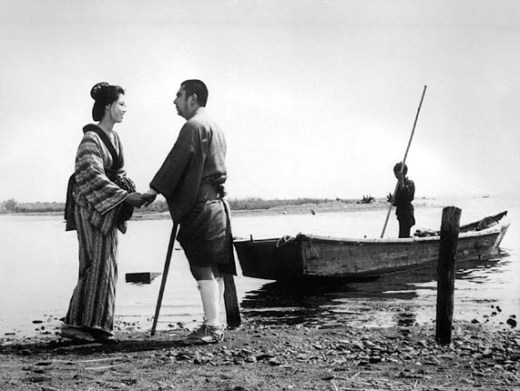
Anyway, this second movie is — as its title might suggest — a direct sequel (a rarity for the series, so I gather), which sees our hero, the blind masseuse and skilled swordsman Ichi (Shintarô Katsu), back in conflict with one of the gangs from the first film. Despite that, it doesn’t start like a direct sequel at all. Reference is made to the previous film, the events of which have given Ichi a reputation, but that could be a reference to something that occurred off-screen for all its significance to the story. Later, however, we learn that Ichi is travelling to pay homage to the grave of the samurai he killed before, and we end up in the same town with some returning characters. It’s quite a nice structure for a sequel: to seem like a new adventure before revealing and exploring connections to the previous movie. Unfortunately, to say this film “explores” anything would be doing it a kindness.

All the ladies love a blind man

The consensus seems to be that The Tale of Zatoichi Continues is a faster-paced and more action-packed movie than its predecessor, which is obviously to some viewers’ taste. The fight scenes are certainly on a more epic scale: where the first movie ended with a one-on-one between Ichi and an opposing samurai, here he takes on a small army of men. It’s less than an hour-and-a-quarter long, too, at which length it’s hard to avoid running at a brisk speed. However, I thought it lacked the artistry of the first film. It’s very focused on plot rather than digging into character, which is especially problematic when it comes to a subplot about a rogue who turns out to be Ichi’s brother. It’s structured to make for good reveals, but they aren’t always well executed, and what should carry a weight of emotion ends up rushed.

The movie as a whole is oddly paced and very oddly ended. What turns out to be the de facto climax starts earlier than you’d expect, but then the film moves on from it… before suddenly stopping. Is this meant to be a cliffhanger? It doesn’t quite play like one, but it’s also unresolved. Film 1 felt like a complete story, but this ends with the need for a Part 3 — or rather a Part 2.1, because it doesn’t feel like a whole movie. The fact the next one is called New Tale of Zatoichi isn’t promising…

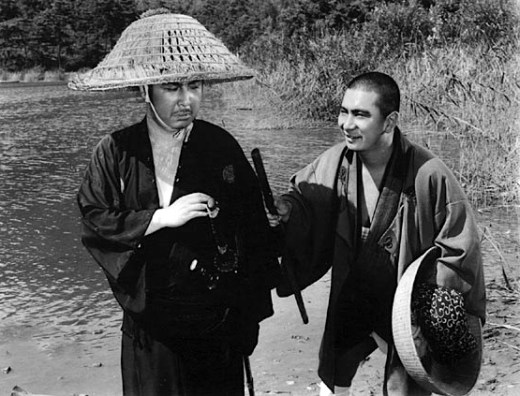
Brotherly love

Technical merits are similarly mixed. It’s not poorly shot, but it’s not as striking as its predecessor. The music is occasionally horrendous. There is indeed more sword fighting, and with it more involved choreography, but it doesn’t feel like an earned trade-off with the lightweight story.

The Tale of Zatoichi Continues comes with lots of great ideas and potential themes, but the rushed production seems to have led to a weak execution. It’s almost like you want to say to the filmmakers, “good effort, you’re almost there. Now try again and do it properly.” Of course, there are 23 more films where they may do exactly that…

3 out of 5

Ninja Scroll (1993)

aka Jūbē Ninpūchō

2017 #3
Yoshiaki Kawajiri | 92 mins | Blu-ray | 1.33:1 | Japan / English | 18

Ninja Scroll

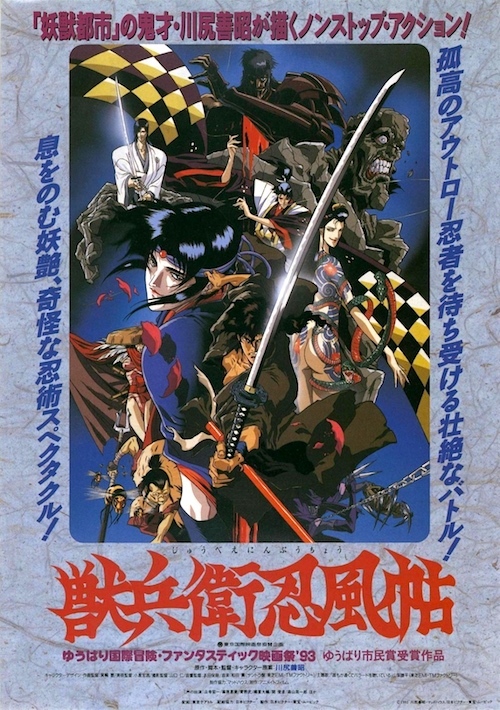
One of the films credited with helping to popularise anime in the West in the wake of Akira (reportedly it has had a greater and more enduring impact in the US than in Japan), Ninja Scroll is a fast-paced fantastical action flick full of gratuitous swordplay, gratuitous gore, and gratuitous nudity.

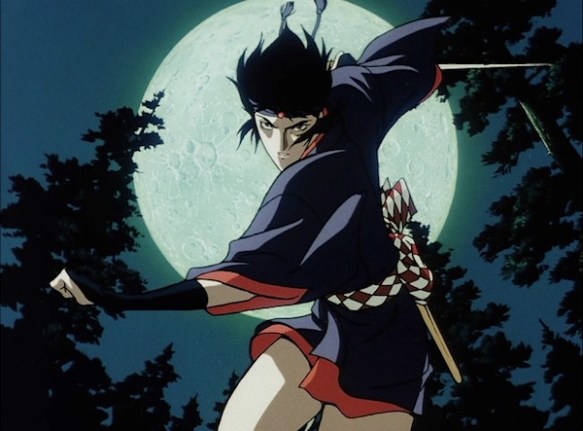
The story begins with Jubei Kibagami, a roaming ninja-for-hire, who becomes embroiled in stopping the machinations of the Shogun of the Dark after he rescues Kagero (a female ninja whose team were slaughtered by the Shogun of the Dark’s minions, the Eight Devils of Kimon), an event witnessed by Dakuan, a government spy who has been sent to investigate and stop the evil Shogun.

Try not to worry about that too much, though: Ninja Scroll moves like the clappers through a plot that is at once incredibly simple and ludicrously over-complicated. On the one hand it’s an action-driven adventure, as our trio of heroes battle their way through the Eight Devils one by one. On the other, it’s got all sorts of backstory stuff about who the Devils’ leader is and how he’s connected to something Jubei did years earlier and what any of this has to do with Kagero’s clan and… so on.

Samurai snack

Similarly, the pace has its pros and its cons. It certainly keeps things lively, with new monstrous Devils turning up regularly, bringing bursts of exciting action with them; but it makes things bewildering at times, with a flurry of characters and exposition introduced throughout the first half-hour or so. Once it settles down, there’s actually some quite nice character stuff involving Jubei and Kagero, and to an extent Dakuan, who remains a tricksy and unreliable ‘hero’.

That’s not what the film is best known for, though, probably because it’s hidden after a big chunk of the other stuff: ultra-violence and a sex obsession. As to the former, men are literally ripped limb from limb, or cut in half, or quarters, with blood regularly spraying everywhere. Depending on your viewing preferences, it’s either incredibly extreme or we’ve seen the same kinda stuff more regularly since. I wasn’t as shocked as some reviews warned I would be, but it’s not for the faint-hearted.

The same goes for the sex and nudity, which embraces everything from the villains bickering about who’s sleeping with who (if they’re devils then half of them are horny ones) to Kagero being sexually assaulted by a rock monster. In the audio commentary recorded for the 20th anniversary, the writer, director, and animation director debate whether some of that content was unnecessary. One of them (it’s hard to tell which from the subtitles) asserts that there were always gratuitous sex scenes in the B-actioners that partly inspired the film, so it goes toward creating the right atmosphere. I guess individual tastes will vary — I mean, it’s not as if Kagero’s assault is presented as a good thing, but it is still presented. Or it is nowadays: on the film’s first release the BBFC cut that part out. Times certainly have changed.

Kick-ass Kagero

For all that Ninja Scroll feels kinda antiquated in this carefree presentation of repellant acts, it has stood the test of time in other ways. For the faults in what happens to her early on, Kagero emerges as a competent and assured female hero (for the most part). The animation is frequently great, with some painterly compositions inspired by traditional Japanese art, as well as dramatic action sequences. I watched the English dub, which is what it is (I’ve heard better; I’ve heard much worse), but on the aforementioned commentary track they regularly sing the praises of the Japanese voice cast, so maybe the subtitled version was the way to go.

Watching Ninja Scroll is a bit of a conflicting experience nowadays. Its story is both numbingly simple (“introduce villain, fight villain, defeat villain, repeat x8”) and insanely complicated; its sometimes balanced gender politics are offset by some gratuitous and distasteful content; its characters are initially archetypal and generally unlikable, but warm up in both regards as the film progresses. A bit like my opinion of it: I wasn’t entirely sure after my first viewing, but as I watched it back with the commentary I re-appreciated an awful lot of it. Maybe it’s a grower, then.

4 out of 5

Ninja Scroll is on Syfy UK tonight at 11:10pm.

Grave of the Fireflies (1988)

aka Hotaru no haka

2016 #67
Isao Takahata | 90 mins | DVD | 16:9 | Japan / Japanese | 12

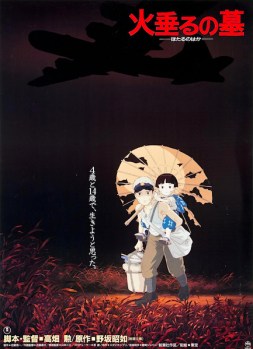
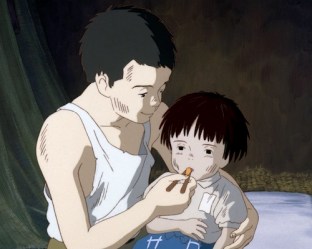
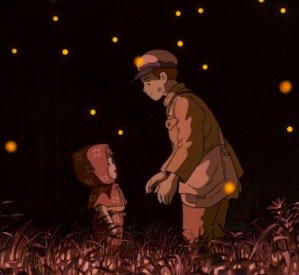
Grave of the FirefliesOne of the most praised animated films of all time, this Studio Ghibli feature tackles grim subject matter: it’s the story of Seita and his little sister Setsuko, a pair of Japanese children who are orphaned and eventually left to fend for themselves in the closing months of World War 2. It begins with Seita dying of starvation and joining the spirit of his dead sister, so you know it’s not going to end well. A Disney movie this is not.

It’s kind of hard to avoid the praise Grave of the Fireflies has attracted, which is why it ended up on my Blindspot list this year. It’s the third highest-rated animation on IMDb (behind Spirited Away and The Lion King), which also places it in the top 25% of the Top 250, not to mention various other “best animated” and “great movie” lists. I mention all this because I fear the weight of expectation somewhat hampered the film for me. It’s by no means a bad film, but, despite the subject matter, it didn’t touch me to the same degree as, say, My Neighbour Totoro (which, coincidentally, it was initially released with).

So where did it go wrong for me? Perhaps my biggest issue was with Seita and the choices he made. I guess part of the point is that he is still a child and so unable to adequately care for himself and Setsuko, but I don’t get why he resorts to stealing, looting, and allowing them to starve when, as it eventually turns out, they still have 3,000 yen in the bank — enough to buy plenty of hearty food when it comes down to it. Why didn’t he turn to that money much sooner? Why did it take a doctor telling him his sister was malnourished and refusing to help before he thought, “you know what, I could always use that money we have saved up in the bank to feed us so I don’t have to steal and nonetheless be short of food”? When he does eventually withdraw that cash and buy some decent supplies, it’s a very literal case of doing too little too late.

Another thing is that the film is often cited as a powerful anti-war movie, because it depicts the ravaging effects on innocents. However, director Isao Takahata insists it isn’t, saying it’s about “the brother and sister living a failed life due to isolation from society”. I’m inclined to believe him, because, from what we actually see on screen, these two kids are the only ones to be so badly affected! Okay, we do see people have died, and we’re told that food is running out… but there’s a gaggle of kids who seem to be having a fun day out when they stumble across the siblings’ makeshift shelter; or, right at the end, people who merrily arrive home and pop their music on. The film doesn’t try to claim that only these two kids suffered, but — aside from a few other destitutes at the start, and the bodies we see after the first bombing (later bombings don’t make any casualties explicit) — we don’t really see anyone else suffering. I’m not arguing that Takahata is saying no one else suffered, nor that these observations make it pro-war (I mean, any children dying, even if others are surviving, is not a good thing), but I didn’t get an anti-war message that was as powerful or as overwhelming as other viewers seem to have.

I’m an advocate of animation as a form (which must sound like a ridiculous position to have to take in some countries, but in the West “quality animation” begins and ends with Disney musicals and Pixar’s kid-friendly comedy adventures), but I think the fact this particular story is being told with moving drawings is detrimental. I’ve seen online reviews that say it makes the film more bearable because it creates a kind of disconnect from the real world — and, really, this story shouldn’t be “bearable”. That’s not to say you can’t feel an emotional connection to animated characters, but, as a medium, animation regularly deals in fantastical subjects, so with material this gruelling it does make it seem less real.

Despite these issues, Grave of the Fireflies does still pack a punch, but I wasn’t as bowled over as I’d expected to be.

4 out of 5

Grave of the Fireflies was viewed as part of my What Do You Mean You Haven’t Seen…? 2016 project, which you can read more about here.

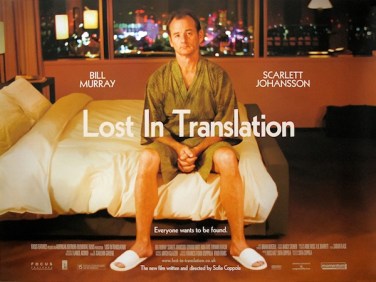
Lost in Translation (2003)

100 Films’ 100 Favourites #56

Everyone wants to be found.

Country: USA & Japan
Language: English, Japanese, German & French
Runtime: 102 minutes
BBFC: 15
MPAA: R

Original Release: 3rd October 2003 (USA)
UK Release: 9th January 2004
First Seen: DVD, c.2004

Stars
Bill Murray (Ed Wood, Broken Flowers)
Scarlett Johansson (Ghost World, Under the Skin)
Giovanni Ribisi (Gone in Sixty Seconds, Avatar)
Anna Faris (Scary Movie, Cloudy with a Chance of Meatballs)

Director
Sofia Coppola (The Virgin Suicides, The Bling Ring)

Screenwriter
Sofia Coppola (Marie Antoinette, Somewhere)

The Story
In Tokyo to shoot a lucrative whiskey commercial, one-time movie star Bob Harris battles with middle-aged ennui. In his hotel he encounters Charlotte, a recent Yale graduate who’s tagged along with her entertainment photographer husband, and feels similarly untethered by life. Perhaps these two lost souls will find something in each other…

Our Heroes
“I just feel so alone, even when I’m surrounded by other people,” says Charlotte, succinctly assessing the life situation of not only herself, but also her new friend, Bob. He’s dryly amused by the world (who better than Bill Murray for that role?), struggling to connect with his wife back home who pesters him with questions about carpet colours. Charlotte, unsure what to do with her life after graduating from university, and finding her husband and his acquaintances to not be on her level, is a kindred spirit, despite the age gap.

Our Villain
Not strictly a villain, but Charlotte’s husband is hardly the most inspiring figure in her life. Not a strong basis for a marriage, really.

Best Supporting Character
A lady known only as Premium Fantasy Woman. “My stockings. Lip them. Lip my stockings. Yes, please, lip them… Lip them. Hey! Lip my stocking!”

Memorable Quote
“Let’s never come here again because it would never be as much fun.” — Charlotte

Memorable Scene
After an exuberant night out, Bob and Charlotte sit quietly side by side in a karaoke joint’s hallway. She slowly lowers her head on to his shoulder, smiling to herself, while he stares into the distancing, participating in the moment but also not. To quote further from my ‘What the Public Say’ selection, “it expresses the connection, and simultaneously, the quiet distance that still exists between them (mostly in their minds). It’s romantic without really consuming the romance.”

Making of
Bill Murray no longer has an agent, instead maintaining a voicemail number that he rarely gives out. Sofia Coppola reportedly left hundreds of messages on it, having written the part of Bob especially for him. Eventually he called her back, but still only gave a verbal commitment to appear — she wasn’t sure he was actually going to show until the first day of filming, when he did.

Awards
1 Oscar (Original Screenplay)
3 Oscar nominations (Picture, Actor (Bill Murray), Director)
3 BAFTAs (Actor (Bill Murray), Actress (Scarlett Johansson), Editing)
5 BAFTA nominations (Film, Director, Original Screenplay, Cinematography, Music)
FIPRESCI Prize (to Sofia Coppola for “the cool detachment and freshness with which she observes the antics of various American and Japanese television and communication industry people in the anonymous surroundings of a large Japanese city, and for the sensitivity with which she modulates the atmosphere of the film from comedy to melancholy.”)
1 MTV Movie Awards Mexico nomination (Funniest American in Japan — it lost to Tom Cruise in The Last Samurai)

What the Critics Said
Lost in Translation revels in contradictions. It’s a comedy about melancholy, a romance without consummation, a travelogue that rarely hits the road. Sofia Coppola has a witty touch with dialogue that sounds improvised yet reveals, glancingly, her characters’ dislocation. She’s a real mood weaver, with a gift for […] mining a comic’s deadpan depths. Watch Murray’s eyes in the climactic scene in the hotel lobby: while hardly moving, they express the collapsing of all hopes, the return to a sleepwalking status quo. You won’t find a subtler, funnier or more poignant performance this year than this quietly astonishing turn.” — Richard Corliss, TIME

Score: 95%

What the Public Say
“It’s an incredibly quiet film, with little narrative or story-related dialogue. We follow Bob and Charlotte as they gently explore their environment and grow towards each other, and it feels like we’re watching seaturtles swim together. It’s all very graceful and beautiful, and quiet, and meandering, and slow. And I mean that in a good way […] For a film that explores disconnection and loneliness, to me there is no better way to frame that story.” — Reinout van Schie, One Shot

Verdict

There seems to have been a glut of “men coming to terms with their place in the world”-type movies in the early ’00s, for whatever reason. (I’m not sure there was before that? There have been plenty since, though they can feel like hangers-on.) Some once-popular ones have turned into objects of derision (Garden State), but I think others hold up. No doubt the quality of the BAFTA-winning performances of Bill Murray and Scarlett Johansson have a lot to do with that, creating a cross-generational pairing of two lost souls that feels real and touching, rather than tipping into some creepy love affair thing. Nonetheless, through to its ending the film plays with variations on melancholy — a difficult feeling to evoke in movies, in my opinion, but a level writer-director Sofia Coppola here hits with impressive consistency.

#57 will be… Denzel Washington in flames.

Ghost in the Shell (1995)

100 Films’ 100 Favourites #36

It’s found its voice…
now it needs a body.

Original Title: Kôkaku Kidôtai
Also Known As: Mobile Armored Riot Police: Ghost in the Shell (Japan)

Country: Japan
Language: Japanese
Runtime: 83 minutes
BBFC: 15

Original Release: 18th November 1995 (Japan)
UK Release: 8th December 1995
First Seen: DVD, 2000

Stars
Atsuko Tanaka (Ghost in the Shell 2: Innocence, Bayonetta: Bloody Fate)
Akio Ôtsuka (Black Jack, Paprika)
Kôichi Yamadera (Ninja Scroll, Cowboy Bebop: The Movie)
Yutaka Nakano (Cowboy Bebop: The Movie, Ghost in the Shell 2: Innocence)
Tamio Ôki (Journey to Agartha, Wolf Children)

Director
Mamoru Oshii (Patlabor: The Movie, Ghost in the Shell 2: Innocence)

Screenwriter
Kazunori Itō (Patlabor: The Movie, .hack//SIGN)

Based on
The Ghost in the Shell (攻殻機動隊 Kōkaku Kidōtai, literally Mobile Armoured Riot Police), a manga by Masamune Shirow.

The Story
Japan, 2029: Public Security officer Major Motoko Kusanagi and her team are assigned to track down and capture a dangerous hacker known as the Puppet Master, but they soon find themselves embroiled in a far-reaching conspiracy…

Our Hero
In a future world where humans can undergo varying degrees of cyberisation, Major Motoko Kusanagi is a “full-body prosthesis augmented-cybernetic human” — only her brain is organic. Her body is a generic mass production model, so she can blend in while being a kick-ass law enforcement officer.

Our Villain
The Puppet Master, a cyber criminal who hacks into people’s brains and gives them false memories. But is there something even worse going on behind the hacker?

Best Supporting Character
Kusanagi’s second-in-command Batou is stoic to the point of brusqueness — apparently quite a different characterisation to his portrayal in other Ghost in the Shell media.

Memorable Quote
“If we all reacted the same way, we’d be predictable, and there’s always more than one way to view a situation. What’s true for the group is also true for the individual. It’s simple: overspecialise, and you breed in weakness. It’s slow death.” — Major Kusanagi

Memorable Scene
Pursuing the Puppet Master, Kusanagi comes face to face with a six-legged tank. After a blazing gun battle, she tries to physically rip it open, her cybernetic body straining to breaking point — and beyond…

Technical Wizardry
Ghost in the Shell was groundbreaking in its skilful combination of traditional 2D animation with CGI additions. It used a process called “digitally generated animation” (DGA), which combined cel animation with computer graphics to create lens effects that simulated depth, motion, and unusual lightning techniques, as well as mixing in 3D CGI and digital audio.

Letting the Side Down
In 2008, Oshii revisited the film to create Ghost in the Shell 2.0, which regraded the colour, replaced some of the original animation with new CGI, omitted several scenes, and featured a remixed and re-recorded soundtrack. (More details here.) As is almost always the case when directors fiddle with their creations decades later, it wasn’t well received by fans.

Next time…
As befalls many a popular anime franchise, Ghost in the Shell has spawned a raft of sequels and reboots. The only direct sequel, Innocence, was released in 2004. TV series Ghost in the Shell: Stand Alone Complex ran for two seasons between 2002 and 2005, with the first run compiled into movie The Laughing Man and the second into Individual Eleven, all of which were followed by a final film, Solid State Society. Another reboot came in 2013 with direct-to-video series Ghost in the Shell: Arise, which so far totals five episodes and, last year, continuation film Ghost in the Shell: The New Movie. (Only four episodes have so far been released in the West, but the movie — which continues the story from the fifth episode — came out on Monday in the UK. Just to make things more complicated.) A live-action American remake is currently shooting for release in March 2017 — you’ve probably heard about it.

Awards
5 Annie Awards nominations (Animated Feature, Directing, Producing, Writing, Production Design)

What the Critics Said
“When Akira first blasted out of Japan back in 1991 it looked like the Western concept of widescreen animation would be changed forever. […] Unfortunately, it was not to be. Sure, on video, the Manga scene has gone from strength to strength, but as far as theatrical releases are concerned, nothing has really come along to match Akira’s sheer retina-scalding magnificence. Until now. […] From its baddie-eviscerating opening sequence through innumerable car chases, shoot outs and tongue-in-cheek dialogue exchanges, this is exactly the kind of film that James Cameron would make if they ever let him through the Disney front gates.” — Clark Collis, Empire

Score: 95%

What the Public Say
“both the film and Oshii have fallen into a kind of disrepute among the anime community. The common line on GITS is that it’s wordy, masturbatory, and pretentious with nothing going on intellectually and that the (plainly inferior but more easily accessible) GITS: SAC is a better alternative. I wanted to write this article to respond to that notion. GITS is a highly thoughtful film and worthy of comparison to virtually any scifi feature you could name. ” — tamerlane, too long for twitlonger

Verdict

Ghost in the Shell was the first anime I consciously saw, which maybe helps it earn a place here. It’s an initially accessible movie that’s also very complicated — there are pulse-pounding action scenes and a thriller storyline to keep things exciting, but also a lot of deep philosophical discussions, touching on themes of gender and identity. I think for some viewers the latter are a negative, while for others they’re the entire point. (I imagine the forthcoming Hollywood remake will either ditch or seriously curtail them, but you never know.) The combination makes for a stimulating (in multiple senses) sci-fi actioner.

Next… who ya gonna call? #37 !

47 Ronin (2013)

2016 #18
Carl Rinsch | 119 mins | streaming (HD) | 2.35:1 | USA / English | 12 / PG-13

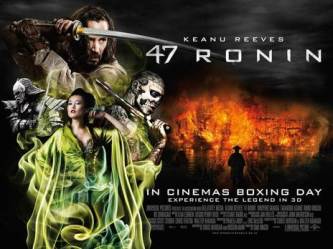
Blighted by behind-the-scenes difficulties, 47 Ronin wound up among the biggest box office bombs of all time — a fate not entirely undeserved.

It concerns a gang of samurai who set out to avenge their master, a true story that’s legendary in Japan. This telling is enhanced with fantasy elements — which, despite some critics’ views, is just fine, as the film’s historical advisor explains in this excellent defence.

Sadly, what falters is everything else: clumsy storytelling, poorly edited action, Japanese actors struggling with English dialogue, Keanu Reeves’ acting. Magnificent imagery and design stop it being a total disaster, but only just.

2 out of 5

For more quick reviews like this, look here.

Evangelion: 3.33 You Can (Not) Redo. (2012/2013)

aka Evangelion shin gekijôban: Kyū / Evangelion New Theatrical Edition: Q

2016 #42
Hideaki Anno, Masayuki, Mahiro Maeda & Kazuya Tsurumaki | 97 mins | Blu-ray | 2.35:1 | Japan / English | 15

Evangelion 3.33 You Can (Not) RedoWell now, hasn’t this been a long time coming? Just over two years since its western disc release was first announced, just over three years since it debuted in Japanese cinemas, and just over four-and-a-half years since the previous instalment’s English-language release, those of us in the UK who don’t attend anime conventions (where it’s had a few screenings in that time) are finally able to see the penultimate part of creator Hideaki Anno’s Rebuild of Evangelion tetralogy. As to whether it’s worth the wait… well, your mileage will vary.

The “rebuild” movies started out with a literal interpretation of that moniker: the first movie is a faithful (though condensed and sometimes slightly rearranged) retelling of the series’ early episodes, even using the original art from the show. The second movie deviated much further: familiar characters were introduced in completely different ways, wholly original characters appeared, and some subplots became more prominent. It culminated in a climax that was a drastic departure from the series, and now this third movie forges into entirely new territory — so new that I’m not going to give any kind of plot summary, for the sake of readers avoiding any spoilers. Good luck to you if so: not only do most reviews divulge the first major divergence, but so does the film’s own blurb.

Maybe that’s for the best — I’ve read more than one review bemoaning the confusion at the opening of the film, which stems from not knowing that thing I’m not telling you that the blurb does tell you. It’s surely deliberate, though: hero Shinji is in a similarly confused position, and we’re clearly being aligned with him in this strange new situation. Besides, for me this was the most engaging and exciting segment of the movie. As well as a couple of thrilling action scenes, it juggles character relationships in interesting ways, establishing a new status quo unlike that we’ve seen before in the franchise. It culminates in a fantastic stand-off between former allies — indeed, former friends. How times change.

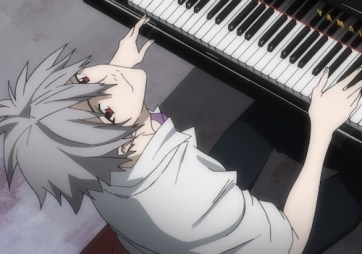
Sad ShinjiChange, and the embracing or rejection of it, is surely one of the major themes of Evangelion. This is more explicitly debated as 3.33 moves into its middle section, where we get an extended dose of Shinji’s traditional insecurities. Hey, it wouldn’t be Evangelion without Shinji having a self-pitying whinge, right? Fortunately there’s more going on than that, but this is a section light on action and heavy on the series’ more thoughtful elements. There are answers to some of the mysteries, but it again wouldn’t be Evangelion if it all made easy sense. At the same time, Shinji bonds with new Eva pilot Kaworu. A controversial character, apparently, and not just because of the homosexual overtones (which some reviewers claim to miss, presumably because they’re blind), but the scenes where they harmonise by playing piano together are quite fantastically animated.

Indeed, whatever else you can say about 3.33, it looks glorious. The choice of a 2.35:1 aspect ratio for the first time helps emphasise the story’s epic qualities, but that’s incidental to the fantastic images conjured up by the animators. Various techniques are hurled at the screen — there’s a lot of CGI as well as traditional hand-drawn art, and they even used motion-captured stuntmen for one scene — but it marries perfectly, allowing camera angles and moves that are incredibly filmic and more dynamic than you normally find in 2D animation. The makers of the Rebuild have always talked about wanting to create innovative, memorable imagery, and they’ve once again succeeded here.

Pia-pia-piano3.33 divides quite neatly into three half-hour sections. I guess that should be expected, as the whole tetralogy has been based in traditional Japanese ideas of narrative/musical structure, hence the films’ Japanese titles incorporating the names for the three movements: jo, ha, and kyū (序破急), which roughly equate to “beginning”, “middle”, and “end”. As discussed, the first is fantastic, some of the best material in the entire series, in my estimation. Also as discussed, the second is a lot slower, but has its plus points too. The third… ah, the third. Here we get some more action, which will please anyone who thrills to Eva combat, but it is also utterly mind-boggling. I’ve been reading up on a few fan sites since watching, and I’m still not absolutely sure what was going on or what it signified. You won’t find any enlightenment in the disc’s special features, which present a long list of extras at first glance, but turn out to be 19 repetitive trailers, TV spots, and promo reels. Yes, nineteen.

After all that, it ends on a rather low-key cliffhanger, making it feel like one of those two-part finales that Hollywood YA adaptations are so fond of at the moment (cf. Harry Potter, Twilight, Hunger Games, etc). In some respects that’s actually true: it was originally said that films 3 and 4 would be half-length movies released together. Obviously that plan disappeared a long time ago. Still, it does make you wonder if that confusing third act will play better when paired up with the tetralogy’s concluding instalment. In the meantime, it’s hard to call 3.33 a completely effectual film in its own right. It quite successfully introduces us to an entirely new era for Evangelion, and teases that various groups’ plans are entering their final stages, but a possibly-indecipherable climax and a “we’ll just have to pause here”-level “to be continued” leave you wanting the next part more than feeling that was a fulfilling, finite experience.

Double plugSo when will that conclusion come? Well, a few years ago Anno ‘joked’ that the finale might be released “four to six years” after 3.33. As we’re already almost at four years with no sign of a release date, I guess it wasn’t so much of a ‘joke’ after all. An English-friendly DVD/Blu-ray will inevitably take an additional couple of years, too. So an indefinite, but undoubtedly lengthy, wait begins…

4 out of 5

Evangelion: 3.33 is out today on DVD, Blu-ray, and dual format Collector’s Edition.

The Tale of Zatoichi (1962)

aka Zatôichi monogatari / Zatoichi: The Life and Opinion of Masseur Ichi

2013 #92
Kenji Misumi | 96 mins | DVD | 2.35:1 | Japan / Japanese

The Tale of ZatoichiAdapted from a short story by Kan Shimozawa, The Tale of Zatoichi was a low-key release for its studio, Daiei: despite being helmed by “a topflight director”*, it was shot in black and white, its leading man, Shintarô Katsu, “was not really a huge star”, and his co-star, Shigeru Amachi, “had been one of the main stars at Shintoto studios before it went bankrupt and ceased production” — surely a mixed blessing. And yet it was “a surprise hit… touch[ing] a nerve with Japanese audiences, who loved to root for the underdog.” Despite the fact our hero gives up his sword at the end of the film, Daiei produced a sequel, and… well…

Some things are created as film series (all those ’30s and ’40s Hollywood mysteries; Cubby Broccoli and co always intended to do multiple James Bond movies), others just turn into them. The Tale of Zatoichi was the latter. Far from a low-key one-off, it would go on to be a huge touchstone for Japanese culture, spawning 24 sequels over the next 11 years, followed by a 100-episode TV series in the ’70s, and a revival film in 1989 — all starring Katsu. Although he passed away in 1997, Zatoichi has lived on through several remakes and spin-offs in the past decade. Although the character and series has a cult following in the West (brought into sharper focus by the well-received 2003 remake), added significance has been imbued by the incredible, beautiful, 25-film, 27-disc, dual format Criterion Collection box set released last year.

Blind men get all the girlsBut enough hyperbole — what about The Tale itself? The story sees blind masseuse Zatoichi accepting an old invitation to visit an acquaintance, Sukegorô (Eijirô Yanagi). But Sukegorô is a yakuza boss, and he presses Zatoichi to join his side in a brewing war with rival Shigezô (Ryûzô Shimada) — because although he’s blind, the masseuse has legendary sword skills. On Shigezô’s side is a hired samurai, Hirate (Amachi), who Zatoichi encounters by chance. Despite the mutual respect between these two coerced warriors, the eventual gang battle comes down to a duel between them…

Though Zatoichi is best (or quickest) defined as a series of samurai films, those taking that to mean copious swordplay will leave with their expectations unmet after this first movie (I can’t speak for the others yet). Tale is more of a dramatic piece, exploring the dilemmas faced by Zatoichi and Hirate — honour and what is right vs. money and misplaced promises — as well as the fatal romantic entanglements of a couple of other characters in Sukegorô’s camp. Even at the climax, the final (well, only) confrontation between the two warriors is an ‘action sequence’ more in the vein of Sergio Leone than Michael Bay: the characters face each other, they wait, the tension grows, and then there’s a couple of short bursts of to-the-point violence.

CalmThose prepared for a calmer, more considered film may find much to like, however. Katsu’s understated style holds your attention and makes you want to learn more about the character; not his past, necessarily, but his qualities as a man. The same is true of Amachi, in some ways even more appealing as the doomed ronin. You get a genuine sense that Zatoichi and Hirate would have had a great, long-lasting friendship if they’d met under better circumstances, which makes the manner of their encounter all the more tragic. For all the bluster about a big gang war on the horizon, it’s the relationship between these two men that forms the heart of the film.

Also worthy of note is Misumi’s direction, including some choice angles and compositions. There’s the restraint to not always be showy: at times, the bulk of a scene plays out in one static but immaculately framed take. At others, however, the camera is shifted around into positions that are never distracting but always beneficial to the storytelling or beautiful to the eye. Credit to cinematographer Chishi Makiura too, of course, especially for some magnificent lighting. Many a shot here would challenge the best of film noir for shadow-drenched beauty. (I should say, I picked up on none of this from the crummy old DVD I first saw the film on, but a re-watch from Criterion’s Blu-ray was glorious.)

The cane swordReportedly this opener is “not the best of [the] series”, but remains “a grand introduction to the character and a touchstone for many of the themes and gags presented in the later films”.** To me, that suggests much promise for the 24 further instalments: what The Tale of Zatoichi lacks in action, it more than makes up for in character and, perhaps surprisingly, emotion. I thought it was excellent.

4 out of 5

Reviews of further Zatoichi films will follow next year.

* All quotes in the opening paragraph from Chris D.’s notes in the Criterion booklet. ^
** According to The Digital Bits. ^

Evangelion: 2.22 You Can (Not) Advance. (2009/2010)

aka Evangerion shin gekijôban: Ha / Evangelion New Theatrical Edition: Break

2011 #65
Hideaki Anno, Masayuki & Kazuya Tsurumaki | 112 mins | Blu-ray | 15
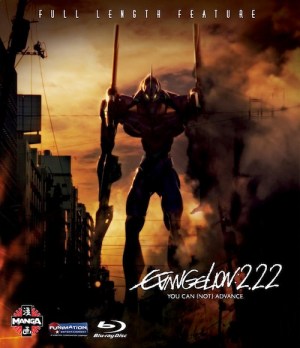
Evangelion 2.22 You Can (Not) AdvanceJust over a year since the preceding film made it to UK DVD and Blu-ray, and two years since this was theatrically released in Japan, the second part of creator Hideaki Anno’s Rebuild of Evangelion tetralogy reaches British DVD/BD today. Continuing to re-tell the story originally visualised in the exceptional, and exceptionally popular, TV series Neon Genesis Evangelion, You Can (Not) Advance throws in more changes to the original tale than its predecessor, including at least one significant new character.

This is very clearly a second part. It hits the ground running, with no thought for those not up to speed on the characters and events so far. Indeed, there’s perhaps little regard for those who may be familiar with it anyway: certain significant events rattle past, the storyline spewing mysteries via dialogue we barely understand, so dense is it with references and allusions. In some respects that’s realistic, of course — why would characters explain, for instance, the Vatican Treaty to each other when they all know about it — but it might leave the viewer struggling to keep up. It’s not all like that, but there’s plenty of it; and when there’s few answers forthcoming within the film itself, the mysterious references feel even more opaque.

Eva vs AngelFor my money, the first 40 minutes or so of the film are (by and large) the best bits. It opens with a barnstorming action sequence, a great scene for newbies and fans alike as we’re introduced to Eva pilot Mari, who didn’t appear in the TV series. That she then disappears for most of the film, only to make a thoroughly mysterious return later, is one of those explanation-lacking flaws. I’m sure it won’t look so bad once the next two films provide us with answers. Well, I hope not.

After that the film seems to trade one-for-one on character scenes and action sequences: ostensible lead character Shinji and his father have what amounts to a heart-to-heart, for them, in a vast cemetery; Eva pilot Asuka is introduced in another action sequence — different to her intro in the TV series, and I’d say not as memorable, though it’s still visually exciting. This is followed by some of the film’s best sequences: an “everyday morning in Tokyo III” montage is a beautifully realised piece of animation, depicting the commute to work/school under the backdrop of a megacity that can sink and rise as needed, moving into the school lives of our band of awkward misfit ‘heroes’. It’s not readily describable on the page, which is arguably the definition of properly filmic entertainment.

AsukaThen the gang take a trip to a scientific installation which is trying to preserve the oceans and their wildlife. It feels like animation shouldn’t be as effective for such a sequence as, say, the footage in a David Attenborough documentary, but nonetheless it feels extraordinary, in its own way. It also marks itself out with the interaction of the characters on a fun day out rather than their usual high-pressure monster-fighting world. And then it’s back to that world for another impressive three-on-one Angel attack.

I’m loath to say it’s after this that Evangelion 2.22 begins to slip off the rails, because flicking back through it after (the distinct advantage of watching something on DVD rather than in a cinema!) I struggled to find any point where I felt it lost its way or dragged with an interminable or pointless sequence. That said, this is where it begins to get more complicated. Much is made of the international situation, something I don’t recall from the TV series. It’s a neat addition — the world bickering over who has the Evas and how many — but it takes some following at times and the relevance isn’t always clear.
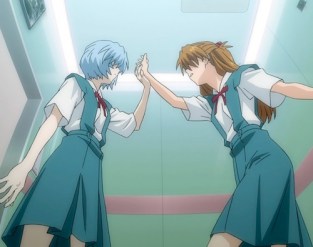
Rei vs AsukaBut it’s all building somewhere. For one, there’s another of the film’s best sequences — certainly, its most shocking, which readily earns the 15 certificate. I don’t want to spoil it for anyone yet to see the film, because it’s one of the plot points that differs from the TV series, but it involves the death of a main character in a brutal, deranged way. I say “death” — they pop up in the third film trailer that runs after the end credits, so there’s more to this yet…

Other than that, it sometimes feels like the story is meandering through thematic points that don’t engage as well as the character and action ones earlier in the film. Again, flicking back through, I couldn’t spot what I felt had slowed it, so maybe it functions better on a second viewing, knowing what ending it’s headed towards — at least one apparently minor subplot is, in its own way, vital to the climax, and the climax is certainly vital: unlike the first film’s ending, which was suitably climactic but clearly with story left to tell, this is a major turning point, a proper cliffhanger. Indeed, after a long stretch of confusion, it’s something of a gut-punch to reach such a dramatic point. I loved it, even if I felt I was missing some of the significance of the five minutes that led up to it.
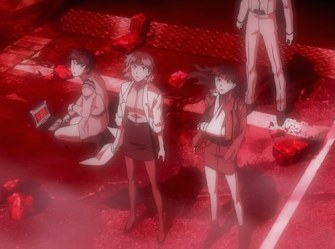
Watching Third ImpactAnd then, after the end credits, there’s a brief scene that throws another spanner in the works! Double-cliffhanger-tastic… one might say…

Oh, and we get an explanation for why Shinji’s still using a tape player in the near-future (which, you may remember, was a (minor) complaint I had about the last film).

The second new Evangelion film isn’t as straight-up enjoyable as the first. It starts incredibly well, but then it feels like its getting too bogged down in the politics of a world that hasn’t been properly established for us and in the intricacies of some thematic considerations — the latter is especially worrying as it was this that made the ending of the TV series so unsatisfactory, which in turn led to a pair of movies that, frankly, didn’t do that much better. But the ending did cause me to rethink my position a little, and perhaps a second viewing would find the whole film a better structured and more understandable experience.
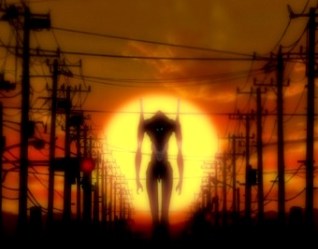
Tokyo III sunsetIn short, if you’ve always liked Evangelion then you won’t be waiting for me to tell you this is a must-see reimagining; if You Are (Not) Alone was your first experience and you enjoyed it, this is an essential continuation of the story — but be prepared that it’s not as simplistically entertaining. I didn’t enjoy it as much on this first viewing, but it may in retrospect pan out as the better of the two.

4 out of 5

Evangelion 2.22 is out on DVD and Blu-ray today.