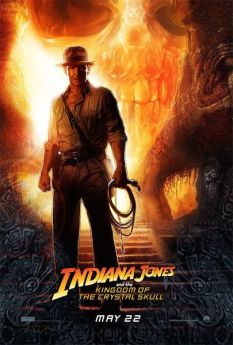
2008 #32
Steven Spielberg | 122 mins | cinema | 12A / PG-13
This review contains major spoilers.
For a spoiler-free view, see my initial thoughts.
 I’ve grown up with Indiana Jones around. Not in the way Harry Knowles may have (apparently if you weren’t old enough to see the original trilogy in the cinema, at precisely the right age, then this film isn’t for you), but they’ve always been there. I was so young when I first saw Last Crusade (on video) that, even though it can only have been two years old at most, it was a film that had Always Existed as far as I was concerned (much like Ghostbusters and Back to the Future, or so many other ’80s movies that I love). I remember directing a recreation of Last Crusade in the playground (with me as Indy, of course, and one of my best friends hating me for days because he’d been Brody and I’d melted him at the end, my 6-year-old memory having confused the character with Donovan); loving Young Indiana Jones whenever they showed it on BBC Two; visiting the absolutely fantastic stunt show at DisneyWorld Florida; churning through a couple of the tie-in novels (carefully selected from the gift shop based on their blurbs); having the Raiders poster on my door for at least a decade; running around with my Indy hat and Nazi cap gun (wow, we must’ve bought a lot in that gift shop); wishing there were action figures for me to play with (and appropriating an Alan Grant from Jurassic Park for the task, because he had a vaguely similar hat)… There are many more Indy memories locked away in my head, but I think those examples will more than suffice.
And so, about 17 years or so since I first encountered Dr Henry Jones Jr, I finally get to see him in the cinema. I don’t think I’m one to be easily suckered in by that thrill factor, however. I wasn’t one of the people who came out of Phantom Menace extolling it’s virtues only to later realise how disappointing it was; heck, I came out of Two Towers not with the feeling that after a whole year (wow!) of waiting Lord of the Rings was back and wasn’t it great — I thought it dragged for at least the first half and found Helm’s Deep somehow anticlimactic. I say this in defence of the fact that I enjoyed Crystal Skull and think it’s a good film, an opinion that seems oddly rare at the minute. I suspect this will change with time.
That’s not to say the film isn’t flawed, mind. The opening’s a bit slow for my liking, there are few lines that are as funny or as quotable as in the other films, and some moments push things a bit too far — I’m thinking specifically of Indy escaping a nuclear test in a lead-lined fridge. It’s not as bad as Bond surfing the wave from a melting ice shelf in Die Another Day, but it’s not really in-keeping either. Another oft-cited problem is the amount of material the film awards to some of its starry cast members. Actors of the calibre of John Hurt, Jim Broadbent and… well, most people say Ray Winstone, but I think he’s overrated as an actor… still, they don’t get a great deal to do. The problem here is that they’re John Hurt, Jim Broadbent and Ray Winstone — replace them with unknowns and far fewer people would whinge about the size and point of their roles. Quite why an actor like John Hurt would accept such a small, almost one-note role (while there may be more depth to the character, it’s all revealed in Mutt’s memories rather than Hurt’s performance) is a different issue, but he does play the part well.
The rest of the cast fare better: Shia LaBeouf continues to be a star on the rise, here blessed with a teen rebel who isn’t also incredibly irritating. Mutt has a heart, and we don’t have to suffer a two-hour ‘emotional journey’ to find it. He pairs well with Harrison Ford too, and one can see why George Lucas suggests a future for the franchise that emulates the father-son dynamic from Last Crusade. That said, Ford gets his best partner in Karen Allen’s Marion. She was always the best ‘Indy girl’, and while her return may be as surprising as Indy wearing that hat and carrying a whip (not just because we’ve seen her in all the trailers, but who else is it going to be when Mutt first mentions a Marion in the diner?) she plays a vital role in injecting some verbal humour and banter into proceedings. The only other noteworthy female cast member is Cate Blanchett as a villainous Russian psychic (maybe). She’s clearly having bags of fun with the part, and is rewarded primarily with a death scene that is pleasingly in line with those in the rest of the series. This is another moment some reviewers have whined about, saying we’ve seen it before, but personally I’d’ve been disappointed with anything less from an Indy film.
Of course, this is all without really mentioning the man himself. Make no mistake, Harrison Ford is still Indiana Jones. The hair may be grey, the face covered in more lines, but the attitude and humour is still there. This is an older Indy, of course — he’s not only aged nearly two decades since we last encountered him, he’s also lived through the Second World War. The snippets of dialogue that explain what he’s been up to since we last saw him are all very nice for fans too, I think, but are pleasingly not dwelt upon for too long — this is a film that will work just fine for anyone who somehow hasn’t seen the first three. Ford can still hold his own in the action stakes too, running, swinging and punching his way through a variety of thrilling sequences. The screenplay could have used his age as a crutch, leaving him with some comedy running away while the much younger Mutt got stuck in; this isn’t the case, and that’s great.
As for those action sequences, they’re a lot of fun. The best by far is an extended chase through the jungle, including a fantastically conceived sword fight on the back of two moving vehicles. There’s a good deal of silliness in it — Mutt’s Tarzan-like vine swinging, or Marion’s use of a handily-placed tree to get their car into a river — but this is a franchise explicitly inspired by the B-movie thrills of the ’30s, ’40s and ’50s, in which context these things are more than acceptable. It’s a little daft, but it’s all such fun that if you’re worrying about the realism you’re not entering into the spirit of things. More disappointing is some lacklustre CGI, which is used far more often than Spielberg might have liked us to believe. There’s also a bit with some large ants that may be a little too close to the use of beetles in The Mummy, but as that’s basically an Indiana Jones rip-off it seems only fair to return the favour.
Finally, there’s the MacGuffin: the eponymous Crystal Skull (the “Kingdom of the” prefix isn’t really needed). It’s alien, as long-rumoured, which has undoubtedly angered some fans. Personally, I don’t find it any sillier than the Ark of the Covenant or the Holy Grail, equally unreal items (in fact, less real — maybe the aliens are too likely to be true for some viewers?) with equally fantastical powers. It also fits with the mid-50s setting, post-Roswell and heading into the Space Race. The design of the aliens and their saucer is pleasingly retro, though obviously achieved with CGI, and it does tie to theories that ancient monuments and civilisations had contact with aliens (again, true or not, they’re no worse than the religious artefacts of the other films). Like everything else about the film, the MacGuffin may not be quite as good as the equivalent elements in Raiders and Last Crusade, but it pushes close enough.
Speaking of which, it’s worth quickly mentioning the UK rating. For some reason, Crystal Skull is a 12A while Raiders and Last Crusade are both only PG. I swear there’s nothing worse in this film than those; in fact, I’m sure there’s nothing here that’s as likely to be traumatising for youngsters as Donovan melting at the end of the third film. I expect it says more about our variable rating system than it does about the films themselves, but in the unlikely event anyone reading this is wondering about its suitability for a younger audience, there’s my thoughts.
As I mentioned earlier, reaction to the film, both from critics and the general viewing audience, has been somewhat mixed. It seems plenty of fans have left their rose-tinted glasses with their DVD box set and viewed Crystal Skull with the all-too-critical eye of one who isn’t aware they don said goggles to watch the older films. Crystal Skull is a suitable return to the Indiana Jones series — full of fun and excitement, and a good chance to be reacquainted with old friends. It can’t beat Raiders because that came first, automatically embedding itself as the best in the minds of many; and it can’t beat Last Crusade, partly because it lacks the wonderful dynamic between Harrison Ford and Sean Connery, and partly because I just love that film. But, crucially, it is in the same league as them, and that’s fine by me.
My initial reactions to Kingdom of the Crystal Skull can be read here.

 Adapted from the classic young adult sci-fi novel by Orson Scott “bigoted idiot” Card, Ender’s Game is the story of Andrew “Ender” Wiggin (Asa Butterfield), who displays uncommon aptitude in a military programme to train children to fight against an alien race that attacked Earth decades earlier. Sent to a training centre in space, Ender must battle his fellow candidates to prove their worth to their hardened commander, Colonel Hyrum Graff (Harrison Ford), ready for the real battle to come.
 It tips its hat to things like drone warfare, child soldiers, and understanding our enemy, but that’s all it does: acknowledge those parallels exist, then refuse to explore them. Conversely, the music is too heavy-handed, taking on the burden of providing emotion that’s lacking from the screenplay.
 Sadly, after all that training fun, once the cadets jet off to the other side of the galaxy for a rushed third act, interest evaporates speedily. It even has to work hard to sell its own twist as a twist! (Spoilers follow in this paragraph.) In a simulation for a war, Ender does what he’d do to win that war. Then he’s told it wasn’t a simulation, it was the actual war… and he’s all cross. I mean, okay, the fella kinda has a point when he gets angry afterwards: they’ve lied to him, and maybe he would’ve behaved differently if he’d known. But the point of the training was to teach them what they needed to do to win, and it taught them that, and he did it. Maybe this twist works in the book, but in the film it felt somehow unearned.

 Score:



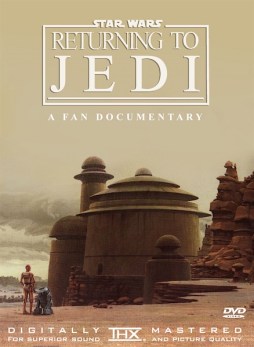 Returning to Jedi completes fan/editor Jamie Benning’s trilogy of documentaries about
  and Mark Hamill expected more darkness for Luke — but I guess they weren’t to be heard by an increasingly autocratic Lucas (reports of him essentially directing Jedi for Richard Marquand, or of his clash with the Directors’ Guild that prevented Steven Spielberg from directing the film, go unmentioned here).
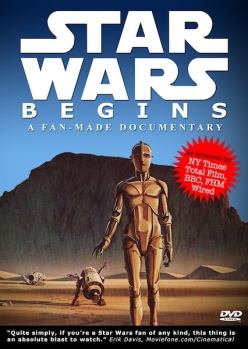 This year, I finally got round to watching the Star Wars Blu-rays I bought back whenever they came out, so I thought what better time to also finally watch Jamie Benning’s trilogy of “filmumentaries”. What’s a filmumentary, you ask? Well, here’s the opening text of the film itself:
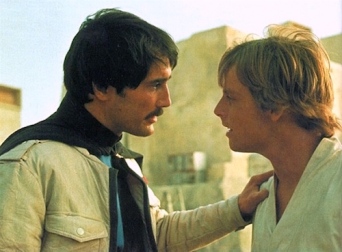 (i.e. before we even meet Luke in the finished film), the sequences were removed en masse due to execs’ fears they made the movie feel like “
 Star Wars Begins may not be the first port of call for anyone looking for an overview of the making of Star Wars, but it’s a goldmine of behind-the-scenes titbits and occasional candid revelations for anyone with a strong enough interest.
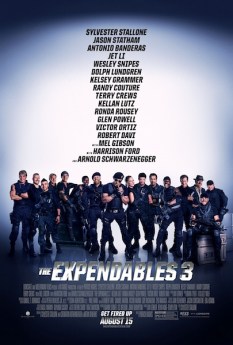 Oscar-nominated screenwriter Sylvester Stallone continues his examination of masculinity and machismo amongst older men in this trilogy-forming instalment of his Expendables franchise.
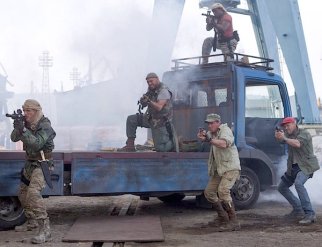 though occasionally obscured by camerawork and editing that turns it into a cacophony of violence. The Blu-ray release helps expose this: the special features include an extended version of Statham’s main battle from the climax, and in that focused form you can see how it’s been carefully constructed and designed. In the film itself, it’s chopped up into ten-second chunks and intercut with everyone else’s duels. It becomes like an impressionistic painting of shooting, punching, kicking, stabbing, running, jumping… It’s a war, as the now-double-sized team of heroes takes on a literal army, and some will revel in the over-the-top-ness of it all. The sheer excess does have a certain charm.
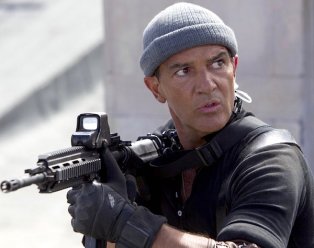 The best addition, unquestionably, is Antonio Banderas. He’s a parkour-performing blabbermouth who keeps pestering Grammer for a job, but no one wants him because he won’t stop talking. And he’s hilarious. Of the 93 changes in the five-minutes-longer extended version (yes,
 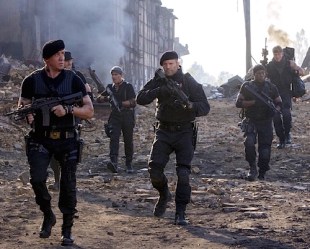 I kind of hope they do make more. The Expendables movies aren’t great films — heck, they aren’t even really great action films — and they’re a bit too cheesy and in-joke-y for the own good — and yet, somehow, I can’t resist them, and I’ll be happy to keep watching them for as long as Stallone and co can keep making them. After all, there are an awful lot of ageing action actors who’ve not appeared yet…
 I don’t know if it says more about me or the two Harrison Ford-starring Jack Ryan movies that I wrote 250 words of this review before I realised I was actually talking about
 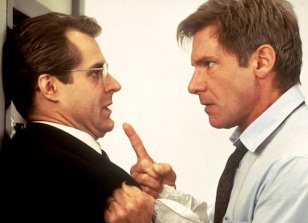 It’ll come as no surprise that Ryan ends up exposing the nasty conspiracy — which goes as high as the President! But what does a good American patriot do when he finds out the practically-holy President has committed such a sin?! The novel ends with Ryan confronting him… and then deciding not to expose his secret war. Presumably this is thanks to Clancy’s obviously-Conservative political views. “Liberal” Hollywood, on the other hand, has given us a more just — and more satisfying — conclusion. Thank goodness for that.
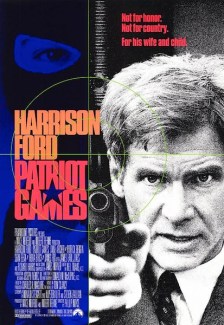 A sequel to
 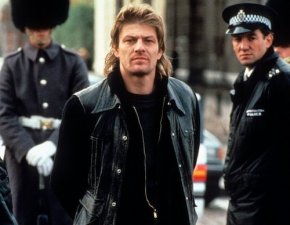 There’s a nasty synth score, just to make things drag more. There are some moments of brilliance though, not least the beautifully-shot boat chase climax. There’s also the dubious joy of seeing Sheffield’s most famous son, Sean Bean, doing an Irish accent. Co-terrorist Polly Walker is English though — twist! Not that her subplot really goes anywhere. Possibly she just couldn’t do the accent.
 I couldn’t make it to the local midnight showing of
  100Films.co.uk