
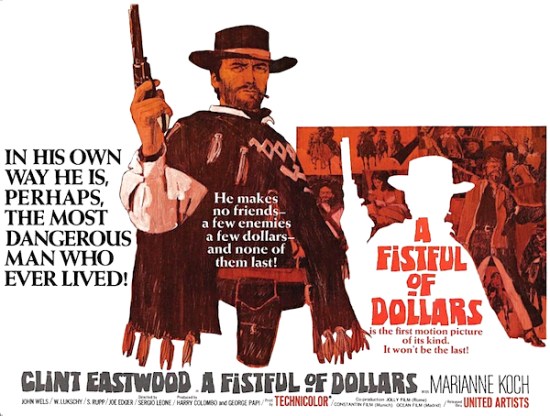
Original Title: Per un pugno di dollari

Country: Italy, Spain & West Germany
Language: English and/or Italian
Runtime: 100 minutes
BBFC: X (cut, 1967) | AA (1981) | 15 (1986)
MPAA: M (1967) | R (1993)
Original Release: 12th September 1964 (Italy)
UK Release: 11th June 1967
Budget: $200,000
Stars
Clint Eastwood (High Plains Drifter, Gran Torino)
Marianne Koch (The Devil’s General, Spotlight on a Murderer)
Gian Maria Volontè (For a Few Dollars More, Le Cercle Rouge)
Wolfgang Lukschy (Dead Eyes of London, The Longest Day)
José Calvo (Viridiana, Day of Anger)
Director
Sergio Leone (The Colossus of Rhodes, The Good, the Bad and the Ugly)
Screenwriters
Víctor Andrés Catena (Kill Django… Kill First, Panic)
Jaime Comas (Nest of Spies, Cabo Blanco)
Sergio Leone (The Last Days of Pompeii, Once Upon a Time in the West)
Dialogue by
Mark Lowell (High School Hellcats, His and Hers)
Story by
Adriano Bolzoni (Requiescant, Your Vice is a Locked Room and Only I Have the Key)
Víctor Andrés Catena (Sandokan the Great, Cabo Blanco)
Sergio Leone (Duel of the Titans, Once Upon a Time in America)
Based on
Yojimbo, a Japanese samurai film written by Akira Kurosawa & Ryûzô Kikushima and directed by Kurosawa. (Not officially, but the makers of Yojimbo sued and it was settled out of court — presumably because it’s really, really obviously a remake of Yojimbo.)
The Story
The Mexican border town of San Miguel is ruled over by two rival gangs. When a gunslinging stranger arrives, he attempts to play the two gangs off against each other to his benefit.
Our Hero
The Man With No Name, aka Joe, seems to just be a drifter, who rocks up in San Miguel and sees an opportunity to make some money by doing what he does best: killing people.
Our Villains
Neither of the two gangs — the Baxters and the Rojos — are squeaky clean, but the Rojos are definitely the nastier lot. Led by three brothers, the cleverest and most vicious of them is Ramón, who’ll stop at nothing to punish Joe after he threatens their empire.
Best Supporting Character
The innkeeper Silvanito, who warns Joe away when he first arrives, but becomes his friend and almost sidekick later on.
Memorable Quote
“When a man with .45 meets a man with a rifle, you said, the man with a pistol’s a dead man. Let’s see if that’s true.” — Joe
Memorable Scene
As Joe heads off to confront three of Baxter’s men who shot at him earlier, he passes the coffin maker — and tells him to get three coffins ready. Coming face to face with four of Baxter’s goons, Joe asks them to apologise to his mule. They, naturally, refuse… so he shoots them all dead. As he walks back past the coffin maker, he casually apologises: “My mistake — four coffins.”
Memorable Music
Ennio Morricone’s score is as much a defining element of this movie as the visuals or the cast. His later theme for The Good, the Bad and the Ugly may be his best-known work, but there’s a cracking main title theme here too.
Letting the Side Down
It’s just a fact of this kind of production from this era, but the English dubbing is really quite terrible. Well, the acting’s not all that bad, as it goes, but the lip sync is not very synced.
Making of
When it premiered on US TV in 1977, the network found the film’s content morally objectionable: the hero kills loads of people, apparently only for money, and receives no punishment. While that might sound perfectly attuned to US morals today, they had different ideals back then. So they ordered a prologue be shot, showing Eastwood’s character receiving a commission from the government to go sort out the town of San Miguel by any means necessary — thus morally justifying all his later killing, apparently. The short sequence was directed by Monte Hellman (Two-Lane Blacktop) and starred Harry Dean Stanton (RIP).
Next time…
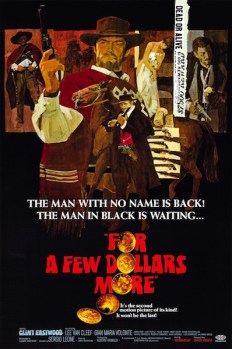
The loosely connected Dollars (aka Man With No Name) Trilogy continued with For a Few Dollars More (which was part of my 100 Favourites last year) and concluded with The Good, the Bad and the Ugly (which someday will get the “What Do You Mean You Didn’t Like” treatment).
The Dollars trilogy were among the first Westerns I saw, and I’ve been meaning to revisit them for many years. I was finally spurred on to start by watching Yojimbo for the first time. Watching that and this back to back, you can’t miss how similar they are — no wonder they settled the legal case, they wouldn’t’ve had a leg to stand on. Yojimbo is the classier handling of the material, giving the whole scenario a weightiness that has gone astray here. Fistful has its own charms, of course, as director Sergio Leone merrily reinvents the Western genre before our eyes — out go the simple white hat / black hat moral codes, in comes baser motivations (greed, lust) and quick sharpshooting. What it lacks in classiness or weight, it makes up with coolness and style.


 Score:



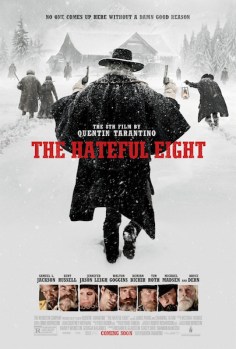 Quentin Tarantino hadn’t made a film in the same genre as his preceding movie for almost 20 years when The Hateful Eight came out — his second go-round with the Western genre, after the Spaghetti-ish thrills of
 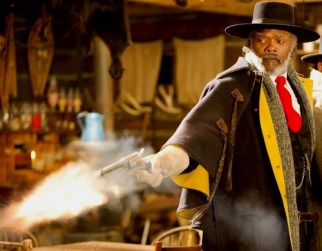 And it’s all in a remote, isolated location which has been cut off by weather, and every character is hiding some nefarious past — so far, so And Then There Were None. All of this comes dressed in QT’s famed dialogue, unfurled at the somewhat languorous pace he’s gradually been cultivating for a few movies now, and topped off with a few doses of the old ultra-violence.
 Ultra Panavision 70 produces an ultra-wide 2.76:1 frame (for those not in the know, your widescreen TV is only 1.78:1), which for such an intimate story has struck people as odd ever since it was announced. In fact, it pays off in (at least) two ways: firstly, all the scene-setting scenery looks magnificent; secondly, for a lot of the film there’s stuff going on in the background or at the edge of frame — it’s not just a series of close-ups or two-shots where the ancillary detail is either non-existent or doesn’t matter, but one where that ‘background’ detail is sometimes very instructive to what is going on. Tarantino also uses the full width a lot of the time, placing two figures at either edge of the image — this really isn’t a film you could crop (thank goodness it doesn’t exist in the pan & scan era!)
 as if to bring the point home (and that’s far from the only thing about The Hateful Eight that’s indebted to The Thing, but I’ll leave that for someone else to dig into another time). Even though this is the first time he’s had a full score composed for one of his films, Tarantino still sources a couple of well-selected songs from elsewhere, including a very apt credits track by Roy Orbison.


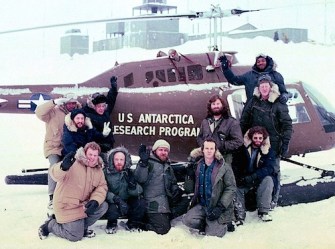
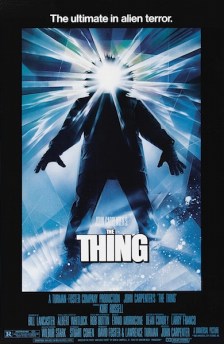 It’s just an ordinary day at the US Antarctic research base staffed by helicopter pilot MacReady (Kurt Russell) and his compatriots, until a helicopter buzzes overhead dropping grenades on a dog it’s pursued across the ice fields. The dog finds sanctuary in the US base; the helicopter and its crew are less fortunate. Realising it’s from a Norwegian facility an hour’s flight away, MacReady and the doctor brave inclement conditions to investigate. They find numerous corpses and the base burnt to ruins. What horrors befell the Norwegian base? And have they inadvertently brought them into their own…?
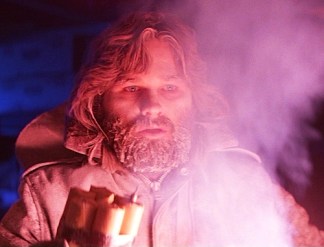 Even if you don’t want to get deep about it, The Thing has the “who’s human?” thrills to keep you engaged on that level. Accusations of boredom no doubt stem from the fact it’s a bit of a slow burn, the early acts building suspicion and unease as MacReady and co investigate. Even after the true nature of the threat is revealed, Carpenter paces himself, though the frequency of incidents begins to mount inexorably as we head towards the climax. Well, that’s just good structure.
 For me, it’s the psychological quandaries that are gripping and exciting, rather than any enjoyed disgust at the emetic special effects. However, knowing the characters a little better — thus caring if they’d been replaced or not, and also perhaps allowing us a chance to try to guess for ourselves — would have just made it that bit superior.
 100Films.co.uk