
Joe Johnston | 119 mins | Blu-ray | 15 / R
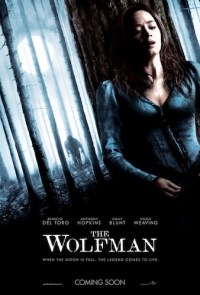 The “extended director’s cut” (as the Blu-ray blurb describes it) of The Wolfman begins with a new CG’d version of Universal’s classic ’30s/’40s logo, the one that I’m sure opened many/most/all of their beloved classic horror movies. As well as being a self consciously cool opening shot, it’s a succinct way for director Joe Johnston to signal his intentions: this is not your modern whizzbang horror movie, but something more classically inspired.
Aside from a murderous opening teaser, the film makes this clear pretty quickly — or rather, quite slowly. The plot and character are allowed to unfurl at a gradual rate, building up to bursts of action later on rather than trying to keep the audience’s adrenaline pumping with a constant barrage of set pieces. This rationale seems to be particularly true in the 16-minutes-longer extended version, which adds additional dialogue-centric scenes from the outset. It also adds flaws like blatant continuity errors: in the original cut, Gwen writes to Lawrence to persuade him to come; in the extended version, she visits him in person, rendering future references to her letter baffling.
An extensive illustrated list of the numerous changes can be found here. Despite the “unrated” branding implying “more gore” as per usual, there’s hardly any of that added. Instead it’s mainly character moments of varying degrees of relevance, plus an array of inconsequential tweaks. I appreciate the attempt to bring a slower, creepier style back to modern horror films, but Johnston over-eggs it at times. This becomes especially evident when the majority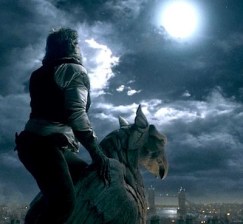 — perhaps even the totality — or plot developments and, particularly, twists are guessable far in advance. Trying to lose 16 minutes for the theatrical cut was probably a good idea, though some of my favourite moments lie amongst what was excised.
The other downside comes when Johnston tries to have his cake and eat it. The plot may retain its relatively leisurely pace throughout, but room is found for three or four CGI-packed action sequences. I think the film indulges too much in CGI. It’s a useful tool when used well and all that, and it’s undoubtedly found itself well employed in out-and-out blockbusters, but its obvious presence in even low-key scenes here — it’s used to realise a tame bear and sacrificial deer, for instance — feels incongruous; a sore thumb when so much of the script, plotting and pacing is old school.
There’s plenty of computer work on show in the transformations, fights and deaths too, of course, but I feel a similar sense of incongruity there: after the filmmakers went to publicised effort to make the Wolfman himself a creation of makeup rather than computers, it’s a shame they couldn’t extend the practical approach to more effects, particularly others involving the werewolves. As it stands, The Wolfman’s CGI is unoriginal, the same pretty-real-but-undoubtedly-computer-generated stuff we’ve seen in every blockbuster for the past five to ten years. Even Anthony Hopkins’ decapitated noggin feels like something I saw in some 12A blockbuster in the last half decade.
The gore all round, however, was rather good. I’m no gore fiend, but considering the subject matter and the film’s more adult bent, it was appropriately gruesome and, at points — such as the (brief) reveal of Ben Talbot’s mutilated body — scary and plausible; indeed, it was scarily plausible. The same can’t be said of the abundant jump scares though. Such artificial frights are widely considered the scourge of horror movies, and The Wolfman certainly has more than its fair share of cheap ones. Generally speaking, in most films I find such moments to be neutered by the events and signposts being so damned predictable; Johnston is frequently not guilty of this, at least, pulling off some genuinely surprising jolts. And some of them are even legitimate, if such a distinction is possible.
Despite the avowed interest in story, I nonetheless found the scary bits and action sequences to be The Wolfman’s most engaging. Leaving aside the predictability I already noted, the cast are at least partly to blame. I’ve never much rated Benicio del Toro as an actor (with exceptions) and here he does little to change my mind. Indeed none of the cast excel themselves — Hopkins, Blunt and Weaving may not be bad per se, but there’s little to endear them either. Hopkins stands out as either rather good or rather hammy, depending on your point of view; and either way, he’s distinctly Hopkins-y. Plus ça change.
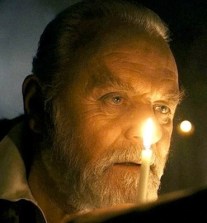 Max Von Sydow’s cameo-sized role (only found in the extended cut) is possibly the film’s best bit. Aside from the fact he’s usually good value, the relevance of the scene itself is unclear. That might sound like a problem, but I choose to see it as making the sequence — and the character — rather intriguing. The rest of the supporting cast are largely British faces recognisable from TV and similarly-sized film roles, playing the parts you’d expect them to and existing primarily as monster ready-meals. Equally, Danny Elfman’s score is disappointingly generic and clichéd, particularly so whenever the film is being the same.
Considering Johnston’s background in family-friendly films, he always seemed an uncertain choice for an adult horror movie. In some respects there was nothing to fear — the adultness is clearly undiluted — but he’s nonetheless made an adequate movie, rather than the exceptional one a classically-styled horror revival deserved. On the bright side, it’s immeasurably better than Universal’s last foray into their horror back catalogue, Van Helsing. In fact, placed in such company, The Wolfman almost begins to look like a masterpiece.

The Wolfman begins on Sky Movies Premiere tonight at 10pm, and is on every day at various times until Thursday 16th December.
 I don’t know if you’re aware of a website, dear reader, called
 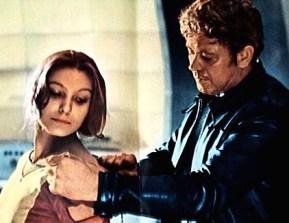 The fact that it’s the better part of three hours long, in Russian, and notoriously slow-paced, adds a different kind of weight. It’s quite easy to see how Soderbergh felt able to
 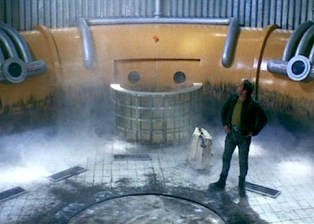 how it might work, or any other scientifically-bent notions that other films or filmmakers might choose to focus on. It also doesn’t centre on the romantic side of events, the route Soderbergh chose to pursue; or, if it does, it does so coldly and clinically and doesn’t feel romantic in the slightest. Alternatively, that could be the point.
 Robin Williams surprised everyone when he started appearing in films as a serious actor in the early ’00s. Previously — and, if you’ve seen him on chat show in recent years, still — an outrageous funnyman, Williams turned in excellent straight performances in the likes of
  Still, Robin Williams is excellent, once again displaying his recently-found gift for serious acting. His character’s homosexuality is nicely handled too. It seems to have overshadowed the rest of the film for some viewers, but I’m confused as to why. Perhaps precisely because it doesn’t come out screaming “look, look, he’s gay! Isn’t that edgy!”, leaving it as just a fact of his character — and one that’s only important because his personal life is part of the story — means some viewers are so shocked by their own realisation of his sexual orientation that it gets in the way for them.
 this “but it happened!” logic seems to allow the filmmakers to get away with not offering adequate explanation. Then again (not sure how many “other hand”s I’m on now), it’s just like real-life: sometimes things can’t be explained in a rational way. Some people will have a problem with that from their films; sometimes I’m among them, but in this instance I think there are enough explanations and ambiguities. My problem was more that getting to them seemed to provide nothing, particularly as, being twist-free, they only confirmed one of the options that had been supposed an hour earlier.
 Do you need me to tell you how great Beauty and the Beast is? I imagine not. If you’ve seen it, you’ll know. If you haven’t, you really should, and then you’ll know.
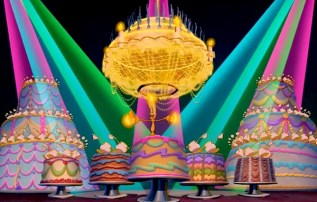 It’s not a bad song — not at all — but it’s a notch below the others. (There are a few more changes to the film than just adding the song, listed
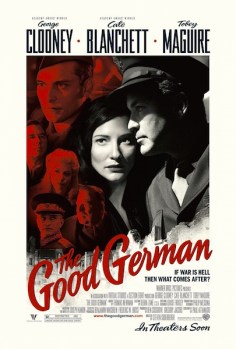
 the visual, audio, acting and plot styles of the era, why not ensure the dialogue and action follow suit? There’s no need for the violence, sex and swearing in this particular tale; at least, no need for it in a way that couldn’t be conveyed as effectively using Production Code-friendly methods. I’m uncertain if I like the film less for failing on this measure, but it does add to its inherent oddness.
 But how much do we get to know them, really? It’s easy to see why critics said “not very well”, because they’re too busy uncovering the conspiracies and revealing their part to actually show us much about themselves. But then why should that be a problem? It’s a noir thriller, not a character drama. Surely it’s about the mysteries and, if you like, the themes, rather than letting us understand the people caught up in them?
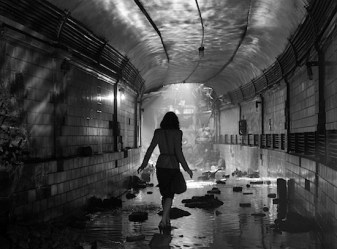 production intentions rather than being invented to slot into them — provides meat on the stylistic bones.
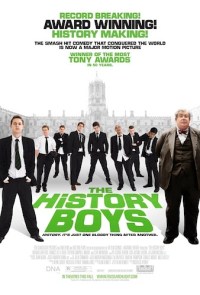 Nicholas Hytner’s film of Alan Bennett’s play, about a group of unlikely ’80s grammar school boys trying out for Oxbridge, sticks with a Bennett screenplay and the original West End/Broadway cast. However, it succeeds in not being very stagey — to the credit of Bennett’s screen adaptation and Hytner’s direction, I should imagine.
 I said it wasn’t stagey. That’s not entirely true: the exception is the finale, which in both execution and dialogue feels incredibly Theatrical. But it’s a nice idea — much better than a half dozen “what happened next” screens of text — and I wouldn’t want to lose something so effective. It also succinctly reminds us that, though this story is over, lives go on.
 Post
Post  depending on your point of view, either supports the “it was all a dream” reading or is just a case of artistic licence, hardly uncommon in SF cinema.
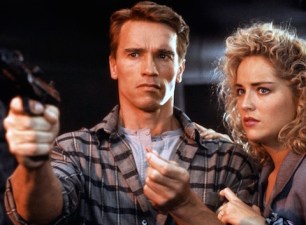 Perhaps it’s ultimately destined for an afterlife as a film representative of its era; the kind of thing that comes up as a footnote or personal favourite in texts & documentaries specifically discussing things like The Sci-fi Cinema of the ’90s. Or perhaps I’m doing it a disservice. We shouldn’t really try to predict these things too much, it’ll only lead to embarrassment when the opposite happens.
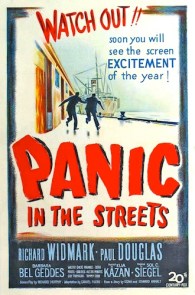 Film noir is a pretty unspecific genre, or unconscious movement, only really defined (however loosely) once it was already over. So to say a film noir isn’t particularly film noir-y might seem a tad daft, but, Panic in the Streets isn’t a particularly film noir-y film noir.
 has a beautifully bad-guy-friendly skull-like face, with his jutting cheek bones and flat-ended nose. (I imagine I’m far from the first to make this observation, but hush.)
 The world, so they say (and by “they” I mean “absolutely no one” — I’m making this up), is divided into three sorts of people: those who love
 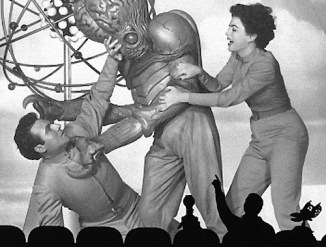 Anyway, the gang set their sights on one film per episode — or, in this feature film, one film per film. They’re being forced to watch these movies, for various unimportant reasons, and every once in a while we get comedic ‘host segments’, where they get up to hijinks on their space station (I forgot to mention, they live on a space station). These bits are well-meaning and quite funny — and in this big screen outing have been shot with a suitably filmic gloss that the video-shot TV episodes lack, which adds a surprising magnitude to the still-small-and-cheap sets and props — but the real meat of the humour is in the riffing over the film.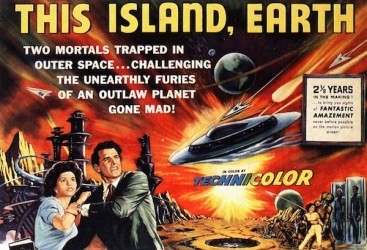
 when you’re in the mindset to take the piss out of the film. That is, if you get on with the characters (as it were) and sync with their sense of humour; if you dislike them or their humour, or like whatever they’re watching too much, then it’s probably more like some irritating yobs nattering away over something you’d quite like to watch thank you very much. (Equally, if you embark on this intending to watch This Island Earth, more fool you.)
 Alternate histories are always fun, and nothing seems to have provoked more than the Second World War. Which, as a defining event in modern history for a good chunk of the world, is understandable. It Happened Here is perhaps one of the earliest examples, depicting a 1940s Britain under Nazi occupation.
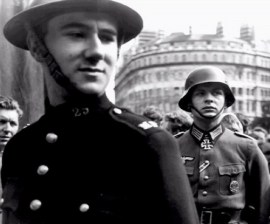 namely, the quiet but methodical enacting of The Final Solution in an occupied territory. The whole film builds to this point, gradually showing the darker and deeper levels of cooperation — which starts out almost harmless and ends with organised mass murder — meaning it never feels like Brownlow and Mollo are pushing an agenda too hard, but still confront us with the reality: that we’d probably succumb too, and this is where we’d end up.
 Another controversy arose over the villains being British collaborators — few German Nazis are seen — and the ease with which many agreed. But this is based in the facts of what occurred in other occupied territories; maybe Britain’s plucky spirit would’ve shown through, as many like to believe, or maybe many would have caved for the easier life — or, indeed, life at all. The film is examining several perspectives of occupation, and using the fictional context to good effect: this could have happened, the film says, however much we like to believe we wouldn’t have collaborated like (and/or resisted better than), say, the French.
 Nonetheless, It Happened Here is more anti-Nazi than pro-Nazi propaganda, in my opinion, though it’s easy to see why any material critical of the Allies could have outweighed the overall bias when the film was first released, just 20 years after victory in Europe. Generally, and viewed from a much more removed perspective, Brownlow and Mollo do a good job of offering conflicting perspectives with minimal comment, allowing the viewer to decide how ridiculous certain newsreels or opinions are, or how weak or misguided characters may or may not be — on both sides.
 100Films.co.uk