Fist of Legend (1994)

aka Jing wu ying xiong

2008 #77
Gordon Chan | 99 mins | TV | 18 / R

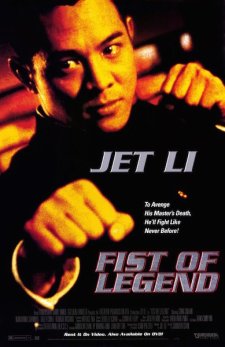
Fist of LegendI found myself watching Fist of Legend unintentionally following this year’s Children in Need appeal. The significance of this piece of trivia is that I watched it on TV, which means I had to watch it dubbed. Apparently, “it is regarded as one of the best martial arts films of all time, and almost universally viewed as Jet Li’s best” (thank you Wikipedia), but the dub does its utmost to obscure this.

Putting the audio aside (for the moment), the film has a lot to recommend it — primarily, the fights. At 2am, after seven hours of near-solid TV watching, it was these that drew me in. I’m no expert on martial arts, but I do like a good fight (on film) and Fist of Legend serves up plenty of those. In fact, there’s approximately one every five minutes, an impressively high ratio that consciously — and very pleasingly — fulfills what you want from this kind of film. This quantity doesn’t seem to have damaged quality either: all are generally impressive, but there are some particularly good ideas floating about too, such as a long fight where both participants are blindfolded.

There’s a plot too, which includes a few surprisingly surprising twists and an interesting undercurrent of Japanese/Chinese racial tensions thanks to the setting (1937, during a Japanese occupation of Shanghai). This adds an extra level to what could otherwise be a stock revenge plot.

So, that just leaves the soundtrack. The English audio is at least as bad as you’d imagine, and a reminder — if one were needed — about why dubbing foreign language films is so hated. Whatever the qualities of the film itself, the clichéd dub script and flat voiceover performances, awkwardly delivered to fit the actor’s mouth movements, make the film look cheap and poorly done. On the bright side, the main villain has an amusingly gravelly “I am playing a villain!” voice.

If you can look past the rubbish dub (which I should imagine is even easier on DVD, what with turning it off), Fist of Legend is very enjoyable. However, with the action being the primary source of pleasure, those who don’t like martial arts movies may want to imagine a lower score.

4 out of 5

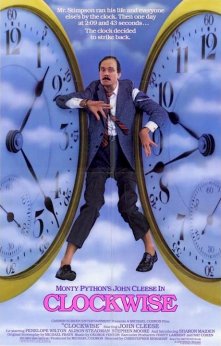
Clockwise (1986)

2008 #76
Christopher Morahan | 92 mins | DVD | PG / PG

ClockwiseClockwise, so I’m told, was written after John Cleese (who, I should point out, isn’t credited as the writer) attended Robert McKee’s famous screenwriting seminar. What this means for your average viewer is that Clockwise is expertly constructed. More importantly, it’s also very funny.

The first 15 minutes are a little dubious, but it soon becomes apparent that some of McKee’s principles are being followed (if you’re aware of them, of course) as this opening serves to establish the everyday life of Cleese’s character, headmaster Brian Stimpson. The point of this soon becomes apparent: when everything goes to hell over the next hour-and-a-quarter, the viewer can fully appreciate the impact on Stimpson’s existence. And all go wrong it does, in a manner that’s rather reminiscent of Fawlty Towers — not in the sense that Cleese is repeating himself, but rather that you could replace Stimpson with Basil Fawlty and merrily carry on along much the same path; though, I hasten to add (to this over-punctuated sentence) that Stimpson is not a clone of Fawlty, but he is prone to ending up in similar accident-and-misunderstanding-based farcical situations.

I imagine that Clockwise is less well known than it deserves because it is so very British. The humour — largely based around issues of punctuality, politeness, and social custom — is particularly British, as are the countryside settings and the finale set at a public school conference. And, in the first instance, everything goes so spectacularly wrong thanks to our wonderful language’s multiple meanings for the word “right”. From this point Cleese & co escalate the hopelessness of the situation beautifully (and very much in keeping with McKee’s ideas of good structure), gradually crafting more absurd events and dragging in more and more characters, most of whom come together in that finale. This final section perhaps goes on too long, with a rather inconclusive ending, and it lays on the anti-public school gags with a trowel — though that suits me just fine.

Some have argued that Clockwise is more like a series of sketches than a cohesive whole, but all the independent scenes are connected by a common goal, meaning very few (if any) feel genuinely out of place or inelegantly shoved in. The calm pauses between the comic scenes also allow it to remain hilariously funny so consistently — an all-out assault of comedy, no matter how good, can become rather wearing. Again, this ebb-and-flow is something the filmmakers may well have picked up from McKee.

While you could probably use Clockwise as a mini masterclass in applying some of Robert McKee’s structural principles, that’s thankfully not the be-all of it. Very funny once it gets going, this is one that fans of Fawlty Towers will likely especially enjoy — and, really, who with a sense of humour isn’t a Fawlty Towers fan?

4 out of 5

Sherlock Holmes and the Secret Weapon (1943)

2008 #75
Roy William Neill | 66 mins | DVD | PG

The name’s Holmes, Sherlock Holmes, as Universal’s loose adaptations of Britain’s Greatest Detective deliver a low-key proto-Bond, 22 years before Goldfinger applied the same tricks to Britain’s Greatest Spy.

“How so?”, you might ask. Well, Holmes has been employed as a spy for His Majesty’s Government; it begins with an ‘end of the previous adventure’ almost-action sequence that would undoubtedly take place before the opening credits now; there’s a war-winning weapon at stake; a bit of globetrotting (albeit just from Switzerland to London); some double-crossing and side-switching; even a surprisingly nasty torture sequence; a nice race-against-time final act; and an equally-matched villain, with a secret lair, who has devised a clever death for our hero. So the lair is just a house with soundproofing and unbreakable glass, but that’s not a bad effort — I don’t think there are many volcanoes to hollow out in the London area. It may be Bond on a World War Two London scale, but the feeling is there.

I discussed the controversy (for a modern audience, at least) of this updated setting in my last Holmes review, and it’s even more abundant here — seeing Baker Street as a victim of the Blitz, and 221B surrounded by sandbags, is very odd indeed — but at least it employs several elements from a variety of Conan Doyle’s plots, and it’s not unreasonable to assume that, given his skills of deduction and disguise, Holmes would’ve been employed as a spy had he been ‘alive’ during the war. In fact, Holmes actually does some detecting this time, whereas in Voice of Terror he seemed to meander around a bit, and employs several disguises, even if some of them are about as much cop as one of those glasses-nose-and-moustache masks. Of course, it would help the mystery if its solution wasn’t revealed before Tobel (the inventor of the titular war-winning weapon) was even kidnapped, but you can’t have everything.

What lets the film down more is Lionel Atwill as a weak Moriarty, supposedly the film’s grand villain. It’s not all his fault — for one example of poor writing, Holmes deduces the final code after an accidental clue from Watson, while Moriarty gets it by clumsily spilling water over a copy, hardly displaying great powers of deduction — but he doesn’t compare to the scheming, cunning Moriarty we saw played by George Zucco in The Adventures of Sherlock Holmes. On the plus side, the ease with each Moriarty outwitted Holmes in that earlier outing made our hero look a bit ridiculous, whereas here Holmes gets to outwit his nemesis a couple of times, including a particularly nice denouement.

As with Voice of Terror, I enjoyed a lot of Secret Weapon in spite of its distinct un-Holmes-ness — it’s another pacey, exciting World War Two spy thriller. It’s better than its immediate predecessor on the whole, though a spot of miscasting nearly persuaded me to remove another star.

4 out of 5

Quantum of Solace (2008)

2008 #73
Marc Forster | 106 mins | cinema | 12A / PG-13

This review contains spoilers.
For a spoiler-free view, see my initial thoughts.

Quantum of SolaceQuantum of Solace is to Casino Royale what Tomorrow Never Dies was to GoldenEye: it’s the second film of a new Bond, tasked with revitalising a flagging franchise (this time creatively rather than monetarily); it’s been promoted as shorter (though by 38 minutes, not TND’s mere 11) and more action-packed; and it’s got to follow a huge success, both critically (94% on Rotten Tomatoes) and commercially ($588m worldwide). It’s a tall order — one many believe TND failed to live up to (personally, I’ve always liked it). Does QoS do any better?

Well, it’s certainly action-packed. Bond hurtles from budget-blowing sequence to budget-blowing sequence with alarming fervour, the camera literally struggling to keep up. It’s this zoomed-in, over-cut, handheld style that most grates with me during these sequences. I quite like it in the Bourne films — it’s part of their style; it fits — but I was incredibly glad to not find it in Casino Royale, and therefore disappointed to see it showing up here. Compare Royale’s early free running chase to the early rooftop one in QoS and you’ll quickly see not only which is better staged, but which is better shot. There are some good moments action-wise — for every disappointing boat or plane battle there’s an effective duel (swinging from scaffolding) or a destructive car chase — but I do wish someone would put the camera on a tripod. The frequency of such sequences, plus an abundance of other common action/spy movie tropes (a rogue agent, shadowy organisations, moles — in fact, trust has never been more of an issue), suggest that this is very much the Action Movie on director Marc Forster’s increasingly eclectic CV. His true strengths show up elsewhere however, as the most memorable parts of the film aren’t the headache-inducing punch-ups, but any scene that involved Bond and M or Bond and Mathis.

The acting, you see, is of a high standard, certainly above the requirements of the genre. While Craig may be lumbered with a very focussed, almost one-note Bond, the flashes of drama and dark humour allow him the odd chance to stretch. He may not get the variety that Casino Royale offered in this department, but he does enough with what’s there. Never more so than in the scenes with Giancarlo Giannini’s Mathis — the action pauses for breath when Bond seeks him out, and we’re treated to some of the film’s very best bits. Some fans wondered how the character could be brought back after Casino Royale, and the trick is to transform his role: what was previously a minor part designed to facilitate the plot here becomes one of unique significance, an injection of emotion and humour that makes his unfortunate death the film’s most heartbreaking moment — in fact, I might go so far as to argue it’s the saddest moment in a Bond film since the end of On Her Majesty’s Secret Service. It’s these scenes that allow Forster’s dramatic directorial abilities to come to the fore, confirming that this is where his true talent lies.

Best of all is Dame Judi Dench, unsurprisingly excellent as ever. She’s aided considerably by M having a much bigger part this time out — not in an obvious The World Is Not Enough-style “have her kidnapped” kind of way, but just by giving her a lot more to do as James’ boss. In the old days the boss sending an agent out into the field and not hearing from him again until the mission was over may have made sense, but in our world of easy telecommunication it would be ridiculous if M wasn’t closely monitoring and commanding Bond every step of the way. So she does, and it’s great for the viewer to be treated to so much of Dench and her relationship with Craig. Not only that, but M has a spot of governmental and inter-agency politics to deal with too, increasing her role still further. If they retain any element of QoS for Bond 23, I hope it’s this.

As for the other Bond girls, Olga Kurylenko is fine but unmemorable, perhaps most significant for being the only major Bond girl who doesn’t sleep with our hero. (Incidentally, this is the third action film in two years in which Kurylenko plays a major part and doesn’t sleep with the hero. That’s quite a niche to be carving.) Back-up girl Gemma Arterton is disappointingly underused, existing primarily for the sake of being another girl in an otherwise masculine film. Her Goldfinger-tribute death, a nice nod in a franchise that has almost entirely excised its past, is an effective touch in and of itself (aficionados will surely note that, this time, there’s no conveniently-placed cushion), but considering the substance at stake turns out to be water rather than oil, it’s either Quantum playing some misplaced guessing game or an ill-considered plot hole. More annoying is her name, however. I don’t care that she’s named Strawberry Fields — it’s either an appropriately silly Bond girl name or, in this day and age, depressingly believable — but much is made of her first name going unrevealed, only to be rewarded with no pay-off. It’s not revealed on screen (only in the end credits), and Bond doesn’t even have an (admittedly clichéd) “I never even knew her first name” line on finding her body. Only a minor misstep, to be sure, but a nagging one.

As the scheming villain-by-proxy, Dominic Greene, Mathieu Amalric feels underused. He’s not as non-present as some Bond villains (The Spy Who Loved Me comes to mind, where Bond shares all of three lines with his nemesis before shooting him), but there’s a definite sense that the military coup/water hoarding storyline is a perfunctory element around Bond’s hunt for the men behind Vesper, in the process establishing Quantum so they can be dealt with in a later film. While I like having a Big Bad Organisation to cross over the films, much as SPECTRE did in the early days, the downside to their first real appearance here is that this particular scheme — a coup in a relatively inconsequential country, it must be said — is a bit lightweight for such a powerful, important organisation. This, plus Greene being more of a civil servant-type figure than an evil megalomaniac, leaves the climax feeling rather anticlimactic, lacking both the grandeur of the old Bond and the emotional weight of Casino Royale (as if a sinking building wasn’t quite grand!) It’s been touted in interviews that Greene’s fighting style is that of “a man who can’t fight”, but that’s no reasonable excuse for his final duel with Bond being so brief. Try harder next time.

Which, it seems, has been the closing impression of QoS for many fans. In this vein, placing the famous gunbarrel at the film’s close is surely highly symbolic, in the same way that saving the equally famous theme music for the end of Casino Royale was: Bond has now completed his evolution, excised his Vesper-demons, and is now the character we all know. Where at the start of the film he merrily kills everyone he comes across, at the end, face to face with the man mostly directly responsible for Vesper’s suicide, who he’s spent most of the film tracking down, he questions him before handing him over to MI6. For all those who dislike QoS’s style, this closing gunbarrel is hopefully an indication that, come 2011, the Bond they know will be back.

So does QoS do any better than Tomorrow Never Dies? Critically, yes, actually — although it’s received mixed reviews, they’ve been positive overall. At the box office, very much so, including the franchise’s best-ever US opening weekend (in this case topping the widely-disliked Die Another Day, something Casino Royale didn’t even manage). As for me, the opinion that opened my initial thoughts on the film still stands: it’s not as good as Casino Royale, but that was a far above average piece of entertainment. QoS isn’t a great Bond film, and it certainly doesn’t have the cross-fandom appeal that Brosnan at his best managed — and it certainly does have more than its fair share of detractors — but it’s a solid entry in the series. When the preceding instalment was possibly the best the franchise has produced in its 46-year history, that can make things seem worse than they are.

4 out of 5

My initial thoughts also offer additional comments on the level of humour, the title sequence, and more.

The Diving Bell and the Butterfly (2007)

2008 #69
Julian Schnabel | 112 mins | download | 12A / PG-13

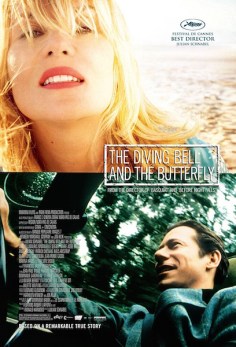
The Diving Bell and the ButterflyLe Scaphandre et le Papillon, as it’s titled in its original French, has until now been on my (unwritten) ‘List of Films to Avoid’, alongside the likes of Ichi the Killer, Hostel, Caligula, and Salo. Strange company for an Oscar-nominated drama I know, but whereas those others have visceral horror that I have no real desire to deal with, the situation of Diving Bell’s central character, Jean-Dominique Bauby, which is exacerbated by it being a true story, seemed too horrendous to bear. In a similar way to how one might struggle to think about death if one doesn’t believe in an afterlife, the idea of being paralysed but for one eye is an almost unimaginably tortuous fate. Nonetheless, in the wake of a huge amount of praise — and in the name of finding a film starring Mathieu Amalric for My Quantum of Solace Film Season — I resolved myself and hoped for the best.

The most striking thing about the film is that, for about the first 40 minutes, it takes place almost entirely within the head of Jean-Do, as Bauby is affectionately known. From the opening shot we literally see through his his eyes, blurry and limited as that is, and hear his thoughts, which brings us a lot closer to him than any character in the film can be as we soon realise he can’t speak. During this first third the film only ventures outside Jean-Do’s immediate vision for memories or imaginings — although the viewer might perceive them as breaks from the prison of his mind due to the change in imagery, we’re actually still stuck inside his head, just as he is. One begins to wonder if the whole film will be told this way, or, if it does break free, how Schnabel and writer Ronald Harwood are going to find a cinematically plausible way to achieve this after so long. (Pleasingly, when do they it doesn’t feel like a contrivance.)

Jean-Do’s situation is obviously far from everyday, so this device makes for a highly effective — and, indeed, affective — form of identification. As we can see all he sees and hear all he hears, and as he can’t feel anything, we’re being given access to his entire sensory experience and, through his voice over, we even have access to his thoughts. (I say “his entire sensory experience” — it’s never mentioned whether he can taste or smell; but as his paralysed mouth means he’s unable to eat I presume the former isn’t much of a consideration at least.) This style also creates some exceptionally uncomfortable moments, such as when Jean-Do’s right eye has to be sewn up so as it doesn’t dry out, even though it still works at the time. As we see from his vision, we see the eyelid being half-closed and the needle pushing through as if it were our own. Again, it brings the viewer a lot closer to his experience than watching the act objectively from a third-person perspective would.

It’s not just the effect on Jean-Do that we’re privy to, however. As the story progresses we encounter his family: an estranged wife, three children, a mistress, and a house-bound father. The pain these relatives feel is both varied and palpable, as is the added pain for Jean-Do. He can’t play with his kids, or even really communicate with them, and his mistress is too afraid to visit — in one scene, his disability means they have to communicate uncomfortably through his wife. Arguably most affecting of all is his father. Played by Max von Sydow, the couple of scenes featuring him are beautifully understated in both direction and performance, but it’s their attempt at a phone conversation, using only the awkward blinking system developed by Jean-Do’s speech therapist, that is absolutely heartbreaking.

Incidentally, the scenes where Jean-Do uses this method — which, put simply, involves him choosing one letter at a time — are quite odd to watch for an English viewer. Obviously the word is being spelt in French, but the subtitles unsurprisingly spell the word in English. It’s the only sensible way to convey the point, but it makes for an especially odd disjunct between original dialogue and the subtitle translation. It’s not so much a flaw as something that distracted me at times, but I can’t come up with a better solution.

As Jean-Do, Amalric is required to give a rather unusual performance — not just because he’s stuck with only the use of one eye, but because for much of the film Jean-Do is omnipresent while Amalric is nowhere to be seen. This in-his-head style means that the direction, cinematography, editing and sound design are as much part of the character as the work Amalric does. He rarely actually narrates anything — it’s sort of a half voiceover, with snippets of thoughts and the like. That said, it’s to the credit of his work with this slight material, and to those on the technical side, that when he does actually appear on screen it doesn’t seem unusual or disconnected.

I’m not sure where I got the notion that The Diving Bell and the Butterfly would be truly excruciating to watch, but, as anyone who has seen the film will surely be aware, it isn’t. Schnabel and Harwood employ a variety of techniques to make you understand the real-life horror of Jean-Do’s situation, but these don’t tip the film into sensationalism or terror. In fact, despite the measures taken to enable the viewer to identify with Jean-Do and make his a very personal drama, I found it was primarily interesting on a documentary level — understanding the hard, slow, awkward processes of recovery (as much as he can) and coping (to a degree); how it might feel to be in that situation, or stuck in similar aspects of human experience, such as in the visit from a former Beirut hostage.

In fact, if the film had a message it would surely be, “live every day as if it’s your last”. That might sound a bit corny — something which I certainly wouldn’t accuse the film of being — but it’s never been presented so starkly. Never mind dying, thereby having no chance to realise what you didn’t do — Jean-Do is a prisoner, tortured with all the things he never did or didn’t do enough, and the knowledge that he will never be able to do them again.

4 out of 5

Inside-Out (1999)

2008 #66a
Tom & Charles Guard | 7 mins | DVD | 12

This charming little short stars Simon McBurney as a hapless market researcher on a busy London street, failing to get a single passerby to complete his survey — perhaps the film’s greatest achievement is making a market researcher sympathetic. Anyway, he’s quietly observed by a woman, played by Lena Headey (yup, Mrs. Leonidas and the new Sarah Connor [and now Cersei Lannister, of course]), who’s dressing the window of a clothing/department store on the street. She notices his failed attempts, which amuse her; he notices her laughing, and begins to muck around to entertain her.

It’s a simple premise, but one that’s executed with comedic flair and a surprising amount of emotion. The music and lack of dialogue evoke an old-ish French mime comedy, making a nice contrast with the modern-day London setting, but it’s the relationship that silently develops between the two characters that provides the heart around the humour. And the ending, as carefully constructed as any moment of humour in the short, is painfully heartbreaking.

However many times you might want to re-watch this — and I think you would want to — you’ll always wish for the same outcome, and always be let down. It’s a sweet kind of pain and longing that, in spite of that French style, is very British.

4 out of 5

This short is available on the Cinema16: British Short Films DVD, and online free at Total Short Films or YouTube.

Shoot ‘Em Up (2007)

2008 #66
Michael Davis | 83 mins | DVD | 18 / R

Shoot Em UpShoot ‘Em Up is the film Wanted wants to be. It’s packed to bursting with utterly ludicrous — but, consequently, ludicrously cool — action sequences. It’s fast-paced, witty, and endlessly inventive. As the action genre goes, this is pure entertainment.

The plot, such as it is, is borderline nonsensical — some craziness to do with a baby factory (which is, believe it or not, the morally acceptable part), political coups, and goodness knows what else. If you want to follow it you might need to engage your brain at times, but so long as you can tell who’s bad and who’s good — and you can, easily — then all is well. This might sound like a criticism, but by pushing the implausibility of an action-thriller plot as far as it can, the story becomes another element in the whole film’s spoof-homage aesthetic. Everyone involved is clearly having fun with this, though none more so than Paul Giamatti. His wonderful villain is cunningly evil but constantly interrupted by domestic phonecalls from his beloved wife. Luckily this enjoyment is conveyed to the viewer, lending the one-liners and sundry other gags more humour than they might otherwise deserve.

Some quarters have criticised Shoot ‘Em Up for being cheesy and clichéd. My favourites are those that label it “so daft at least I enjoyed it on that level”. I’m sure these people feel very clever for spotting all the poor stereotypes of an action flick, from the unbelievable plot to the literally impossible feats of action. Unfortunately for those oh-so-clever people, they’ve entirely missed the point — even those daft-lovers. The clue’s in the title, a simple statement of genre that blatantly acknowledges the film’s aim in a way that genuine crap-because-they’re-crap action flicks don’t. Shoot ‘Em Up is an homage and spoof of its genre, pushing everything to the limit. If it took itself seriously the above might be valid criticisms, but it’s meant to be this way.

And if you know that, it works, navigating a successful path between spoof and homage — it’s not Action Movie, a film which must be inevitable by this point — and packed with inventive stunts and shoot outs. For every impressively-inventive-but-physically-implausible stunt in Wanted, this produces half a dozen. And they weren’t all in the trailer either. Silly, fun, and easily better than that over-promoted comic adaptation, in these respects Shoot ‘Em Up deserves much wider recognition.

4 out of 5

Batman: Gotham Knight (2008)

2008 #65
Shojiro Nishimi, Futoshi Higashide, Hiroshi Morioka, Yasuhiro Aoki, Toshiyuki Kubooka & Jong-Sik Nam | 73 mins | DVD | 15 / PG-13

Batman: Gotham KnightGotham Knight is an American-Japanese produced anime — the animation is Japanese and anime-styled, but the original soundtrack is English — that aims to bridge the gap between Batman Begins and The Dark Knight. In this case that equates to six short films, with some narrative connections, strung together to make a movie.

Overseen by executive produce Bruce Timm (Batman: The Animated Series, and most of the DCAU) and all with story credits to Jordan Goldberg (Nolan’s assistant on Batman Begins and now associate producer on The Dark Knight), the shorts, in order of appearance, are:

  • Have I Got a Story For You, written by Josh Olson (A History of Violence) and directed by first-time director Shojiro Nishimi;
  • Crossfire, written by Greg Rucka (Gotham Central and other comics) and directed by first-time director Futoshi Higashide;
  • Field Test, written by Goldberg and directed by Hiroshi Morioka (Tsubasa Chronicle);
  • In Darkness Dwells, written by David Goyer (Batman Begins, Blade trilogy) and directed by Yasyhiro Aoki (one episode of Tweeny Witches);
  • Working Through Pain, written by Brian Azzarello (100 Bullets and other comics) and directed by first-time director Toshiyuki Kubooka;
  • Deadshot, written by Alan Burnett (Batman: Mask of the Phantasm) and directed by Jong-Sik Nam (He-Man 2002).
  • Compiling that list, one has to wonder about the blurb’s claim that these shorts are directed by “some of the world’s most visionary animators”. I suppose the key word is “animators” (rather than “directors”), as some have worked on things like Neon Genesis Evangelion, various iterations of Gundam, and even Akira. Regardless of their level of experience, they all seem to do a fine job here, even managing a couple of vaguely memorable moments among fairly stock dialogue scenes and effective, if occasionally unoriginal, fights.

    The six-stories/one-film concept works well enough on the whole. While these are clearly standalone pieces in terms of style and each telling a complete story, they still work best when viewed together — most follow on from the preceding entry and some elements skip across films. These links are nicely varied. For example, while the end of Film 1 merely leads directly to Film 2, there’s a relatively minor action at the end of Film 3 that is picked up in Film 5, and a large chunk of Film 3 is spent on something seemingly insignificant that is picked up on in Film 6. There are some missed opportunities in this respect, such as the transition from the fourth to fifth entries. It would be neater if Batman’s injury in Film 5 was the one from Film 4; based on the settings and their consecutive sequence, I presume this is what was intended, so it’s a shame the wound’s in a completely different place.

    Gotham Knight seems to be squarely aimed at fans — who else could work out that the long-haired mustachioed crime lord here is actually Eric Roberts’ character in The Dark Knight! This is just one of several other factors that seem strange considering Gotham Knight is meant to bridge Nolan’s two live-action Bat-epics: Alfred is the traditional posh Englishman; few/no other characters sound like their Nolan-era counterparts; one segment even features the Burton-style Batmobile! It’s also a shame that the Scarecrow short isn’t last as it would lead even more directly into The Dark Knight. On the other hand, it succeeds in crafting a decent-enough ‘real world’ explanation for Killer Croc, which is no small feat, and Kevin Conroy, now in his mid-50s, still makes a good younger Batman. Thankfully he doesn’t attempt Bale’s over-done Bat-voice, though a nod in that direction might’ve been nice.

    I’ve managed to get this far without invoking The Animatrix, unquestionably the forefather of this and other similar projects. Gotham Knight takes the concept a step further by linking its shorts so clearly, and while it’s not wholly satisfying in this respect, it’s a successful enough step in the right direction. If we do get a The Dark Knight 2, I’d be quite happy to see another direct-to-DVD effort in this vein.

    4 out of 5

    The Wizard of Oz (1939)

    2008 #60
    Victor Fleming | 98 mins | DVD | U / G

    The Wizard of OzThe Wizard of Oz is one of those films whose reputation unavoidably precedes it. Considering it’s nearly 70 years old now, that’s a reputation long in the making.
    The biggest problem with this is that, coming to it for the first time as an adult, one knows just about everything that’s going to happen. There are still some gaps to fill for the uninitiated — it takes a surprisingly long time to get to Oz, and a surprisingly quick time from there to the Wizard — but it mostly feels oddly disconcerting: it’s such a well-known tale, even to those of us who hadn’t seen it, that having it played out in full, complete with bits one didn’t know about, is strange. That’s not really anything to do with the film, of course, just my personal impression.

    My other observations amount to little more than “the second half is surprisingly light on musical numbers” and “the transition from sepia to full colour is still highly effective and glorious to watch” — as the (very interesting) restoration featurette on the DVD details, it literally looks better now than it ever has before. Beyond that, I had the sense that the film would exert a greater sense of wonder over the very young. That’s appropriate enough, but it means that, coming to it a tad later in life, it’s not a film I’m ever likely to really love.

    4 out of 5

    Texas Across the River (1966)

    2008 #58
    Michael Gordon | 101 mins | DVD | PG

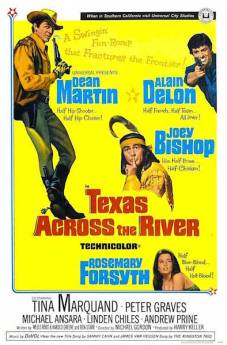
    Texas Across the RiverTexas Across the River hardly seems to be a well-remembered film — the only DVD edition available (as far as I can tell) is a legally-produced DVD-R, clearly in the wrong aspect ratio. I only come to see it because a friend happened to have a VHS as a child, enjoyed it back then, and we managed to track down that DVD. [It was later released on UK DVD in 2012. (Amazon claim 2007, which is clearly BS.)]

    And actually, it’s a fairly entertaining film. Little more than a comedic Western runaround, it sees Alain Delon — as a Spanish nobleman — trying to get to Texas to escape the Cavalry (led by Jim Phelps himself, Peter Graves) and marry his betrothed. On the way he enlists the help of Dean Martin and his Indian sidekick. Hilarity ensues!

    OK, so it’s probably funnier if you watch it before your age hits double figures, but it still has enough entertaining moments and decent gags that its complete expungement from almost anyone’s consciousness seems unwarranted.

    I don’t expect it’ll ever undergo some miraculous revival (it’s not that good), and perhaps is of primary interest as a curio for fans of Dean Martin, Alain Delon or Mission: Impossible, but it made me laugh — and, as I believe I’ve said before, that’s all I really ask of a comedy.

    4 out of 5