Flushed Away (2006)

2008 #57
David Bowers & Sam Fell | 81 mins | DVD | U / PG
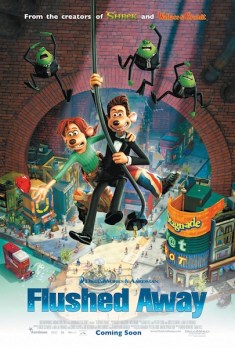
Flushed AwayAardman Animations, the Bristol-based company most famous for Wallace & Gromit and Creature Comforts, branch out into CGI for the first time with this tale of rats trying to save the sewers of London. CGI rats? Yes, thoughts of Ratatouille are inevitable. Can Aardman beat Pixar at their own game? You might be surprised…

The primary reason for comparison here, as mentioned, are the rats. Despite Pixar’s stated intention to redeem rats in the eyes of viewers — to turn them from vermin into loveable little fluffy things, essentially — I felt the same about bloody rodents at the end of Ratatouille as I did at the start. Here, however, they’re Disneyfied (oh the irony) — where Pixar had cartooned versions of the real thing, Aardman have given them a human shape. It’s surely this disjunction from reality that makes them more likeable, but it does mean there’s never that distracting “but they’re vermin” impulse. They’re humanisation is helped by the performances of a star-studded cast, including Hugh Jackman and Kate Winslet amongst the ratty voices. Ian McKellen is a fabulously dastardly villain, ably supported by a pair of comedy henchman… and Jean Reno as a French frog. Yep, the humour is that British.

One thing Pixar unquestionably still excel at is the actual animation, however. Ratatouille is gorgeous to watch and will take some effort to beat; Flushed Away, on the other hand, doesn’t really come close to Pixar’s earlier efforts, never mind Ratatouille’s artistry. It’s mostly passable, especially once the action migrates to the mini-London in the sewers, but at other times it looks little better than a computer game. The second biggest mistake (I’ll get to the worst in a minute) is opening the film in a pristine up-market house — presumably it was an artistic choice to have it so tidy and clean, but this has the unfortunate side effect of highlighting the animation’s plainness right from the start. Once the story moves underground the level of detail improves, but it takes a little while to get there.

A bigger error was made with the lip-synching, however, and obviously this dogs the film throughout. Aardman consciously designed the characters’ mouth movements to imitate the clay animation the company usually employs (Flushed Away is CG because of the volume of water featured, an element too complex to achieve in stop motion). Instead of invoking that stop motion feel it just looks cheap and underdone — such jerkiness is easily ignored as part of the technique when viewing clay animation, but there’s no need or excuse for it in CGI. Ultimately it looks like the animators were lazy or the rendering has skipped frames, and is frequently distracting.

It’s possible to put the disappointing quality of the animation aside though, because the script’s a good’un. Like the animation it doesn’t really get going until we’re flushed into the sewers, but once there it’s pleasantly witty, full of good one-liners and clever visual gags. The latter includes a good line in intertextuality, with entertaining and easily-noticed references to Finding Nemo, X-Men and others, including numerous nods to Wallace & Gromit. They don’t dominate, but their variety makes for a nice bit of I-spy for both kids and adults of varying degrees of film-buffery.

Despite the inevitable comparisons, Flushed Away is really a very different beast to Ratatouille. Pixar’s effort is, for want of a better word, artistic; Flushed Away is simply a family-orientated slice of adventure-comedy… rather of the kind you might expect Pixar to produce. Aardman’s initial CG effort is not better or worse than ‘the other CG rat flick’, but it is perhaps more like what you — or, at least, kids — would expect. With a starry cast, strong script and good sense of visual comedy, Flushed Away manages to overcome its lower production values to create an above-average piece of entertainment. And that’s, as Wallace would say, cracking.

4 out of 5

The Jane Austen Book Club (2007)

2008 #54
Robin Swicord | 101 mins | DVD | 12 / PG-13

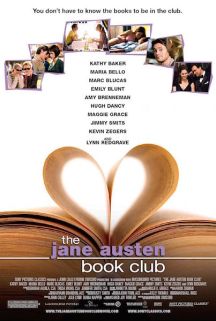
The Jane Austen Book ClubI like to think I have a fairly high tolerance for ‘chick flicks’ — over the years I’ve rather enjoyed films such as Love Actually or Bring It On, and not just because of the male-friendly porn-stand-in scenes or cheerleader costumes — but even I was a bit uncertain about this one at first. However, as it progressed, gradually revealing more about the characters, their lives, and how they cope with what the world throws at them, I found myself increasingly enjoying it. By the time we had to pause it twenty minutes from the end, I found myself itching to continue to find out what would happen.

Inevitably, it’s not flawless. At times it feels like a collection of subplots linked only by the monthly book group meetings, with whichever plot thread is the focus of a scene becoming the de facto main story… until the next scene begins, of course. A working knowledge of Austen’s novels is helpful too. I presumed the film (and book on which it is based) merely invoked Austen’s perennially popular name to boost sales, but there’s actually a fair bit of analysis of the books thrown in, which often reflects what’s happening to the characters. You can get by without an Austen familiarity, but I found the Pride & Prejudice segments made more sense than the others thanks to my (marginally) increased understanding of that particular text.

It would be very easy to pigeonhole The Jane Austen Book Club as a ‘film for women’… and, to be honest, that wouldn’t be at all unfair: it’s as squarely aimed at a female audience as Die Hard is aimed at blokes. It’s also ultimately disposable, apparently with nothing new or revelatory to say about womankind. In spite of all that, I enjoyed it more than I probably had any reason to — and not just because of the male-friendly lesbian character.

4 out of 5

The Golden Compass (2007)

2008 #51
Chris Weitz | 113 mins | Blu-ray | PG / PG-13

The Golden CompassThis adaptation of the first novel in Philip Pullman’s His Dark Materals trilogy (known as Northern Lights in the UK, but adopting the US title for the film — unlike Sorcerer’s Stone, it’s actually more appropriate) received quite the critical drubbing on its cinematic release, and wasn’t a huge success at the US box office either, which has cast doubt on the prospects of the following two instalments ever being produced. Which is a shame, because this is actually a fine family fantasy film.

The requisite elements are present and correct: a well-realised alternate world, engaging heroes, slightly camp villains, mysterious items, mysterious backstories, a globe-trotting quest, talking non-human characters, a couple of action sequences and casual doses of spectacle. The latter was something that worried me going into the film, in fact, as the CGI looked dreadful in the trailer. When it won the Oscar I really couldn’t understand how, but now having seen the film — and in high definition to boot — it was, to my surprise, mostly exemplary. There are weak patches, of course (Mrs Coulter’s monkey being the main one), but the majority is either appropriately realistic or in a suitable style enough that it didn’t matter. “Don’t judge a book by it’s cover,” as they say; or indeed a film by its trailer.

Another key sticking point for me was the discarding of the books’ religious elements, which is far too atheistical for most Americans (not that I’ve actually read the books yet, but I always enjoy a good bit of Christian baiting). The filmmakers have found an appropriate way around this however: there’s a subtext, blatant to the intelligent viewer, which carries such views. It will like whoosh over the heads of those who would’ve been offended by it, which is surely the point. Nonetheless, the lack of commercial success suggests that the stir it had already caused served to cement it as “the anti-Christian film” in too many people’s minds. Or perhaps it was merely that too few had heard of the books? Or there’s always those variable reviews…

Leading the cast as Lyra, Dakota Blue Richard’s accent seems forced and occasionally grates, but really speaking she’s pretty good (pun retrospectively intended). The rest of the cast make a good account of themselves, though the likes of Daniel Craig, Derek Jacobi and Christopher Lee were clearly cast in readiness for the intended sequels. Ian McKellen is as good value as ever and the rest of the voice-only actors offer able support. Nicole Kidman never really gets the chance to unleash her full evil potential however.

In fact, therein lies probably the film’s primary weakness. While Golden Compass does work in its own right, it’s as much Part One of a trilogy as Fellowship of the Ring: at the end you feel curiously fulfilled, even though there’s clearly a lot of tale left to tell. I can only hope that the muted success it achieved is enough to get the continuing and concluding parts made, though that seems increasingly, disappointingly, unlikely.

4 out of 5

Hamlet (1996)

2008 #50
Kenneth Branagh | 232 mins | DVD | PG / PG-13

Hamlet (1996)Following his success with Henry V and Much Ado About Nothing, Kenneth Branagh tackled arguably Shakespeare’s most revered play, Hamlet. And he didn’t do it by half. It’s the first ever full-text screen adaptation, which means it clocks in just shy of four hours; he unusually shot it on 70mm film, which means it looks gorgeous; and, while he grabbed the title role himself, he assembled around him a ludicrously star-packed cast from both sides of the pond — in alphabetical order, there’s Richard Attenborough, Brian Blessed, Richard Briers, Julie Christie, Billy Crystal, Judi Dench, Gerard Depardieu, Nicholas Farrell, John Gielgud, Rosemary Harris, Charlton Heston, Derek Jacobi, Jack Lemmon, John Mills, Jimi Mistry, Rufus Sewell, Timothy Spall, Don Warrington, Robin Williams and Kate Winslet — not to mention several other recognisable faces. Even Ken Dodd’s in there!

But, with impressive statistics and name-dropping put to one side, what of the film itself? Well, it’s a bit of a slog, especially for someone unfamiliar with the text. While there is much to keep the viewer engaged, the high level of attention required can make it a little wearing; certainly, I took the intermission as a chance to split the film over two nights. Amusingly, the second half uses the original text to provide a sort of “Previously on Hamlet“, which was very useful 24 hours later. None of this is the fault of Branagh or his cast, who do their utmost to make the text legible for newbies — for example, there are cutaways to events that are described but not shown by Shakespeare, which, among other things, help establish who Fortinbras is (Rufus Sewell, as it turns out) before he finally turns up later on.

That said, some of the performances are a bit mixed. Branagh is a good director and not a bad actor, but his Shakespearean performances are variations on a theme rather than fully delineated characters. While there a new facets on display here thanks to the complexity of the character, there are also many elements that are eerily reminiscent of his Henry V and Benedick. The Americans among the cast seem to be on best behaviour and generally cope surprisingly well, while Julie Christie achieves an above average amount of fully legible dialogue. Perhaps the biggest casting surprise is Judi Dench, appearing in what is barely a cameo — one wonders if the film-career-boosting effects of a certain spy franchise would have changed that.

The best thing about this version, however, is how it looks. Much credit to cinematographer Alex Thomson for using the larger 70mm format to its full, loading every frame with vibrant colours and packing detail into even the quietest moments. Not every frame is a work of art — there is, after all, a story to be told — but there’s more than enough eye candy to go round. Also, a nod to the editing (the work of Neil Farrell), which makes good use of long takes — many of them full of camera moves — but also sharply edited sequences, such as the all-important play. The fast cuts make for a joyously tense scene in a way only cinema can provide, which I suppose is rather ironic during a ‘play within a play’.

For fans of Shakespeare, I suspect Branagh’s Hamlet is a wonderful experience, finally bringing the complete text to the screen and executing it all so well. For us mere mortals, it’s a beautifully shot and engagingly performed film, that I’m sure would benefit from a greater understanding of the text.

4 out of 5

WALL-E (2008)

2008 #48
Andrew Stanton | 98 mins | cinema | U / G

“Pixar films” seem to have become a bit of a genre unto themselves — yes, they fit into “animation” (always dubious as a genre), “family” (almost as bad), “comedy”, and occasionally a few others, but, much as the Bond films have their own rules and expectations outside the “action” and “spy thriller” conventions, the work of Pixar always achieves special and particular attention. WALL-E subverts some of these expectations (it’s not a buddy comedy, mainly) and has received huge amounts of praise — “consequently”, some might add. It is indeed a very good film, but you’ll surely have heard all that elsewhere; instead, I’m going to draw attention to a couple of things that bothered me.
Most of these issues can be attributed to the fact that WALL-E is a film of two halves. They’re not exactly poorly linked, as elements from each feed into the other, but they are notably different. The first presents a realistically-rendered future Earth, deserted by humans (who are nonetheless represented on hologram screens by live-action actors) and now only inhabited by insects and a trash-collecting robot called WALL-E. Silent but for R2D2-like bleeps, WALL-E quickly endears himself to the audience through his actions. He’s cute, funny and likable, and the early scenes cement him in the audience’s sympathies, which is certainly handy for later. When EVE — a futuristic, iPod-alike ‘female’ robot — turns up, the film becomes a sweet love story, as WALL-E tries to instill the human-like emotions he’s developed into the cold new robot. A very funny and surprisingly touching love story, this is the film’s better half.

The second travels out into space, taking us to meet cartoon humans on a cartoony spaceship. It jars painfully with the realism that pervades the Earth-bound scenes, and the continued use of real actors in holograms highlights the cartoonish style of the future humans. There’s nothing wrong with a cartoon style, I hasten to add — certainly, it works better in films like The Incredibles and Ratatouille than the attempts at realism do in the Toy Story films — but it’s the contrast that’s uncomfortable. The story itself also takes a weak turn here: it becomes a light kiddy-adventure runaround, which is fun and still has flashes of humour and heart, but is nowhere near as daring or as effective as the first half. This is where the sympathies engaged earlier become important, because it’s the audience’s affection for WALL-E that provides most of the genuine quality in this half.

If I were to broadly characterise the two halves, I’d say the first is everything you’d hoped for after the advance hype, while the second is something you could have feared. It’s not bad — it’s still a superior light kiddy-adventure runaround, with exciting-enough sequences and a largely interesting (if unoriginal and preachy) plot — but it’s not as groundbreaking or engaging as the first half. Worst of all is when the cartoon humans land on the realistic Earth, however — it brings to mind films like Who Framed Roger Rabbit, where cartoon characters are placed in the real world. In this instance, that’s not a positive comparison.

WALL-E is a good film. The bits that work do so perfectly, keeping the overall quality high, and the weaker sections are ultimately only poor by comparison. If the whole film were like the second half I’d probably merrily accept it as a cartoon runaround but, coming after that beautiful beginning, it only served to gradually erode the fifth star from my rating. It’s a shame, in that respect. On the other hand, this is still one of Pixar’s very best films — I’d certainly rate it above the even-more-over-praised Ratatouille, and probably slot it close behind The Incredibles or Toy Story 2 at the top of the scale. Being pipped by films of that level — and then only just — is nothing to be ashamed of.

4 out of 5

The Incredible Hulk (2008)

2008 #45
Louis Leterrier | 114 mins | cinema | 12A / PG-13

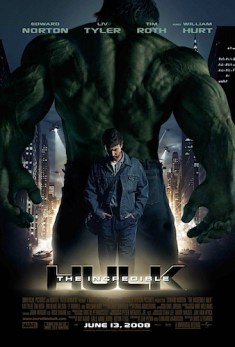
The Incredible HulkNow here’s something I didn’t think we’d see: a sequel to Ang Lee’s disappointing 2003 version of the Hulk, Marvel’s big green superhero-monster-thing. It’s not precisely a sequel though — for those who’ve somehow missed the behind-the-scenes goings on, this one has an all-new cast and crew, led by Hulk-fan Edward Norton on both leading man and (uncredited) writing duties. But does that mean it’s any better?

I think you’d be hard pushed to deny that this version is more entertaining. From the off it strikes a good balance between plot, character development and action. It doesn’t try to dig as far into the hero’s psychology as Lee’s film, but as that crippled the earlier attempt it’s for the best. Norton is a more appropriate Banner than Eric Bana was, achieving drama, humour and action with aplomb. In fact, even though there’s notably less of it, it seems Leterrier and his cast are as adept at crafting dramatic scenes as Lee and his lot were. They’re certainly better at action sequences, of which there are a good number and all well executed. Attempting an athletic chase over rooftops and through small streets so soon after Casino Royale and The Bourne Ultimatum did similar things to such acclaim seems a bold move, and while Hulk‘s version isn’t as memorable it doesn’t suffer unduly from comparison. The final monster-on-monster punch-up is immeasurably better than the first film’s bizarre climax, but the real stand out for me was the battle on the university campus. All of this is helped by vastly improved CGI. No longer is the Hulk an oversized action figure, but instead has weight and grit, and is altogether more believable. You’re never going to be convinced he’s real, obviously, but this time round they’ve made him more than close enough.

In terms of being a sequel, The Incredible Hulk pretty much has its cake and eats it. It makes good use of all the benefits of being Film 2 — it’s not an origin story, it doesn’t waste too much time introducing the characters — but without a dependence on the poor first film — new actors and a modified origin story distance it, so the main plot grows out of the basic ‘facts’ of Hulk’s origin rather than specific incidences from the first film. In fact, those who were lucky enough not to see Lee’s Hulk may well assume the opening credits’ origin story recap is just a retelling of the first film — and there’s no need to inform them otherwise. As well as dispensing with all the first film’s “evil dad” stuff, the version of the origin story here is apparently highly in debt to the ’70s live action Hulk TV series. In fact, there are also numerous nods and cameos to that version throughout (check out the IMDb trivia page for more).

Considering I did as much for Marvel’s other 2008 blockbuster, Iron Man, I feel I should make some comment on the brief franchise-building coda. Unlike Iron Man, however, Hulk doesn’t bury its scene after 10 minutes of credits, much to my joy. For those who don’t know, the brief scene sees Tony Stark — yes, Iron Man himself, naturally played by Robert Downey Jr — have a brief chat with General Ross about the problem of the Hulk. It’s initially immensely fanboy-pleasing, but is allying such a cool, likable hero as Stark with the despicable General Ross such a good idea? Of course, we’ll find out just what the Marvel planning bods have in mind come 2011.

In the end, this sequel is unquestionably superior to Hulk — who’d’ve thought a near-unknown director, whose major previous credit was the fairly risible Transporter 2, could best Ang Lee? The Incredible Hulk is a good blockbuster in its own right, requiring no need to have suffered the previous film, and there’s even room for a sequel. Now there’s something I didn’t think last time.

4 out of 5

Hard Boiled (1992)

aka Lat sau san taam

2008 #43
John Woo | 122 mins | DVD | 18 / R

Hard BoiledThe first John Woo film I saw was Mission: Impossible II. I think. It may’ve been Face/Off, which I love, but this works better with M:I-2 because most people don’t like it. Personally, I like M:I-2. It’s not the greatest action thriller ever, but it has its moments and the plot isn’t half as complex as some like to claim. It’s certainly more fun than Brian de Palma’s Euro-thriller first film, which in retrospect looks a bit like a proto-Bourne. Of course, what M:I-2 really had going for it were its action sequences, which are occasionally a bit out there but always expertly done. Face/Off’s are even better again. Anyone with a basic understanding of structure can’t fail to see what I’m going to say about Hard Boiled.

I don’t think realism is Woo’s strong point — at least, not in his straight-up action movies. That’s not a flaw, though, but a deliberate choice — he dispenses with the realism of what a gunfight would be like (presumably, bloody scary and with fewer shots fired) and pushes the male fantasy of mindless slaughter to the limit. Which means his action sequences are pure adrenaline-pumping fun. Chow Yun-Fat single handedly slaughtering a warehouse full of heavily armed gangsters? Well, of course! Or directly hitting a small object wedged in an electrical pipe with a shaky shooting arm? Naturally! The action may have all the realism of a Dali painting, but it also has all the gleeful fun of repeating everything your sibling said when you were five — except with more choreography. It’s a cliché, but there’s something about Woo’s action that makes you want to use the word “balletic”. Not that I’ve ever really watched ballet. I expect it involves fewer guns.

These sequences seem to have been designed with one thing in mind — cool. And they are. There are a few holes in the plot and characters’ logic, but that doesn’t matter when they can leap around firing two pistols at once and always hit their target, while the bad guys — who could shoot just fine when they slaughtered some innocents a few minutes ago — keep missing them… with machine guns. If you think about it too hard then of course it’s nonsensical, but somehow, in some way, this sort of action seems to appeal to most men (not all, of course, and if you enjoy it then don’t worry, it doesn’t mean you’re a bloodthirsty braindead weirdo). One particularly astounding sequence is achieved in a single long take, as Yun-Fat and Tony Leung make their way down several corridors killing Very Bad Men literally left, right and centre. It’s both exciting and technically impressive, considering how many squibs, blood packs, weapons and extras must have been involved to pull it off in one uncut shot.

If you don’t care for people shooting at each other, especially when it pushes believability beyond the limit, then there’s not really anything for you here. There’s some male bonding stuff, and other bits about duty and honour and sacrifice, and a climactic subplot involving lots of cwute lickle baby-wabies; but Hard Boiled is most at home when the bullets are flying and things are blowing up. And what a lovely home it is.

4 out of 5

Almost Famous (2000)

2008 #41
Cameron Crowe | 118 mins | DVD | 15 / R

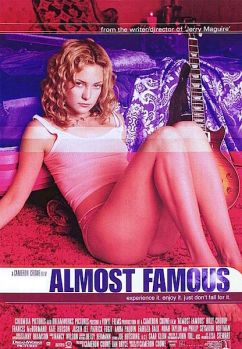
Almost FamousSometimes I find I have quite a lot to say about a film when it comes to writing my review for this blog — recently, witness Cloverfield, Transformers, or Indiana Jones 4 (of course, using Indy 4’s full title more than once guarantees a long review). Other times it’s a struggle to come up with anything at all — try the relatively brief comments on The Fountain, The Adventures of Sherlock Holmes or Field of Dreams. Almost Famous falls into the latter camp. Not because it’s no good, or because it’s middle-of-the-road, but because there’s nothing I’m dying to praise or slate about it.
Everything about it is solidly done. Patrick Fugit is an engaging and relatable lead, ably supported in the acting stakes by a good ensemble, especially Philip Seymour Hoffman (unsurprisingly) and fellow top-billers Billy Crudup, Frances McDormand and Kate Hudson. And there’s Zooey Deschanel, who doesn’t have many scenes, but, y’know, still…

Crowe’s autobiographical screenplay is a good one, with plenty of amusing and dramatic moments to keep it ticking over — the most memorable, on a crashing plane, manages both with aplomb. Likewise, his direction is rarely flashy but always works. The music, costumes, design and cinematography evoke the period well (to me, at least, who didn’t live anywhere near the ’70s). There’s probably some life lessons in here — it’s a coming-of-age film after all (as well as a rock & roll road movie, of course) — but they’re not over-laboured.

In short, I really liked Almost Famous. It’s the sort of film that might creep in at the lower end of a (relatively long) list of favourites, not because there’s anything exemplary about it, but because the cumulative effect makes for an enjoyable experience.

4 out of 5

Almost Famous is on Movie Mix (aka more>movies) tonight, Sunday 31st May 2015, at 1:15am.

Cloverfield (2008)

2008 #40
Matt Reeves | 81 mins | DVD | 15 / PG-13

This review contains major spoilers.

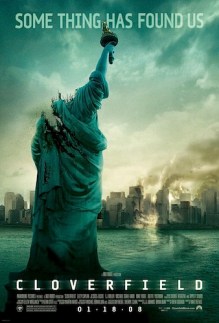
CloverfieldAh, Cloverfield — probably the most hyped “film no one knew was coming” since The Blair Witch Project, if not even longer, and the most widely-discussed marketing campaign since Snakes on a Plane (all of two years earlier). And then, in what can only be described as a surprise, it got good reviews. Less surprisingly, it did pretty well at the box office. Even less surprisingly, they announced a sequel. So far more Blair Witch than Snakes on a Plane, then. Of course, not all reviews were good, and with all this in mind I finally come to see it myself.
Cloverfield works. It has flaws, but overall it works. The opening 20 minutes set up the characters fairly well, though it does take its time. One would hope the idea is to increase the tension by delaying the monster’s appearance, but I can’t help feeling it’s probably just because they think they’re providing a great emotional background. Those who compare these bits to Hollyoaks clearly haven’t seen that risible C4 pile of tosh — Cloverfield’s performances (largely improvised, at least in the early scenes) and direction are much better than that, even if the plot would probably fit snuggly on the teeny soap. I found the opening held my attention well enough, so one has to wonder about the attention span of those who switched off during it. The characters and their relationships may be archetypes, and consequently rather one-dimensional, but at least they show an attempt to make it more than a Big Monster Go Smashy Smashy movie.

That said, it’s when the monster turns up that things kick off. From then the film does a great job of creating an unrelenting chase/escape, drawing the viewer in with its first-person/eyewitness style. You’re never going to be fooled into thinking it’s a real thing that really happened, obviously, but it comes as close as it’s likely to. This is partly thanks to the camerawork, which I’ll get into later. The deliberate drip-feed of information about the monster is well handled also. Those expecting lots of exposition and answers have clearly come to the wrong film, and should perhaps stick to a more straightforward blockbuster. Those who complain that the monster doesn’t make sense, or the bug-parasite-things that drop off it make even less sense, are clearly missing the point — the characters don’t know what this is or what’s going on, so we don’t either; and it’s a sci-fi movie, so any number of explanations you care to put forward could explain things. There are a couple of misfires in this respect — the military’s willingness to explain their plan is unbelievable, and a shot of the monster towering over Hud is a step too far — but mostly it succeeds.

Talking of Hud, he’s come in for criticism, it seems to me for two main reasons: he’s not a great character, and he can’t hold the camera steady. Have the latter viewers ever watched home movie footage? Cloverfield does a spot-on replication of it, which naturally looks odd if you think of it as ‘professional film’ (where even handheld is only slightly wobbly). I challenge anyone to take a normal home video camera and put it through the same things Hud does and come out with any steadier a shot. Sometimes credibility is pushed by having Hud film other characters instead of the more interesting monster (surely where any normal person would point the camera), but it’s only an occasional and minor point. As for his character, he may be dopey, dull, and occasionally even irritating, but his purpose is to be the cameraman — if he were notably likable or, well, notable then you’d want him in front of the camera too. For the sake of the style, someone has to be behind the camera, and Hud’s a perfect fit. You get so used to him as the almost-unobtrusive cameraman that when he’s killed it’s very nearly an audacious shock, though it’s such an obviously audacious move that it’s predictable to most film-literate viewers.

Unsurprisingly, there’s not a huge deal of originality in Cloverfield. The monster itself may look different to the norm, but it stomps through the streets like Godzilla, the attack of its minions/parasites/whatever in a dark tunnel is a sequence we’ve all seen before (nonetheless, it’s effectively done here), and their chestbursting-like birth is obviously straight out of Alien (even if it’s toned down to a PG-13-friendly silhouette). Even the (in)famous handheld style has, of course, been done before. But in marrying all these elements Cloverfield creates something that feels fresh enough (pasting the first-person/handheld/eyewitness style onto almost any genre would give it a new angle, I’d imagine), and, for the most part, it both entertains and intrigues. It may not be quite Empire’s 5-star wunderkind, but it pushes close.

4 out of 5

Cloverfield placed 9th on my list of The Ten Best Films I Saw For the First Time in 2008, which can be read in full here.

The Adventures of Sherlock Holmes (1939)

2008 #39
Alfred Werker | 79 mins | DVD | PG

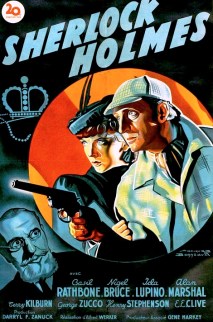
The Adventures of Sherlock HolmesNever mind waiting two or three years for a sequel these days — after the 1939 Hound of the Baskervilles was a box office success, Fox had a sequel out just five months later! I reviewed that first Rathbone/Bruce film back in February, promising an irregular series reviewing the further thirteen pictures the pair starred in. Well, I’ve finally got round to watching the second, and while I was a tad harsh on the first I found myself enjoying this one more.

The Adventures of Sherlock Holmes pits the titular detective against his arch-nemesis, Moriarty, in what’s really speaking a relatively weak plot — most depressing of all is how easily Moriarty’s plan to distract Holmes almost succeeds. But never mind that! There’s rain-lashed, fog-drenched Victorian London streets! Brutal murders by foul foreigners! Dastardly plots against the crown! Galloping carriages! Romantic subplots! A smattering of comedy! A song-and-dance number! (No, really, there is.) And a final shoot out… in the Tower of London! You can’t escape the joyous feeling that this was designed as pure entertainment, literally including something for everyone.

Bruce’s Watson may bumble about too much for the purists (me included, more often than not), the murder plot lacks proper explanation (the production notes on Optimum’s DVD pleasingly expand on this), Rathbone’s characterisation of Holmes may be a touch too friendly… but by then I’m just nitpicking. This sequel is atmospherically, entertainingly and excitingly executed, and that’s plenty good enough for me.

4 out of 5