
Alien³ (1992)

2009 #15
David Fincher | 110 mins | DVD | 18 / R

3 times the stupid taglines.We’re used to seeing big studio’s logos transformed at the start of films — Universal perhaps do it most often, having a handy globe, though others are far from immune — but I think Alien³ is the first instance I’ve seen where the logo is left untouched but the music is altered. Right from the disconcerting modification of the famous Fox fanfare you can tell this is going to be something a bit different and a bit edgy. Unfortunately, it’s also a bit rubbish.

At the very least the Alien franchise has to be applauded for giving each film a very different feel and tone. Even if in some ways 3 combines the first two — single Alien, claustrophobia, unarmed heroes; but there are lots of them, most with experience of killing — it adds enough variety, especially stylistically, to mark it out. This can probably be attributed to first-time feature director David Fincher, who, despite severe studio interference, still manages to quickly make the film his own. Though the story picks up directly from the previous film (as Aliens did from Alien), it soon turns dark, dirty and decrepit, abandoning both the military sheen of Aliens and the old tanker grime of Alien.

The sets and costumes have a Gothic feel, devoid of most of the franchise’s sci-fi trappings, and though the cinematography is glossier than either preceding entry (Aliens looks distinctly ’80s, whilst this has a distinctly ’90s look — I’m not well enough versed in technical details to know why this is) it manages to feel grungier. From style to story, the whole film is bleak and uncompromising, particularly with its brutal plot — from the start, only Ripley survives the crash, and soon after there’s a horrid autopsy performed on Aliens‘ lovable little Newt, who Ripley previously fought so hard to save.

Alien³ is very dark and very nasty — and these are by far the best things about it.

Put simply, the story — or the way the story is handled — lets everything down. It all goes well for the first 40 minutes or so, but then it begins to get scrappy, and gets steadily worse as the running time rolls on. Leaps in story and logic abound, either creating plot holes or doing nothing to hide them. Much of the middle is the worst, where the convicts’ plans are muddled and quickly discarded. That said, this is also true of the climax — something to do with running around corridors and a giant piston and… I have no idea. It’s a shame because someone clearly had plenty of fantastic ideas, plot twists and action sequences, but they’re all squandered either by weak editing or, even worse, simply by being in this film.

As for the Alien, it sadly has no real menace — it just turns up as and when it (or, rather, the plot) fancies, and goes away for the rest of the time. In the first film it could be anywhere, in the second they were constantly advancing, but this time it’s just around, somewhere, sometimes. It’s not helped by poor realisation, spending too much time either in the light or in clear shots, both of which show the shortcomings of the special effects in a way the previous two films fought to hide.

The total lack of weapons or monster-fighting skill on the part of the supporting cast exacerbate these problems, meaning that, even when the Alien does turn up, the result is always a foregone conclusion. Even worse, any characters we really care about — or can even identify, to be honest — are killed early on, leaving a bunch of faceless potential victims who weren’t invested with any character and so who we’re not invested in. This is worsened by using a fantastic, recognisable British cast, none of whom are given anything much to do. For all these reasons, almost the entire film is devoid of any genuine tension.

Alien³ isn’t irredeemable — it’s packed with good ideas and good direction — but that’s also why it hurts. Lumbered with a hatchet job on the plot, characters and editing, it feels like some very talented people made a good film before someone else hacked it up a bit. The result is quite bad but, even worse, it’s disappointing.

3 out of 5

Tomorrow, Alien Resurrection.

My review of the Alien³ Special Edition can now be read here.
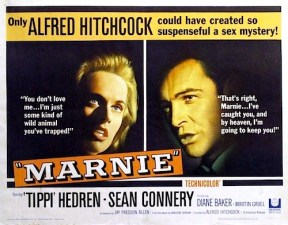
Marnie (1964)

2009 #6
Alfred Hitchcock | 125 mins | DVD | 15 / PG

MarnieMarnie is a film grounded in the field of psychoanalysis, though that word is never used and none of the characters are a therapist. Instead, it just concerns itself with a main character suffering under the strain of repressed childhood memories, though this isn’t revealed until the end. Unfortunately, psychoanalysis was only an emerging area at the time of production, and the price Marnie pays for being ahead of the pack in the mid ’60s is that it looks dated and inaccurate now.
For one thing, it’s slow paced. Not necessarily a bad thing, and here it does serve to gradually build some elements, but at times you wonder where it’s all going. Part of the problem is that much of the story’s first half is just a distraction from the main point, in which case I suppose it’s Hitchcock’s famous MacGuffin; but the changes between elements of crime, romance, family drama and internal struggle come across not as a measured part of a considered whole, but as a mishmash of genres. One might consider this a good thing, adding variety and complexity to the film, but as it merrily switches back and fore it doesn’t seem to fulfill any genre to its full potential.

That isn’t to say Marnie is meritless. Plot-wise, the central mystery does get more intriguing as it goes on and the whole film gets better with it. It’s not just that it becomes a more interesting story, but almost every scene is more engaging, better written, acted and directed. Also, without a single frame of grinding, moaning, kicking or screaming, it contains one of the most sinister (suggested) sex scenes in the movies, thanks to the combined skills of Hitchcock and his two stars.

In the title role, a lot is asked of Tippi Hedren — a lot more than she had to manage in The Birds the year before — but she rises to the occasion, most of the time. It’s through no fault of hers that Marnie’s aversion to red is overplayed, especially as it’s the picture constantly fading through red that almost pushes it to the point of amusement. This is again a problem of being one of the first to try to film an entirely internal struggle. In the other lead role is Sean Connery, just two years after he created James Bond on screen, and here he plays a smooth playboy-esque character with a fondness for women and a tendency to violent outbursts. Not straying too far afield then, but he fits the role like a glove.

In this DVD age, I’d also like to point out that the film’s trailer is truly fantastic. Narrated by Hitchcock, he merrily takes the mick out of his own movie for several minutes. It’s a slice of joyous irreverence that makes you wish he’d brought some of it to the actual film, and wonder what would happen if a film was advertised with such a tonally incongruous trail today.

Trailer aside, Marnie is sub-par Hitchcock, but even then his considerable skill coaxes it to greater heights than many — perhaps any — other director could have achieved with the basic material.

3 out of 5

Angels & Demons (2009)

2009 #25
Ron Howard | 138 mins | cinema | 12A / PG-13

This review contains minor spoilers.

Three years ago, I found myself at a packed midnight first-screening of The Da Vinci Code, the Tom Hanks-starring Ron Howard-directed adaptation of the Dan Brown-written novel that’s probably only second-most-read to The Bible by now. I liked the book — its prose is a long way from great, that’s true, but the storytelling is fantastic, helped in no small part by its undermining of the Christian church so thoroughly and consistently that it can only be described as wish fulfillment (well, it fulfilled my wishes). I liked the film too — again, it’s not great, but it was an entertaining adaptation.
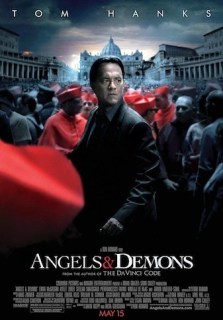
Despite this, I’ve never read another Dan Brown book. Not even Angels & Demons, which also stars Robert Langdon (that’s Hanks’ character, in case you’ve somehow missed this entire phenomenon) but was written first. Rather than being yet another prequel, however, Howard and co. have chosen to make it as a sequel — entirely logical in the past, though these days it almost makes them seem behind trend. In spite of my unfamiliarity with the source, I once again found myself at the film’s first screening here — though it says something about how well The Da Vinci Code was received (i.e. not very) that Angels & Demons made its bow on a damp Thursday afternoon in a barely-attended screening.

It may come as a surprise that Angels & Demons has a subtly different feel to its predecessor. It still concerns itself with Hanks’ Langdon dashing about trying to solve insanely cryptic clues in a limited timeframe, surrounded by irritating policeman, suspicious friendly characters, and a girl who is almost pointless. However, it’s a lot less talky — there are few grand theories to be explained, and while there are still a few exposition-dense monologues they aren’t the focus in the same way. Instead, with just an hour to solve each set of puzzles, our intrepid symbologist hares around Rome, desperately trying to save lives. Unfortunately, the trail he’s following doesn’t seem as well thought out as the previous tale’s mysteries, and the speed at which they must be solved seems designed to gloss over this — there’s no time for the viewer to consider everything Langdon’s telling us, we just have to accept it.

If that wasn’t enough, the film comes with a moderately hefty sci-fi element — yes, really — which makes a huge change tonally. While The Da Vinci Code is patently not based in much truth, both Brown’s novel and the adaptation mixed in enough facts, half-truths and very plausible lies to give it a real-world believability. The abundance of tie-in books and documentaries proving or disproving its theories show that people bought it. There’ll be no such thing here though: from the beginning the use of CERN and the Large Hadron Collider (y’know, the thing that’s going to end the world) and a theoretical bomb adds a science fiction feel, and while it’s really no more than “a very big bomb” for most of the film the damage is already done. To cap it off, the CGI-decked finale — which is further bogged down with feats of logic and physics that require at least a little suspension of disbelief — brings the film more in line with science fiction blockbusters than thriller blockbusters.

All this does nothing for the central villains either. When judged independently, the Illuminati are actually more believable than the Priory of Sion — they’re certainly more based in fact — but they come across as less so because no one’s bothered to construct that web of facts required to sell the half-truths, and in turn to sell the lies. Nonetheless, the film does a good job of hiding the Secret Villain’s identity. Well, sort of. Those not paying any attention may guess it relatively early and turn out to be right; those following it only slightly more closely may be lured astray by a couple of clear red herrings; while those indulging in an intelligent game of guess-the-twist will flip around a bit more as various characters show slight ambitions or potential motivations that suggest they may be the subject of a Shocking Twist. That it eventually comes back round to where you always thought it would is not necessarily a bad thing, but neither is it as surprising as the makers wished we thought.

Howard does his best to ring tension and excitement out of all this, but the problem is fundamentally the screenplay — as with The Da Vinci Code, adapted by an overpaid Akiva Goldsman, this time with David Koepp credited too. Of course, they’re lumbered with Brown’s novel, but that doesn’t excuse some truly clunking dialogue. It’s also their fault that the cast are so underused. Ayelet Zurer has perhaps the most thankless part as Token Female with minimal relation to the plot, though one of the screenplay’s wisest decisions is in modifying her backstory — based on summaries I’ve read, in the novel it’s near identical to that of Sophie’s from Da Vinci Code. (That’s Audrey Tautou’s character. Yes, I’d forgotten her name too.)

Despite being the lead, Tom Hanks has little more to do than look concerned and explain the reasons for all the running around. On the positive side, as silly hairstyles are only allowed if you’re Australian this Summer, at least Langdon’s ludicrous lengthy locks have been lopped off. Few among the rest of the cast fare any better, with Stellan Skarsgard being particularly underused — his primary function seems to be Quite Famous so we’ll consider him a decent contender to be the Secret Villain. The other star name, Ewan McGregor, does the best he can with perhaps the film’s best character — his Irish Camerlengo is more interestingly conflicted than the film deserves or can manage, and as such is underwritten. That said, he’s stuck with an Irish accent that comes and goes and is still lumbered with at least one dire speech. Only Armin Mueller-Stahl emerges with much dignity left, in the medium-sized role of fellow Secret Villain possibility Cardinal Strauss.

In another misstep, Angels & Demons exhibits an overuse of special effects. It may not seem like the sort of film that would need them, but the sci-fi side of things brings plenty of CGI along whenever it rears its head. These include some elements at the climax that may have been literally copy-and-pasted from Watchmen’s graphics department, though to say much more would spoil the sheer lunacy of how the film finishes. Suffice to say, most will absolutely hate it; I almost do, but at the same time almost respect it for being so bonkers. On top of this, that the crew were denied permission to film in many of Rome’s famous locales means there’s an abundance of computer-aided locations. They probably look perfectly real to your average movie goer, but for me they all had that slight indefinable oddness that’s present too often these days — think Quantum of Solace’s Siena chase and bell-tower-to-art-gallery tumble for an example of what I mean.

Angels & Demons makes for an occasionally entertaining run around, though there’s less meat on its bones than The Da Vinci Code, and the comparative lack of believability makes for less fun than its predecessor’s “well, maybe…” plot. Those who disliked the first film may prefer this for being less talky, more pacey, and, perhaps, being aware of its own silliness. Those who actually liked the first film may disagree.

3 out of 5

My review of the extended version of Angels & Demons can now be read here.

Big Nothing (2006)

2009 #12
Jean-Baptiste Andrea | 82 mins | TV | 15 / R

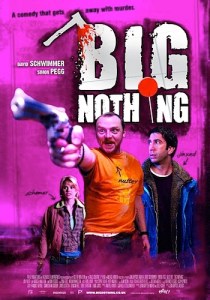
Big NothingBig Nothing was co-funded by the Isle of Man and Welsh film boards; it’s therefore unsurprising that it was filmed in those locations; and there’s a bunch of British actors in it… but they’re all playing Yanks and it’s set in Oregon.

And it’s as schizophrenic as this would suggest. Across its running time — and mostly in the opening half-hour — Big Nothing jumps wildly from mundane comedy to confidence scam thriller to black comedy to geeky spoof. Early on there’s a nice bit referencing The Matrix, for example; a brief moment which feels like it belongs in another film — as do many others. This flitting around makes for a showy opening, Andrea’s direction screaming “look what I can do!” in a way few films have since Guy Ritchie showed off everything he could do in Lock, Stock. It might help Andrea’s showreel, but the downside for viewers is it makes for taxing viewing and a sense that the film lacks its own identity. In short, it’s trying far too hard.

It does settle down however, improving immensely once it gets on with telling its (still loopy) story and stops trying to impress with flashy tricks. It becomes a lot funnier and a lot more enjoyable, slowly fulfilling any hopes the viewer may’ve had.

But it can’t keep it up, despite the brief running time. A long time before the credits roll it degenerates into a grab-bag of random incidents and twists strung together until the made-up-as-it-goes-along script hits something approaching a produceable page count. On the one hand this randomness at least makes it feel different, but on the other it pushes it too far — the array of twists don’t feel like natural occurrences, just plot points that are completely unforeseeable due to being equally nonsensical.

For a good stretch in the middle Big Nothing does more or less what you want it to, leaving the showy opening and desperate series of endings as unfortunate asides to a watchable film struggling to reach feature length.

3 out of 5

The Kite Runner (2007)

2009 #3
Marc Forster | 123 mins | DVD | 12 / PG-13

The Kite RunnerCan no one tell a story from the beginning any more? I blame How To Write books and courses, insisting that films must begin with certain types of incident to hook the audience, even if this isn’t the first event chronologically. Do they think the audience has no patience? Especially in a film, where you’re only committing about two hours of your time (as opposed to however long it takes to read a novel) and even the most lazy viewer is likely to stick it out for at least 15 minutes.
The Kite Runner is just the latest film to do this (and by that I mean “latest I’ve seen”, as I’m sure dozens have done exactly the same thing since), beginning two thirds of the way through with a scene that makes little sense… until, inevitably, the story flashes back to the start and leads us through to that inconspicuous scene, finally giving it some meaning. Really, it’s little more than a cheap tease; a promise to the audience that what follows is actually going somewhere, however pointless it may seem. It’s perhaps the only trick that makes me inclined against a film (or indeed any work of fiction) right from the off.

Perhaps the structure is lifted directly from the source novel. The film certainly has an unusual feel in this sense, like the text has only been half converted for the screen. Not every film should — or does — conform to the structural rules of those How To Write books, but there’s something about the way events progress here that feels more novelistic than filmic. Arguably this is also true of the story itself, which seems to be more about its themes than its characters: bravery, cowardice, and the difference between the two; friendship, and the lengths (or not) it will go to; truth and lies, and what underhand things people — especially children — will do to cover up their own shortcomings and failings.

In this respect it feels like it’s part biography (though it’s fiction) and part moral fable. By the end, we’re presumably meant to leave with the feeling that some justice has been done at last. But while one boy has been saved from the horrors of his captors — and even then, almost too late — there are hundreds left behind with the still-active villain. In this respect it’s undoubtedly true to life, but it belies an attempt at an uplifting and redemptive ending.

In assessing The Kite Runner it feels like I may have missed something and am being unduly harsh, but sadly it failed to engage me. While I long continued to ponder some of the issues it raised for me (always a positive), I’m not certain they were the ones the filmmakers intended.

3 out of 5

This review was written over three months after seeing the film, based entirely on notes made at the time and my rather poor memory. Apologies if it is therefore a bit unfocussed or, God forbid, inaccurate in the odd minor fact.

Sherlock Holmes in Washington (1943)

2009 #1
Roy William Neill | 68 mins | DVD | U

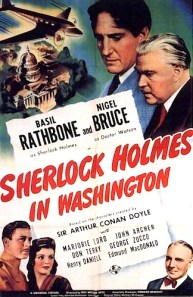
Sherlock Holmes in WashingtonThe last of three World War 2-concerned films in the Rathbone/Bruce series (the previous two being The Voice of Terror and The Secret Weapon), and once again more a spy thriller than a traditional detective tale. That’s not to say Holmes’ abilities as a detective aren’t present — in fact, he does a very reasonable amount — but if you switched him for a generic British Intelligence agent the plot would be unlikely to suffer and the dialogue probably wouldn’t need much work.
Certainly, the quality of Holmes’ detection is a bit of a mixed bag. Some scenes do demonstrate his brilliant reasoning, but others stretch credibility to the limit, for example when he manages to work out what’s been transported in a blanket. Another disappointing moment sees Holmes in awe of and “forget” about modern scientific methods, which seems rather at odds with the highly intelligent detective at the forefront of his field that we see in the original tales. It’s more than a little like the filmmakers have taken the character and methods from his 19th Century setting and dropped (rather than adapted) him into the present day. It’s these little inconsistencies that are arguably most bothersome when such a spy thriller claims to be a Holmes film.

Other deduction scenes do work, however, such as when Holmes enjoyably reasons the hiding place of the matchbook, the film’s MacGuffin. Unfortunately, this sequence suffers from a total lack of tension as we already know where it is. This leaves us watching Holmes play catch-up, and there’s no sense of a race-to-the-prize because we don’t see how the villains’ hunt is progressing. Said matchbook is put to good use in another sequence where it is unwittingly passed around at a party. This is perhaps the most simple and obvious thing to do with such a MacGuffin, but at the same time it’s an always-effective idea. On the other hand, when the matchbook ends up back where it started one has to conclude that this sequence is no more than padding.

One of the more striking elements of the film is it being Holmes’ first trip to the States (on screen in this series, at least). It’s highly praiseful of America, of course, and spends a good bit of time on a travelogue-style showcasing of sights, continuing with Watson remarking on US papers, trying out gum, and more. It makes a change of scene for the series, but also feels a bit self-congratulatory on the part of the American production team, which can be more sickening than the British patriotism of the previous two entries. While that may be national bias on my part, it seems a bit unlike Holmes too. There’s also the prerequisite patriotic closing quote, though at least this time it’s from a British character about US-UK relations. Still, intentional or not, Rathbone delivers it with an almost unwilling flatness.

Elsewhere, Watson’s bumbling comedy is occasionally unobtrusive, occasionally grating, but occasionally raises a smile. Best is the scene where Holmes has him play various characters in a reconstruction, although there’s more mileage in that than the film manages. In complete contrast to this, the film’s villains are a particularly brutal bunch, murdering for no real reason and torturing women.

By the time the film limps to a sudden conclusion at an antiques shop, the quality of the film has become reminiscent of the quality of Holmes’ detection: a mixed bag.

3 out of 5

This review was written over three months after seeing the film, based entirely on notes made at the time and my rather poor memory. Apologies if it is therefore a bit unfocussed or, God forbid, inaccurate in the odd minor fact.

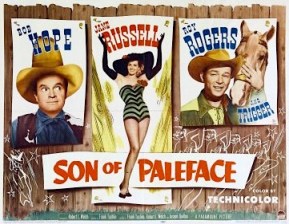
Son of Paleface (1952)

2009 #2
Frank Tashlin | 91 mins | DVD | PG

Son of PalefaceA sequel to 1948’s The Paleface only in the sense that it features Bob Hope in a Western setting, this time playing the son of his character from the first film.

Much of it is only gently funny and likely to try the patience of an unforgiving audience, despite the addition of “King of the Cowboys” Roy Rogers to returning stars Hope and Jane Russell. Between them the three manage to deliver some songs too, but the only memorable one is a reiteration of Buttons and Bows from the first film.

Things improve as the film goes on though. It slowly morphs into a live-action cartoon, in the process becoming a lot funnier and, in recreating the style of cartoons, technically impressive too. That the comedy is genuinely entertaining when Son of Paleface finally reaches these sections makes it a shame it takes so much time — and viewer persistence — to get there.

3 out of 5

Becoming Jane (2007)

2008 #91
Julian Jarrold | 115 mins | DVD | PG / PG

Becoming JaneDirector Julian Jarrold seems to have found his cinematic niche in “coming a bit late”. His Kinky Boots, while entertaining, was reminiscent of films like The Full Monty… except 8 years later; Becoming Jane rides the Pride & Prejudice bandwagon… except 18 months later; and his latest, the new Brideshead Revisited, had something of the Atonements about it… except 6 months later. At least his lead times have got shorter.
Perhaps Jarrold’s other inspiration here was Batman Begins. No, bear with me, for this is Austen Begins: Jane’s literary career has yet to start, but as the film progresses we see something of her personality taking shape — and plenty of the inspiration for her novels. Lord alone knows how factual any of it is, but I’m sure it must be a lot of fun for certain Austenites. On the other hand, purists might be less pleased with their idol being constantly lovelorn and indulging in (whisper it, children) snogging. For those with only the most cursory knowledge of Austen’s work, these might be the only things that stop them believing this is an adaptation of one of her novels; though, in truth, they’re probably not even that intrusive.

The big advantage to this being a somewhat Hollywoodised version of the story is the slew of English acting talent on display. Julie Walters, Maggie Smith and Ian Richardson are all present, in roles of varying sizes, plus the younger Anna Maxwell Martin (Bleak House) and Laurence Fox (son of Edward); not to mention James McAvoy, busy appearing in everything under the sun at the time. In the lead role, Anne Hathaway does a fine job, though there’s the inevitable question of “why not cast a Brit?” (to which one must assume the answer is, “for the sake of the US box office”). At least her accent is good.

Becoming Jane is a Jane Austen biopic treated as if it were a Jane Austen novel. In fact, so much is it embedded in the writing of Pride & Prejudice — and the notion that most of that was inspired by her own life — that it occasionally feels like another adaptation of it. This approach is a little uncomfortable in places, though probably makes sense considering the target market; and, by being so relatively lightweight, the resultant films seems to have faced less criticism from some Austenites than the similarly-timed TV biopic, Miss Austen Regrets. It’s for precisely this reason that the latter was a superior product, however: it may be darker and less uplifting — it ends with Austen’s death, rather than the start of her literary career — but it has a level of reflection that makes it more than Austen-Lite. Unlike this.

3 out of 5

Becoming Jane is on BBC Two today, Wednesday 31st December 2014, at 1:20pm.

(Originally posted on 27th January 2009.)

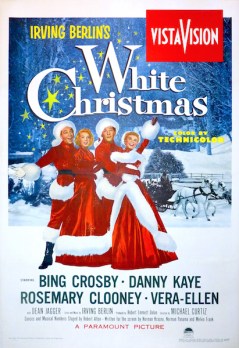
White Christmas (1954)

2008 #97
Michael Curtiz | 115 mins | DVD | U

White ChristmasWhite Christmas is surprisingly un-Christmassy. Yes, it’s set at the right time of year, and the plot concerns itself with do-gooding and charity and other such vaguely seasonal themes; but, crucially, there’s a distinct absence of snow (until the very end) and little else actually inspires much Christmas feeling.

The plot winds its way to a moving finale, but, baring a few memorable numbers — Sisters, for example; and, particularly, a rendition of it by the male leads — most of the path there is quite average. One wonders how much of its renown is actually based on the titular song.

3 out of 5

White Christmas is on Film4 today, Monday 24th November 2014, at 12:50pm.

Snakes on a Plane (2006)

2008 #94
David R. Ellis | 101 mins | DVD | 15 / R

Snakes on a PlaneYou don’t get much more high-concept than “snakes on a plane”, a mission statement of a title if ever there was one. It certainly captured the imagination of online geekdom, who knew everything they wanted just from those four words and famously launched a viral marketing campaign for a film they’d not seen. Ultimately, it’s for that reason it will be remembered, because without the evocative title and the reaction it provoked this would be forgotten quicker than Samuel L. Jackson can utter his Oedipal expletive-laden catchphrase.

The best thing one can say about Snakes… is that it lives up to its B-movie title. Once it gets going it throws lots of gory fun at the audience, like a snake in a microwave, or entirely gratuitous shots of people trampled in panic (which sounds distasteful, but in the context of the film is more amusingly squelchy). It even manages the horror movie’s obligatory gratuitous sex/nudity — courtesy of the Mile High Club, naturally. That’s not to mention the plot, in which a gang release snakes onto a plane (did you guess?) in order to kill an FBI-escorted witness. As assassination plans go, it may just be the barmiest ever, and delightfully so.

However, the plan is flawed — in storytelling terms at least — because snakes don’t actually do much. They drop from ceilings, they slither, they bite… and then you’re pretty much done. When the legless beasties eventually turn up it’s quite good… for a couple of minutes. But a couple of minutes do not a feature film make, so every length-inflating trick is whipped out to boost the running time. The first crime is an irritatingly long opening: a seemingly endless preamble reveals what crime the witness witnessed, why he’s being transported, and how villainous the villain is — but all the average audience member wants is to get on that plane!

But when they finally board there’s a series of establishing scenes to get through. There’s even a full version of the safety demonstration — no one likes the safety demo normally, never mind in a film! This bit at least serves to introduce an array of characters ready to be killed, but as few of their stories go anywhere most should have remained faceless victims. These scenes on the plane feel like the opening, and may have been less interminable if they weren’t preceded by all that needless preamble. It’s especially pointless because, by the time the plane inevitably lands, the makers seem to have forgotten they introduced a villain in the first place.

In between, those snake ideas (drop! slither! bite!) run their course sharpish, so the viewer is treated to an array of stock Plane Disaster Movie scenarios. An investigation on the ground! Something needs fixing in the hold! A non-pilot has to land the plane! Chopping 10 to 20 minutes wouldn’t hurt any — it should be short and efficient — or, instead, putting the same screen time to better use by bringing a resolution to the villain. Normally the plane landing would be a perfect point to end — you want snake-based slaughter, and then you want out — but after the persistence in setting other stories in motion those really ought to be finished.

Snakes on a Plane is as much of a B-movie as the title implies. This seems to be what disappointed some when it was finally released, yet at the same time is clearly the vibe the makers were going for all along. Perhaps a greater problem is that it still sounds like such a good — snakes released on a plane to kill someone? That’s utterly loopy! It should be crazy and great! But it’s treated with too much seriousness, as if the makers are struggling to convince us this is actually a plausible notion in the real world — which it patently isn’t.

Nowhere near bad enough for the infamous “so bad it’s good” classification, nor good enough to rise up on genuine merits, it is instead largely unremarkable though passably entertaining. Perhaps it should’ve been left as just a title.

3 out of 5

Channel 4 are premiering Snakes on a Plane tonight at 10pm (hence why it rises above the eight other still-unreviewed films from 2008 today).

(Originally posted on 17th January 2009.)