Cinderella (1965)

aka Rodgers and Hammerstein’s Cinderella

2009 #91
Charles S. Dubin | 78 mins | TV | G

CinderellaThis clearly made-for-TV adaptation of Rodgers and Hammerstein’s Cinderella (the second of three, to date) is a rather weak affair, easily demonstrating why no one seems to remember it.

The story is almost a scene-for-scene recreation of Disney’s version at times, although considering the limited variation in adapting the story — unless one decides to get quite radical or flesh it out, that is — that’s forgivable. The cast are largely unmemorable, the exceptions (not for good reasons) being Stuart Damon, whose acting is poor but singing is fine, and Ginger Rogers, who is barely noticeable as the Queen, particularly as she doesn’t do what she was most famous for. Fair enough, she was in her 50s, but the only other reason for her presence is to provide a star name at the top of the cast list. And Celeste Holm I recognised from High Society, which is neither here nor there.

Dubin does the best he can with TV studio limitations, using colourful painterly backdrops and trying to find some variation in camera angles, but it’s largely as flat as the sets. The musical numbers are quite entertaining, if mostly insipid, not that any approach R&H’s best anyway. I couldn’t tell you much about any of them within a few hours, never mind longer.

Anyone combating the might of a Disney classic is going to struggle, but that doesn’t prevent a decent effort from being produced. Between a below par set of songs from Rodgers and Hammerstein and weak staging, this Cinderella doesn’t even come close to that.

2 out of 5

Transporter 3 (2008)

2009 #27
Olivier Megaton | 100 mins | DVD | 15 / PG-13

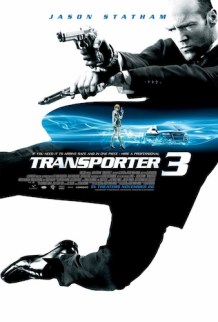
Transporter 3I very much enjoyed the first Transporter film. No, it wasn’t high art, but it did what it did very well — even managing a few outstanding moments — and in a pleasantly efficient running time too. 2005’s sequel kept the latter but sadly lost the former, pushing things too far into the realm of CG-aided silliness. With sequel director Louis Leterrier off bringing some of his much-needed CG silliness to the Hulk franchise, it falls to the amusingly-monikered Olivier Megaton to try to navigate this cars-and-kung-fu series back onto the right road.

Film credits sometimes baffle me. As you may guess, Transporter 3 has a perfect example: “Written by Luc Besson and Robert Mark Kamen. Based on characters created by Luc Besson and Robert Mark Kamen.” I honestly can’t comprehend the need for that second credit. Some may not even comprehend the need for the first one in a film like this, and usually they’d be right. Here, however, Besson and Kamen seem to have decided the presence of writers should be remembered and so stuck in an awful lot of character development. Not only is it not wanted — one of the best things about the first two films was their efficient 80-something minute running times, while this sprawls out to a full hundred — but it’s not very well done either.

Equally, the plot really makes very little sense for much of the film. Worse, when someone eventually explains it, it turns out to be no great shakes, especially as by that point the viewer’s just about pieced it together. I can’t compare it to the first two because, to be honest, I can’t really remember what their plots were, but I don’t remember thinking they were quite so ill conceived. It’s almost a shame, because it isn’t wholly a rehash of the first two — it’s still little more than an excuse to string together some fights and chases, but that doesn’t mean it can’t be different. There’s also a weak villain — never much of a threat, with an attempt at character development that is (of course) misplaced — who’s granted a logic-defying death (albeit with a nice surround sound mix). Overall, the film lacks both the humour and excitement of earlier instalments.

Megaton over-directs and over-edits the action (and a lot else besides) too often — it would be nice to tell what’s going on. Someone also needs to tell him that speeding up footage of two cars racing doesn’t make it more exciting, it just makes it look silly. And he misses apparently-obvious things that would improve sequences. For example, we know Frank’s bracelet flashes between yellow, orange and red as he gets too far away from the car — a conveniently visual warning system — so when someone takes the car and Frank has to run (and cycle) after it to avoid his wrist-bomb going off, we expect a fairly tense chase where the light on Frank’s bracelet-bomb constantly changes colour. But there’s just one half-glimpsed shot of the bracelet in the entire sequence. It’s a glaring omission that robs the setpiece of much of its ingenuity, rendering it a bog-standard chase.

After all the criticism of Transporter 2’s reliance on CGI, most of this sequel features no significant use of it — and that, of course, is a good thing. A car driving at high speed on two wheels between two articulated lorries is just silly if it’s all done with computers; done for real, as it is here, it’s somewhat impressive — exactly as it should be. (By ‘for real’ I mean a real car, real lorries, etc. I’m sure rigs of some kind must’ve been used to actually pull it off.) Unfortunately, after almost an hour and a half of keeping it real, Megaton mucks it all up again by resorting to CGI to pull off the ludicrous climax. Personally, I’d find it pleasantly ludicrous if they’d managed to film a real car doing that stuff on a real train, but the CGI just compounds the silliness.

When a film that exists solely to provide some nice action sequences can’t even do those well, you know you’re in trouble. Transporter 3 should be a mildly diverting piece of action fluff; just a bit of violent fun. I’m not sure if it’s trying to be something more with its added character development, or just generally failing in its primary aims. Either way, it’s still fluffy, but not actually much fun.

2 out of 5

Three in 3D

As you may have noticed, Channel 4 have just had a 3D week. Arguably lacking in content, it included three films. I subjected myself to all of them to provide you with the following…

#75
Flesh for Frankenstein
1973 | Paul Morrissey | 95 mins | TV | 18 / R

“The best thing about the extra dimension is that it provides some genuinely impressive visuals throughout, and not in the gimmicky, thrust-stuff-into-the-audience way — naturally there are some of those shots, but… there are also shots that demonstrate why 3D could be genuinely valuable, to visuals if not necessarily to storytelling.”

2 out of 5


#77
Friday the 13th Part III
1982 | Steve Miner | 91 mins | TV | 15 / R

“They have a whale of a time shoving stuff out into the audience for almost no reason — just like the stereotype of 3D films, of course. That’s part of the fun of trashy 3D movies so I’m not criticising it, but what sadly doesn’t work is the ColorCode 3D system chosen by C4.”

2 out of 5


#78
Hannah Montana/Miley Cyrus: Best of Both Worlds Concert
2008 | Bruce Hendricks | 72 mins | TV | U / G

“The only real exception is the 3D — being a very recent production, that was flawless.”

1 out of 5


It’s quite easy to see why 3D’s never taken off before. Even here, there are some good and/or notorious 3D films they haven’t bothered to show, which is a shame. Now they’ve distributed all those glasses, maybe they’ll consider just slipping some 3D films into the schedule now and again in the future. Doubt it, but it could be fun.

Friday the 13th Part III [3D] (1982)

2009 #77
Steve Miner | 91 mins | TV | 15 / R

Friday the 13th Part IIIJason’s back!

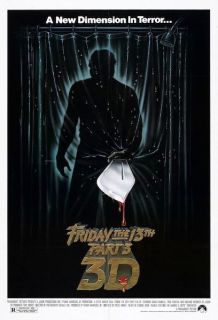
Oh, forget it — I can’t get excited about that. I’ve never even seen a Friday the 13th film, and had no intention to ’til Channel 4 showed this in 3D. Fortunately, general cultural awareness of who Jason is and what he does is all that’s required to understand this third entry in the never-ending franchise.

It’s pretty much your stereotypical horror movie: a group of teenagers just waiting to be slaughtered, a remote cabin-like location, lots of jump scares over nothing, a supernaturally-powered killer stalking them for no apparent reason, lots of gory deaths which have more thought put into them than the plot, characters and dialogue put together… The acting’s all at the level of a high school play, which probably does a disservice to most high school plays. There’s no point wondering who’ll die, because inevitably they almost all will. All this considered, it’s a passably entertaining genre entry.

The good bit here, however, is the 3D. They have a whale of a time shoving stuff out into the audience for almost no reason — just like the stereotype of 3D films, of course. That’s part of the fun of trashy 3D movies so I’m not criticising it, but what sadly doesn’t work is the ColorCode 3D system chosen by C4. It provides lovely depth to normal scenes, but as soon as something’s attempting to come out at you it fails. It could be the age of the film producing flaws in the process as newer things shown during 3D Week have been better, but most do come a cropper as soon as something attempts to come out of the TV as opposed to go deeper into it. Oh well.

Friday the 13th Part III is what it is, and if that’s what you’re after that’s fine. At least the 3D silliness adds an extra dimension of enjoyment. Pun very much intended.

2 out of 5

Flesh for Frankenstein [3D] (1973)

aka Andy Warhol’s Frankenstein

2009 #75
Paul Morrissey | 95 mins | TV | 18 / R

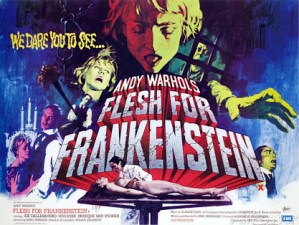
Flesh for FrankensteinFlesh for Frankenstein is thoroughly daft. But it’s also in 3D, so let’s start there.

The best thing about the extra dimension is that it provides some genuinely impressive visuals throughout, and not in the gimmicky, thrust-stuff-into-the-audience way — naturally there are some of those shots, but they seem to work quite poorly here. That could be the fault of Channel 4’s chosen 3D system, or perhaps of watching on a TV rather than a huge screen. Either way, there are also shots that demonstrate why 3D could be genuinely valuable, to visuals if not necessarily to storytelling. For example, early on the wife/sister (a discussion for another time) and her kids go for a picnic. It’s shot from a distance through branches in the foreground, which highlights that there’s a realistic sense of depth to every element of the frame that just isn’t present if you see the same shot in 2D — I know, I checked. For perhaps the first time, I got a sense of why some people harp on about 2D flattening composition.

Unfortunately, while the 3D system used is sometimes flawlessly brilliant, at others it seems to have gone wrong. There’s an odd green ringing in some shots, while at others it appears they’ve used the wrong shade of blue for monochrome-depth because it shows up (in scenes that work, the blue is clearly visible if you take the glasses off, but invisible with them on). Such problems are intermittent in the stuff shown during 3D Week, leading one to suspect it’s as much a fault of the age of the film elements.

I can also now see why people have been complaining so much about 3D — it feels like a constant struggle and strain to watch, like you’re always having to make it work. Perhaps that’s partly down to the technical flaws described above though, because I didn’t suffer as much during an hour of Derren Brown’s Magic Spectacular, whereas here I could feel the strain after just 15 minutes.

As for the film itself… The plot doesn’t make any sense for about 20 minutes, then Udo Kier’s Frankenstein (I presume he’s Frankenstein, I don’t think he’s ever addressed as more than Baron) has a bit of a monologue to explain his Hitler-ish Cunning Plan — to someone who already knows it, naturally — and suddenly most of what’ll happen for the rest of the film is abundantly clear.

The acting is uniformly atrocious. Despite that, it also provides the film’s best moments: the European cast are unable to pronounce “laboratory” — every time it’s uttered it comes out as “lavatory”. Childish I know, but it’s one of the film’s few enjoyable moments. “I had to work for two years before I could even stick my nose in the lavatory” is an instantly classic line. (As is “To know death, you have to fuck life in the gall bladder” — literally, apparently.) Continuing the accented madness, the good-guy serf sounds to be from Brooklyn. At least he can say “laboratory”.

Gratuitous nudity and gore belie some critics’ apparent view that it’s only with the emergence of torture porn that operation-level gore has become a selling point of horror movies — it’s only become more realistic. Just as the gore’s silly, so the sex seems misguided — whoever cast the whores seems to have found believable rather than attractive ones. Oops. That said, whoever in the sound department thought the most realistic sound effects for various sex acts could be found by having someone suck on a balloon, loudly, was even more misguided.

Apparently it’s all meant to be satirical or Pythonesquely humourous. Well, maybe, but it sails too close to the winds of genuine crapness to let such a defence fly — though, as noted, that certainly makes it laughable. Weak in just about every way imaginable, if you’re after a horror, gore, porn or 3D fix, look elsewhere. For “so bad it’s good” value, however, I’ve kindly given it an extra star.

2 out of 5

High Anxiety (1977)

2009 #65
Mel Brooks | 94 mins | TV | 15 / PG

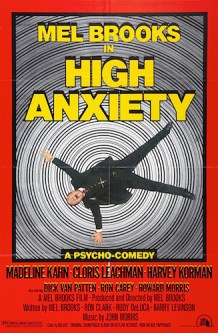
High AnxietyMel Brooks pays comedic tribute to Alfred Hitchcock — in case you can’t tell, the second credit is a prominent dedication — but those unfamiliar with the Master of Suspense’s output need not apply.

Brooks presents a largely Hitchcockian plot, though the clearest references come in a couple of sketches and one-liners. To be fair, there are several significant Hitchcock films I’ve still not seen, leaving the nagging sensation that some allusions and gags simply passed me by. On the other hand, maybe they just weren’t funny — I can’t remember many laughs that didn’t spring from a Hitchcock reference of some kind.

Indeed, whole chunks pass by without a laugh. At other times, bits that are clearly meant to be funny just don’t hit home (though I’m aware that, inevitably, they will for some people), while some gags are almost reassuringly familiar: a dramatic piece of music kicks in, causing characters to look around until they see a band in full swing has appeared nearby, for just one example.

Things pick up considerably in the second half, which is also more obviously Hitchcockian to my mind. Some scenes offer very good, though specific, riffs on famous Hitchcock moments — a version of Psycho’s shower scene is particularly memorable, though a scatological take on The Birds will please some — but these are almost exclusively asides to the story, little sketches inserted wherever Brooks can find space to squeeze them in. They provide welcome amusement, but are far from integrated into the plot.

At this point I’m beginning to suspect Brooks’ humour just doesn’t gel with me. I enjoyed Spaceballs when I was younger, but watching it a couple of years ago I found it more embarrassing than entertaining. Even the widely praised Blazing Saddles raised little more than the occasional smile. High Anxiety, unfortunately, now joins this line-up.

2 out of 5

Saw IV (2007)

2009 #62
Darren Lynn Bousman | 92 mins | DVD | 18 / R

This review contains minor spoilers.

Saw IVSaw IV is the final film in the series directed by Bousman, and will also be my jumping off point (for the time being). According to IMDb (which I presume is sourced from a commentary or something), Bousman had been intending to depart after Saw III, but was persuaded to stay when a twist in the fourth film’s script managed to surprise him, something he thought the franchise was by then incapable of. But do not let this get your hopes up, dear reader, because Saw IV lacks any twists that even come close to those in the preceding films. What caused Bousman to continue is a mystery, and some viewers will inevitably feel the same way about continuing with the series themselves.

After the overly gory third film, Saw IV returns to the franchise’s roots by playing more like a thriller than a horror film — even more so than the previous instalments, one might argue, as aside from a couple of jumps and a few instances of gore, the story and its key sequences move forward via police investigation, endless flashbacks and copious twists. The Saw franchise should be applauded for trying to be more than just another slasher series, but needs to learn the value of restraint in other areas.

The plot, for example, is incredibly complicated. This could be a good thing — it’s rare for the fourth film in a franchise, especially a horror one, to demand so much from its audience — and the viewer not only has to pay attention to the events on screen, but have a pretty good awareness of those from the last two films as well. Despite its complications, such connectedness is actually a reason to retain hope for the franchise, because it really tries to be about more than just how graphically it can slaughter people.

Unfortunately, any effort on the part of the viewer isn’t rewarded. Saw IV is too complex, ultimately descending into the realms of incomprehensibility. There are around four different plot threads, at least two of them jumping around in time like a TARDIS with ADD. Goodness knows how many different time zones are included, how many of them progress in a linear fashion, and whether or not they actually have any bearing on each other. Even references to previous films are confused: while this clearly begins some time after the end of Saw III, it then jumps back before Saw III, and then during Saw III, and then with Saw III, and then after Saw III again… but not as far after it as that opening scene. And that’s just the main plot.

A lot of the complexity is in aid of answering hanging questions from Saw II and, especially, III, but the mass of backstory leaves you wishing for a standalone ‘Test of the Film’ plot, which the first three essentially are. As already expressed, such an intricate array of stories is not necessarily a problem, but neither new writers Patrick Melton and Marcus Dunstan nor director Bousman have the required skill to guide the audience through such dense material. Nor the experience to know when less can be more, clearly.

Fortunately, Bousman seems to have learnt that “less is more” with the deaths. After the excess of Saw III, the gore feels pared back here. The one notable exception is an entirely extraneous autopsy that opens the film, which goes beyond the last entry’s brain surgery in the gruesome stakes. Apparently it’s to prove Jigsaw is unquestionably dead, but it does it with more glee and explicit medical detail than necessary.

Elsewhere, however, the savagery shortage is welcome — except that, in the process, Bousman seems to have misplaced the tension present in the first two films. The only real suspense is an opening trap that is, again, almost entirely extraneous to the rest of the plot, although one trap later on — featuring an abusive husband pinned to his wife — is moderately ingenious, achieving Jigsaw’s proclaimed ideas of apt justice in ways many previous traps failed to.

And what of Jigsaw this time? He may be dead, but instead we’re treated to flashbacks of John Kramer’s pre-Jigsaw life. As you may remember from my complaints in Saw III, revealing more about our villain is, in this case, not a good idea. Seeing Kramer before he was an Evil Bad Guy is clearly an attempt to make him a real person, one inspired to engage in a killing spree by every-day, real-life events. As with the other thriller elements, grounding the villain in the real world — and trying to give him plausible, relatable motivation — sets the Saw series apart from the vast majority of other horror franchises. But there’s no need to understand Jigsaw, and the more we learn about him the less impact he has. His soul is laid bare here, but by trying to make his actions plausible it continues to strip away the mystery and highlights how ludicrous his traps are in reality — they work fine in the conceit of a horror movie, but trying to imply it’s a real person doing these in the real world is one suspension of disbelief too far.

Which kind of sums up the film, really. Saw III went too far with its gore, and now Saw IV goes too far with its plot. As the series rattles on to its fifth instalment (and this year’s sixth, and next year’s seventh, and at least an eighth beyond that), its only hope for regaining a decent level of quality — in my opinion, of course — is to keep the gore at a manageable level, and keep the storytelling at one too.

2 out of 5

Technically I watched the Unrated/Extreme extended cut of Saw IV. The differences are numerous but ultimately minimal. Those desiring a full list of alterations can find one here.

Saw III (2006)

2009 #61
Darren Lynn Bousman | 109 mins | TV | 18 / R

This review could be seen to contain some spoilers.
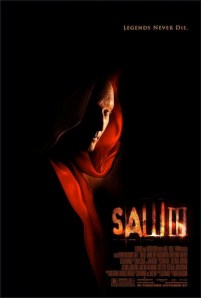
Saw IIII’m reliably informed that, in the UK, we do our best not to allow people with psychopathic tendencies into the armed forces. In the US, on the other hand, they let them all in. And they also let them make movies like this.

Saw III is the point at which the franchise finally tips over into the justly reviled “torture porn” category. That’s not to say it’s solely focused on its gruesome deaths — as with the previous two films, there’s a thriller-ish plot to work through as well — but Jigsaw’s traps this time round are shown in excruciating detail. Perhaps the filmmakers are deliberately trying to shock their audience, increasingly desensitised by Saw wannabes, or perhaps they’ve just let their increased budget run rampant. Whatever the reason, it’s not welcome.

Along with it, the gore feels less justified. The traps have an element of invention about them, but the punishment doesn’t fit the crime in the same way it did in the first two films. There is arguably an explanation for this (to share it would be to spoil some of the plot), but that seems a thin excuse for a lack of intelligence on the part of the writers. In fact, one of the most gratuitously gory scenes is a brain surgery sequence that’s almost entirely unrelated to anyone’s test. It’s shown in unrelenting, unnecessary detail, coming across as the makers using some kind of “but it’s a medical procedure” excuse for showing more grisly detail than they might otherwise be allowed.

The story that links the monstrous set pieces together is a bit of a mixed bag, continuing dangling threads from the previous films while producing a few of its own that seem unconnected. It lacks the focus and straightforward drive of the first two instalments, but leaves the viewer longing for such a thing. The main test, once it gets underway, is quite a good idea, and different again to its predecessors. Here we have one man facing those he holds responsible for the death of his son, and it’s up to him whether they survive their traps. The traps may not be as clever as before, but the storyline is different enough to engage the audience’s interest.

But before the worthwhile bit can begin, we have a section that just feels like housekeeping — where Detective Matthews has got to, what happened next to Detective Kerry, what Amanda is up to now. Worse, woven around the main test is another story thread — one that finds Jigsaw on his deathbed (perhaps) and deems it necessary to fill us in on Amanda’s backstory. Unfortunately, this latter part is incredibly dull. That the film’s final moments reveal it was more relevant than previously expected does invite a re-watch, but the prospect of sitting through the sadistic mutilation — and nonetheless boring expository scenes — for a second time is just as off-putting.

Not only is the Jigsaw subplot dull, it’s also too revealing. One of the many things that marks Saw out from its horror stablemates is that Jigsaw is a real man, not a supernaturally-powered being, but he still works best as an enigmatic figure, menacing characters in occasional scenes that offer no more than a handful of tidbits about his past. Here, he’s both over-central and over-revealed. The more we learn the more his mystery is removed, he becomes less interesting and, worse, less threatening. Tobin Bell’s performance is as good as ever, but the character works better in fewer, more condensed doses.

As well as endless backstory, the screenplay also offers another final array of twists. The closing revelations were some of the best bits of the last two films, so are naturally loaded with expectation here. Personally, I didn’t find them to be much of a surprise, most of it guessable from too far in advance. Rather, the final round of frame-long flashbacks are desperate to make the viewer think it’s more of a twist than it is, kind of like the filmmakers explaining why something’s so clever in spite of it being a bit obvious. To be fair, these ‘twists’ aren’t stupid — in fact, they’re quite good — but I wasn’t surprised by them. As if Bousman and co were trying to redeem themselves, the scene that follows is quite tense, and one very final twist — just when you thought they were all twisted out — does manage to surprise. And it’s a cliffhanger to boot.

Indeed, despite a certain finality at the end, Saw III is ready-made for at least one further sequel (of course, as we now know, it’s got four and counting). There are all kinds of little bits that go unexplained here, from characters to blink-and-you’ll-miss-them plot-points-in-waiting, not to mention that it ends on that fairly substantial cliffhanger-twist. That it’s so brazen in its lack of comprehensive answers will irritate some, while others will delight in the knowledge there are still more mysteries to ponder.

Visually, Saw III is overcooked. The cinematography is too stylised, heavily filtered to offer a single-colour-saturated look for each location. Such a technique can be beneficial in certain contexts — Traffic, for example, lucratively uses an even more extreme example — but here feels like someone was let loose in the grading toolbox. Equally, the trickery with scene transitions — where different locations have been built on the same set so as to move between them without any editing or digital effects* — may have looked clever in 1940, but now seems needless. Worse, it confuses the storytelling and the audience’s sense of geography. It’s one thing tricking your viewer with plot twists, another entirely to needlessly mislead their understanding of filmic space. These wannabe-flashy transitions are inspired by similar ones in the preceding films, but there they were neatly subtle and surprisingly effective, while here they don’t look as cool as someone clearly thinks, as well as initiating moments of befuddlement.

Despite my ever-growing catalogue of complaints, there is a bright side for Saw III. What could have been just another rehash of the same basic plot conceit ramped up a bit more — from two people trapped in a room, to half a dozen trapped in a house, this could’ve just been a dozen trapped in an office block — instead chooses to come up with a new narrative structure. Yes, it’s still based around defeating a series of traps/tests, but in a genre where some franchise entries are merely distinguished by the different modes of death — if that — it’s tantamount to a revelatory change of style. It also holds the distinction of being the only Saw film so far I want to rewatch to better consider events (and, from a filmmaking standpoint, its narrative structure and balance), even if other elements put me off.

Though it’s Jigsaw’s story that merits this feeling, I’d still rather have less of him and more of the test he’s got on the go. Sadly, I think the franchise is headed in the exact opposite direction.

2 out of 5

* This technique was definitely used in Saw IV (according to IMDb), but I don’t know if it was also applied here or if it just looks like it was.


AVP: Alien vs. Predator – Extended Version (2004)

2009 #18
Paul W.S. Anderson | 98 mins | DVD | 15 / PG-13

This review contains minor spoilers.

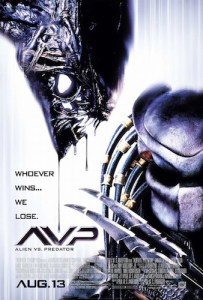
AVPOnce upon a time — around the late ’90s, when he was only known for Event Horizon (and that video game thing no one wanted to mention) — director Paul W.S. Anderson was seriously and vocally attached to a film adaptation of Doctor Who. At the time it was such a good idea, a bright new hope for Who’s revival, with a Hollywood-level — yet, pleasingly, British — director at the helm. When it didn’t come together it was quite disappointing. In retrospect, I think we can breathe a collective sigh of relief.

Anderson’s films always come in for a critical drubbing and AvP was no exception. Sadly, it was well deserved. The main problems are a weak script, including an abundance of prologues in place of genuine character development, and poor performances, not helped by what sounds like a regular use of bad ADR. Characters make leaps of logic that would be reasonable if they’d seen the preceding six films, but make no sense whatsoever given what they know in context. The story begins moderately well, even pushing to the slow build in the franchises’ best entries (though without as much tension), until just 13 minutes in, when there’s a pointless scene on a Predator ship. Of course we know they’re coming — they’re in the title — but it’s a reveal too soon and ruins any mood Anderson’s managed to create. Constant updates on their progress exacerbate the problem.

There are actually some very inventive ideas scattered throughout — like the captured, frozen Alien Queen — but, in storytelling terms, their reveals are poorly handled, occuring too early and too far from the protagonists. However much time Anderson wants to spend getting his humans into position (a lot, just like the other six filmmakers before him), he clearly doesn’t trust the audience to go along with it without some hints of the creatures (unlike the best of the filmmakers before him). It’s not his only directorial misstep. He makes the fatal mistake of letting his monsters out into the light too much, though the choppy editing almost obscures them again. While effects can now withstand this level of scrutiny, the effect of the creatures can’t — they belong half-hidden in shadow, especially the Alien.

Elsewhere, every facehugger is treated to a graphic slow-mo shot. Once might’ve been cool, but it quickly becomes overkill — especially when the first instance features three, immediately rendering every solo example that follows unremarkable. And then there’s the ending nabbed from Predator 2. And the final beat that, though the groundwork is laid earlier in the film, still doesn’t really make sense (considering how fast chestbursters came out of the humans, or how long the Predator had been dead by the time it popped). When the director doesn’t know how to handle the titular monsters correctly, you know you’re in trouble.

That said, Anderson certainly delivers on the title’s Aliens-fighting-Predators promise. Most of the film’s limited imagination is lavished on these battles, but as with most monster-on-monster bouts we have no stake in either side, leaving them mostly heartless and only engaging on the level of “cool!” The human characters are left by the wayside at these moments, disappearing out of the way — and taking what little plot there is with them — for a few minutes. When they do appear there are some attempts at character development (yes, beyond those prologues) which are well-intentioned but painful. All things considered, Anderson has taken two horror franchises with an action-adventure tinge and turned them into an action-adventure film with a horror tinge.

This ‘extended version’ is a whopping 79 seconds longer than the theatrical cut, adding a whaling station prologue. This exacerbates the issue of revealing the monsters too early, but it does go some way to justifying the otherwise random glimpses of the Predator ship. Nonetheless, to be truly effective we shouldn’t know more about what the aliens are up to than the human characters do and it’s all a mistake. (An unrated version of the film is also available in some territories. It runs eight minutes longer, but the additions seem to just be the deleted scenes included on other releases.)

Flash forward however many years since that mooted Who movie, and Anderson’s career has mostly reverted to video game adaptations and trashing as many franchises as he can. AvP is surely the culmination of his efforts: here he manages to amalgamate a popular and acclaimed film franchise, its almost-as-beloved stablemate, and an equally popular and acclaimed comics & video game series, and then decimate all three in one 85-minute (without credits) swoop. Well done Mr Anderson, your efficiency knows no bounds.

2 out of 5

Tomorrow, AVPR – Aliens vs Predator: Requiem.

Sherlock (2002)

aka Case of Evil / Sherlock: Case of Evil

2009 #46
Graham Theakston | 89 mins | TV | R

Case of EvilSherlock Holmes is a character so well known in the international psyche that he is open to seemingly endless reinterpretation — a wartime spy in the Rathbone era, his younger self in a Temple of Doom remake, or cryogenically frozen to reawaken in the 22nd Century (no, really). Indeed, this year alone we can expect to see him re-imagined as both a wisecracking martial artist in a period-set action/adventure film from Guy Ritchie, and as a detective in the present day in a new TV series from Steven Moffat and Mark Gatiss. All of which are considerably more exciting than this lame Young Sherlock effort from 2002.

Here, writer Piers Ashworth — who would go on to pen the new St Trinian’s and Goal! III (for which be sure to read the review at The Big Whatsit) — creates a kind of Holmes Begins, showing a young and unknown Sherlock break his first case against renowned criminal Professor Moriarty, gaining a bit of fame before he joins the investigation of a serial killer. Ashworth makes sure to complete the Begins format with introductions for various iconic elements, like the deerstalker (though only in the final scene), the pipe (though, only in the final scene), and even his drug addiction (though Holmes seems to have already been cured of it).

More fundamentally, however, Holmes is recast as a kind of Victorian James Bond, both in terms of his character and the plot structure. It begins with the end of the previous mission (which, GoldenEye-style, will become relevant later), before progressing through various familiar beats, like the villain helpfully explaining his plan and a climactic big shoot-out a la You Only Live Twice or The Spy Who Loved Me, except on a much, much, much smaller scale. To add to the effect, Dr Watson is revealed to be “a bit of an inventor” — a Q in the making? Even Holmes himself is not immune: young, dashing, and womanising. Yes, womanising. He even has a threesome, shot and scored like soft porn, though with a US TV-friendly complete lack of nudity. Or sex. It does feature an unintentionally hilarious striptease though.

The story itself moves at a decent lick early on, complete with some genuine detective work that even, occasionally, displays Holmes’ genius. Most of this (at least, most of it that’s actually relevant to the plot) occurs during a couple of autopsies, which choose not to stint on the gore. (Incidentally, this makes it even easier to believe it was created with US TV in mind. Nudity? Nooo. Gore and violence? Hurrah!) Unfortunately, the longer the film goes on the more it slows and begins to drag, and the mystery-solving is replaced with running around, backstory exposition, and semi-decent sword fights. The best of these is fortunately at the climax, which takes place (amusingly, like Basil the Great Mouse Detective) atop the Palace of Westminster clock tower — or, at least, a poor computer-generated version of it (also like Basil the Great Mouse Detective). To be fair, the interior is a decent-enough set… though quite how the clock faces function when no workings whatsoever are attached to them is a mystery worthy of Holmes. Sherlock was shot in Romania, so such dodgy effects work rears its head any time they wish to depict a London landmark. Thankfully this isn’t often, because every such shot is appallingly realised.

Much the same could be said of the performances. James D’Arcy initially seems miscast as Holmes, but… well, he is — it’s just that everyone else is even worse. Roger Morlidge’s Dr Watson feels like he’s being portrayed by Ricky Gervais — no, worse, like James Corden’s version of Gervais from Horne & Corden — while Vincent D’Onofrio’s accent wavers all over the place and takes his performance with it. In what amounts to a cameo as Mycroft Holmes, Richard E. Grant is dreadful too. I’ve never been much of a fan of his, but this is weak work even by his standards. About the only passable performance among the major characters comes from Nicholas Gecks as Lestrade. There’s nothing exemplary about his role, but by simply doing nothing wrong he fares better than the rest.

Sherlock probably sounds irredeemably awful, and for some it will be (Sherlock Holmes has a threesome for Chrissake!), but despite the numerous flaws it remains largely watchable and even has its moments, particularly for more forgiving non-Sherlockians.

2 out of 5

Sherlock featured on my list of The Five Worst Films I Saw in 2009, which can be read in full here.