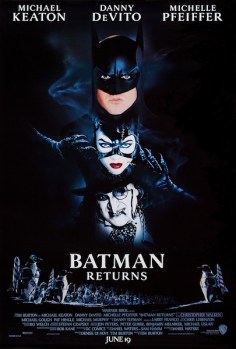
Batman Returns (1992)

100 Films’ 100 Favourites #9

The Bat
The Cat
The Penguin

Country: USA & UK
Language: English
Runtime: 126 minutes
BBFC: 12 (cut, 1992) | 15 (cut, 1992) | 15 (uncut, 2009)
MPAA: PG-13 for “brooding, dark violence”

Original Release: 19th June 1992 (USA)
UK Release: 10th July 1992
First Seen: VHS, c,1993

Stars
Michael Keaton (Beetlejuice, Birdman)
Danny DeVito (Twins, The Rainmaker)
Michelle Pfeiffer (Ladyhawke, Hairspray)
Christopher Walken (The Dead Zone, Seven Psychopaths)

Director
Tim Burton (Edward Scissorhands, Dark Shadows)

Screenwriters
Daniel Waters (Heathers, Demolition Man)

Story by
Daniel Waters (see above)
Sam Hamm (Batman, Monkeybone)

Based on
Batman, a comic book superhero created by Bob Kane and Bill Finger.

The Story
Batman has a lot on his hands when abandoned Oswald Cobblepot, aka the Penguin, emerges from the shadows seeking acceptance by running for mayor, backed by corrupt businessman Max Shreck. Meanwhile, a newly-created Catwoman has an axe to grind with Shreck, and won’t let Batman stand in her way…

Our Hero
Nana-nana-nana-nana nana-nana-nana-nana Batman! But, y’know, with a kind of ’30s Gothic edge.

Our Villains
A triumvirate of terror! Danny DeVito is the Penguin, deformed, abandoned as a child, and out for revenge against the city. Michelle Pfeiffer is Catwoman, PVC-clad, kinky, and also out for revenge. Christopher Walken is Max Shreck, a morally corrupt businessman with political needs, who clashes with Bruce Wayne as much as Batman.

Best Supporting Character
The one significant constant through the four ’80s/’90s Bat-movies, Michael Gough is a near-peerless Alfred.

Memorable Quote
Batman: “Mistletoe can be deadly if you eat it.”
Catwoman: “But a kiss can be even deadlier if you mean it.”

Memorable Scene
Batman and the Penguin are having an argument. Suddenly, a figure comes backflipping towards them — Catwoman. They stare. “Meow.” The building behind her explodes. It’s not actually her first appearance, but it’s quite an introduction.

Technical Wizardry
The whole design of the film, and Gotham City in particular, is fantastic; a kind of ’30s-but-also-modern art deco style. It’s all quite Burtonesque too, though not too much so for my taste.

Truly Special Effect
The Penguin’s army of penguins, an effective mix of real birds, animatronics, and actors in suits.

Making of
The first draft of the screenplay was intended to be more of a direct sequel to Batman: subplots included gift shops selling fragments of the destroyed Bat-Wing, revelations about the past of the Joker, and Bruce Wayne proposing to Vicki Vale by the end of the film. However, Tim Burton was uncomfortable with making a direct sequel, so the script was rewritten. Ah, the days when people wanted sequels to be less connected…

Previously on…
Tim Burton’s first Batman film brought the dark ‘n’ gritty ’70s/’80s evolution of the character from the comic books to the big screen for the first time. It was a huge success, though I think it feels notably more dated today than Returns does.

Next time…
Two semi-direct sequels — though with Burton and Keaton both abandoning the series, they took a distinct downward turn in quality. The 2005 reboot has so far led to three more Bat-movies, and now another new series dawns starring Ben Affleck.

Awards
2 Oscar nominations (Visual Effects, Makeup)
2 BAFTA nominations (Special Effects, Make Up Artist)
1 Saturn Award (Make-Up)
4 Saturn nominations (Fantasy Film, Supporting Actor (Danny DeVito), Director, Costumes)
1 Razzie nomination (Worst Supporting Actor (Danny DeVito))
3 MTV Movie Awards nominations (including Most Desirable Female (Michelle Pfeiffer))
Nominated for the Hugo for Best Dramatic Presentation.

What the Critics Said
“Burton couldn’t play it safe if he wanted to, and he doesn’t want to. Entrusted with one of the most valuable franchises in movie history, he’s made a moody, grotesque, perversely funny $50 million art film. […] Something about the filmmaker’s eccentric, surreal, childlike images seems to strike a deep chord in the mass psyche: he makes nightmares that taste like candy.” — David Ansen, Newsweek

Score: 80%

What the Public Say
“unmissable in Batman Returns, Burton tends to employ the film noir style in his movies. […] a visual sensation from start to finish, nearly all to the credit of Tim Burton, and all of the other elements of the film noir style come together quite brilliantly to reintroduce Batman, as flawed antihero, back into popular culture.” — Kate Bellmore, Reel Club

Elsewhere on 100 Films
Just before the release of The Dark Knight Rises I went back over all the live-action Bat-films of the ‘modern era’. Of Returns, I wrote that “Tim Burton’s first Batman film is great, no doubt, but Returns is a much better film in so many ways. The direction, writing, acting, action and effects are all slicker. They spent over twice as much money on it and it really shows.”

Verdict

Controversial on release — and since — but for me, Batman Returns holds up best out of the four ’80s/’90s Batman movies. Tim Burton brings his own stamp to the Bat-universe, crafting a darkly Gothic fantasy world that’s both striking and effective, populated by grotesques (in different senses) like the Penguin, Catwoman, Shreck, and perhaps even Batman himself. There’s chemistry between the entire cast, memorable scenes and set pieces, and the sense of an entire artistic vision that the Bat-series wouldn’t have again for over a decade.

#10 will be… a tale as old as time.
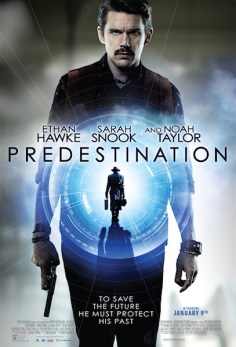
Predestination (2014)

2016 #21
The Spierig Brothers | 98 mins | Blu-ray | 2.40:1 | Australia / English | 15 / R

A man walks into a bar in ’70s New York. The bartender strikes up a conversation, which leads to a wager: if the man’s story is the most incredible the bartender has ever heard, he’ll give him a free bottle of whiskey. It had better be pretty good, because what we know that the man doesn’t is that the bartender, played by Ethan Hawke, is an agent for the Temporal Agency, travelling through time to stop crime before it happens; and he’s just had his face burnt off and completely rebuilt while failing to stop a notorious terrorist known as the Fizzle Bomber. Beat that.

That said, the man’s story is pretty incredible too — but as the telling of it makes up over half the movie, and it’s full of its own twists, I shan’t get into spoiler territory. Predestination is a film that rewards knowing as little as possible, especially as the seasoned sci-fi viewer/reader has a fair chance of guessing a good number of its twists (possibly all of them) long before they’re revealed by the film. Fortunately that doesn’t really matter, because the tale remains an engaging and thought-provoking one, with many thematic points to consider, and not just of a science-fictional nature — there are human and historical issues in play here too, which is undoubtedly a rarity in modern screen SF.

We’re guided through this by a laid-back performance from Hawke, which turns intense when needed, but even more so by an affecting, transformative, award-winning turn from Australian actress Sarah Snook. She really should be much in demand after this. Chunks of the film are just a two-hander between Hawke and Snook, yet it effortlessly captivates throughout these stretches. That’s in part thanks to the fascinating nature of the narrative, adapted faithfully from Robert A. Heinlein’s short story All You Zombies (it has nothing to do with zombies — the story’s from the ’50s, before our modern conception of a zombie was formulated), as well as the direction of the Spierig brothers.

I don’t know how many people will remember, but the pair got a bit of attention back in the early ’00s with their debut feature Undead, because they not only wrote and directed it, but also edited it and created the CG effects at home on their laptops. That’s more commonplace nowadays (well, Gareth Edwards did it for Monsters, anyway), but was A Big Thing in certain circles back then. (I bought Undead on DVD at the time but have never got round to watching it. Plus ça change.) I thought they’d disappeared after that, but they were responsible for vampire thriller (and Channel 5 staple) Daybreakers in 2009. This is their third feature. Working from a low budget once again, they take us to alternate-history versions of the ’40s, ’50s, ’60s, ’70s and ’80s, from bars to orphanages to universities to training for the space programme to the headquarters of a time travelling police organisation and more. To my eyes, it never looked cheap. Sure, it’s not overloaded with CGI, but it doesn’t need to be. I never got the sense anyone was having to hold back because of the low budget. Others may disagree, because I have seen people express the opposite opinion, but I think they’re wrong, so there.

Predestination is the latest reminder that “sci-fi” is not a byword for “action-adventure”. It certainly won’t satisfy the needs of the action-hungry fan (it’s not devoid of the odd punch-up or explosion, but they’re far from the point). For anyone interested in something a bit more intellectual, a bit more thought-provoking, particularly if you like the (potential) complications of time travel, or issues of gender and identity, then Predestination has a lot to offer, even if you guess the twists.

5 out of 5

Predestination placed 5th on my list of The 20 Best Films I Saw For the First Time in 2016, which can be read in full here.

It is available on Sky Movies on demand and Now TV from today. It debuts on Sky Movies Premiere next Friday, February 12th, at 11:30am and 10:20pm.

Purists be aware: existing British releases completely muffed up the aspect ratio (reportedly it’s both open matte and cropped), so there’s every chance Sky’s copy will be similarly afflicted.

Slow West (2015)

2015 #199
John Maclean | 84 mins | streaming (HD) | 1.66:1 | UK & New Zealand / English & French | 15 / R

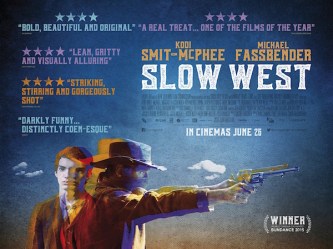
The Coens and Wes Anderson are common reference points in reviews of this slightly quirky Western, which sees Michael Fassbender’s experienced outlaw-type help wet-behind-the-ears Scotsman Kodi Smit-McPhee track the girl he loves, who emigrated for mysterious reasons, also known by the bounty hunters on their trail.


The aforementioned comparisons aren’t wildly inaccurate, but are perhaps reductive. Writer-director Maclean has his own variation on that voice, bringing an occasional comically askew perspective to underscore tense confrontations and well-crafted shootouts. Vibrant photography by DP Robbie Ryan and a pleasantly brisk running time further the enjoyment.

A promising calling card and distinctive treat.

4 out of 5

Batman Begins (2005)

100 Films’ 100 Favourites #8

Evil fears the knight.

Country: USA & UK
Language: English, Urdu & Mandarin
Runtime: 140 minutes
BBFC: 12A
MPAA: PG-13

Original Release: 10th June 2005 (Russia)
US Release: 15th June 2005
UK Release: 16th June 2005
First Seen: cinema, June 2005

Stars
Christian Bale (American Psycho, The Fighter)
Michael Caine (Alfie, Harry Brown)
Liam Neeson (Schindler’s List, Taken)
Katie Holmes (Go, Woman in Gold)
Gary Oldman (Léon, Tinker Tailor Soldier Spy)

Director
Christopher Nolan (Memento, Interstellar)

Screenwriters
David S. Goyer (Blade, Man of Steel)
Christopher Nolan (The Prestige, Inception)

Based on
Batman, a comic book superhero created by Bob Kane and Bill Finger. In part inspired by Batman: Year One by Frank Miller and David Mazzucchelli.

The Story
After Bruce Wayne’s philanthropic millionaire parents are murdered when he’s a kid, he dedicates his life to fighting crime, travelling the world to learn combat skills, then deciding the best way to scare the Mafia-esque scum of his home city is to dress as a bat. As you do.

Our Hero
Nana-nana-nana-nana nana-nana-nana-nana Batman! But, y’know, serious. Important crimefighting jobs include getting hold of cool gadgets your company developed, messing around in restaurant fountains with models, and perfecting a ludicrously gruff voice to use when in costume.

Our Villains
Batman really has his work cut out for him this time: there’s crime boss Carmine Falcone (Tom Wilkinson), mad scientist Dr Jonathan Crane, aka Scarecrow (Cillian Murphy), commander of a league of assassins Ra’s al Ghul (Ken Watanabe), his subordinate — and Bruce’s one-time mentor — Ducard (Liam Neeson). That’s not to mention the bloke doing something dodgy with his family company (Rutger Hauer).

Best Supporting Character
It’s a toss up between two British thesps: there’s Michael Caine as the most involved and caring version of the Waynes’ butler Alfred that we’ve yet seen, and the ever-excellent Gary Oldman as Gotham’s only honourable cop, Jim Gordon. Both are a world away from previous screen incarnations of their characters.

Memorable Quote
“Well, a guy who dresses up like a bat clearly has issues.” — Bruce Wayne

Memorable Scene
Trapped in Arkham Asylum, surrounded by police and with SWAT officers storming the building, Batman activates a device on his boot for “backup”. Moments later, hundreds of bats flood the building, allowing him to make a dramatic escape.

Technical Wizardry
Previously, the Batmobile was a sleek and desirable supercar-type vehicle. Taking inspiration from some of the comics, Begins reinvents the vehicle entirely, rendering it essentially a road-ready tank. A massive change in the very concept, but one that now seems only natural.

Letting the Side Down
Hardly a major point for the viewer, but the design of the Bat-costume meant the actor in it couldn’t turn his neck — a problem also in the previous post-’89 Bat-films. Christian Bale’s frustration with this led to it being redesigned for the sequels (and explicitly referenced on screen, too).

Making of
According to some trivia on IMDb, before shooting began Nolan treated the crew to a private screening of Blade Runner, after which he told them, “this is how we’re going to make Batman.” For more on how exactly Ridley Scott’s seminal sci-fi thriller influenced Begins, check out these interview excerpts.

Previously on…
Batman’s big-screen popularity was kicked off by Tim Burton’s 1989 Batman, but that goodwill was gradually squandered, ending with 1997’s Batman & Robin, which many regard as one of the worst films ever made. It killed a once-profitable franchise, therefore paving the way for an eventual reboot.

Next time…
The Bat-world shaped by Nolan and co reached its apotheosis in the first sequel, The Dark Knight. The trilogy-forming second sequel, The Dark Knight Rises, did that rarest of things: it gave a superhero a definitive, final ending.

Awards
1 Oscar nomination (Cinematography)
3 BAFTA nominations (Production Design, Sound, Visual Effects)
1 Razzie nomination (Worst Supporting Actress (Katie Holmes))
3 Saturn Awards (Fantasy Film, Actor (Christian Bale), Writing)
4 Saturn nominations (Supporting Actor (Liam Neeson), Supporting Actress (Katie Holmes), Director, Music, Costume, Special Effects)
Nominated for the Hugo for Best Dramatic Presentation, Long Form.

What the Critics Said
“If there is one Batman film anyone should see, this is it. It’s a superhero film with a dark tone that’s very well-written with nothing but incredible actors involved. In a world where most movies these days are usually either remakes or films that are made as quickly as possible to cash in on the latest trend in Hollywood, a reboot that is not only worthy of your time but tends to make you forget about every other version that came before it says quite a bit.” — Chris Sawin, examiner.com

Score: 85%

What the Public Say
“One of the best things about Nolan’s Batman is that he grasps the idea of the three personas of Bruce Wayne. There’s Bruce when he’s playing the billionaire playboy, Bruce when he’s alone in the cave or with Alfred, and Bruce when he’s wearing the cowl. This movie truly delved into this in a way that no Batman movie had before it and was performed flawlessly by Christian Bale — whether you like the voice or hate it, Bale did a great job at playing three distinct personas.” — Blue Fish Comics

Elsewhere on 100 Films
Just before the release of The Dark Knight Rises I went back over all the live-action Bat-films of the ‘modern era’, i.e. since Tim Burton’s Batman. Of Begins, I wrote that “Nolan’s first foray into Bat-world really is a stunning piece of work… The monumental achievement of The Dark Knight has come to overshadow Begins, which is now rendered as a functionary prequel to the next film’s majesty. Don’t let that reputation fool you: on its own merits, this is very much a film at the forefront of the action-adventure, blockbuster and superhero genres.”

Verdict

If there was one thing the Burton and Schumacher Batman films were collectively notorious for, it was focusing on their villains more than their hero (not least because they cast bigger name actors in the villain roles). Personally, I don’t think that’s wholly true, but there’s no doubting that Christopher Nolan’s much-needed reboot of the franchise focuses on Bruce Wayne, his reasoning and his psychology, more than ever before. In the process, Nolan and co made us believe a man might reasonably choose to fight crime and corruption by dressing up as a bat. No small feat, that.

For #9 Burton’s Bat’s back.

Happy Feet Two (2011)

2015 #193
George Miller | 99 mins | streaming (HD) | 2.35:1 | Australia / English | U / PG

Mumble and his penguin pals return for another adventure, in a series the Australian film industry are reportedly inordinately proud of.
Not as fun as the first, Happy Feet Two suffers from messy storytelling that can’t seem to settle on a narrative thread. For example: a massive subplot featuring a pair of Pythonesque philosophical krill, voiced by Matt Damon and Brad Pitt, is the film’s most fun element, but never significantly connects to anything else.

At least there are a few good musical sequences, one again re-appropriated from existing pop tunes, not least an Australian-accented elephant seal rendition of Rawhide.

3 out of 5

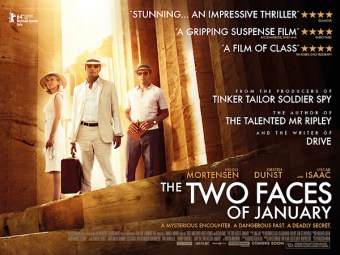
The Two Faces of January (2014)

2016 #15
Hossein Amini | 97 mins | streaming (HD) | 2.35:1 | UK, France & USA / English, Greek & Turkish | 12 / PG-13

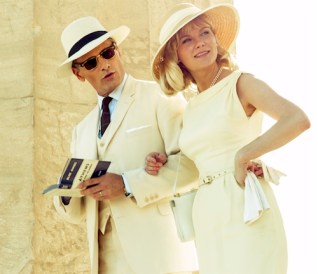
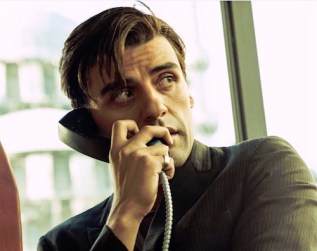
The writer of Drive (and co-writer of Snow White and the Huntsman and 47 Ronin, but maybe he’d prefer we didn’t mention those) moves into the director’s chair with this Patricia Highsmith adaptation. Best know for her Ripley (as in Talented Mr.) tales, this is instead the story of a young American man, Rydal (Oscar Isaac), who, while working as a tour guide in Greece, falls in with middle-aged American couple Chester (Viggo Mortensen) and Colette (Kirsten Dunst). Apparently on holiday, they look like an easy mark for Rydal’s somewhat-con-ish moneymaking practices, but events soon transpire to reveal the pair’s secrets, and Rydal’s greed draws him deeper into their affairs.

Amini has picked some quality material for his directorial debut. The storyline is pretty straightforward, but it’s driven by some interesting characters with complex motivations. You’re never entirely sure what’s driving Rydal and Chester, even if it may appear obvious; and sometimes it can be as much of a twist that a character didn’t have a better plan as it is when their implausibly-intricate machinations are unveiled. It helps that the film has a pair of quality actors in these roles, who effortlessly bring believability to even the slightly-far-fetched elements of the narrative. This is only the second thing I’ve seen where Isaac has made an impression (the other being The Force Awakens; I’d forgotten he was in Robin Hood and Sucker Punch), but I can see why everyone’s calling him one to watch.

If Dunst doesn’t leave as much of a mark as the two chaps, it’s only because Colette is a subtler-still character. Some people reckon The Two Faces of January has a thin story and no development of its characters, but I can’t help but feel it was too subtle for such critics. On the surface it might just seem like Colette is the dim-blonde wife, going along with her husband whatever happens and flirting with their sexy tour guide, but there’s clearly more going on under the surface. How much does she really know about Chester’s actions? Is she an innocent bystander, or is she involved? Is it harmless flirting with Rydal, or are Chester’s drunken suspicions on the money?
By choosing to set the film in the novel’s original 1960s timeframe, Amini adds instant style and class to the whole picture. Didn’t everything look classier back then? I mean, Chester wears linen suits and Panama hats, not T-shirts, shorts, and a baseball cap. It just wouldn’t be the same set today. Even the locations look straight out of the ’60s, even though they’re hundreds or thousands of years old and the film was shot this decade. Marcel Zyskind’s attractive cinematography is surely to thank for that. Again, it’s an element I’ve heard some criticise as boring or plain, which (much like the above views on plot and character) I just don’t understand. It’s not showy or show-off-y, but that’s part of what works. It lets the natural beauty of the locations speak for themselves, with classical compositions and rich lighting.

The era of the setting also helps emphasise the film’s Hitchcockian overtones, which given Highsmith’s other most-famous work is Strangers on a Train (filmed by Hitch, of course) is perhaps an obvious point of comparison, but by no means an inappropriate or negative one. As the narrative twists and turns, tightening the tension ever more, you think the Master of Suspense would’ve been quite pleased if this had been one of his pictures.

Filming this particular Highsmith novel was a long-held ambition for Amini (he first tried to acquire the rights after his big-screen writing debut, Jude, back in 1996). Such much-awaited dreams can sometimes lead to poor results, thanks to a rose-tinted perspective or close-minded obsession, but on other occasions the lengthy preparation pays off. The Two Faces of January is most certainly a case of the latter, a ceaselessly classy, subtly complex thriller that’s very rewarding for those open to its numerous charms.
4 out of 5

The UK TV premiere of The Two Faces of January is on Film4 tomorrow, Sunday 31st, at 9pm.

Come Drink with Me (1966)

aka Dà Zuì Xiá

2015 #178
King Chuan (aka King Hu) | 91 mins | streaming (HD) | 2.35:1 | Hong Kong / Mandarin

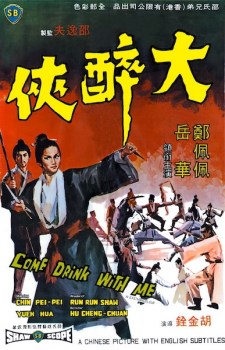
The first wuxia film directed by King Hu (King Chuan, that’s Hu! #MildlyRacistHomophoneJoke), the success of which allowed him to make his next even-more-significant movies in the genre, Come Drink with Me sees a gang kidnap the governor’s son to use him as leverage to release their leader. Instead, the governor sends his daughter, Golden Swallow (Cheng Pei-pei), to rescue her brother. She receives some help from local drunkard Fan Da-Pei (Yueh Hua), who may be more than he’s letting on…
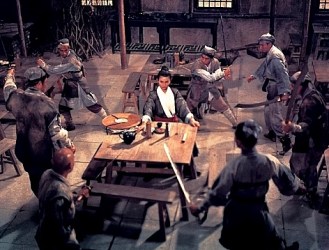
The film features good swordplay action, for the era — i.e. it’s not as tightly choreographed as you’d expect today. There’s a mix of huge free-for-all clashes, and Leone-esque long pauses followed by short bursts of violence. It also establishes Hu’s tendency to feature a strong female protagonist. Okay, she has to be saved by a man in the middle of the film, but at the climax she’s back kicking ass. To cement the point, it’s the female guards who fare best in the climactic battle, surviving long after most of the men have been slaughtered.

For all the fun, the story gets derailed a bit halfway through. Revealing that Fan Da-Pei is not just a drunk but actually an awesome fighter is okay — the groundwork is laid — but shifting the focus on to him and his old rivalry, which springs up out of nowhere two-thirds of the way through, isn’t good. Even the final duel is based on this last-minute subplot. It feels like a late-in-the-day addition designed to add a one-on-one aspect to a climax that would otherwise be about two ‘armies’ duking it out.

But this is a structural niggle, really. There’s so much else to enjoy — not just the action, but some amusing scenes, engaging characters, strikingly brutal villains (they not only kill a child (you wouldn’t get that in most movies) but they do it for no particular reason), and beautiful widescreen Technicolor cinematography — that it doesn’t grate too much.
Two points to be aware of when viewing. Firstly, when Golden Swallow arrives she’s pretending to be a man. This isn’t obvious to the viewer because she’s rather pretty, but all the characters behave as if she’s a fella nonetheless. Secondly, the version available on Netflix doesn’t bother to subtitle a couple of songs, which is frustrating because it’s clear from dialogue that they convey plot points. You get the gist, but it’s not as thorough as it should be. (Hopefully Film4’s screening will be more complete.)

I confess, I primarily watched Come Drink with Me because last year Masters of Cinema released Hu’s next film, Dragon Inn, and this week released the one he made after that, A Touch of Zen — I do like to watch things in order. Those follow-ups are regarded as seminal classics of the genre, a conversation Come Drink with Me doesn’t often come into. Whether that’s right or not, I’m glad to have been led to it, because it’s a very good swordplay movie in its own right. If Dragon Inn and A Touch of Zen are indeed even better, they’re a very exciting prospect.

4 out of 5

The UK TV premiere of Come Drink with Me is on Film4 tonight at 11:15pm.

A Most Wanted Man (2014)

2015 #186
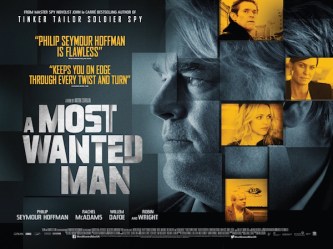
Anton Corbijn | 122 mins | streaming (HD) | 2.35:1 | UK, USA & Germany / English | 15 / R

John le Carré adaptation starring Philip Seymour Hoffman as a German secret intelligence operative who must battle internal politicking while tracking a political refugee who may actually be a terrorist.
A typically complex plot requires the viewer to keep their attention level high. Some find the story a plod, but (one languorous interrogation sequence aside) I thought it relatively brisk, aided by accent-defying performances from Hoffman, Willem Dafoe, Robin Wright, Rachel McAdams, and Grigoriy Dobrygin as the refugee. Though beware: its level of realism, with real-life levels of compromise and betrayal, doesn’t make for an ultimately cheery or triumphant conclusion.

4 out of 5

Begin Again (2013)

2015 #188
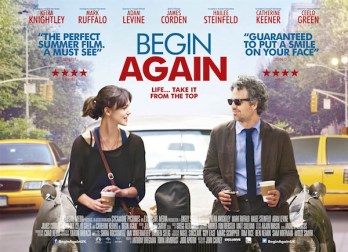
John Carney | 104 mins | streaming (HD) | 1.85:1 | USA / English | 15 / R

Once’s writer-director returns with a film that could’ve been dubbed Once 2: New York.

Mark Ruffalo’s out-of-favour record exec discovers Keira Knightley’s singer-songwriter, stranded after her ex became a hit. Convinced she could salvage his career, he persuades her to record an album. They bond; will there be romance?

The songs aren’t as catchy (though some are decent) and the shape of the story is overfamiliar, but likeable performances from the stars, plus James Corden and Hailee Seinfeld, keep Begin Again a pleasant experience — albeit one that occurs more in the imagination of dreamy creative types than the real world.

4 out of 5

The Golem (1920)

aka The Golem: How He Came into the World / Der Golem, wie er in die Welt kam

2015 #163
Carl Boese & Paul Wegener | 85 mins | streaming | 4:3 | Germany / silent (English) | PG

The word “prequel” was first coined in the ’50s, arguably entered the mainstream in the ’70s, and was firmly established as a term everyone knew and used in the ’90s by the Star Wars prequel trilogy. Works that can be defined as prequels predate their naming, however, and surely one of the earliest examples in the movies must be this silent German horror.

Now lost, 1915’s Der Golem was set in the present day, when “an antiques dealer (Henrik Galeen) finds a golem (Paul Wegener), a clay statue brought to life by a rabbi four centuries earlier. The dealer resurrects the golem as a servant, but the golem falls in love with the dealer’s wife. As she does not return his love, the golem commits a series of murders.” The film was written and directed by both Galeen and Wegener, but the latter was reportedly unhappy with the film due to compromises he’d made during production. So, after a sequel (also lost), Wegener tried to more directly convey the legend as he’d first heard it — hence Der Golem, wie er in die Welt kam, translated as The Golem: How He Came into the World, and commonly abbreviated to just The Golem, what with the original The Golem being lost. (Got it? Good.)

Set in 16th Century Prague (not that there’s any way to know that from the film itself), The Golem 3 tells the story of that rabbi who brought the clay statue to life in the first place. When the Roman Emperor decrees that Jews must vacate their ghetto, a rabbi builds a monster out of clay then summons a spirit to bring it to life. Meanwhile, one of the Emperor’s knights has fallen in love with the rabbi’s daughter, who is also the object of the rabbi’s assistant’s affections, and this love triangle — combined with access to control of the Golem — will eventually spell “climax”.

Regarded as one of the first horror films, The Golem is more of a moderately-dark fantasy, or a fairytale-type myth. There are clear similarities to Frankenstein, though I don’t know if either influenced the other. However, it does feature what I presume is one of first instances of that most daft of horror tropes: running upstairs to escape the monster. It goes as well here as it ever does, i.e. not very. Said monster looks a bit comical by today’s standards. Built by the rabbi to defend the Jewish people, he immediately uses the hulking chap to chop wood and run errands — he doesn’t want a defender, he wants a servant! A terrifying beast nonetheless, it’s ultimately defeated because it picks up a little girl for a cuddle and she casually removes its magic life-giving amulet.

Golem aside, there are some good special effects, like the ring of fire that summons a smoke-breathing demon; composer Aljoscha Zimmerman’s score is largely atmospheric; and there are some nice shots, like when the rabbi walks up to camera, does something with his hands (in what is effectively now a close-up), then walks back to the Golem at the rear of the set. These are the exception, though: it’s mostly a mix of flat long and medium shots. Oddly, the credits on the version currently available note that it adds computer graphics and animation. Presumably this is the English text that’s been digitally pasted into the film on letters, decrees, books, and the like. It also means that the judder, grain, and print damage on the English intertitles is utterly fake. How silly.

Revered for its place in film history, The Golem has elements to commend it still, but doesn’t hold up as well as other films of the era.

3 out of 5