
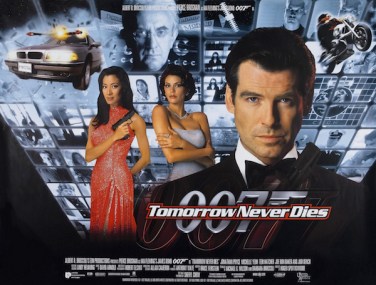
Tomorrow is in the hands of one man.
Bond. You know the rest.
Country: UK & USA
Language: English, German, Danish, Mandarin & Cantonese
Runtime: 119 minutes
BBFC: 12 (cut, 1997) | 12 (cut more, 1998) | 15 (uncut, 2006) | 12 (uncut, 2012)
MPAA: PG-13

Original Release: 12th December 1997 (UK)
US Release: 19th December 1997
First Seen: cinema, December 1997
Stars
Pierce Brosnan (Dante’s Peak, The Ghost)
Jonathan Pryce (Brazil, Pirates of the Caribbean: The Curse of the Black Pearl)
Michelle Yeoh (Supercop, Crouching Tiger, Hidden Dragon)
Teri Hatcher (Tango & Cash, Coraline)
Judi Dench (Mrs Brown, The Best Exotic Marigold Hotel)
Director
Roger Spottiswoode (Turner & Hooch, A Street Cat Named Bob)
Screenwriter
Bruce Feirstein (GoldenEye, The World Is Not Enough)
Based on
James Bond, a character created by Ian Fleming.
The Story
Secret agent James Bond is deployed to investigate a media baron who is plotting to ignite a war between the UK and China to further his business empire.
Our Hero
The name’s Bond, James Bond. In his second outing as agent 007, Pierce Brosnan has settled comfortably into his interpretation of the hero, a mix of Roger Moore’s eyebrow-raising levity with some of Sean Connery’s slightly harder, man-of-action edge.
Our Villain
Elliot Carver is a megalomaniac media mogul — the owner of the newspaper Tomorrow, who intends to secretly provoke a war in order to boost sales and ratings. James Bond does satire? Kinda.
Best Supporting Character
Wai Lin, a spy who’s investigating Carver for the Chinese. A skilled martial artist, she kicks all kinds of ass. Despite initial mistrust, she and Bond ultimately team up. Lin is arguably one of the first Bond girls who can genuinely claim to be a competent character in her own right. Still ends up sleeping with Bond, though.
Memorable Quote
Admiral Roebuck: “With all due respect, M, sometimes I don’t think you have the balls for this job.”
M: “Perhaps. But the advantage is I don’t have to think with them all the time.”
Memorable Scene
Remote control car, James Bond style: Bond lies in the backseat of his BMW, driving it around a multi-storey car park with his mobile phone, deploying its weapons against a gang of attackers. It was a fun concept back in ’97, but I imagine you could do it yourself with an app now. Apart from the weapons. And the legal implications. So maybe not.
Memorable Music
After the disastrous ‘modern’ score for GoldenEye, music duties were here handed to David Arnold. At the time he had composed the scores for Stargate and Independence Day, but, even more pertinently, he had produced Shaken and Stirred, an album of contemporary-styled covers of great Bond themes. The album was heard by iconic Bond composer John Barry, who then recommended Arnold to producer Barbara Broccoli. Arnold’s score is much more in-keeping with classic Bond music, but given a modern (well, ’90s) flavour. Backseat Driver, the soundtrack to my Memorable Scene pick, is a particularly great action cue. Arnold would become the series’ composer for the next four films, until Sam Mendes chose to use his regular collaborator Thomas Newman for Skyfall and Spectre. With Mendes moving on, perhaps Arnold will be back for Bond 25…
Write the Theme Tune…
Arnold wanted to have a hand in writing the title song and integrate it into his soundtrack, like the great Bond composers of old. To that end he wrote a theme sung by k.d. lang… which plays over the end credits and is titled Surrender, though has a tellingly prominent use of the phrase “tomorrow never dies” in its lyrics.
Sing the Theme Tune…
The producers went with a more marketable proposition for the final opening credits song, however, in the shape of Sheryl Crow, famous for her pop-rock-y hits like All I Wanna Do, A Change Would Do You Good, and Everyday is a Winding Road. In the pantheon of Bond title themes, her Tomorrow Never Dies sits firmly in the middle — it’s not a GoldenEye, but it’s not a Die Another Day either.
Making of
The film was originally called Tomorrow Never Lies, referencing Carver’s newspaper, Tomorrow. Some kind of production mix-up (a typo, a smudged fax — pick your story) led to it being misread as Tomorrow Never Dies, and the new, less meaningful title stuck.
This Category Sponsored By BMW
Apparently Tomorrow Never Dies was the first movie in history to have its entire budget covered by product placement endorsements — that’s over $100 million in advertising. Featured companies include BMW, L’Oréal, Heineken, Dunhill, Ericsson, Omega, Smirnoff, Brioni, Bollinger, and Avis, plus a tie-in game from Electronic Arts.
Previously on…
17 previous Bond films (which are all technically in the same continuity). The previous one, GoldenEye, was the first to star Pierce Brosnan and relaunched the series to mass popularity after a fallow period.
Next time…
Two more Brosnan Bonds, before he was unceremoniously dumped to reboot the series for the first time. With a 25th film now in the works, the series is set to continue indefinitely.
Awards
1 Saturn Award (Best Actor (Pierce Brosnan))
3 Saturn nominations (Action/Adventure/Thriller Film, Supporting Actress (Teri Hatcher), Music)
2 MTV Movie Awards nominations (Action Sequence for the motorcycle/helicopter chase (somehow it lost to Face/Off), Best Fight for “the fight between Michelle Yeoh and some ‘bad guys’.”)
What the Critics Said
“East meets West, yin meets yang and chop-socky meets kiss-kiss bang-bang in Tomorrow Never Dies, a zippy 007 romp that draws as heavily from the Asian action genre as from the formula that has served the series so well for 35 years. Goldeneye and Pierce Brosnan’s debonair Bond resuscitated the creaky franchise in 1995, but […] Tomorrow, jazzier, wittier and more costly than its predecessor, also comes closer to catching up with ’90s style and politics. […] Hong Kong kung-pow chick Michelle Yeoh, as the cool-headed Chinese agent Wai Lin, proves 007’s equal at kicking post-Cold War butt. The two take on craven communications baron Elliot Carver (Jonathan Pryce), a deliciously exaggerated — or is it? — composite of Ted Turner, Rupert Murdoch and the late Robert Maxwell. Carver’s not only the most plausible Bond nemesis ever but the perfect one for the current global villain shortage.” — Rita Kempley, The Washington Post
 Score:
 57%
57%What the Public Say
“TND is somewhat underrated. Jonathan Pryce plays a villain who is essentially Rupert Murdoch smooshed together with Ted Turner. His plan isn’t to take over the world so much as it is getting rich by starting a war and then covering it on his news outlets. This just may be the most plausible Bond villain scheme of all times – which admittedly isn’t saying much. […] TND may not be among the best Bonds, but it’s got more going for it than I think it gets credit for.” — Lebeau, Lebeau’s Le Blog

I know some of you will be thinking, “how can you leave out Goldfinger / Thunderball / The Spy Who Loved Me / For Your Eyes Only / The Living Daylights / Licence to Kill [delete according to personal preference] but include Tomorrow Never Dies?!” It’s true, TND is far from the most popular Bond film, but it was the first I saw on the big screen, and that gives me a certain soft spot for it. It’s not just that, though.
Here’s a thing: one of the criticisms levelled at the film is that it’s just an action movie, lacking the peculiarly Bondian thrills a Bond adventure should have. But if it is “just an action movie” then it’s the best action movie in the Bond series. The pre-titles gunfight at the arms meet, the ‘backseat driver’ sequence, and the motorbike-vs-helicopter chase are three of the finest action scenes in the entire franchise, and that’s without even touching on Michelle Yeoh kicking ass. Couple that with Brosnan still new and confident in the lead role, and Jonathan Pryce nibbling the scenery as a lightly satirical villain, and I think you have a Bond film that is pretty entertaining, even if it’s mainly on an adrenaline-pumping level.

#92 has… a friend in me.
 Between his popular English-language debut
 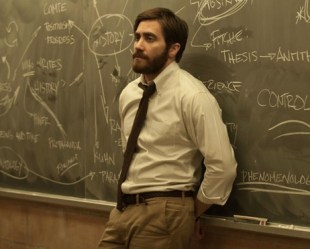 While looking up those various explanations, I read at least one review that asserted it’s a good thing that the film doesn’t provide a clear answer at the end. Well, I think that’s a debatable point. I mean, there is an answer — Villeneuve & co clearly know what they’re doing, to the point where they made the actors sign contracts that forbade them from revealing too much to the press. So why is it “a good thing” that they choose to not explain that answer in the film? This isn’t just a point about Enemy, it’s one we can apply more widely. There’s a certain kind of film critic/fan who seems to look down on any movie that ends with an explanation for all the mysteries you’ve seen, but if you give them a movie where those mysteries do have a definite answer but it’s not actually provided as part of the film, they’re in seventh heaven. (And no one likes a movie where there are mysteries but no one has an answer for them, do they? That’d just be being mysterious for precisely no purpose.) But why is this a good thing? Why is it good for there to be answers but not to give them, and bad for there to be answers and to provide them too? If the answers the filmmakers intended are too simplistic or too pat or too well-worn or too familiar, then they’re poor for that reason, and surely they’re still just as poor if you don’t readily provide them? I rather like films that have mysteries and also give me the answers to those mysteries. Is that laziness on my part? Could be. But I come back to this: if, as a filmmaker (or novelist or whatever) you have an answer for your mystery and you don’t give it in the text itself, what is your reason for not giving it in the text? Because I think perhaps you need one.
 Fortunately, Enemy has much to commend aside from its confounding plot. Gyllenhaal’s dual performance is great, making Adam and Anthony distinct in more ways than just their clothing (which is a help for the viewer, but not for the whole film), and conveying the pair’s mental unease really well. It would seem he errs towards this kind of role, from his name-making turn in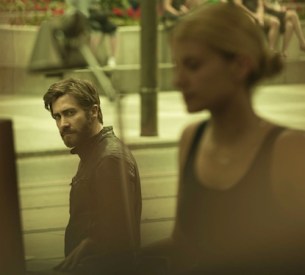

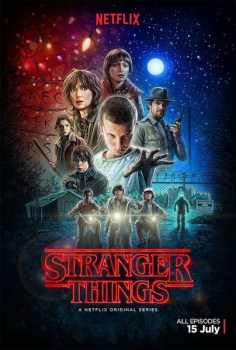 Hype — it’s a funny old business. It’s hard to have avoided hearing something about Stranger Things, Netflix’s summer hit that went down like gangbusters, its ’80s nostalgia perfectly calibrated to target the kind of people who run entertainment news websites these days — just to be cynical about it. Or truthful. Then there came the backlash, which attested there was nothing more to the show than those callbacks and tributes; a hollow experience of copying and “hey, remember this? That was good, wasn’t it?”
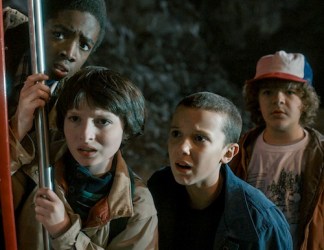 Without wanting to get into spoiler territory (despite what the media would have you believe, not everyone has Netflix all the time and not everyone watches every new zeitgeisty series immediately. Apologies if you write for an entertainment site and I’ve just given you palpitations), everything comes together nicely for a barnstorming pair of climactic episodes. For my money, the penultimate chapter is the best one: with a bunch of revelations out of the way (some of them easily guessed but finally confirmed), the series kicks off a run of long-awaited fan-pleasing events (as in many a drama, it takes this long for everyone to finally start talking to each other; also, the bit with the van!) The finale is less accomplished, with some characters wandering around for a bit in a way that feels designed to pad the running time. Still, it’s a satisfying conclusion… to season one, anyway.
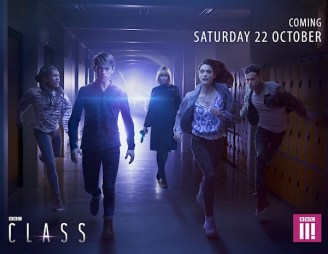 Ten years to the very day since the launch of the original dark, sexy BBC Three Doctor Who spin-off,
  The CW’s raft of superhero shows restarted on UK TV this month. I’ve given up on Legends of Tomorrow and am still not joining Supergirl (though I got hold of the opening episodes, co-starring Superman, to maybe make time for at some point); but, five seasons in, Arrow has me suckered for the long-haul, and The Flash tempted me back with the intrigue of adapting Flashpoint. I’ve never got on the bandwagon with Flash, which attracted a lot of praise during its first season that I simply didn’t agree with, leading it to outshine Arrow in ratings and people’s affections. Arrow has long been off the boil, and season five certainly hasn’t got it back up to temperature so far, but The Flash had plenty of issues of its own. It’s not problem free now, but I actually really liked the first couple of episodes of the new season. It’s still a long way from the top tier of TV superheroes (Netflix have that sewn up), but it’s likeable.
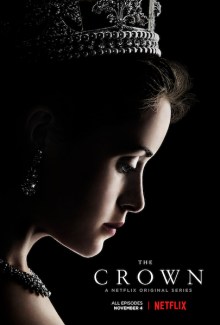 This month, I have mostly been missing the most expensive TV show ever made*, Netflix’s much-discussed The Crown. I don’t know if they’ve been pushing it as much in the rest of the world as they did in the UK, but it certainly felt like it was everywhere… for about a week, as is usually the way with Netflix series. Also missed: the equally-discussed Netflix-exclusive new run of Black Mirror. Both of these are because I don’t keep up a permanent Netflix subscription, but between them, the forthcoming Gilmore Girls revival, and the Series of Unfortunate Events remake in January, I will be signing up again late in December (using the free month voucher they had in the Radio Times, hurrah!)
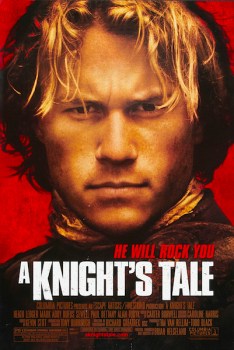 A squire fakes being a knight to win a jousting contest, and a lady’s affection, in this medieval comedy-adventure.
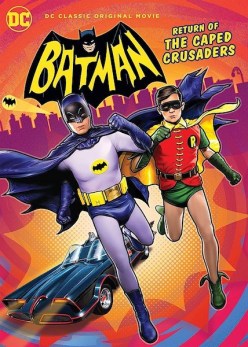 Holy nostalgia hit, Batman! This animated movie reunites the surviving stars of the enduringly popular
 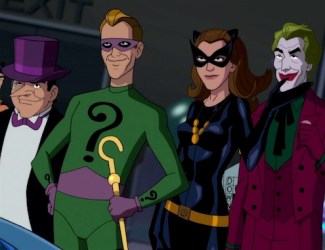 fundamentally, a comedy. Conversely, Ward still sounds pretty spry, and is gifted plenty of those “Holy [insert something here], Batman!” catchphrases that never cease to be fun. Unfortunately, Newmar also sounds her age, but doesn’t seem to quite have the liveliness that West retains. In the behind-the-scenes featurettes she seems a delightfully kooky old bird (at the recording she’s wearing cat ears, for one thing), so it’s hard to resent her, but the portrayal of Catwoman as slinky and sexy feels a little… odd. On the bright side, it means you don’t get the uncomfortableness of West flirting with a much younger actress, even in animated form.
 On the whole, Return of the Caped Crusaders is a resounding success. It’s a fun return to a beloved incarnation of arguably the most popular superhero; a version who’d been somewhat left out in the cold for a couple of decades by a world that grew up a bit too much, but is now being re-embraced and held in deserved esteem. And, even better, there’s already a follow-up in the works. Holy must-see sequel, Batman!
 ’70s self-sufficiency sitcom
 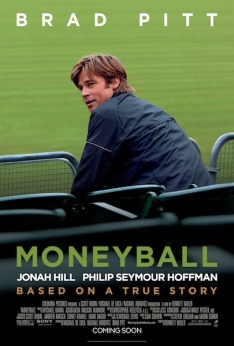 Based on a true story, Moneyball concerns the management of baseball team Oakland Athletics during the 2002 season. General manager Billy Beane (Brad Pitt) struggles to put a squad together due to a comparatively low budget for players, which has seen all his best ones drift off to richer contracts elsewhere. Fed up with the traditional scouting system, he recruits Peter Brand (Jonah Hill) to use statistical analysis to select a cheap team of quality players. The rest of his staff despair, including coach Art Howe (Philip Seymour Hoffman), who refuses to play the team as Beane and Brand suggest, which unsurprisingly leads to self-vindicating failure — until they force his hand…
 Problems extend beyond the sporting specifics. It’s quite some way into the movie before it gets stuck into the meat of the plan working, and before that it often throws in asides that meander around through Beane’s earlier playing career and current family life. The former has some bearing on the plot, though feels inadequately integrated — as one flashback it might work, but as a series of them it’s not enough to constitute a parallel story. The latter, his family life, provides character texture, but it’s slight, uninformative, and ultimately unnecessary. You could cut it and the film would lose nothing.
 and didn’t need any work, which probably explains why it’s not so Sorkin-y. Zaillian is not a bad writer — his credits include
 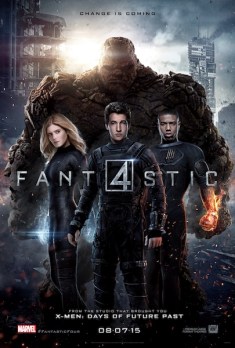 Sometimes you just have to see what all the fuss is about, even if that fuss is overwhelmingly negative. Obviously that’s the case with the most recent attempt to bring Marvel’s popular “first family” to the big screen. The behind-the-scenes stories are already the stuff of movieland legend, so I won’t repeat them here, but what of the film itself? Or the version that ended up available for public consumption, anyway.
 and serve as new pieces — like a shattered mug that’s been reassembled with lashings of superglue and using a handle from another vessel, which has inexplicably wound up a slightly different size and shape to how it used to be. Considering the studio got cold feet and insisted on massive reshoots, this is quite possibly exactly what happened.
 Fox like to keep their superhero movies Serious and Dark — and why not? Before this, it had worked pretty well for them across seven X-Men movies, while their colourful-and-cheery
  What could have been a comfortable 3-star movie, maybe even 4 if it followed through well enough, is dragged down to 2 by studio meddling. Will they never learn? Nonetheless, I actually enjoyed enough of Fantastic Four that, while it won’t be going on the long-list of contenders for the best movies I’ve seen this year, I won’t be putting it on the list for the worst either.



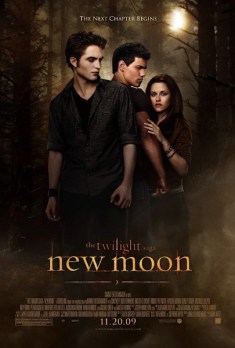 Last Halloween, I reviewed one of the most horrifying movies of all time:
  And they accuse teenage guys of being shallowly obsessed with the opposite sex’s chests. But then Jacob starts acting aggressively, and hanging out with a gang, and there are stories about beasts in the woods killing people, and his tribe leader type guy looks shifty whenever all that’s mentioned, and… wait, could there be a connection between Jacob and his friends and the wolf-like attacks in the woods?! Gasp!
 so that even bits that aren’t bad in isolation (the wolves, for instance) are poorly integrated into the live-action. And at one point the characters go to the cinema to see an action movie… called Face Punch. At this point New Moon slips from ineptitude into genius. It’s the best worst fake action movie title ever. The scene where they discuss it is so hilarious, I actually had to pause the movie to finish laughing.
 100Films.co.uk