2015 #26a
1968 | Stanley Kubrick | 149 mins | Blu-ray | 2.20:1 | USA & UK / English | U / G
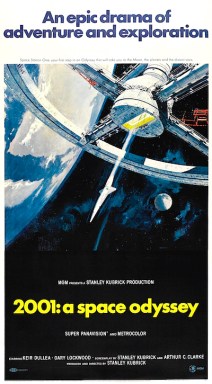 As suggested (and named) by the ghost of 82, this is the first in an occasional series* in which I revisit films that are highly acclaimed but I didn’t enjoy first time round. First up, Stanley Kubrick’s monumental sci-fi opus, 2001: A Space Odyssey.
Now, let me begin with a point of clarification: I don’t remember when I first saw 2001, but I was very young, and most likely looking for SF films in the vein of others I’d enjoyed, like, say, Star Wars. I think we can all agree that 2001 is not like Star Wars. Nonetheless, while I wouldn’t have said I disliked 2001, I didn’t understand it either — and not in the “let’s debate its meaning” way in which no one else really understands it either, but in a more “well I didn’t get that, let’s ignore it” kinda way. I tried to watch it again in my teens, but it was late and I fell asleep. Some bits of it are very calming…
I think whenever it is someone first watches 2001, it’s the kind of film a viewer needs to be ‘prepared’ for. You can’t just watch it like “any other film”; it doesn’t quite play by the normal rules of mainstream narrative cinema. There is a story, but it’s slight, and told almost incidentally, half in asides and snatched exposition amongst other goings-on, and it’s never thoroughly elucidated. It exists to serve the film’s themes, or explorations, or whatever you want to call them, which I think is contrary to how most people (outside of the arthouse crowd) view cinema.
In reality, 2001 probably is an arthouse film. The final 20 minutes, with their bizarre and initially-inexplicable imagery, certainly are. The opening Dawn of Man sequence probably is too. The long, slow shots of spacecraft drifting, or of people silently riding said spacecraft, fit in that box ‘n’ all. These may be groundbreaking special effects, but the feelings they generate aren’t exactly the same as Star Wars, are they. The everyday mundanity of the space travel as seen in the film is almost its point, even if it’s conveyed through awe-inspiring effects work. Today, a mainstream director producing an expensive effects-heavy movie 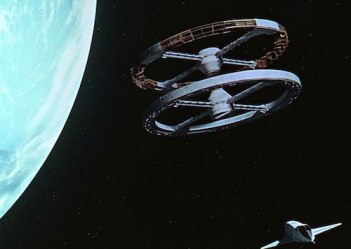 with this kind of pace and uncertainty would be unthinkable, but I guess audiences were a little more mature in the Good Old Days. Even then, Kubrick cut 19 minutes after the film’s premiere in order to “speed up the pacing”. Maybe he succeeded, but no one’s going to be calling this a fast-paced thrillride any time soon.
The effects, incidentally, are magnificent. They still look spectacular today — one can only imagine the impact they had on the big screen in the mid-’60s, nearly a decade before Star Wars came along to blow people’s minds. There are incredible sets too, which, even when you know the kind of behind-the-scenes techniques they likely employed, make the mind boggle — “that circular room on the Discovery is massive; it can’t be one giant rotating set, surely?” The sound design, an often overlooked element of filmmaking, is amazing as well. The EVA with Dave’s breathing echoing constantly around the soundstage, making the experience feel claustrophobic even when what you’re seeing is a giant craft in the vastness of space… And the music, of course. It’s completely unnerving whenever the monolith is near, a score filled with freaky voices that wouldn’t be out of place in a horror movie. The movie’s influence is perhaps most clearly seen in what you might call its title track, Richard Strauss’ Thus Spoke Zarathustra, which 2001 established as the soundtrack of space exploration.
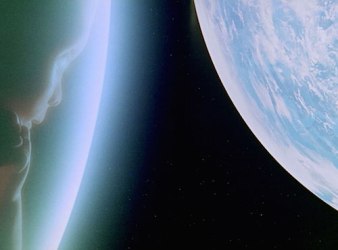 Technically, then, 2001 is undeniably stunning. Thematically, though… what’s it all about? What does it mean? Author Arthur C. Clarke once said that “if you understand 2001 completely, we failed. We wanted to raise far more questions than we answered.” Some find such goals unsatisfying, especially when it comes to storytelling, but the very spirit of space exploration, of science, is to keep asking questions that don’t necessarily have answers. Of course, the ending is actually very easy to explain: the evil alien monolith kidnaps Dave, ages him to death, then mutates him into a giant Space Foetus, which it sends back to Earth. Why they didn’t make 2002: Invasion of the Giant Space Baby, I don’t know. Who doesn’t want to see that movie?
(Just so we’re clear, I’m being facetious. Probably. Though if 2010 is actually about an invasion by a giant space baby, somebody please let me know.)
Having said the film looks to expound the scientific virtues of asking questions and pushing forward, it’s interesting that it’s very easy to read it as technophobic — arguably, the entire point might be, “be wary of technology”. Such themes are expressed succinctly in possibly the most striking, probably the most audacious, and certainly the most famous, jump cut in movie history. The strange presence of the monolith leads ape-man to discover tools, 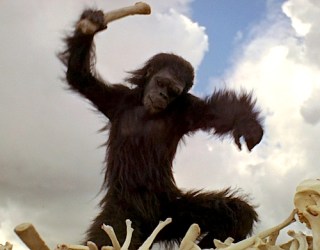 and almost immediately use them to kill, first a beast for food, then another ape for territory. Then, in a literal split second, we jump forward millennia, as that simple tool turns into a nuclear weapon drifting in orbit — the entirety of human technological innovation summed up in a single cut.
And then there’s a new monolith and things all go to shit again.
The simple point is, technology has led us to develop, to literally reach for the stars, but it also drove us to savagery, and still does. So is it a good thing? Surely the film can’t be condemning it entirely…? Whether it is or isn’t, it’s ironic that themes of “bad technology” should be expressed in the most technologically-driven of all entertainment media (at the time), and created largely through advanced and innovative technological effects at that.
Leaving aside those effects and themes and all the questions we’re left with, what amazes me most about 2001, in a way, is how well-regarded it remains by a general audience, exemplified by public-voted lists like the IMDb Top 250. Of course critics still love it, but you’d think its artiness would have caused a gradual decline over time as the wider viewership immatures. But no; or, at least, not enough that it’s disappeared from consideration. Yet.
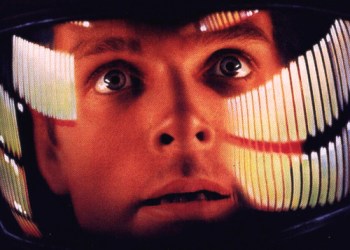 In the end, I think 2001 is a film that’s very easy to admire, for all sorts of reasons, but to enjoy in the traditional sense of “enjoyment”? Surely it’s far too removed, too obtuse, too joyless, for that? Some people will like those qualities, of course, and all power to them. For me, 2001 is a film to be impressed, even awed, by; but not one to love.
2001: A Space Odyssey is on BBC Two, in HD, tonight at 11:05pm.
* Read: there may be more but I’ve not got any planned. ^

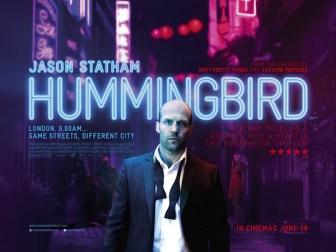 Steven Knight, the writer of Eastern Promises and Peaky Blinders — and, latterly, writer-director of “Tom Hardy driving on the phone” thriller Locke — made his directorial debut with this Jason Statham thriller that isn’t.
 The film’s problem, perhaps, is that it slips a little between two stools. It’s certainly not action-packed enough to appeal to a good deal of Statham’s fanbase — the one or two instances of him kicking ass are very much asides. On the flipside, it may not commit to the character drama fully enough to satiate the needs of that kind of viewer. However, for anyone at peace with those two apparently-disparate styles — like, well, me — Hummingbird will be a more satisfying experience.
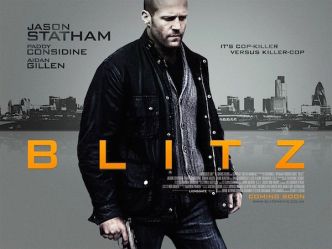 Jason Statham plays the kind of copper who wakes up on his sofa in the middle of the night, immediately pours himself a whiskey in a mug, then goes out and beats up three youths who were trying to nick a car, in this godawful crime novel adaptation.
 At least it has some so-bad-they’re-good one-liners — “Aren’t you going to take any notes?” “Do I look like I carry a pencil?” Unfortunately, their presence meant the thing Blitz most reminded me of was
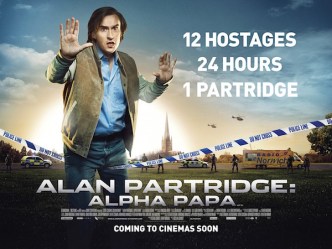 Steve Coogan brings his popular character to the big screen. When Partridge’s radio station colleague Pat (Colm Meaney) is fired, he takes a group of employees hostage at gunpoint. At Pat’s request, Partridge is sent in to negotiate.
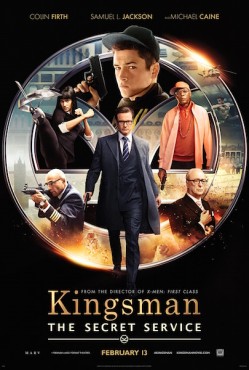 The team behind
 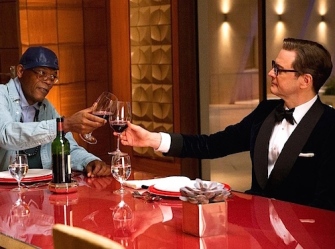 An even bigger part of the film’s triumph, and what likely led it to over $400 million worldwide in spite of its higher-than-PG-13 classifications (it’s Vaughn’s highest-grossing film to date, incidentally; even more so than
 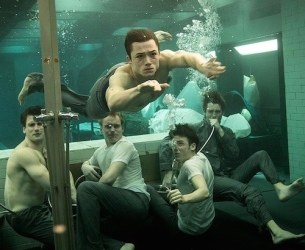 rather than the supposed real-world universe of spy movies. What the worldwide success of Kingsman proves is that audiences don’t need the set-dressing of superpowers to accept an action movie that’s less than deadly serious. It’s a place I don’t think the Bond movies could go anymore — not without accusations of returning to the disliked Moore or late-Brosnan films — but it’s one many people clearly like, and Kingsman fulfils it.
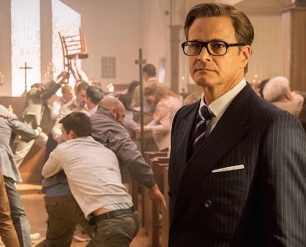 Criticisms of the film tend to pan out to nought, in my opinion. Is there too much violence? There’s a lot, certainly, but part of the point of that church sequence (for instance) is just how long it goes on. Other excellent action sequences (the pub fight you might’ve seen in clips; the car chase in reverse gear; the skydiving) aren’t predicated on killing. Similarly, Samuel L. Jackson’s baseball-capped lisping billionaire is a perfect modern riff on the traditional Bond villain, not some kind of attack on Americans or people with speech impediments. Some have even attempted a political reading of the film, arguing it’s fundamentally conservative and right-wing because the villain is an environmentalist. Again, I don’t think the film really supports such an interpretation. In fact, I think it’s completely apolitical — just like its titular organisation, in fact — and such perspectives are being entirely read into it by the kind of people who read too much of this kind of thing into everything.
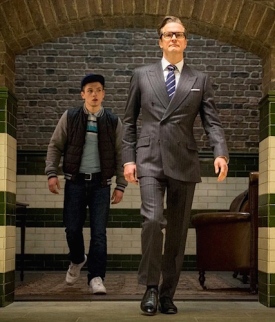 Not everything hinges on being wall-to-wall groundbreaking, though, and Kingsman has so much to recommend it. It ticks all the requisite boxes of being exciting and funny, and some of its sequences are executed breathtakingly. The plot may move along familiar tracks — deliberately so — but it pulls out a few mysteries and surprises along the way. There’s an array of likeable performances, particularly from Firth, Egerton (sure to get a lot of work off the back of this), Jackson and Strong, and Sofia Boutella’s blade-legged henchwoman is yet another why-has-no-one-done-that great idea.
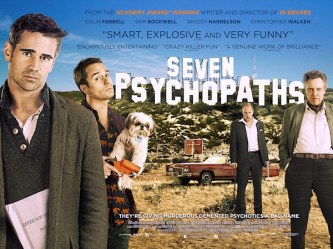 The writer-director and star of
  mainly via references to Farrell’s endeavours to pen a movie called, you guessed it, Seven Psychopaths. One wonders if there’s a hefty dose of autobiography in the writer’s struggle…
 David Tennant replaces Martin Freeman as the teacher of a primary school class who enter themselves in a Christmas singing competition in this part-improvised sequel to the
 Adapted from one of Agatha Christie’s best-regarded novels (now commonly known by its US title, And Then There Were None), Ten Little Indians sees a group of ten people invited to a remote location (in the book, an island; here, an alpine hotel) by a mysterious host, who doesn’t appear but does accuse them all of murder via a recorded message. Then, stranded, they begin to die one by one.
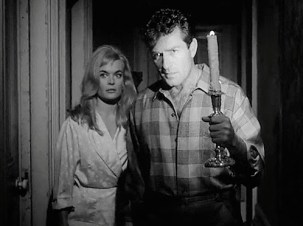 voiceover informs us this is our chance to have a guess. Ah, the ’60s.
 If you’ve ever found a late-night train commute dull, this single-location thriller may make you rethink any complaints. Half-a-dozen people travelling from London to Tunbridge Wells find their train speeding out of control. It’s up to them to discover what’s happening and how to stop it.
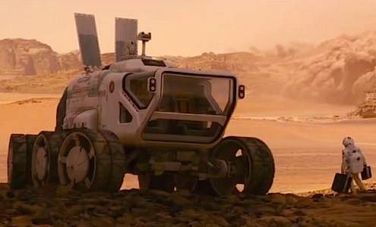
 The first manned mission to Mars is reaching the end of its six-month tour. As they count down the final hours, battling a dust storm and its attendant power outages and communications blackouts, one of the team secretly discovers bacterial life on the surface. Attempting to recover further samples, a sink hole opens beneath him. When the rest of the crew try to recover his body, it’s not there. Then he arrives back at base… only, he’s not quite himself anymore…
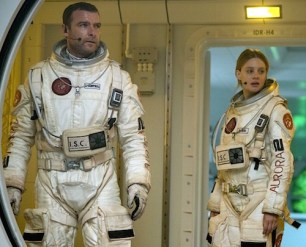 These faults persist despite the best efforts of a quality cast, particularly Romola Garai as (in functional terms) the capable sidekick, and Olivia Williams as the bitch whose heartless practicality becomes an asset when the going gets tough. First-time feature director Ruairí Robinson assembled his cast on the principle of “people who aren’t normally in sci-fi movies”, and that does feed in to the sense of realism. It also looks great, the production, costume and effects designs gelling to create a believable Mars mission, all in spite of a tiny budget (funded by the BFI and the Irish Film Board, it had about a tenth of Gravity’s budget, for example). Credit, too, to cinematographer Robbie Ryan for lensing the Martian surface convincingly (it’s actually the Jordanian desert). The editing may descend into fast-cut blurriness during action scenes — only emphasised by Max Richter’s predictably derivative horror movie score — but during calmer moments the film looks very good.
 and was more sure of its tone. There may be elements to commend The Last Days of Mars in this comparison (the much bigger budget pays off in the scope of the visuals, of course), but as a story and viewing experience, The Waters of Mars wins hands down.
 100Films.co.uk