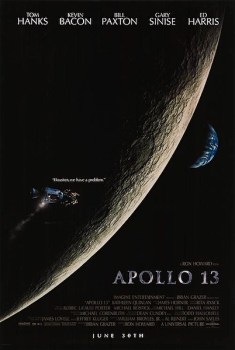
Apollo 13 (1995)

100 Films’ 100 Favourites #4

“Houston, we have a problem.”

Country: USA
Language: English
Runtime: 140 minutes
BBFC: PG
MPAA: PG

Original Release: 30th June 1995 (USA)
UK Release: 22nd September 1995
First Seen: cinema, 1995

Stars
Tom Hanks (Philadelphia, Saving Private Ryan)
Bill Paxton (Tombstone, Twister)
Kevin Bacon (Footloose, The Woodsman)
Gary Sinise (Forrest Gump, Snake Eyes)
Ed Harris (The Right Stuff, The Truman Show)

Director
Ron Howard (Willow, A Beautiful Mind)

Screenwriter
William Broyles Jr. (Cast Away, Flags of Our Fathers)
Al Reinert (For All Mankind, Final Fantasy: The Spirits Within)

Based on
Lost Moon, a true-story book by Jim Lovell & Jeffrey Kluger.

The Story
The third manned mission to land on the Moon launches to little public interest… but that all changes when an accident cripples the spacecraft. Not only will the three astronauts on board not be landing on the Moon, but they might not be able to make it back to Earth…

Our Hero
Everybody — from the three men who may die in space, to the spurned astronaut who locks himself in the simulator to find a solution, to the dozens of mission commanders and tech guys who work round the clock to keep the astronauts alive and bring them home.

Best Supporting Character
The whole cast are pretty great, but Ed Harris really earnt his Oscar nomination as the commander in Mission Control, Gene Kranz. (See also: memorable quote, below.)

Memorable Quote
NASA Director: “This could be the worst disaster NASA’s ever faced.”
Gene Kranz: “With all due respect, sir, I believe this is gonna be our finest hour.”

Memorable Scene
After surviving days in space on dwindling power, slingshotting the craft round the moon, and adjusting course last-minute to actually aim at Earth, the crippled remains of Apollo 13 enter the atmosphere. There will be three minutes of radio silence before they know if the astronauts have survived reentry. Everyone watches and waits. Silence. Three minutes is reached. Silence. Three minutes thirty seconds passes… In the command center, at the astronauts’ home, at Jay Lovell’s school, everyone waits. Four minutes passes… Goodness, it’s shamelessly manipulative filmmaking, but if your hair isn’t on end and you aren’t practically on your feet cheering with everyone else, you truly are immune.

Technical Wizardry
Gravity used a shedload of groundbreaking tech and computer graphics to simulate zero-G. 20 years earlier, Apollo 13 wasn’t so lucky, so how did they do it? In part, for real. Sets were built inside NASA’s (in)famous ‘Vomit Comet’, an airplane that flies in parabolic arcs to give astronauts an experience of zero-G, but only for 23 seconds at a time. With such a small window, shots to be achieved were carefully planned out, and cast and crew endured over 500 arcs in 13 days to film the necessary footage.

Truly Special Effect
The lift-off sequence, a combination of models and CGI without a single frame of stock footage, is iconic. For me, at least, the shot tracking down the side of the craft as the supports pull away is as indelible an image of an Apollo launch as any documentary footage.

Letting the Side Down
Two decades on, some of the CG effects (especially on Earth) are beginning to show their age. (The model work still looks grand, though.)

Making of
According to Ron Howard in a 20th anniversary interview, Tom Hanks was cast because they thought he was the actor the world would most want to save.

Next time…
The film was followed by 12-part HBO series From the Earth to the Moon, which tells the entire story of the US’s quest to put a man on the moon, from the creation of NASA to the end of the Apollo programme. It’s really good.

Awards
2 Oscars (Sound, Film Editing)
7 Oscar nominations (Picture, Supporting Actor (Ed Harris), Supporting Actress (Kathleen Quinlan), Adapted Screenplay, Art Direction-Set Decoration, Visual Effects, Original Score)
2 BAFTAs (Special Effects, Production Design)
3 BAFTA nominations (Cinematography, Editing, Sound)
1 Saturn nomination (Action/Adventure Film)
Nominated for the Hugo for Best Dramatic Presentation.

What the Critics Said
“In the end, this failed mission seems like the most impressive achievement of the entire space program: a triumph not of planning but of inspired improvisation.” — Terrence Rafferty, The New Yorker

Score: 95%

What the Public Say
“filmmakers combined elements most go to the movies for — drama, comedy, suspense, thrills, and tug of the heart. After reading Lost Moon I’ve come to appreciate the William Broyles Jr. and Al Reinert screenplay the more. Given the archival detail Lovell and Kluger documented, getting a good portion of it into a 140-minute movie was its own remarkable feat.” — le0pard13, It Rains… You Get Wet

Verdict

What could have been one of the US space program’s greatest tragedies turned out to be one of its greatest successes, a sensation that is conveyed by Ron Howard’s thrilling rendition of events. The film is too emotionally manipulative for some palates, but by and large it works magnificently for me. Bonus points are earnt for rejecting sycophancy in favour of depicting the people involved as human beings who endured and triumphed in extraordinary circumstances.

#5 will be… reached at 88mph.
Lady of Burlesque (1943)

2016 #5
William A. Wellman | 89 mins | streaming | 4:3 | USA / English | PG

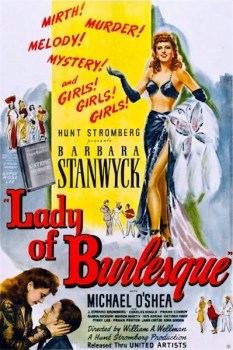
Based on the novel The G-String Murders by Gypsy Rose Lee (as in Gypsy), Lady of Burlesque stars Barbara Stanwyck as Gypsy surrogate Dixie Daisy, a performer in a burlesque show in New York where the backstage arguments turn murderous.

The story unfurls in the traditional Christie-esque shape of a murder mystery: we find out all the different reasons why everyone hates a particular character, then that person dies and they all have motive. For set dressing, instead of the English country houses and other upper-middle-class establishments of Christie, we have the slightly seedy, slightly risqué world of ’40s burlesque… tempered by the strictures of the production code, of course. Stanwyck may get out on stage and wiggle around, but she’s largely shot from the waist up; and it may’ve been released as Striptease Lady in the UK (allegedly), but the clothes remain on (I can’t imagine anyone expected anything else, then or now).

Nonetheless, the world of the story adds some sparkle to proceedings. The investigations are largely confined to a couple of lengthy scenes when the cops turn up, led by Charles Dingle’s meticulous Inspector Harrigan (“This is my first experience with burlesque. It’s a surprising profession.”), and question everyone in one room. These bits have their moments, but feel a little heavy-handed. Around them, the world of burlesque, and the relationships between its performers, rolls on.

Stanwyck carries the film, both on stage and off. Her “will they/won’t they (of course they will)” romance with Michael O’Shea’s comic is kept aloft by her biting ripostes to his advances, and when a comedy sketch is interrupted by backstage noises she saves the day by breaking into song, doing the splits, a cartwheel, and the Cossack dance in quick succession. Not bad for a 36-year-old!

Ostensibly a murder mystery, in practice Lady of Burlesque plays as all-round entertainment with a bit of everything: comedy, romance, songs, shoot-outs, and, yes, both mystery and murders. It’s not the kind of film that will linger long in the memory (apart from Stanwyck’s gymnastics, that is), but it’s entertaining while it lasts.

3 out of 5

This review is part of the Remembering Barbara Stanwyck Blogathon. Be sure to check out the many other fantastic contributions collated by host In the Good Old Days of Classic Hollywood.

Ender’s Game (2013)

2015 #146
Gavin Hood | 114 mins | streaming (HD) | 2.35:1 | USA / English | 12 / PG-13

Adapted from the classic young adult sci-fi novel by Orson Scott “bigoted idiot” Card, Ender’s Game is the story of Andrew “Ender” Wiggin (Asa Butterfield), who displays uncommon aptitude in a military programme to train children to fight against an alien race that attacked Earth decades earlier. Sent to a training centre in space, Ender must battle his fellow candidates to prove their worth to their hardened commander, Colonel Hyrum Graff (Harrison Ford), ready for the real battle to come.

Ender’s Game endured a pretty mixed reception a couple of years ago (not helped by the media exposure given to Card’s less-than-savoury personal views), and it’s quite a mixed film: for every positive, a negative follows close behind. It’s not helped by its first act, where the film seems to struggle with its own setup. After that, however, it’s a fairly well structured story, in which you can actually believe Ender is learning to be a better leader. Normally when a movie features “an excellent military strategist” we’re told that and never shown it, but here we see how Ender’s skills as a strategist develop and are exhibited.

The rest of writer-director Gavin Hood’s screenplay is, again, a mixed bag. The dialogue is frequently clunky, particularly struggling with exposition — there are utterly dead scenes where characters just explain the plot to each other — but, while it is at no point strong, it’s often serviceable. There are strong themes, however, several of which have relevance to our modern world. Unfortunately, none feel fully developed or explored. It tips its hat to things like drone warfare, child soldiers, and understanding our enemy, but that’s all it does: acknowledge those parallels exist, then refuse to explore them. Conversely, the music is too heavy-handed, taking on the burden of providing emotion that’s lacking from the screenplay.
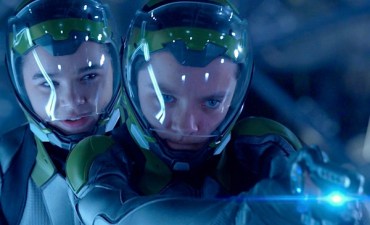
Most of the cast are very good. Asa Butterfield well conveys a moderately complex character, though I can believe others’ comments that Ender is more fully developed in the book. Hailee Steinfeld and Abigail Breslin offer able support; Harrison Ford proves he’s still awesome; Ben Kingsley battles what turns out to be a New Zealand accent (I’d assumed it was South African) in a cameo-sized turn; Viola Davis is ludicrously underused — she does basically nothing, then walks into Ford’s office and essentially declares, “I am no longer needed by the plot, I quit.”

At least there are solid action/sci-fi thrills on offer. The inter-student practice fights in the Danger Room (or whatever it was called) are really good — suitably exciting and fun, with impressive effects work. There are many good visuals in the film, but then strong CGI is par for the course these days. That’s why the space station stuff is best: the alien race and their planet are well-realised but also feel like nothing new; and the space station’s corridors, offices, and bunk room sets are well done, though as derived from familiar real-life and/or near-future styles as much as many other SF movies; but the station’s giant glass-walled zero-G training arena is stunning.

Sadly, after all that training fun, once the cadets jet off to the other side of the galaxy for a rushed third act, interest evaporates speedily. It even has to work hard to sell its own twist as a twist! (Spoilers follow in this paragraph.) In a simulation for a war, Ender does what he’d do to win that war. Then he’s told it wasn’t a simulation, it was the actual war… and he’s all cross. I mean, okay, the fella kinda has a point when he gets angry afterwards: they’ve lied to him, and maybe he would’ve behaved differently if he’d known. But the point of the training was to teach them what they needed to do to win, and it taught them that, and he did it. Maybe this twist works in the book, but in the film it felt somehow unearned.
Ender’s Game is not all it could be, but as a straightforward young-adult sci-fi action-adventure, I really rather enjoyed the majority of it.

4 out of 5

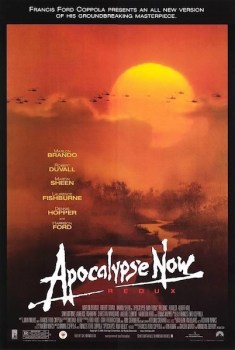
Apocalypse Now Redux (1979/2001)

100 Films’ 100 Favourites #3

Francis Ford Coppola presents an all new version of his groundbreaking masterpiece.

Original Title: Apocalypse Now (obviously)

Country: USA
Language: English, French & Vietnamese
Runtime: 202 minutes (theatrical/DVD) | 196 minutes (Blu-ray)*
BBFC: 15
MPAA: R

* This appears to be due to the Blu-ray removing the end credits, but the number of disc reviewers who haven’t even noticed the discrepancy is remarkable.

Original Release: 15th August 1979 (USA)
UK Release: 19th December 1979
Redux Release: 11th May 2001 (Cannes) | 23rd November 2001 (UK)
First Seen: DVD, c.2002

Stars
Martin Sheen (Badlands, The Departed)
Marlon Brando (A Streetcar Named Desire, The Godfather)
Robert Duvall (THX 1138, The Godfather)
Dennis Hopper (Easy Rider, Speed)

Director
Francis Ford Coppola (The Godfather, The Conversation)

Screenwriters
Francis Ford Coppola (Patton, The Godfather Part II)
John Milius (Conan the Barbarian, Red Dawn)

Based on
Heart of Darkness (loosely), a novella by Joseph Conrad.

The Story
In the middle of the Vietnam war, burnt out soldier Captain Willard is given a top-secret mission: locate US Army Colonel Kurtz, who’s gone renegade and is leading his own personal army in unauthorised attacks, and terminate his command. Travelling up the river on a Navy patrol boat, its crew unaware of Willard’s goal, they see snapshots of the war and the elements of human nature it exposes — the very horrors that drove Kurtz insane…

Our Hero
Martin Sheen is Captain Benjamin Willard — not exactly a hero, but certainly the narrator. Already mentally wracked by his experiences in Vietnam, he may not be the best person to send after another officer similarly mentally afflicted…

Our Villain
Marlon Brando — top billed, only on screen for minutes, and a nightmare to work with… but another performance for the ages as the rambling, insane, but insightful, Colonel Kurtz.

Best Supporting Character
A Golden Globe, a BAFTA, and an Oscar nomination rewarded Robert Duvall for his turn as the commander of a helicopter unit, Lt. Col. Kilgore. More than that, though, was true immortality in the form of the movie’s most famous quote: “I love the smell of napalm in the morning.”

Memorable Quote
Colonel Lucas: “When you find the Colonel, infiltrate his team by whatever means available and terminate the Colonel’s command.”
Willard: “Terminate the Colonel?”
General Corman: “He’s out there operating without any decent restraint, totally beyond the pale of any acceptable human conduct. And he is still in the field commanding troops.”
Civilian: “Terminate, with extreme prejudice.”

Memorable Scene
The sound of unseen helicopters circle. The Doors playing. A pretty forest… which explodes into flame, under the barrage of a napalm attack. One of the most iconic opening scenes.

Technical Wizardry
Apocalypse Now was one of the films that pioneered the creation of surround sound, now the industry standard. Nowhere is it better exemplified than in that opening scene, with the helicopters circling the room.

Making of
“My movie is not about Vietnam, my movie is Vietnam.” Apocalypse Now was a notoriously troubled shoot, for all kinds of reasons, from an uncooperative Brando, to Martin Sheen’s heart attack, to the cast and crew’s copious drug use… Originally scheduled to shoot for six weeks, it ended up filming for 16 months, and took nearly three years to edit.

Awards
The original version won 2 Oscars and 2 BAFTAs, and was nominated for 6 more Oscars and 7 more BAFTAs. In 2002, the Redux was nominated for 7 World Stunt Awards.

What the Critics Said
“this might be the most audience-friendly art-house film ever made, and that’s where the sheer majesty of Coppola’s daredevil balancing act comes into true focus. Coppola’s art is stripped of pretension; what lies on screen may as well be Coppola’s — and probably several other peoples’ — heart, laid bare for all to see, somehow expressed through arguably the most populist of all mediums. It may be messy, but it’s also vivaciously alive.” — Rob Humanick, Slant

Score: 93%

What the Public Say
“The most critically acclaimed movie of 2001 was made 22 years ago… The new material isn’t entirely necessary, and some may find it excessive… But Redux’s virtues far outweigh its flaws. Apocalypse Now in any version remains one of the richest, most extravagant moviegoing experiences of my life.” — Jeffrey Overstreet, Looking Closer

Verdict

The first (and, indeed, last) time I watched Apocalypse Now was shortly after the Redux version had been released, when Francis Ford Coppola was busy proclaiming it was the only version that would be made available ever again. That didn’t last, of course. Adding some 49 minutes of footage to the praised theatrical version, Redux divides viewers and critics on whether the extensions make a classic even better or just dilute it. If there’s a consensus, it’s that in either version this is a great movie. I’ve never got round to the original cut to compare for myself, so it’s the longer one that makes my list. My favourite quote about it comes from Danny Boyle: “It’s imperfect; which every film should be.”

#4 will be… the 13th.

What Dreams May Come (1998)

2015 #129
Vincent Ward | 114 mins | streaming (HD) | 2.35:1 | USA & New Zealand / English | 15 / PG-13

When What Dreams May Come first came out, the reviews seemed to conclude that it was rubbish, but at least visually splendid. Back in 1998, that put me off — “it’s not meant to be very good” was the takeaway thought there. As the years have gone on, for some reason those reviews (or possibly just one I extrapolated into a consensus, who knows?) stuck with me; and as my temperament as a film fan grew, that it was visually extraordinary (even if nothing else) began to seem reason enough to watch it. It lingered in the back of my mind, never quite becoming a “must see”, especially as the opportunity rarely (if ever) presented itself. So that’s more or less how I come to it now, 17 years since its release and those reviews — a long-awaited scratch of a long-lingering itch. (Perhaps this gives some insight into why/how it takes me so long to get round to watching recommendations/things I’m quite keen to see/etc.)
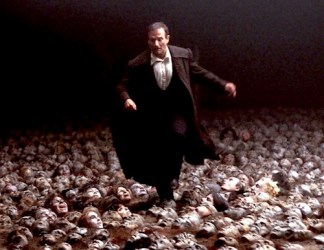
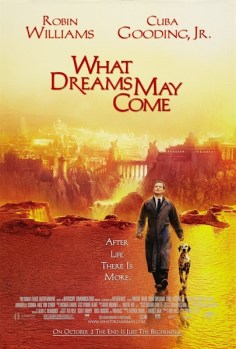
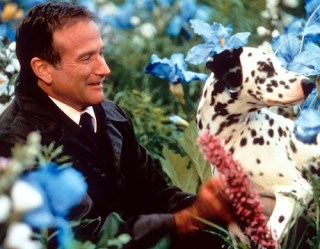
Adapted from a novel by Richard “I Am Legend” Matheson, the story concerns Dr Chris Nielsen (Robin Williams) and his wife Annie (Annabella Sciorra). Their perfectly lovely life is shattered when their two kids are killed in a car crash. Despite Annie suffering a mental breakdown, they hang in there… until Chris is killed in another car crash a few years later. He ascends to a kind of Heaven, a wondrous place controlled by his imagination — this is where those visuals come in. However, Chris learns that Annie has committed suicide, and so been condemned to Hell. He vows to do what has never been done, and travel to Hell to rescue her.

Hell, incidentally, also looks incredible, as do the various locales visited by Chris and his companions (played by Cuba Gooding Jr and Max von Sydow) on their way there. Director Vincent Ward and his team have created a rich, engrossing visual space here. It’s not just the Oscar-winning visual effects either, which create Chris’ initial realisation of Heaven as a kind of living painting, but also the locations, their decorations, and some fantastic sets. The design work is brilliant, and the vast majority of it still holds up today. Even the CGI doesn’t look glaringly like 17-year-old graphics, and in many cases what I presume is a mix of live action, models and some CGI is far more effective than the all-CG look it would likely have if made today.
However, the story is… problematic. Its logic comes and goes (the afterlife’s rules have to be obeyed or are able to be broken depending on the situation, for instance), it goes on too long, with too many asides, and there are needless twists, reveals, and reversals that are neither surprising (thanks to their ultimate predictability) nor illuminating (thanks to their unnecessariness). There were too many flashbacks and asides to real life, and I’d have liked it more if it stuck to the afterlife stuff — cut the flashbacks, limit the story to the afterlife quest, and stop mirroring it in the couple’s earlier real-life troubles. That would make the movie shorter, more streamlined, less wishy-washily sentimental, more focused, and therefore better.

Nonetheless, some will identify with the sentimental “love transcends death”-type message more than others, and there’s a chance those who like (or don’t mind) their films to be at the soppier end of the spectrum will genuinely love it. For the rest of us — for anyone who likes visual splendour in their movies, anyway — it does indeed merit a look for the imagery alone.
3 out of 5

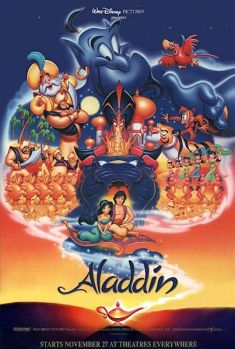
Aladdin (1992)

100 Films’ 100 Favourites #1

Imagine if you had three wishes,
three hopes, three dreams
and they all could come true.

Country: USA
Language: English
Runtime: 90 minutes
BBFC: U
MPAA: G

Original Release: 25th November 1992 (USA)
UK Release: 18th November 1993
First Seen: VHS, c.1993

Stars
Scott Weinger (Aladdin and the King of Thieves, Shredder)
Robin Williams (Good Will Hunting, Insomnia)
Linda Larkin (The Return of Jafar, Joshua)
Jonathan Freeman (The Return of Jafar, The Ice Storm)

Directors
Ron Clements (Basil the Great Mouse Detective, Hercules)
John Musker (The Little Mermaid, The Princess and the Frog)

Screenwriters
Ron Clements (The Little Mermaid, The Princess and the Frog)
John Musker (Basil the Great Mouse Detective, Hercules)
Ted Elliott (The Mask of Zorro, Pirates of the Caribbean: The Curse of the Black Pearl)
Terry Rossio (Shrek, Pirates of the Caribbean: At World’s End)

Story by
Deep breath… Burny Mattinson and Roger Allers, Daan Jippes, Kevin Harkey, Sue Nichols, Francis Glebas, Darrell Rooney, Larry Leker, James Fujii, Kirk Hanson, Kevin Lima, Rebecca Rees, David S. Smith, Chris Sanders, Brian Pimental & Patrick A. Ventura.

Based on
The folktale of Aladdin and the magic lamp from One Thousand and One Nights, aka The Arabian Nights.

Music
Alan Menken (Little Shop of Horrors, Tangled)

Lyrics
Howard Ashman (Little Shop of Horrors, Beauty and the Beast)
Tim Rice (The Lion King, Evita)

The Story
Street urchin Aladdin falls for bored Princess Jasmine when she sneaks out of her palace one day, leading him to the clutches of evil vizier Jafar, who needs Aladdin to retrieve a magic lamp as part of his scheme to rule the land. When Aladdin accidentally discovers the lamp’s inhabitant, a wish-granting Genie, he uses his wishes to set about wooing the princess. Jafar, of course, has other ideas…

Our Hero
One jump ahead of the bread line, one swing ahead of the sword, steals only what he can’t afford (that’s everything). Riffraff, street rat, scoundrel. It’s Aladdin, of course.

Our Villain
Grand Vizier Jafar, a plotting underling — the kind of role that has strong precedent in fiction, I’m sure, though Conrad Veidt as villainous Grand Vizier Jaffar in The Thief of Bagdad is rather clearly the direct inspiration.

Best Supporting Character
Oh, I don’t know, maybe… the Genie! Fantastically voiced by a heavily-improvising Robin Williams, praise is also deserved for Eric Goldberg’s character animation, which matches him every step of the way. In fact, it was an animation Goldberg created using one of Williams’ stand-up routines that convinced the comic to take the part.

Memorable Quote
Aladdin: “You’re a prisoner?”
Genie: “It’s all part and parcel, the whole genie gig. Phenomenal cosmic powers! Itty bitty living space.”

Memorable Scene
Trapped in a desert cave, Aladdin accidentally rubs a lamp and unleashes the Genie — and with it, Robin Williams’ all-time-great hilarious performance.

Best Song
For me, it’s Prince Ali, the huge Genie-led number as a disguised Aladdin arrives back in town in grandiose style. The Genie’s big solo number, Friend Like Me, is an incredibly close second. Soppy A Whole New World won all the awards, because of course it did.

Truly Special Effect
Only the second time Disney used CGI with 2D character animation. In Beauty and the Beast, it built a room for the characters to dance in; here, there’s a character (the entrance to the cave) and a whole action sequence (the flying carpet escape from said cave). It earnt the team a BAFTA nomination. There’s no shame in what they lost to: Jurassic Park.

Making of
Robin Williams ad-libbed so much of his role as the Genie — generating almost 16 hours worth of material, in fact — that the film was rejected for a Best Adapted Screenplay Oscar nomination.

Previously on…
Aladdin is Disney’s 31st Animated Classic, their official canon of animated movies. It’s the fourth film in the “Disney Renaissance”, the decade-long period (starting with The Little Mermaid and ending with Tarzan) when they had a run of films that were critically and financially successful (unlike those before and after said period).

Next time…
Two direct-to-video sequels, the second of which is quite good; in between those, a TV series ran for 86 episodes(!); a Broadway adaptation debuted in 2014 (it’s coming to the West End in May); not to mention numerous video games and appearances in other works, almost all still voiced by the less-starry names among the original cast. The go-to new voice for the Genie? Dan “Homer Simpson” Castellaneta.

Awards
2 Oscars (Original Song (A Whole New World), Original Score)
3 Oscar nominations (Sound, Sound Effects Editing, Original Song (Friend Like Me))
2 BAFTA nominations (Score, Special Effects)
1 Annie Award (Animated Feature)
3 Saturn Awards (Fantasy Film, Supporting Actor (Robin Williams), Younger Actor (Scott Weinger))
1 Saturn nomination (Music)
Nominated for the Hugo for Best Dramatic Presentation.

What the Critics Said
“What will children make of a film whose main attraction — the Genie himself — has such obvious parent appeal? They needn’t know precisely what Mr. Williams is evoking to understand how funny he is. […] What will come through clearly to audiences of any age is the breathless euphoria of Mr. Williams’s free associations, in which no subject is off-limits, not even Disney itself.” — Janet Maslin, The New York Times

Score: 94%

What the Public Say
“the perfect Disney film, one that cleverly combines the sensibilities of classic and modern audiences, one that matches toe to toe with many of the studio’s greatest films. You may prefer the emotional heart-ache of The Lion King or the romantic magic from Beauty and the Beast, but I would always prefer the witty and charming Aladdin.” — feedingbrett @ Letterboxd

Verdict

Hailing from slap-bang in the middle of the Disney Renaissance, Aladdin may not be quite as strong as the films either side of it (Beauty and the Beast and The Lion King), but it’s the next best thing. Buoyed by Robin Williams’ top-drawer performance (have I mentioned that yet?), multiple toe-tapping musical numbers, and a dastardly villain who’s among Disney’s best — and is just one of several great supporting characters here, actually — Aladdin is an A-grade animated Arabian adventure.

In #2 no one can hear you scream.

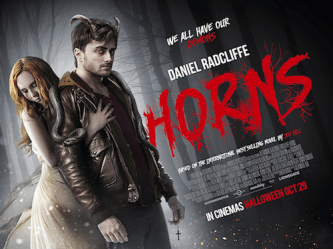
Horns (2013)

2015 #173
Alexandre Aja | 120 mins | streaming (HD) | 2.35:1 | USA & Canada / English | 15* / R

Did Daniel Radcliffe murder his girlfriend? Sprouting devilish horns doesn’t help his case…

Ostensibly a fantasy-horror murder-mystery, in execution Horns is mostly black comedy: the horns force people to tell the truth, to amusing effect. The mystery is so-so: it’s glaringly obvious whodunnit… though, ironically, one reason it’s obvious is ultimately inaccurate. Oops.

It goes wrong in the overblown climax. It’s like someone didn’t know how to conclude the story so went all-out Fantasy. It would’ve been stronger to stay grounded, stick with the characters’ emotions, rather than getting sidetracked into a profusion of effects.

Still, fun while it lasts.

4 out of 5

This drabble review is part of the 100 Films Advent Calendar 2015. Read more here.

* Horns was cut to get that 15 — details here. It’s available uncut, rated 18, on Blu-ray (but not DVD). Unusually, it’s the edited version that’s on Netflix UK. ^

Mr. Holmes (2015)

2015 #165
Bill Condon | 104 mins | Blu-ray | 2.40:1 | UK & USA / English | PG / PG

Once-great detective Sherlock Holmes (Ian McKellen) has retired to the countryside with his housekeeper (Laura Linney), her son Roger (Milo Parker), and his bees, but an unsolved case from late in his career troubles his dementia-addled mind. As he tries to remember the events, we also learn the significance of a trip he recently made to Japan, and the benefits of his growing friendship with Roger.
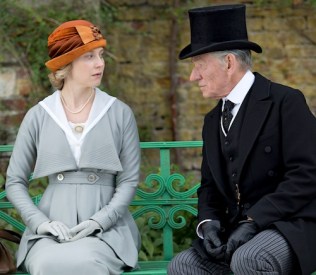
The story is slight and the pace sedate, the latter seemingly to stretch the former to feature length. I’m not saying it needs the quick-cut whizziness of Sherlock or the Downey Jr movies — doubly so as this is a movie about an older, slower Holmes — but there are times when it could do with a bit of a kick up the backside. It doesn’t help that Bill Condon’s direction goes for stately “prestige picture”, making this feel like a movie that could’ve been made at any point in the last 30 years. Again, I’m not calling for more bombast, but a little more flair wouldn’t have gone amiss.

There are strong thematic threads, though, about loss, loneliness, and the strength and importance of fiction. This is barely a mystery movie, and certainly not a thriller; it’s a character drama that happens to be about a detective and his last unsolved (or, rather, unremembered) case. Nonetheless, it didn’t need to be so ponderous about it. As such, the film is all about McKellen’s dual performance, playing Holmes both in his 60s and at 93, when he’s struggling with memory loss and slowly dying in retirement. The difference between the two versions is striking, achieved with minimal make-up but instead primarily via two very different types of physicality. It’s a showcase for the actor, as well as being a grand interpretation of the Great Detective.

Alongside him, the lad, Milo Parker, is very good, managing to holding his own against the knight of the realm. Also excellent is Hattie Morahan, playing the object of the case in Holmes’ flashbacks. She’s probably best known for playing embattled fellow parent Jane in Outnumbered, but she first garnered attention as one of the leads in the 2008 Sense & Sensibility miniseries and has done mostly dramatic work since, too. This is a relatively small part, but a high quality performance. Conversely, nominal co-lead Laura Linney is woefully miscast as the middle-aged housekeeper, struggling with an accent so poor I wouldn’t even like to attempt to guess where it’s meant to hail from. Otherwise, there are an array of recognisable faces (Roger Allam, Frances de la Tour, Francis Barber, Phil Davis, John Sessions) playing blink-and-you’ll-miss it roles that are beneath almost all of them.

There is much to commend Mr. Holmes, not least McKellen’s performance, but by the end I found myself feeling disappointed. Perhaps I’d invested too much expectation — it’s a great actor playing one of my favourite characters, after all — and it will improve on a future viewing. For now, I felt it could’ve been more.

3 out of 5

This review is part of the 100 Films Advent Calendar 2015. Read more here.

The Informant! (2009)

2015 #133
Steven Soderbergh | 104 mins | streaming (HD) | 16:9 | USA / English | 15 / R

The InformantMatt Damon turns whistleblower (or does he?) in this amusing romp based on a true story of complicated corporate fraud.

Director Steven Soderbergh is clearly having fun: despite the ’90s setting, the aesthetics harken back to the ’70s and its political exposé movies; while Marvin Hamlisch’s fun score references Bond during mundane stuff but offers tunes you’d expect from a farce during undercover FBI business.

If you want to follow the ins and outs you have to pay attention, but the main thrust is conveyed in the flow. Besides, such specifics barely matter to the farcical fun Soderbergh largely achieves.

4 out of 5

This drabble review is part of the 100 Films Advent Calendar 2015. Read more here.

Le Mépris (1963)

aka Contempt

2015 #190
Jean-Luc Godard | 103 mins | DVD | 2.35:1 | France & Italy / French, English, German & Italian* | 15

Le Mépris establishes its two main themes with its two opening shots. First, a static shot of the film’s cinematographer, Raoul Coutard, filming a scene from the film, over which writer-director Jean-Luc Godard reads out the credits, which never appear on screen. This is a movie about moviemaking, and its inherent artifice. Second, a shot of Brigitte Bardot’s naked bottom. This is a movie about a man being in love with Bardot (well, the character she plays), and another man lusting after her, and what happens when the first man pats a different bottom. Maybe.
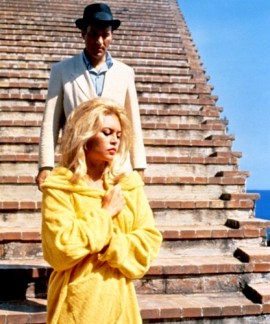
The first man is Michel Piccoli, playing a playwright turned screenwriter who is only in it for the money, to buy a flat to share with Bardot to keep her happy. But she doesn’t want it. Or she does. Or maybe she doesn’t. The second man is Jack Palance, playing an American studio executive who’s paying the writer, but who seems to covet Bardot. It’s his assistant/translator whose bottom gets patted, in a relatively innocent matter. As innocently as an attractive Frenchman in Italy in the ’60s ever pats a woman’s bottom, anyway. The film is being directed by Fritz Lang, playing Fritz Lang, who comes out with some words of wisdom but mainly is present to represent the art of cinema. The playwright doesn’t see it as art, because it’s not a play. The producer doesn’t want it to be art, because he wants to make money.

All of this plays out over a day or two in some very long scenes. Indeed, the centrepiece is a 34-minute quiet, passive-aggressive argument between the playwright and Bardot in the aforementioned flat. They go round in circles about staying together or being apart. The point? Your guess is as good as mine. Perhaps it’s the unknowableness of the other gender (whichever gender you are). Perhaps it’s just the unknowableness of other people fullstop. Perhaps it’s the unknowableness of our own emotions — eventually Bardot decides she does want to leave the playwright to run off with the producer, but no one seems to know why.

Apparently it’s somewhat autobiographical. Maybe that explains everything.

There are attractive performances from all concerned, and gorgeous saturated cinematography by Coutard. The location manager has also done superlative work, from the run-down mostly-deserted Cinecittà studio the film opens in, to the stunning and unusual holiday home in Capri where it comes to a head. Even if you’re left a little baffled by the exact point of what you’re watching, at least it’s pretty to look at.

4 out of 5

Le Mépris was viewed as part of my What Do You Mean You Haven’t Seen…? 2015 project, which you can read more about here.

This review is part of the 100 Films Advent Calendar 2015. Read more here.

* All 4 languages are prominently spoken at times, but it’s mainly French, with a big dose of English from Jack Palance. On the Criterion DVD, the German and Italian parts aren’t even unsubtitled. ^