Deadpool (2016)

2016 #107
Tim Miller | 108 mins | Blu-ray | 2.40:1 | USA / English | 15 / R

In the US Deadpool was, famously, rated R — which (for those not up on their international film certificates) ostensibly means you have to be over 17 to see it. In the UK it was rated 15, which is much more appropriate, because if Deadpool had a mind it would be that of a 15-year-old boy. Of course, plenty of grown men also have the mind of a 15-year-old boy, and that’s why it’s the highest-grossing R-rated movie (worldwide) ever. And I guess I must still have the mind of someone half my age too, because I loved it.

Spinning off from the X-Men series (more on that later), Deadpool is the story of Wade Wilson (Ryan Reynolds), a former mercenary who falls in love with Manic Pixie Geek Wet Dream Girl Vanessa (Morena Baccarin) before being diagnosed with aggressive cancer. He agrees to radical treatment in an attempt to cure it and be with Vanessa forever ‘n’ that. The treatment drives him pretty much insane, but also ignites his mutant genes, which give him the power of self-healing (like that other mutant whose name rhymes with Polverine…) Permanently scarred and feeling like he can’t return to Vanessa, Mr Pool sets out for revenge.

Yeah, it’s a pretty standard superhero origin plot. But the devil is in the details, and it’s how Deadpool tells its story that matters — the narrative is just a framework on which to hang the gags. The immediate point of comparison on a superhero comedy is surely Kick-Ass, and it doesn’t take deep analysis to see that Deadpool isn’t as subversive as that movie. Where Kick-Ass comments on, at times even deconstructs, the superhero genre, Deadpool takes its rules as a given and throws a shedload of humour on top of it. Is that a problem? It depends what you’re looking for. I think Deadpool’s makers set out to make a superhero film that was genre-aware and prepared to take the piss out of that, but I don’t think they were aiming to deconstruct superhero narratives. It might make Deadpool a less ‘intelligent’ movie than Kick-Ass, but it doesn’t stop it being entertaining.

That doesn’t mean Deadpool’s makers are short on cleverness, though. The film’s structure is particularly nifty: it gets right into the action, then mixes the back story in as it goes on. This avoids either, (a) boring stretches while we wait for the hero to turn up, or (b) shoehorning in fight sequences where they don’t belong just so that the action quotient is met upfront. Plus it allows for a few transitioning gags and flashback humour, which I’m not sure we’ve seen since Fight Club. It’s well-paced too, the story positively flying by. This may be somewhere else the familiar shape of the story works in its favour — we know where this is all going, so it doesn’t need to dwell on plot details. No one’s really here for the plot, so why not?

The jokey opening credits say that the writers are “the real heroes here”, the joke being they wrote the credits so of course they’d call themselves the heroes. But it’s also true. I mean no disservice to the producers who persuaded the studio to greenlight it, or director Tim Miller’s handling of the material, or Reynolds embodying the character so well — they’ve all undoubtedly contributed enormously to the film’s success (and I’m sure there’s a ton of improvisation in the final cut, so even more so) — but a lot of what makes the film really work, in a way that goes beyond just “it had some funny bits and some cool action”, is that structure, that pace, those gags… which, as just discussed, can well have come from the cast and director, and editors and stuff, too. So what I’m basically saying is: everyone’s a winner! Yay!

So what of that humour? It’s an R-rated action-comedy, you know what to expect: Swearing! Crudeness! Nudity! Throwing in four-letter words and assuming that counts as a joke! Well, Deadpool does have swearing and crudeness, but it’s not so completely mindless about it. It has violence and nudity, too, just like the good old days of R-rated action movies. But it doesn’t resort to throwing any of those in for cheap humour — they’re there because they are there and can be there, not as a get-out-of-actually-coming-up-with-gags card. Most R-rated comedies these days factor somewhere on a scale of “saying a rude word just to get a laugh”, that scale stretching from “just doing it once or twice” to “all the ‘humour’ in the film”. Such words are thrown around liberally here, but if there was an occasion where that was substituted for an actual gag then it didn’t stick in my mind. That doesn’t mean it isn’t crude, or using Rude Things for laughs, but it’s not just going, “I said the F word, at a time when I shouldn’t say the F word — isn’t that funny?!”

There’s one particular type of humour that Deadpool is most famous for, of course. From the self-parodying, Honest Trailer-inspired opening credits, to the Ferris Bueller-referencing, Marvel pillorying post-credits scene, Deadpool less breaks the fourth wall, more obliterates it, then stomps on the rubble until it’s in little tiny pieces, then grinds those under its shoe until they are dust, then snorts that dust and digests it, then… well, y’know. The film handles this really well: it’s not a non-stop commentary, but it’s also not isolated off in little clumps, like, “this had to be here but it’s kinda awkward to have him always talking to the audience”. It’s often used for irreverence, and I like a bit of irreverence. There are clearly some rules and/or considered choices with this fourth-wall breaking, though. In his commentary on the deleted scenes, Miller says that Reynolds kept wanting to pull the boom mic down from out of frame and use it to batter one of the villains, or something along those lines, but Miller thought this would be breaking the film’s rules. That’s a pretty fine line to tread — knowing he’s in a film, but not, like, using the fact he’s in a film… I guess it’s more of a “what feels right” set of choices than a little rulebook.

One of my favourite little fourth-wall breaks is Deadpool’s one-liner when he’s dragged off to meet Professor X, which brings me somewhat neatly to the film’s relationship to its franchise mothership. I think I’d assumed it would be kind of subtle about the fact it’s technically an X-Men movie, even though everyone knows Deadpool was in X-Men Origins and this co-stars Colossus who’s been in several X-Mens at this point. That expectation was cemented by the number of reviews/blog posts/etc that have continued to refer to Apocalypse as the 8th X-movie. But no: within ten minutes we have a scene explicitly set at Xavier’s School, and Colossus has dialogue about Deadpool refusing to join the X-Men. References and connections to the X-Men are too numerous to count from then on out. This isn’t a movie hiding away its connections as a technicality only comic book fans will know about, which is something the main X-franchise has arguably done at times (though Apocalypse marks a distinct change in that, explicitly making Cyclops and Havok brothers, and stating that Magneto is Quicksilver’s dad… but I digress).

One of the film’s best bits comes courtesy of that X-connection: stroppy teenage goth mutant Negasonic Teenage Warhead (excellent newcomer Brianna Hildebrand), and her immensely comic-faithful costume. Ironically, it’s not at all faithful to how NTW is portrayed in the comics (and you can find dozens of think-pieces about how the film changed her character and how that’s more than OK, if you’re so inclined), but it is generally like X-Men comic costumes, certainly ones that cropped up in the early ’00s. (I swear there was a Frank Quitely New X-Men cover showing a bald female in a costume really like NTW’s yellow-and-black X-Men uniform, but I can’t find it now. Maybe I imagined it.) Comic-faithful costumes are very much the MO of Marvel movies nowadays, but because the X-Men film franchise sprung from the “how do we make superheroes acceptable in movies?” period of the genre, the X-movies have never really done that before (though they do sort of, in passing, at the end of Apocalypse — I’m beginning to think we’re one day going to look back at that as a transition movie, assuming the next one goes super comic-book-y). I mean, this doesn’t really signify anything about Deadpool, I’ve just gone off on a geeky tangent.

Deadpool does have flaws, and other reviews have certainly pointed them out: it’s not always hilarious (well, how many comedies are?), it’s another origin story (I believe I mentioned this one), it mocks superhero tropes but ticks most of the same boxes (ooh, I did that one too!), it has a somewhat low-rent feel… which, actually, I don’t get. I mean, it cost $58 million — a sliver of the budget of most blockbusters nowadays, but only slightly less than Jurassic Park cost (20 years ago), and 33% more than Serenity cost (10 years ago). It actually looked bigger-budgeted than I was expecting. The action sequences are really good, for one thing. If it feels small compared to other blockbusters, that’s just a complaint brought about by too much money being spent on movies nowadays — go watch a Big Budget Blockbuster from the ’80s or ’90s and you might be surprised how low-key half of them are. Tsk, young(er-than-me) people.

Speaking of which, I do feel like I should be mature enough to have grown out of loving Deadpool… buuuut tough. It’s fantastic fun. Though, it’ll be interesting to see how it holds up to re-watches. I’ve read reviews which point out it doesn’t have the substance underneath the jokes that Kick-Ass does (did I mention that already? I didn’t steal that point from someone else, nope, noooo sir), so while Matthew Vaughn’s film is completely enjoyable on multiple go-rounds, any enjoyment to be found in Deadpool will ultimately fade once the novelty has gone. I mean, that’s possible — literally, only time will tell — but there’s not necessarily anything wrong with a “first time is definitely the best” movie, if that first time is good enough. Heck, The Game made it into my 100 Favourites with exactly that experience.

Anyway, until I do re-watch it, I really enjoyed it. How much?

5 out of 5

That much.

Deadpool is released on DVD and Blu-ray in the UK today.

It placed 8th on my list of The 20 Best Films I Saw For the First Time in 2016, which can be read in full here.

The Equalizer (2014)

2016 #37
Antoine Fuqua | 127 mins | streaming (HD) | 2.35:1 | USA / English, Russian & Spanish | 15 / R

Back in the ’80s, everyone’s favourite actor whose name is also the punchline to a joke (“what do you call a man with three planks on his head?”), Edward Woodward, starred in a US TV drama about a former secret agent who uses those skills to exact vigilante justice for innocents who can’t help themselves. I’ve never seen it, but I guess it was popular back in the day because, 25 years after it ended, it was rebooted on the big screen. Or maybe they’ve just run out of popular stuff and are now rebooting anything and everything they can get their hands on. Either way, it’s a decent enough IP to fashion into a contemporary action-thriller, and indeed director Antoine Fuqua has made a decent-enough contemporary action-thriller.
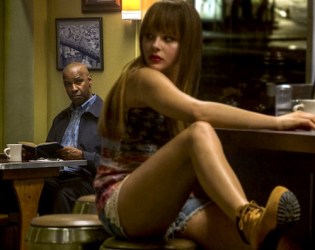
In this iteration, Robert McCall (Denzel Washington) is, by day, a mild-mannered member of staff at whatever the US equivalent of B&Q is; but by night, memories of his former life as some kind of special agent keep him awake, so he hangs out at a diner where he regularly bumps into working girl Teri (Chloë Grace Moretz). After she’s hospitalised by a client, McCall feels he can’t sit on the sidelines anymore, and applies his Very Special Skills to her pimps — just to, you know, equalise things. Unfortunately, turns out those pimps were Russian gangsters, and now McCall has a bigger fight on his hands…

The Equalizer is a decently-made, well-performed, pretty entertaining action-thriller for fans of the genre. There’s nothing fundamental to complain about if you take it for what it is, and anyone who enjoys inventive deaths will be tickled by some sequences. Otherwise, it lacks originality, remixing familiar tropes and plot points into a passably-new shape.

Viewers who as a rule don’t enjoy this kind of movie will find nothing remarkable. Equally, fans of the genre will be perfectly entertained for a couple of hours.

3 out of 5

A Boy and His Dog (1975)

2016 #19
L.Q. Jones | 90 mins | streaming | 2.35:1 | USA / English | 15 / R

Based on a novella by esteemed author Harlan Ellison, this is a low-budget sci-fi comedy-drama about a horny teenager (Don Johnson) and his telepathic dog (voiced by Tim McIntire) surviving in a post-apocalyptic wilderness, who are lured into a weird underground world. It’s a film fuelled by weirdness, left-field ideas, and a controversial tragicomic ending.

It’s a “not for everyone” kind of film that, I must confess, I found hard to properly engage with thanks to watching the poor quality, overly dark, windowboxed copy that used to be hosted on Amazon Prime Instant Video.

One to try again someday, maybe.

3 out of 5

The Revenant (2015)

2016 #103
Alejandro G. Iñárritu | 156 mins | Blu-ray | 2.40:1 | USA, Hong Kong, Taiwan & Canada / English, Pawnee & French | 15 / R

Oscar statue2016 Academy Awards
12 nominations — 3 wins

Winner: Best Actor, Best Director, Best Cinematography.
Nominated: Best Picture, Best Supporting Actor, Best Film Editing, Best Costume Design, Best Makeup and Hairstyling, Best Sound Mixing, Best Sound Editing, Best Visual Effects, Best Production Design.

The Revenant is the Oscar-winning, acclaim-gathering story of Hugh Glass, the expert guide for a pelt-collecting group (is that what they are? Is that a thing?) in the Old West, who’s mauled by a bear to within an inch of his life. Eventually betrayed and left for dead by the members of the group who’d vowed to stay with him to the end, Glass somehow survives, and crawls across the wintery wilderness in search of his revenge! And it’s all the more remarkable for being based on a true story… though this retelling contains approximately as many “historical events that actually occurred” as does Game of Thrones.

The main talking point of The Revenant has been Leonardo DiCaprio’s performance, which finally bagged him an Oscar after four unsuccessful nominations (and I’m sure plenty of other roles that he thought might snag him some Academy recognition but didn’t). How much is it acting and how much was it just an endurance test that director Alejandro González Iñárritu subjected him to? Is there a difference? If you have to suffer for great art, Leo certainly did that. In some ways it’s testament to the Academy being able to look past delivery of dialogue as an indication of performance quality, because Glass doesn’t speak much — not when he’s in the company of others, and certainly not when he’s trying to get by on his lonesome, which he is for much of the film. Nonetheless, Leo conveys thoughts and emotions — which do go beyond, “I can’t believe Iñárritu is making me eat this raw liver” — effectively through expression and action.

In some respects it’s a shame the rest of the cast were consequently overshadowed — Leo may spend a huge chunk of the film on his own, but there are frequent cutaways to what everyone else is up to. Tom Hardy is the obvious standout as selfish bastard Fitzgerald, a perfectly detestable but completely believable villain — I’m not saying we’d all sink to his depths, but I’m not convinced most of us are above some of the choices he makes, either. Will Poulter steps outside the comedy roles he’s mostly taken since his Son of Rambow debut to give an effective turn as the group’s youngest, most conflicted member, while Domhnall Gleeson is commanding as the group’s leader. Gleeson was something of a lucky charm last awards season, appearing in no fewer than four Oscar-nominated films, including two that were up for Best Picture. Not only that, but look at his turn here (as an honourable, disaster-struck Captain) alongside his appearances in those other films (a small town nice guy in Brooklyn; an inexperienced evil military commander in Star Wars; a naive, selfish, sort-of-moral, easily-led programmer in Ex Machina) and you can see the kid’s got range.
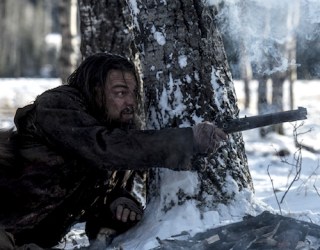
Far from just an acting showcase, The Revenant is a film of thematic weight. In fact, it’s like an old-fashioned blockbuster — the kind of thing you’d’ve seen in the 1950s (epic revenge Western) or 1970s (bleak revenge Western) as among the year’s biggest movies — crossed with a slow-paced, scenery-loving, meditative arthouse piece. If it’s about anything (beyond, y’know, the plot), it’s surely about nature — both the amazing vastness of natural spaces, but also the brutality of survival. And not just humans, either, which is the go-to simplistic message (“isn’t nature good? aren’t humans bad?”) of such cod-thoughtful fare. Like the rest of nature, humanity is varied: there are some very harsh, cruel acts herein, but also acts of kindness — sometimes perpetrated by the same people.

The avoidance of pat depictions extends to its portrayal of Native Americans, too. They’re neither simplistic Evil Foreigners, nor a “we’re so sorry for how we’ve treated them before, they’re great really” apologia. Instead, they’re just as brutal and as human as the rest of us, and made up of varied groups who behave differently, or even slaughter among themselves. The main band of Indians we see do serve as the film’s villains (as if Fitzgerald wasn’t bad enough), a hunting party acting out an inverted Searchers as they hunt for a kidnapped daughter. In The Searchers the group hunting and killing in search of a girl are the heroes; here, they’re the villains. Makes you think, don’t it? I’m not accusing Iñárritu of casual racism — I imagine that’s exactly their point.
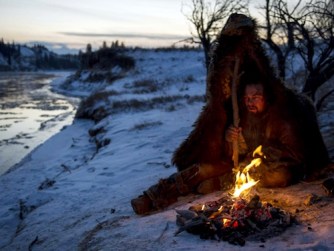
And speaking of Iñárritu, I wonder if this is his first genuine masterpiece. I didn’t care for 21 Grams or Babble, and Birdman was good but overrated. (In fairness, I’ve not seen Biutiful, which people seem to disregard nowadays, or Amores Perros, which is a rare foreign language film in the IMDb Top 250.) It seems like he was a nightmare during production — the budget was set at $60 million, but ultimately more than doubled to $135 million due to delays thanks to his production choices. In hindsight it looks like genius — “I knew it would be amazing so we kept going” — but if it had flopped, I’m sure an awful lot more would’ve been made of Inarritu’s excessively picky directorial style and fractious treatment of the crew, which apparently led Tom Hardy to try to strangle him…

At the Oscars, I was pulling for Roger Deakins to make it 13th time lucky, or for Mad Max to do a technical sweep and take cinematography with it (not undeservedly); but having now actually seen Lubezki’s work on The Revenant, it’s hard to deny it’s an immensely deserving winner. His mastery of all elements of the form is on regular display: the use of light (all natural!), perspective, lenses, focus; the single-shot techniques he and Iñárritu learnt for Birdman are put to superior use here, creating some stunning sequences (rather than taking over the entire movie). It looks incredible on Blu-ray, too — so detailed, crisp, epic. If anything was going to convince me 4K was an idea worth investing in, it’s material like this. (The cost of a new TV, new Blu-ray player, re-buying films, and the real estate needed in the lounge for a screen big enough to appreciate it puts the other half me off again.)
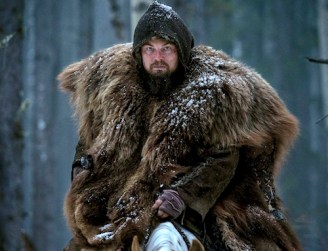
The film’s biggest flaw is that it goes on a bit too long in the middle. I’m not saying it needs to be a fast-paced thrill-ride, I just think it lingers a little longer than it needs to in places. Individual shots are beautiful, but the sheer volume of them stretches the centre part thin. There’s probably one too many action sequences where Indians attack and our hero has to escape, not least the one that ends in a too-obviously-CGI dive off a cliff. Equally, for every one of those there’s an incredible sequence, like the opening Indian attack. For a film that could easily be described as arthouse-y and thematically-driven, there are some truly stunning action scenes. The long middle means you couldn’t really call it “an action movie”, but focus on the first and last acts and it absolutely is.
I slipped in the word “masterpiece” a few paragraphs back, and I’d wager that’s what The Revenant is. It’s not perfect, and I don’t know that I’d say it’s the best film of last year either; but it is magnificently made, telling its story in a way only cinema can truly manage.

5 out of 5

The Revenant is out on DVD and Blu-ray in the UK as of yesterday.

It placed 4th on my list of The 20 Best Films I Saw For the First Time in 2016, which can be read in full here.

Teenage Mutant Ninja Turtles (2014)

2016 #48
Jonathan Liebesman | 97 mins | streaming (HD) | 2.35:1 | USA / English & Japanese | 12 / PG-13

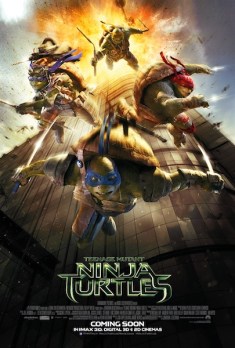
While I was killing time waiting for my coffee to brew before I sat down to watch Teenage Mutant Ninja Turtles, 2014 edition, I drafted the introductory paragraphs to this review. Yes, before I’d even started the movie, so sure was I that I would dislike it. Naturally they took an appropriately condemnatory tone, talking about how it was a product and not a movie, designed primarily to sell tie-in plastic to grown men who wish they were still children, etc etc. Unfortunately writing those paragraphs was a waste of my time, because I can’t use them, because — shock of shocks — I actually quite liked this movie.
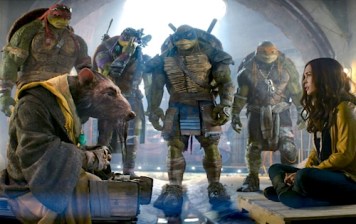
Now, let’s immediately throw some caveats on that, because it’s clearly riddled with flaws. The story is slight and so filled with over-familiar tropes that it barely bothers to play them out in full. On the bright side, that does mean it rattles along. However, the grand plan/climax is lifted straight from The Amazing Spider-Man. The action is often poorly directed, a too-close whirlwind of pixels. That said, there’s one sequence so OTT crazy that — if you ignore that the film is supposed to be live action and embrace the wild camerawork, physically impossible antics, and mind-boggling speed — it’s almost impressive. The CGI is variable: the Turtles themselves actually look alright, maybe even good, but Splinter is piss poor.

Megan Fox is miscast, not that she can act anyway. She’s clearly only there because producer Michael Bay thinks she’s hot (bit too plastic for my taste). Shredder is Bay-ed to the max, essentially becoming a Transformer made of knives. The Turtles’ personalities are pretty one-note, but not unfaithful to the original — the franchise started life as a spoof of things like Daredevil, after all, not a realistic character drama. That said, turning Mike into basically a turtle version of Michael Bay — i.e. he’s focused on lusting after Megan Fox and occasionally causing explosions — is a little cringe-y. Quite a few bits are a little cringe-y, actually; but they’re tempered by a few comedic bits that hit home, and a general veneer of “well, it could’ve been worse”.
“Well, it could’ve been worse” is pretty much the definition of “damning with faint praise”, but for all those many problems, I actually enjoyed myself while watching the film. It was funny enough, it was exciting enough, it was almost well-made enough. It’s not a good movie, but I did think it was an “entertaining enough for a couple of hours on a particularly lazy evening” kind of movie. And, despite the weak reviews it’s been receiving, the trailers for the second movie make it look better. I’m not going to fork out cinema prices to see it anytime soon, but on the strength of this first one, I will eventually. Which may not please the plastic-pedlars, exactly, but is a better result than I’d expected.

3 out of 5

Teenage Mutant Ninja Turtles: Out of the Shadows is in cinemas worldwide now.

The Assassin (2015)

aka Cìkè Niè Yǐnniáng

2016 #99
Hou Hsiao-Hsien | 105 mins | Blu-ray | 1.40:1 + 1.85:1 | Taiwan, China, Hong Kong & France / Mandarin | 12

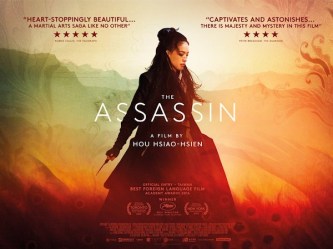
The Assassin is a martial arts drama about Nie Yinniang (Shu Qi), a woman trained since childhood to be a highly-skilled assassin. When her emotions lead her to renege on a mission, her master sets a difficult task for Yinniang to prove herself: she must return to her homeland and assassinate its leader, Tian Ji’an (Chang Chen) — her cousin, to whom she was once betrothed.

The Assassin is also a Palme d’Or nominee, winner of Best Director at Cannes, a BAFTA nominee for Best Film Not in the English Language, and Sight & Sound’s critics’ poll winner for the best film of 2015.

If those paragraphs sound somewhat incompatible, it’s because they kinda are. Has the artier side of the film appreciation world gone genre mad? In short, no. If you take those two paragraphs at face value — martial arts flick vs. Sight & Sound poll-topper — then The Assassin is more befitting of the latter. It’s a slow film, that revels in shots of the countryside or people sat waiting. The backstory is told in infodumps (at least, that’s what we’d flag them as in ‘lesser’ films), while the present narrative comes in dialogue about political intricacies or the looks people give each other at certain times.

So little happens at times that it’s very easy to become disconnected from it. At one point my mind wandered to other films it reminded me of. Ashes of Time, for instance, which was an arthouse-bent martial arts movie that I really liked. Also, oddly enough, The Wolverine. I wondered how and why that film seemed to have been so quickly forgotten, concluding it wasn’t just because it’s not as memorably great as the finest X-Men films, but also because it wasn’t as memorably bad as The Last Stand or X-Men Origins; and therefore that that was pretty unfair, because shouldn’t the fact it’s better (quite a bit better) than those two mean it comes up more often; and— wait, what were we meant to be talking about? Oh yes, this calming scenery shot, which hasn’t ended yet.
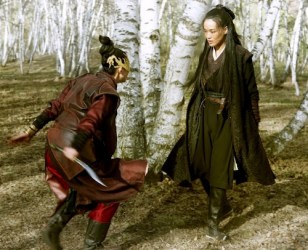
The cinematography is certainly pretty — we’re all agreed on that. Framing it in more-or-less Academy ratio (apparently the ratio shifts slightly from shot to shot, but you’d have to be some kind of wunderkind obsessive to even notice that) is an uncommon choice, but not an unprecedented or unattractive one. However, the choice of ratio is brought to our attention by the inclusion of one scene in widescreen, especially as it’s difficult to see what purpose this serves. It’s not a scenery shot or an action sequence, the kind of things that might benefit from a wider canvas, but someone singing a song in flashback. Maybe it’s simply to differentiate that it is a flashback? That seems a pretty shallow reason for such an extravagance as completely switching aspect ratio, though.

For all that, there is some action, but director Hou Hsiao-Hsien has said he’s more concerned about the before and after of a fight than the process itself — it’s about the mood, the tension, the ultimate outcome of winning or losing, rather than the choreography of the combat — so there’s a lot of build-up for very brief bursts of action. That’s certainly not an invalid way to handle it — it’s Leone-esque, in its way — but it does mean anyone looking for the detailed swordplay or fisticuffs you expect of a martial arts film will come away disappointed.
The Assassin is far from your typical martial arts film, and so will appeal to a different kind of viewer. Hou has said it’s more about the spirit and deeper meanings of martial arts than it is the physical combat, and I can only presume that’s true. Besides looking very pretty, and presenting a (barely explained) adjustment in the mentality of one character, it’s difficult to know what to take away from it.

3 out of 5

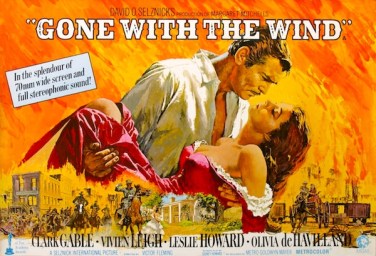
Gone with the Wind (1939)

100 Films’ 100 Favourites #41

The most magnificent picture ever!

Country: USA
Language: English
Runtime: 233 minutes
BBFC: A (cut, 1940) | PG (1988)
MPAA: G (1971)

Original Release: 15th December 1939 (premiere in Atlanta, Georgia, USA)
US Release: 17th January 1940
UK Release: 18th April 1940 (premiere)
First Seen: TV, c.2005

Stars
Clark Gable (It Happened One Night, Mutiny on the Bounty)
Vivien Leigh (Fire Over England, A Streetcar Named Desire)
Leslie Howard (Of Human Bondage, 49th Parallel)
Olivia de Havilland (The Adventures of Robin Hood, The Dark Mirror)
Hattie McDaniel (Show Boat, Song of the South)

Director
Victor Fleming (The Wizard of Oz, A Guy Named Joe)

Screenwriter
Sidney Howard (Arrowsmith, Dodsworth)

Based on
Gone with the Wind, a novel by Margaret Mitchell.

The Story
The American South, 1861: wealthy teenager Scarlett O’Hara spends her days attending parties and flirting with her many admirers, though she only really has eyes for her neighbour, Ashley. After he declares his intention to marry his cousin Melanie, a furious Scarlett meets Rhett Butler, a practically-minded gent who only serves his own interests. When the American Civil War breaks out, Scarlett has to apply her manipulative nature to survival, as down the years she engages in a love/hate relationship with the similarly-tempered Rhett.

Our Heroes
Scarlett O’Hara is the perennial belle of the ball in her Southern community, until the American Civil War comes and she’s forced to grow up. Her innate selfishness and tendency to manipulate people (or try to, at least) helps her survive the conflict in more-or-less one piece. Equally self concerned is Rhett Butler, a gentleman not afraid to stand up to Scarlett, which is why they clash, and why they’re probably made for one another.

Our Villains
Those damn Unionists, with their trying to get rid of slavery and everything!

Best Supporting Character
Hattie McDaniel is memorable, likeable, and Oscar-winning as the O’Haras’ maid, Mammy. Whether her performance was a good thing for the African American community or just an ‘Uncle Tom’ is another matter.

Memorable Quote
“As God is my witness, as God is my witness they’re not going to lick me. I’m going to live through this and when it’s all over, I’ll never be hungry again. No, nor any of my folk. If I have to lie, steal, cheat or kill. As God is my witness, I’ll never be hungry again.” — Scarlett O’Hara

Quote Most Likely To Be Used in Everyday Conversation
“Frankly, my dear, I don’t give a damn.” — Rhett Butler

Memorable Scene
In the streets of Atlanta, Scarlett comes across the casualties from the battle. First we only see her face as she comes upon a shocking sight. Then it cuts to a long-shot: Scarlett stood by some soldiers, a couple of wounded men on the ground before her. The camera tracks back as Scarlett walks forward, gradually revealing the field of wounded soldiers she’s walking among. It continues to pull back, up into the sky, for a full 55 seconds, the injured stretching as far as the eye can see as a damaged Confederate flag flutters into view in the foreground.

Technical Wizardry
The Technicolor photography by Ernest Haller is absolutely gorgeous, and looks better than ever nowadays thanks to new restoration techniques developed in 2004 (12 years ago?! Where does time go?) That restoration is where the real wizardry lies. Gone with the Wind was shot with Technicolor’s three-strip process, in which a prism split the light entering the camera into its green, red and blue parts, which were each exposed on a strip of black-and-white film. These strips were then dyed the appropriate colour, before being combined onto a new film to create the final full-colour print. Naturally this process was liable to human error: misalign one of the strips by even the slightest amount and you get errors; small and almost unnoticeable, maybe, but less than perfection. In 2004, they went back to the original three strips and, using complicated new computer programs, realigned them from scratch. This perfect alignment revealed details that have always been on the film but would never have been seen before, meaning these movies (they also did it for the likes of The Wizard of Oz, Singin’ in the Rain, and The Adventures of Robin Hood) literally looked better than they ever had. Magic.

Letting the Side Down
There are a raft of criticisms that can be levelled at Gone with the Wind, from its depiction of black characters, to making the South seem not so bad, to the faithfulness of its adaptation (too much). The second half is certainly less focused and less memorable than the first, but the whole overcomes that, for me.

Making of
The search for an actress to play the leading role of Scarlett O’Hara is legendary — it was even dramatised in an Emmy-winning TV movie in 1980. In all it lasted two years, including an open casting call that interviewed 1,400 unknowns (useless for casting, great for publicity), and the formal screen-testing of 31 actresses, including the likes of Lucille Ball, Clara Bow, Joan Crawford, Bette Davis, Katharine Hepburn, Ginger Rogers, Barbara Stanwyck, and many more. In the end, it of course went to a young British actress, then unknown in America, called Vivien Leigh. The rest is screen history.

Next time…
Fans and filmmakers alike tried to get Margaret Mitchell to write a sequel until her death in 1949. In the ’70s, her brother agreed a deal with MGM and Universal under which a novel would be written and simultaneously adapted into a film. Despite a 775-page manuscript being produced, the deal fell apart. Numerous sequel novels have been published, and in 1994 one of these, Alexandra Ripley’s Scarlett, was adapted into a miniseries starring Joanne Whalley as Scarlett and Timothy Dalton as Rhett, with a supporting cast that includes Sean Bean, John Gielgud, and Ann-Margret. Apparently it’s not very good.

Awards
8 Oscars (Picture, Actress (Vivien Leigh), Supporting Actress (Hattie McDaniel), Director, Screenplay, Color Cinematography, Art Direction, Editing)
1 Honorary Award from AMPAS (for “outstanding achievement in the use of color for the enhancement of dramatic mood”)
1 Technical Achievement Award from AMPAS (for being “pioneering in the use of coordinated equipment”)
5 Oscar nominations (Actor (Clark Gable), Supporting Actress (Olivia de Havilland), Score, Sound Recording, Special Effects)

What the Critics Said in 1939
“There has never been a picture like David O. Selznick’s production of Gone With the Wind. It is so true to Margaret Mitchell’s novel of the Civil War, as it was fought in and around Atlanta, that the film is of the same epic quality as the book. […] Vivien Leigh, the little English girl imported to play the role of Scarlett, gives a magnificent performance. No other actress in Hollywood, or on the New York stage, could have come close to equalling it. […] She is pert and beautiful, lacking in erudition but the possessor of all the arts and allure of the vital female. She is quick-tempered, selfish, untruthful, sturdy and wilful as a lioness. No attempt has been made to gloss over Scarlett’s weaknesses and sins. As she is, she dominates the picture from its gay and light-hearted beginning to its tragic close.” — Kate Cameron, New York Daily News

What the Critics Said in 1973
“The most interesting way to consider GWTW today is in comparison with the film that may eventually surpass it in profits, The Godfather. Look at the similarities. Both originated in best-selling American novels. Both are very long. Both are about predators. Both are ultra-American yet are very closely allied to Europe (Walter Scott and Sicily). And, most important, both live within codes of honor, and both codes are romances. William R. Taylor has shown, in Cavalier and Yankee, that the ‘Walter Scott’ antebellum South was largely a literary fabrication, concocted at the time, not retrospectively; as for The Godfather, our newspapers show us daily that ‘They Only Kill Each Other’ is just another escape hatch to allow us to blink facts. ‘Us,’ by the way, means the world, not just the United States, since the whole world flocks to both films. And that’s interesting, too, because it leads to a difference, not a likeness. In a new age, when the ‘realistic’ Godfather is packing them in, the romantic GWTW is still popular. There’s a crumb of comfort in that: at least culture is still more pluralist than some of our propagandists would have us believe.” — Stanley Kauffmann, The Atlantic

What the Critics Said in 2015
“Its stereotype of happy slaves and kindly masters has never been more wince-inducing […] But no one watches Gone with the Wind for historical accuracy. What keeps us coming back is four-hours of epic romance in gorgeous Technicolor. Slavery, the Civil War, the burning of Atlanta, a street knee-deep in dead soldiers—all just a backdrop to the main event, Scarlett ’n’ Rhett. The feminist jury is still out on Southern belle Scarlett O’Hara (Vivien Leigh). Nothing but a serial husband-thief? Or a resilient modern woman doing what she can to survive? You decide.” — Cath Clarke, Time Out

Score: 94%

What the Public Say
“What’s striking almost 75 years on is how fresh and modern both Rhett and Scarlett remain. Gable’s eyes twinkle as he rolls Sidney Howard’s dialogue around his mouth, but there’s also a sadness there and a resignation that, no matter how hard he tries, he and Scarlett can never last. Leigh, who came through a tortuous audition process to land the part, positively crackles. Although still one of the feistiest and most driven female parts committed to screen Scarlett is, for the most part, pretty damn annoying and does little to enamour herself as the film progresses. […] Rhett sums Scarlett up perfectly when he remarks that she’s ‘like the thief who isn’t the least bit sorry he stole, but is terribly, terribly sorry he’s going to jail’.” — Three Rows Back

Elsewhere on 100 Films
I briefly reviewed Gone with the Wind after a re-watch way back in 2007, when I assessed that “the direction is brilliant, displaying styles you think weren’t invented for another 20 years; all of the design work is gorgeous; and the story is epic and expertly told, moving across genres (romance, war, melodrama, comedy) with ease. It’s easy to see why this is the most popular film ever made.”

Verdict

Last week I wrote about the enduring mass popularity of The Godfather, and here’s another case in point. Gone with the Wind may not rack up the ratings in the same circles as Coppola’s opus, but it has consistently been voted America’s most favourite movie, and its numerous massively successful re-releases mean that, adjusted for inflation, it’s still the highest grossing movie of all time. It’s an epic in the truest sense of the word, with a story spanning many years and many miles, passing by historical events in the process. However, at its core it’s the story of a tumultuous romance between two people, who may love each other or may hate each other, but who, with their unique, selfish, manipulative perspectives, are surely perfect for each other.

#42 will be… #42 will be… #42 will be…

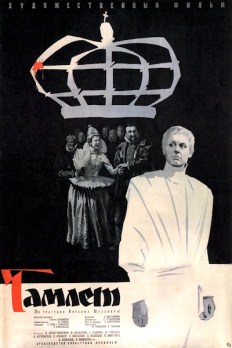
Hamlet (1964)

aka Гамлет / Gamlet

2016 #96
Grigori Kozintsev | 142 mins | TV (HD) | 2.35:1 | Soviet Union / Russian | U

A black-and-white, two-and-a-half hour Shakespeare adaptation in subtitled Russian? No, wait, come back! Actually, don’t bother, because if you’re turned off by any or all of that description then, yeah, this isn’t for you. If you don’t object, however, then you’ll find a film that the likes of Sir Laurence Olivier, Sir John Gielgud, and Sir Kenneth Branagh have hailed as the greatest film adaptation of arguably the Bard’s most revered play.

I shan’t bother to summarise the plot, because if you don’t know the story already this isn’t a film for you. Even for those who have no problem with black-and-white, or Shakespeare, or subtitles, the latter occasionally race by at a rate of knots, making them hard to keep up with. Unless you fancy regularly pausing and/or rewinding, you’ll have to accept that you’re going to miss a line here or there. (If you do keep up with them throughout, well done, you’re better at quickly parsing Shakespearean dialogue than I am.)

For those in a position to appreciate it, however, this is a great version of the play. Based on Boris Pasternak’s translation, it moves through the narrative with reasonable speed, but without losing anything fundamental (as far as I was aware). Director Grigori Kozintsev expressed a particular interest in the political themes, in contrast to their de-emphasis in Olivier’s 1948 film (which I’ve not seen). He particularly highlights Elsinore’s role as a prison, framing characters through bars, constraining Ophelia in a metal corset, and staging Hamlet’s dismissal to England on a courtroom-like set. I felt like Rosencrantz and Guildenstern had bigger roles here than in other versions I’ve seen, with Hamlet’s plot to have them dispatched also given focus. Ophelia’s storyline is more present than normal too, whereas the roles of Gertrude and Horatio felt consequently reduced. This is partly down to which sections of the text are used, but Kozintsev also features dialogue-free realisations of elements of the story, which build up these parts further.

In the famously complex lead role, Innokenty Smoktunovsky gives a Hamlet who you really feel is more intelligent than everyone else around him — like a student fresh home from his studies, who has surpassed his parents and old acquaintances in sheer learning and attentiveness to philosophical topics, but doesn’t yet have a firm handle on his swirling thoughts. It’s possible he’s going genuinely mad with it, too, rather than the playfulness some choose to interpret in the part. Anastasiya Vertinskaya embodies sweet innocence as Ophelia, who Hamlet seems to genuinely care for, but has a poor way of showing it. Conversely, Mikhail Nazvanov makes for a somewhat neutered Claudius — he’s almost bumbling, outwitted by Hamlet but with enough innate power (he’s King, after all) to mask it. I suppose that emphasises the “student who’s outstripped his parents” point, but it doesn’t exactly make for a powerful villain. Still, different interpretations are always interesting.

As a film it looks incredible, with Jonas Gritsius’ cinematography bestowing grandiosity on the striking castle set (built on location over six months), without losing sight of the characters who inhabit these spacious environments. Nighttime scenes are a visual standout — it’s a time of day that’s always set to look good in black-and-white, with light cutting out details from the pervading darkness, and Gritsius doesn’t waste the opportunity. The outdoor staging of the play-within-a-play, and the events around it, is a particularly memorable sequence. Whereas Branagh would use editing to guide us around the various observers in his film, Kozintsev more often achieves it with well-chosen pans and tilts. The visitation of Hamlet’s father’s ghost is another tour de force moment, the kind of visual impact that benefits not a jot from being described in text.
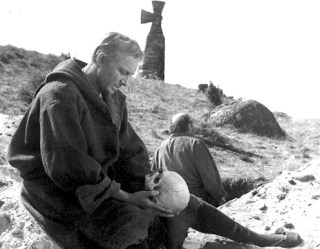
I don’t normally comment on my method of viewing when reviewing a film, but the UK R0 DVD of Hamlet has at least one aspect worthy of note: in an era when widescreen TVs are the norm, someone at Mr. Bongo had the bright idea to release this 2.35:1 film in fullscreen, and to let the subtitles fill the black bar underneath the picture to boot. Practically, this means you have to watch the film in a small box in the centre of your TV — and, at 2.35:1, that’s a very small box. It’s not as if Mr. Bongo do it with all their releases, so goodness knows what made them think it was a bright idea in 2011 to release a fullscreen DVD of a widescreen film. However, I was fortunate enough to catch BBC Four’s screening, in HD, as part of the current BBC Shakespeare Festival. If you missed it, it’s unfortunately not available in HD on iPlayer, but I’d wager the BBC’s SD version is at least the equal of the DVD in terms of resolution, and it doesn’t have the problem of stupidly-placed subtitles.

In many respects this is a 5-star adaptation — it brings vitality to the text, there are several strong performances, the staging is highly cinematic — but the language is something of a barrier to entry. This is most certainly not a neophyte’s Hamlet. But then, why should it need to be? That’s not a fault of the film, just a factor in deciding when to watch it. Even with the subtitle issue feeling like an obstacle to engagement, this was perhaps the most enjoyable Hamlet film I’ve seen. Maybe that’s because it has an advantage in that I’m now more familiar with the play (something which hindered Branagh’s version, as that was the first time I’d seen it), but it speaks to the film’s overall quality that it has more to offer than just Shakespeare’s words.

5 out of 5

Hamlet is available on BBC iPlayer for another seven days.

The Godfather (1972)

100 Films’ 100 Favourites #39

An offer you can’t refuse.

Country: USA
Language: English, Italian & Latin
Runtime: 175 minutes
BBFC: X (cut, 1972) | 18 (1987) | 15 (2008)
MPAA: R

Original Release: 24th March 1972
UK Release: 18th August 1972
First Seen: DVD, c.2001

Stars
Marlon Brando (On the Waterfront, Apocalypse Now)
Al Pacino (Dog Day Afternoon, Scarface)
James Caan (Rollerball, Misery)
Robert Duvall (The Seven-Per-Cent Solution, Network)

Director
Francis Ford Coppola (The Godfather Part II, Apocalypse Now)

Screenwriters
Mario Puzo (Earthquake, Superman)
Francis Ford Coppola (The Great Gatsby, The Conversation)

Based on
The Godfather, a novel by Mario Puzo.

The Story
1945: Michael takes his girlfriend to his sister’s wedding, where she’s introduced to his family, including his father, Vito — the Don of New York’s Corleone crime family. Over the next decade, decisions made by the family lead to escalating gang war, and just as he thought he was out, Michael is pulled in to the family business.

Our Hero
A good college kid who dropped out to fight in World War 2, Michael Corleone has distanced himself from his family’s criminal activities… until a series of events find him drawn inescapably in.

Our Villain
According to the AFI, Michael is the 11th most iconic villain in film history. Of course, he winds up a Mafia Don, so he’s hardly a good guy in the traditional sense, but we’re surely on his side, at least throughout this film. Even in that context, I think you could argue the titular Godfather himself, Don Corleone, is the villain: his one son who tried to escape the life of crime is pulled into it after a string of poor choices and unfortunate incidents land the family in trouble.

Best Supporting Character
James Caan is Vito’s hot-headed eldest son, Sonny, heir apparent to the crime empire. Unfortunately, that very hot-headedness is liable to leave the position open…

Memorable Quote
“Luca Brasi sleeps with the fishes.” — Clemenza

Quote Most Likely To Be Used in Everyday Conversation
“I’m gonna make him an offer he can’t refuse.” — Don Corleone
(According to the AFI, this is the second best movie quote ever.)

Memorable Scene
The opening is the perfect scene-setter for the movie. On the day of his daughter’s wedding, Don Corleone hears requests for favours. One man asks for retribution against men who assaulted his daughter, which he has been denied by the legal system. Corleone questions why the man didn’t come straight to him, but ultimately grants the grovelling father his wish. Here, the film has established its pace, its tone, and themes of family, respect, and the important point that these criminals think of themselves as the honourable ones.

Write the Theme Tune…
Italian composer Nino Rota composed the majority of the soundtrack (Carmine Coppola contributed some music), including the famous main theme. Apparently a Paramount executive described Rota’s score as too “highbrow” and urged it be ditched, but Coppola won out. Considering the music’s subsequent fame and familiarity, I think we know who was right.

Technical Wizardry
The dark but amber-tinged cinematography by Gordon Willis is gorgeous. It’s stuff like this that high definition was made for.

Making of
Cinematographer Gordon Willis insisted that every shot represent a point of view, placing his camera around 4ft off the ground and keeping the angle flat. Coppola persuaded him to do a single aerial shot, in the scene when Don Corleone is gunned down, by telling Willis that the angle represented God’s perspective.

There’s a first time for everything…
According to IMDb, “Coppola turned in an initial director’s cut running 126 minutes. Paramount production chief Robert Evans rejected this version and demanded a longer cut with more scenes about the family. The final release version was nearly 50 minutes longer”. Studios love extended cuts for DVD these days, but choosing to take up more time in theatres? Not bloody likely.

Next time…
Debate rages as to whether sequel The Godfather Part II is an even better film. Either way, it was the first sequel to win Best Picture (and still one of only two). In 1977, Coppola edited the two films together in chronological order, along with some deleted scenes, to form The Godfather Saga miniseries, aka The Godfather: A Novel for Television. (Although it’s not been released on home media since VHS, it has been repeated on TV in HD, meaning copies can be… acquired.) Over a decade later, Coppola turned his duology into a trilogy with The Godfather Part III. Although generally reviled whenever it’s spoken about, it has a not-bad 7.6 on IMDb and was also nominated for Best Picture, as well as six other Oscars. (Part III was later added to the chronological cut to make The Godfather Trilogy: 1901-1980.)

Awards
3 Oscars (Picture, Actor (Marlon Brando), Adapted Screenplay)
8 Oscar nominations (Supporting Actor (James Caan, Robert Duvall, and Al Pacino), Director, Costume Design, Sound, Editing, Score)
1 BAFTA (Music)
4 BAFTA nominations (Actor (Marlon Brando), Supporting Actor (Robert Duvall), Costume Design, Most Promising Newcomer to Leading Film Roles (Al Pacino))

What the Critics Said
“It seems that the first question everyone asks about The Godfather is concerned with Marlon Brando’s interpretation of the title role. That is the way the movie has been programmed and promoted: Brando, Brando, Brando, and more Brando. The word from advance hush-hush screenings was wow all caps and exclamation point. […] So to answer belatedly the first question everyone asks about The Godfather: Brando gives an excellent performance as Don Vito Corleone [however,] though Brando’s star presence dominates every scene in which he appears, the part itself is relatively small, and there are other people who are equally good with considerably less strain, among them the extraordinarily versatile James Caan as the hot-headed, ill-fated Sonny Corleone, Richard Castellano as the jovially gruesome Clemenza, and Robert Duvall as Don Vito Corleone’s non-Italian consigliere, Tom Hagen.” — Tony Ortega, The Village Voice

What One Single Critic Said
“I don’t see how any gifted actor could have done less than Brando does here. His resident power, his sheer innate force, has rarely seemed weaker. […] Al Pacino, as Brando’s heir, rattles around in a part too demanding for him. James Caan is OK as his older brother. The surprisingly rotten score by Nino Rota contains a quotation from “Manhattan Serenade” as a plane lands in Los Angeles. Francis Ford Coppola, the director and co-adapter (with Mario Puzo), has saved all his limited ingenuity for the shootings and stranglings, which are among the most vicious I can remember on film. The print of the picture showed to the New York press had very washed-out colors.” — Stanley Kauffmann, New Republic (the one and only critical review on Rotten Tomatoes)

Score: 99%

What the Public Say
“Few people could have anticipated during the course of adapting Mario Puzo’s best-seller The Godfather to the big screen that it would become a lasting legacy in cinema. Forty-plus years have passed since its theatrical release, yet it stands the test of time as not only one of the greatest depictions of a crime family, but as one of the best films ever made. […] That lasting popularity isn’t a fluke; the Godfather films stand the test of time because these aren’t just movies, they’re cultural touchstones.” — Colin Biggs, Movie Mezzanine

Verdict

Has it really been almost eight years since the IMDb Top 250’s unshakeable #1 was usurped? The Godfather sat pretty at the top of that user-voted ranking for the best part of nine years, its balance between critically-acclaimed filmmaking finesse and quotable gangster machinations almost perfectly calibrated for that website’s prevailing demographic. (It’s since settled at #2, hardly a failure.) It’s not just IMDb users, though: The Godfather places 6th on the latest iteration of The 1,000 Greatest Films, the as-near-to-definitive-as-you-can-get poll-of-polls compilation. It’s for the same reasons, really: The Godfather combines thriller elements and striking violence with a strong understanding of character and a believable exploration of organised crime, a world as fascinating as it is morally repulsive, for a whole that is as artistically accomplished as it is palatable to the mainstream.

Sky Movies Select are showing the complete Godfather trilogy today from 4:30pm.

Next… you know the name, you know the number — it’s #40.

300: Rise of an Empire (2014)

2016 #78
Noam Murro | 98 mins | streaming (HD) | 2.35:1 | USA / English | 15 / R

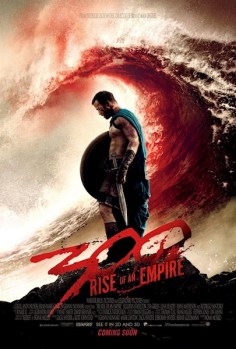
Taking place before, during, and after the events of Zack Snyder’s surprise-hit graphic novel adaptation 300, belated follow-up Rise of an Empire tells the wider story of what was going on in the war between Greece and Persia. In particular, it follows Themistokles (Sullivan Stapleton) as he commands a series of sea battles against the Persian navy, led by Artemisia (Eva Green).
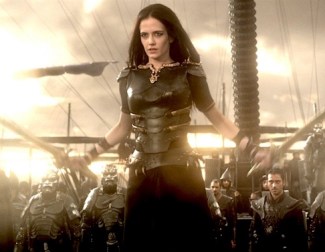
300 was known from the off as a case of style over substance, both in terms of its visuals (the ultra-heightened colour palette at a time when extreme digital grading still felt new; the slow-mo/fast-mo/etc editing) and its storytelling (taking an historical event and ramping it up to the level of legend; dialogue more concerned with being readily quotable than sounding plausible). But it committed so thoroughly to that methodology that it kind of worked, in its own ridiculous way. It helped that, as I said, it was all quite new — 300 was a visual revelation back in 2007, and that was enough. Now, plenty of films look like that, leaving 300 2 in search of a hook. It doesn’t find one.

It doesn’t help that the CGI this time is terrible, making the whole thing look like a computer game with real people occasionally dropped in. It’s not just the low quality of the graphics (calling them “effects” or “visuals” seems generous), but the way the camera moves and frames things. And the gore is gorno-level outrageous. In one shot early in the film, we see a horse rise up in fright, slow motion emphasising how its whole body is lifting into the air on its hind legs, its front hoof flailing, its eyes wild… before it comes crashing down, its hoof smashing into a grounded man’s head, the not-even-vaguely-plausible CGI blood exploding everywhere — in slow motion, of course.

It’s also terribly obvious that it was shot for 3D. I’m not normally one to criticise a film for that — I think when some critics know a film is being released in 3D they see that in its shot choices, even if they’re perfectly valid choices for 2D. But Rise of an Empire screams that it was made for 3D from the start, with all manner of things thrust towards the camera, usually in slow motion, and the constant explosions of blood (to call them squirts or sprays implies a more liquid-like quality than they actually possess) which go nowhere else but camerawards. Presumably the only reason it’s not an 18 for violence is because it’s all so bloody silly.

There is no point discussing or analysing any other aspects of the film. In every respect — from the clunky structure, to the leaden dialogue, to the poor performances, to the cheap visuals, to the fake CGI — this doesn’t feel like the $110 million blockbuster it is, but like a direct-to-Syfy TV movie.

1 out of 5

300: Rise of an Empire is available on Amazon Prime Instant Video UK as of yesterday.

It featured on my list of The Five Worst Films I Saw in 2016, which can be read in full here.