
Noam Murro | 98 mins | streaming (HD) | 2.35:1 | USA / English | 15 / R
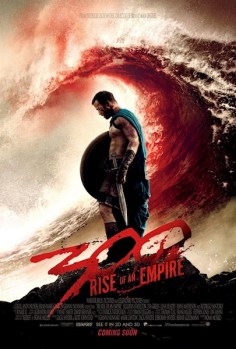 Taking place before, during, and after the events of Zack Snyder’s surprise-hit graphic novel adaptation 300, belated follow-up Rise of an Empire tells the wider story of what was going on in the war between Greece and Persia. In particular, it follows Themistokles (Sullivan Stapleton) as he commands a series of sea battles against the Persian navy, led by Artemisia (Eva Green).
300 was known from the off as a case of style over substance, both in terms of its visuals (the ultra-heightened colour palette at a time when extreme digital grading still felt new; the slow-mo/fast-mo/etc editing) and its storytelling (taking an historical event and ramping it up to the level of legend; dialogue more concerned with being readily quotable than sounding plausible). But it committed so thoroughly to that methodology that it kind of worked, in its own ridiculous way. It helped that, as I said, it was all quite new — 300 was a visual revelation back in 2007, and that was enough. Now, plenty of films look like that, leaving 300 2 in search of a hook. It doesn’t find one.
It doesn’t help that the CGI this time is terrible, making the whole thing look like a computer game with real people occasionally dropped in. It’s not just the low quality of the graphics (calling them “effects” or “visuals” seems generous), but the way the camera moves and frames things. And the gore is gorno-level outrageous. In one shot early in the film, we see a horse rise up in fright, slow motion emphasising how its whole body is lifting into the air on its hind legs, its front hoof flailing, its eyes wild… before it comes crashing down, its hoof smashing into a grounded man’s head, the not-even-vaguely-plausible CGI blood exploding everywhere — in slow motion, of course.
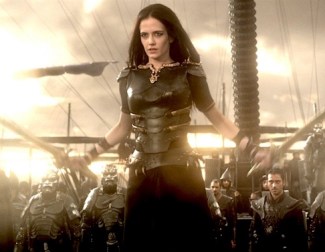 It’s also terribly obvious that it was shot for 3D. I’m not normally one to criticise a film for that — I think when some critics know a film is being released in 3D they see that in its shot choices, even if they’re perfectly valid choices for 2D. But Rise of an Empire screams that it was made for 3D from the start, with all manner of things thrust towards the camera, usually in slow motion, and the constant explosions of blood (to call them squirts or sprays implies a more liquid-like quality than they actually possess) which go nowhere else but camerawards. Presumably the only reason it’s not an 18 for violence is because it’s all so bloody silly.
There is no point discussing or analysing any other aspects of the film. In every respect — from the clunky structure, to the leaden dialogue, to the poor performances, to the cheap visuals, to the fake CGI — this doesn’t feel like the $110 million blockbuster it is, but like a direct-to-Syfy TV movie.

300: Rise of an Empire is available on Amazon Prime Instant Video UK as of yesterday.
It featured on my list of The Five Worst Films I Saw in 2016, which can be read in full here.

 Score:



 Macbeth is my favourite Shakespeare play. Not that I’m a great scholar of the Bard, but I’ve seen and/or read enough to have a favourite. I also think it’s one of his most accessible works: its story and characters are relatively straightforward without being devoid of complexity; it’s got some immensely effective imagery and dialogue, including a solid compliment of famous lines; and it’s not excessively long either (it’s Shakespeare’s shortest tragedy, in fact). I also studied it twice over in secondary school, so I know it fairly well. Now, this doesn’t mean I have exacting standards when it comes to film adaptations (Shakespeare is plenty open to interpretation), but it does mean I have my expectations up, especially as there isn’t a film version of Macbeth that could reasonably be described as “definitive” (though I know
  What I mean, more specifically, is that he’s visualised parts of the text; applied the old rule of “show don’t tell”. So rather than a messenger giving the King a full account of Macbeth being awesome in battle, we see some of the combat; Banquo has hardly any lines early on, but we still understand his friendship with Macbeth just from the way they look at one another and go into battle together.
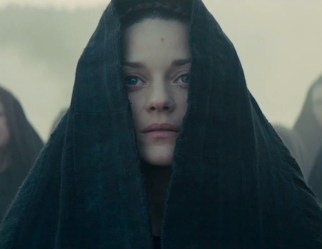 Cotillard is fantastic in all of this, and certainly worked hard for it: the way the French language applies emphasis is not suited to delivering iambic pentameter, apparently, so she worked hard with a dialect coach to nail her delivery. Her accent clearly marks Lady Macbeth as the only non-Scottish character here, which becomes another layer added to this interpretation.
 a good film based on a computer game.




 So says Peter Jackson in the special features accompanying this extended cut of his trilogy-closing saga-ending sixth Middle-earth movie, as
  Most obvious, and most discussed, is the dwarves’ war chariot action scene, whose bloody decapitations saw the film earn an R in the US and 15 over here. A seven-minute action sequence in the middle of the battle, it’s by far the largest single addition, and is mainly notable for all that blood and its use of the word “jambags”. Somewhat ironically, the sequence was a last-minute addition (the physical chariot was the last thing built for the films), which even as they’re shooting it Jackson acknowledges is an indulgence, and then of course it got bumped to the extended edition for being just that.
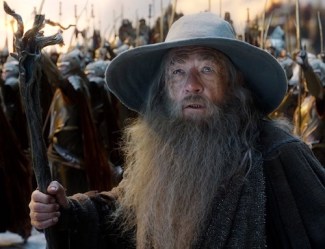 Not a sausage, unless I missed something. It didn’t bother me too much because, quite frankly, I can’t quite remember what it was all about; but when I inevitably watch the extended trilogy back to back one day, it may do then. That said, I can’t imagine it’s a major fault, but again highlights the built-on-the-fly, ill-thought-through state of expanding The Hobbit 2 into The Hobbit 2 and 3.
 Adapted from the classic young adult sci-fi novel by Orson Scott “bigoted idiot” Card, Ender’s Game is the story of Andrew “Ender” Wiggin (Asa Butterfield), who displays uncommon aptitude in a military programme to train children to fight against an alien race that attacked Earth decades earlier. Sent to a training centre in space, Ender must battle his fellow candidates to prove their worth to their hardened commander, Colonel Hyrum Graff (Harrison Ford), ready for the real battle to come.
 It tips its hat to things like drone warfare, child soldiers, and understanding our enemy, but that’s all it does: acknowledge those parallels exist, then refuse to explore them. Conversely, the music is too heavy-handed, taking on the burden of providing emotion that’s lacking from the screenplay.
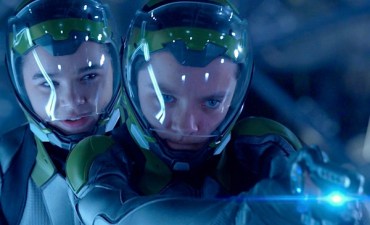 Sadly, after all that training fun, once the cadets jet off to the other side of the galaxy for a rushed third act, interest evaporates speedily. It even has to work hard to sell its own twist as a twist! (Spoilers follow in this paragraph.) In a simulation for a war, Ender does what he’d do to win that war. Then he’s told it wasn’t a simulation, it was the actual war… and he’s all cross. I mean, okay, the fella kinda has a point when he gets angry afterwards: they’ve lied to him, and maybe he would’ve behaved differently if he’d known. But the point of the training was to teach them what they needed to do to win, and it taught them that, and he did it. Maybe this twist works in the book, but in the film it felt somehow unearned.

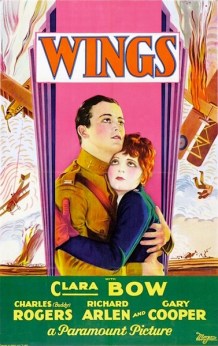 Students of the Oscars well know that, technically speaking, there wasn’t a single “Best Picture” award at the inaugural Academy Awards ceremony in 1929. Instead, there were two awards that covered that ground, seen (at the time) as being of equal significance. One was for “Unique and Artistic Production” — which I’d argue is more or less what most people think Best Picture represents today. That was given to F.W. Murnau’s
  he learnt to fly just for the film), and, mid-flight, had to film their own close-ups by switching on battery-operated cameras mounted in front of them. You wouldn’t know it from watching the film itself, though: even today, the action sequences carry a palpable air of excitement, aided (perhaps even created) by the knowledge that it was all done for real — including the crashes.
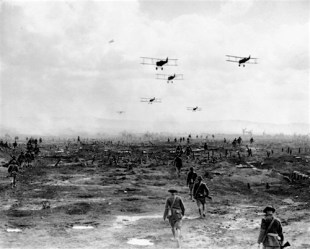 bomb-pockmarked battlefield. Those bomb craters were, in fact, genuine: the military spent a few days before filming using the location for target practice. The climactic battle that occurred on this site was filmed with up to 19 cameras at once, including some mounted on four towers, the highest of which reached 100ft. I know this is a review, not a catalogue of production numbers, but it’s quite incredible.
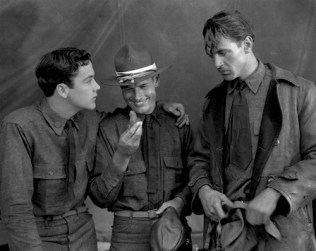 How much these factors affect the film’s quality seems to be very much a personal matter. Wings set the stall for many a Best Picture winner to follow by being not that well regarded by critics; indeed, more time and praise is given to its top-award compatriot, Sunrise. For the most part, I found the personal dramas passable enough, with a few outstanding scenes — David’s farewell to his stoical parents; Cooper’s scene; the bubbles (at first). However, the combat sequences, and in particular the aerial photography, are stunning; so impressive as to easily offset whatever doubts the other elements may engender.
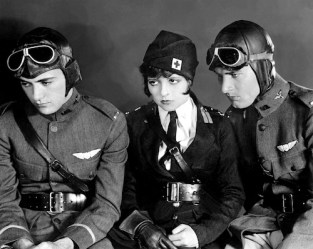 But I digress. Wings is a film that deserves to be remembered as more than a mere footnote. It’s not just a trivia answer to “what was the first Best Picture?”, but a worthy winner of that prize; a movie that, almost 90 years after it was produced, still has the power to elicit excitement and awe. Wellman’s picture may not have been deemed unique or artistic, even though it’s definitely the former and possibly the latter, but it was deemed outstanding, and it’s definitely that.
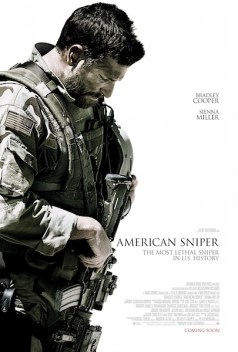 Politics aside, American Sniper is an adequately-made film. Eastwood’s direction is at best workmanlike, at worst laughably clichéd. Jason Hall’s screenplay rehashes better movies’ insights into the mental effects of war on combatants. Neither elicit much excitement from a half-arsed sniper-vs-sniper storyline. The film belongs to a bulked-up Bradley Cooper, who
 100Films.co.uk