The Invasion (2007)

2008 #72
Oliver Hirschbiegel | 99 mins | download | 15 / PG-13

The InvasionThe Invasion is a modern thriller aimed at a mainstream audience, which naturally means it begins at the end. Is there a reason for this? As is too often the case these days, no. The only explanation I could come up with is that such an opening suggests there’ll eventually be some some actual scares in this sci-fi/horror, and so is designed to help the viewer persevere through the distinctly lacking film that follows.

Things go sharply down hill from the lacklustre opening ending opening: Jeremy Northam accidentally stabs himself with an Evil Alien Parasite Thing in a blatant genre convention that seems to have moved from the “necessary to get on with the plot” to the “badly obvious cliché”. The order of scenes that follow seems to be a random mess — for example, Nicole Kidman’s kid, Olly, begins to have nightmares again; a few scenes later, his dad (Northam, now taken over by the Evil Alien Parasite Thing) phones wanting to see him after a long absence; a few scenes later, Kidman tells a friend that Olly’s nightmares restarted after he was told he was going to see his dad. This is not an isolated example.

Much of the dialogue is on the level of bad exposition, but, to rub salt in the wound, it explains things we’ve already been shown. Normally reliable actors turn in flat performances with such an awkward script, which ponderously works its way through a plot that’s far too slow-moving considering how obvious it is. We know it’s an Evil Alien Parasite Thing within the opening minutes and even a passing familiarity with the genre will let you know how things are going to end up (as if opening with the ending didn’t give you a hint), but we’re still treated to near-endless scenes of our luckily-immune heroes trying to work out why everyone else is behaving oddly. It takes a full 36 minutes for Kidman to finally realise what we’ve all known from the start, but just in case you’ve missed the bleeding obvious there’s a pile of handy flashbacks. More to the point, how come only two people in the entire world (the other being Daniel Craig) have noticed what’s going on? The possessed have all the subtlety of a Jeremy Clarkson joke, walking around in a permanent mechanical daze.

A lot of articles have noted that the studio disliked how the film ended and so brought in other writers and director(s) to re-shoot the final act, aiming to bolster the action. Thank goodness they did, because it’s at this point that there’s finally something worth watching. The aliens’ dominance is a near-inevitable and obvious eventuality from very early on, and so structurally speaking should have been reached sooner. Unfortunately, when it does arrive, the weak early scenes mean we don’t care about the characters, so while some of the more action-packed scenes are well staged they have little genuine impact. Some good moments sneak through though, like a couple’s very public suicide, or… No, that was the only one I noted.

In this structural imbalance The Invasion is reminiscent of I Am Legend: a ponderous dramatic first half turns into an all-action assault as the only uninfected people are relentlessly pursued by the infected majority. In an inversion of the disappointing (but not dreadful) Will Smith vehicle, The Invasion‘s first half is dire while the second at least has some excitement and jeopardy. In Legend it was a shame that they couldn’t keep the first half running for the rest of the film; here you’re glad the studio intervened and forced some actual events on the film. It would be quite interesting to see how it was all meant to turn out originally, but I doubt it would be entertaining in the slightest.

Once it’s all over there’s a truly dreadful info-dump that explains what happened next. Besides making you cringe and wonder how a piece of exposition so blatant could ever have been greenlit, all it achieves is the delivery of a killer blow — not by blatantly stating the film’s subtext (which it does — not so ‘sub’ then), but with what that subtext actually is: when humanity is taken over by aliens, war stops; ergo, war is what makes us human. Lovely.

2 out of 5

The Invasion featured on my list of The Five Worst Films I Saw in 2008, which can be read in full here.

Hitman: Unrated (2007)

2008 #70
Xavier Gens | 94 mins | download | 15

HitmanVideo games have been fertile ground for filmmakers over the past couple of decades — or, rather, for film financiers, because while they almost invariably garner poor reviews they do insist on making them. What marks Hitman out from the crowd? Well, nothing.
In fact, Hitman seems to be doing its best to blend in and go unnoticed — much like a good hired assassin would do, you’d imagine. Except in this film, all the assassins are bald and have barcodes tattooed on the back of their head — not at all conspicuous. The story begins at the end, as is the fashion for most films these days, and as usual there’s absolutely no reason why it should. After that, you’ve got a series of ideas and scenes recycled from the likes of The Bourne Identity — and by “from the likes of” I really mean “from” — that don’t add up to anything particularly new. The majority of the plot is easily guessed within the first half-hour; those guesses that don’t pan out aren’t because the film has anything surprising to do, but instead because it seemingly can’t be bothered to resolve certain plot threads. Equally, the plentiful leaps in logic appear to be the result of lazy filmmaking, not caring to fill in the gaps between two cliched plot beats.

Characters suffer from poor performances — disappointing in the case of lead Timothy Olyphant, who was pretty good in Deadwood — but are also let down by a lack of technical ability, featuring a copious amount of clearly dubbed dialogue. They shouldn’t’ve bothered, because it’s all atrocious. Behind the dialogue, the rest of the writing isn’t any better. Agent 47’s characterisation is all over the place. He’s clearly supposed to be calm and robotic, and at times he is, with an appropriate lack of understanding about life and women; but then there are moments where he’s shouty, or humourous, or eye-rollingly knowing. It’s like the screenwriter’s copied the scene from another film (usually The Bourne Identity) and forgotten to put his characters into it. As for the rest of the cast, Dougray Scott and current Bond girl Olga Kurylenko are also let down by poor material. Also worthy of note is a Russian General toward the end, who is a spectacularly bad actor.

Believe it or not, Hitman does have the odd moment that’s almost worthwhile. There’s some wit with the sex (or, rather, “lack of sex”) scenes, and I quite liked the (derivative, it must be said) score. And then there’s the action, of course, which is naturally the main point of a film like Hitman. It’s fairly extreme, considering, and appropriately bloody — exploding heads from snipers, many spurting wounds from SMGs, and so on. This is the ‘benefit’ of the unrated cut, which is barely any longer than the theatrical one but does have plenty of extra blood CG’d in. For a full list of differences — as well as that blood, there’s a few extra shots in fights and of ‘controversial things’ like drug-taking — have a look at this page (translated from German). Most of the action scenes are passable but with nothing to mark them out, the one exception being a four-way blade fight in a disused train carriage between Agent 47 and three other bald assassins. It’s a good idea fairly well executed, but suffers from a nagging question: where did the other three come from and, more importantly, why were they there?

I’ve made it this far without mentioning Leon, the gold standard against which all other assassin movies will inevitably be compared. It feels almost cruel to mention it though, because Hitman’s aims are nothing so lofty. Style and content-wise, films such as Wanted and Shoot ‘Em Up are much closer relations, as well as the film it so often imitates, The Bourne Identity. Hitman is not as original nor as fun as any of these, which makes it all rather pointless.

2 out of 5

Stay (2005)

2008 #68
Marc Forster | 95 mins | DVD | 18 / R

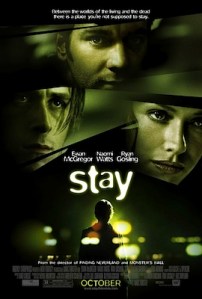
StayI’m sure some viewers didn’t bother to stay until the end of Stay, baffled by an increasingly bizarre plot — which, at times, seems to be doing its best to stay still too — and put off by apparently pointless scenes. If only they had stayed, they could’ve discovered that they had indeed wasted an hour and a half of their lives on a story with a deceptively unoriginal conclusion.

The main problem with Stay is that it thinks it’s cleverer than it is. At its heart is a mystery, or set of mysteries, which the conclusion of can be too easily guessed right from the start. That’s not to say you can piece it together from the clues given, but you can certainly guess at it. This is because much of the film, and its clues, are apparently meaningless. Either there’s supposed to be some deeper, unrevealed significance to things like never-ending staircases and a blind man’s vision being restored, or it’s all there just to look significant and help hide/complicate the final revelation. The climax is consequently disappointing: it’s too obvious, it doesn’t bother to tie everything in, nor does it seem to allow room for the viewer to retrospectively tie things up. To rub salt in the wound, a brief epilogue is twee, one of those ideas that might sound like a neat tweak on what we’ve seen but should actually have been cut.

There are some positives, mostly in the direction. Forster has proved himself excellent with visuals — look at the fantasy scenes in Finding Neverland or the HUD-like graphics in Stranger Than Fiction — and there’s plenty to add to that list. The intriguing scene transitions are the stand-out. While they may initially seem pointlessly flashy, the ending, however flat it may be, does suggest they were done for a reason. Throughout, the film is well shot and well edited, but, perhaps, too well — or, rather, ‘too obviously’. By deliberately ignoring several standard editing rules (I won’t reveal which here), the film-literate viewer may find that too much is given away too early on.

Clearly someone liked Stay, as writer David Benioff sold the screenplay for $1.5 million, and it would be nice to agree with that buyer — there’s a good cast, a good director, some good ideas — but ultimately it’s 85 minutes that seem retrospectively pointless when the final ten do so little with them. There’s no final “oh, that’s what it was about!” twist, just “well, I’d guessed that much” coupled with “and I’ve seen that before”. Some qualities (Forster’s visuals, the likable cast) almost earned it an extra star, but the ending took it back off them.

2 out of 5

After the Sunset (2004)

2008 #67
Brett Ratner | 93 mins | TV | 12 / PG-13

After the SunsetI’ve never had as much of a problem with Brett Ratner as some others. I quite enjoyed the first two Rush Hour films (though, admittedly, I was relatively young) and also liked Red Dragon (though, at the time, I hadn’t seen Silence of the Lambs), and would lay the blame for X-Men: The Last Stand at the feet of the producers who decided to save all the Wolverine backstory stuff for a spin-off, in the process disconnecting the threequel from the Wolverine-obsessed first two — what was left was pretty decent, if you ask me. After the Sunset, on the other hand, is like Woody Harrelson’s character: not much cop.

The story concerns a retired jewel thief goaded into performing one last job by the FBI officer who never caught him (that’s Harrelson’s character — you see, he’s not much of a cop! Geddit?) A decent enough premise, suggesting something Ocean’s Eleven-like; but someone didn’t think this was enough story — or, perhaps, couldn’t come up with a complex-enough security system for the jewel — and so tacked on a buddy comedy. It’s a pretty illogical one as well: the two men hate each other, so why would they spend so much time together? It feels like padding around the heist plot, but takes up more screen time. Other subplots, like Don Cheadle as the unspecified Caribbean island’s resident gangster, who wants the jewel to fund something or other, also don’t go anywhere.

Each of these plots seem to have originated in different films — some serious, some light, some thoroughly comedic. When stuck together they make for a constantly varying tone, and it’s difficult to work out which was the intended one. By the end there’s so much going on (though, barely) that the ending goes on forever, wrapping up its various near-unrelated threads in as drawn-out a manner as possible, apparently just to make the film hit a decent length. The final twist is almost good, but remains a bit underdeveloped and consequently isn’t clever enough to be worthwhile — it winds up as just another pointless extension.

Despite all this it does have its moments, thanks primarily to a skilled cast… not that I can remember any specific good bits now. It does at least mean that, if you can put the tonal and structural oddities to one side, it can be a moderately pleasant way to pass an hour and a half.

3 out of 5

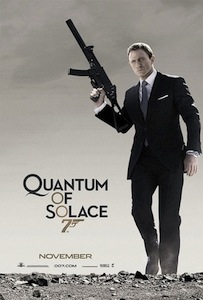
Quantum of Solace: Initial Thoughts (no spoilers)

Quantum of SolaceQuantum of Solace isn’t as good as Casino Royale; though I should immediately qualify that statement by saying that the previous Bond movie is not only one of my favourites of the series, but also one of the best action-thrillers ever made. It would’ve been some feat indeed for QoS to top it.

As it is, director Marc Forster doesn’t really try. Casino Royale was about a poker game; QoS is about bringing down a significant player in a worldwide Secret Evil Organisation — but it’s the former that’s more epic. Bond rattles around the world, from action sequence to action sequence, at a rate of knots. There’s a sense that Forster, who has never made an action film before and was initially reluctant to take this one on, has treated this as the time he tried an Action/Spy Movie and so thrown everything at it. There’s a car chase, a bike chase, a roof-top chase, a foot chase, a plane chase/fight, gunfights, fist fights, knife fights, sneaking around, going in all guns blazing, betrayals, reversals, having to be a maverick agent because Bond’s right while his superiors refuse to trust him… And all this squeezed into the shortest Bond film yet made.

In truth, the running time isn’t really a problem. The film doesn’t come up for air until quite far in, but if one pays attention (and can remember Casino Royale — this really is a direct sequel) the plot can be followed well enough and you’re not likely to get bored. It’s a tad ironic that Forster was chosen because of his Oscar-nominated ability to do Character Drama and the like, and yet has wound up crafting such a relentlessly action-packed entry in the series. QoS is perhaps at its best when getting stuck into the meatier scenes between Bond and M, or Bond and Camille, or Bond and a returning character from the last film. The action scenes occasionally had too much of a Bourne vibe for my taste. I love the Bourne films, but the Bond films are different, and I don’t want a handheld camera shoved so close you can barely see anything, and even when you can the next cut is only 0.4 seconds away.

There are other flaws. I don’t mind Bond being light on humour, and it does at least mean when the jokes come they’re all the more welcome, but I think Casino Royale‘s torture scene exemplified the overall mix the rebooted Bond should aim at: dark, gritty, nasty, real… but the scene also got the biggest laughs of any part when I saw it at the cinema. Bond doesn’t need the campness of Moore or Brosnan, or even as much humour as Connery injected, but I think it could do with more than Dalton had, and The Craig Era has now reached that level of humour-dearth. On the flipside of that argument, this is a darker story all round… but I’ll have to save the end of that argument for my spoilery review at a later date.

My other main complaint is probably the title sequence. I like the song, personally, but MK12’s titles are bland, generic, and too colourful for either the film or the song. They’d look fine on a tie-in video game (in fact, they do — I saw it on YouTube), but in the film itself I almost began to wonder what they were thinking. I may have some residual distaste for the dropping of Daniel Kleinman here — certainly, I haven’t seen anyone else write about them; but then Proper Critics tend to have other things on their mind — especially after he created one of the best main titles ever for Casino Royale, but I sincerely hope they bring him back for the next film.

As for the next film, I think QoS will leave some with a feeling of, “well that’s that out of the way — next!” In truth, it’s not that bad. It suffers by following the exceptional quality of Casino Royale, and also being so tied to the former’s story, but despite that pulls a well-above-average action-thriller out of the bag. I expect it will continue to receive a mixed response from critics and audiences, which is more due to people’s expectations than the film’s inherent quality, but that’s the way things go. As far as I’m concerned, Bond’s back, and that’s always a good thing.

A fuller review of Quantum of Solace — I have a lot more to say! — will appear as #73 in the next few weeks, following my reviews of After the Sunset, Stay, The Diving Bell and the Butterfly, Hitman, St. Trinian’s, The Invasion, and Casino Royale.

Shoot ‘Em Up (2007)

2008 #66
Michael Davis | 83 mins | DVD | 18 / R

Shoot Em UpShoot ‘Em Up is the film Wanted wants to be. It’s packed to bursting with utterly ludicrous — but, consequently, ludicrously cool — action sequences. It’s fast-paced, witty, and endlessly inventive. As the action genre goes, this is pure entertainment.

The plot, such as it is, is borderline nonsensical — some craziness to do with a baby factory (which is, believe it or not, the morally acceptable part), political coups, and goodness knows what else. If you want to follow it you might need to engage your brain at times, but so long as you can tell who’s bad and who’s good — and you can, easily — then all is well. This might sound like a criticism, but by pushing the implausibility of an action-thriller plot as far as it can, the story becomes another element in the whole film’s spoof-homage aesthetic. Everyone involved is clearly having fun with this, though none more so than Paul Giamatti. His wonderful villain is cunningly evil but constantly interrupted by domestic phonecalls from his beloved wife. Luckily this enjoyment is conveyed to the viewer, lending the one-liners and sundry other gags more humour than they might otherwise deserve.

Some quarters have criticised Shoot ‘Em Up for being cheesy and clichéd. My favourites are those that label it “so daft at least I enjoyed it on that level”. I’m sure these people feel very clever for spotting all the poor stereotypes of an action flick, from the unbelievable plot to the literally impossible feats of action. Unfortunately for those oh-so-clever people, they’ve entirely missed the point — even those daft-lovers. The clue’s in the title, a simple statement of genre that blatantly acknowledges the film’s aim in a way that genuine crap-because-they’re-crap action flicks don’t. Shoot ‘Em Up is an homage and spoof of its genre, pushing everything to the limit. If it took itself seriously the above might be valid criticisms, but it’s meant to be this way.

And if you know that, it works, navigating a successful path between spoof and homage — it’s not Action Movie, a film which must be inevitable by this point — and packed with inventive stunts and shoot outs. For every impressively-inventive-but-physically-implausible stunt in Wanted, this produces half a dozen. And they weren’t all in the trailer either. Silly, fun, and easily better than that over-promoted comic adaptation, in these respects Shoot ‘Em Up deserves much wider recognition.

4 out of 5

Batman: Gotham Knight (2008)

2008 #65
Shojiro Nishimi, Futoshi Higashide, Hiroshi Morioka, Yasuhiro Aoki, Toshiyuki Kubooka & Jong-Sik Nam | 73 mins | DVD | 15 / PG-13

Batman: Gotham KnightGotham Knight is an American-Japanese produced anime — the animation is Japanese and anime-styled, but the original soundtrack is English — that aims to bridge the gap between Batman Begins and The Dark Knight. In this case that equates to six short films, with some narrative connections, strung together to make a movie.
Overseen by executive produce Bruce Timm (Batman: The Animated Series, and most of the DCAU) and all with story credits to Jordan Goldberg (Nolan’s assistant on Batman Begins and now associate producer on The Dark Knight), the shorts, in order of appearance, are:

  • Have I Got a Story For You, written by Josh Olson (A History of Violence) and directed by first-time director Shojiro Nishimi;
  • Crossfire, written by Greg Rucka (Gotham Central and other comics) and directed by first-time director Futoshi Higashide;
  • Field Test, written by Goldberg and directed by Hiroshi Morioka (Tsubasa Chronicle);
  • In Darkness Dwells, written by David Goyer (Batman Begins, Blade trilogy) and directed by Yasyhiro Aoki (one episode of Tweeny Witches);
  • Working Through Pain, written by Brian Azzarello (100 Bullets and other comics) and directed by first-time director Toshiyuki Kubooka;
  • Deadshot, written by Alan Burnett (Batman: Mask of the Phantasm) and directed by Jong-Sik Nam (He-Man 2002).
  • Compiling that list, one has to wonder about the blurb’s claim that these shorts are directed by “some of the world’s most visionary animators”. I suppose the key word is “animators” (rather than “directors”), as some have worked on things like Neon Genesis Evangelion, various iterations of Gundam, and even Akira. Regardless of their level of experience, they all seem to do a fine job here, even managing a couple of vaguely memorable moments among fairly stock dialogue scenes and effective, if occasionally unoriginal, fights.

    The six-stories/one-film concept works well enough on the whole. While these are clearly standalone pieces in terms of style and each telling a complete story, they still work best when viewed together — most follow on from the preceding entry and some elements skip across films. These links are nicely varied. For example, while the end of Film 1 merely leads directly to Film 2, there’s a relatively minor action at the end of Film 3 that is picked up in Film 5, and a large chunk of Film 3 is spent on something seemingly insignificant that is picked up on in Film 6. There are some missed opportunities in this respect, such as the transition from the fourth to fifth entries. It would be neater if Batman’s injury in Film 5 was the one from Film 4; based on the settings and their consecutive sequence, I presume this is what was intended, so it’s a shame the wound’s in a completely different place.

    Gotham Knight seems to be squarely aimed at fans — who else could work out that the long-haired mustachioed crime lord here is actually Eric Roberts’ character in The Dark Knight! This is just one of several other factors that seem strange considering Gotham Knight is meant to bridge Nolan’s two live-action Bat-epics: Alfred is the traditional posh Englishman; few/no other characters sound like their Nolan-era counterparts; one segment even features the Burton-style Batmobile! It’s also a shame that the Scarecrow short isn’t last as it would lead even more directly into The Dark Knight. On the other hand, it succeeds in crafting a decent-enough ‘real world’ explanation for Killer Croc, which is no small feat, and Kevin Conroy, now in his mid-50s, still makes a good younger Batman. Thankfully he doesn’t attempt Bale’s over-done Bat-voice, though a nod in that direction might’ve been nice.

    I’ve managed to get this far without invoking The Animatrix, unquestionably the forefather of this and other similar projects. Gotham Knight takes the concept a step further by linking its shorts so clearly, and while it’s not wholly satisfying in this respect, it’s a successful enough step in the right direction. If we do get a The Dark Knight 2, I’d be quite happy to see another direct-to-DVD effort in this vein.

    4 out of 5

    Zodiac (2007)

    2008 #64
    David Fincher | 151 mins | DVD | 15 / R

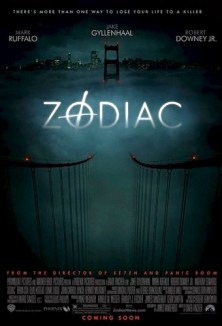
    Context time: I’m a David Fincher fan. Se7en and Fight Club number among my favourite films of all time; I’ve always found The Game to be an immensely enjoyable thriller; much the same can be said of Panic Room, especially the famous slow motion sequence, which is one of my favourite action scenes ever; and I love The Hire series of short films, which Fincher produced but (sadly) never directed. I’ve never seen Alien³ (or Aliens, or any other entry in that series bar Ridley Scott’s first for that matter), but considering its troubled production history one might say it barely counts. All this considered, why’s it taken me so long to see Zodiac? Well, laziness, to be honest, but I’m here now. And unlike another recently-viewed highly-anticipated film (namely, Southland Tales), this was more than worth the wait.

    As other reviews have pointed out, Zodiac is really a film about obsession, and it makes for as engrossing a tale as the case was for those investigating it. In following the story the film chooses to eschew normal structural niceties for fact-following, yet structure is never a problem. Yes, it jumps from character to character, and if you step back and analyse it that’s odd, but while watching it doesn’t matter one jot — this is more like real life than some shallow crime thriller dependent on a twist ending. That level of realism is key throughout, be it the period detail or the exemplary performances — both are excellent and accurate without being showy. Much like Fincher’s direction, in fact, which is appropriately more restrained than usual, though he can still display a suitable level of flair when warranted.

    Some have called it slow, even dull, but I was totally engrossed throughout and never overwhelmed by the number of facts being thrown around — and I was watching it in the middle of the night when I should have been asleep. At 5AM, when it finally ended, I was even wishing there was more. (It seems a shame that the recently-released (in the UK) director’s cut adds barely five minutes.) It does exactly what it aims to: it’s not about the killer’s mind and it’s not a whodunnit; it’s about procedure, obsession, and how one deals with an unsolved mystery. The fact it isn’t definitively solved — and yet, for all the characters, there’s a way out or a solution that satisfies them — is possibly the most telling part of the whole film.

    After the disappointment of the long-awaited Southland Tales, it’s especially pleasing that the long-awaited Zodiac is such a triumph. It’s easily up there with Fight Club and Se7en, and perhaps even surpasses them both. My most unreserved full marks since Dark City.

    5 out of 5

    Zodiac placed 2nd on my list of The Ten Best Films I Saw For the First Time in 2008, which can be read in full here.

    My more thorough review of the Zodiac: Director’s Cut can now be read here.

    Southland Tales (2006)

    2008 #63
    Richard Kelly | 139 mins | DVD | 15 / R

    Southland Tales

    – confusing mess? or profound experience?

    I won’t go into my full “how I discovered Donnie Darko” spiel [save that for whenever I finally watch the Director’s Cut!], but ever since I saw Richard Kelly’s first writing/directing effort way back on its original UK release I’ve been waiting eagerly for his second film. It’s a testament to the negativity of the reviews it received — and, perhaps, the influence of reviews in general — that I skipped Southland Tales at the cinema, left it five months after release before getting it on DVD… and even then it was only a rental.

    At some point, Kelly split his story into six parts and, in a Star Wars-like move, the film was to be Parts 4-6, while the first three would be told in accompanying graphic novels. “The film will work fine without reading them,” he said (I paraphrase here), “but reading them will lead to a deeper experience.” Southland Tales: The Movie begins with a long recap of events from these books, going so far as to include images from their art. “Oops”?

    You have to wonder, if you switched “Directed by Richard Kelly” for, say, “Directed by David Lynch”, would the critics’ reviews have suddenly jumped up a star or two? [some of it is certainly very Lynchian in feel — not a normal film with bemusing aspects, like Donnie Darko, but an all-out muddled weird-fest]

    • David Lynch fans may find this more entertaining than most. Or they may hate it for trying to be Lynchian but failing, or perhaps like it as an example of why Lynch is so good and others fail when they attempt similar feats. I don’t know how they’d use it like that, but I expect they would know.
    • the clear IV, V and VI presented at the start of each chapter — as well as showing I, II and III blatantly on screen during the recap, and having the narration have to recap bits of them — seems to hammer home that this is really for people who are prepared to invest in the whole thing, not people who just watch the film

    ** raises the question, should you ever have to go further (e.g. reading companion books, comics, websites, etc) to understand a film? Yes and no. If it’s consciously part of a wider ‘experience’, labelled and marketed as such, then why not? But if it’s sold as a film in its own right — or, at least, potentially in its own right (as this was) — then it should really work that way too.

    • narration: tries to explain everything, though does very little to help (difference between Kelly and someone like Lynch, who just leaves it all up to the viewer?) — at times almost uncomfortably over-explaining — you wish it could’ve been done properly, rather than with narration
    • Kelly spent months re-editing, following the critical panning it got at Cannes, trimming the length and restructuring it. And it seems to show, as it feels like a failed attempt to construct something legible out of a mess of half-thought-through scenes and subplots
    • one feels a good director’s commentary and/or the original cut might shed more light on things — this is the sort of film that could benefit from a decent DVD edition, that it probably won’t get due to its lack of popularity… unless it gains surprise critical acceptance years down the line, which isn’t unheard of… though I wouldn’t bank on it here. Perhaps, one day, when we’re all watching Data Crystals, Kelly will have gained enough reputation that a 20th anniversary release will finally explain the damned thing
    • seems to become clearer toward end — there are some answers, at least — but ultimately a lot is left out
    • too many of the ‘underlying ideas’ in the climax feel like a Donnie Darko rehash; odd musical numbers and long takes add to this feeling — almost like Kelly’s taken what he did in Darko and tried to expand it into some ensemble epic kinda thing

    i thought, with respect to the film’s crazy half-constructed mess of half-ideas, i’d copy&paste my notes rather than a normal review. so at least that’s one answer at the end for you.

    when it was originally conceived, it was set a couple of years in the future; now, it’s just set ‘now’; and soon, of course, it will be set in a fictional past — the copyright year on the film is 2005; it’s credited as 2006 on IMDb (which is when it turned up at Cannes); it was finally released in 2007; and it’s set in 2008

    I really wanted to like Southland Tales, in spite of the critical mauling it received, and because I loved Donnie Darko and actually enjoyed Domino too (which Kelly wrote). Maybe — maybe — with time to invest in reading the prequel graphic novels, and exploring whatever official sites or crazy fan theories may be out there on the web, I could get more from this film. Personally, I don’t have that kind of time to invest right now, but I might give it a shot sometime. Until then, it will just remain a largely disappointing mess.

    http://www.imdb.com/title/tt0405336/faq

    this is the way the review ends, not with a bang but with a whimper

    2 out of 5

    Southland Tales featured on my list of The Five Worst Films I Saw in 2008, which can be read in full here.

    Agatha (1979)

    2008 #62
    Michael Apted | 100 mins | TV | PG / PG

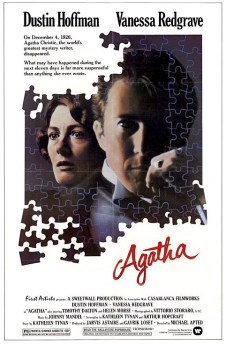
    AgathaThere are no giant wasps in sight as Vanessa Redgrave’s Agatha Christie goes missing for eleven days in December 1926, and Dustin Hoffman’s journalist tries to track her down. While the frame of the story is true, the reasons behind Christie’s disappearance, and what occurred during it, aren’t known — which makes it fertile ground for speculation. Sadly, a fantastical plot about jewel thieves and shapeshifting aliens is much more exciting than the down-to-earth mystery we’re offered here.

    It’s easy to see the attraction of Christie’s disappearance: it’s a real-life mystery about arguably the greatest mystery author ever, with enough unusual events surrounding it to make it extra suspicious and a long enough gap for something significant to have happened. But while the idea is initially exciting, when it comes to retelling it there isn’t a great deal there — the facts of her disappearance are just the ‘before & after’, amounting to little more than an abandoned car, an assumed name and some amnesia. Unless one invents something to fill those missing days, there’s little to tell (she went to a hotel and forgot what happened, essentially) — so, of course, this film fills in the gap. With a murder mystery, naturally. Sort of, anyway.

    To be honest, I found it a tad confusing for the most part. While the initial setup is well handled, showing what drives Christie to run away (consciously or not) and the beginning of the police search, it begins to flounder once the plot slides into its fully fictional phase. Hoffman’s journalist, who had been hoping to interview Christie, manages to stumble across her at the hotel, where he pretends not to know who she is, while she… has health treatments… It’s only at the conclusion, when Christie’s plan begins to come together, that one realises there was a plan at all. It’s a shame the revelation comes so late because it’s actually not that bad a plot, and makes for quite a neat and almost plausible (providing you can accept Christie as a potential murderess (sort of)) explanation for everything.

    The performances do nothing to raise the film. Redgrave is lumbered with little to do, mostly wandering around looking dazed. Her performance is decent but the material she has is lacking. Hoffman, on the other hand, is just flat, while Timothy Dalton’s sneering Colonel Christie sadly barely features. On a more technical level, the police investigation subplot is disappointingly forgotten halfway through, and everything is shot with too little light. Sometimes the latter is effective, such as during a train journey where occasional flashes of light illuminate Christie’s uncomfortably blank face, but at other times it merely obscures events. (It’s possible this is just the print, of course.)

    Christie’s disappearance remains a fascinating mystery, though in all likelihood the true causes were either very internal or mental health related — not the easiest thing to depict in a movie, especially when your audience is likely expecting a thriller. Agatha has a game stab at weaving an interesting tale into the gaps in the facts, but by the end I was wondering if a straightforward biopic mightn’t have been a better idea.

    3 out of 5