100 Films’ 100 Favourites #79

The mission is a man.

Country: USA
Language: English, French, German & Czech
Runtime: 170 minutes
BBFC: 15
MPAA: R
Original Release: 24th July 1998 (USA)
UK Release: 11th September 1998
First Seen: TV, c.2001
Stars
Tom Hanks (Big, Cast Away)
Edward Burns (She’s the One, 15 Minutes)
Matt Damon (Good Will Hunting, Jason Bourne)
Tom Sizemore (Natural Born Killers, Black Hawk Down)
(The lead cast includes since-famous people like Vin Diesel, Barry Pepper, and Giovanni Ribisi, and the supporting cast even more recognisable faces, but, still, Edward Burns is second billed.)
Director
Steven Spielberg (Empire of the Sun, War Horse)
Screenwriter
Robert Rodat (Fly Away Home, The Patriot)
The Story
In the immediate aftermath of D-Day, a group of soldiers are tasked to locate and rescue just one man: Private Ryan, whose three brothers have been killed in action, earning him a free pass home. As the squad trek across France, mindful of the waste of resources, they encounter first-hand the early days of the Allied invasion of Europe.
Our Heroes
Just a regular bunch of soldiers, co-opted into a PR mission that isn’t that easy. They’re commanded by Captain Miller, their respected leader with a secretive past… a past which is actually thoroughly mundane, and just highlights the bizarre, heightened world of the war.
Our Villains
Nazis!
Best Supporting Character
Matt Damon was cast as the eponymous soldier because Spielberg wanted an unknown with an all-American look. Unfortunately for that plan, before Private Ryan came out Damon won an Oscar for Good Will Hunting and became famous overnight. It certainly changes the effect to have the team rescuing Movie Star Matt Damon rather than Some Unknown Actor, but, on the bright side, he’s good.
Memorable Quote
Reiben: “Hey, so, Captain, what about you? I mean, you don’t gripe at all?”
Miller: “I don’t gripe to you, Reiben. I’m a captain. There’s a chain of command. Gripes go up, not down. Always up. You gripe to me, I gripe to my superior officer, so on, so on, and so on. I don’t gripe to you. I don’t gripe in front of you. You should know that as a Ranger.”
Reiben: “I’m sorry, sir, but uh… let’s say you weren’t a captain, or maybe I was a major. What would you say then?”
Miller: “Well, in that case, I’d say, ‘This is an excellent mission, sir, with an extremely valuable objective, sir, worthy of my best efforts, sir. Moreover, I feel heartfelt sorrow for the mother of Private James Ryan and am willing to lay down my life and the lives of my men — especially you, Reiben — to ease her suffering.’”
Memorable Scene
The opening half-hour, which recreates the Normandy landings in shocking, brutal detail, and is supposedly very true to the actual experience. Surely the definitive modern combat sequence from any war movie.
Technical Wizardry
The heavily desaturated cinematography by Janusz Kaminski instantly lends the film a grim veracity, very appropriate to its tone. Such extreme colour palettes are commonplace nowadays, mainly thanks to digital grading, but when Private Ryan came to US TV providers had to deal with numerous complaints from viewers who thought there was a problem with their signal — which the broadcasters fixed by just upping the saturation of the film, of course.
Truly Special Effect
The involvement of ILM was downplayed so that the film didn’t come across as “an effects movie”, but they still had a key role — for instance, providing most of the bullet hits throughout the D-Day sequence. Not remarkable effects work in itself, maybe, but it’s appropriately invisible.
Making of
The D-Day sequence alone cost $11 million. It was filmed over four weeks (almost half the entire shoot), gradually moving up the beach to film the whole thing in chronological order. Spielberg personally operated the camera for many shots, none of which were storyboarded. The shoot involved up to 1,000 extras, 20 to 30 of whom were amputees fitted with prosthetic limbs to simulate them being blown off. Reportedly, many veterans have congratulated Spielberg on the sequence’s accuracy, including actor James Doohan, aka Star Trek’s Scotty, who participated in the Normandy landings.
Next time…
HBO’s Band of Brothers is basically Saving Private Ryan: The Series, taking the film’s visual style to tell the true story of a company of soldiers from their training, through the invasions of France and Germany, and right up to the end of the war. Often topping lists as the greatest TV series ever made, it certainly belongs in consideration.
Awards
5 Oscars (Director, Cinematography, Editing, Sound, Sound Effects Editing)
6 Oscar nominations (Picture, Actor (Tom Hanks), Original Screenplay, Score, Art Direction-Set Decoration, Makeup)
2 BAFTAs (Sound, Special Effects)
8 BAFTA nominations (Film, Actor (Tom Hanks), Director, Music, Cinematography, Editing, Production Design, Make Up/Hair)
1 Saturn Award (Action/Adventure/Thriller Film)
1 Saturn nomination (Special Effects)
3 MTV Movie Awards nominations (including Action Sequence for the Normandy landings. It lost to Armageddon.)
What the Critics Said
“hands-down the best film of 1998. Spielberg has clearly stated in recent interviews that he made the film as a monument to the brave men who fought and died in that terrible war (and on D-Day, in particular), but he’s also done something morally heroic in the process. Private Ryan clearly illustrates, once and for all, that war — the real, appalling thing, not the flag-waving glorification that you usually see at the movies — is hell on earth. Spielberg accomplishes these goals with a technical virtuosity that no other director, arguably in the history of the cinema, can even approach. […] He’s a director whose work has grown right before our eyes from that of a precocious whiz-kid to the complex, humanistic statements of a true artist. Whether or not you always appreciate how he utilizes his skills, the man is an undeniable genius.” — Paul Tatara, CNN
What the Public Say
“the opening 25 minutes of Saving Private Ryan – where [Spielberg] thrusts us into the 1944 D-Day landings of Omaha Beach – is arguably his most impressive and certainly his most visceral work. It’s absolutely exhausting in its construction and sense of realism and the realisation soon sets in, that this cinematic auteur is not about to pull any punches in portraying a time in history that’s very close to his heart. The opening is so commanding that some have criticised the film for not living up this grand and devastating scale but Spielberg has many more up his sleeve. He’s just not able to deliver them too close together – otherwise, the film would be absolutely shattering and very difficult to get through. To bridge the gap between breathtaking battles scenes the film falls into a rather conventional storyline about men on a mission but its only purpose is to keep the film flowing and allows Spielberg the ability to make the brutality of war more personal.” — Mark Walker, Marked Movies
Verdict
Is Saving Private Ryan the greatest war movie ever made? Maybe. The relatively simple story allows it to explore the mindset of the soldiers making the first forays into Europe after D-Day, both their camaraderie as a group of men and the actions they took to function through the experience. It’s certainly the most influential World War 2 movie of modern times — nearly 20 years later, its desaturated colour palette remains de rigueur for films set in the war. So too its realistic depiction of combat, which is more plausible than some of the Boy’s Own adventures that came before, though not so ridiculously gruelling as some that have come in its wake. Personally, the only superior WW2 ‘film’ I can think of is Band of Brothers, and considering that has ten hours to explore its characters and situations, it’s not really a fair comparison.
#80 will be… a very different Spielberg/WW2 story.

 The director of minor horror Clown and (more significantly to the history of cinema, maybe) next year’s Spider-Man: Homecoming, Jon Watts drew the attention that landed him the latter job with this festival-hit thriller.
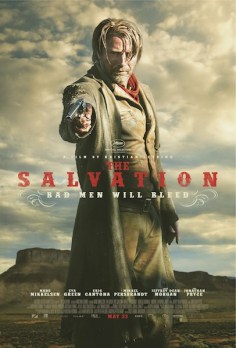 The spirit of the Spaghetti Western is kept alive in this Euro-minded South Africa-shot revenge Western.
 Deep Blue Sea is Terence Davies’ adaptation of Terence Rattigan’s play about the wife of a judge getting caught in a self-destructive love affair with an RAF pilot.

 Score:



 Sometimes you have to wait to see a film because it’s not accessible for some reason (no one’s put it out yet, or it’s out of print and costs a fortune, or whatever). Other times… maybe it’s just me, but there are some films that I wait years to watch for no particular reason. Not wait in the sense of “drumming my fingers waiting for the chance”, but in the sense that I’ll get to it someday, it’s just not a priority, for whatever reason. And then one day, with nothing apparently having changed, the time comes when it’s that movie’s turn.
 If you’re a reader from outside the UK, I guess you’ve probably not heard of Tim Peake. He’s (quite rightly) been big news here for the last year or so because he was our first (official) astronaut. That it’s taken until now for there to be a British astronaut seems remarkable, but there you go. I guess we always let other people do the initial exploring, then come along later to own the place — I mean, that Columbus fella was Italian, and is Italian the official language of America? No it is not. Anyway, Peake is a qualified helicopter pilot and instructor, has a degree in Flight Dynamics and Evaluation, was selected to be an astronaut in a process that involved academic tests, fitness assessments, and several interviews, and then received six years of training, including a mission as an aquanaut, before he went into space. But no, you can totally train a group of drillers to do that in a fortnight.
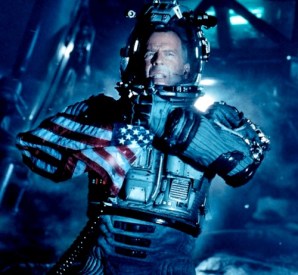 Apparently Michael Bay thinks it’s his worst film. In 2013, he said, “I will apologise for Armageddon, because we had to do the whole movie in 16 weeks. It was a massive undertaking. That was not fair to the movie. I would redo the entire third act if I could.” The problems stretch further than that, Michael.
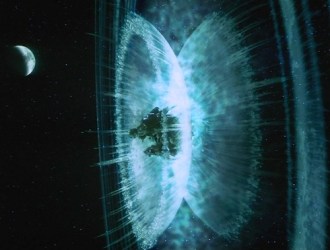 Maybe I’m wrong — it has a lower rating on IMDb. But then, that is IMDb. I should probably watch it again, but even without doing that I feel pretty confident saying it’s the better film.
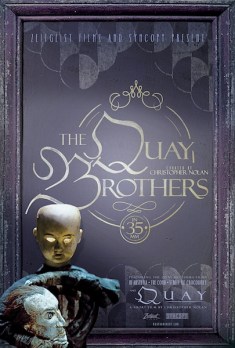 Christopher Nolan made a few headlines last year when his first post-
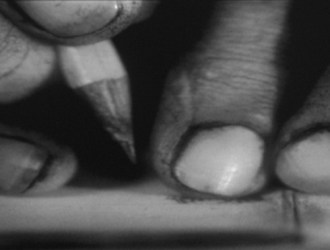 For all that In Absentia initially feels like flailing in deep water without armbands, accompanied with “what have I got myself into?!” thoughts, in retrospect I found it to be the most accessible of the three animations. It’s abstract and confusing for most of its running time, but by the end you can decipher some meaning; you can understand the relevance of the feelings it aims to generate — and if you haven’t got there yourself, or if you’re unsure, there’s a dedication to point you in the right direction. I didn’t get that with the next two; not so easily, anyway, which is why I say they’re less accessible rather than less good per se.
 Michael Brooke notes that it is “setting out to wrong-foot the viewer at every turn, and the result wilfully defies verbal analysis.” What can be easily discerned is that it’s about a dream, and it probably shouldn’t be a surprise that there’s some dream-logic involved. As to what else is to be gleaned, your guess is as good as mine.
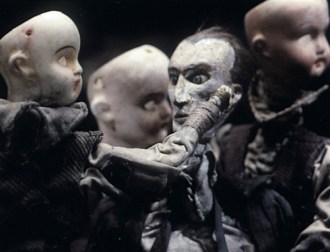 sometimes informative about the world the rest of us live in (In Absentia), sometimes a twisted analogy for it (Street of Crocodiles), and sometimes just fascinatingly unknowable (The Comb). All the films are teasingly oblique, and by all rights that should make them frustrating to the point of irritation, even abandonment… yet they’re kind of compelling nonetheless.
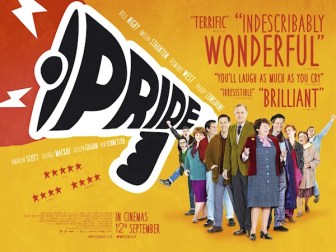 I don’t know if the true story behind Pride was big news back when it all actually happened in 1984, but I hadn’t heard of it until the film came along. For those who’ve still missed it, it’s about a group of gay activists deciding to form a group, LGSM, to support the striking Welsh miners — two groups who were poorly treated in one way or another by ’80s Britain.
 whose dancing display has to be seen to be believed. Bill Nighy and Paddy Considine are understated as quiet, hesitant characters who have inner steel, and Jessica Gunning makes a similar impact as a housewife who is completely emboldened by the activism.
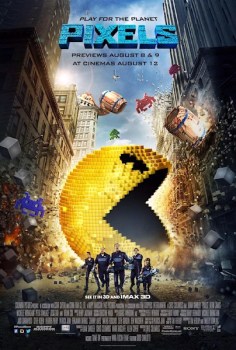 Adam Sandler, eh? He has his fans, though apparently not among people who can write because you rarely see a good word penned about him. The one exception is
 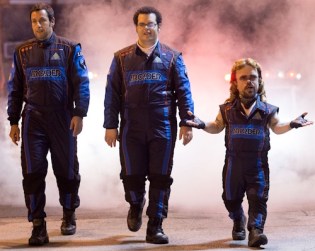 Pixels is the virtual definition of brain-off entertainment. The story has the plausibility of a kids’ daydream, the humour is frequently unimaginative, and the action sequences mostly coast on their basic concept rather than trying to elevate them. And Peter Dinklage is going to get a reputation for having terrible taste. I mean, I liked
  There are two stars in Mike Leigh’s biopic of famed British artist J.M.W. Turner: Timothy Spall, grunting his way through the title role with a deceptively layered realisation of an apparently simple but deeply complex man; and Dick Pope’s cinematography, which makes almost every frame look like a rich landscape painting, so that you feel you can almost see the brushstrokes.
 sometimes lack clear relevance (recognisable-off-the-telly actors turn up silently for what we’d call cameos if they were more famous). It creates a measured pace that is surely not to every taste, especially over the long running time, though personally I only found it sluggish towards the very end.
