Country: USA & Canada
Language: English
Runtime: 92 minutes
BBFC: 12A
MPAA: PG-13

Original Release: 11th June 2004 (USA)
UK Release: 29th October 2004
First Seen: DVD, 2005
Stars
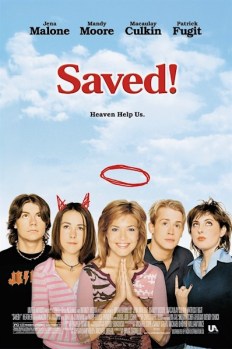
Jena Malone (Donnie Darko, The Hunger Games: Catching Fire)
Mandy Moore (A Walk to Remember, Tangled)
Macaulay Culkin (Home Alone, My Girl)
Patrick Fugit (Almost Famous, Wristcutters: A Love Story)
Eva Amurri (The Banger Sisters, The Life Before Her Eyes)
Director
Brian Dannelly (Struck by Lightning, Scream: The TV Series)
Screenwriters
Brian Dannelly (He Bop)
Michael Urban (Who’s Afraid of Vagina Wolf?)
The Story
When teen Mary learns her boyfriend is gay, a vision of Jesus leads her to attempt to cure him through sex. Unfortunately for her, the only result is she gets pregnant, which she decides to keep secret from friends and teachers at her ultra-Christian high school. As Mary questions her beliefs, she falls in with the school’s misfits, while her former friends endeavour to aggressively restore her faith.
Our Hero
Mary has “been born again her whole life”, but has her eyes opened a bit when her attempts to cure her homosexual boyfriend don’t go as Jesus promised.
Our Villain
Hilary Faye, the ‘perfect’ Christian who mainly uses her devotion to God to be the school’s queen bitch.
Best Supporting Characters
Hilary’s wheelchair-bound brother, Roland, and the school’s only “Jewish”, Cassandra, who come together with shared cynicism, but at heart better embody Christian values than some of their more militant schoolmates.
Memorable Quote
“Why would God make us so different if he wanted us to be the same?” — Mary
Memorable Scene
At the first assembly of the school year, cool headmaster Pastor Skip flips onto stage (“Give it up to the Lord, Jesus is in the house! Let’s get our Christ on, let’s kick it Jesus style! … Who’s down with G-O-D? Alright! Jesus rules! Jesus rules!”), before prayer time gives an insight into what everyone’s thinking (“thank you for sparing me from the eternal hell fires of damnation, I’m sorry I let that Promise Maker guy touch me in the rectory”), and then Cassandra starts ‘speaking in tongues’ (“mah puhsah issa hot puhsow”), though Hilary Faye sees through it (“she’s saying she’s got a hot p—!”)
Awards
2 Teen Choice Awards nominations (Movie Hissy Fit (Mandy Moore), Movie Sleazebag (Mandy Moore))
What the Critics Said
“Dannelly and Urban, first-time filmmakers, don’t have the ruthlessness of dedicated satirists like the writer-director team of Jim Taylor and Alexander Payne, whose movies Citizen Ruth and Election are modern classics. But satire can sting without being ruthless. Saved! is a minor work, yet it has a teasing lilt to it, and to make it at all took courage and originality. […] Saved! is not an attack on Christianity; if anything, the movie wants to reassert the Christian spirit. But it goes after pious hypocrites, the kind of people who never stop speaking of love yet find an unaccountably large number of folks to hate.” — David Denby, The New Yorker
 Score:
 61%
61%What the Public Say
“many moments [are] screamingly funny but also sad in Brian Dannelly’s incisive, but not entirely irreverent, send-up of Christian fundamentalism. The title’s exclamation point isn’t for show, but questions Christianity’s constant urgency: Is salvation really unattainable for these kids if they’re not seeking it this second, every second, 24/7? […] Dannelly and Michael Urban’s script could’ve settled for empty-calorie satirical slapdowns, but instead posed thoughtful, challenging questions about the relative worthlessness of forced value systems.” — Nick Rogers, The Film Yap

Mixing “mean girl” high school comedy with religious satire, which initially seems more cutting than it perhaps is, Saved! triumphs by having something to say but saying it very amusingly. Some criticise it for pulling its punches, not going all out in its damnation of religious types, but — conversely — that quality of mercy arguably makes it a better, more intelligent movie. It’s not saying having religious faith or sharing those values makes you inherently bad, but applying those beliefs hypocritically kinda does. Whatever your position on that matter, the screenplay’s gentle irreverence and the cast’s quality comic performances make it an often hilarious delight.

#79 will be… a lot of bother to rescue Matt Damon.
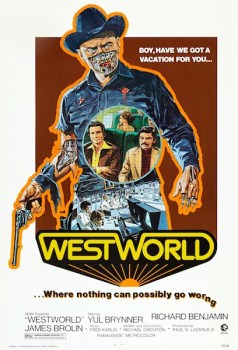 When writer-director Michael Crichton hit upon the notion of a theme park where the future-science star attractions broke free of their shackles and endangered the lives of the guests, it was so good it served him twice: he replaced the initial murderous AI-powered robot cowboys with rampaging genetically-engineered dinosaurs and sparked
 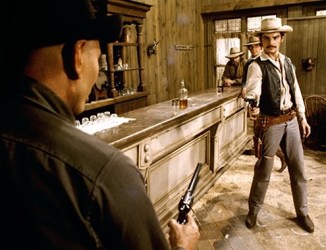 under $76,000, or about £58,200. The potential threat of the robots malfunctioning is built up gradually here and there, in asides from what our ostensible heroes are up to, and isn’t explained. There are nods to the fact the human staff don’t actually know how the robots work, but why should that be? Some of them were apparently designed by other robots, but how did the designing robots come about? Rather than explore any of its science fiction themes, the film just uses the basic idea to have the robots go on a killing spree right at the climax. This is something Crichton definitely turned around for
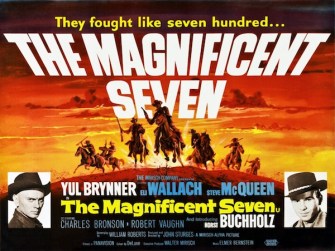 Described in the booklet accompanying the Ultimate Edition DVD release as “the last great American western before Sergio Leone reinvented the genre,” The Magnificent Seven doesn’t feel as dated as that might make it sound. Famously, it’s a remake of Akira Kurosawa’s
 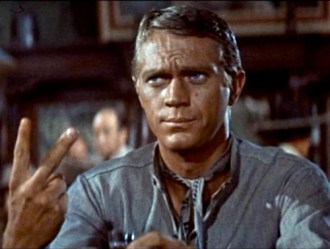 With even less screen time to go round than in Kurosawa’s original, the cast only get to provide thumbnail sketches of their characters. However, bearing that in mind, only Vaughn really feels shortchanged on time, while McQueen manages to steal every scene he’s in, even when he was supposed to just be in the background — much to Brynner’s annoyance. One reason this works is because the seven represent more or less the same things thematically, in some respects functioning as one hero character with seven parts. They are all unsettled drifters, good at killing but not at settling down; they have nothing to do but win and so be damned to go find another cause, or die trying. This is taken from Kurosawa’s film too, of course, but it fits just as well in its new setting, and the main scene where the seven discuss it is a definite highpoint of the movie.
 That’s not something that bothered me, but where I did find it suffering was in comparison to Kurosawa. While it has obviously been rejigged for its new setting, it’s not just borrowed the basic concept of seven violence-skilled loners defending a needy village, but rather retained all the bones of the samurai original. As with most remakes, it falters by not doing the same thing quite as well, for one reason or another. Still, if it is a faded copy then at least it’s of one of the greatest films ever made, which leaves it a mighty fine Western in its own right.


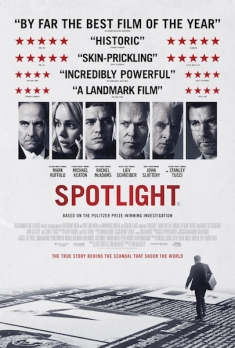 The most recent Best Picture Oscar winner tells of how the Boston Globe’s investigative journalism unit, the eponymous Spotlight team, exposed the widespread sexual abuse of children by the local Catholic Church — and, just as shockingly, the way the institution itself swept this under a rug for decades. As a film, this story is effectively a conspiracy thriller: a team of journalists expose a wide-reaching criminal cover-up within a respected and powerful institution. If it were fiction, you’d struggle to believe it, the scale of the conspiracy so vast that the very notion of it would be implausible. So it’s all the more astonishing — and horrifying — that it was real. And, as the closing title cards reveal, far larger than the Spotlight team realised even when they went to print.
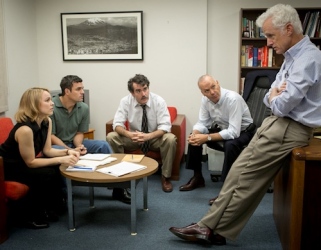 Instead, it lets the story and the events speak for themselves, with the screenplay being the real powerhouse here. On that scale the directing isn’t even in second place. That’d be the performances, as the actors carry the delivery of information while still feeling like human beings pursuing an investigation, rather than mere narrators of what they discovered. McCarthy’s work is therefore the kind of helmsmanship that wouldn’t attract awards attention, except maybe by association with the film’s overall acclaim (he did get nominations, but the cynical side of me doubts awards bodies genuinely appreciated the qualities of what they were watching). Nonetheless, awards are not the be-all-and-end-all, and the low-impact style was surely the right way to go. This is a tale bigger than auteurist showboating, and McCarthy handles it with appropriate respect.
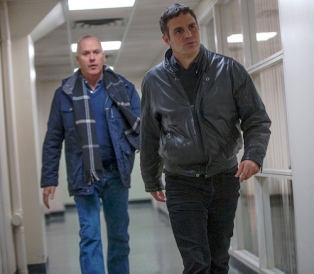 this is also perhaps where the film’s only egregious bum note comes in: Ruffalo’s shouty speech about how they need to go to press now, which was naturally used across all the trailers and clips. It feels like that is precisely what that speech was designed for — that it was written, directed, and acted with the “here’s our big dramatic trailer moment” in mind. It’s not entirely out of character in context, but it is a bit much.
 So was it the best film of last year? Perhaps that depends what you look for in movies. As much as I think the understatement fits, I also think it’s what stops it from being as cinematically exciting as, say, the visually-driven hyper-kinetic storytelling of
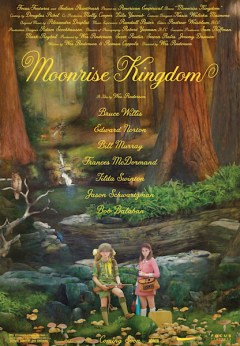 On the New England island of New Penzance in the summer of 1965, a troop of scouts at camp discover that unpopular member Sam Shakusky (Jared Gilman) has fled in the night. Meanwhile, on the other side of the island, troubled kid Suzy Bishop (Kara Hayward) runs away from home. Unbeknownst to Sam’s scoutmaster (Edward Norton) or Suzy’s parents (Bill Murray and Frances McDormand), the pair of unhappy 12-year-olds have secretly plotted to disappear together. As a violent storm threatens to hit the island, the scouts and police Captain Sharp (Bruce Willis) hunt for the runaways.
 If the film has a fault it’s in this part, where the entire cast engage in a runaround as the hurricane arrives and floods the island; but (to give it the benefit of the doubt) perhaps that plays more smoothly with familiarity. And I don’t know what it is that Anderson has against dogs (nor, it seems, does anyone else, bar


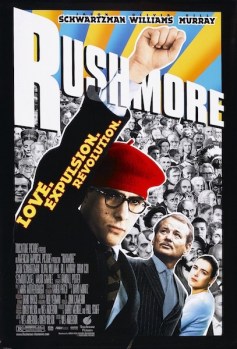 The breakthrough film of cult writer-director Wes Anderson, Rushmore is the story of high school student Max Fischer (Jason Schwartzman, making his debut, aged 18 but still looking like one of those twentysomethings-playing-highschoolers you so often see in US productions). He’s a prolific participator in extracurricular activities at the prestigious Rushmore Academy, but is put on notice for his failing academic standard. At the same time, he becomes infatuated with first grade teacher Miss Cross (Olivia Williams) and attempts to woo her by building an aquarium on school grounds. He enlists the support of local business magnate Herman Blume (Bill Murray), but soon Blume is falling for Miss Cross too, setting the men on a path of mutual enmity.
 Part of that is probably tied to Anderson’s own development. It’s not only his very personal touches that have flourished with further films, but I feel like his storytelling and depiction of character has become more sophisticated, too. That’s not to say Rushmore comes up short, but coming to it for the first time with that degree of hindsight, it feels very much like a formative work.
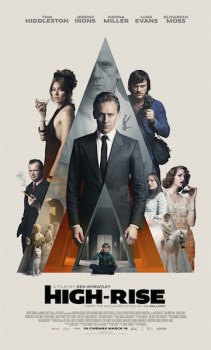 I was looking forward to this sci-fi-ish ’70s social satire, but, having let it percolate for a few months, I still have no real grasp of what it was about. I mean, it’s obviously about society, but what its point about society is… I have no idea.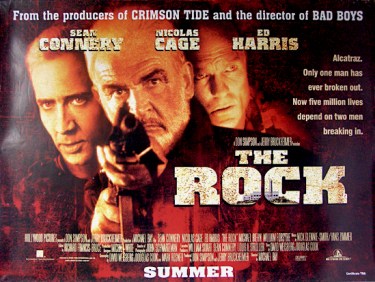
 Believing the mission lost, the military has launched its back-up plan: an airstrike that will destroy the poison gas but also kill everyone on the island. Naturally our heroes manage to complete their mission nonetheless, and as the jets streak across San Francisco Bay, Stanley attempts to signal abort with two green flares. In slow motion, of course.