Unbreakable (2000)

100 Films’ 100 Favourites #95

Are you ready for the truth?

Country: USA
Language: English
Runtime: 107 minutes
BBFC: 12
MPAA: PG-13

Original Release: 22nd November 2000 (USA)
UK Release: 29th December 2000
First Seen: DVD, 2001

Stars
Bruce Willis (Armageddon, Looper)
Samuel L. Jackson (Pulp Fiction, Avengers Assemble)
Robin Wright Penn (The Princess Bride, The Conspirator)

Director
M. Night Shyamalan (The Sixth Sense, The Village)

Screenwriter
M. Night Shyamalan (Stuart Little, The Visit)

The Story
When security guard David Dunn is the only survivor of a train crash, and without a scratch on him, he encounters comic book fan Elijah Price, who has an unusual theory: that David is indestructible, a real-life superhero.

Our Hero
David Dunn is just an ordinary guy, with a low-key job and a wife and kid, but after his near-impossible feat of survival he begins to test himself. Could he be more remarkable than he ever imagined?

Our Villain
Spoilers! Which, considering this is an M. Night Shyamalan movie, is basically a red flag saying “here’s where the twist is”. All I’ll say is, keep an eye on David’s kid, Joseph. I mean, pointing a gun at your parent is never innocent, is it?

Best Supporting Character
Comic book art dealer Elijah Price was born with Type I osteogenesis imperfecta, a rare disease that makes his bones extremely fragile and prone to fracture. Losing himself in the world of comic book superheroes throughout his childhood, he develops a theory: that if he represents an extreme of human weakness, there must be someone at the opposite extreme…

Memorable Quote
Elijah: “Why is it, do you think, that of all the professions in the world you chose protection?”
David: “You are a very strange man.”
Elijah: “You could have been a tax accountant. You could have owned your own gym. You could have opened a chain of restaurants. You could’ve done of ten thousand things, but in the end, you chose to protect people. You made that decision, and I find that very, very interesting.”

Memorable Scene
As well as his indestructibility, David comes to believe he may have a form of ESP, that allows him to glimpse people’s criminal acts when he touches them. Encouraged by Elijah, he goes to a bustling train station, stands in the middle of the crowd, and holds out his arms…

Next time…
Reportedly the plot of Unbreakable was merely Act One of Shyamalan’s original concept, until it wound up expanding into an entire movie. Talk of a sequel and/or trilogy used to occur regularly, but Shyamalan made a bunch of crap no one liked instead. 16 years on, I guess hopes of a continuation are long dead.

Awards
1 Saturn nomination (Action/Adventure/Thriller Film)

What the Critics Said
The Sixth Sense was no fluke. Unbreakable, writer-director M. Night Shyamalan’s dazzling reunion with Bruce Willis confirms he’s one of the most brilliant filmmakers working today. […] The deliberately paced Unbreakable, make no mistake about it, is a vehicle form-fitted to Bruce Willis’ burgeoning gifts as an uncommonly subtle and affecting actor. Willis should get the Oscar nomination he deserved for The Sixth Sense, and Jackson’s enigmatic Elijah – who has devoted his life to searching for the sole survivor of a disaster, for reasons that won’t be explained here – is equally commanding in a difficult if somewhat underwritten role.” — Lou Lumenick, New York Post

Score: 68%

What Quentin Tarantino Says
“The final film, alphabetically, on my top twenty list is M. Night Shamalamadingdong’s Unbreakable, which I actually think, 1) not only has Bruce Willis’ best performance on film that he’s ever given. I think he’s absolutely magnificent in the film. It also is a brilliant retelling of the Superman mythology. In fact, so much so that, to me, the film was very obscure when it came out as far as what it was about. I actually think they did themselves a disservice, because you can actually break down what the film is about by basically one sentence, that I should think would’ve proved far more intriguing than their ad campaign, which is basically, “what if Superman was here on Earth and didn’t know he was Superman?”, which is what the film is about. Course, you don’t know that until actually you see the movie. Anyway, Unbreakable is, I actually think, one of the masterpieces of our time.” — Quentin Tarantino’s Favourite Movies from 1992 to 2009

What the Public Say
“The story is unique… I mean we see stories about superheroes everywhere… everywhere, and despite things here and there changed, they are still the same stories we have heard a thousand times before. This film had an original story that was both compelling and intense. The use of the camera angles is so well done it is a shock that Unbreakable is not at the top of everyone’s favorite Shyamalan film. It is masked under the presumption that it is moving slowly, because in reality… a lot is going on.” — Dave, Dave Examines Movies

Verdict

Some people view Unbreakable as the start of M. Night Shyamalan’s inexorable quality slide after the debut peak of The Sixth Sense (not that it was his debut). Those people are wrong. Partly because that degeneration doesn’t really start until the final act of The Village; partly because Unbreakable is Shyamalan’s best film. We’ve now had countless big-screen takes on superhero mythology, but none are quite like this. Man of Steel may have attempted to ask “what would happen if Superman were real?”, but it’s Unbreakable that better answers that question. With subtle performances, including arguably a career-best turn from Bruce Willis, and a plausible handling of its fantastical material, which nonetheless develops into a satisfying climax, Unbreakable is still one of the most original and best superhero movies ever made.

#96 will be… gunpowder, treason, and plot.
The Past Fortnight on TV #11

As discussed yesterday, I’m out of the country for a fair chunk of December, including when my regular monthly TV review is due. So to placate the ravenous need for my opinions about television that you will surely feel if such thirst goes unquenched for six-to-eight-weeks, here’s what I watched in the fortnight since my last TV post.

Crisis in Six Scenes
Crisis in Six ScenesWhen Amazon started making a serious effort to challenge Netflix in the field of streaming original series, one of their early moves was the headline-grabbing signing of Woody Allen to create his first TV series. As has since become clear, Allen didn’t know what he was letting himself in for. To summarise his comments from various interviews (and read between the lines a little), it seems he had a view of TV that’s about 20 years out of date, and thought he’d be able to dash off something suitable between two of his annual movies. At some point he obviously realised how much more sophisticated TV has become, and coopted a movie idea he’d had on the back-burner to expand into a short TV season. Allen’s been vocal about how miserable he found this process, but I’m not sure if he’s aware that he made a rod for his own back: he essentially made three movies in two years instead of his usual two. It probably would’ve been wise to swap out one of the films for the TV series, but you get the sense that, despite having been shown TV’s burgeoned respectability, Allen’s still something of a film snob. Rather than the potential of TV coming as a revelation to him, he’s declared he won’t be making any more.

On the evidence of the single six-episode season we did get out of him, that’s neither here nor there: Crisis in Six Scenes is just a slightly-longer-than-average Woody Allen film split into instalments. The first episode is the worst offender in this regard — it doesn’t reach a climax of any description, it just stops. The rest of the episodes aren’t as blatant (episode five’s ending even feels like it’s genuinely meant to be the end of an episode!), but none of them are particularly satisfying as a discrete segment. I’m not really one for binge-watching — I get fidgety and want a change; or if a show’s too good, I want to savour it rather than race on — but I watched all of Crisis in one sitting, because at heart it’s just a chopped-up movie. Some characters or events are confined to a single episode, but you get the impression that’s almost incidental rather than a deliberate attempt to make six finite units. The main storylines flow between episodes like the boundaries are artificially imposed — which, in a medium without the constraints of broadcast time slots and where all the episodes are released at the same time, they are.

A scene of CrisisBut enough of the form — what of the content? This is not prime Allen, that’s for sure. At times it makes for uncomfortable viewing, when it’s hard to tell if it’s half improvised or if half the cast are just a bit doddery (and I suspect it’s the latter). Other bits do work, though, and while it isn’t massively rewarding it is amusing at times. Even less assured are some broadly political points that it seems like Allen is trying to tap into, or maybe it’s just incidental. He appears to be using the series’ 1960s setting as a mirror of the present: the plot concerns a twenty-something anti-government protestor, and there’s lots of talk about unnecessary wars, campus demonstrations, young people staging protests, rights for women and black people, etc, etc. At first blush these parallels are all well and good, but I’m not sure they develop into much more than wry observations. The best I can take from it is a result of the particularly farcical last episode, where it may be that he’s trying to say people in general should be more aware and active, like the young are — to walk the walk of political change rather than just talking the talk.
If he was trying to spread such a message, it’s a bit buried. Maybe he was just picking on some low hanging fruit. Considering Allen’s half-arsed attitude to the whole endeavour, I guess that’s more likely. Oh well.

The Grand Tour (Season 1 Episodes 1-2)
The Grand TourAnother big gun in Amazon’s streaming mission, their £160 million “Not Top Gear, Honest” original series kicked off last month to widespread positive reviews and, apparently, big ratings (relatively speaking). I’m not really a ‘car person’, but like millions of others I wound up watching Top Gear during the height of the Clarkson / Hammond / May era for all the other hijinks. I thought it was going off the boil a bit even before their semi-enforced departure — I didn’t even get round to watching their last series. They come to Amazon after a short break (a long break for us, but it takes time to film these things, so, short break), and I think reinvigorated — possibly by the rest, possibly by the change of management, possibly by the huge budget.

There’s no denying that this is their Top Gear with just a few tweaks… unless you’re an Amazon lawyer, in which case it’s a completely different show. But the freedom from being a motoring programme on a public service broadcaster means they’re not quite so constrained by that remit. Episode 2, for instance, is half given over to them attacking a military training course in Jordan, a riff on Edge of Tomorrow in which they get to play at being action movie stars, and which features cars because action movies feature car chases, not because they’re actually reviewing how the motor performs while in a high-speed chase. There are still genuine car reviews, and they’re as dull / interesting (delete as applicable) as they always were. At least they’re excitingly shot and scored (still using cues from film music, as they always have).

Some bits are improved: the famous Star in a Reasonably Priced Car segment was always one of the weakest parts of the show (the track times were fun, but Clarkson is no interviewer), but here the need for celebrity guests is neatly pilloried. Conversely, a couple of things are weaker: their blatant attempt at a Stig replacement, The American, doesn’t really work. It’s also one of the bits that most feels “changed just enough to avoid a legal challenge”. I imagine there are only so many different ways to do a car show, so of course there are going to be similarities, but you could imagine them having done this as their next run of Genuine Top Gear (well, aside from the expense) without people thinking, “wow, they’ve completely changed the show!”

Still, it is what it is, and if you liked it before I can’t imagine you wouldn’t like it now, maybe even a little more.

Class (Series 1 Episodes 6-7)
ClassThe Doctor Who spin-off that no one’s watching continues with two of its strongest episodes. A two-parter that isn’t, the first is a “bottle episode”, with most of the cast stuck in detention and forced to confess their secret feelings by an alien rock. Cue arguments. Not Class’ strongest instalment — it’s a good idea, but the characters haven’t amassed quite enough secrets over just five episodes to make it feel as cathartic as it should — but it’s considerably better than the weaker ones. Even better is the next episode, which shows what Quill was up to while the kids were bickering. A world-hopping quest (presumably paid for by saving so much money on episode 6), it has several good ideas that it burns through like they’re going out of fashion. It feels most like Doctor Who, too, which provokes no complaints from me.

Next time: the Shadow Kin are back, again. Ah well.

Also watched…
  • Castle Season 7 Episodes 16-21 — by sheer bloody coincidence, the night before flying from London to the US I watched the episode where Castle flies from the US to London and has to deal with a murderer and possible terrorist on his flight. Super timing.
  • The Flash Season 3 Episodes 3-5 / Arrow Season 5 Episodes 3-5 — the much-anticipated four-way crossover between The CW’s superhero shows finished last night in the US, which means it’s at least a few weeks away over here. I’ll say something about it next time, then. Or the time after.
  • Junior Bake Off Series 4 — the main thing I take from this is that all kids are incredibly clumsy and slapdash.
  • The Moonstone — the recent BBC adaptation of Wilkie Collins’ novel, which is generally regarded as the first full-length English-language detective novel. This decent miniseries version was produced for daytime, and was the kind of series certain viewers proclaimed was good enough for prime time. It wasn’t.

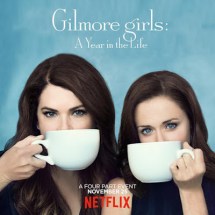
    Gilmore GirlsThings to Catch Up On
    This fortnight, I have mostly been missing Netflix’s Gilmore Girls revival, subtitled A Year in the Life. Rather than race through the four feature-length instalments between their release last Friday and our departure yesterday, we decided to save them for when we’re back, like a Christmas treat. Maybe we’ll just watch them in four days then instead, but at least we’ll feel like we have a choice.

    Next time… a festive special, looking at what seasonal delights the tellybox has provided us with this year. As far as December 29th or so, anyway.

  • The Transporter (2002)

    100 Films’ 100 Favourites #94

    Rules are made to be broken.

    Country: France & USA
    Language: English, French & Mandarin
    Runtime: 92 minutes
    BBFC: 15
    MPAA: PG-13

    Original Release: 11th October 2002 (USA)
    UK Release: 17th January 2003
    First Seen: DVD, c.2003

    Stars
    Jason Statham (Snatch., Crank)
    Shu Qi (The Storm Riders, The Assassin)
    Matt Schulze (Blade II, Fast Five)
    François Berléand (Au Revoir Les Enfants, The Chorus)

    Directors
    Louis Leterrier (The Incredible Hulk, Now You See Me)
    Corey Yuen (The Legend of Fong Sai Yuk, DOA: Dead or Alive)

    Screenwriters
    Luc Besson (Léon, Lucy)
    Robert Mark Kamen (The Karate Kid, Taken)

    The Story
    Frank Martin is “The Transporter”, a driver for hire who moves people and goods, no questions asked. He never looks inside the package… until, on one job, the package moves. Finding a young woman gagged inside, Frank winds up embroiled in her rescue from some very bad men.

    Our Hero
    Frank Martin, expert driver (he’s the titular transporter after all) and martial artist, as handy with his fists as he is with a steering wheel. Lives by a simple set of rules… which he breaks, because it’s a movie and it needs a plot.

    Our Villain
    Darren “Wall Street” Bettencourt, an American gangster who initially hires Frank, then tries to kill him — even though he did a good job! And you thought people who left unnecessarily low feedback on eBay were a pain.

    Best Supporting Character
    Inspector Tarconi, the local police detective who’s on to Frank but can’t prove anything. Comes through in the end, becoming Frank’s ally in the sequels.

    Memorable Quote
    “Rule #1: never change the deal.” — Frank

    Memorable Scene
    Oil everywhere + people wanting to fight = ingeniously slippery combat. Seriously, that one scene is the main reason the entire film is here.

    Technical Wizardry
    Jason Statham did most of his own stunts, fighting, and driving. That included learning martial arts to supplement his kickboxing abilities and, for one sequence, actually hanging off the bottom of a truck with just a wire up his leg for safety.

    Letting the Side Down
    The trailer showed Frank deflecting a missile with a tea tray. A missile. With a tea tray. It was removed from the final cut because Statham didn’t think audiences would believe it, but c’mon, this is an action movie, and that’s silly-awesome. I mean, deflecting a missile… with a tea tray!

    Making of
    The oil in the famous fight scene is actually molasses syrup. Apparently it was very sticky, which is kind of the opposite to its purpose in the film, but that’s movie magic for you.

    Next time…
    Two direct sequels of typically decreasing quality; a spin-off TV series that ran for two seasons; and a reboot movie last year, which went down badly but I quite enjoyed (for what it was). Plus: a mini-empire of similarly-styled Euro-produced English-language action movies masterminded by Luc Besson, the most famous of which is the Taken series.

    What the Critics Said
    “Post-Ghosts Of Mars, if anyone had suggested that big, bald, brusque Jase could hold his own as an action hero, they’d have been laughed out of town. And while he doesn’t exactly deliver an acting masterclass (his ‘American’ accent doesn’t quite stand up to the rigours of actually opening his mouth and talking), this is all about kicking ass and taking names. […] The spirit of Hong Kong action movies hangs heavily over The Transporter, most notably in the CG-free fight scenes which, thanks to former fight choreographer Yuen, have enough zing and originality to satisfy even Hong Kong aficionados. […] simultaneously the best (the fight scenes) and worst (everything else) action movie of the year. Destined for drunken Friday night rental heaven.” — William Thomas, Empire

    Score: 54%

    What the Public Say
    The Transporter doesn’t hold up as well on a rewatch as I would have hoped. It’s a bit stop-start and the ending didn’t feel as BIG as it should have been. At the same time, it has a couple of outstanding scenes and no review of this film is complete without a reference to and expression of WTF?! about the now infamous oil-slick fight scene. Truly a marvel of film thinking, then perfectly executed. […] The Transporter is exactly the kind of daft film that Hollywood became ashamed of making — and it really shouldn’t have.” — Steve G @ Letterboxd

    Verdict

    The Transporter is neither big nor clever. In terms of the former, it’s a relatively small-scale, low-key action movie, not some Hollywood extravaganza; and in terms of the latter, it’s a relatively small-scale, low-key action movie, so of course it’s not been pumped full of brains. Instead it’s pumped full of adrenaline, with a brisk running time that serves up impressively choreographed action at a solid rate, with an amenably light tone in between the combat. It also made an action star of Jason “The Stath” Statham, which I’m sure some people would thank it for. It certainly brought down the average age of participants in The Expendables.

    #95 is… indestructible.

    The Transporter Refuelled (2015)

    aka The Transporter Refueled

    2016 #166
    Camille Delamarre | 96 mins | streaming (HD) | 2.35:1 | France, China & Belgium / English, Russian & French | 15 / PG-13

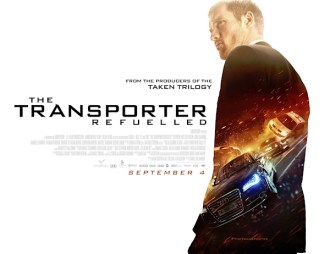
    The Transporter RefuelledI kind of knew The Transporter Refuelled was going to be bad before I even began, but I watched it anyway because, well, I watched the first three Transporter movies and I really liked one of them, so… It’s just the completist in me, really; though why I was able to ditch Transformers when they semi-rebooted after three films and not this I don’t know. Possibly because the Transporter films have never been good, just entertaining trash, and even though Refuelled’s acting looked terrible and I can’t even remember if the trailer gave any indication of the plot, if it had half-decent action scenes then I’d be passingly happy for 90 minutes of entertainment (unlike Transformers 4, which runs the best part of 3 hours).
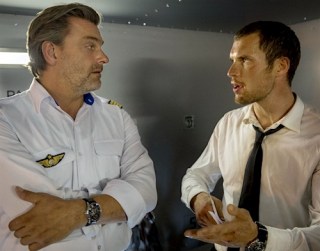
    So imagine my surprise when, actually, I rather enjoyed it; way more than I probably should have, in fact. I mean, whenever it slows down for some plot or (especially) character stuff, it begins to go awry; but the action is pretty good, with some impressive car stunts and some neatly choreographed punch-ups. That’s all I expect or want from a movie like this, really, and even though it may not be an exceptional example of the form, the fisticuffs entertained me. I’ve certainly seen far worse. It helps that the over-reliance on CGI seen in the second two Statham instalments has been tempered. It’s still used to make us think the actors are in the actual car when they’re clearly on a soundstage, but all the flips and crashes look to have been done for real. Director Camille Delamarre previously edited several EuropaCorp movies, including Transporter 3, Colombiana, and Taken 2, and consequently he seems to know his way around an action sequence.

    Like father like sonUnfortunately I wasn’t wrong about the acting, which is indeed pretty shit. Ed Skrein was truly dreadful in Game of Thrones (until he was thankfully recast) but was passable as the villain in Deadpool. As this film’s Statham-replacement hero he charts a course somewhere between those two stools. The supporting cast aren’t much better, with the notable exception of Ray Stevenson as Skrein’s dad, who brings much fun whenever he’s on screen. If anything makes Refuelled work as entertainment away from the violence, it’s the father-son dynamic. I want a sequel just to get another dose of that.

    Sadly, poor critical reception may have scuppered this attempted reboot at the first hurdle. True, we don’t need more Transporter movies, but they provide a kind of simple but well-made action charm that sometimes hits the spot. I’d say Refuelled is more-or-less as good as any of its franchise brethren.

    3 out of 5

    Jason Bourne (2016)

    2016 #185
    Paul Greengrass | 123 mins | Blu-ray | 2.40:1 | UK, USA & China / English & German | 12 / PG-13

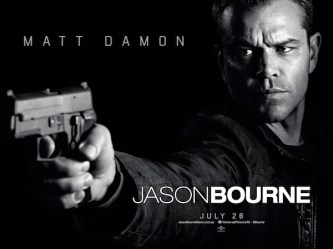
    Jason BourneMuch like the Bond films to which they’re so often compared, the Bourne movies have their devotees while only fitfully pleasing the critical establishment. This fifth movie — which is notable for marking the return of star Matt Damon and director Paul Greengrass after the semi-reboot of The Bourne Legacy — certainly met with mixed reviews when it came out at the end of this summer. Mixed erring towards negative, anyhow, though it does have its supporters. I’d love to say I’m among them, but my take was more… well, mixed.
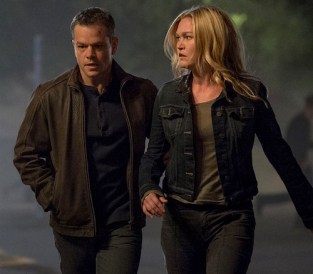
    The story picks up a decade-ish since the last Damon movie, Ultimatum (I don’t recall if the time gap is specified on screen, but we’re led to believe it’s been roughly real-time). Bourne is still living off the grid, participating in underground bare-knuckle fights in Greece for money and/or something to do. When his former associate Nicky Parsons (Julia Stiles) hacks into the CIA to retrieve documents on the black ops missions she and Bourne used to be a part of, she discovers something about Bourne’s past that leads her to meet up with him. In Langley, hotshot young tech-head Heather Lee (Alicia Vikander) and her boss Director Dewey (Tommy Lee Jones) are on to Nicky and presume Bourne is involved in her plot, dispatching The Asset (Vincent Cassel) to rub them out — but he has his own history with Bourne.

    Bourne againAction sequences ensue, shot with all the ShakyCam you’d expect from Greengrass. By now I imagine you have your own view on whether his style works or not. Personally, I think it’s considerably less bamboozling than when it made its debut in Supremacy 12 years ago — it’s been so copied that we’re more used to seeing it. I think Greengrass has a better handle on the purpose of the style than many of his imitators, however. I’d also argue that the cinematography in Jason Bourne is a smidgen more stable, with shots held a few frames longer, so that it’s even less seasickness-inducing than before. In fact, some shots — even in the quick-cut action montages — are downright pretty. The film was shot by Barry Ackroyd, who hasn’t lensed a Bourne before but has done most of Greengrass’ other movies, so maybe that has something to do with it.
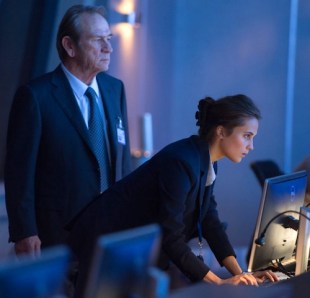
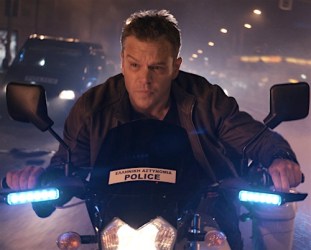
    It’s in the big set pieces that Jason Bourne functions best. One in London in the middle of the film is just people walking around a lot looking over their shoulders, but Greengrass still invests it with some tension. Better is the climax, a kind of drag race down the Las Vegas strip… in the middle of traffic, of course. It’s largely implausible (I’ve been to Vegas — I remember the strip as being permanently gridlocked), but it’s certainly adrenaline-pumping. However, the highlight is probably the first: a chase through a smoky nighttime riot in Athens, with Bourne and Nicky on foot and then a motorbike as they’re pursued by the local police, an undercover CIA team, and the Asset, the latter two directed by Lee, Dewey, and their Langley lot via satellite imagery, CCTV, and… social media.

    Government surveillanceFrankly, Jason Bourne is at pains to mix in hyper-current iconography; the reasoning for Damon and Greengrass’ return now being that the world has changed and how does Bourne fit into that? So as well as social media and Greek riots we’ve got references to and riffs on hacking, Edward Snowden, government surveillance of its own citizens, the prevalence of Facebook/Twitter-esque tech companies, and so on. Sadly, I’m not sure the film’s actually got anything to say about any of these things. Greengrass and his co-writer, editor Christopher Rouse, have appropriated all these zeitgeisty concepts to make the film feel very Now, but that surface sheen is more or less where it ends. I mean, there’s a whole subplot starring Riz Ahmed as the Zuckerberg-like CEO of a social media company that I didn’t even mention in my plot summary because it’s kind of an aside. It’s kind of ironic, really, that it always seemed as if Greengrass’ more natural stomping ground was his documentary-ish real-world-exposé type movies, with his contributions to the Bourne series an unusual sideline; yet when he finally marries the two halves of his filmmaking career, it’s the action rather than current-affairs commentary that takes precedence.
    Even leaving that aside, the plot is no great shakes. It’s too slight, serving primarily to string together the three or four big set pieces; and it’s too simplistic — Greengrass’ Bourne movies used to be entertainingly baffling, a web of crosses and double-crosses and historical connections and hidden plans. Jason Bourne re-appropriates many of the series’ familiar beats — all of them, in fact — but it feels like Greengrass and Rouse just analysed the previous movies for repeated elements and copied them, rather than having anything fresh to do with the constituent parts. So while few of these building blocks are poorly handled, there’s little remarkable about them either. Some are at least elevated by quality performances: Vikander tries to inject complexity into her character, with some success thanks to final-act kinda-twists, while Tommy Lee Jones brings natural class.

    Bourne bikerThe end result is that Jason Bourne does thrill as an action movie, which seems to have been the primary goal of its makers, at the end of the day. As an action-thriller, however, the rinsed-and-repeated plot is a slightly faded imitation of former successes; a through-the-motions way to provide those impressively staged chases and punch-ups. It’s not the definitive Bourne movie one might’ve expected from the returning star/director combo (why else come back if not to perfect, or at least add to, the formula?), but instead means the film ends on an odd note: even though it wasn’t a wholly satisfying experience, and even though it doesn’t end with questions still blatantly hanging (as every Bourne movie bar Ultimatum has done), I want Damon and Greengrass to come back and do it all again, please. Only do it properly next time, yeah guys?


    3 out of 5

    Jason Bourne is released on DVD and Blu-ray in the UK today and the US next week.

    Toy Story 2 (1999)

    100 Films’ 100 Favourites #93

    The toys are back!

    Country: USA
    Language: English
    Runtime: 92 minutes
    BBFC: U
    MPAA: G

    Original Release: 24th November 1999 (USA)
    UK Release: 11th February 2000
    First Seen: cinema, 2000

    Stars
    Tom Hanks (Apollo 13, The Da Vinci Code)
    Tim Allen (Jungle 2 Jungle, Wild Hogs)
    Joan Cusack (Addams Family Values, School of Rock)
    Kelsey Grammer (Anastasia, X-Men: The Last Stand)

    Director
    John Lasseter (Toy Story, Cars 2)

    Co-directors
    Ash Brannon (Surf’s Up, Rock Dog)
    Lee Unkrich (Finding Nemo, Toy Story 3)

    Screenwriters
    Andrew Stanton (Monsters, Inc., WALL·E)
    Rita Hsiao (Mulan, My Little Pony: The Movie)
    Doug Chamberlin (Bruno the Kid: The Animated Movie)
    Chris Webb (Bruno the Kid: The Animated Movie)

    Story by
    John Lasseter (A Bug’s Life, Tinker Bell and the Pirate Fairy)
    Pete Docter (Toy Story, Inside Out)
    Ash Brannon (Surf’s Up, Rock Dog)
    Andrew Stanton (Toy Story, Finding Dory)

    The Story
    After Woody is stolen by a nefarious toy collector, the rest of the toys set out to rescue him — but, tempted by the idea of spending eternity in a museum with friends from his TV show, does Woody want to be saved?

    Our Heroes
    Buzz and Woody are back, and now the best of friends. This time, Woody is confronted with his past when he meets a gang of other toys from the TV series he starred in, but will he stay with them or return to Andy? Meanwhile, Buzz sets out to rescue Woody, but has issues of his own to tackle when he comes face to face with his nemesis, Emperor Zurg.

    Our Villain
    Al McWhiggin, the owner of Al’s Toy Barn and serious toy collector, who steals Woody when he’s accidentally put in a yard sale box.

    Best Supporting Character
    Jessie, a cowgirl from Woody’s TV show. Fundamentally an excitable and chipper character, she was left distraught after being abandoned by her owner, and is now scared of being put back in storage — which will happen if Woody isn’t part of Al’s collection.

    Memorable Quote
    “You never forget kids like Emily, or Andy, but they forget you.” — Jessie

    Memorable Scene
    On their hunt for Woody, the other toys explore a giant toy emporium, in which Buzz comes across an aisle filled with fellow Buzzes. Spotting one with a new utility belt, he tries to acquire the accessory, only to awaken his double…

    Making of
    Toy Story 2 was originally commissioned by Disney as a direct-to-video sequel, because they did that a lot back then, and went into production without Pixar’s primary staff, who were already busy creating A Bug’s Life. When early work looked promising, Disney bumped the project’s status up to a full theatrical release. Conversely, Pixar were unhappy with the quality of what they were seeing. The main team took charge, redeveloping the film’s entire story in a single weekend, but still had to meet the release date Disney had already set. Although most Pixar films take years to produce, the production of Toy Story 2 was compressed into just nine months. The pressure got to people: at one point someone accidentally deleted 90% of the film’s files, representing two years work. Fortunately, another crew member working at home had back-ups of all but the last few days’ work.

    Previously on…
    The original Toy Story was the first computer-animated feature film.

    Next time…
    Toy Story 3 followed 11 years later, with Toy Story 4 set to come 9 years after that. Also shorts, TV specials, and the Buzz Lightyear spin-off (see last time).

    Awards
    1 Oscar nomination (Song)
    7 Annie Awards (Animated Feature, Directing, Writing, Female Voice Acting (Joan Cusack), Male Voice Acting (Tim Allen), Music, Storyboarding)
    2 Annie Awards nominations (Character Animation, Production Design)
    2 Saturn nominations (Fantasy Film, Music)
    1 Teen Choice Awards nomination (Choice Hissy Fit)

    What the Critics Said
    Toy Story 2 is a brilliant example of that rarest of Hollywood phenomena — a sequel to a major hit film that’s as good, if not better, than the original. This is mainly the result of a perfect mixture of two essential elements. First, there’s an excellent script by Andrew Stanton and his team of writers […] Second, there’s the remarkable technology developed by Pixar for the film A Bug’s Life. It’s this approach they’ve now taken to even greater heights […] These filmmakers have taken the 1995 characters and given them more depth, creating a new story that lets the toys interact in a larger world. It all comes down to amazing visuals and basic storytelling — and this is one heck of a good tale.” — Paul Clinton, CNN

    Score: 100%

    What the Public Say
    Toy Story 2 is considered, by most, to be a perfect film. The characters are amazing. The stakes are higher than the first film. And the emotional beats hit harder than before. With two successes under their belt, it’s hard to believe that Pixar could not only be consistent with that quality, but somehow also manage to pull off something even more amazing than we thought possible. Expanding the mythology of this world and really making us feel for the toys that we forgot as children, Toy Story 2 is, in the words of Mary Poppins, practically perfect in every way.” — Jaysen Headley, Jaysen Headley Writes

    Verdict

    Sequels are notorious for not being as good as their progenitor. I feel like this is a trend that is increasingly being bucked — with everything Hollywood makes designed to be a franchise, Film 1 is often about setup and Film 2 is where the makers are allowed to do what they really wanted to do in the first place. But when you strike gold first time out, it’s still hard to do it justice second time round. Pixar do that and more here, with a sequel that is slicker, funnier, more exciting, and more emotional than its forebear. Even if it’s happening more often now, good sequels are still hard to do — trust Pixar to have got there ahead of the pack.

    #94 will be… transportive.

    The Good Dinosaur (2015)

    2016 #130
    Peter Sohn | 90 mins | streaming (HD) | 2.35:1 | USA / English | PG / PG

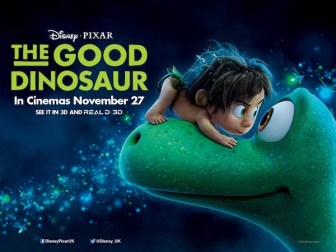
    The Good DinosaurOnce upon a time, Pixar could do no wrong. Then Cars happened; and worse, its sequel. Now, their movies remain an event, and some people still swear by everything they do, but I think there’s a greater awareness that they’re fallible. When it came out at the tail end of 2015, The Good Dinosaur was received as further evidence of that. Especially coming in the same year that gave us the universally praised (*coughoverratedcough*) Inside Out, it was instantaneously dubbed a “lesser Pixar”. But here is where completism has its merits, because I really enjoyed it.

    Set in an alternate world where the dinosaurs were never wiped out and so have evolved to the point where they talk, farm, etc, the film tells the story of little Arlo, an Apatosaurus who’s regularly overshadowed by his siblings. When an accident leaves him stranded many miles from his family he must make the long trek home, finding his inner courage on the way ‘n’ that kind of thing.

    There’s no denying that The Good Dinosaur contains an abundance of re-heated elements: there are multiple plot beats shared with The Land Before Time, not to mention the general “talking child dinosaurs” thing; a major inciting incident is taken from The Lion King; the episodic structure is reminiscent of The Jungle Book; animated dinosaurs on photo-real backgrounds recalls Dinosaur; and the moral message and main character arc are lifted from any number of children’s animations. While I did find this bothersome at first — especially as the worst offenders are concentrated in the saccharine first act — by the time the film had settled into its meandering middle I came to quite like it.

    MalickianPixar have on several occasions produced films with an innovative opening act that descends into derivative kids’ animation runaround territory. WALL-E and Up are the worst offenders for this; Inside Out does it too, though there’s more of a mix of the two throughout the film. For many critics and viewers, the quality of those openings seem to be enough to earn the films heaps of praise. The Good Dinosaur inverts the formula: the easy, overfamiliar material is at the start, while the more meditative, mature content comes later. Clearly this didn’t work for many viewers, so I guess the lesson for Pixar is to put the clever stuff up front if they want universal praise.
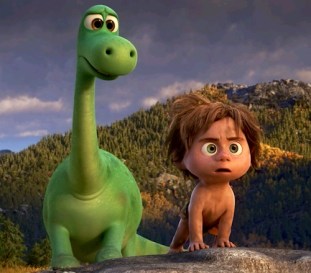
    Instead, The Good Dinosaur was often dismissed as only being for very young children. Some bits do come over that way, but it has quite a harsh edge at times, and the scene where the heroes get high on rotten fermented fruit is freaky even for adults (or this adult, at any rate). It’s a bit of a tonal oddity in this respect, especially when you also factor in some of the leisurely, silent moments spent admiring nature that evoke a filmmaker like Terrence Malick. No, seriously. That’s helped by the animation being mind-blowingly good. Not so much the character animation (which is still strong — the character models are more detailed than you first suspect), but the scenery those characters are placed in… wow. If you didn’t know better I’m sure much of it could pass for photography. And the way they’ve achieved water, a notoriously hard thing to capture in CGI, is absolutely incredible.

    You've got a friend in mePerhaps most powerful of all is the relationship it creates between Arlo and a young human child he befriends, Spot. With humanity in a much earlier state of evolution, Spot is basically characterised as a dog — the way he moves, comes to his name, follows scents, shakes, scratches and enjoys being scratched, and so on — so of course I warmed to him. Nonetheless, though the building blocks used to create their friendship are very familiar, the way the film sells its emotional arc is ultimately immensely effective. Its resolution may even bring a tear to the eye.

    While it may take a while to warm up, The Good Dinosaur is ultimately a very affecting entry in Pixar’s canon. It’s by no means a perfect movie, but I do think it’s an underrated one. And, in all honesty, I enjoyed it more than Inside Out.

    4 out of 5

    Toy Story (1995)

    100 Films’ 100 Favourites #92

    The toys are back in town.

    Country: USA
    Language: English
    Runtime: 81 minutes
    BBFC: PG
    MPAA: G

    Original Release: 22nd November 1995 (USA)
    UK Release: 22nd March 1996
    First Seen: cinema, 1996

    Stars
    Tom Hanks (Sleepless in Seattle, Catch Me If You Can)
    Tim Allen (Galaxy Quest, The Shaggy Dog)

    Director
    John Lasseter (A Bug’s Life, Cars)

    Screenwriters
    Joss Whedon (Alien Resurrection, Avengers: Age of Ultron)
    Andrew Stanton (A Bug’s Life, John Carter)
    Joel Cohen (Cheaper by the Dozen, Garfield)
    Alec Sokolow (Cheaper by the Dozen, Garfield: A Tale of Two Kitties)

    Story by
    John Lasseter (Toy Story 2, Planes)
    Pete Docter (Monsters, Inc., Up)
    Andrew Stanton (Finding Nemo, Toy Story 3)
    Joe Ranft (Beauty and the Beast, Cars)

    The Story
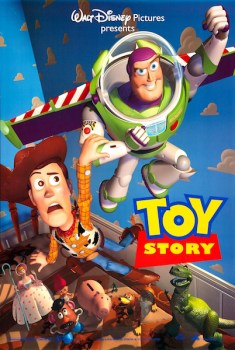
    In a world where toys come to life when humans aren’t around, Woody is six-year-old Andy’s favourite doll… until he gets Buzz Lightyear, a space ranger action figure, for his birthday. An upset Woody clashes with Buzz, but when the bickering pair are left behind during a house move they must work together to get back to their kid.

    Our Heroes
    Woody is a cowboy doll, the favourite of his kid, Andy, and consequently the leader of all Andy’s toys. That is until Andy gets a shiny new Buzz Lightyear action figure, whose newness ingratiates him with all the other toys. Plus, to Woody’s continued annoyance, Buzz believes he really is a space ranger and has no idea he’s just a toy.

    Our Villain
    Sid, Andy’s nasty neighbour kid who does terrible, terrible things to toys…

    Best Supporting Character
    Mr Potato Head, whose various body parts are slotted on and therefore removable and interchangeable. Hilarity ensues. Also has a nice line in snarky comments.

    Memorable Quote
    “To infinity, and beyond!” — Buzz Lightyear

    Quote Most Likely To Be Used in Everyday Conversation
    “You are a sad, strange little man, and you have my pity.” — Buzz Lightyear

    Memorable Scene
    One of Buzz’s claims as a real space ranger is that he can fly, so Woody challenges him to prove it. Buzz closes his eyes, dives off the bed… and, through a series of flukes, bounces and coasts his way around the room, landing back on the bed. “That wasn’t flying,” cries Woody, “that was falling with style!”

    Memorable Song
    The film’s themes are perfectly reflected in Randy Newman’s Oscar-nominated and endlessly catchy song, You’ve Got a Friend in Me. Both Toy Story sequels have tried to emulate it, with… less success.

    Technical Wizardry
    Only the whole movie — it was the first feature-length wholly-computer-generated animated film. As such, we have it to thank/blame for the current entire state of popular Western animation.

    Making of
    The animators perfected the movement of the toy soldiers by nailing a pair of shoes to a wooden plank and trying to walk around in them.

    Previously on…
    Toy Story was the first feature-length computer-animated film — there is, in that sense, literally nothing before it.

    Next time…
    Two feature film sequels, both of which are at least as artistically successful as this first, with a fourth set to follow in 2018. Also, three short films and two TV specials to date, plus direct-to-video spin-off movie Buzz Lightyear of Star Command: The Adventure Begins and the TV series that follows it. You could also argue the entirety of Pixar’s highly-praised output is a follow-up to the success of Toy Story, as well as American feature animation’s almost entire conversion from traditional cel animation to 3D CGI.

    Awards
    1 Special Achievement Oscar to John Lasseter for “the development and inspired application of techniques that have made possible the first feature-length computer-animated film.”
    3 Oscar nominations (Original Screenplay, Song, Musical or Comedy Score)
    1 BAFTA nomination (Visual Effects)
    8 Annie Awards (Animated Feature, Directing, Writing, Producing, Music, Production Design, Animation, Technical Achievement)
    1 Annie Awards nomination (Voice Acting (Tom Hanks))
    2 Saturn nominations (Fantasy Film, Writing)
    Nominated for the Hugo for Best Dramatic Presentation

    What the Critics Said
    “Far from just a technological breakthrough, this hellzapoppin fairy tale […] is a magically witty and humane entertainment. It has the purity, the ecstatic freedom of imagination, that’s the hallmark of the greatest children’s films. It also has the kind of spring-loaded allusive prankishness that, at times, will tickle adults even more than it does kids. The moment Mr. Potato Head arranges his snap-on features into a Cubist mash and says, ”I’m Picasso,” it’s clear that director John Lasseter and his team of writer-technicians have taken their most anarchic impulses and run with them. […] In its techno-cool photo-realist way, though, this movie, too, invites you to gaze upon the textures of the physical world with new eyes. What Bambi and Snow White did for nature, Toy Story, amazingly, does for plastic — for the synthetic gizmo culture of the modern mall brat. The film’s wit (and resonance) is that it brings toys to life exactly the way children do in their heads. It molds plastic into pure imagination.” — Owen Gleiberman, Entertainment Weekly

    Score: 100%

    What the Public Say
    “The Animation is superb. Given that this was one of the first ever feature length computer animated movies, those guys at Pixar really hit the nail on the head. The colours are vibrant and the characters are dynamic. An excellent use of Blues, Yellows and Reds really accentuate the ‘children’ and ‘toys’ feel. There are also beautiful realistic elements such as a scene where Woody and Buzz find themselves under a lorry in a petrol station. With this, I was simply amazed at the attention to detail with the stones, tarmac and oil stains on the textures. It really looks like you are close-up to the ground and I love it!” — Alexander Potter, Pottercraft’s Pictures

    Verdict

    Just because something’s the first to do something doesn’t necessarily mean it’s any good, but Pixar didn’t strike gold with Toy Story just because computer animation was New. It’s the likeable characters, how they develop and learn, the amusing situations they’re put in, plus some heartwarming messages about friendship. There’s more emotion and character development in these wooden-and-plastic toys generated with pixels in a computer than many a film can achieve with real human beings, and that’s why Pixar came to revolutionise and dominate the Western animation genre.

    Some would say “the original is still the best”, and it is up there, but on Sunday I will beg to differ…

    #93 will be… a superior sequel.

    The Sting (1973)

    2016 #127
    George Roy Hill | 129 mins | Blu-ray | 1.85:1 | USA / English | PG / PG

    The StingSet in Chicago during the Great Depression, The Sting follows a young street-level con artist (Robert Redford) as he seeks revenge for his murdered partner by teaming up with a seasoned big-con pro (Paul Newman) to scam the mob boss responsible (Robert Shaw).
    If that sounds like a somewhat violent crime movie… well, it kinda is. Although The Sting is often billed as a caper, sometimes even as a comedy (look at those grinning mugs on the poster!), it actually has more of an edge. I mean, it’s not The Godfather, but it’s not Ocean’s Eleven either. The star power and chemistry of Redford and Newman are what give the movie a buoyancy to overcome the storyline’s inherent darkness, though I wouldn’t say that reaches far enough to regard the film as a romp, which is the impression I’d obtained over the years.

    Indeed, I wonder if it suffers from its age more broadly. Not because the filmmaking quality has dated (they may not make ’em like this anymore, but great filmmaking is timeless), but because it was so influential that it’s been copied to death. It still has a lot of points to commend it, but the heist — the driving force of the plot — lacks freshness to modern eyes. Newness is not the be-all-and-end-all, of course, but the con only really comes to life in a flurry of last-minute twists… most of which have also been copied ad nauseam, of course.

    The Sting is certainly not a bad movie — and, for all my talk of it being mercilessly copied, it did manage to con me in a couple of places — but it wasn’t exactly what I’d anticipated. Perhaps I’ll like it more on some future re-watch.

    4 out of 5

    The Sting was viewed as part of my What Do You Mean You Haven’t Seen…? 2016 project, which you can read more about here.

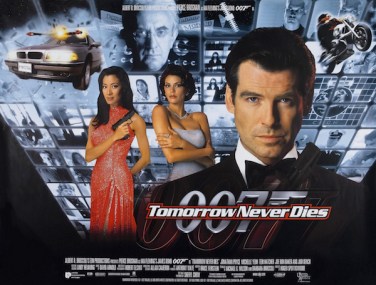
    Tomorrow Never Dies (1997)

    100 Films’ 100 Favourites #91

    Yesterday is a memory. Today is history.
    Tomorrow is in the hands of one man.
    Bond. You know the rest.

    Country: UK & USA
    Language: English, German, Danish, Mandarin & Cantonese
    Runtime: 119 minutes
    BBFC: 12 (cut, 1997) | 12 (cut more, 1998) | 15 (uncut, 2006) | 12 (uncut, 2012)
    MPAA: PG-13

    Original Release: 12th December 1997 (UK)
    US Release: 19th December 1997
    First Seen: cinema, December 1997

    Stars
    Pierce Brosnan (Dante’s Peak, The Ghost)
    Jonathan Pryce (Brazil, Pirates of the Caribbean: The Curse of the Black Pearl)
    Michelle Yeoh (Supercop, Crouching Tiger, Hidden Dragon)
    Teri Hatcher (Tango & Cash, Coraline)
    Judi Dench (Mrs Brown, The Best Exotic Marigold Hotel)

    Director
    Roger Spottiswoode (Turner & Hooch, A Street Cat Named Bob)

    Screenwriter
    Bruce Feirstein (GoldenEye, The World Is Not Enough)

    Based on
    James Bond, a character created by Ian Fleming.

    The Story
    Secret agent James Bond is deployed to investigate a media baron who is plotting to ignite a war between the UK and China to further his business empire.

    Our Hero
    The name’s Bond, James Bond. In his second outing as agent 007, Pierce Brosnan has settled comfortably into his interpretation of the hero, a mix of Roger Moore’s eyebrow-raising levity with some of Sean Connery’s slightly harder, man-of-action edge.

    Our Villain
    Elliot Carver is a megalomaniac media mogul — the owner of the newspaper Tomorrow, who intends to secretly provoke a war in order to boost sales and ratings. James Bond does satire? Kinda.

    Best Supporting Character
    Wai Lin, a spy who’s investigating Carver for the Chinese. A skilled martial artist, she kicks all kinds of ass. Despite initial mistrust, she and Bond ultimately team up. Lin is arguably one of the first Bond girls who can genuinely claim to be a competent character in her own right. Still ends up sleeping with Bond, though.

    Memorable Quote
    Admiral Roebuck: “With all due respect, M, sometimes I don’t think you have the balls for this job.”
    M: “Perhaps. But the advantage is I don’t have to think with them all the time.”

    Memorable Scene
    Remote control car, James Bond style: Bond lies in the backseat of his BMW, driving it around a multi-storey car park with his mobile phone, deploying its weapons against a gang of attackers. It was a fun concept back in ’97, but I imagine you could do it yourself with an app now. Apart from the weapons. And the legal implications. So maybe not.

    Memorable Music
    After the disastrous ‘modern’ score for GoldenEye, music duties were here handed to David Arnold. At the time he had composed the scores for Stargate and Independence Day, but, even more pertinently, he had produced Shaken and Stirred, an album of contemporary-styled covers of great Bond themes. The album was heard by iconic Bond composer John Barry, who then recommended Arnold to producer Barbara Broccoli. Arnold’s score is much more in-keeping with classic Bond music, but given a modern (well, ’90s) flavour. Backseat Driver, the soundtrack to my Memorable Scene pick, is a particularly great action cue. Arnold would become the series’ composer for the next four films, until Sam Mendes chose to use his regular collaborator Thomas Newman for Skyfall and Spectre. With Mendes moving on, perhaps Arnold will be back for Bond 25…

    Write the Theme Tune…
    Arnold wanted to have a hand in writing the title song and integrate it into his soundtrack, like the great Bond composers of old. To that end he wrote a theme sung by k.d. lang… which plays over the end credits and is titled Surrender, though has a tellingly prominent use of the phrase “tomorrow never dies” in its lyrics.

    Sing the Theme Tune…
    The producers went with a more marketable proposition for the final opening credits song, however, in the shape of Sheryl Crow, famous for her pop-rock-y hits like All I Wanna Do, A Change Would Do You Good, and Everyday is a Winding Road. In the pantheon of Bond title themes, her Tomorrow Never Dies sits firmly in the middle — it’s not a GoldenEye, but it’s not a Die Another Day either.

    Making of
    The film was originally called Tomorrow Never Lies, referencing Carver’s newspaper, Tomorrow. Some kind of production mix-up (a typo, a smudged fax — pick your story) led to it being misread as Tomorrow Never Dies, and the new, less meaningful title stuck.

    This Category Sponsored By BMW
    Apparently Tomorrow Never Dies was the first movie in history to have its entire budget covered by product placement endorsements — that’s over $100 million in advertising. Featured companies include BMW, L’Oréal, Heineken, Dunhill, Ericsson, Omega, Smirnoff, Brioni, Bollinger, and Avis, plus a tie-in game from Electronic Arts.

    Previously on…
    17 previous Bond films (which are all technically in the same continuity). The previous one, GoldenEye, was the first to star Pierce Brosnan and relaunched the series to mass popularity after a fallow period.

    Next time…
    Two more Brosnan Bonds, before he was unceremoniously dumped to reboot the series for the first time. With a 25th film now in the works, the series is set to continue indefinitely.

    Awards
    1 Saturn Award (Best Actor (Pierce Brosnan))
    3 Saturn nominations (Action/Adventure/Thriller Film, Supporting Actress (Teri Hatcher), Music)
    2 MTV Movie Awards nominations (Action Sequence for the motorcycle/helicopter chase (somehow it lost to Face/Off), Best Fight for “the fight between Michelle Yeoh and some ‘bad guys’.”)

    What the Critics Said
    “East meets West, yin meets yang and chop-socky meets kiss-kiss bang-bang in Tomorrow Never Dies, a zippy 007 romp that draws as heavily from the Asian action genre as from the formula that has served the series so well for 35 years. Goldeneye and Pierce Brosnan’s debonair Bond resuscitated the creaky franchise in 1995, but […] Tomorrow, jazzier, wittier and more costly than its predecessor, also comes closer to catching up with ’90s style and politics. […] Hong Kong kung-pow chick Michelle Yeoh, as the cool-headed Chinese agent Wai Lin, proves 007’s equal at kicking post-Cold War butt. The two take on craven communications baron Elliot Carver (Jonathan Pryce), a deliciously exaggerated — or is it? — composite of Ted Turner, Rupert Murdoch and the late Robert Maxwell. Carver’s not only the most plausible Bond nemesis ever but the perfect one for the current global villain shortage.” — Rita Kempley, The Washington Post

    Score: 57%

    What the Public Say
    TND is somewhat underrated. Jonathan Pryce plays a villain who is essentially Rupert Murdoch smooshed together with Ted Turner. His plan isn’t to take over the world so much as it is getting rich by starting a war and then covering it on his news outlets. This just may be the most plausible Bond villain scheme of all times – which admittedly isn’t saying much. […] TND may not be among the best Bonds, but it’s got more going for it than I think it gets credit for.” — Lebeau, Lebeau’s Le Blog

    Verdict

    I know some of you will be thinking, “how can you leave out Goldfinger / Thunderball / The Spy Who Loved Me / For Your Eyes Only / The Living Daylights / Licence to Kill [delete according to personal preference] but include Tomorrow Never Dies?!” It’s true, TND is far from the most popular Bond film, but it was the first I saw on the big screen, and that gives me a certain soft spot for it. It’s not just that, though.

    Here’s a thing: one of the criticisms levelled at the film is that it’s just an action movie, lacking the peculiarly Bondian thrills a Bond adventure should have. But if it is “just an action movie” then it’s the best action movie in the Bond series. The pre-titles gunfight at the arms meet, the ‘backseat driver’ sequence, and the motorbike-vs-helicopter chase are three of the finest action scenes in the entire franchise, and that’s without even touching on Michelle Yeoh kicking ass. Couple that with Brosnan still new and confident in the lead role, and Jonathan Pryce nibbling the scenery as a lightly satirical villain, and I think you have a Bond film that is pretty entertaining, even if it’s mainly on an adrenaline-pumping level.

    #92 has… a friend in me.