The Happening (2008)

2008 #44
M. Night Shyamalan | 90 mins | cinema | 15 / R

This review contains spoilers.

The HappeningWhile others have been lamenting the slide in quality of Shyamalan’s work since his breakthrough 1999 hit The Sixth Sense, I’ve been quietly enjoying most of his films since then. I liked Sixth Sense and appreciated its ingenious twist, but it was the fantastic real-world-superhero tale Unbreakable that did the most to cement him in my affections. Signs was another strong effort, an unusual perspective on alien invasion backed by decent family drama and a few good laughs, helped by the always-watchable Joaquin Phoenix and a sweet kid. On the other hand, it suffered from a stretch of a resolution, and that it starred Mel Gibson. His next was the The Village, in my opinion his biggest misfire thanks to a story disappointingly reliant on an easily-guessed twist, further undermined by a third act structure that bent over backwards to hide the reveal for as long as possible. Most reviewers seem to disagree slightly though, as Lady in the Water was widely panned. Personally I liked it, at least on the level at which it was intended, as a modern fairytale.

This, his latest effort, falls mostly in the middle of the road — a bit like a few of its extras, then. You see, the plot concerns the release of a toxin (from where, no one knows) that causes people to begin committing suicide en masse, by jumping off buildings, or shooting themselves, or a variety of other, more gruesome ideas. It’s in these sequences that The Happening is at its best — Shyamalan can still craft chilling scenes and effective jumps, even if their onset is obvious to a moderately seasoned film viewer. Unfortunately, the rest of the film is a tad weak. Mark Wahlberg’s performance is flat, John Leguizamo struggles to do much better, and Zooey Deschanel gets by in a kooky role that is by turns endearing and slightly irritating. The script is mostly passable, though occasionally heavy-handed, repetitive and clunky — one moment especially jarred for me, when in a middle-of-nowhere diner it seems one person’s dialogue has been split between two actors.

Shyamalan nicely keeps the cause of the toxin up in the air — though the most probable cause is first suggested fairly early on, other theories continue to float around — but with no last-minute revelation such juggling feels unwarranted. Instead there’s just a “it could happen again” final scene, that might be chilling if it weren’t so predictable. Part of the problem with the film’s central conceit is that it’s not very believable. Now, I know, being able to see dead people, developing superpowers or finding a mermaid-like girl in your pool are hardly realistic plot points either, but here it strays too close to the realm of “I expect you to believe this is possible” pseudoscience and so, unlike Princeton gardeners, my belief struggled to be fully suspended.

Ultimately, I’d rank The Happening as Shyamalan’s worst film to date. While it’s pleasing that he doesn’t force everything to rely on a final twist, the overall quality is variable — at least The Village had something going for it before the poor climax. The cod-science explanation feels like a big excuse for a topical eco-message, otherwise just being a basis to string together a collection of well-executed creepy sequences. Perhaps Shyamalan should stop trying so hard to come up with amazing new ideas and just concentrate on telling a good story. There are things to like though, enough to scrape the film into the middle of the road. Sort of the opposite to those suicidal extras then.

3 out of 5

They’ve just watched the film…

They've just watched the film...

Léon: Version Intégrale (1994/1996)

2008 #42
Luc Besson | 127 mins | DVD | 15*

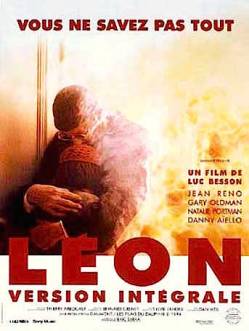
Léon: Version IntégraleI first saw Léon about 10 years ago, back when video was still an acceptable way of watching things. A friend leant it to me, insisting it was a film I absolutely had to see, and he wasn’t wrong. It’s remained one of my favourite films ever since, though typically I haven’t watched it more than once or twice in the intervening decade. (It also fostered a love for Sting’s closing song, Shape of My Heart, which is criminally missing from a Greatest Hits CD my dad owned (even though his dire song from Demolition Man is on there), and in moderately recent years was indifferently reused by both Sugababes and Craig David.)

I became aware of this extended cut a few years ago, a little while before it was released on R1 DVD. Having held out for a UK R2 release for about half a decade now, I gave in and bought the (apparently superior, and also in a Steelbook, which always has a way of persuading me) German R2. It’s labelled as a “Director’s Cut” but, as Besson states in the relatively lengthy booklet (translated with the aid of [the now defunct] Babel Fish), “the second version is neither better nor worse than the original” — it’s not a preferred cut, just a different, extended one.

But personally, I prefer this version. Not because there’s anything wrong with the original — far from it — but because this one has more. Sometimes you can have too much of a good thing of course, but I don’t think that’s happened here. The additions build on the characters and relationships, primarily between the two leads, and also add extra doses of humour and action. Besson wasn’t necessarily wrong to remove these things from his original cut — the extent of Léon and Mathilda’s relationship is especially controversial for some, and the extended scenes of Léon training Mathilda as a Cleaner are arguably extraneous — but they all add to the experience. Wisely, he doesn’t seem to have touched what was already there. Everything that was great about the original — from the astounding performances of Jean Reno, Natalie Portman and Gary Oldman, to the thrilling action sequences, and plenty else in between — remains intact. They’ve not been buggered about with, just expanded around.

Ultimately, the reason I prefer this version is quite simple: I love the film and the characters, I could happily take more of them, and I very much enjoyed all of the added material. I can understand objections to the insinuations about Léon and Mathilda’s relationship, but I didn’t find it any creepier here than it was before (besides which, any paedophilic notions come from her and he quashes them). The quality of the performances in the new scenes, plus other solid additions, make all the new bits worthwhile.

The version intégrale isn’t too much of a good thing, then, just more of a great thing. To my mind, Léon (in either cut) is unquestionably essential.

5 out of 5

* The original cut of Léon was last classified in 1996 and given an 18. The longer version was classified in 2009 and received a 15. That must be a pretty rare case of a longer version (technically) having a lower certificate. ^

Almost Famous (2000)

2008 #41
Cameron Crowe | 118 mins | DVD | 15 / R

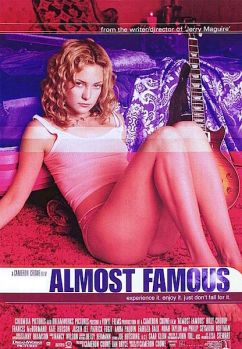
Almost FamousSometimes I find I have quite a lot to say about a film when it comes to writing my review for this blog — recently, witness Cloverfield, Transformers, or Indiana Jones 4 (of course, using Indy 4’s full title more than once guarantees a long review). Other times it’s a struggle to come up with anything at all — try the relatively brief comments on The Fountain, The Adventures of Sherlock Holmes or Field of Dreams. Almost Famous falls into the latter camp. Not because it’s no good, or because it’s middle-of-the-road, but because there’s nothing I’m dying to praise or slate about it.

Everything about it is solidly done. Patrick Fugit is an engaging and relatable lead, ably supported in the acting stakes by a good ensemble, especially Philip Seymour Hoffman (unsurprisingly) and fellow top-billers Billy Crudup, Frances McDormand and Kate Hudson. And there’s Zooey Deschanel, who doesn’t have many scenes, but, y’know, still…

Crowe’s autobiographical screenplay is a good one, with plenty of amusing and dramatic moments to keep it ticking over — the most memorable, on a crashing plane, manages both with aplomb. Likewise, his direction is rarely flashy but always works. The music, costumes, design and cinematography evoke the period well (to me, at least, who didn’t live anywhere near the ’70s). There’s probably some life lessons in here — it’s a coming-of-age film after all (as well as a rock & roll road movie, of course) — but they’re not over-laboured.

In short, I really liked Almost Famous. It’s the sort of film that might creep in at the lower end of a (relatively long) list of favourites, not because there’s anything exemplary about it, but because the cumulative effect makes for an enjoyable experience.

4 out of 5

Almost Famous is on Movie Mix (aka more>movies) tonight, Sunday 31st May 2015, at 1:15am.

Field of Dreams (1989)

2008 #38
Phil Alden Robinson | 103 mins | TV | PG / PG

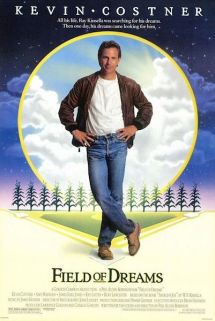
Field of DreamsI’ve never made much of an effort to see Field of Dreams, for a couple of reasons. Aside from its famous mantra/catchphrase (“if you build it he will come”), the only things I’d heard were it was mawkishly sentimental and was about Kevin Costner trying to build a baseball pitch for a ghost — which doesn’t sound particularly exciting and is about sport, something I’m not very fond of. Of course, as anyone who’s seen it will know, I was a tad misled on that last point, as the glorified rounders pitch is built in the first 20 minutes. What follows certainly has its fair share of sentimentality, but I wouldn’t call it mawkish.
In fact, it’s almost unremittingly pleasant. The lack of anything hard-hitting is no doubt why some have such a dim view of the film, as “nice” has become synonymous with “not very good” in modern parlance (I blame Primary School teachers desperate to increase vocabulary). Field of Dreams won’t shock you, it likely won’t make you think very hard, and any moral message or meaning it has is positive and reassuring… but what’s so wrong with that? The plot keeps moving, refusing to be bogged down in navel-gazing or star-gazing. The story is also too unusual to be marred by any serious degree of predictability, though some events are of course easily guessed, but the mystery of how the various elements would come together kept my attention throughout. Crucially, it doesn’t labour its sentimentality or batter you round the head with morals or meanings. It’s hardly ambiguous, but nor is it over done.

Field of Dreams may not be astounding filmmaking — it’s not especially complex, radical, thrilling, thought-provoking, intense or revolutionary, nor terribly serious or terribly funny, nor indeed wholly original — but it is nice. And I mean that in a good way.

4 out of 5

Field of Dreams is on ITV today, Saturday 27th September 2014, at 2:35pm.

The Fountain (2006)

2008 #37
Darren Aronofsky | 93 mins | DVD | 12 / PG-13

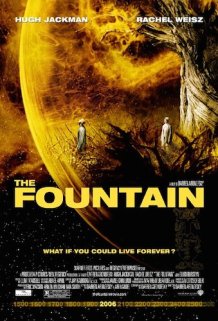
The FountainThe Fountain was one of the more critically divisive films of recent years, eliciting genuine “love it or hate it” reviews all round. I find myself leaning more towards the former. While I can’t claim to fully understand (let alone explain) much of what it means, and while I usually dislike things that can pretentiously be described as “film as poetry” (or similar), there’s something in the qualities of The Fountain that engaged me.
For one thing it looks gorgeous. While the whole film is beautifully shot, it’s hard not to single out the future segments, in which Aronofsky chose to create space with “micro-photography of chemical reactions” rather than the usual CGI. However it was achieved, the important thing is it looks great. Clint Mansell’s score is equally beautiful, both dramatically exciting and romantically tender — sometimes at the same time. Performance-wise, Hugh Jackman is undoubtedly at the centre and is as likeable as ever. It’s only the present-day segments where he really has much to do, in the arguably-clichéd story of a scientist so desperate to find a cure for his wife’s disease he misses out on spending time with her. Rachel Weisz is good as ever as the wife, even if her American accent is occasionally distracting.

Meanwhile, the past segments are essentially an historical adventure movie with some of the plot scenes cut, and the future segments offer near-2001 levels of silent obscurity. By a similar token, the film has an apparently ambiguous finale that, unusually, I’m quite happy to let wash over me. I’m sure there are multiple conclusions a viewer can reach for what it’s ‘about’ — the eternity of love, the repetition of life, or simply a sci-fi/fantasy quest for immortality — but I find myself happy to accept that it may mean one, all, or none of those things and just leave it be. It’s an odd way to feel at the end of a film — not caring about what it meant, but in a good way.

I can only apologise that, a bit like the film, this review is relatively brief, a tad dreamy, and somewhat inconclusive. I can see why some dislike this film, and I think I’d normally be one of them, but in this case something about it captured me. I look forward to seeing it again and, maybe, getting a better idea what it was.

4 out of 5

Hulk (2003)

2008 #36
Ang Lee | 132 mins | DVD | 12 / PG-13

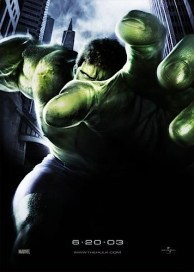
HulkWith the Edward Norton-starring (and -penned), Louis Leterrier-directed sequel/re-imagining of the Hulk coming this summer, I decided it was finally time to watch Ang Lee’s much derided 2003 attempt at bringing Marvel’s green monster-hero-thing to the big screen. Much like the lead character — in a Jekyll & Hyde-style, he’s mild-mannered scientist Bruce Banner by day, but the big green monstrous Hulk when angry — this is very much a film of two vastly different sides.

Indeed, the most striking thing about Lee’s interpretation of the Hulk is what a mish-mash of styles it is. On the one hand, it wants to be a drama/thriller, focussed on father-child issues and military cover-ups. On the other, it has comic book action sequences and a bizarre editing style inspired by comics — a compilation of unusual techniques that look like a Media Studies teacher’s wet dream. Not even Spider-Man was that kooky. In the end, it just means the cutting style feel out of place, firstly because for much of the film (at least the first 45 minutes) it’s the only reminder of the film’s comic roots, but especially because Lee’s use of the tricksy techniques is inconsistent — sometimes confusingly overused, sometimes apparently forgotten. Other technical elements also detract. Danny Elfman’s score is blandly uninspired, a carbon copy of his work on similar films. Worst of all is the CGI Hulk — it looks like they used an action figure he’s so plasticky. It gets by OK in early appearances, swathed in moody shadows, but in the glaring desert sunlight he doesn’t stand a chance.

The big, destructive sequences starring the Hulk himself are too little too late. There’s nothing wrong with sneaking drama into blockbusters, but this feels like a blockbuster snuck into a drama. There are fights because there have to be, not because anyone involved in making the film seems to want them. They’re badly placed thanks to the plot structure and the film’s pace topples under their weight. Even the climax wants to be a battle of wills between father and son, but turns into a nonsensical messy CGI splurge. That said, the dramatic moments don’t fare much better. Usually so watchable, Eric Bana can do little with the material offered here. The rest of the cast don’t suffer as much, and there are times when it almost works, but neither the dramatic nor blockbuster sides fully function in themselves, and certainly not when slammed together.

Hulk is not a film anyone could love — even the weakest comic adaptations usually have their fans — and, for a film aimed at a devoted fan base, this is perhaps its biggest flaw. Equally, it retains too much of the superhero genre for anyone to consider admiring it as a purely dramatic film. Hopefully Hulk-fan Norton’s film can marry the two halves better… or if not, at least create some cool destruction-filled action.

2 out of 5

I Am Legend (2007)

2008 #35
Francis Lawrence | 96 mins | DVD | 15 / PG-13

This review contains major spoilers.

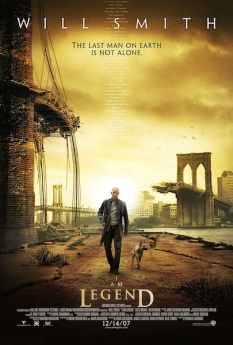
I Am LegendWill Smith stars in this adaptation of Richard Matheson’s classic sci-fi novel from the director of Constantine. The latter is a film I personally enjoyed (and which features a relatively early appearance of the currently prolific Shia LaBeouf) but received some mixed reactions on the whole. By a broadly similar token, I Am Legend has received a fair share of negative reviews, though my opinion is a little more divided.
Things go very well for the first half. It’s nicely paced, concentrating on a depiction of one man’s loneliness taken to the extreme. The script, and Smith’s acting, handle the material well. The deserted and destroyed New York looks as stunning as the trailers promised, while the CGI animals that roam it are as good as any. The flashbacks that punctuate the film are well executed too, drip-feeding clues to what happened while maintaining some mysteries of their own. There are some other good sequences: Neville’s exploration of a pitch-black Dark Seeker-infested building is tense, and the death of his pet dog — his one remaining companion — is moving, even if it was given away in the trailer. That scene is effectively played and shot, showing only Neville’s face as he is forced to euthanize the diseased animal by suffocation.

Sadly, this is where things begin to go down hill. The Dark Seekers — the film’s vampires/zombies/whatever — are crafted with pretty good CGI, but they’re still not life-like enough to work. If it were a mindless blockbuster they would’ve been more at home, but as it’s managed to be an effective drama they feel entirely out of place. It’s true that real actors couldn’t have managed the physical feats the creatures are made to pull off, but do they really need to do those things? I suspect not. The film also leaves several holes in the Dark Seeker’s actions — for example, they copy Neville’s trap, a move apparently beyond their intelligence, but the film neglects to explore why or how they did this.

Instead it moves on to the arrival of some more survivors. Quite where they came from, or how they got into the supposedly isolated Manhattan, is another inadequately explained set of circumstances. After they arrive, the film’s climax comes out of nowhere. It’s as if the screenwriters ran out of ways to keep things going so just bunged on a big climactic action sequence. And what happens in it is pretty silly too, especially Neville’s self sacrifice — why not get in the Magic Safe Hole too and then chuck the grenade out? Perhaps he just has a death wish by that point. It would seem most of the audience did. There’s also a pathetic epilogue, and an even worse final line that attempts to make sense of the title.

I Am Legend is something of a disappointment. The considered and effective first half gives way to an increasingly nonsensical second, marred by numerous flaws that stack up til a near-laughable conclusion comes from nowhere. I’ve been told that the ‘alternate theatrical cut’, with a handful of additional scenes and a new ending, is marginally more effective. I’m sure I’ll watch it someday and share my thoughts. For now, I Am Legend’s two halves of differing quality just leave it in the middle of the road.

3 out of 5

I Am Legend is on Watch tonight, Saturday 11th October 2014, at 9pm. It’s on again on Tuesday, when I’ll (re-)share my thoughts on the so-called “Alternate Theatrical Version”.

Throne of Blood (1957)

aka Kumonosu jô

2008 #33
Akira Kurosawa | 105 mins | DVD | PG or 12

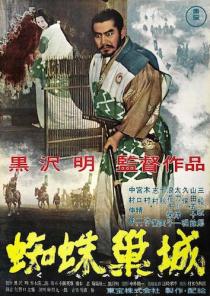
Throne of BloodKurosawa moves Macbeth from Scotland to 16th Century Japan in this retelling of Shakespeare’s infamous Scottish Play. I’ve heard this described as a loose adaptation — perhaps those reviewers have never read the play. Kurosawa sticks very closely to the structure of Shakespeare’s version of the story (though based on real events, Shakespeare changed key details), often choosing to adapt it scene-for-scene. It works well in the new setting, with some of the themes — honour, respect, betrayal — perhaps becoming more understandable when placed in samurai culture. Kurosawa changes other elements too — character names are understandably localised, there’s only one witch, there’s no version of the famous “Is this a dagger which I see before me?” monologue, and so on. It’s not all omissions however, as Kurosawa adds imagery and symbolism of his own. Again this helps to place the story in its new context, but also covers the loss of Shakespeare’s original language (a major sticking point for some critics).
Beyond the Shakespearean similarities (or lack of), there’s much to see in Throne of Blood — literally, thanks to the atmospheric cinematography. Most of the exteriors are doused in fog, and while this is sometimes over-done (an extended sequence of Washizu and Miki riding in and out of it goes on too long) it also makes for some amazing moments, such as when the trees of Cobweb Forest drift menacingly forward. The interior of the forest is suitably oppressive and scary too, the perfect location for encountering a witch. Kurosawa was inspired by Japanese Noh theatre in his construction of the film, so there are a lot of longer shots that allow the characters to be blocked as if on stage. It’s not overly theatrical, thankfully, and works suitably.

Cinematic techniques are not entirely abandoned however. The most memorable is the banquet scene, in which Washizu sees Miki’s ghost: we see Miki’s empty seat, the camera tracks forward to a shocked Washizu, then back to reveal the ghost of Miki sat at his place, before tracking and panning around the room to follow Mifune’s brilliant performance. It’s an infinitely more effective reveal than any amount of jiggery pokery with dissolves or CGI could provide. Similarly, Washizu’s iconic death scene — in which hundreds of arrows puncture him and the surrounding walls — is impressively achieved (using real arrows), including one seamless shot when an arrow pierces his neck.

Macbeth is my favourite Shakespeare play — it’s a great story, with great themes, imagery and language. Throne of Blood obviously loses some of this, but it doesn’t matter in the slightest — Kurosawa has constructed an excellent and well-conceived retelling with a few of his own flourishes.

5 out of 5

A note on the classification: the UK DVD from the BFI is rated PG, classified in 1991. A few months after the DVD’s release in 2001, the film was re-submitted to the BBFC and received a 12. Quite way the rating was raised isn’t explained, and copies of the DVD still bear a PG on the cover.

Henry V (1989)

2008 #29
Kenneth Branagh | 132 mins | DVD | PG / PG-13

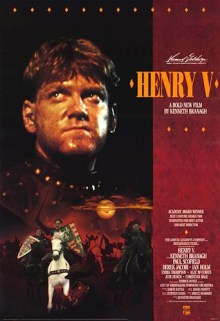
Henry V (1989)Once more unto the breach, dear friends, as I delve into a second version of Henry V in as many (viewing) days. (I dread to think how many reviews of this film began with a similar quote-based pun.) Inevitably, having watched them so close together, this is as much a comment on the relative merits of Branagh’s and Olivier’s interpretations of Henry V as it is a review of Branagh’s film in its own right.

Branagh’s version opens with almost a direct homage to Olivier’s, though with an important difference. Olivier opened with the Chorus’ narration on a stage ; Branagh opens with the Chorus’ narration on a film set. Rather than wasting half an hour with this conceit (as Olivier did), Branagh pushes into the ‘reality’ of the story before another actor has even entered. And his reality is much more real. The film looks as if it’s lit by candles and daylight, the castles and tavern are rough and dark, the battlefields muddy and grimy; everyone gets dirty and bloodied by the fights. On the whole it’s a grittier and more realistic version. Yet there’s room for more than that. The story still seems concluded at the Battle of Agincourt, but the proposal scene no longer feels tacked on. In fact it’s now laugh-out-loud hilarious, with Branagh and Emma Thompson demonstrating the undeniable chemistry that would help make Much Ado About Nothing so good a few years later. Unlike Olivier’s fluffy limp to the credits, this is an entertaining round-off to the plot.

The fact I’d never seen a version of Henry V before Olivier’s ostensibly gives Branagh’s the benefit of a better understanding on my part. Practically, it matters little that I saw Olivier’s first, as the more modern and film-friendly performances in Branagh’s version mean that, while Olivier’s allowed me to broadly follow the majority of what was happening, Branagh’s gives more access to the nuances of both plot and character. He’s aided in the latter by the inclusion of scenes deemed inappropriate for a World War 2 propaganda film: in one, Henry and co confront three traitors; in another, he hangs an old friend in order to make an example. Other scenes are played differently too, so that Branagh’s Henry is a more complex and morally debatable figure, unlike Olivier’s bright-eyed hero. Whatever your opinions on the two actors on the whole, these changes make for a better character and therefore a better film.

It would be remiss not to mention the rest of the cast. Brian Blessed is positively restrained as Exeter, one of Henry’s key associates — you’d never imagine he could turn in such a performance if you’d only seen his recent go at hosting Have I Got News For You. Paul Schofield, as the aging French King, and Michael Maloney, as the contemptible Dauphin, help flesh out the French side more than Olivier’s version managed, as does Christopher Ravenscroft’s Mountjoy, the French herald who all but switches his allegiance. The English ranks are swelled by Bilbo Baggins, Hagrid, and the current incarnations of ‘M’ and Batman (don’t worry, the French have Miss Marple); not to mention the recognisable faces of Richard Briers, Danny Webb, Simon Shepherd and John Sessions (and no doubt others I’ve accidentally missed). Of course, a starry and recognisable cast does not necessarily a good film make, but this is a dependable lot and there are good performances all round — even if Ian Holm’s Welsh accent is somewhat dubious (though it’s a lunar leap on from the one in Olivier’s version).

And deserving of a paragraph unto himself is Derek Jacobi’s masterful Chorus, who, with just a handful of narrational lines and a big black coat, is somehow one of the coolest characters I’ve seen of late.

There’s no contest here for me. Olivier’s version is an over-stylised, propaganda-inspired, outdated version of Shakespeare, whereas Branagh’s is a comprehensible, realistic, textured and, perhaps most importantly, genuinely enjoyable interpretation.

4 out of 5

Henry V (1944)

2008 #28
Laurence Olivier | 131 mins | VHS | U

Henry V (1944)Or The Chronicle History of King Henry the Fift with His Battell Fought at Agincourt in France, as the title card (and therefore IMDb) would have it.

The works of Shakespeare tend to be a love-it-or-hate-it experience for most people, often based on one’s social class and/or experiences at school (obviously not exclusively). Just to be awkward, I’m going to say I have mixed feelings about his plays: on the one hand, I consistently enjoy Macbeth and find Much Ado About Nothing a diverting enough rom-com; on the other, I was bored by Richard III, even when played by Sir Ian McKellen, and never got on with A Midsummer Night’s Dream (to pick just two examples for each side). I imagine most people have their likes and dislikes of course, but I often feel I fall between the the dislike Normal people have for Shakespeare and the love that Cultured people have for him.

This may seem beside the point, but it does lead to Olivier’s Henry V. Simply put, I didn’t much care for it. It failed to engage me, and I’d put this down to Olivier’s infamous staging (literally) of it. The first half hour is a recreation of the play’s first performance in 1600, complete with fluffed sound cues and heckles from the crowd. The goings-on backstage and performer/crowd interactions heavily distract from the actual text being performed, as much as anything because they’re more entertaining. Then, cued by one of the Chorus’s lines, the film moves to showing the story in ‘reality’ — except this is a reality made of painted scenery, primary-coloured landscapes, and cardboard fairy castles. It’s a deliberate effect, designed to emulate pre-Renaissance painting, but it didn’t work for me — it’s over-stylised and distracting, and if you’re not familiar with the play (as I wasn’t) getting distracted is a problem. The concept of transition from performance to reality has potential (as would the idea of presenting the whole thing on stage with crowd interactions, actually, considering I missed them when they went), but I personally feel Olivier executed it poorly. For one thing, it spends too long bedding in the feel of the stage performance before it gets round to the shift to reality.

Stylised productions can work, and excellently, but here the direction and acting are sometimes as flat as the castles. Actors arbitrarily shout some lines, hush others, and put in emphasis of dubious relevance — it’s like Shakespeare-by-numbers, the sort of production that reveres the text so much it doesn’t bother to think about it. It hampers any understanding of what they’re saying, especially for newcomers. Perhaps more fairly, the performance style is incredibly stagey. My degree-related reading suggests this is one of the earliest proper Shakespeare films (previous adaptations being silent or even less complete), so perhaps the idea of a more subdued, screen-acting style had yet to permeate such productions. Things do pick up as the film goes on: the battles are effective, and the proposal scene is more comfortably performed than the pre-war politics. That said, the story seems to be over once Agincourt is won, so by modern structural standards the hasty single-scene romance that follows feels pointlessly tacked on.

Olivier’s Henry V has received plenty of praise in its time, as well as derision, largely for its conception as World War 2 propaganda. The latter is hard to ignore, with grand speeches delivered in a way reminiscent of Churchill’s and scenes removed so that Henry’s character becomes unquestionably good — both aspects that are distinctly less relevant to today’s more complex, war-dubious world. Even leaving the propaganda aside, the performances are outdated, the design several stylised steps too far, and on the whole the production failed to engage or hold my interest. However good it may once have seemed, I think this version has had its day.

2 out of 5

Next I’ll be reviewing Kenneth Branagh’s all-star 1989 version of Henry V, here.