The Diving Bell and the Butterfly (2007)

2008 #69
Julian Schnabel | 112 mins | download | 12A / PG-13
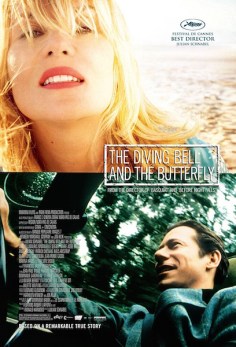
The Diving Bell and the ButterflyLe Scaphandre et le Papillon, as it’s titled in its original French, has until now been on my (unwritten) ‘List of Films to Avoid’, alongside the likes of Ichi the Killer, Hostel, Caligula, and Salo. Strange company for an Oscar-nominated drama I know, but whereas those others have visceral horror that I have no real desire to deal with, the situation of Diving Bell’s central character, Jean-Dominique Bauby, which is exacerbated by it being a true story, seemed too horrendous to bear. In a similar way to how one might struggle to think about death if one doesn’t believe in an afterlife, the idea of being paralysed but for one eye is an almost unimaginably tortuous fate. Nonetheless, in the wake of a huge amount of praise — and in the name of finding a film starring Mathieu Amalric for My Quantum of Solace Film Season — I resolved myself and hoped for the best.

The most striking thing about the film is that, for about the first 40 minutes, it takes place almost entirely within the head of Jean-Do, as Bauby is affectionately known. From the opening shot we literally see through his his eyes, blurry and limited as that is, and hear his thoughts, which brings us a lot closer to him than any character in the film can be as we soon realise he can’t speak. During this first third the film only ventures outside Jean-Do’s immediate vision for memories or imaginings — although the viewer might perceive them as breaks from the prison of his mind due to the change in imagery, we’re actually still stuck inside his head, just as he is. One begins to wonder if the whole film will be told this way, or, if it does break free, how Schnabel and writer Ronald Harwood are going to find a cinematically plausible way to achieve this after so long. (Pleasingly, when do they it doesn’t feel like a contrivance.)

Jean-Do’s situation is obviously far from everyday, so this device makes for a highly effective — and, indeed, affective — form of identification. As we can see all he sees and hear all he hears, and as he can’t feel anything, we’re being given access to his entire sensory experience and, through his voice over, we even have access to his thoughts. (I say “his entire sensory experience” — it’s never mentioned whether he can taste or smell; but as his paralysed mouth means he’s unable to eat I presume the former isn’t much of a consideration at least.) This style also creates some exceptionally uncomfortable moments, such as when Jean-Do’s right eye has to be sewn up so as it doesn’t dry out, even though it still works at the time. As we see from his vision, we see the eyelid being half-closed and the needle pushing through as if it were our own. Again, it brings the viewer a lot closer to his experience than watching the act objectively from a third-person perspective would.

It’s not just the effect on Jean-Do that we’re privy to, however. As the story progresses we encounter his family: an estranged wife, three children, a mistress, and a house-bound father. The pain these relatives feel is both varied and palpable, as is the added pain for Jean-Do. He can’t play with his kids, or even really communicate with them, and his mistress is too afraid to visit — in one scene, his disability means they have to communicate uncomfortably through his wife. Arguably most affecting of all is his father. Played by Max von Sydow, the couple of scenes featuring him are beautifully understated in both direction and performance, but it’s their attempt at a phone conversation, using only the awkward blinking system developed by Jean-Do’s speech therapist, that is absolutely heartbreaking.

Incidentally, the scenes where Jean-Do uses this method — which, put simply, involves him choosing one letter at a time — are quite odd to watch for an English viewer. Obviously the word is being spelt in French, but the subtitles unsurprisingly spell the word in English. It’s the only sensible way to convey the point, but it makes for an especially odd disjunct between original dialogue and the subtitle translation. It’s not so much a flaw as something that distracted me at times, but I can’t come up with a better solution.

As Jean-Do, Amalric is required to give a rather unusual performance — not just because he’s stuck with only the use of one eye, but because for much of the film Jean-Do is omnipresent while Amalric is nowhere to be seen. This in-his-head style means that the direction, cinematography, editing and sound design are as much part of the character as the work Amalric does. He rarely actually narrates anything — it’s sort of a half voiceover, with snippets of thoughts and the like. That said, it’s to the credit of his work with this slight material, and to those on the technical side, that when he does actually appear on screen it doesn’t seem unusual or disconnected.

I’m not sure where I got the notion that The Diving Bell and the Butterfly would be truly excruciating to watch, but, as anyone who has seen the film will surely be aware, it isn’t. Schnabel and Harwood employ a variety of techniques to make you understand the real-life horror of Jean-Do’s situation, but these don’t tip the film into sensationalism or terror. In fact, despite the measures taken to enable the viewer to identify with Jean-Do and make his a very personal drama, I found it was primarily interesting on a documentary level — understanding the hard, slow, awkward processes of recovery (as much as he can) and coping (to a degree); how it might feel to be in that situation, or stuck in similar aspects of human experience, such as in the visit from a former Beirut hostage.

In fact, if the film had a message it would surely be, “live every day as if it’s your last”. That might sound a bit corny — something which I certainly wouldn’t accuse the film of being — but it’s never been presented so starkly. Never mind dying, thereby having no chance to realise what you didn’t do — Jean-Do is a prisoner, tortured with all the things he never did or didn’t do enough, and the knowledge that he will never be able to do them again.

4 out of 5

Stay (2005)

2008 #68
Marc Forster | 95 mins | DVD | 18 / R

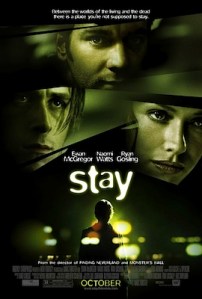
StayI’m sure some viewers didn’t bother to stay until the end of Stay, baffled by an increasingly bizarre plot — which, at times, seems to be doing its best to stay still too — and put off by apparently pointless scenes. If only they had stayed, they could’ve discovered that they had indeed wasted an hour and a half of their lives on a story with a deceptively unoriginal conclusion.
The main problem with Stay is that it thinks it’s cleverer than it is. At its heart is a mystery, or set of mysteries, which the conclusion of can be too easily guessed right from the start. That’s not to say you can piece it together from the clues given, but you can certainly guess at it. This is because much of the film, and its clues, are apparently meaningless. Either there’s supposed to be some deeper, unrevealed significance to things like never-ending staircases and a blind man’s vision being restored, or it’s all there just to look significant and help hide/complicate the final revelation. The climax is consequently disappointing: it’s too obvious, it doesn’t bother to tie everything in, nor does it seem to allow room for the viewer to retrospectively tie things up. To rub salt in the wound, a brief epilogue is twee, one of those ideas that might sound like a neat tweak on what we’ve seen but should actually have been cut.

There are some positives, mostly in the direction. Forster has proved himself excellent with visuals — look at the fantasy scenes in Finding Neverland or the HUD-like graphics in Stranger Than Fiction — and there’s plenty to add to that list. The intriguing scene transitions are the stand-out. While they may initially seem pointlessly flashy, the ending, however flat it may be, does suggest they were done for a reason. Throughout, the film is well shot and well edited, but, perhaps, too well — or, rather, ‘too obviously’. By deliberately ignoring several standard editing rules (I won’t reveal which here), the film-literate viewer may find that too much is given away too early on.

Clearly someone liked Stay, as writer David Benioff sold the screenplay for $1.5 million, and it would be nice to agree with that buyer — there’s a good cast, a good director, some good ideas — but ultimately it’s 85 minutes that seem retrospectively pointless when the final ten do so little with them. There’s no final “oh, that’s what it was about!” twist, just “well, I’d guessed that much” coupled with “and I’ve seen that before”. Some qualities (Forster’s visuals, the likable cast) almost earned it an extra star, but the ending took it back off them.

2 out of 5

Zodiac (2007)

2008 #64
David Fincher | 151 mins | DVD | 15 / R

Context time: I’m a David Fincher fan. Se7en and Fight Club number among my favourite films of all time; I’ve always found The Game to be an immensely enjoyable thriller; much the same can be said of Panic Room, especially the famous slow motion sequence, which is one of my favourite action scenes ever; and I love The Hire series of short films, which Fincher produced but (sadly) never directed. I’ve never seen Alien³ (or Aliens, or any other entry in that series bar Ridley Scott’s first for that matter), but considering its troubled production history one might say it barely counts. All this considered, why’s it taken me so long to see Zodiac? Well, laziness, to be honest, but I’m here now. And unlike another recently-viewed highly-anticipated film (namely, Southland Tales), this was more than worth the wait.

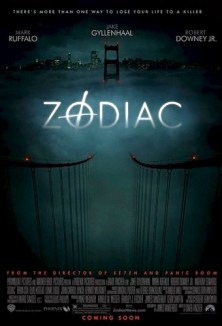
As other reviews have pointed out, Zodiac is really a film about obsession, and it makes for as engrossing a tale as the case was for those investigating it. In following the story the film chooses to eschew normal structural niceties for fact-following, yet structure is never a problem. Yes, it jumps from character to character, and if you step back and analyse it that’s odd, but while watching it doesn’t matter one jot — this is more like real life than some shallow crime thriller dependent on a twist ending. That level of realism is key throughout, be it the period detail or the exemplary performances — both are excellent and accurate without being showy. Much like Fincher’s direction, in fact, which is appropriately more restrained than usual, though he can still display a suitable level of flair when warranted.

Some have called it slow, even dull, but I was totally engrossed throughout and never overwhelmed by the number of facts being thrown around — and I was watching it in the middle of the night when I should have been asleep. At 5AM, when it finally ended, I was even wishing there was more. (It seems a shame that the recently-released (in the UK) director’s cut adds barely five minutes.) It does exactly what it aims to: it’s not about the killer’s mind and it’s not a whodunnit; it’s about procedure, obsession, and how one deals with an unsolved mystery. The fact it isn’t definitively solved — and yet, for all the characters, there’s a way out or a solution that satisfies them — is possibly the most telling part of the whole film.

After the disappointment of the long-awaited Southland Tales, it’s especially pleasing that the long-awaited Zodiac is such a triumph. It’s easily up there with Fight Club and Se7en, and perhaps even surpasses them both. My most unreserved full marks since Dark City.

5 out of 5

Zodiac placed 2nd on my list of The Ten Best Films I Saw For the First Time in 2008, which can be read in full here.

My more thorough review of the Zodiac: Director’s Cut can now be read here.

Southland Tales (2006)

2008 #63
Richard Kelly | 139 mins | DVD | 15 / R

Southland Tales

– confusing mess? or profound experience?

I won’t go into my full “how I discovered Donnie Darko” spiel [save that for whenever I finally watch the Director’s Cut!], but ever since I saw Richard Kelly’s first writing/directing effort way back on its original UK release I’ve been waiting eagerly for his second film. It’s a testament to the negativity of the reviews it received — and, perhaps, the influence of reviews in general — that I skipped Southland Tales at the cinema, left it five months after release before getting it on DVD… and even then it was only a rental.

At some point, Kelly split his story into six parts and, in a Star Wars-like move, the film was to be Parts 4-6, while the first three would be told in accompanying graphic novels. “The film will work fine without reading them,” he said (I paraphrase here), “but reading them will lead to a deeper experience.” Southland Tales: The Movie begins with a long recap of events from these books, going so far as to include images from their art. “Oops”?

You have to wonder, if you switched “Directed by Richard Kelly” for, say, “Directed by David Lynch”, would the critics’ reviews have suddenly jumped up a star or two? [some of it is certainly very Lynchian in feel — not a normal film with bemusing aspects, like Donnie Darko, but an all-out muddled weird-fest]

  • David Lynch fans may find this more entertaining than most. Or they may hate it for trying to be Lynchian but failing, or perhaps like it as an example of why Lynch is so good and others fail when they attempt similar feats. I don’t know how they’d use it like that, but I expect they would know.
  • the clear IV, V and VI presented at the start of each chapter — as well as showing I, II and III blatantly on screen during the recap, and having the narration have to recap bits of them — seems to hammer home that this is really for people who are prepared to invest in the whole thing, not people who just watch the film

** raises the question, should you ever have to go further (e.g. reading companion books, comics, websites, etc) to understand a film? Yes and no. If it’s consciously part of a wider ‘experience’, labelled and marketed as such, then why not? But if it’s sold as a film in its own right — or, at least, potentially in its own right (as this was) — then it should really work that way too.

  • narration: tries to explain everything, though does very little to help (difference between Kelly and someone like Lynch, who just leaves it all up to the viewer?) — at times almost uncomfortably over-explaining — you wish it could’ve been done properly, rather than with narration
  • Kelly spent months re-editing, following the critical panning it got at Cannes, trimming the length and restructuring it. And it seems to show, as it feels like a failed attempt to construct something legible out of a mess of half-thought-through scenes and subplots
  • one feels a good director’s commentary and/or the original cut might shed more light on things — this is the sort of film that could benefit from a decent DVD edition, that it probably won’t get due to its lack of popularity… unless it gains surprise critical acceptance years down the line, which isn’t unheard of… though I wouldn’t bank on it here. Perhaps, one day, when we’re all watching Data Crystals, Kelly will have gained enough reputation that a 20th anniversary release will finally explain the damned thing
  • seems to become clearer toward end — there are some answers, at least — but ultimately a lot is left out
  • too many of the ‘underlying ideas’ in the climax feel like a Donnie Darko rehash; odd musical numbers and long takes add to this feeling — almost like Kelly’s taken what he did in Darko and tried to expand it into some ensemble epic kinda thing

i thought, with respect to the film’s crazy half-constructed mess of half-ideas, i’d copy&paste my notes rather than a normal review. so at least that’s one answer at the end for you.

when it was originally conceived, it was set a couple of years in the future; now, it’s just set ‘now’; and soon, of course, it will be set in a fictional past — the copyright year on the film is 2005; it’s credited as 2006 on IMDb (which is when it turned up at Cannes); it was finally released in 2007; and it’s set in 2008

I really wanted to like Southland Tales, in spite of the critical mauling it received, and because I loved Donnie Darko and actually enjoyed Domino too (which Kelly wrote). Maybe — maybe — with time to invest in reading the prequel graphic novels, and exploring whatever official sites or crazy fan theories may be out there on the web, I could get more from this film. Personally, I don’t have that kind of time to invest right now, but I might give it a shot sometime. Until then, it will just remain a largely disappointing mess.

http://www.imdb.com/title/tt0405336/faq

this is the way the review ends, not with a bang but with a whimper

2 out of 5

Southland Tales featured on my list of The Five Worst Films I Saw in 2008, which can be read in full here.

Agatha (1979)

2008 #62
Michael Apted | 100 mins | TV | PG / PG

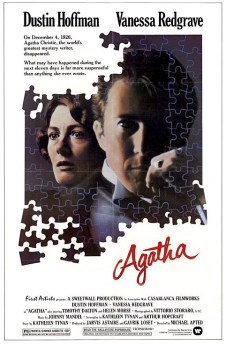
AgathaThere are no giant wasps in sight as Vanessa Redgrave’s Agatha Christie goes missing for eleven days in December 1926, and Dustin Hoffman’s journalist tries to track her down. While the frame of the story is true, the reasons behind Christie’s disappearance, and what occurred during it, aren’t known — which makes it fertile ground for speculation. Sadly, a fantastical plot about jewel thieves and shapeshifting aliens is much more exciting than the down-to-earth mystery we’re offered here.

It’s easy to see the attraction of Christie’s disappearance: it’s a real-life mystery about arguably the greatest mystery author ever, with enough unusual events surrounding it to make it extra suspicious and a long enough gap for something significant to have happened. But while the idea is initially exciting, when it comes to retelling it there isn’t a great deal there — the facts of her disappearance are just the ‘before & after’, amounting to little more than an abandoned car, an assumed name and some amnesia. Unless one invents something to fill those missing days, there’s little to tell (she went to a hotel and forgot what happened, essentially) — so, of course, this film fills in the gap. With a murder mystery, naturally. Sort of, anyway.

To be honest, I found it a tad confusing for the most part. While the initial setup is well handled, showing what drives Christie to run away (consciously or not) and the beginning of the police search, it begins to flounder once the plot slides into its fully fictional phase. Hoffman’s journalist, who had been hoping to interview Christie, manages to stumble across her at the hotel, where he pretends not to know who she is, while she… has health treatments… It’s only at the conclusion, when Christie’s plan begins to come together, that one realises there was a plan at all. It’s a shame the revelation comes so late because it’s actually not that bad a plot, and makes for quite a neat and almost plausible (providing you can accept Christie as a potential murderess (sort of)) explanation for everything.

The performances do nothing to raise the film. Redgrave is lumbered with little to do, mostly wandering around looking dazed. Her performance is decent but the material she has is lacking. Hoffman, on the other hand, is just flat, while Timothy Dalton’s sneering Colonel Christie sadly barely features. On a more technical level, the police investigation subplot is disappointingly forgotten halfway through, and everything is shot with too little light. Sometimes the latter is effective, such as during a train journey where occasional flashes of light illuminate Christie’s uncomfortably blank face, but at other times it merely obscures events. (It’s possible this is just the print, of course.)

Christie’s disappearance remains a fascinating mystery, though in all likelihood the true causes were either very internal or mental health related — not the easiest thing to depict in a movie, especially when your audience is likely expecting a thriller. Agatha has a game stab at weaving an interesting tale into the gaps in the facts, but by the end I was wondering if a straightforward biopic mightn’t have been a better idea.

3 out of 5

Cathy Come Home (1966)

2008 #59
Ken Loach | 77 mins | DVD | PG

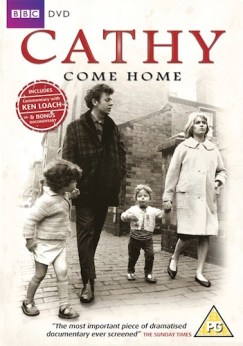
Cathy Come HomeTechnically a one-off TV drama from the BBC’s Wednesday Play strand, Cathy Come Home more than deserves consideration as a film in its own right, due to it being an early work of director Ken Loach, the fact that it’s shot largely on film using relatively experimental storytelling techniques, and also considering the huge social impact it had.
The piece tells the story of Cathy, a young woman who leaves behind a comfortable life for the excitement of the big city. There she falls in love with Reg, who she marries and has children with. But, through a series of incidents and accidents — most of them no fault of their own — Cathy, Reg and the children wind up without a house, and then gradually slide down the scale toward homelessness. In this respect the film can remind us of a facet of the ‘good old days’ that is often overlooked when our collective memory of the ’60s is made up of James Bond, the Beatles, and programmes like Mad Men. The drama also had a big impact at the time: 12 million watched, it boosted the newly-formed charity Shelter, led to debates in parliament, and, eventually, changes to the law.

Loach structures the film cleverly: Cathy and Reg’s slide into poverty is all too believable, while at the same time allowing the viewer to see a cross section of the homeless experience. He employs a documentary style throughout, so effectively that it still fools some into believing the whole piece is factual. In fact there’s a mix of interviews with those really suffering such situations, and performed scenes that are shot and cut disjointedly, as if they were observed rather than written. While some of the performances give the game away, they’re never poor enough to really detract. The downside of this style is that the storyline isn’t always clear. I’m still not sure if it was Cathy’s children that died in the caravan fire or someone else’s, just one among a few such examples. While ambiguity is no bad thing — the cruelly unresolved ending being a case in point — it sometimes just seems like a hole in the narrative. However, these moments are relatively minor, and certainly don’t dint the film’s impact.

Cathy Come Home is a powerful piece of work; an undoubted television classic that (bar a few technically-incongruous studio scenes shot on video) wouldn’t look out of place on a big screen. As an important and timely history lesson, a challenge to prejudices that some of us may hold, and a reminder of how close most of us are to such a fate — especially right now — it remains essential viewing. Sadly, I suspect it always will.

5 out of 5

The Jane Austen Book Club (2007)

2008 #54
Robin Swicord | 101 mins | DVD | 12 / PG-13

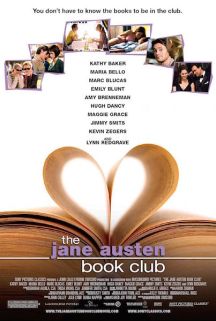
The Jane Austen Book ClubI like to think I have a fairly high tolerance for ‘chick flicks’ — over the years I’ve rather enjoyed films such as Love Actually or Bring It On, and not just because of the male-friendly porn-stand-in scenes or cheerleader costumes — but even I was a bit uncertain about this one at first. However, as it progressed, gradually revealing more about the characters, their lives, and how they cope with what the world throws at them, I found myself increasingly enjoying it. By the time we had to pause it twenty minutes from the end, I found myself itching to continue to find out what would happen.

Inevitably, it’s not flawless. At times it feels like a collection of subplots linked only by the monthly book group meetings, with whichever plot thread is the focus of a scene becoming the de facto main story… until the next scene begins, of course. A working knowledge of Austen’s novels is helpful too. I presumed the film (and book on which it is based) merely invoked Austen’s perennially popular name to boost sales, but there’s actually a fair bit of analysis of the books thrown in, which often reflects what’s happening to the characters. You can get by without an Austen familiarity, but I found the Pride & Prejudice segments made more sense than the others thanks to my (marginally) increased understanding of that particular text.

It would be very easy to pigeonhole The Jane Austen Book Club as a ‘film for women’… and, to be honest, that wouldn’t be at all unfair: it’s as squarely aimed at a female audience as Die Hard is aimed at blokes. It’s also ultimately disposable, apparently with nothing new or revelatory to say about womankind. In spite of all that, I enjoyed it more than I probably had any reason to — and not just because of the male-friendly lesbian character.

4 out of 5

Hamlet (1996)

2008 #50
Kenneth Branagh | 232 mins | DVD | PG / PG-13

Hamlet (1996)Following his success with Henry V and Much Ado About Nothing, Kenneth Branagh tackled arguably Shakespeare’s most revered play, Hamlet. And he didn’t do it by half. It’s the first ever full-text screen adaptation, which means it clocks in just shy of four hours; he unusually shot it on 70mm film, which means it looks gorgeous; and, while he grabbed the title role himself, he assembled around him a ludicrously star-packed cast from both sides of the pond — in alphabetical order, there’s Richard Attenborough, Brian Blessed, Richard Briers, Julie Christie, Billy Crystal, Judi Dench, Gerard Depardieu, Nicholas Farrell, John Gielgud, Rosemary Harris, Charlton Heston, Derek Jacobi, Jack Lemmon, John Mills, Jimi Mistry, Rufus Sewell, Timothy Spall, Don Warrington, Robin Williams and Kate Winslet — not to mention several other recognisable faces. Even Ken Dodd’s in there!

But, with impressive statistics and name-dropping put to one side, what of the film itself? Well, it’s a bit of a slog, especially for someone unfamiliar with the text. While there is much to keep the viewer engaged, the high level of attention required can make it a little wearing; certainly, I took the intermission as a chance to split the film over two nights. Amusingly, the second half uses the original text to provide a sort of “Previously on Hamlet“, which was very useful 24 hours later. None of this is the fault of Branagh or his cast, who do their utmost to make the text legible for newbies — for example, there are cutaways to events that are described but not shown by Shakespeare, which, among other things, help establish who Fortinbras is (Rufus Sewell, as it turns out) before he finally turns up later on.

That said, some of the performances are a bit mixed. Branagh is a good director and not a bad actor, but his Shakespearean performances are variations on a theme rather than fully delineated characters. While there a new facets on display here thanks to the complexity of the character, there are also many elements that are eerily reminiscent of his Henry V and Benedick. The Americans among the cast seem to be on best behaviour and generally cope surprisingly well, while Julie Christie achieves an above average amount of fully legible dialogue. Perhaps the biggest casting surprise is Judi Dench, appearing in what is barely a cameo — one wonders if the film-career-boosting effects of a certain spy franchise would have changed that.

The best thing about this version, however, is how it looks. Much credit to cinematographer Alex Thomson for using the larger 70mm format to its full, loading every frame with vibrant colours and packing detail into even the quietest moments. Not every frame is a work of art — there is, after all, a story to be told — but there’s more than enough eye candy to go round. Also, a nod to the editing (the work of Neil Farrell), which makes good use of long takes — many of them full of camera moves — but also sharply edited sequences, such as the all-important play. The fast cuts make for a joyously tense scene in a way only cinema can provide, which I suppose is rather ironic during a ‘play within a play’.

For fans of Shakespeare, I suspect Branagh’s Hamlet is a wonderful experience, finally bringing the complete text to the screen and executing it all so well. For us mere mortals, it’s a beautifully shot and engagingly performed film, that I’m sure would benefit from a greater understanding of the text.

4 out of 5

Brideshead Revisited (2008)

2008 #49
Julian Jarrold | 133 mins | cinema | 12A / PG-13

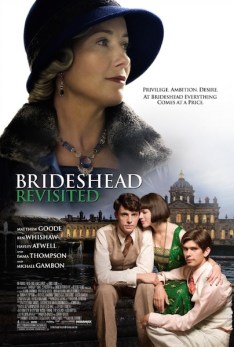
Brideshead RevisitedI’ve not seen the miniseries and I’ve not read the book, but I do know that both are considerably longer than Jarrold’s two-and-a-quarter hours film. So why does it feel so slow? Perhaps it’s the pair of opening flashforwards (easier to refer to them as that than to the majority of the film as one great big flashback), an overused technique these days that here serves no purpose whatsoever: there’s no additional insight on events that follow (or, rather, precede) by placing these snippets at the start, and there’s no new perspective on the snippets when we reach them chronologically (except that, second time round, we actually know who the characters are). It’s the most niggling fault in a film that, like my just-reviewed WALL-E, is of two halves.

The first is very good. It’s entertainingly written and performed, firmly in the tradition of the ‘heritage’ films and TV series that Britain churned out through the ’80s and ’90s — it’s the natural successor to the work of Merchant-Ivory, who of course produced the tonally-similar (at least at first) A Room With a View, which makes this all seem very appropriate. As Sebastian, Ben Whishaw is, perhaps unsurprisingly, the best of the three leads. When he’s off screen you miss him, and the point at which Sebastian leaves the story is arguably when things go off the boil. As Charles, Matthew Goode by and large holds his own — handy really, as he is definitely the centre of the film. Emma Thompson is as you’d expect her to be, which is to say she’s pretty good but ultimately it’s all rather familiar from her other performances.

The second half is where the film falls apart. The focus shifts from Charles and Sebastian’s friendship/possible homosexuality, to Charles and Julia’s love affair. The latter seems to come from nowhere and never takes off, consequently making it hard to accept the lengths they’re prepared to stretch to in order to make it work when they’re finally reunited years later. The plot slowly slides into darker and bleaker territory, needlessly dragging small characters back into proceedings to kill them off and finally pushing towards an Atonement-esque World War II epilogue. Some or all of this is obviously derived from the source, but considering the praise garnered by the novel and miniseries I presume it’s made to work there. Here it doesn’t.

An hour-and-a-half in I couldn’t understand what story there was left to tell, and I continued to be bemused by the sudden import of Charles and Julia’s relationship as the next hour dragged by. It’s a shame, because Brideshead starts out so promisingly and enjoyably, but once it begins to slide it never recovers.

3 out of 5

I Am Legend: Alternate Theatrical Version (2007/2008)

2008 #47a
Francis Lawrence | 104 mins | Blu-ray | 15

This review contains spoilers.

I Am Legend: Alternate Theatrical VersionI only watched the theatrical version of I Am Legend earlier this year (it’s #35), but, for reasons I won’t elaborate on for once, I’ve found myself watching this alternate version already.

Most of the comments in my original review still apply, as this cut only has minimal differences: there are a couple of very short new scenes in the third act, which were presumably excised because they primarily feed into the different ending, the main attraction of this version. Personally, I prefer it. The whole butterfly thing is too God-messagey, recalling the weakest elements of Signs, but if one can put that aside then the new content fits in much better with several threads that develop in the rest of the film (in both versions — in the original cut they’re just ignored). It feels like this was the intended conclusion but, for whatever reason, someone decided it needed changing. Perhaps it wasn’t explosive enough; or, indeed, conclusive enough, as it dispenses with the safe-haven epilogue and its pathetic attempt at justifying the title — another pleasurable loss as far as I’m concerned.

One other element I’ve reconsidered thanks to this repeat viewing are the CGI humans. They’re good enough in and of themselves, and would make more than passable foes in another action film, but here they ruin the ambiance that’s so carefully built up before their first appearance. Yes, the CGI lions are also clearly fake, but with limited methods to create such scenes they seem more acceptable. The arrival of the Dark Seekers, on the other hand, barges the film from thoughtful sci-fi drama into horror action blockbuster stylistically, in a way that using real actors simply wouldn’t. The not-real Dark Seekers may have superhuman jumping abilities, but the film doesn’t need those either, and could easily have crafted a similarly action-packed climax with real performers.

I Am Legend is still as middle-of-the-road as before, with very little to choose between the two versions. However, thanks to a less irritating final few minutes, this version just has the edge — if you ever intend to watch I Am Legend, be it a repeat viewing or your first, I recommend you plump for the alternate cut.

3 out of 5

The theatrical version of I Am Legend is on Watch tonight, Tuesday 14th October 2014, at 10pm.