
Rob Reiner | 138 mins | download | 15 / R
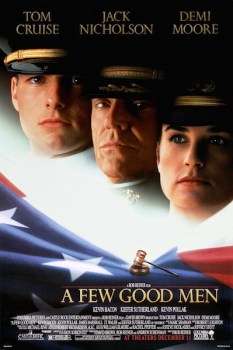 Sometimes you have to wonder where it all went wrong. I can only imagine how good things looked for Rob Reiner at the start of the ’90s, when he’d had an almost-interrupted near-decade-long run of acclaimed movies in the director’s chair: This is Spinal Tap, Stand By Me, The Princess Bride, When Harry Met Sally, Misery, and finally this. ‘Finally’ being the operative word however, as it all seems to have gone down hill from there, to the extent that I actually felt the need to look him up on IMDb to check if he was still working/alive. (He’s both, having recently directed The Bucket List, a bit of a hit if I recall correctly.) Reiner is a recognisable name, and if he’d stopped making films after A Few Good Men perhaps he’d find himself bandied about on lists of Great Directors (at least in certain circles/magazines), but the fact I had to check what he’s been up to (and had forgotten how many acclaimed films he’d made in the first place) shows what a 15-year run of nothingy films can do for your reputation. Even the career of Spinal Tap themselves seems to be in better condition.
All that said, A Few Good Men isn’t really Reiner’s show. It’s not that he does a bad job — far from it — but courtroom dramas primarily depend on two things, even more so than most films: the quality of the writing and the quality of the performances. When you have scene after scene in which a handful of people battle with words alone, often in one-on-one confrontations, then those two elements are virtually all you’ve got. Of course camerawork, editing, music and the rest still have their part to play, but without the underpinning of good writing and good performances the technical attributes are merely fighting to cover for significant shortcomings. Fortunately, A Few Good Men has those underpinnings.
In this case the screenplay is by Aaron Sorkin, adapting from his own play, who would go on to create and write a great deal of The West Wing (which, incidentally, was inspired by leftover ideas from a later Sorkin/Reiner collaboration, The American President). The seeds of that show’s influential style are in evidence here, although the sheer pace and famous ‘Walk and Talk’ scenes aren’t yet part of the formula. As in The West Wing, Sorkin’s writing is both intelligent and witty, a hallmark of high-quality writing that’s able to rise above the shackles of “it’s not real drama unless it’s all grimly serious”. His characters and their personal story arcs may be straight from the stock pile — Tom Cruise is the hot-shot young lawyer who’s actually trying to live up to his daddy (and comes through in the end); Demi Moore is the goody-two-shoes woman trying to make it in a man’s world (who learns to work with her colleagues); and so on — but the plotting of the central case remains undiminished, and Sorkin thankfully avoids such obvious subplots as a romance between Cruise and Moore’s initially-mismatched-but-ultimately-mutually-respectful good guys. Nonetheless, the occasional lapses into extreme, often patriotic, sentiment that would later mar the odd episode of The West Wing are also on show here, most notably at the climax, though they fail to do any serious damage.
It’s in the all-important court scenes that Sorkin’s writing really shines. Dialogue flies back and forth like bullets, full of protocol and technical jargon — like in The West Wing — that we either understand or, when we don’t, get enough of the gist to follow the key plot points — like in The West Wing. The biggie is the final confrontation between Lt. Kaffee and Col. Jessep, an interview that’s the courtroom equivalent of a high noon showdown. It’s true that Tom Cruise plays Tom Cruise and Jack Nicholson plays Jack Nicholson, just as they almost always do, but it makes for a grand act-off. It’s fair to say that Nicholson comes out the victor, gifted with material that guides him from cocksure commanding officer to angry thug in just a few minutes, but it’s the bravado of Cruise’s questioning — undercut with uncertainty and genuine surprise when he pulls it off — that pushes Jessep there.
There are plenty of other good performances — typically competent work from Kevin Pollak doing the best friend thing and Kevin Bacon doing the friend-turned-rival thing, while Kiefer Sutherland’s ‘head bully’ role is memorable and Demi Moore holds her own better than the rest of her career might suggest — but this is undoubtedly a showcase for Nicholson and Cruise, and through them Sorkin’s writing. Not to mention that there are some nice directorial flourishes from Reiner. I wonder what happened to him?

A Few Good Men is showing on Five tonight at 10pm.
 Six years after the once-phenomenal TV series meandered to an inconclusive conclusion, Mulder and Scully were back at the cinema, a decade on from their previous between-seasons big screen outing. The big threat this time was not aliens, however; nor even something more Earthly supernatural; but rather, where they would find an audience? There are now kids old enough to watch this in a BBFC-endorsed fashion who weren’t even born when the series started, and that’s not to mention the misguided attempt to pitch this as a Summer blockbuster.
 It’s been two years since I reviewed the second in Clint Eastwood’s 2006 double bill of World War II films; thanks to the machinations of my DVD rental site, it’s taken this long to see the first. In a somewhat innovative move, the pair examine both sides of the battle for Iwo Jima:
  Stand By Me is a film an awful lot of people love an awful lot, which it always seemed to me was down to first seeing it at the right age (more or less the age of the main characters, I think) and possibly to being part of a certain generation — would it have the same effect for kids today, when the relative innocence and freedom of the ’50s is arguably lost? As I say, “seemed”, because now I’m not sure either of these factors really matter.
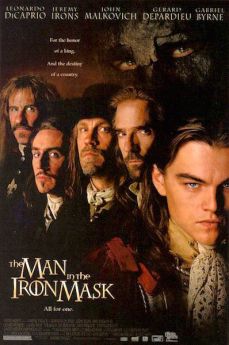 From the off it’s clear that The Man in the Iron Mask is not going to go well. It’s an adaptation of a tale of the Three Musketeers, so naturally is set in historical Paris… where everyone has a different accent and very few of them are French. It is, to be blunt, a horrid mishmash — much like the whole film.
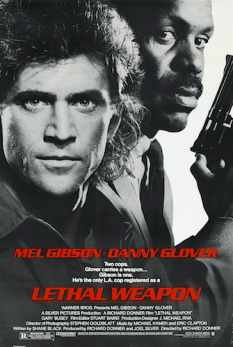 Lethal Weapon comes from another era — an era in which R-rated films were still allowed to be blockbusters. One only needs to look at the classifications attached to the most recent instalments of formerly-R-rated ’80s franchises — primarily,
  Ed Zwick seems to like war. More accurately, Zwick likes making films about war, but clearly isn’t a fan of the act itself. Since gaining attention with multi Oscar-winner Glory, about the first black regiment during the American Civil War, he’s directed a number of films concerned with wars and those that fight them:
 One of the great things about doing 100 Films in a Year has been the number of firsts it’s either led me to or just been there to document: my first time watching films on
  When Andrei Tarkovsky adapted Stanislaw Lem’s thoughtful science fiction novel
