Wallander: Before the Frost (2005)

aka Mankell’s Wallander: Innan Frosten

2009 #74
Kjell-Åke Andersson | 93 mins | TV | 15

You’re likely familiar with Swedish police detective Kurt Wallander — in passing if not in detail — from the Kenneth Branagh-starring BBC series broadcast at the end of last year (a second series has just finished filming). For the sake of omitting excusatory clauses from the next paragraph, I’ll assume that’s all you know (not that I mean to sound like an expert, because, well, I’m not).

Wallander is adapted from a series of novels by Swedish author Henning Mankell, previously filmed in their original language, between 1994 and 2007, as a series of TV movies starring Rolf Lassgård. A different series of Swedish Wallander films began in 2005 — so, concurrent with the TV adaptations — featuring Krister Henriksson as the titular detective in original stories based on plots by Mankell. Three of these thirteen films received a theatrical release, the remainder going direct to DVD. It’s this latter series that BBC Four are currently halfway through showing, and it’s their theatrical releases that will see three of them reviewed as part of 100 Films 2009.

Before the Frost is the first of this series, and is actually an exception: where the others are original stories, this is adapted from a spin-off novel starring Wallander’s daughter, newly-qualified policewoman Linda Wallander. This leaves Kurt as something of a guest star in the first episode of his own series, but we still see enough of Henriksson to get a feel for his Wallander. Where Branagh is soul-searching, constantly staring silently into the distance, occasionally with a few tears for company, Henriksson is just a guy trying to do his job; struggling to be a good dad and maybe struggling with his health, but still a regular guy. Maybe the introspection and crying come later.

As the de facto lead, Johanna Sällström gets the best of the material. Linda’s troubled relationship with her father, including her decision to work in the same station as him when she could’ve gone anywhere but, are major threads. Sällström plays this central contradiction well, only occasionally (and, thankfully, briefly) slipping down into stroppy teenager histrionics, such as when she storms away from a crime scene early on. As Linda’s friend Anna, Ellen Mattsson also has daddy issues to contend with, though sadly they’re underwritten by comparison. Nonetheless, her significant role is finely portrayed.

Sadly, the majority of the detective story isn’t up to the personal relationships. The villains turn out to be Evil Christians — always a good enemy in my book — with a variety of nefarious plans that lead the story to touch (briefly) on hot-topic issues like abortion, single-parent artificial insemination, and same-sex marriage. While a British or American drama might feel the need to include more of a debate about the morals of such acts, here they seem accepted as a right that the Evil Christians want to steal. Though this arguably leaves them under-considered, it’s a refreshing change of pace.

More problematic is that the villains are never properly introduced or explored. Some events are undersold — a woman is murdered for no decent reason, a case of wrong-place-wrong-time, but once her body is discovered no thought or mention is given to her unfortunate luck or her family’s grief. Obvious deductions stare Wallander and his team in the face yet they fail to make them — the length of time it takes anyone to twig that the fundamental Christians might intend to attack the high-profile gay wedding is astounding. All of these faults rob a few plot twists of their full potential, though at least one still left me surprised and feeling like I should have spotted it (which, of course, is what a competent twist ought to do). Arguably, however, there’s too great a reliance on coincidence to connect all the dots.

Visually this Wallander is as different from the BBC’s as Henriksson is from Branagh. Where the British one seems to attempt an emulation of what our idea of Sweden might be — all cold, desaturated blues and greys, lingering shots of vast empty countryside, and so on — the Swedish version is more, well, normal. (That said, early on it contains a perversely beautiful shot of two swans in flight while engulfed in flames.) No doubt the differences between series are the product of the British version trying to create a Foreign Culture while the Swedish one is just content with filming it as-is, much the same as British-set British dramas do with Britain. On a broadly related note (in that they’re visual), the subtitles are mostly fine, though some jokes and language tricks are unfortunately lost in translation.

Before the Frost is, sadly, not all it could be. Whether this is the fault of Mankell’s novel or Stefan Ahnhem and Pelle Berglund’s adaptation I don’t know (I’ve never read a Mankell), but while it seems fine as it goes along a bit of reflection reveals all these niggling gaps. That might be a little harsh though, as there’s still much to admire and enjoy in the first of what could be a fine series.

4 out of 5

The second theatrical release, Mastermind, was on BBC Four last week and is available on iPlayer for another 24 hours. The third, The Secret (aka Hemligheten), is episode thirteen and will air later this year.

Ashes of Time Redux (1994/2008)

aka Dung che sai duk redux / Dong xie xi du zhongji ban

2009 #71
Wong Kar-wai | 90 mins | TV | 15 / R

Ashes of Time ReduxA wandering man with magic wine and no memory; a clan prince who’s also his beloved sister; a master swordsman who’s almost blind; his wife, who loves his best friend; a persistent peasant girl after revenge for her little brother, with only eggs for payment; a young swordsman with no shoes and a camel; a large gang of bandits with a left-handed member; and a desert-dwelling problem solver who connects them all. Oh if only Ashes of Time were as simple as that sounds.

Despite apparently being an Eastern action movie — it’s in the wuxia genre, which, for the uninitiated, also covers the likes of Crouching Tiger, Hidden Dragon and House of Flying DaggersAshes of Time isn’t what one would typically expect from such a billing. Reviews talk about it being a confusingly-plotted art film — and those are the positive ones — which, coupled with my relative dislike of Chungking Express, meant I didn’t really expect to like it a great deal. But I found myself surprised, because I really enjoyed it.

For one thing, I followed the plot right to the end, though the final fifteen minutes throw up a series of twists to rival any thriller. I don’t claim to understand every nuance of every character, the meaning of every event, exactly how everything is connected (assuming it is), or what it’s really all about… but based on what I’ve read, even following it is an achievement on a first viewing. I felt more or less the same way at the end of The Big Sleep, and the trick here is the same: pay attention. Yes, this requires some effort on the part of the viewer — I was aware of myself paying close attention throughout in order to follow and comprehend the story, more so than in most films (even discounting easily-followed mainstream-aimed efforts). An awareness of this need for hyper-attentiveness from the get-go (which, as I say, I had thanks to perusing a couple of reviews) is likely to aid the viewer (which, as I say, it did me).

The story itself, then, is quite episodic. There’s some overlap, but in general characters come and go from the problem solver’s home in a parade, rarely interacting with one another. Each individual piece explores a different facet of a similar theme — “anecdotes about chivalric swordsmen”, as the Radio Times puts it — which serves to tie them together, alongside other plot elements and character points — several have wives in love with others, for example, while others have left their wives at home and one has been followed by his.

Wong (again, so I read) broke ground within the genre by prioritising emotion over action. Therefore potential viewers shouldn’t expect the abundant martial arts/swordplay the genre often provides. If Hero was too arty for you (as it was for me first time round), then this will almost certainly be beyond the pale. Despite the paucity of action — despite several stories concerning assassination and death, the actual act isn’t the point in the slightest — when it does turn up (the first significant sequence is halfway through) it’s excellent; effectively, if differently, done.

Indeed, the film is beautifully shot; perhaps not as obviously as Hero’s colour-coded vibrancy, but there are frequent moments that dazzle and I can’t recall a single weak visual. Wong mucked about with the colours as part of his reduxing, to the reported distaste of cinematography Christopher Doyle, but it still looks stunning throughout.

Wong’s 2008 redux included not only these tweaks to the visuals, but also modifications to the audio and losing seven minutes from the original cut. I’ve never seen it so can’t compare, though some reports claim the changes helped clarify the plot. For the curious, a catalogue of differences can be found here. Equally, those after better-informed reviews might like to read DVD Times’ coverage, with Noel Megahey on the DVD and John White on the BD, and Heroes of the East’s review of both cuts.

Having pointed you toward those wise reviewers, let me just say that Ashes of Time Redux is not your typical wuxia film and not for everyone. My enjoyment of it came as something of a surprise, which is always nice.

4 out of 5

Film4 are showing Ashes of Time Redux tonight at 1:05am.

The Apartment (1960)

2009 #36
Billy Wilder | 125 mins | download | PG

The ApartmentAn article I once read (but have long since misplaced, unfortunately) asserted that Billy Wilder once said (and I paraphrase heavily here, I’m sure) that, contrary to expectations, when he was feeling happy he’d make a serious picture, and when feeling down he’d make a comedy. Goodness only knows what kind of mood he was in when he chose to make The Apartment, then, because it flits between the two with gay abandon.
It begins almost as a farce, with Jack Lemmon playing up the near-misses inherent in lending your apartment to adulterous men; and though this comedic vein never goes away, the film also develops a dark side. Alongside the affairs and underhand dealings — in which our hero is closely involved — there’s an attempted overdose, discussion of other suicide methods, and respectable men getting divorced. It all seems quite shocking for a film made under the Hays Code, though that was on its last legs (Wilder’s own Some Like It Hot had been released without code approval the year before and still been a huge hit), and Mad Men and its ilk suggest such goings-on by businessmen may not have been so surprising to contemporary viewers either.

On the technical side, Wilder employs long scenes and long takes, but Lemmon never stops bustling through them, always doing something, keeping the film active and moving even when Wilder declines to follow. It’s the latter that makes the former so effective, rendering Lemmon’s character the odd one in an otherwise static world, the one still turning to humour in the face of all life’s bleakness.

Real life always serves up humour alongside tragedy, yet despite that it takes skilled filmmakers to do the same without one lessening the other. Wilder and Lemmon are, of course, among them, and one can imagine few finer examples of such a blend than The Apartment.

5 out of 5

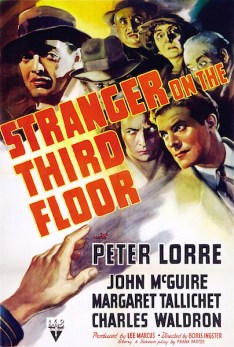
Stranger on the Third Floor (1940)

2009 #55
Boris Ingster | 64 mins | TV

Stranger on the Third FloorDespite being “released the same month as Raoul Walsh’s They Drive By Night, and four months after Alfred Hitchcock’s Gothic Noir Rebecca,” says Paul Duncan in The Pocket Essential Film Noir, “this is often listed as the first Film Noir”. Not often enough to earn the treatment you’d expect such an accolade to afford, it would seem, as I hear it’s rarely screened and only available on DVD in Spain. That’s a shame, because it’s an entertaining — if brief — example of the genre.

The story is a morality tale of sorts. A journalist is the key witness to convict a man of murder, albeit on fairly circumstantial evidence; the journalist’s fiancee disagrees with what he did, though he tries to persuade her round to his way of thinking; but then the journalist finds himself in virtually the same situation, and it’s up to the fiancee to prove his innocence. And that’s most of the plot I’m afraid, though to be frank it’s fairly ancillary anyway.

The screenplay is a little slight and stretches its credibility — would a man really be convicted on such circumstantial evidence, for example? It plays structural tricks too: at one point the lead character is arrested off screen and the focus switches to his fiancee for the remainder of the film. Perhaps they didn’t have the money left for a cell set. Such leaps suggest an underdeveloped story, but on the bright side it certainly keeps things moving.

Despite these faults, many individual scenes are rather good. The journalist spends half the film pacing his room, for example, contemplating whether his irritating neighbour is dead or not, but it remains gripping. When he sleeps he has a nightmare, a showcase not only for the expressionist-influenced cinematography, but also the writing: the opening trial scene features a humourously inattentive judge and sleepy jury, but the exact same elements return to haunt our hero when he dreams he’s in the dock.

The climax is virtually the only scene to feature top-billed Peter Lorre to any significant degree, here fulfilling a couple of days left on his RKO contract with a small role. Nonetheless, in this one scene he out-acts the rest of the cast put together, using just a few lines of backstory to really flesh out his underwritten character. The sequence where the fiancee tries to escape him is suitably sinister. Still, the scene is over quickly and without the fullest logic in its execution — much like the film as a whole.

Stranger on the Third Floor is so imbued with the recognisable calling cards of noir in its cinematography, characters and plot points that it feels more like an entry in a well-established genre than a formative inclusion. At only just over an hour it is, on the one hand, too brief to dig into its characters or complicate its story, but on the other, it rattles past quickly enough that the good bits impress, the weak bits are only briefly registered, and it’s over long before anyone might even consider considering it a waste of time.

4 out of 5

Babel (2006)

2009 #41
Alejandro González Iñárritu | 138 mins | TV (HD) | 15 / R

BabelMulti Oscar nominated and one of Ebert’s Great Movies, Babel is one of those films that comes with a lot of expectation riding on it. The fact that the only Iñárritu film I’ve previously seen is 21 Grams, which I thought was distinctly overrated, takes the shine off those expectations. Probably for the best.

The quickest way to assess Babel is to say that it is about something — or, About Something. The plots, such as they are, aren’t really the point; nor is how they connect, or what chronology they actually occurred in — this isn’t a Memento or a Rashomon, a narrative in odd pieces designed to be reconstructed by the viewer. Naturally, because it is About Something, the Something it is About isn’t made blindingly clear, though there are many contenders — loneliness, miscommunication, culture clashes, the ripple effect, children, and on. Perhaps this means it isn’t as focused as it could (or should?) be; perhaps Iñárritu revels in ambiguity, which isn’t necessarily a problem.

On a relatively surface level, then: the Japanese story barely connects to the others, which are all more directly woven together. Even if their connectedness isn’t the point, when the others are so clearly and directly related it leaves the Japanese thread feeling the odd one out, almost tacked on to the others. It’s probably a coincidence that it’s also the film’s best story, containing about as much incident and interest as the other three put together.

The central character in that particular thread is portrayed by Rinko Kikuchi, who justly earnt a Best Supporting Actress Oscar nomination for her work. The film’s only other Oscar acting nomination went to Adriana Barraza, in the same category, for her role as a Mexican nanny. Again, a deserved nod, as these are easily the two most compelling performances in Babel. (They lost to Jennifer Hudson in Dreamgirls. I’ve not seen Dreamgirls, but as the other nominees were Abigail Breslin (for Little Miss Sunshine) and Cate Blanchett (for Notes on a Scandal), I’m willing to bet she was the least deserving of all five.)

If the Japanese thread is the best then Brad Pitt and Cate Blanchett’s story is the weakest of the bunch, managing to underuse both those leads and a host of British talent too. The other two stories are equally slight, but at least muster up some genuine emotion.

Babel is the kind of film that it’s easy to overrate because, ooh, doesn’t it seem clever. Conversely, it’s easy to underrate because, ooh, doesn’t it seem pretentious. Naturally, therefore, I’m going to come down right in the middle (but note that the Japanese story on its lonesome would earn a 4).

3 out of 5

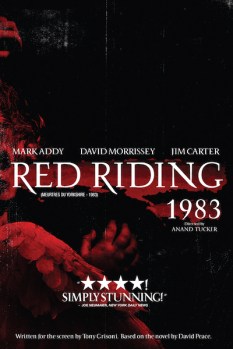
Red Riding: 1983 (2009)

aka Red Riding: In the Year of Our Lord 1983

2009 #52
Anand Tucker | 100 mins | TV (HD) | 15

Red Riding: 1983The Red Riding Trilogy draws to a close with its finest instalment, a superior work in just about every respect.

From the off, 1983 returns to the story of the previous films, showing events from different perspectives. It’s dominated by a new story — the search for a child kidnapper in the titular year — but even this harks back to the past, the actual kidnapping closely resembling the one that kick-started 1974. Indeed, it’s 1974 that’s primarily drawn upon, confirming 1980 as little more than an aside in the scope of the trilogy.

1983 doesn’t just reiterate, however, but builds on previously-seen events and characters, both overtly — showing the police investigation into Clare Kemplay, which was the story of 1974 — and more subtly — Hunter’s apparent sidekick being present at secret meetings of the Evil Policemen in 1974. Despite clear links to the past, 1983 may also work well enough on its own. It’s undeniable that there’s more depth when viewed in light of the first two films, but most (perhaps all) of it would be comprehensible simply from what’s presented here.

Tucker’s film bests its predecessors in almost every assessable value. The story and characters have more genuine surprises and suspense than ever, while the performances are at the very least the equal of what’s gone before. Unlike the other two films, where the corrupt cops were little more than cartoon villains despite claims to the contrary, 1983 makes their brutality really felt; here, for the first time in the trilogy, their disregard for the law and their vicious methods made me feel sickened and angry, just as they should.

But best of all is the stunning sepia-tinged cinematography, which uses the popular RED cameras to amazing effect. The instances of beauty are too numerous to mention, from obvious moments such as the final scenes of white feathers drifting in slow motion through shards of sunlight as part of a heroic closing image (even if one finds it tonally incongruous, which some surely will, it looks gorgeous), to low-key scenes like Jobson lost in contemplation, the sepia-toned foreground standing out from the blues of the background. The omnipresence of lens flare, an idea that was so annoying when liberally sprinkled across Star Trek, seems to work perfectly here. Perhaps it’s due to consistency: every light source seems to cast streaks across the frame, not just the occasional flourish. The trilogy isn’t yet available on Blu-ray, but for some of the images in this film alone it really should be.

Sadly, 1983 still isn’t perfect. Many plot threads are tied off, or we can infer our own explanations for the missing bits, but significant others are left hanging, not least what happened to the numerous corrupt police officers. We don’t necessarily need to see them come to justice — though that might be nice, obviously — or even a summary of the rest of their life, but some nod of a conclusion to their stories would be appreciated. Elsewhere, BJ’s narration is slightly twee, which is a shame because his story is both compelling and one of very few that is actually told across all three films, even though he’s barely noticed at first, rather than just starring in one and cameoing in the others.

I enjoyed 1983 immensely, much more so than either of the preceding films, so it’s only minor flaws like these that hold it back from full marks.

4 out of 5

Red Riding: 1980 (2009)

aka Red Riding: In the Year of Our Lord 1980

2009 #51
James Marsh | 93 mins | TV (HD) | 15

This review contains major spoilers.

Red Riding: 1980The second instalment of the Red Riding Trilogy sets out its stall with a stunning opening montage, covering six years of the Yorkshire Ripper case in as many minutes through news footage and faux news footage. In one fell swoop this establishes its own storyline, fills in some of what’s happened since 1974, and sets itself apart from its predecessor: this one’s based on fact. Well, a bit.

Unfortunately, a factual grounding hasn’t helped the story one jot. Where the first idled, this meanders, flitting between the Yorkshire Ripper, the investigation into the Karachi Club shooting (which closed 1974), and the private life of lead character Peter Hunter. It’s the cover up surrounding the middle of these that’s the most interesting, but that’s also the bit with the least time devoted to it. Most is spent on Hunter’s investigation into the investigation of the Ripper case, though by the end it becomes apparent this exists to cover the ‘real’ story — which is, of course, the Karachi Club cover up. Consequently neither are covered with the appropriate depth: the Ripper investigation is never a serious thread, the team we follow uncovering nothing significant and the Ripper himself captured by chance, off-screen, by a previously-unseen regular constable; and the incidents at the Karachi Club, and their lasting impact, are just about clarified but given no serious weight before a last-minute explanation.

If that sounds complicated, it isn’t. As in 1974, it’s all too straightforward: the people you suspect did it actually did, as it turns out, and there’s no serious attempt to conceal that. In fairness, it just about manages one surprise, right at the end, and the moment after this — where Hunter’s murderer shows remorse with one brief, subtle facial expression — is by far the best bit of the film. Worse than the lack of suspense, 1980 seems to forget its own plot all too often. Hunter is employed by the Home Office, for example, and told to report directly to them and them alone. But then we never see those characters again, not even when he’s later dismissed by lower-ranked officers — why not return to the men he was, supposedly, actually employed by? Other plot points are pushed aside too soon, forgotten about or just abandoned.

Characters and locations resurface from the first film — an unsurprising continuity, but pleasingly almost all appear in a context that’s actually relevant to the plot, rather than a mere catch-up on a previously-known person. Some of them have great import now, their role in the trilogy apparently fulfilled, while others remain little more than cameos with no bearing on the story, suggesting an even bigger part still to play. This works quite well, creating a real world where characters come and go rather than one that is obsessively — and unrealistically — interconnected.

The same can be said of the cinematography. Marsh frequently finds a beautiful or unusual shot, enlivening proceedings considerably. The 35mm glossiness doesn’t evoke the feel of a grimy past quite so thoroughly as Jarrold’s hazy 16mm, but as this is now the ’80s perhaps that’s the point. Nonetheless, the setting conveyed is still a drab, dreary — and constantly damp — North.

Underscored by a plot that doesn’t really come together, and largely bears little relation to the other two films, 1980 is the weakest entry in the trilogy.

3 out of 5

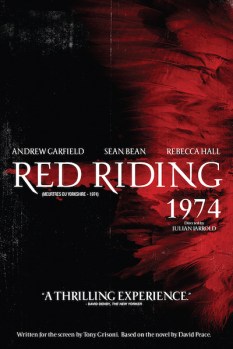
Red Riding: 1974 (2009)

aka Red Riding: In the Year of Our Lord 1974

2009 #50
Julian Jarrold | 102 mins | TV (HD*) | 18

Red Riding: 1974The Red Riding Trilogy covers nine years of police corruption and child kidnap/murder in Yorkshire, amongst one or two other things, and begins here with a very film noir tale, courtesy of author David Peace and screenwriter Tony Grisoni, slathered in neo-noir stylings, courtesy of director Julian Jarrold.

Jarrold is most recently responsible for Kinky Boots, Becoming Jane and Brideshead Revisited, all of which stand in a sharp juxtaposition to the style and content of Red Riding. But turning from his lovely English-as-they-come costume dramas to something altogether nastier should come as no great surprise, for Jarrold is merely returning to his TV roots: in the mid ’90s he directed episodes of Cracker, Silent Witness and Touching Evil.

He certainly seems to know his territory, but perhaps he knows it too well — though this is also the fault of Grisoni and, perhaps, Peace — as the plot that he unfolds is not only familiar but told as if he’s all too aware we know what’s coming. The feeling one gets is of a British James Ellroy, albeit a low-rent, less complex version. (The same is true of 1980, though for me 1983 manages to escape such comparisons.) The story idles along, not exactly slow so much as in no hurry, full of near-clichéd plot points and an unrelentingly standard structure. These things aren’t necessarily a problem, but when you’ve got as big and bold a reality claim as the Red Riding Trilogy they feel out of place.

Another recent point of comparison would be David Fincher’s Zodiac — young newspaperman on the hunt for a serial killer in an inspired-by-fact ’70s setting — though this does 1974 no favours. It may be grittier than Fincher’s film, but it lacks the polish, the originality, and manages to feel slower, despite being a whole 50 minutes shorter. However much arty photography, disjointed storytelling, relatively dense accents and ‘gritty reality’ is plastered over the barebones of the tale, the familiarity of it — to both viewers and the makers, who don’t even seem to be trying — means there’s not an ounce of suspense or surprise to be had.

The cast is made up of established names, familiar faces and rising stars, many of them unfortunately stuck in familiar roles or otherwise left stranded by the unrewarding material. If they’re not quite stereotypes it’s because they’re too bland, lacking enough discernible character traits to reach such lofty heights. Occasionally this is because, with two films to come, some minor parts here have a major role later, but this can’t be said of them all. As the lead, Andrew Garfield’s journalist is as much of a stock character as the plot he finds himself in: a young reporter type, idealistic among journalists who no longer care (if they ever did), hunting to expose The Truth. Again, it could work, but is belied by the insistence — in both promotion and filmmaking style — that Red Riding is something more than Another Murder Mystery. Only Rebecca Hall, as a mother whose young daughter went missing years earlier, is granted the material to give an outstanding performance — which she does, easily justifying her recent BAFTA Rising Star nomination.

Besides Hall, the best thing about 1974 is its dull, desaturated photographing of grimy, desolate locations, where any colour that isn’t beige desperately wants to be. It suits the story and era perfectly, and the choice of 16mm seems to add a level of haziness that is equally appropriate. It’s perhaps indicative of everything this is aiming for that the most beautiful imagery is of an incinerated gypsy camp. Rendered almost black and white by the soot and desaturisation, ash floats through the air like snowflakes as Garfield stumbles through it, the whole picture a vision of Hell. It’s a kind of perverse beauty, true, but that’s also entirely in keeping with Red Riding.

1974 is a stock noir tale, dressed up with fancy filmmaking techniques and claims of realism to look like something more truthful, more real, more Important. And it makes me a little bit angry because of it. Maybe the violence is more realistically depicted than your average genre entry, maybe the police corruption is a little more plausible — then again, maybe it isn’t — but the real story here is so familiar they haven’t even bothered to hide the plot beats and twists properly, no doubt assuming a “gritty” veneer plastered over the top would do the job for them. It doesn’t. Maybe 1974’s grimy setting, brutal violence and unbeatable police corruption are all true to life, but the familiar and predictable plot leaves the realism feeling like no more than a pretence.

I was enjoying 1974 a lot more by the time the unexpectedly satisfying conclusion came around, but the sense that it had tried to pull the wool over my eyes throughout — and not in the good way a thriller should — just leaves a bitter taste.

3 out of 5

* Though I watched Red Riding: 1974 on 4HD, it’s my understanding that it was upscaled. ^

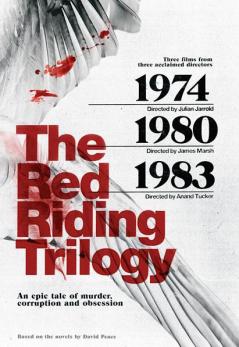
The Red Riding Trilogy

Red Riding Trilogy UKYou’d think Red Riding was a TV miniseries, wouldn’t you? After all, it was on Channel 4 on the same day for three consecutive weeks (recently repeated over three consecutive nights).
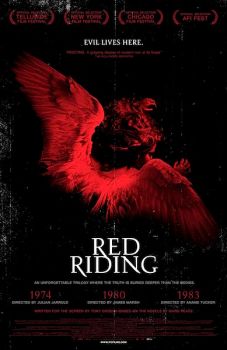
But the promotion — on iTunes, for example, or of Silva Screen’s soundtrack releases — is very keen to make reference not to “Red Riding” — as in, the title of a TV series — but “The Red Riding Trilogy” — as in, a series of films. Indeed, they are frequently referred to as “the films” (and similar variations thereof) in promotion and press, have received screenings at various film festivals and cinema releases in much of the rest of the world, including the US, and several other production and style points could also be rallied to confirm them as a film trilogy rather than miniseries.

As that’s how the makers would most like them to be regarded, then, it seems only fair to treat them as such. And so:


“The feeling one gets is of a British James Ellroy, albeit a low-rent, less complex version. The story idles along, not exactly slow so much as in no hurry, full of near-clichéd plot points and an unrelentingly standard structure. These things aren’t necessarily a problem, but when you’ve got as big and bold a reality claim as the Red Riding Trilogy they feel out of place.” More…

3 out of 5


“Where the first idled this meanders, flitting between the Yorkshire Ripper, the investigation into the Karachi Club shooting, and the private life of lead character Peter Hunter. Most time is spent on Hunter’s investigation into the investigation of the Ripper case, though by the end it becomes apparent this exists to cover the ‘real’ story — which is, of course, the Karachi Club cover up. Consequently neither are covered with the appropriate depth.” More…

3 out of 5


“Tucker’s film bests its predecessors in almost every assessable value. The story and characters have more genuine surprises and suspense than ever, while the performances are at the very least the equal of what’s gone before. Unlike the other two films, where the corrupt cops were little more than cartoon villains despite claims to the contrary, 1983 makes their brutality really felt.” More…

4 out of 5


Red Riding Trilogy USMy final thoughts about Red Riding — other than “that was disappointing” — are stuck on the reality (or not) of the police corruption it portrays. It’s difficult to know whether anyone who believes our police were never so nasty as this is naive, or whether anyone who believes they were quite this bad is paranoid. The truth no doubt lies somewhere in between.
Despite my disappointment with the majority of the Red Riding Trilogy, I intend to return to it some day: considering my enjoyment of the third instalment and the adjusted expectations that come from being disappointed first time round, the potential inherent in the trilogy means it certainly merits revisiting.

The Right Stuff (1983)

2009 #49
Philip Kaufman | 181 mins | TV | 15 / PG

The Right StuffThe Right Stuff ostensibly dramatises the story of the ‘Mercury 7’, America’s first group of astronauts, but in fact equally concerns itself with the tale of test pilot Chuck Yeager. But I’ll get to him.

I’ve recently steeped myself in dramas and documentaries relating to the US space program, from For All Mankind’s contemporary footage to In the Shadow of the Moon’s retrospective interviews, from Moonshot’s earnest docudrama account of Apollo 11 to From the Earth to the Moon’s thorough chronicling of events. But all of these have one thing in common: they cover the Apollo missions alone. Mercury came first, America’s initial attempts to put men into space before Apollo’s grand mission to the Moon.

In this context it’s nice to actually get some coverage of these earlier, vital missions, though such an in-depth knowledge of what was to follow has its problems for The Right Stuff’s narrative, just as knowing the facts always does for a historical movie. Equally, it gives the emotional resonance a helping hand — knowing Gus Grissom’s tragic fate lends the poor treatment he received following his unfortunate splashdown an extra poignancy; or when Alan Shepard asserts he’s going to the Moon you know he’ll make it (eventually).

Exposure to other such works makes quality comparisons inevitable too, though the only one of serious relevance here is From the Earth to the Moon. It’s an unfair one, of course: despite The Right Stuff’s epic running time, it’s nothing to the twelve hours afforded to an HBO miniseries. Conversely, where the miniseries is effectively twelve one-hour plays, shifting focus every episode, director Philip Kaufman’s film does follow a more linear — albeit wide-reaching — progression. While Yeager may disappear for long stretches, for example, his story is revisited and continued; while Gordon Cooper isn’t introduced until after we’ve had plenty of Yeager, the film closes on his first spaceflight. Flitting from character to character could make the film feel fragmented — and the brevity in dealing with many of the supporting characters, especially the wives, does suggest this — but the missions move ever on and take the narrative with them.

The other effect of having seen so much about the space program of late is that the trips to space lose some of their wonder. The handful of spaceflights actually depicted here are often praised, both for their special effects and their pure effect on the viewer, but having seen many others recently does tarnish the sense of wonder somewhat. The effects work is faultless however, as is the integration of footage of the real missions, and the unique qualities of John Glenn’s flight make it stand out regardless of how many other real spaceflights one’s seen recreated on screen.

A handful of these sequences aside, Kaufman leaves the technical aspect of proceedings alone. The various test flights and rocket launches we do see are undoubtedly important set pieces, but they’re not a thorough catalogue of events. Attention is only lavished on the scientific and engineering challenges when it has some direct impact on the characters, and just as often Kaufman is concerned with the family — specifically, the wife — behind the astronaut. These touches of family drama are well played, most affectingly with Glenn and his shy, stuttering wife, but each astronaut’s tale comes and goes, not even one relationship going through an arc that lasts more than two or three scenes. Even when powerfully portrayed, these are portraits not stories.

There are some injections of humour and symbolism too, but again in keeping with the piecemeal style. A pair of NASA recruitment officers, played by Jeff Goldblum and Harry Shearer, provide some comic relief early on for quite a sustained stretch, but then more or less disappear — excepting a recurring motif of Goldblum telling a room of Important Men news they already know. Similarly, the film opens with a fantastic image of Death, a black-clad preacher arriving to inform a wife and child of their husband/father’s fiery death. He crops up again, demonstrating his presence as symbol and not character, but is too often forgotten about. Plaudits are due for not overusing him, naturally, but a few more appearances wouldn’t have gone amiss.

And so what of Yeager? Why so much of a test pilot who was denied the chance to apply to be an astronaut, even if he’d wanted to? It’s hard to disagree with the assessment of screenwriter William Goldman, who left the project over disagreements with the director: it seems Kaufman, for whatever reason, is set in a belief that Yeager had ‘the right stuff’ pumping through his veins, while those chosen to be astronauts were just ordinary guys who got lucky; that Yeager was a pilot proper, brave and skilled, while the Mercury 7 were little more than living computers to perform a handful of tasks atop a huge rocket. If this is Kaufman’s belief it isn’t overbearing, but you can see where Goldman’s coming from. After all, if this is purely the story of the Mercury 7 and their trips into space, why is Yeager there at all, never mind so prominently?

By eschewing a straight trotting out of facts and incidents, even a dramatised one, for a selection of events and experiences, Kaufman made a film that is perhaps less about the real-life story and more thematic — that theme being, primarily, heroism. If he winds up uncertain whether or not the Mercury 7 were heroes, perhaps that’s the point: these were just ordinary men, thrust into an extraordinary situation. Except Yeager, of course, who is never anything less than the flawless embodiment of the titular virtue.

4 out of 5

The Right Stuff is on ITV4 tonight at 10:35pm.