Wallander: Mastermind (2005)

aka Mankell’s Wallander: Mastermind

2009 #88
Peter Flinth | 96 mins* | TV | 15

Sixth in the series of Wallander films starring Krister Henriksson as the titular Swedish detective, though only the second to be released theatrically.

Mastermind works to earn its status as a theatrical release, everyone upping their game to provide something more filmic than the other direct-to-DVD entries in the series. That’s not to say the other films in the series are bad — they’re certainly as well-produced as any other detective series on TV — but this episode seems to have been constructed from the outset with an eye on a standalone cinema release, rather than just randomly plucking an episode from the thirteen produced to receive such an honour.

From the start (literally) there are slicker opening titles, and longer end credits to bookend that. The direction is flashier too — still grounded in reality, unlike the heavily-stylised British Wallander, but with more filmic shot choices and editing. Take, for example, the Rear Window-inspired scene where Wallander looks out over the adjacent block of flats while listening to classical music that completely fills the soundtrack — not the kind of sequence you tend to find in TV drama. On-going subplots from the series go unreferenced — there’s no need to have seen a single other episode to follow the story without a hitch.

The main plot’s on a bigger scale — a serial murderer who has eyes and ears inside the police department — and This Time It’s Personal for good measure, with the villain targeting friends and family and (spoiler) a past connection to several characters. It’s not a realistic-scale case-of-the-week, but a once-in-a-career unusual case, the kind of plot that graces serial killer films (Se7en comes to mind, obviously) in a way those case-of-the-week plots rarely do. It stretches credibility a little, as these types of tale often do, which does at times leave it feeling a tad out of place in Wallander’s grounded world, which is usually about more realistic murders rather than megalomaniac super-powerful serial killers. Still, it ups the ante appropriately, making the events more action-packed and conforming to the theory that films should never have a “just another day at the office”-style plot.

With the extra effort afforded to make this series instalment appropriately cinematic, the Wallander team achieve their aim and produce one of the stand-out of all thirteen films. That said, some viewers of the whole series may find it a bit OTT when compared to the series’ regular style.

4 out of 5

* The running time is listed as 102 minutes on IMDb, but 96 is taken directly from the BBC’s iPlayer.

(Originally posted on 14th February 2010.)

Rage (2009)

2009 #81
Sally Potter | 98 mins | streaming | 15
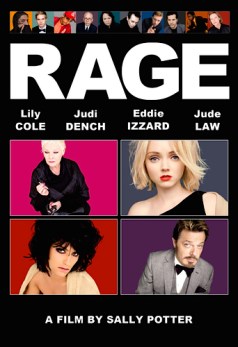
RageI really didn’t expect to like this: a series of straight-to-camera monologues, performed in front of just plain-coloured backgrounds, about the fashion industry, written and directed by the writer/director of Orlando, which I thoroughly disliked. But I watched because it was going free and, despite the concept’s innate pretentiousness, it’s an intriguing one. Once Rage settled into its stride (or, perhaps, I settled into its stride), however, I loved it.

The group of fourteen people who appear before the camera are almost entirely self-centred and/or not very nice, which you may guess from the outset considering their industry, though almost all still have something to reveal as the film progresses. It’s surprisingly funny too. The off-screen action is conveyed by a very effective sound mix — we see nothing but talking heads (until an incongruous final shot, at least), but there’s always background noise, however subtle, and the key action in the wider world is revealed to the viewer through this, plus comments from some of the talking heads. But time isn’t wasted spelling out what we can’t see; instead, a bit of the viewer’s own imagination is required in addition to the sound and dialogue clues to create a version of events.

A starry cast (Steve Buscemi, Lily Cole, Judi Dench, Eddie Izzard, Jude Law, John Leguizamo, David Oyelowo, Dianne Wiest… plus recognisable (depending on what you’ve seen, of course) faces like Simon Abkarian, Bob Balaban and Babel’s Adriana Barraza.) provide exemplary acting across the board, even if some of the accents (mainly Brits playing at yanks) are frequently dubious. It seems unfair to pick anyone out, but Lily Cole is perhaps the most surprising, her fragile character aided by her Pipling-esque eyes and pale skin, but it’s her actual performance that ultimately delivers more than her autobiographical-seeming first appearance would suggest. And one can’t ignore Jude Law playing a Russian/American female(?) fashion model — for once I actually thought he was quite good. Maybe this is his niche. The majority of the performances err toward the theatrical — something certain film viewers seem to struggle with — though the intercutting and passage of time, reflected in intertitles and costume changes, make the whole experience more suited to film; indeed, with the cameraperson being such a major character (as it turns out), it is technically unstageable. (It could be staged, of course, but it belongs as a film.)

And, talking of how things turns out, the most intriguing character of all is Michelangelo, the cameraman and only main character we never see on screen — indeed, it’s a considerable amount of time before we realise he’s a character at all and not just a filmmaking conceit. His presence and the filming style (supposedly shot on a mobile phone (or, I suppose, ‘cell phone’) camera) is not just a gimmick, but, as it turns out, vital to the story. It’s probably the only film ever made that perhaps works better viewed streaming online. All the characters are in some way unveiled throughout the film, but, almost without the viewer releasing it, so too is our supposedly-inconspicuous cameraman. By the end, what seemed to be a critique of the fashion industry — and a well-worn one at that — has something else to say too.

At least, one hopes this ‘critique’ of the fashion industry isn’t the main point, because it may be the film’s biggest problem. There’s very little, if anything, new to be found in the comments and criticisms made — we well know it’s a business filled with too-thin weight-obsessed diva-ish models, self-obsessed pretentious designers, money-grabbing moral-less Murdoch-alikes and no-hope fame-hungry wannabes, and Rage doesn’t have much more to say about it than this. Sure, no one sits around pontificating on why it’s all so evil, but it doesn’t take much to see the subtext. At least it’s often funny about it; though based on comments I’ve read online, it seems this humour may be too subtle for some. Perhaps they can’t see the inherent ludicrousness of it all, with the performances flying closer to realist than the My Family-level bluntness some require from their comedy.

It’s hard going at times, even if one is enjoying it — after all, it’s still just a succession of people talking to camera. Obviously what they say — and, indeed, don’t say — reveals things about themselves, others, and events off screen, but while I was never bored there were several occasions when my eyes strayed to the clock out of curiosity over how long was left. I’ve still seen much duller films.

I don’t doubt that Rage isn’t for everyone. Indeed, you only have to look at IMDb to see how many people loathe it with near-religious fervour. (Prepare yourself if you do, because some of the criticism is irritatingly brain dead. But hey, that’s IMDb!) Some people just won’t get on with its style, or find it too slow, and with 14 characters in 98 minutes, awarding them an average of under seven minutes each, you’re not going to get Alan Bennett-level character deconstruction. But Rage unapologetically is what it is, and I liked it.

5 out of 5

If you’re interested in an in-depth (and spoiler-filled) review of Rage which features phrases like “extraordinary testament to the mindbrain”, “Mugel and Potter use sound to build an entire lifeworld”, and “it enlivens, emboldens and enriches the film, engaging ear, heart, mind, memory, intelligence, even skin and senses as a brilliant texture”, try this one from Little White Lies.

Rage placed 10th on my list of The Ten Best Films I Saw For the First Time in 2009, which can be read in full here.

Hamlet (2009)

aka The Royal Shakespeare Company’s Hamlet

2009 #90
Gregory Doran | 183 mins | TV | 12

Hamlet (2009)It doesn’t seem like 18 months since the RSC brought Hamlet to the stage with British TV’s biggest star actor (probably) as the titular Dane, but it is (more or less). Thanks to sold-out performances and largely positive reviews (theatre critics seem even less keen to agree on anything than film ones), we’re now treated to this film adaptation, shown on BBC Two on Boxing Day and released on DVD (but not Blu-ray, boo*) earlier this week.
Hamlet hangs primarily on its central performance — so we’re constantly told, anyway; this being only the second production I’ve seen I can’t confidently assert so for myself, but I can certainly see where the consensus comes from. Equally, I can’t accurately compare David Tennant’s performance to any other, which often seems to be a central consideration in any review of the play. In near-isolation, however, it’s a thoroughly convincing performance. He glides seamlessly from withdrawn and grief-stricken in his first appearance, to intrigued and excited by the ghost of his father, to clever and wily as he plots, and finally to an alternation between assumed madness and serious introspection as he enacts his plans.

Any number of scenes show off Tennant’s abilities, particularly the way he treats other characters. He resolutely takes the piss out of both Polonius and Rosencrantz & Guildenstern, but plays each in subtly different ways: the former is like someone intelligent teasing with someone who doesn’t get it, which sounds distasteful but is enjoyable because of Polonius’ plotting and influence; while the latter is like a cat toying with a pair of treacherous mice, who are aware they’ve been caught out but struggle on regardless. Hamlet’s pair of ‘friends’ can be seen as insignificant characters by some — it’s part of what led Tom Stoppard to pen Rosencrantz and Guildenstern Are Dead, after all — but with a few silent additions around Shakespeare’s dialogue and the way Tennant, Sam Alexander and Tom Davey choose to play the original lines, their roles seem to have increased importance.

The other notable facet of Tennant’s interpretation of the character is humour. Hamlet’s madness here is almost unrelentingly funny — even in deadly serious situations, like capture following a murder, Tennant’s Hamlet can’t resist taunting the other characters, keeping the viewer onside by keeping his apparent insanity entertaining rather than scary or darkly intense. If anything, however, this screen version fails to capture just how funny Tennant was on stage. Perhaps it’s the loss of a bigger audience, or the energy of performing on stage, or perhaps Tennant has reined in, switching from Stage Acting to Screen Acting. He’s still funny, certainly, but its not as striking as it was live. In fact, more laughs are earnt by Oliver Ford Davies as Polonius. As his lines dither on like many a real forgetful old man, it’s difficult to imagine the part played any other way.

The other stand-out is an award-winning Patrick Stewart in the dual role of Claudius and the Ghost, though the fact he plays both feels relatively insignificant. His cool politician of a King makes a perfect contrast to the crazed energy of the Prince, the latter constantly bounding around while the former remains still and collected. In my view it’s a shame Stewart has a beard in the filmed version (a necessity forced by his concurrent appearance in Waiting for Godot, I believe) — on stage he was clean-shaven and therefore somehow more reminiscent of numerous other political villains, both real and fictional, whereas his bearded visage is more reminiscent of a traditional Kingly role. Still, it’s a minor aesthetic point that doesn’t hamper his wonderful performance.

Director of the original stage production, Greg Doran, also helms this version. It’s a convincing adaptation too, making good use of sets, locations and, vitally, camerawork, rather than employing static shots of the original theatrical blocking. A quick shoot (18 days for an over-three-hours film) and single location combine to reduce the number of on-screen locations, unfortunately, though the main set is fairly well rearranged to stand in for a number of rooms. It does branch out occasionally, but it’s a shame this couldn’t have been done more often, as consecutive scenes on the same slightly-redressed main set occasionally confuse whether we’ve changed location or not.

Doran’s main screen gimmick, however, is security cameras. Every so often our viewpoint switches to a grainy black & white high angle as we survey the scene via CCTV. It’s a neat idea to convey the concept of Elsinore as a place where everyone is under constant scrutiny, and it’s occasionally used very well indeed — during the Ghost’s appearance to Hamlet, for example, or when he rips a camera down to declare “now I am alone”. Unfortunately, it’s not as consistently thought-out as one might like. When Claudius and Polonius spy on Hamlet and Ophelia, for example, they do so from behind a two-way mirror (as in Branagh’s film, incidentally) rather than, say, from a control room with a bank of security monitors, an idea which seems to naturally flow from the presence of CCTV. Following this, when Polonius talks to Hamlet he delivers several asides to camera — not the security camera, mind, just to the audience. It would have been more effective to have him offer them to a security camera, knowing Claudius to be viewing in another room. It’s moments like these that turn the omnipresent video surveillance from a clever idea to little more than a gimmick. And by the time it’s cut to during the climactic sword fight, you just want it to go away.

It’s almost certain that this production will be remembered as “The Doctor Who Hamlet” thanks to its leading man. Whether that’s unfair or not is another debate, though it shouldn’t mean this version goes ignored. Tennant’s excellent performance reminds us that he was an accomplished performer with the RSC long before he gained televisual fame, and a strong supporting cast ensure this can’t just be dismissed as a popularity-seeking vanity venture by the RSC. Indeed, if there’s one good thing about the “Doctor Who Hamlet” label, it’s that the potential viewership is increased massively, bringing some to Shakespeare who never would have bothered otherwise. Surely no true theatre aficionado could argue with that.

4 out of 5

* A Blu-ray was eventually released in April 2010. ^

Hard Candy (2005)

2009 #72
David Slade | 100 mins | TV | 18 / R

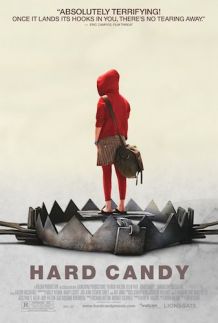
Hard CandyHard Candy’s director David Slade has followed this up with vampire horror with 30 Days of Night and will shortly unleash an altogether different kind of horror by joining the ranks of evil that are bringing us The Twilight ‘Saga’. His feature debut may be a two-hander between a teenage girl and middle-aged man, but in its own way it’s just as much a horror movie.

Actually, that’s mainly a review-opening conceit: one tense torture-ish sequence aside, Hard Candy is a consistently surprising thriller about real-world horrific things rather than depicting them itself. To reveal too much of the plot would spoil it, though I imagine most viewers will already be aware of the first big turn: the real intentions of Ellen Page’s 14-year-old protagonist. It follows this wannabe-surprise (“wannabe” because it occurs too early to escape description in most plot overviews) with a series of equally playful reversals. The viewer’s never quite sure of any fact about either of the two characters; never quite sure if they’re being genuine or at any moment will undermine their present emotion with the revelation it’s just an act, an attempt to fool the other. Arguably it’s played this card too often come the end, and perhaps it could have stood being a more efficient 80 minutes rather than pushing on to 100.

The other assertion in my introduction is also disingenuous, because there are more than two characters. It’s basically a two-hander though, reliant for great stretches on two people in a room conversing and attempting to outwit each other. It’s more exciting than that might sound — the action is far from limited to chatter. Such a production rests entirely on the skills of its two leads, and fortunately both provide excellent performances. Watchmen’s Patrick Wilson is perfectly cast to alternate charming and sleazy, though Ellen Page — pre Oscar nomination for Juno — is the stand-out. Actually 18 at the time, she’s more than convincing as an older-than-her-years 14-year-old, selling the character’s confidence but also revealing an occasional vulnerability and uncertainness that just about keep proceedings the right side of believable. Still, plausibility isn’t exactly the film’s strongest point. There’s enough that one follows it, with the more implausible sections wisely saved for later on, by which time we’re drawn in and accept that Page’s character is clever, cunning and above all prepared.

Other characters do intrude however, and it’s almost a shame when they turn up: it breaks the perfect technical accomplishment of a locationally-limited two-hander for little more than another few minutes of screen time. That said, it’s the arrival of the constantly-referenced former love that finally provokes the ending, a worthwhile climax to a film so caught up in its to-and-fros that anything less than the influence an external factor providing a conclusion would’ve been a disappointment. The neighbour character, on the other hand, feels a little too inevitable; an obvious attempt to ratchet up the tension that arrives too late. It seems Slade thinks it’s as compulsory as the audience might, and dispatches with it quickly… just not quickly enough.

Story aside, Slade’s direction makes for an interestingly shot film. There are many close-ups, in which characters and action are often calm, but then there are occasional explosions of flashy camerawork, usually during acts of violence or other sudden bursts of plot-driving action. The grading is similarly fiddled with during these sections, emphasising the primary-coloured walls of the house that make for an interesting backdrop. Indeed, the walls are used to particularly good — if, arguably, obvious — effect throughout, such as slowly panning across a red wall so that it fills the screen during the lengthy castration sequence.

Hard Candy is sort of a morality play, though it’s hardly a moral that requires increased awareness. Primarily it’s a revenge thriller though, and with limited settings and characters it makes for an admirably intense — if occasionally credibility-stretching — and pleasantly unusual entry in the genre.

4 out of 5

(Originally posted on 7th February 2010.)

Children of Heaven (1997)

aka Bacheha-Ye aseman

2009 #83
Majid Majidi | 82 mins* | TV | PG

Children of HeavenChildren of Heaven is an Iranian film, which means it’s in a Foreign Language and it’s Subtitled. And yet, it was on ITV. Sometimes the mind boggles. Still, it was relegated to a post-midnight showing, so some things never change. Indeed, the one thing that inspired me to watch it is that it’s referred to by Roger Ebert in his wonderfully evangelical (about film, not Christianity (thank God!)) article to commemorate reaching 100 entries in his Great Movies series. I recommend it, incidentally; Children of Heaven comes up for good reason about halfway through.

The film itself is a charming little number, with a simple story about a brother and sister that nonetheless runs itself on inventive incident — the amount of (pleasingly light-hearted) drama it can ring from one missing pair of shoes is, in many ways, quite extraordinary. It also contains moments of simple beauty and pleasure, like blowing bubbles while cleaning or sunlight glittering on the goldfish pool. This is more what I had in mind when someone described Slumdog Millionaire as “feel-good”.

Speaking of which, Children of Heaven adds depth with an amiable commentary on poverty: this poor family live in close proximity to such rich ones, but they can all get along. When Zahra sees another girl wearing her shoes, she doesn’t confront her or demand them back, even when the other girl’s dad buys her a brand new pair and the all-important pair are thrown away again. Halfway through, Ali and their father go up to town and we see how the other half live — enough glass-fronted skyscrapers, dozen-laned roads, tree-lined avenues and blindingly-white mansions to rival any metropolis. And yet they don’t get angry at their lot, and the film doesn’t shove the obvious comparison down your throat. It doesn’t go for the simplistic and oft-tried “poor have little, but have each other so are ultimately happy; rich have lots, but are lonely and so ultimately sad” conclusion (though it does, briefly, err along that path), and nor does it end with the family getting rich and managing to move up in the world.

In fact, the finale deals solely with the issue of the shoes (pun not intended). It’s a long-distance running competition in which Ali must come third in order to win a new pair of sneakers. It’s nail-biting and a beautifully conceived idea — he doesn’t need to win, he needs to come third. If only mainstream films were so simply innovative more often.

Unfortunately, several plot threads feel underdeveloped or unresolved, ultimately coming across as a pleasant but unnecessary aside — the elderly neighbours, for example, who Ali delivers soup to in one scene, or the persistent landlord. The viewer can read more into these if they wish — the neighbours representing the generosity of those with nothing, for example, while we can assume the landlord is eventually paid off now Ali’s father apparently has better employment — but the film itself does nothing with them. There’s a difference between not spelling things out and just abandoning them, and perhaps Children of Heaven falls on the wrong side of this divide. It’s most galling at the very end (after the race), when the film seems to just stop abruptly. IMDb notes that originally there was an epilogue explaining Ali’s future which is for some reason absent from the American-released version, and the presence of something like that is indeed missed. However, the interweb can also provide theories on how the foreshortened ending does have significance, with the goldfish being symbolic, if one chooses to look for them.

But no matter — it seems churlish to complain about such diversions. Children of Heaven is a beautifully simple and good-hearted film and, apparently, a great way to introduce children to the notion of having to read while watching a film.

4 out of 5

* This is timed from ITV’s broadcast. The listed running time is 89 minutes; with PAL speed-up this would be c.85; hopefully the remaining three are accounted for by snipping the closing credits.

(Originally posted on 6th February 2010.)

Seance on a Wet Afternoon (1964)

2009 #64
Bryan Forbes | 111 mins | TV | PG

Seance on a Wet AfternoonDespite being an early-60s British domestic drama, Seance on a Wet Afternoon has a plot that one might describe as high-concept: a medium kidnaps a little girl so she can prove her abilities by revealing where the girl is. But, unsurprisingly, the execution is more in line with its roots: more drama than overblown thriller, not so much about the kidnap plot as the psychological state of Kim Stanley’s medium, Myra Savage, and her downtrodden husband, played by Richard Attenborough.

It certainly doesn’t start high-concept either, beginning with a near-15-minute dialogue-driven enigmatically expository two-hander. Some would consider the whole film too slow, I’m sure, but once it gets past this (to be frank, over-long) opening it maintains an appropriate pace. It never threatens to become a thrill-a-minute rollercoaster ride, but what it does do is build tension and gradually unveil the true natures of the two leads. In this regard it becomes something of a showcase for Stanley and Attenborough.

In a word, Stanley’s performance is stunning. Initially just a Hyacinth Bucket-esque overbearing wife, as the film continues we learn more about her almost solely from what Stanley brings to the role. By the final scene, when the truth of her character is laid bare, there’s little doubt that she’s given an extraordinary performance. She was Oscar-nominated for her role, losing out to Julie Andrews in Mary Poppins. I love Mary Poppins as much as the next well-adjusted human being, but Andrews’ relatively simple role isn’t a patch on the complexity Stanley has to offer.

In the face of this stiff acting competition, Attenborough holds his own throughout. His transformation is more understated perhaps — the ‘revelation’ here being that he is not downtrodden but in fact incredibly supportive, something that will only dawn on the viewer late on but shed a subtly different light on what has gone before — plus there is a degree of skill in portraying a character doing reprehensible things but who remains the audience’s surrogate ’til the last.

Bryan Forbes’ direction is also first-rate. He keeps things clear and simple during dialogue scenes, but adds scale with location work in busy London streets, and flair during a few tense sequences. The best of these is the second seance, where the kidnapped girl sleeps in a room next door. As she begins to stir, the viewer is torn between wanting the Savage’s plan to succeed and wanting the girl to be rescued from their misguided scheme. Such a dichotomy of feeling is entirely reliant on the skill displayed by Stanley, Attenborough and Forbes up to that point, building our allegiance to these characters in spite of what they’ve done.

Unfortunately, the film isn’t without its flaws. The story doesn’t always hold up — some of the police procedure is dubious at best, while the Savages’ scheme comes off as much through chance and luck as planning. In fairness, our ability to spot the former is probably in part thanks to decades of police procedurals filling the TV schedules, while the latter actually fits the under-confident, ill-prepared, dubiously-sane protagonists, and coincidence is mostly confined to the plot’s early stages. Some elements of the plan make you wonder how they ever thought they’d get away with it, though at the same time you have to allow that maybe they just weren’t that self-aware.

The real key to the film, however, is what’s slowly revealed over its course: Myra Savage’s mentality, as well as the truth about the history of her abilities and marital situation. To reveal any details would ruin the carefully controlled slow explanation of who these people are and what background they come from, all of which builds to a beautifully performed final few scenes. Seance on a Wet Afternoon may have a high concept driving its plot, but the true delights are to be found in its characters and the actors’ performances of them.

4 out of 5

Shadow of the Vampire (2000)

2009 #56
E. Elias Merhige | 81 mins | TV | 15 / R

Shadow of the Vampire“What if Max Schreck really was a vampire?” is the simple, thoroughly daft, and equally promising, premise of this low-budget horror/drama/comedy.

Having the advantage of such a good concept to kick things off, all starts well, but the longer it runs the more it loses it. Screenwriter Steven A. Katz seems unsure of what Shreck/Orlok actually wants or what the rules governing his existence are, leaving him little more than a threat for the sake of a threat. Still, Willem Dafoe’s performance in the role is brilliant, reveling in the chance to overact — and yet, somehow, subtly overact — as a silent movie vampire. The rest of the cast are fine; in particular, the obsessive and mildly unhinged Murnau seems to suit Malkovich down to the ground. It’s also scary in places, as it should be, because it’s a vampire horror movie that just happens to take the making of another real one as its starting point. Unfortunately, as the plot becomes confusing and ill explained towards the end, so the scares dissipate alongside the viewer’s understanding.

My confusion over the film’s third act may have an external explanation, however. The BBFC list the PAL running time as 88 minutes, but BBC Four’s showing only just hit 81. It certainly felt like there was a chunk missing somewhere in the middle — a slew of characters just disappear and there’s an unexplained leap in the plot — but I can’t think of a reasonable explanation for why or how the BBC would cut seven minutes out of the middle of a film, and the only detailed plot descriptions I can find don’t describe anything I missed.

Nonetheless, even allowing for omissions Katz gives up on any semblance of following the facts toward the end (and throughout, apparently): almost everyone involved is slaughtered, even when they clearly survived in reality, while one character is driven out of his mind, even when he clearly wasn’t… well, presumably. That said, we all know Schreck wasn’t a vampire — his life isn’t nearly mysterious enough to allow for the possibility, should you even believe in such a possibility being possible — so with that leap already taken, why not take as many others as you fancy? Perhaps because it’s not as clever, and not nearly as much fun, as fitting the preposterous tale around the known facts.

Merhige’s direction is occasionally very interesting, such as a couple of grand shots early on, but at other times is perfunctory. To be kind, one might say he goes too far in the aim of replicating silent film style — certainly the intertitles that needlessly replace chunks of the plot are a step beyond. He does manage to create and maintain a weird, unsettling atmosphere, which remains even when all sense disappears.

It’s difficult to accurately assess a film when it appears a good chunk has been lost somewhere in the middle, especially when one suspects some of its major flaws — namely, a lack of coherence at the end — may be due to this omission. On the other hand, I can’t find any evidence that something has been cut, so maybe it just doesn’t make sense? Either way, even on the evidence of what I’ve seen it feels like Shadow of the Vampire takes a good idea, runs well for a while, but winds up uncertain of what to do with it. Though it remains interesting, I won’t be rushing to see any fuller form.

3 out of 5

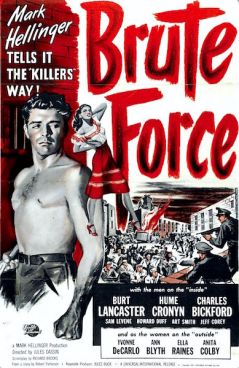
Brute Force (1947)

2009 #73
Jules Dassin | 94 mins | TV | 12

Brute ForceJules Dassin’s prison-set noir concerns a group of inmates trying to escape from the cruel regime of a vicious warden, allowed free reign by an ineffectual governor and target-driven bureaucrats (nothing changes, eh?)
Tonally, it’s varied. Early on it’s quite humourous, with a weak warden, jaunty calypso-singing inmate (who occasionally threatens to tip the whole thing over into a musical) and amusingly drunk doctor. Then there are the flashbacks to the outside world, laden with undercooked romance and awkward dialogue. In the final act it turns decidedly grim: warden Munsey lives up to his lowly reputation, goading one prisoner to suicide and beating another close to death, while the other wardens listen on from outside; one of the good guys betrays his mates, ultimately leading to wholesale slaughter as the escape plan goes awry. A balanced, varied tone is not necessarily a problem, but the flashbacks are almost uniformly unwelcome asides and, by separating the distinctly comical from the resolutely grim by placing them firmly at either end of the film, they don’t quite gel as a whole.

Still, the climactic prison break — including the build-up — is a brilliant extended sequence. Tense, epic and exciting, it concludes with a fantastic action sequence. It also delivers a powerful moral message, underlined by its direct delivery from a prison staff member rather than an inmate. It goes some way to make up for the earlier flaws, like the dialogue that’s occasionally typical of the period’s worst — “I’m just a guy who… explained his entire backstory in one slightly long and unwieldy sentence to someone who already knew it”.

What gets forgotten in all this, perhaps most depressingly, is the fate of those on the outside. We’re told early on that Collins’ love is refusing treatment for her cancer until she sees him again. This seems ready-made to provide justification for a prisoner to escape; indeed, the whole film is skewed this way, as we never discover many of the inmates’ crimes, and those we do hear are either done for good reason or not that bad. But it toes the more obvious moral line by having no one escape, and while the cancer isn’t mentioned again after the slaughter, it leaves what might otherwise seem a morally justifiable cheat (the prisoners are the good guys here — we expect and want them to triumph — but that they don’t is ‘correct’) with a bitter taste.

3 out of 5

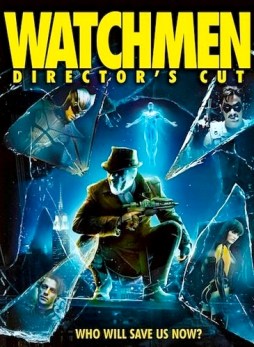
Watchmen: Director’s Cut (2009)

2009 #79
Zack Snyder | 186 mins | Blu-ray | 18 / R

This review contains spoilers.

Hitting US Blu-ray so long ago that it’s shameful I haven’t watched it ’til now, and finally arriving in the UK next Monday, the Director’s Cut is Zack Snyder’s final vision of Watchmen: The Movie. The Ultimate Cut (currently available in the US but with no confirmed UK release), which integrates the animated Tales of the Black Freighter into the main feature, is, in Snyder’s words, “an experiment”. Maybe one day he’ll change his mind and say that’s actually his definitive version; I suppose these days — when it seems every major film has a proliferation of different cuts across theatrical release, home entertainment release, and home entertainment re-release — such a thing as a “definitive version” doesn’t necessarily exist. But that’s a debate for another day: for now, this — not The Ultimate Cut, and certainly not the theatrical cut — is Snyder’s Watchmen.
That said, I wouldn’t be inclined to say it’s vastly different to the previously seen version. There are some obvious new scenes and extensions, especially if you’re familiar with the original novel, but ultimately I didn’t find the additional 24 minutes created a vastly different experience. Most of the flaws still remain, from the unfixable — Malin Akerman is somewhat miscast; sometimes episodic storytelling (a largely unavoidable side effect of faithfully adapting a novel that is very much a story in 12 parts, as opposed to a story divided into 12 chunks) — to those that Snyder could potentially have rectified — the alley fight/Manhattan interview crosscutting still doesn’t quite work; Bubastis is inadequately explained; too little time is devoted to the large cast of secondary characters in New York to give Adrian’s plan the same emotional kick it has in the novel; and so on.

By the same token, none of the great bits are ruined, while some are enhanced. Although mostly faithful to the novel, the changes Snyder and co have made are almost all for the better: Rorschach’s “what do you see?” beats the fan-favourite landlady scene (goodness knows why it’s a fan favourite), and Matthew Goode’s slightly built, faintly Germanic Veidt seems a more natural fit for the character now than Gibbons’ more butch version (possibly only in my opinion, that one). Best of all is the modified climax, which retains all the significance of the original but, by changing the way in which it’s brought about, streamlines and tidies up the storytelling. The giant squid is a great comic book image, but this is superior plotting, especially in the abridged form a film adaptation must take.

As for the new bits themselves, some are slightly misguided — Rorschach’s escape from Blake’s apartment, for example, is wholly unnecessary; it shows him injuring a policeman, an incident now referred to over the next few scenes, but we don’t need to see it to follow the references, and showing it gets in the way of the previously perfect match-cut from the Minutemen photo in Blake’s apartment to the same one in Hollis Mason’s. By and large, however, the extensions add depth via little lines and moments. The most noticeable are a better building of Laurie’s backstory, and Hollis Mason’s death. The latter is a little ancillary to the main plot, its excision from the theatrical version easily justified to keep the running time down, but in itself is a well-played and tragic scene that adds further resonance to the end of Dan’s story.

Whatever you thought of Watchmen after the theatrical cut, this extended version is likely to change your opinion no more than any other re-viewing would. That said, with a little extra room to breathe and a few worthwhile extensions, and in spite of the odd tweak that doesn’t work, this is the superior cut of the film.

5 out of 5

Most of the comments in my lengthy review of the theatrical cut still stand, so I invite you to read it here.

Watchmen: Director’s Cut placed 3rd on my list of The Ten Best Films I Saw For the First Time in 2009, which can be read in full here.

Ripley’s Game (2002)

2009 #67
Liliana Cavani | 106 mins | TV | 15 / R

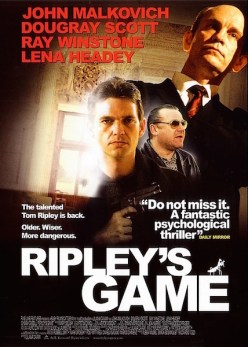
Ripley's GameMatt Damon is back as… Oh, wait, no he isn’t — he’s turned into John Malkovich.

Not quite — there’s no reasonable way Ripley’s Game can be considered a sequel to Anthony Minghella’s The Talented Mr Ripley. Though it’s adapted from a later novel in Patricia Highsmith’s Ripley series (previously filmed as the Dennis Hopper-starring The American Friend, incidentally), the action is relocated to the present day, and it’d be a pretty hard sell to believe Matt Damon would grow up to be John Malkovich.

Despite the acclaim of Minghella’s effort just three years earlier, and a cast that includes recognisable faces such as a Ray Winstone, Dougray Scott and Lena Headey alongside Malkovich, Ripley’s Game snuck out with barely anyone noticing, including going straight to TV in the US. There are surely reasons for this, reports of a problematic shoot probably among them, but the neglect is undeserved. In 2006, Roger Ebert saw fit to include it in his Great Movies list, though other critics are less favourable (the Radio Times, for one handy example, rate it just three out of five). While Ebert is in my opinion overselling the film by including it in a list of the best films ever made ever, it’s certainly an above average, consummately made, and constantly entertaining Euro-thriller.

Perhaps the difference in opinion about the film stems from one, arguably crucial, sticking point: the Radio Times criticises the humour included in the murders and thriller sections, viewing it as a failure of director Liliana Cavani; conversely, Ebert approves of it, praising them as appearing somewhere “between a massacre and the Marx Brothers”. There’s undoubtedly more to the diverging opinions than this, but it’s at least emblematic. I’m inclined to agree with Ebert: these sequences do have tension — not the most one’s ever experienced in a thriller, but enough — but they marry the humour to it, leaving you chuckling on the edge of your seat.

For the most part the story keeps moving, twisting and turning in sometimes unexpected directions. Other films would happily take the first half-hour or so of this and stretch it to a whole feature, but screenwriters Charles McKeown and Cavani — adapting from Highsmith’s novel, of course, so the credit lies with her — take the premise further and in new directions. It’s not flawless, with the climax by far the biggest let down: Ripley and Trevanny hole up in the former’s villa, preparing for a veritable war as Ripley anticipates goodness-knows how many men to turn up. When it’s only two, it seems more believable than a whole army of mafia goons descending on the relatively insignificant pair, but it’s also distinctly anticlimactic after the hype. Still, at least the story has a final twist up its sleeve.

Malkovich may be a fairly respected actor, but to me he’s always seemed detached, flat, or mannered — often all three. Here, he’s still all three, but it suits Ripley’s unusual character down to the ground. His dry wit and incessant matter-of-fact delivery craft a quietly sinister, stalking nature, aiding the character’s believable unpredictability — that is to say, you’re never certain what he’s going to do next, but when he does it’s not surprising. I’ve never read a Ripley novel (there are five) nor seen another Ripley film (there are four), but Malkovich’s performance fits so perfectly I have little doubt this is precisely how Ripley should be played.

Among the rest of the cast, Ray Winstone is landed with a role he could play in his sleep, Lena Headey is perfectly fine as an unremarkable wife, and Scot Dougray Scott plays a none-more-plummy Brit. Unfortunately this accent sometimes seems to be the main focus of his performance, and it occasionally falters when he gets highly emotional, but it’s not really a problem… though it is rather odd to hear if you’re familiar with how he normally sounds. His character, Trevanny, is primarily a pawn in Ripley’s titular amusement, leaving Scott with only a passing hint of the character arc with which the role could have been gifted.

As noted earlier, there are numerous tales of problems on set, not least the multinational cast coping with a multinational crew in multiple nations, culminating in Cavani leaving towards the end of shooting and directorial duties being fulfilled by Malkovich. But as many have noted before, happy sets can produce dreadful movies and unhappy sets masterpieces, and while I don’t quite share the view that Ripley’s Game is entirely the latter, it certainly errs more in that direction than the other.

4 out of 5