
 Ridley Scott’s Crusades epic is probably best known as one of the foremost examples of the power of director’s cuts: after Scott was forced to make massive edits by a studio wanting a shorter runtime, the film’s summer theatrical release was so critically panned that an extended Director’s Cut appeared in LA cinemas before the end of the year, reaching the wider world with its DVD release the following May. The extended version adds 45 minutes to the film (and a further 4½ in music in the Roadshow Version), enough to completely rehabilitate its critical standing.
The story begins in France, 1184, where blacksmith Balian (Orlando Bloom) is something of a social pariah. Offered the chance to head off to fight in the Crusades, Balian… refuses. But then something spoilersome happens and he thinks it might be a good idea after all. When he eventually arrives in Jerusalem, he finds a kingdom divided by political squabbling, quite apart from the uneasy truce with the enemy. You know that’s not going to end well.
Kingdom of Heaven is, in many respects, an old-fashioned epic. It’s a long film not because the director is prone to excess and didn’t know when to cut back, but because it has a lengthy and complicated story to tell. It isn’t adapted from a novel, but the structure feels that way, spending a lot of time on characters and what some might interpret as preamble — it’s a long while before the movie reaches Jerusalem, ostensibly the film’s focus, and it completes the arcs of several major characters along the way. The scale of such stories isn’t to everyone’s taste, but, well, what can you do.
 A strong cast bolsters the human drama that sometimes gets lost in such grand stories. Bloom is a perfectly adequate if unexceptional lead, but around him we have the likes of Michael Sheen, David Thewlis, Alexander Siddig, Brendan Gleeson, and Edward Norton (well done if you can spot him…) There are even more names if you look to supporting roles. Most notable, however, are the co-leads: both Liam Neeson, as the knight who recruits Balian, and Jeremy Irons, as the wise advisor when he gets to Jerusalem, bring class to proceedings, while Eva Green provides mystery and heart as the love interest. Of everyone, she’s best served by the Director’s Cut, gaining a whole, vital subplot about her child that was entirely excised theatrically. It’s the kind of thing you can’t imagine not being there, and Scott agreed: it seems the chance to restore it was one of his main motivators for putting together a release of the longer version.
It is very much a Ridley Scott film, too. The way it’s shot, edited, styled… you could mix bits of this up with Gladiator or Robin Hood and you might not realise you’d switched movie. As a student of film it frustrates me that I can’t put my finger on exactly what qualities define this “Scott style” — and it’s a specific one to his historical epics, too, because it’s less present (or possibly just in a different way) in his modern-day and sci-fi movies — but I’m certain it’s there. I guess it’s the way he frames shots, the mise-en-scène, the editing, the richness of the photography… The quality of the end result may vary across those three movies, but Scott’s technical skill is never in doubt.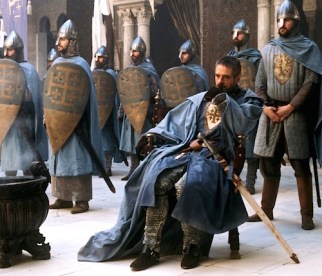 (I’d wager Exodus is the same, but its poor reception hasn’t exactly left me gagging to see it.)
Similarly, I can’t quite identify what’s missing from Kingdom of Heaven that holds me back from giving it full marks. It’s a je ne sais quoi edge that I just didn’t feel. I do think it’s a very, very good film, though; one that would perhaps well reward further viewings.

A version of Kingdom of Heaven is on Film4 tonight at 9pm. Their listings suggest it’s the theatrical cut, though if that’s true then they’ve put in an hour-and-a-half of adverts…
* For what it’s worth, I actually watched what’s now called the “Director’s Cut Roadshow Version”. This was released as the Director’s Cut on DVD, but in the early days of Blu-ray it couldn’t all fit on one disc, so they lopped off the overture, intermission, and entr’acte and still labelled it the Director’s Cut. As of the 2014 US Ultimate Edition, however, those missing bits have been optionally restored, with the set containing ‘three’ versions of the movie. ^
 Will Smith is the eponymous drunken vagrant, who also has the powers of Superman, in this under-appreciated superhero comedy-drama. Hated by the public for the destruction he causes while ‘helping’, and wanted by the authorities for the same — though they can’t catch him because, you know, superpowers — he gets an image makeover when he saves wannabe entrepreneur Jason Bateman. Bateman’s wife, Charlize Theron, is less sure of Hancock’s merits.
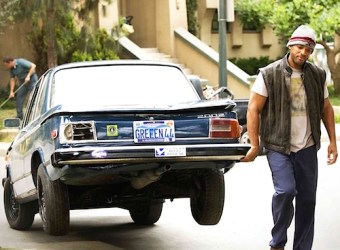 but it rubs against comedy stuff that feels like it’s from a Comedy. The extended cut includes an early sex/ejaculation joke/sequence that wasn’t in the theatrical cut because Berg thought it wasn’t funny and test audiences agreed. Goodness knows why it got put back, other than because of length — it accounts for over half of the extensions (more details
  Why indeed, because a) she’s not a supervillain, and b) even if she were, why get changed?! It’s a kind of bait-and-switch: she’s made to look like a villain because we think that’s what she’s about to be revealed as, and a big hero-vs-villain fight follows too… but she isn’t. It’s not quite up there with the magically-changing Batsuits of
  The film would work a lot better on the whole if the tone had been settled on as definitively as Smith’s performance, rather than trying to have its cake and eat it by mining both the “what if this were real?” and “haha, an unlikeable drunk superhero!” versions concurrently. For my money, however, if you treat Hancock as a fairly seriously-intended movie that was forced to contain more (half-arsed) action and (misjudged) comedy for the sake of box office, it’s not a bad experience at all.
 After winning the Best Adapted Screenplay Oscar for
 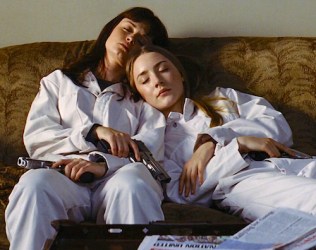 Here, Fletcher either needs to settle on one or the other, or clearly signal his intentions earlier.
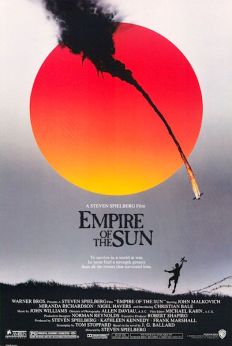 Steven Spielberg’s adaptation of J.G. Ballard’s semi-autobiographical novel stars a 13-year-old Christian Bale as Jim, the son of British ex-pats in China when the Japanese invade during World War II. Separated from his family as they try to flee, Jim encounters born survivor Basie (John Malkovich) and, when they wind up in an internment camp for the rest of the war, a cross-section of the rest of the left-behind. To Jim, a somewhat naïve but capable, confident and determined endurer, the whole thing is a big adventure; we can see the truth, though: that it’s a grim slog of life and death, and most succumb to the latter. The reality of the situation gets to Jim in the end, too… but maybe I’m getting ahead of myself.
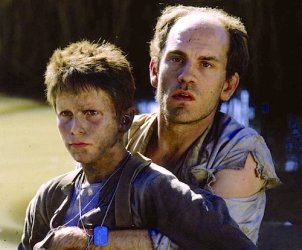 As it stands, the film is a fascinating insight into a less-often-covered aspect of the war. Even in small roles, the quality cast keep it watchable and relatable. Bale’s performance comes in just the right side of annoying — quite an achievement for a character who seems inherently brattish and prone to irritate.
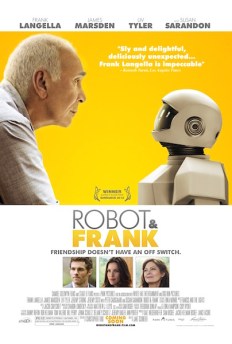 In “the near future”, Frank (Frank Langella) is an ageing jewel thief in denial about his dementia, contenting himself with visits to the local library, which is being taken over by a bunch of yuppies to turn into “the library experience”, and shoplifting from the beauty store that used to be his favourite restaurant. Concerned for his wellbeing, his son (James Marsden) gets him some home help in the form of a humanoid robot (voiced by Peter Sarsgaard). Initially reluctant to accept its presence, when the robot attempts to help by also shoplifting from the beauty store, Frank senses an opportunity…
 (part of a half-realised almost-subplot about robot rights, or something), we not only feel Frank’s (temporary) loss of his friend, but also urge the film to turn the robot back on and get back to what’s really making the movie work. The event serves a purpose (it’s the point Frank realises he’s stopped just putting up with the damn robot and actually come to appreciate its presence), but still.
 Equally, this is of a branch of science-fiction we see all too rarely on the big screen, but which is fertile ground for those wishing to explore it: using fantastical concepts to explore and enlighten our own world. Even if you learn nothing revelatory about old age and the rigours of dementia, the friendship between the robot and Frank is reason enough to enjoy.
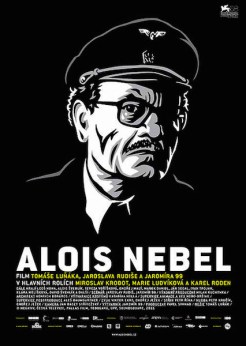 A Czech noir animation, set around Christmas 1989 to the backdrop of the country’s Velvet Revolution. Eponymous character Alois Nebel is a train station guard whose flashbacks to an event at the end of World War 2 see him sectioned, though possibly for other nefarious purposes. Having lost his job, he travels to head office in Prague to try to reclaim it, where he meets a ragtag gang of social misfits. Finally returning home, the mystery of what happened 44 years earlier may be resolved…
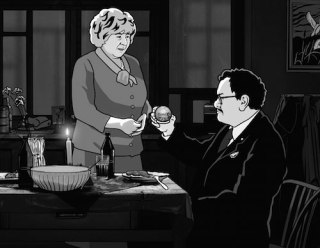 Perhaps the whole film is Deeply Thematic, then? It may be to do with the country moving on and making peace with its past, seen in a microcosm in the actions of Nebel (moving past the flashbacks, having new experiences, finding love, etc) and the people around him (finally getting revenge for something that happened nearly half a century ago). Maybe that’s all more clear if you know the Czech mindset, or the history of the Velvet Revolution. The second post in
 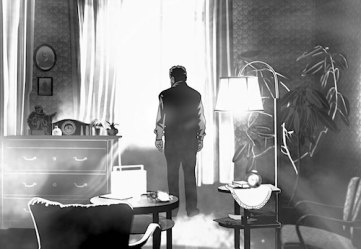 With some attractive black-and-white animation and a sporadically engaging mystery plot, Alois Nebel is far from meritless. However, its firm grounding in a wide spread of Czech history and attitudes suggests it may be best suited to those already well-versed in that country’s history and culture.
 Steven Spielberg’s second feature (or “first” if you’re American) is based, loosely, on a true story. The fictionalised version sees Lou Jean (Goldie Hawn) breaking her husband (William Atherton) out of prison so they can travel cross state to liberate their baby from foster care. Everything goes smoothly until they accidentally kidnap a police officer (Michael Sacks), hundreds of police cars begin to follow them, and a multi-day slow-paced chase ensues.
 when filmmakers became contractually obliged to keep their compositions “TV safe”). The camerawork is frequently extraordinary, including at least one unbroken shot where the camera moves around inside and outside the car, like something out of
 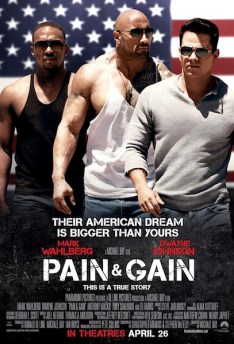 For his first non-sci-fi movie in a decade, divisive action director Michael Bay channels Tarantino (kinda) for this based-on-a-true-story crime comedy. Dwayne “The Rock” Johnson, Mark “Marky Mark” Wahlberg and Anthony “
 Bay is aided by leads who are surprisingly adept at comedy. Johnson is the best thing in it, consistently hilarious as his conscience battles former addictions and newfound religious convictions. I noted down some of his best lines to quote in the review, but they lose something without his delivery.
 After he’s become so sidetracked making the
 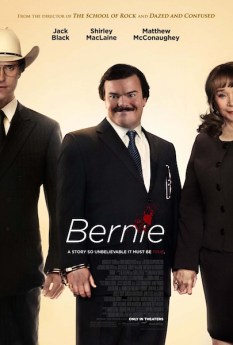 I seem to vaguely remember dismissing Bernie as just ‘Another Jack Black Comedy’ back whenever it came out (in the UK, that wasn’t until April 2013), and essentially forgot about it until earlier this month when it came up on
  (If you’re observing similarities to Midnight in the Garden of Good and Evil there, you’re not the first: the magazine article that inspired Bernie, published around the same time as
 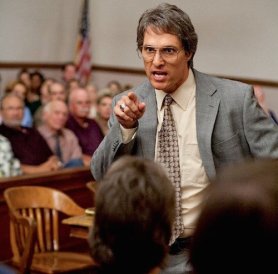 The local attorney seeking Bernie’s prosecution is played by man-of-the-moment Matthew McConaughey. I don’t know when we’re meant to deem the start of his “McConaissance”, but I’m not sure this really qualifies as part of it. Not that he’s bad, but it feels like the kind of played-straight comedy Southerner I’ve seen him do a few times now; indeed, it’s how he comes across in real life, from what I’ve seen. It fits the role like a glove, but doesn’t make for a remarkable performance.
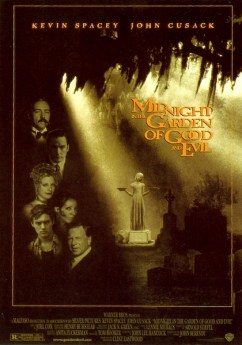 Sent to write “500 words on a Christmas party” in Savannah, Georgia, journalist John Kelso (John Cusack) instead finds himself covering a murder trial where he’s become friendly with the accused (Kevin Spacey).
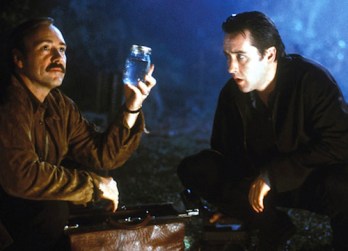 Like many an “adapted from a bestseller!” movies, I guess Midnight in the Garden was a big deal in its day that’s faded to semi-obscurity since (see:
  100Films.co.uk