aka La Passion de Jeanne d’Arc / Jeanne d’Arc’s lidelse og død
2015 #69
Carl Th. Dreyer | 96 mins | Blu-ray | 1.37:1 | France / silent (Danish) | PG
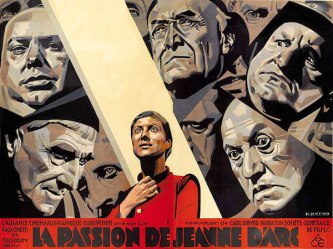 Widely regarded as one of the greatest movies of all time (look at the lists!), Danish director Carl Theodor Dreyer’s French-produced silent movie depicts the last hours in the life of Joan of Arc (Falconetti), a nineteen-year-old who is on trial by the Church for claiming God instructed her to fight to free France from British rule. You probably know it doesn’t turn out well for her.
Such a summary, while not inaccurate, is almost disingenuous. “This is by all odds the least religious and least political Joan ever made,” write Jean and Dale D. Drum (in a piece included in the booklet accompanying Masters of Cinema’s Blu-ray release), because Dreyer was explicitly not interested in the political or theological issues of the trial, which he felt were no longer relevant by the 20th Century. As he wrote in 1950, “I have tried to show that people in the medieval tragedy were, behind their historical costumes, people just as you and I are, caught up in the web of political and religious opinions and prejudices of the time.” With those religious and political issues set aside, Dreyer was instead focused on the universality of Joan’s experience as a human being. He was attempting to relate the tale — and, more importantly, the emotions — of a young woman sure of her convictions but persecuted for them.
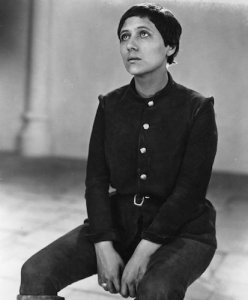 Dreyer based his telling on the written records of Joan’s trial. Although that’s grand for claims of historical accuracy, it’s hard to deny that silent cinema is ill-suited to thoroughly portraying something dialogue-heavy. There are many things silent film can — and, in this case, does — do very well indeed, but representing extensive verbal debate isn’t one of them. Bits where the judges argue amongst themselves — in silence, as far as the viewer is concerned — leave you longing to know what it is they’re so het up about. Sometimes it becomes clear from how events transpire; other times, not so much.
Dreyer’s faithfulness was not in aid of precisely representing what happened, however. For instance, the film takes place over a day or two, at most, while in reality Joan’s imprisonment, trial and execution took most of a year. Events were condensed so as to provide “a kind of bird’s-eye view, where all the unnecessary elements disappear” (Dreyer, quoted by Drum & Drum). This was partly in aid of what Dreyer described as “psychological realism”: rather than slavish fidelity to the facts of the era, it was about accurately and universally conveying the human experience.
According to Chris Marker (also in Masters of Cinema’s booklet), the aesthetic element of achieving this goal is one reason the film has endured so. Dreyer’s efforts to make the events seem ‘present’, as opposed to historical, works to make the film eternally present; they help it to transcend not only the 15th Century, but also the more recognisable trappings of “a silent-era movie”. The actors wear no make-up, perform in  neutral costumes on sparsely-decorated sets, and are almost entirely shot in close-ups — all elements that avoid the usual grandiosity of historical movies, both in the silent era and since. What we perceive as being ‘grand’ changes over time (things that were once “epic” can become small scale in the face of increasing budgets, for instance); pure simplicity, however, does not age much.
The near-constant use of close-ups, in particular, is one of the film’s most renowned elements. Dreyer was inspired by D.W. Griffith’s Intolerance, feeling this was an area film could excel in a way theatre obviously couldn’t. For Dreyer’s goal of giving us access to Joan’s very soul, it’s arguably the perfect medium — eyes are the window, and all that. This hinges on Falconetti’s acting. In her only major screen appearance, she delivers a performance that is still considered one of the greatest ever. It’s hard to pinpoint what she’s doing, but her wide eyes and almost crazed expression convey more subtlety than that sketched summary might imply. She is Joan, you feel, which again was Dreyer’s goal: he wanted his cast to inhabit their characters; to be them. He insisted the words from the trial record were spoken accurately (even though they obviously couldn’t be heard by the audience) and he built a whole 15th Century city set so that the actors might feel they were really there. As the film is shot largely in close-ups, that feels like a stupendous waste of money; and it led to the crew having to drill holes in walls and dig pits in the floor in order to get the shots Dreyer desired. But hey, whatever works.
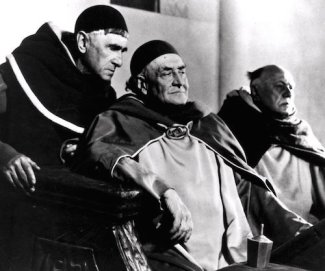 The actors playing the judges may be less individually memorable than Joan, but it’s their conflict — the personal battle between Joan and these men, as Dreyer saw it — that drives the film. Dreyer believed the judges felt genuine sympathy for Joan; that they did what they did not because of politics (they represented England, and she had led several successful campaigns against the Brits) but because of their devout belief in religious dogma. Dreyer says he tried to show this in the film, though it strikes me the judges still aren’t portrayed too kindly: they regularly seem contemptuous of Joan, and are outright duplicitous at times. Maybe that’s just religion for you.
Despite being one of the film’s most famed elements, Joan isn’t entirely constructed of close-ups. When Dreyer breaks free of such constraints, the dynamic camerawork on display transcends many people’s view of silent cinema. A swinging pan as maces are dropped from a window was a personal highlight, but there are some great, dramatic push-ins during the trial. That’s just the tip of the iceberg. There’s the editing as well: it’s surprisingly fast-cut at times, and the use of montage for some sequences (particularly in the torture chamber and the epic climax) makes for stunning visual cinema.
Reportedly Dreyer’s preferred soundtrack was complete silence, which makes sense given his other aims and views on depicting realism rather than interpretation. That sounds a little like an endurance test, however, and so of course the film is usually presented with a score. In the US, it’s now routinely accompanied by Richard Einhorn’s Voices of Light. Clearly it’s a noteworthy soundtrack because it feels like the vast majority of reviews and comments online make reference to it. Masters of Cinema’s Blu-ray doesn’t include it, 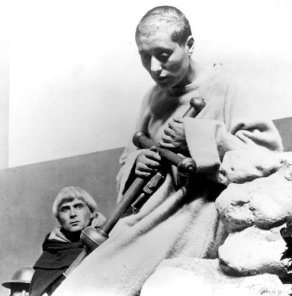 however, so I have no opinion. Instead, they offer two alternatives. On the correct-speed 20fps version, there’s a piano score by silent film composer Mie Yanashita. Apparently this is the only existing score set to 20fps, and Masters of Cinema spent so much restoring the picture that there was no money left to commission an original score. Personally, I don’t think they needed to. Yanashita’s is classically styled, which works best for the style of the film, and it heightens the mood of some sequences without being overly intrusive, by and large. Compared to Dreyer’s preferred viewing method, of course it affects the viewing experience — how could it not, when it marks out scenes (with pauses or a change of tone) and emphasises the feel of sequences (with changes in tempo, for instance). That’s what film music is for, really, so obviously that’s what it does. Would the film be purer in silence? Maybe. Better? That’s a matter of taste. This particular score is very good, though.
The Masters of Cinema disc also includes the film in a 24fps version, which is how it used to be presented most of the time (what with that being the standard speed for so long; it’s also the version Einhorn’s score was written for). I watched just the climax at that speed, and I’d agree with the scholarly consensus that it’s clearly running too fast. If it was the only version you knew, you might not notice; but in direct comparison, people are clearly moving unnaturally fast and the pacing of camera moves and edits feels off, like there’s not quite long enough to appreciate what you’re being shown. At 24fps the Blu-ray includes an avant-garde score by Loren Connors. It feels apocalyptic and so, in its own way, is somewhat appropriate, but it’s far too dissonant for my taste. I can’t imagine enduring it for the entire film, even at the commensurately shorter running time. Silent London’s review describes it as “tedious and barbaric… insensitive and intrusive”, and advises first-time viewers to “steer well clear.” I concur.
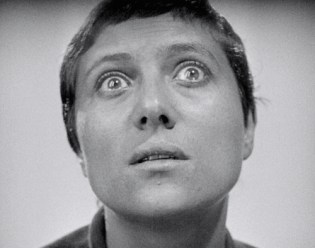 Some viewers describe how they’ve found The Passion of Joan of Arc to be moving, affecting, or life-changing on a par with a religious experience. I wouldn’t go that far, but then I’m not religious so perhaps not so easily swayed. As a dramatic, emotional, film-viewing experience, however, it is highly effective. As Dreyer wrote in 1950, “my film on Joan of Arc has incorrectly been called an avant-garde film, and it absolutely is not. It is not a film just for theoreticians of film, but a film of general interest for everyone and with a message for every open-minded human being.” A feat of visual storytelling unique to cinema, it struck me as an incredible movie, surprisingly accessible, and, nearly 90 years after it was made, timeless.
The Passion of Joan of Arc was viewed as part of my What Do You Mean You Haven’t Seen…? 2015 project, which you can read more about here.
It placed 14th on my list of The 20 Best Films I Saw For the First Time in 2015, which can be read in full here.
Also of note: this is the 1,000th feature film review I’ve published. (For what it’s worth, 2015 #112 will be 100 Films #1000. I’ll probably reach that in August.)


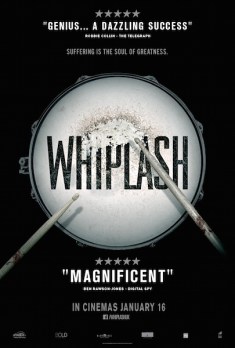 Mr Fantastic dates Supergirl and is taught the drums by J. Jonah Jameson in writer-director Damien Chazelle’s Oscar-winning music drama.
 Simmons’ Oscar is well earnt as the unpredictable Fletcher. If you’ve seen clips and trailers you might imagine it’s a fairly one-note turn, the Angry Teacher who possibly reveals a Heart Of Gold either just in time for the third act or at the very end. But no, there’s more to it than that, and Simmons negotiates every facet and nuance with the expertise of an experienced character actor. Commendations to both Chazelle and Simmons for wrong-footing me on what was actually going on with him more than once.
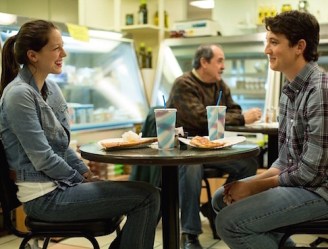 That thread could do with a boost in the middle, to give their relationship a little more weight when we reach the decisions Andrew must make about it later on. (Personally, I’d choose Melissa Benoist over J.K. Simmons any day, but I don’t think that’s the point…) The same could be said of Andrew’s relationship with his father (Paul Reiser), though that’s actually given more screen time and is consequently more impactful.
 “Horrible people do horrible things to each other” is the Post-it Note summary of this dark drama-thriller from director David Fincher, adapted by screenwriter Gillian Flynn from her own novel, which is short on heroes and overloaded with villains. An alternative brief summation is, “modern society is shit.”
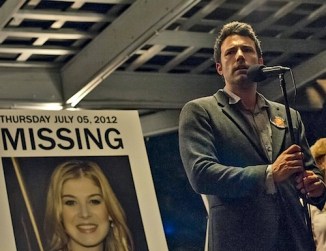 However, that opinion may stem from the same point as my view on the more praise-filled reactions: that Gone Girl is not a film as great as
 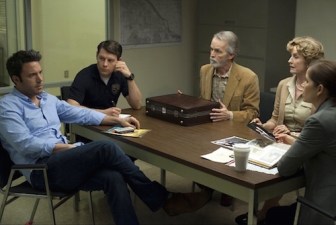 This is an argument for which I have a lot of time. The majority of Fincher’s filmography is made up of policiers and thrillers of one form or another, and even when he breaks out of that mould — in The Social Network, for instance — he often brings a similar perspective and toolset. Many of these films are borderline-rote, heavily-generic schedule-fillers at screenplay level, and would have been just that in the hands of a lesser director; in the hands of a master filmmaker, however, they become genre-transcending classics. I think that same sentence could be said about most (all?) of Hitchcock’s best films.
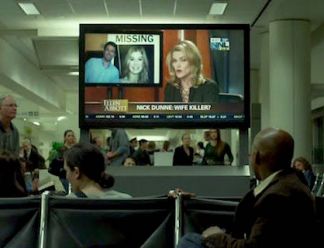 Is it for the masses, too? Maybe. In his
  a lesser actress could’ve given a performance with fewer notes and the film still would’ve functioned; or they would have struggled to contain the numerous sides to Amy’s personality in the form of a plausible human being. Pike does that, and more. She goes on my list of “people who were robbed of an Oscar because it was someone else’s ‘time’” (alongside Paul Greengrass’
 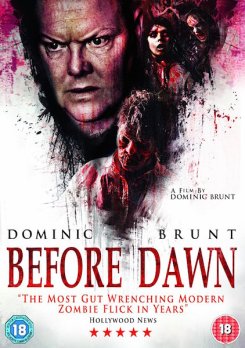 Directed by
 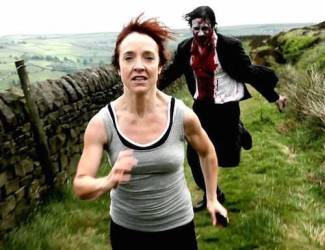 Amateurish production values often let the side down. I don’t think Brunt’s direction would be too bad were it not for the cheap camerawork, although the action scenes are overrun with ShakyCam. There are some very good bits late on: the developments that come as a result of a stranger’s arrival; a phone call with the kids; perhaps even the very end, which is a bold climax.
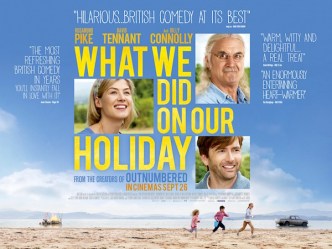 “
“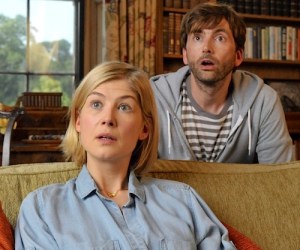 For some, the shift may scupper things. For me, it only makes it better: the story’s pathos and emotion are brought into focus, and the humour becomes all the funnier for punching in as tonal relief. It often seems to me that movies struggle to stay amusing for a full feature running time (there’s surely a reason all TV comedy comes in 30 minute chunks), but this story allows Hamilton and Jenkin to spread the laughs out a little without them feeling few or far between.
 including the likes of Ben Miller, Amelia Bullmore (getting the best subplot), Annette Crosbie and Celia Imrie. The real grown-up star, however, is Connolly. You get the sense he’s as scriptless as the kids are, improvising away with a mischievous twinkle in his eye, like some kind of idealised fun granddad. The scenes with just him and the kids are certainly one of the highlights, among the most amusing and the most affecting.
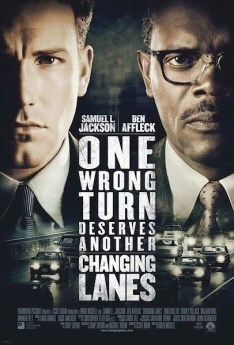 Hot-shot lawyer Ben Affleck and down-on-his-luck Samuel L. Jackson are involved in what Americans like to assonantly call a fender bender, making the latter miss a custody hearing and the former lose an important document worth millions… which Jackson happens to pick up. Cue a game of tit-for-tat retaliation, as Affleck tries to recover the file by ruining Jackson’s life further, and an increasingly-desperate Jackson enacts increasingly-violent revenge.
 I don’t know why they bothered). The worst offender is David Arnold’s score — all turn-of-the-millennium club-y electronic-drum-kit-y beats, for a character-driven drama/thriller? Ugh.
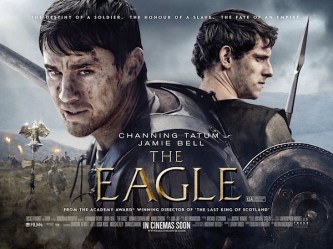 Channing Tatum is a brave Roman general whose father lost his company’s standard, the titular eagle, north of Hadrian’s Wall (a real historic event, coincidentally depicted in
 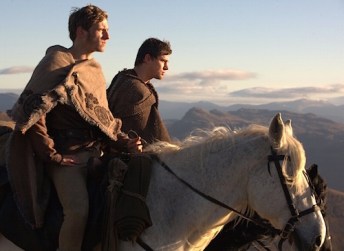 quality to the setting, characters, and imagery that’s quite striking.
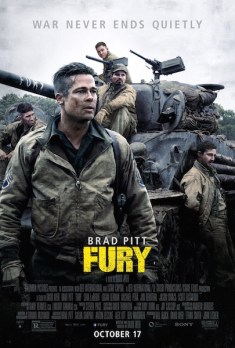 I don’t believe there are very many movies about tanks — there’s
 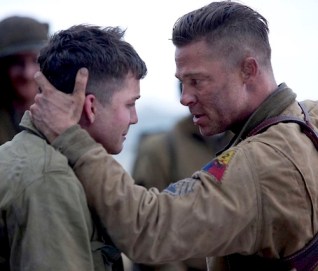 Most of the characters exist in a moral grey area, something which some reviewers seem to struggle with. From the off, our ostensible heroes are not shown in a particularly pleasant light, committing or encouraging acts we would view as unconscionable. As the film goes on, it seems like we’re being invited to bond with them, to respect or admire them. I’m not sure that’s a wholly accurate reading of it, though. I think we’re being shown different sides to them — much as Norman is, in fact. At first you see the depths they have reached; then, as you get to know them, you see a little more of their true (or at least their pre-corrupted-by-war) characters. Does this redeem them or excuse their actions? Well, that’s your decision. I don’t think the film is predicated on you coming round to their way of thinking. Without meaning to spoil anything, it’s not as if the meta/karmic world of plot construction lets them off scot-free by the end. Of course, whether we need our focus characters to be clean-cut heroes or whether complex morally-grey/black characters are preferable is another debate.
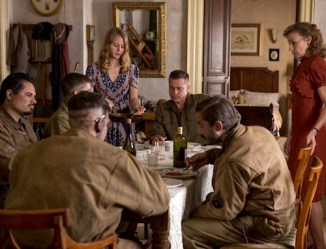 This is a scene most reviews seem to single out, I’ve since realised, but that’s for good reason: even watching it cold, the powerful writing, direction and performances mark it out as a sequence that transcends the movie it’s in. Again, it’s the unpredictability of what these men might do; the grey area of the guys we’re meant to think are the heroes not always being heroic.
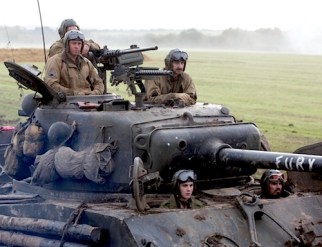 I think Fury is a rather rewarding movie for those that can, though. The fact it provokes debate is no bad thing — I think it’s a misinterpretation to read the film, as some online commenters clearly have, as “these guys do horrible things, but they’re the main characters and the not-Nazis, so I must be meant to like them, so the film is bad”. Well, I suppose it’s not news that some people struggle with cognitive dissonance. On the flipside, I don’t think you’re meant to outright hate them — there’s an element of “the Allies did bad things too, y’know” about the film, but that’s not its sole aim. I think it’s more complicated than that, and, naturally, all the better for it. Even on a more surface level, though, there’s adrenaline-pumping excitement to be had from the well-realised action scenes. It’s a combination that worked very well indeed for me, and if my score errs on the side of generosity then, well, consider it redressing the balance.
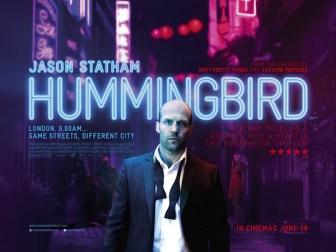 Steven Knight, the writer of
  The film’s problem, perhaps, is that it slips a little between two stools. It’s certainly not action-packed enough to appeal to a good deal of Statham’s fanbase — the one or two instances of him kicking ass are very much asides. On the flipside, it may not commit to the character drama fully enough to satiate the needs of that kind of viewer. However, for anyone at peace with those two apparently-disparate styles — like, well, me — Hummingbird will be a more satisfying experience.
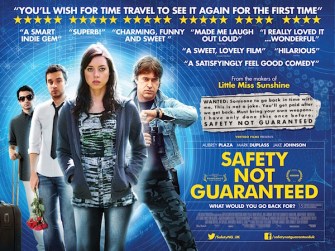 The debut feature from the director of all-conquering box office behemoth
  Maybe I’m missing something, I don’t know, but where other directors currently making a similar transition (Gareth Edwards, Josh Trank, Duncan Jones) showed some signs of a reason for the upgrade in their debut and/or sophomore features, I can’t fathom what singled Trevorrow out. He seems to have done alright with it though, so never mind.
 100Films.co.uk