The Cable Guy (1996)

2008 #79
Ben Stiller | 88 mins | download | 12 / PG-13

The Cable GuyThe best thing I have to say about The Cable Guy is that the opening titles were very well done.

The second-best thing I have to say is that a subplot featuring director Ben Stiller as a faded-child-star twin-killer is very neatly integrated into the film, seeming utterly pointless until it has a near-vital role in the climax. That’s a pleasing piece of writing/editing right there. Unfortunately, the point this seems to be aiming at — that TV rules our life too much, that we’re too addicted to it, etc etc — is not only old hat, but also rendered meaningless in this instance by the lack of impact: TV goes off for the night, and one guy picks up a book. Oh, wow. And to top it off, thanks to an unnecessary final beat, it seems Jim Carrey’s titular character hasn’t actually learnt the lesson we thought he had.

Incidentally, The Cable Guy is a comedy, though at times it seems to wish you’d forget that so it could be a psychological stalker thriller. Perhaps that’s what it had wanted to be — for one thing, there are surprisingly accurate predictions for the future of telecommunications, although their coming true may simply have killed another joke (“play Mortal Kombat with a friend in Vietnam!”) — until someone realised the idea was too silly to be taken completely seriously. How funny you find the end product will depend on whether you like the style of comedy Carrey employed in the early & mid-’90s, and whether you can stomach pointless asides that don’t do anything for the plot (final act freaky nightmare, step forward). There’s little else to engage interest — Matthew Broderick’s pseudo-protagonist is, perhaps, too nice and too eager to please, and the go-nowhere romantic subplot — his main action aside from being Carrey’s straight man — has all the depth and shape of something from a cookie cutter.

More fun than the jokes, actually, is playing Spot The Pre-Fame Comedy Star. Eyes open for young-looking turns from (in ease-of-identification order) Jack Black, Ben Stiller, Owen Wilson, Janeane Garofalo, and Kyle Gass. And Eric Roberts randomly shows his face too, not that that’s relevant to anything.

The Cable Guy is rated 12, or PG-13 in the US, which may also be the last ages you’d enjoy it at.

2 out of 5

In case anyone’s wondering what’s happened to #77 & #78… Despite spending 23 months carefully posting reviews in order (well, the first two months are actually a bit of a muddle), it’s now December and I’m a few behind, so I’ve decided to throw numerical sequence to the wind and just post reviews as & when I get round to completing them. The main reason for this is to help drive things forward so that I can actually end 2008’s posting by December 31st, rather than having it drag on into 2009 and overlap with Year 3. I’m sure no one will really mind. Or care.
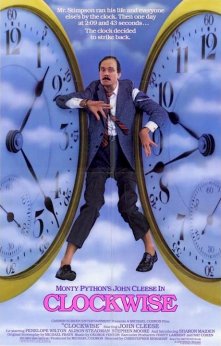
Clockwise (1986)

2008 #76
Christopher Morahan | 92 mins | DVD | PG / PG

ClockwiseClockwise, so I’m told, was written after John Cleese (who, I should point out, isn’t credited as the writer) attended Robert McKee’s famous screenwriting seminar. What this means for your average viewer is that Clockwise is expertly constructed. More importantly, it’s also very funny.
The first 15 minutes are a little dubious, but it soon becomes apparent that some of McKee’s principles are being followed (if you’re aware of them, of course) as this opening serves to establish the everyday life of Cleese’s character, headmaster Brian Stimpson. The point of this soon becomes apparent: when everything goes to hell over the next hour-and-a-quarter, the viewer can fully appreciate the impact on Stimpson’s existence. And all go wrong it does, in a manner that’s rather reminiscent of Fawlty Towers — not in the sense that Cleese is repeating himself, but rather that you could replace Stimpson with Basil Fawlty and merrily carry on along much the same path; though, I hasten to add (to this over-punctuated sentence) that Stimpson is not a clone of Fawlty, but he is prone to ending up in similar accident-and-misunderstanding-based farcical situations.

I imagine that Clockwise is less well known than it deserves because it is so very British. The humour — largely based around issues of punctuality, politeness, and social custom — is particularly British, as are the countryside settings and the finale set at a public school conference. And, in the first instance, everything goes so spectacularly wrong thanks to our wonderful language’s multiple meanings for the word “right”. From this point Cleese & co escalate the hopelessness of the situation beautifully (and very much in keeping with McKee’s ideas of good structure), gradually crafting more absurd events and dragging in more and more characters, most of whom come together in that finale. This final section perhaps goes on too long, with a rather inconclusive ending, and it lays on the anti-public school gags with a trowel — though that suits me just fine.

Some have argued that Clockwise is more like a series of sketches than a cohesive whole, but all the independent scenes are connected by a common goal, meaning very few (if any) feel genuinely out of place or inelegantly shoved in. The calm pauses between the comic scenes also allow it to remain hilariously funny so consistently — an all-out assault of comedy, no matter how good, can become rather wearing. Again, this ebb-and-flow is something the filmmakers may well have picked up from McKee.

While you could probably use Clockwise as a mini masterclass in applying some of Robert McKee’s structural principles, that’s thankfully not the be-all of it. Very funny once it gets going, this is one that fans of Fawlty Towers will likely especially enjoy — and, really, who with a sense of humour isn’t a Fawlty Towers fan?

4 out of 5

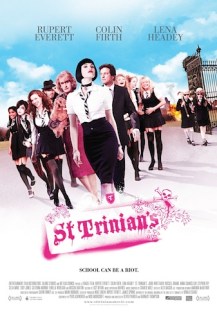
St. Trinian’s (2007)

2008 #71
Oliver Parker & Barnaby Thompson | 97 mins | download | 12

St. Trinian'sI really didn’t think I was going to like St. Trinian’s. It seemed to be aimed squarely at teens whose quality barometer is fixed at Girls Aloud being the best music artists of all time and aren’t old enough to have seen There’s Something About Mary. Certainly, some of the film lives up to these expectations, but other bits are surprisingly good.

For one thing, it has a pleasantly wicked sense of humour, which must be pushing that 12 certificate on moral grounds — 10-year-olds producing black market vodka, for just one example. There’s a number of good, brief, visual gags too, such as the RE department having a Practical Study of the Easter Story with a girl strung up like Jesus on the cross (Christian bating is always funny). On the other hand, it merrily includes some ancient gags too — a dog shags someone’s leg! Hilarity! But then again, it makes no bones about being aimed at a relatively young audience, and for them this probably seems wonderfully fresh and naughty. Thankfully it’s not all down on this level — it has an even better line in Colin Firth spoofing than the Bridget Jones movies, and while some of these references may fly over the heads of that intended audience, they should at least keep any adult viewers amused. My personal favourite was the two 10-year-old girls who keep quoting famous movie lines. Simple, but effective.

A fair number of people seem to have considered the moral vacancy of St. Trinian’s’ style of comedy a bad thing, claiming impressionable girls will copy the characters’ actions or at least be influenced by their anarchic attitude. Not likely, I say — the school is such a fantasy-mess that I think even the very young would struggle to believe it as a potential reality. In fact, I’d go so far as to say that most of it is relatively harmless fun — if only some of The Youth Of Today would copy this lot rather than getting stupidly drunk, pregnant as soon as they’re able, and knifing each other every evening, then we might not be in the state we’re in. But anyway…

Through any weak patches, affairs are buoyed by a rather wonderful cast. The likes of Colin Firth and Rupert Everett are clearly having a ball, the young (though most not as young as their characters) cast all do a good job, with Gemma Arterton standing out in particular, and anything featuring Stephen Fry is at least worth a look. Yes, he’s only playing himself (literally) on a version of University Challenge that no doubt owes something to QI (even if it is just Fry hosting), but luckily he’s given a smidgen more to do than just read out cue cards. In spite of which names may be above the title or which characters get introduced first, it’s decidedly an ensemble piece — every time you think a lead is emerging another takes centre stage. In that respect it might be seen as a bit messy, but each one gets a decent enough through-line.

Incidentally, it’s incredibly British — not just in its setting and style, but also the very current cultural references — which might explain why it still hasn’t had a US release. It wouldn’t look out of place premiering on TV, probably at Christmas considering the scale of it, and I wouldn’t be surprised if the budget had been TV-sized. It’s also got a posh girl played by that girl who plays a posh girl in everything on TV (namely, Lucy Punch). That doesn’t really signify much, but my God she’s done well out of playing essentially the same role in numerous productions.

Despite my preconceptions when starting out, which were all supported by the opening few minutes, I ultimately found St. Trinian’s quite enjoyable. It’s far from perfect, and every time I began to truly warm to it — I even found myself laughing at a final beat for the leg-shagging dog cribbed from a decade-old comedy (I believe I already mentioned it…) — there was another recycled or immature joke to make me despair. In spite of that, the overall impression was adequate enough.

3 out of 5

After the Sunset (2004)

2008 #67
Brett Ratner | 93 mins | TV | 12 / PG-13

After the SunsetI’ve never had as much of a problem with Brett Ratner as some others. I quite enjoyed the first two Rush Hour films (though, admittedly, I was relatively young) and also liked Red Dragon (though, at the time, I hadn’t seen Silence of the Lambs), and would lay the blame for X-Men: The Last Stand at the feet of the producers who decided to save all the Wolverine backstory stuff for a spin-off, in the process disconnecting the threequel from the Wolverine-obsessed first two — what was left was pretty decent, if you ask me. After the Sunset, on the other hand, is like Woody Harrelson’s character: not much cop.

The story concerns a retired jewel thief goaded into performing one last job by the FBI officer who never caught him (that’s Harrelson’s character — you see, he’s not much of a cop! Geddit?) A decent enough premise, suggesting something Ocean’s Eleven-like; but someone didn’t think this was enough story — or, perhaps, couldn’t come up with a complex-enough security system for the jewel — and so tacked on a buddy comedy. It’s a pretty illogical one as well: the two men hate each other, so why would they spend so much time together? It feels like padding around the heist plot, but takes up more screen time. Other subplots, like Don Cheadle as the unspecified Caribbean island’s resident gangster, who wants the jewel to fund something or other, also don’t go anywhere.

Each of these plots seem to have originated in different films — some serious, some light, some thoroughly comedic. When stuck together they make for a constantly varying tone, and it’s difficult to work out which was the intended one. By the end there’s so much going on (though, barely) that the ending goes on forever, wrapping up its various near-unrelated threads in as drawn-out a manner as possible, apparently just to make the film hit a decent length. The final twist is almost good, but remains a bit underdeveloped and consequently isn’t clever enough to be worthwhile — it winds up as just another pointless extension.

Despite all this it does have its moments, thanks primarily to a skilled cast… not that I can remember any specific good bits now. It does at least mean that, if you can put the tonal and structural oddities to one side, it can be a moderately pleasant way to pass an hour and a half.

3 out of 5

Inside-Out (1999)

2008 #66a
Tom & Charles Guard | 7 mins | DVD | 12

This charming little short stars Simon McBurney as a hapless market researcher on a busy London street, failing to get a single passerby to complete his survey — perhaps the film’s greatest achievement is making a market researcher sympathetic. Anyway, he’s quietly observed by a woman, played by Lena Headey (yup, Mrs. Leonidas and the new Sarah Connor [and now Cersei Lannister, of course]), who’s dressing the window of a clothing/department store on the street. She notices his failed attempts, which amuse her; he notices her laughing, and begins to muck around to entertain her.

It’s a simple premise, but one that’s executed with comedic flair and a surprising amount of emotion. The music and lack of dialogue evoke an old-ish French mime comedy, making a nice contrast with the modern-day London setting, but it’s the relationship that silently develops between the two characters that provides the heart around the humour. And the ending, as carefully constructed as any moment of humour in the short, is painfully heartbreaking.

However many times you might want to re-watch this — and I think you would want to — you’ll always wish for the same outcome, and always be let down. It’s a sweet kind of pain and longing that, in spite of that French style, is very British.

4 out of 5

This short is available on the Cinema16: British Short Films DVD, and online free at Total Short Films or YouTube.

Shoot ‘Em Up (2007)

2008 #66
Michael Davis | 83 mins | DVD | 18 / R

Shoot Em UpShoot ‘Em Up is the film Wanted wants to be. It’s packed to bursting with utterly ludicrous — but, consequently, ludicrously cool — action sequences. It’s fast-paced, witty, and endlessly inventive. As the action genre goes, this is pure entertainment.

The plot, such as it is, is borderline nonsensical — some craziness to do with a baby factory (which is, believe it or not, the morally acceptable part), political coups, and goodness knows what else. If you want to follow it you might need to engage your brain at times, but so long as you can tell who’s bad and who’s good — and you can, easily — then all is well. This might sound like a criticism, but by pushing the implausibility of an action-thriller plot as far as it can, the story becomes another element in the whole film’s spoof-homage aesthetic. Everyone involved is clearly having fun with this, though none more so than Paul Giamatti. His wonderful villain is cunningly evil but constantly interrupted by domestic phonecalls from his beloved wife. Luckily this enjoyment is conveyed to the viewer, lending the one-liners and sundry other gags more humour than they might otherwise deserve.

Some quarters have criticised Shoot ‘Em Up for being cheesy and clichéd. My favourites are those that label it “so daft at least I enjoyed it on that level”. I’m sure these people feel very clever for spotting all the poor stereotypes of an action flick, from the unbelievable plot to the literally impossible feats of action. Unfortunately for those oh-so-clever people, they’ve entirely missed the point — even those daft-lovers. The clue’s in the title, a simple statement of genre that blatantly acknowledges the film’s aim in a way that genuine crap-because-they’re-crap action flicks don’t. Shoot ‘Em Up is an homage and spoof of its genre, pushing everything to the limit. If it took itself seriously the above might be valid criticisms, but it’s meant to be this way.

And if you know that, it works, navigating a successful path between spoof and homage — it’s not Action Movie, a film which must be inevitable by this point — and packed with inventive stunts and shoot outs. For every impressively-inventive-but-physically-implausible stunt in Wanted, this produces half a dozen. And they weren’t all in the trailer either. Silly, fun, and easily better than that over-promoted comic adaptation, in these respects Shoot ‘Em Up deserves much wider recognition.

4 out of 5

Southland Tales (2006)

2008 #63
Richard Kelly | 139 mins | DVD | 15 / R

Southland Tales

– confusing mess? or profound experience?

I won’t go into my full “how I discovered Donnie Darko” spiel [save that for whenever I finally watch the Director’s Cut!], but ever since I saw Richard Kelly’s first writing/directing effort way back on its original UK release I’ve been waiting eagerly for his second film. It’s a testament to the negativity of the reviews it received — and, perhaps, the influence of reviews in general — that I skipped Southland Tales at the cinema, left it five months after release before getting it on DVD… and even then it was only a rental.

At some point, Kelly split his story into six parts and, in a Star Wars-like move, the film was to be Parts 4-6, while the first three would be told in accompanying graphic novels. “The film will work fine without reading them,” he said (I paraphrase here), “but reading them will lead to a deeper experience.” Southland Tales: The Movie begins with a long recap of events from these books, going so far as to include images from their art. “Oops”?

You have to wonder, if you switched “Directed by Richard Kelly” for, say, “Directed by David Lynch”, would the critics’ reviews have suddenly jumped up a star or two? [some of it is certainly very Lynchian in feel — not a normal film with bemusing aspects, like Donnie Darko, but an all-out muddled weird-fest]

  • David Lynch fans may find this more entertaining than most. Or they may hate it for trying to be Lynchian but failing, or perhaps like it as an example of why Lynch is so good and others fail when they attempt similar feats. I don’t know how they’d use it like that, but I expect they would know.
  • the clear IV, V and VI presented at the start of each chapter — as well as showing I, II and III blatantly on screen during the recap, and having the narration have to recap bits of them — seems to hammer home that this is really for people who are prepared to invest in the whole thing, not people who just watch the film

** raises the question, should you ever have to go further (e.g. reading companion books, comics, websites, etc) to understand a film? Yes and no. If it’s consciously part of a wider ‘experience’, labelled and marketed as such, then why not? But if it’s sold as a film in its own right — or, at least, potentially in its own right (as this was) — then it should really work that way too.

  • narration: tries to explain everything, though does very little to help (difference between Kelly and someone like Lynch, who just leaves it all up to the viewer?) — at times almost uncomfortably over-explaining — you wish it could’ve been done properly, rather than with narration
  • Kelly spent months re-editing, following the critical panning it got at Cannes, trimming the length and restructuring it. And it seems to show, as it feels like a failed attempt to construct something legible out of a mess of half-thought-through scenes and subplots
  • one feels a good director’s commentary and/or the original cut might shed more light on things — this is the sort of film that could benefit from a decent DVD edition, that it probably won’t get due to its lack of popularity… unless it gains surprise critical acceptance years down the line, which isn’t unheard of… though I wouldn’t bank on it here. Perhaps, one day, when we’re all watching Data Crystals, Kelly will have gained enough reputation that a 20th anniversary release will finally explain the damned thing
  • seems to become clearer toward end — there are some answers, at least — but ultimately a lot is left out
  • too many of the ‘underlying ideas’ in the climax feel like a Donnie Darko rehash; odd musical numbers and long takes add to this feeling — almost like Kelly’s taken what he did in Darko and tried to expand it into some ensemble epic kinda thing

i thought, with respect to the film’s crazy half-constructed mess of half-ideas, i’d copy&paste my notes rather than a normal review. so at least that’s one answer at the end for you.

when it was originally conceived, it was set a couple of years in the future; now, it’s just set ‘now’; and soon, of course, it will be set in a fictional past — the copyright year on the film is 2005; it’s credited as 2006 on IMDb (which is when it turned up at Cannes); it was finally released in 2007; and it’s set in 2008

I really wanted to like Southland Tales, in spite of the critical mauling it received, and because I loved Donnie Darko and actually enjoyed Domino too (which Kelly wrote). Maybe — maybe — with time to invest in reading the prequel graphic novels, and exploring whatever official sites or crazy fan theories may be out there on the web, I could get more from this film. Personally, I don’t have that kind of time to invest right now, but I might give it a shot sometime. Until then, it will just remain a largely disappointing mess.

http://www.imdb.com/title/tt0405336/faq

this is the way the review ends, not with a bang but with a whimper

2 out of 5

Southland Tales featured on my list of The Five Worst Films I Saw in 2008, which can be read in full here.

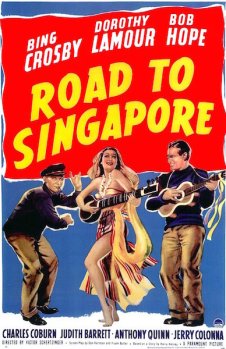
Road to Singapore (1940)

2008 #61
Victor Schertzinger | 85 mins | VHS | U

Road to SingaporeBob Hope and Bing Crosby star as a pair of young(ish) playboy sailors who run away from responsibility and family expectations in this comedy that launched the perennially popular Road to… series, which would spawn six sequels over the next 22 years.
Rather than a “comedy”, Road to Singapore might best be described as a “variety film” — it offers a mix of comedy, excitement, romance and song, a selection of entertainment that is more often provided by a few hours of TV these days. While it’s predominately light-hearted, the overall air is still more serious than that of the one other Road to… film I’ve seen, Road to Morocco: the plot seems to have been the film’s starting point, rather than an afterthought to connect the appropriate set pieces, and a couple of fight scenes are not wholly comedic in their choreography.

Unfortunately, in spite of this, there’s nothing here that’s as memorable as in Morocco. Bob and Bing are a great double act, undoubtedly carrying the film, but while it starts well enough it loses it as it goes on — even at a brief 85 minutes, it begins to drag early in the second half. It’s also worth noting that much of it is incredibly dated now, peppered with things like blacked-up natives (and our heroes blacking up to fit in) and the “good little housewife” routine. This is more an observation than a criticism — it’s very much a film of its time.

It might also be worth noting that, while I found Singapore reasonably entertaining, the friend I was watching with — who has enjoyed several other entries in the series, but had yet to see this — found it lacking. The score, however, is solely my own.

3 out of 5

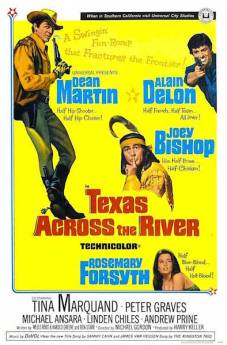
Texas Across the River (1966)

2008 #58
Michael Gordon | 101 mins | DVD | PG

Texas Across the RiverTexas Across the River hardly seems to be a well-remembered film — the only DVD edition available (as far as I can tell) is a legally-produced DVD-R, clearly in the wrong aspect ratio. I only come to see it because a friend happened to have a VHS as a child, enjoyed it back then, and we managed to track down that DVD. [It was later released on UK DVD in 2012. (Amazon claim 2007, which is clearly BS.)]
And actually, it’s a fairly entertaining film. Little more than a comedic Western runaround, it sees Alain Delon — as a Spanish nobleman — trying to get to Texas to escape the Cavalry (led by Jim Phelps himself, Peter Graves) and marry his betrothed. On the way he enlists the help of Dean Martin and his Indian sidekick. Hilarity ensues!

OK, so it’s probably funnier if you watch it before your age hits double figures, but it still has enough entertaining moments and decent gags that its complete expungement from almost anyone’s consciousness seems unwarranted.

I don’t expect it’ll ever undergo some miraculous revival (it’s not that good), and perhaps is of primary interest as a curio for fans of Dean Martin, Alain Delon or Mission: Impossible, but it made me laugh — and, as I believe I’ve said before, that’s all I really ask of a comedy.

4 out of 5

Flushed Away (2006)

2008 #57
David Bowers & Sam Fell | 81 mins | DVD | U / PG

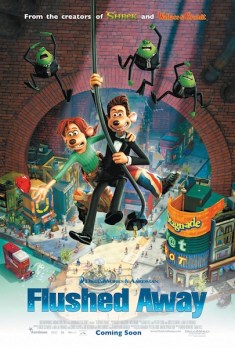
Flushed AwayAardman Animations, the Bristol-based company most famous for Wallace & Gromit and Creature Comforts, branch out into CGI for the first time with this tale of rats trying to save the sewers of London. CGI rats? Yes, thoughts of Ratatouille are inevitable. Can Aardman beat Pixar at their own game? You might be surprised…

The primary reason for comparison here, as mentioned, are the rats. Despite Pixar’s stated intention to redeem rats in the eyes of viewers — to turn them from vermin into loveable little fluffy things, essentially — I felt the same about bloody rodents at the end of Ratatouille as I did at the start. Here, however, they’re Disneyfied (oh the irony) — where Pixar had cartooned versions of the real thing, Aardman have given them a human shape. It’s surely this disjunction from reality that makes them more likeable, but it does mean there’s never that distracting “but they’re vermin” impulse. They’re humanisation is helped by the performances of a star-studded cast, including Hugh Jackman and Kate Winslet amongst the ratty voices. Ian McKellen is a fabulously dastardly villain, ably supported by a pair of comedy henchman… and Jean Reno as a French frog. Yep, the humour is that British.

One thing Pixar unquestionably still excel at is the actual animation, however. Ratatouille is gorgeous to watch and will take some effort to beat; Flushed Away, on the other hand, doesn’t really come close to Pixar’s earlier efforts, never mind Ratatouille’s artistry. It’s mostly passable, especially once the action migrates to the mini-London in the sewers, but at other times it looks little better than a computer game. The second biggest mistake (I’ll get to the worst in a minute) is opening the film in a pristine up-market house — presumably it was an artistic choice to have it so tidy and clean, but this has the unfortunate side effect of highlighting the animation’s plainness right from the start. Once the story moves underground the level of detail improves, but it takes a little while to get there.

A bigger error was made with the lip-synching, however, and obviously this dogs the film throughout. Aardman consciously designed the characters’ mouth movements to imitate the clay animation the company usually employs (Flushed Away is CG because of the volume of water featured, an element too complex to achieve in stop motion). Instead of invoking that stop motion feel it just looks cheap and underdone — such jerkiness is easily ignored as part of the technique when viewing clay animation, but there’s no need or excuse for it in CGI. Ultimately it looks like the animators were lazy or the rendering has skipped frames, and is frequently distracting.

It’s possible to put the disappointing quality of the animation aside though, because the script’s a good’un. Like the animation it doesn’t really get going until we’re flushed into the sewers, but once there it’s pleasantly witty, full of good one-liners and clever visual gags. The latter includes a good line in intertextuality, with entertaining and easily-noticed references to Finding Nemo, X-Men and others, including numerous nods to Wallace & Gromit. They don’t dominate, but their variety makes for a nice bit of I-spy for both kids and adults of varying degrees of film-buffery.

Despite the inevitable comparisons, Flushed Away is really a very different beast to Ratatouille. Pixar’s effort is, for want of a better word, artistic; Flushed Away is simply a family-orientated slice of adventure-comedy… rather of the kind you might expect Pixar to produce. Aardman’s initial CG effort is not better or worse than ‘the other CG rat flick’, but it is perhaps more like what you — or, at least, kids — would expect. With a starry cast, strong script and good sense of visual comedy, Flushed Away manages to overcome its lower production values to create an above-average piece of entertainment. And that’s, as Wallace would say, cracking.

4 out of 5