Gentlemen Prefer Blondes (1953)

2008 #56
Howard Hawks | 87 mins | DVD | U

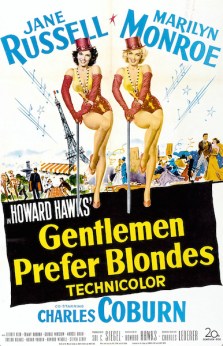
Gentlemen Prefer BlondesIt’s easy to see how Gentlemen Prefer Blondes helped launch Marilyn Monroe as a sex-symbol superstar — her ditzy, breathy blonde, who may just be cleverer than she looks, is clearly the star of the film.

For starters, she gets the lion’s share of the best bits. Diamonds Are a Girl’s Best Friend has justifiably become a classic song and there’s a solid routine attached, but the rest of the musical numbers are disappointingly weak. Jane Russell does get her fair share of good lines, but the most memorable comedic moment is Monroe’s: climbing out of a window, she gets stuck halfway and has to enlist the help of a little boy — and a big coat — to pretend she’s standing outside in the cold. That last one makes more sense in context…

Frankly, it’s all a bit sillier than I expected, more in line with the likes of Texas Across the River and the Road to… series than my memories of Some Like It Hot. That’s not necessarily a bad thing (I enjoyed both those examples), but it didn’t gel with my expectations of a film that’s got a greater reputation than they do.

I suspect said reputation is founded on Monroe’s career-making performance. I don’t have anything against her, but I’m not especially a fan either; yet despite my indifference she’s easily the best reason to watch this. Famously, when told she wasn’t the star of the film Monroe replied, “well whatever I am, I’m still the blonde.” The clue’s in the title, people.

3 out of 5

Gentlemen Prefer Blondes is on More4 today, Monday 6th April 2015, at 12:45pm.

The Jane Austen Book Club (2007)

2008 #54
Robin Swicord | 101 mins | DVD | 12 / PG-13

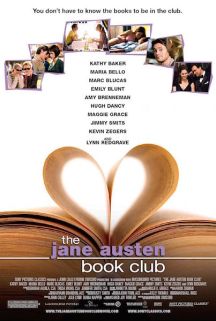
The Jane Austen Book ClubI like to think I have a fairly high tolerance for ‘chick flicks’ — over the years I’ve rather enjoyed films such as Love Actually or Bring It On, and not just because of the male-friendly porn-stand-in scenes or cheerleader costumes — but even I was a bit uncertain about this one at first. However, as it progressed, gradually revealing more about the characters, their lives, and how they cope with what the world throws at them, I found myself increasingly enjoying it. By the time we had to pause it twenty minutes from the end, I found myself itching to continue to find out what would happen.

Inevitably, it’s not flawless. At times it feels like a collection of subplots linked only by the monthly book group meetings, with whichever plot thread is the focus of a scene becoming the de facto main story… until the next scene begins, of course. A working knowledge of Austen’s novels is helpful too. I presumed the film (and book on which it is based) merely invoked Austen’s perennially popular name to boost sales, but there’s actually a fair bit of analysis of the books thrown in, which often reflects what’s happening to the characters. You can get by without an Austen familiarity, but I found the Pride & Prejudice segments made more sense than the others thanks to my (marginally) increased understanding of that particular text.

It would be very easy to pigeonhole The Jane Austen Book Club as a ‘film for women’… and, to be honest, that wouldn’t be at all unfair: it’s as squarely aimed at a female audience as Die Hard is aimed at blokes. It’s also ultimately disposable, apparently with nothing new or revelatory to say about womankind. In spite of all that, I enjoyed it more than I probably had any reason to — and not just because of the male-friendly lesbian character.

4 out of 5

Hairspray (2007)

2008 #53
Adam Shankman | 111 mins | DVD | PG / PG
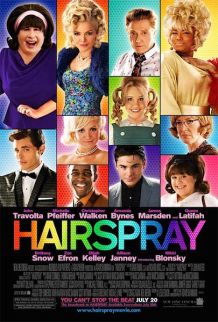
HairsprayWho’d’ve thought a John Waters film could become a bright and breezy musical? It’s a bit of a surprise but, thanks to a successful Broadway version, that’s exactly what’s happened. But while the key to Hairspray’s success may be its positive attitude and memorable songs, perhaps the key to its quality — and the eventual score of this review — are the issues it tackles around those.

It’s the latter that I found must surprising while watching the film. Everything about its advertising campaign, largely young cast and candy-coloured design suggested Hairspray was a light-as-air feel-good flick — no bad thing, but nothing more than a couple of hours of disposable fun. Pleasantly that’s not the case, as the film tackles head-on issues of racism and other such discrimination, with the ‘beautiful people’ — led by a deliciously bitchy Michelle Pfeiffer — doing their best to keep down those who are in any way different, be they black or, in the case of lead character Tracy Turnblad, fat. The apparently fluffy style of the film in many ways makes it perfect to tackle such issues, showing how they can permeate every area of life, not just Serious Social Dramas, and forces those who would normally avoid the latter type of drama to face up to them. Its ultimately happy ending may be more in keeping with the film’s overriding optimism than with reality, but equally it’s wholly appropriate: the crusade against oppression has to end well here, because if it didn’t the concluding message would be “don’t bother fighting, things won’t change”.

The film’s unwavering optimism is perfectly encapsulated by newcomer Nikki Blonsky, leading the cast as Tracy. She’s instantly and constantly likeable, irrepressibly chirpy and yet not annoying — an impressive feat. Equally remarkably, she’s never overshadowed by the heavyweights who round out the cast; instead, they provide able support. Even John Travolta, disturbingly convincing as a housewife (under a ton of makeup), doesn’t steal the show — he comes close, but Blonsky’s performance holds sway. Elsewhere, Christopher Walken, Queen Latifah, James Marsden and Zac Efron all get catchy songs and have a whale of a time — and, unlike the Ocean’s… sequels, the fun the cast is having is infectious.

The first credit at the close is an unusual one: “Directed and Choreographed by Adam Shankman”. Rather than shirking in either department, the rare combination seems to have helped proceedings: the numbers are all exemplarily executed and the direction doesn’t suffer elsewhere. It’s an indication of the music’s quality that even the three cut songs, which play over the end credits, are pretty good and wouldn’t’ve been out of place in the film itself. The first of these is clearly the actual closing number, though the decision to bump it to the end credits, thereby leaving You Can’t Stop the Beat as the final song of the film proper, was a wise one — it makes for a stronger, catchier, more upbeat finale.

Hairspray is a deft mix of issue-driven drama and colourful musical levity. Catchy, optimistic, uplifting, funny and fun, it may just surprise you.

5 out of 5

Hairspray is on Film4 today, Tuesday 11th November 2014, at 6:45pm.

Hairspray placed 6th on my list of The Ten Best Films I Saw For the First Time in 2008, which can be read in full here.

Superhero Movie (2008)

2008 #52
Craig Mazin | 85 mins | in-flight | 12A / PG-13

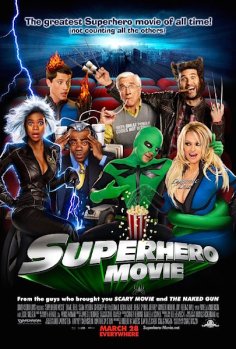
Superhero MovieYears ago, I saw Scary Movie. I don’t really know what I thought of it anymore, but I never expected I’d find myself watching another entry in the critically-derided …Movie series. But then I found myself on a plane, half asleep and with a choice of films I’d mostly rather watch on a decent-sized screen, and decided that maybe Superhero Movie wouldn’t be so bad after all…

As anyone who saw a trailer will have guessed, Superhero Movie is mainly a spoof of Spider-Man… a film that is now six years old. Unfortunately, this means that most of the best jokes have already been done in numerous other sketch-length spoofs, amongst them one at the MTV Movie Awards and one during Comic Relief 2005. The latter even did the green costume thing, though the hero was ‘Spider-Plant Man’ rather than the (less funny) Dragonfly employed here. Superhero Movie takes all this sketchery to the next level, however, crafting its story simply by reworking the first Spider-Man film almost scene by scene, inserting jokes (and, more often, ‘jokes’) where it can — which is about once per scene.

There are also asides that spoof X-Men, Fantastic Four and Batman, but they barely warrant a mention. They’re certainly not any funnier. In fact, the climax is the only wholly original plot point — or, at least, plot point not directly lifted from Spider-Man, as it may well come from some other comic source. This incessant copying makes the film feel like an over-extended sketch, and so it becomes clear that something like Mystery Men, with its genuinely original plot, makes for a much better superhero comedy movie.

As for the gags themselves, they’re childish, lewd, offensive (“isn’t Stephen Hawking funny!”), too specific to American culture, too topical (they’ll be dated within six months), already dated (“isn’t the Windows paperclip annoying!”), too obvious… It’s very much a movie made for now, not for posterity. Actually, to be fair, it’s very much a movie made for six years ago. In this respect I suppose it’s just like the rest of the …Movie series, which I’ve always felt looked like cheap TV specials owing to their specificity and, well, rubbishness. Still, believe it or not, some bits are actually amusing. Or amusing enough while they’re on. Perhaps I was just laughing out of desperation. I certainly can’t remember any of the jokes now.

Intriguingly (a word I use loosely here), there are a bunch of deleted scenes and gags during the end credits — not bloopers, but genuine deleted bits. It’s a mystery as to why these aren’t either in the film itself or relegated to DVD extras — it’s not like running time is an issue, and clearly pacing isn’t. In fact, some of the deletions are much funnier than gags that were left in. They’re probably the only reason to keep watching Superhero Movie to the end, though they’re not reason enough to start it in the first place.

2 out of 5

Superhero Movie featured on my list of The Five Worst Films I Saw in 2008, which can be read in full here.

WALL-E (2008)

2008 #48
Andrew Stanton | 98 mins | cinema | U / G

“Pixar films” seem to have become a bit of a genre unto themselves — yes, they fit into “animation” (always dubious as a genre), “family” (almost as bad), “comedy”, and occasionally a few others, but, much as the Bond films have their own rules and expectations outside the “action” and “spy thriller” conventions, the work of Pixar always achieves special and particular attention. WALL-E subverts some of these expectations (it’s not a buddy comedy, mainly) and has received huge amounts of praise — “consequently”, some might add. It is indeed a very good film, but you’ll surely have heard all that elsewhere; instead, I’m going to draw attention to a couple of things that bothered me.
Most of these issues can be attributed to the fact that WALL-E is a film of two halves. They’re not exactly poorly linked, as elements from each feed into the other, but they are notably different. The first presents a realistically-rendered future Earth, deserted by humans (who are nonetheless represented on hologram screens by live-action actors) and now only inhabited by insects and a trash-collecting robot called WALL-E. Silent but for R2D2-like bleeps, WALL-E quickly endears himself to the audience through his actions. He’s cute, funny and likable, and the early scenes cement him in the audience’s sympathies, which is certainly handy for later. When EVE — a futuristic, iPod-alike ‘female’ robot — turns up, the film becomes a sweet love story, as WALL-E tries to instill the human-like emotions he’s developed into the cold new robot. A very funny and surprisingly touching love story, this is the film’s better half.

The second travels out into space, taking us to meet cartoon humans on a cartoony spaceship. It jars painfully with the realism that pervades the Earth-bound scenes, and the continued use of real actors in holograms highlights the cartoonish style of the future humans. There’s nothing wrong with a cartoon style, I hasten to add — certainly, it works better in films like The Incredibles and Ratatouille than the attempts at realism do in the Toy Story films — but it’s the contrast that’s uncomfortable. The story itself also takes a weak turn here: it becomes a light kiddy-adventure runaround, which is fun and still has flashes of humour and heart, but is nowhere near as daring or as effective as the first half. This is where the sympathies engaged earlier become important, because it’s the audience’s affection for WALL-E that provides most of the genuine quality in this half.

If I were to broadly characterise the two halves, I’d say the first is everything you’d hoped for after the advance hype, while the second is something you could have feared. It’s not bad — it’s still a superior light kiddy-adventure runaround, with exciting-enough sequences and a largely interesting (if unoriginal and preachy) plot — but it’s not as groundbreaking or engaging as the first half. Worst of all is when the cartoon humans land on the realistic Earth, however — it brings to mind films like Who Framed Roger Rabbit, where cartoon characters are placed in the real world. In this instance, that’s not a positive comparison.

WALL-E is a good film. The bits that work do so perfectly, keeping the overall quality high, and the weaker sections are ultimately only poor by comparison. If the whole film were like the second half I’d probably merrily accept it as a cartoon runaround but, coming after that beautiful beginning, it only served to gradually erode the fifth star from my rating. It’s a shame, in that respect. On the other hand, this is still one of Pixar’s very best films — I’d certainly rate it above the even-more-over-praised Ratatouille, and probably slot it close behind The Incredibles or Toy Story 2 at the top of the scale. Being pipped by films of that level — and then only just — is nothing to be ashamed of.

4 out of 5

Presto (2008)

2008 #47b
Doug Sweetland | 5 mins | cinema | U / G

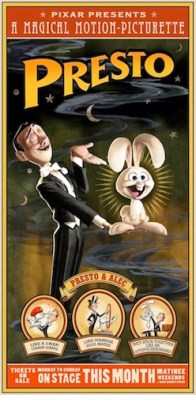
PrestoThe last Pixar film I bothered to head to the cinema for was 1999’s Toy Story 2, back in the days before “it’s made by Pixar” was reason enough to see a film (remember those times? They seem so long ago…) Their only other releases had been the first Toy Story (my enjoyment of which being the motivation to see the sequel) and the unappealing A Bug’s Life. Since then I haven’t had enough desire to expend the effort — or the money — to catch any of their films on the big screen. I explain this because, I’m reliably informed, all Pixar films are preceded by a short while in cinemas… but, because I’ve only seen most of them on DVD, I forgot this, so was initially surprised to see a caged rabbit when I was expecting an adorable little robot.

This rabbit, it turns out, is called Alec, and he’s a bit of a bastard. I think we’re supposed to root for him, and I’m sure kids (and many adults too) will, but while his owner (the titular magician) isn’t especially nice to our starring bunny (the plot is concerned with Alec trying to get a carrot that Presto won’t give him, yet), Presto doesn’t treat Alec quite as badly as Alec treats Presto. On the other hand, the overload of OTT physical violence is all in the name of humour, so that’s OK. It’s not as satirically extreme as The SimpsonsItchy & Scratchy though, which will ironically lead some to declare it promotes violence as comical. But then such ludicrousness is political correctness for you — in fact, Presto‘s brand of violence is very funny indeed. Completely dialogue free, it quickly becomes a breakneck feast of visual, mostly slapstick, humour. It may be violent, but it’s also highly witty, marvelously inventive, and wholly entertaining… even if the hero is morally dubious. But then, Roadrunner was a total wanker and he always won.

You can’t judge shorts on the same level as features, because they’re a different form — that’s why I don’t include them in the main numbering on this blog, and why I once felt the need to go on about that. So while awarding Presto a full five stars doesn’t mean it’s likely to be vying with The Dark Knight or… well, The Dark Knight… for my Film of the Year, it is thoroughly deserved. It’s a perfectly entertaining piece of short comedy, and it’s great that Pixar continues to facilitate wide exposure for such work.

5 out of 5

Best in Show (2000)

2008 #15
Christopher Guest | 87 mins | DVD | 12 / PG-13

Best in ShowMockumentary from some of the team behind the perennially popular This is Spinal Tap. The target this time is the Competition Documentary, a genre of which the best comparable example I can recall is the excellent Spellbound (not the 1945 Hitchcock one). In this case, the film follows five sets of dog owners as they enter a prestigious dog show — an American Crufts, if you will.

The script, acting and direction always err just this side of believability, meaning if you came to this cold (and managed to not recognise any actors) you might be fooled into believing it was genuine. That doesn’t mean it’s short on laughs however — quite the opposite — and much of the comedy comes from the various recognisable character types. Not all of it mind, as many of the best moments are courtesy of a pair of commentators, who are always a good source for laughs (the first example that springs to mind is Dodgeball). Fred Willard does an excellent job as the poorly chosen sports commentator, and even his British straight man (in the ‘comedy double act’ sense), Jim Piddock, manages to grab a few laughs.

I reviewed This is Spinal Tap back at the start of last year, and while I enjoyed it (enough to award four stars) I found it often underwhelming and perhaps a victim of its own hype. No such issues with Best in Show. While it may not manage laugh-a-minute, its hit rate is above average, and what passes in between the gags is a surprisingly decent comedy-drama.

4 out of 5

Ratatouille (2007)

2008 #13
Brad Bird | 106 mins | DVD | U / G

RatatouilleMy 2007 catch-up continues with Pixar’s highly-praised and award-winning latest, which currently sits as that animation studio’s highest entry in the IMDb Top 250 (their only films not to feature are A Bug’s Life, Monsters, Inc. and Cars). It seems a bit unfair to begin this review on such a downbeat note, but I personally don’t find such a position deserved. As is all too frequently the case, Ratatouille has become another victim of hype.
It’s been pretty impossible to avoid the praise that’s been heaped upon Ratatouille, be it unanimously positive reviews in papers, magazines and online, or overheard conversations in public, or the numerous high-profile awards it’s garnered (most recently, the best animation Oscar, plus a nomination for original screenplay). I was left expecting to be blown away by the best Pixar film made thus far. Sadly, this was not to be. It’s not as funny as Finding Nemo, or Toy Story, or Toy Story 2, or probably The Incredibles. Nor is it as cute as many of them. Or quite as heartwarming, to be honest. And the characters aren’t really as lovable.

OK, this is getting too depressing. The thing is, Ratatouille is a good film, but it is also a flawed one. It’s not nearly funny enough for a kid’s movie — laughs are almost non-existent in the first half and hard to come by in the second — and it’s too long, needing a good chunk taken out of that duller first half. It’s a bit confused as to who the villain is, meaning there’s a lack of real menace from either of the candidates. Despite a professed aim to make rats lovable, they’re not really. Even the potential love story is lacklustre because they wind up together far too quickly.

There I go again with the negatives. I think it’s far too easy to spot the faults in Ratatouille because everyone else has done such a thorough job on the positives, so I’m stuck analysing why I was so disappointed. There’s no denying how gorgeous it looks though — I can’t think of another CG film that even comes close. The level of detail is stunning, not just in set design (which includes whole intricately designed locations just for seconds-long sequences) but also in terms of what’s going on in the background. Check out Remy’s first conversation with his dad at the rats’ new home in Paris, for example: a simple shot-reverse-shot dialogue scene with two characters, but there’s continuously other rats talking, moving past, and so on in the background — all out of focus, not trying to be showy, like natural background detail in a live action film. No other CG film with such attention to ‘pointless’ detail comes to mind. But it also allows itself to be what it is — for want of a better word, a cartoon. Linguini waves his arms about like rope when he’s out of control, the chase sequences are madness, the design of the humans, cars, and almost everything else are suitably stylised. And it all comes with a soft warm glow that is, frankly, beautiful.

Despite my criticisms, Ratatouille is nonetheless a four-star film as far as I’m concerned. I also think that, with its shortage of laughs and cute characters, and with the main areas of appreciation in facets such as cinematography, it’s more a movie for adult animation fans than children. It’s not Pixar’s best, but true to form it’s head and shoulders above most other CG animated fare. Approach it with lower expectations than most reviews would give you and perhaps you’ll enjoy it even more than I did.

4 out of 5

Ocean’s Thirteen (2007)

2008 #11
Steven Soderbergh | 117 mins | DVD | PG / PG-13

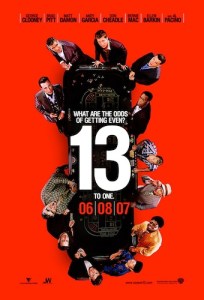
Ocean's ThirteenLast year I reviewed Ocean’s Twelve, and came to the conclusion that it had been slightly harshly treated by critics — while not a patch on the first film, it was a decent enough heist romp. Now it’s the turn of last year’s threequel and, by contrast, I found it to be distinctly overrated.

In fact, I’d personally put Thirteen at about the same level as Twelve. The return to both a Las Vegas setting and the first’s glossy cinematography seem to have fooled many into thinking it’s more like Eleven, but the convoluted and over-long plot (needlessly complicated by some chronologically variable storytelling), relative lack of humour, over-abundance of under-used characters, and lacklustre finale belie the truth.

Thirteen is Twelve with Eleven’s sheen. Its critical success relative to its immediate predecessor is, I think, another of the gang’s expertly executed cons.

3 out of 5

Calendar Girls (2003)

2008 #6
Nigel Cole | 103 mins | DVD | 12 / PG-13

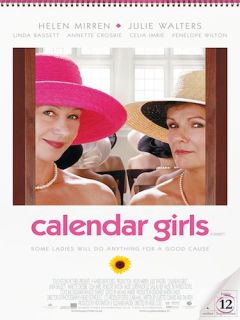
Calendar GirlsHelen Mirren and Julie Walters lead a cast of recognisable British actresses in this popular comedy drama about the true story of a group of Women’s Institute members who posed nude for a charity calendar. The film could so easily have been quite a lowly, cheap TV movie effort, what with its apparently farcical premise, worthy cause and older characters. But instead the filmmakers have crafted a movie that is both utterly hilarious and deeply moving — even for this younger male viewer.

Balancing comedy and drama, and making both work, is quite a feat — as someone once said, most comedy-dramas are so called because they’re neither very funny nor very dramatic — so it’s always impressive to see it pulled off so well. It’s surprisingly fast-paced, the central story supported by a number of well-chosen subplots that help shed light on the motivations of the women, making them more than just some older ladies who decided to strip off. Penelope Wilton is especially worthy of mention, as the downtrodden housewife who uncovers her husband’s affair. Of all the supporting cast she gets probably the largest role, even if it would seem to be the least heralded, and does an excellent job with it.

When I sat down to watch Calendar Girls I was expecting a pleasant bit of fluff that would make a lazy afternoon pass by amiably enough, even if it made an hour-and-three-quarters feel like two-and-a-quarter. I was surprised on most fronts: funnier, pacier, more dramatic, and more affecting than I had any reason to expect. Recommended, especially if you didn’t think it was for you.

4 out of 5