White Christmas (1954)

2008 #97
Michael Curtiz | 115 mins | DVD | U

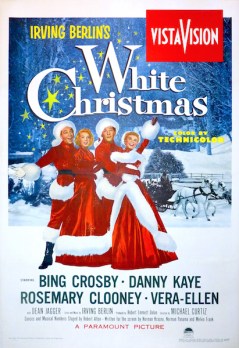
White ChristmasWhite Christmas is surprisingly un-Christmassy. Yes, it’s set at the right time of year, and the plot concerns itself with do-gooding and charity and other such vaguely seasonal themes; but, crucially, there’s a distinct absence of snow (until the very end) and little else actually inspires much Christmas feeling.

The plot winds its way to a moving finale, but, baring a few memorable numbers — Sisters, for example; and, particularly, a rendition of it by the male leads — most of the path there is quite average. One wonders how much of its renown is actually based on the titular song.

3 out of 5

White Christmas is on Film4 today, Monday 24th November 2014, at 12:50pm.

Chicago (2002)

2008 #96
Rob Marshall | 108 mins | DVD | 12 / PG-13

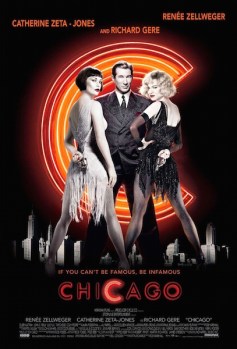
ChicagoI remember being distinctly unimpressed when Chicago took the Best Picture Oscar in 2003, especially as the alternatives included Gangs of New York and The Two Towers — not to mention Road to Perdition, an excellent film that was massively undervalued during award season.

In its favour are a number of memorable songs, all performed with impressive routines. On the downside, they’re all quite stagey in their choreography, though this suits the daydream-fantasy style in which they come about. In fact, the ability of film to make clear the distinction between ‘real life’ and fantasy means the film is far easier to follow than the stage version.

The story is passable enough, serving as a roadmap between the songs and offering the occasional bit of commentary/criticism on celebrity culture — it may be set in the ’20s and have been written in the ’70s, but the characters’ underhand tactics to keep their story on the front pages are as pertinent now as ever.

Five years on, Chicago isn’t as poor as expected — it manages to be consistently entertaining — but nor is it superior to the alternatives. For a current comparison, it’s only marginally better than if Mamma Mia were to trot round winning Best Picture gongs this year.

4 out of 5

The Blues Brothers (1980)

2008 #99
John Landis | 142 mins | DVD | 15 / R

The Blues BrothersCult comedy musical, with a more-than-healthy dose of the surreal, about two brothers on a mission from God, here watched in the extended DVD version (full details at IMDb). Maybe this is why it takes a while to get going — the first hour or so could do with a kick up the proverbial — and has a tendency to sprawl like an unruly first draft.

On the other hand, its insistence at being random, crazy, and incessantly silly throughout is beautifully anarchic. There’s an array of fabulous cameos — Ray Charles! Aretha Franklin! and Carrie Fisher, feeding the anarchy with her ludicrous attempts to kill one of the titular pair. While there were fewer songs than I’d expected, they’re all classics rewarded with infectiously fun performances. Then there’s the climactic car chase, which surely challenges many more serious examples for pure excitement value.

And any film which sees Neo-Nazis jump into a river to avoid being run over has to be good.

4 out of 5

The Blues Brothers is on ITV4 tonight, Friday 26th September 2014, at 11:35pm.

(Originally posted on 24th January 2009.)

Swing Time (1936)

2008 #100
George Stevens | 99 mins | TV | U

Swing TimeSwing Time is, I’m told, widely hailed as the greatest of the Fred Astaire/Ginger Rogers pictures. The plot isn’t especially captivating, one of the stock variations on “boy meets girl” that still serve romcoms to this day, but that’s not the main reason these films are so loved.

That, of course, is the song and (especially) dance numbers. I can’t say I recall any of the songs now, but the dances are suitably impressive. Particularly memorable is an early number where, after Astaire accidentally gets Rogers’ dance teacher character fired, he shows the proprietor how much she’s taught him in the last ten minutes, winning her job back. Trust me, that makes far more sense on screen than in that pathetic explanation. Elsewhere, Astaire blacks up for a dance to Bojangles of Harlem. These days one might wonder why he had to black up, or consider the concept faintly racist, but clearly it was acceptable for the time and in no way detracts from the skill on display.

One interesting note is some story similarities to Sideways — yes, Sideways, the recent Oscar-winning indie comedy about love and wine tasting. Whether Swing Time had any influence on that (made almost 70 years later), or it’s just a huge coincidence, I don’t know, but there are several reminiscent moments throughout the engaged-man-and-buddy-find-love-in-far-off-location-(then-accidentally-let-truth-slip) plot.

I haven’t seen enough Astaire/Rogers films to declare whether this is their best or not, though personally I preferred Top Hat. In the same way the plot of some action films doesn’t matter one iota so long as the fights are good, so the story here is irrelevant beside the quality of the dancing — and that, at least, is exemplary.

4 out of 5

(Originally posted on 9th January 2009.)

Wallace and Gromit in A Matter of Loaf and Death (2008)

2008 #88a
Nick Park | 29 mins | TV | PG

Wallace and Gromit are phenomenally popular, as proven this Christmas Day when their latest adventure became the most-watched programme on British TV for three years (and that was just the overnights — ratings will rise when official figures are released in a couple of weeks). Not only that, but the TV premiere of their big screen adventure also made the Christmas Day top ten, a not insignificant feat. Popularity does not necessarily mean quality, of course, and in this case such figures come on the back of three popular shorts and a successful feature film. They were all extremely good too and, luckily, A Matter of Loaf and Death doesn’t let the batch down. (I feel there should be a better baking pun there…)

As ever it’s packed with inventive humour, both visual and verbal, and Gromit remains one of the finest silent comedy characters ever created. The amount of emotion and story that can be conveyed with a lump of plasticine is tribute to the abilities of Park and his team of animators. The rest of the creation is top notch too, not just in terms of impressive craft on characters and sets, but also in the use of lighting and camera angles to evoke other films while not losing the series’ individuality. If anyone still thinks stop motion is about a locked-off camera at a flat angle they are sorely mistaken.

Film fans will also delight in a slew of movie references, from a poster for Citizen Canine to an Aliens-inspired climax, and numerous even subtler ones in between. This is a feast that will undoubtedly reward seconds — and more.

If there’s one problem it’s that it’s too short. I don’t mean that in the usual “I just want more” way, but literally that it could perhaps do with being longer. There’s easily a feature-length story here, meaning it feels a little abridged as a half-hour short. It’s not rushed, thankfully, just not played out as effectively as it could be with double the running time.

The last three Wallace & Gromit adventures have each won Park an Oscar (and the first only lost out to Park’s own Creature Comforts). Will this bring the series’ fourth? It would certainly be deserved.

5 out of 5

The Aristocrats (2005)

2008 #87
Paul Provenza | 85 mins | TV | 18

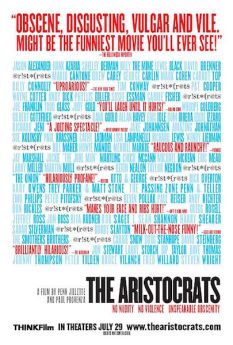
The AristocratsIt’s not unusual for films showing on TV to be prefaced with content warnings about language, sex or violence, but I don’t think I’ve ever previously seen one that feels the need to place such a warning after every single ad break. But if there’s one film that needs that treatment — or, rather, one film they could actually show on TV that needs that treatment — it’s The Aristocrats.

The Aristocrats is, apparently, an incredibly famous joke, well known to all comedians — and, generally, only told to each other, not to audiences — that is flexible enough for anyone to tell in their own way and still have it work. It’s also incredibly vulgar; in fact, the point is often to make it as vulgar as humanly possible. To explain much more would ruin the point of the film, which aims to expose and explain this cultish joke to the masses. Personally I’ve never heard of the thing, and for all I know The Aristocrats could be an elaborate Blair Witch-esque hoax — “oh yeah, all comedians know it”. Note this: the only people you’ll see throughout are comedians, and they all seem to know each other too.

Subject matter aside, there’s not much of a structure to the material presented. Mostly compiled from dozens of interviews, the resultant piece is a jumbled mix of comedians telling their version of the joke, comedians explaining variations on it (those whose telling completely changes it are the ones who succeed), comedians explaining why it’s funny, comedians explaining how it works, comedians explaining how and why it varies, comedians musing on the differences between male and female tellings of the joke…

On the other hand, even though there is a degree of repetition, there’s also a surprising amount to say about it — even by the end, when yet another comedian launching into their version has you reaching for the remote, there’s often another little titbit around the corner. In other notes: for British viewers, the biggest and most widely known names — Billy Connolly, Eddie Izzard — barely feature; for everyone, it features one of the worst ventriloquists I’ve ever seen; and a mime artist who singlehandedly makes the entire thing worthwhile.

The biggest problem with The Aristocrats — the film, not the joke — is quite a simple one: it’s about a single joke. Even the most meandering comedians tell several of those in an hour and a half. To compound the issue, said joke can vary so much as to defy a lot of comedy-killing “why’s it funny?” analysis. What you’re left with is repetitive retellings of a joke that, to be blunt, is rarely funny whatever you shove in the middle. It’s an insider’s film about an insider’s joke; for the rest of us, it rather over eggs the point.

3 out of 5

Madagascar (2005)

2008 #89
Eric Darnell & Tom McGrath | 82 mins | TV | U / PG

MadagascarIt had been my impression that this summer’s sequel, Madagascar: Escape 2 Africa, was a weaker follow-up to a middling original. Clearly I was reading the wrong review, because Rotten Tomatoes offers a different consensus: “an improvement on the original, with more fleshed-out characters, crisper animation and more consistent humor.” Oh. So what of the original?

The characters may not offer great depth, but they serve their purpose well enough. The plot focuses on Marty the zebra, voiced by Chris Rock, who wants to escape to the wild, and Alex the lion, voiced by Ben Stiller, who doesn’t — but doesn’t have a choice when they’re whisked off half-an-hour in. This might leave David Schwimmer’s giraffe Melman and Jada Pinkett Smith’s hippo Gloria with little to do but support, but in an 80-minute kids’ animation you can’t expect an Altman-esque portmanteau.

The animation is better than I expected. At the time, the angular style looked cheap, like a step back from the realism-aiming work of Pixar and the Shrek team. It’s just stylised however, still allowing plenty of expression in characters’ faces and detail in their movements and the locations. It’s not a exceptional example of how brilliant computer animated films can be (unquestionably Pixar’s forte, especially in the likes of Ratatouille and WALL-E’s earlier scenes), but it’s better than some sparse and clunky efforts (such as Aardman’s Flushed Away).

Equally, the humour is above average. Large laughs may be sporadic but are there, particularly in a few moments that nicely spoof other films. Standouts include Planet of the Apes and American Beauty — clearly aimed at the adult audience who have been dragged along by the kids, have come expecting Pixar-level entertainment, or want to see what Chris Rock and Sacha Baron Cohen can be doing in a family film. Plus there’s the penguins, a little band of wannabe escapees who thankfully aren’t overused, especially as the last few years have seen a severe overload of penguin movies (March of the Penguins, Happy Feet, Surf’s Up…) If there’s one element that could’ve been bumped up it’s the monkeys; on the other hand, like the penguins, they’re not done to death.

Madagascar doesn’t reach the highs of Pixar — no surprise there — but it’s at least nudging the ballpark. If the sequel’s better then I might even seek it out before it makes it all the way down to TV.*

4 out of 5

* I never did; and now it’s been on TV (several times), I still haven’t. ^

Enchanted (2007)

2008 #80
Kevin Lima | 103 mins | DVD | PG / PG

EnchantedYou’ve probably heard about Enchanted: it’s the one that starts out as a traditionally animated Disney film, before The Normal Girl Who Will Marry A Prince is thrown into a Magic Portal by The Evil Stepmother and finds herself in present-day New York. It’s one of those concepts so good it just makes you think, “why haven’t they thought of that before?”

Thankfully, they pull it off. It’s very funny, riffing on many recognisable elements from Disney’s considerable library of classics, and manages to produce a number of catchy songs of its own. Amy Adams is brilliant in the lead role, managing to be infectiously sweet rather than sickeningly sugary, while Susan Sarandon has a whale of a time in her boundlessly camp (though disappointingly small) role. The rest of the cast are good too, especially a wonderfully vacant James Marsden as The Prince.

The plot is ultimately predictable, but no more than you’d expect considering the target audience — certainly, kids will likely go through all the requisite emotions, and it would probably be more disappointing if they did try anything truly shocking. Still, it’s crammed with more than enough fun invention and new ideas to make up for any unsurprising plot beats.

Quite simply, Enchanted is a fantastic concept, beautifully executed. A veritable success.

4 out of 5

Scenes of a Sexual Nature (2006)

2008 #88
Ed Blum | 88 mins | DVD | 15 / R

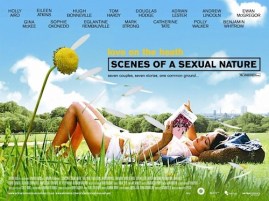
Scenes of a Sexual NatureScenes of a Sexual Nature is a half-accurate and half-misleading title for this low-budget British comedy drama. The first half is spot on — the film’s made up of seven unconnected scenes — while the second implies it’s ruder than it is.

Effectively, Scenes is seven short two-hand plays stuck together, occasionally intercut for no good reason (only one runs throughout), all on a similar theme — which, despite the title, is really “relationships” rather than “sex”. And “plays” is the right word: the styles of dialogue and acting, plus the sparsity of locations and cast members, not to mention the thematic construction, all suggest theatrical roots. In fact, so much does it seem grounded in the stage that I was thoroughly surprised to discover it wasn’t an adaptation. One wonders if writer Aschlin Ditta has perhaps launched his work into the wrong medium then; on the other hand, a stage production would never have attracted such attention or such a high number of recognisable names and faces.

Most of the scenes can be simply labelled — the Gay Couple, the Old Couple, and so on — and, unsurprisingly, some are better than others. The Gay Couple is a textbook example of how to write conflicting motivations both between a loving couple and within a single character, nicely performed by Ewan McGregor and Douglas Hodge. Consequently, it’s probably the film’s best sequence. Elsewhere, the Old Couple are quite sweet, Ditta pleasingly taking their story beyond an obvious, clichéd end point, though it is lumbered with a bench metaphor that’s a touch heavy-handed. Similarly, the Blind Date Couple is initially hilarious but doesn’t seem to know where to go, a problem that afflicts most of the film as every scene is distinctly inconclusive.

Worst is the one starring Mark Strong and Polly Walker, in which nothing at all happens in the name of a closing twist. It’s like the antithesis of the Old Couple bits. The one that stretches credibility the most, however, is the Divorcing Couple. Amicable divorces surely exist, but not that amicable — it’s very hard to believably see why they’re not still together. On the bright side, at least they’re not reunited by the scene’s end; but then, like much of the film, they’re not definitely apart either — it’s inconclusive.

Scenes of a Sexual Nature isn’t a bad film, but it is a bit of a mixed bag. Some stories work, others don’t. It’s not badly directed, but the writing and acting is all very stagey. It’s more like a collection of thematically and stylistically linked shorts than a feature in its own right. Some will no doubt take more from it than others, but I can only fall down the middle.

3 out of 5

Mamma Mia! (2008)

2008 #81
Phyllida Lloyd | 104 mins | DVD | PG / PG-13
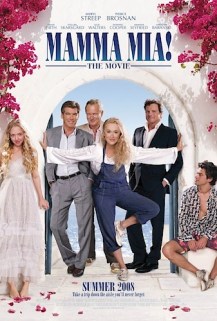
Mamma Mia!If you listen to the critics, no one liked Mamma Mia. If you listen to the public, everyone loved it. It’s the highest grossing British film of all time at the UK box office — at last count, just over £400,000 away from being the highest ever* — and was still playing on the big screen at hundreds of locations the weekend before its DVD release.

Mamma Mia! is the first feature from director Lloyd, who also directed the original stage production — and sometimes both facts show. She doesn’t always quite know what to do with the camera, the choreography is often aimed at a theoretical audience rather than the camera position (a pet peeve of mine), some shots are over-simplistic, others over-done, and there’s a bit of “point and shoot” too, missing opportunities that would be obvious to more experienced film directors. It’s never atrociously directed — at the very least, the scenery looks stunning, and is put to much good use — but it does the job and little more.

The songs themselves don’t need discussion (everyone knows what they think of Abba) but it’s worth mentioning how they’re choreographed and how they come about in story terms. Some have been brilliantly staged (Mamma Mia itself, but especially Does Your Mother Know), though others are flat and awkward (The Winner Takes It All doesn’t win anything as far as I’m concerned). Equally, some emerge naturally from the story (Chiquitita, Money Money Money), while others feel shoehorned in (again, The Winner Takes It All). For others still they seem to have just given up forcing them into the plot, leaving them to be performed by a musical act: Super Trouper, which at least is vaguely appropriate to the juncture it appears; and Waterloo, which is tacked on during the end credits, though at least is amusingly done.

The majority of the cast were clearly chosen for acting skills rather than singing ability, not that it’s done the film many favours. Pierce Brosnan was unfairly singled out by critics for poor vocals, but he’s no worse than several others. On the other hand, Julie Walters is as much of a riot as you’d expect, right from her first line, and earns the lion’s share of the laughs. For any bored male viewers, there’s always Amanda Seyfried, with her often bouncy pair of friends — played by newcomers Rachel McDowall and Ashley Lilley (why, what did you think I meant?) Every cast member is clearly having a ball, so much so that some forget to do more than read lines aloud; but it’s occasionally infectious, the frequency of infection being directly proportional to how susceptible the viewer is to this genre of music and this genre of film.

It may go without saying, but the more you like Abba the more you’ll like Mamma Mia. Conversely, the more you hate them the more you’ll hate it. (Extra stars can be added or subtracted at the end depending on which side of the fence you fall.) It’s therefore easy to see why audiences — especially British audiences — have lapped it up, while the critics have been fairly damning. On the other hand, the often clichéd first-draft-level script and occasionally ungainly first-readthrough-level performances don’t help things any. Luckily it very rarely takes itself too seriously, and consequently is often hilariously funny. Though it attempts both, it clearly works best when being a camp and cheesy comedy rather than a serious romance/family drama. One especially weak note, in my opinion, is the subplot awarded to Colin Firth’s character, who turns gay almost out of nowhere. It’s not a bad idea for a subplot, especially in a film based on Abba music (not that I’m applying any stereotypes here), but it’s poorly executed.

Mamma Mia! never aimed to please the critics, or even your regular movie-goer. Instead it sets its sights firmly on Women Of A Certain Age who can remember Abba from first time round, and students who perhaps listen to them in a more ironic way nowadays. In that sense, it’s clearly an unmitigated success. As camp as a row of tents, disliked by critics, loved by audiences: Mamma Mia! is everything you’d expect from Abba.

3 out of 5

* In the interests of fully-correct information, I feel I should point out that Mamma Mia! has now [December 28th, 2008] overtaken Titanic at the UK box office. (BBC News) ^