
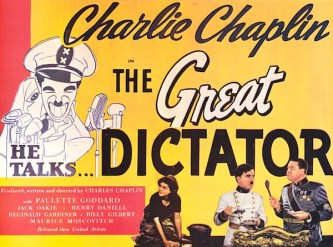
 One of the great things about doing 100 Films in a Year has been the number of firsts it’s either led me to or just been there to document: my first time watching films on Blu-ray and via legal download; my first time seeing films from directors as diverse as Woody Allen, Akira Kurosawa, F.W. Murnau and Krzysztof Kieslowski; my first time viewing such notable works as Breathless, Brief Encounter, Chinatown, Taxi Driver, This is Spinal Tap, The Wizard of Oz, and many more — including my first time seeing Citizen Kane. And here’s another for the list: my first ever Charlie Chaplin film.
The Great Dictator is one of Chaplin’s most widely-known films thanks to setting its sights on the Nazi regime and Adolf Hitler in particular. The general perception of silent comedians like Chaplin immediately suggests slapstick, but the real-world targets here make his work (on this film at least) satirical as well. I’m sure this made for great propaganda when it was released just a year into the war, but Chaplin’s skill and accuracy mean it works beyond that: like all good impersonations or spoofs it doesn’t make its objects silly for no reason, but instead takes what’s inherently laughable about them and exploits it. This would age some satirical humour, reliant as it can be on topicality, but the wide awareness even a modern audience has of Hitler means there are no comprehension problems today.
The style of humour can date nonetheless, but The Great Dictator remains funny — arguably the real test of a good comedy. It might not be to everyone’s taste, but that’s a problem comedy faces whenever it’s made. Chaplin loads the film with inventive and timeless routines, like the upside-down-plane, the coin-in-the-pudding, or the classic dance with an inflatable globe. Sometimes with comedy from decades previous, there’s the feeling you’re watching something that was funny at the time but no longer actually makes you laugh, thanks to changed conventions and expectations. For me, at least, there was no such problem here.
Surprisingly, there are some serious scenes too. While it doesn’t outweigh the comedy, there’s a degree of semi-factual drama in the plot that’s been well judged to help the humour cut deeper. The closing speech could come across as overly propagandistic but, again, it’s well pitched and therefore more galvanizing than inappropriately laughable. There are some bits, like this, that are sadly just as applicable to the modern world.
Chaplin allegedly said he wouldn’t have made The Great Dictator if he knew how bad things really were under Hitler, though some dispute this, arguing he knew and made it regardless. Some bits are slightly uncomfortable when one knows the reality, but whether Chaplin knew the truth or not these moments are fleeting. And, either way, Hitler and the Nazis were a worthwhile target: laughing at those who attempt to terrorise and dominate us is one of the most powerful weapons we have against them. That, certainly, is still true today.

* For reasons known only unto the BBFC, The Great Dictator was classified U until 2003, when film and video reclassifications both made it a PG. ^
 In Bruges has gathered quite a bit of indie-level praise and acclaim, culminating in wider recognition at the Oscars and other awards ceremonies at the start of this year. For those like me, finally getting round to seeing it in the wake of all this, it comes with quite a burden of expectation on its shoulders. Can it possibly be the modern classic many make it out to be? I mean, it is set in, y’know, Bruges…
 Commentary! The Musical falls somewhere between DVD extra, TV episode and short film. Whatever it should be classed as, it’s utter genius.
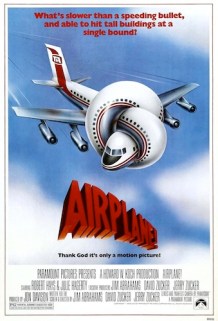 Airplane! is not… well, many things. But what it is is a comedy, and, as I’ve said before, if a comedy makes me laugh that’s good enough — it’s its job and, unless there’s more advertised, there’s no good reason to expect or desire more. So is it funny? Yes. But…
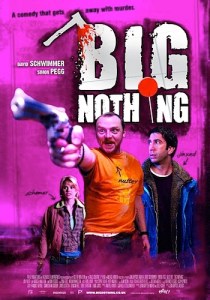 Big Nothing was co-funded by the Isle of Man and Welsh film boards; it’s therefore unsurprising that it was filmed in those locations; and there’s a bunch of British actors in it… but they’re all playing Yanks and it’s set in Oregon.
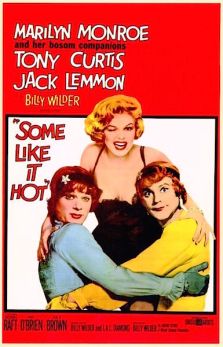 Did you know that Some Like It Hot is a remake of a 1951 German film,
 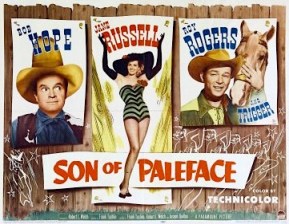 A sequel to 1948’s
  The work of Michel Gondry and the comedy of Jack Black are both, shall we say, acquired tastes, and not ones you would necessarily expect to overlap. Yet here they do — at least to an extent — but while Black is again doing his usual schtick as the Ker-Azy Best Mate, it’s the writer-director who is perhaps offering some surprises.
