The Gruffalo (2009)

2009 #89a
Max Lang & Jakob Schuh | 27 mins | TV
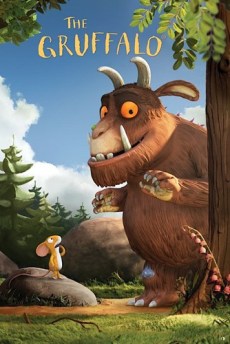
The GruffaloJulia Donaldson and Axel Scheffler children’s book The Gruffalo was a bit after my time but, I’m told, is incredibly popular with The Youth Of Today (not the ones that hang out on street corners earning ASBOs, obviously). It’s certainly a pleasant read, with rhythmic poetry and the kind of repetition that allows children to join in with ease, but it’s also quite short — fine for a children’s book, but not so good for attempting a screen adaptation of any length.

Having turned down numerous offers for feature-length versions, Donaldson accepted the half-hour short film treatment. Thank God she did, because even at under 30 minutes there’s some padding in evidence. There’s a brief bookend narrative featuring some squirrels, plus a leisurely pace throughout that takes in the scenery and wildlife of the forest world these character inhabit. Seeing a segment in isolation the film can look far too slow, with uncomfortably long pauses between each line of the original verse. As a whole, however, the viewer settles into its style and it rarely if ever feels forced.

The CG animation is well pitched. The textures and style at times left me wondering if the film was actually stop-motion animation, and consequently it carries the warm, cosy, intimate feel that such productions achieve and CGI almost universally fails at (even from Pixar). Whether it was the intention to emulate claymation or just a side effect, it’s certainly more effective than the work on Flushed Away, Aardman’s first CG outing that deliberately set out to look like their traditional stop-motion.

The voicework is equally spot on. John Hurt sounds fabulous in anything, Rob Brydon’s vocal changeability lends appropriate sibilance to the snake, it’s difficult to imagine anyone other than Robbie Coltrane providing the monsterly tones of the titular beast, and even James Corden fits as the mouse. Tom Wilkinson and Helena Bonham Carter also do fine work, meaning there’s not a weak link among them.

Despite being primarily aimed at kids — who hopefully won’t struggle too much with the languid pace — the very listenable poetry of the text and hand-made look of the visuals provide much for older children and adults to enjoy as well. Super.

4 out of 5

The Gruffalo can still be seen on the BBC iPlayer until 7:29pm today. It is also available in HD.

(Originally posted on 2nd January 2010.)
Fatal Instinct (1993)

2009 #86
Carl Reiner | 90 mins | download | 15 / PG-13

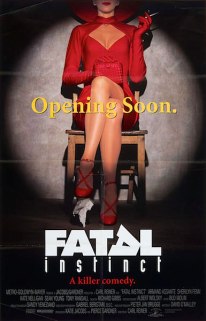
Fatal InstinctHaving just recently laid into High Anxiety, a spoof in a broadly similar style that also took on thrillers, it seems a little hypocritical to praise this, which flopped so badly in the US it went straight to video over here. Unfortunately, life isn’t that simple, and where Mel Brooks’ effort failed to amuse me this succeeded.

The plot, such as it is, doesn’t bear much discussion, being a loose amalgamation of half a dozen other films in the name of spoofery. So too the performances — no one distinguishes themselves as a comedic genius, but none let the side down. Reiner’s direction is equally fine, setting up and paying off the visual, verbal and aural jokes perfectly well. He drops the ball in a couple of instances however, allowing several jokes to run on well past their natural conclusion, and indulging in a few well-worn staples of the genre — the on-screen-musicians-playing-the-score turn up, for example, although at least there’s a nice variation at one point involving a tape player.

It’s a little difficult to understand exactly why it flopped so badly in the US as it followed in the wake of the similarly-styled Hot Shots!, which was successful enough to spawn a sequel. But then perhaps exactly that hindered it — Fatal Instinct’s release came just a few months after Hot Shots! Part Deux.

Or perhaps its targets were just too broad to attract a mass audience. While it ostensibly tackles then-recent thrillers like Basic Instinct, Cape Fear and Fatal Attraction (though the latter was already six years old at this point), it also has a lot of time devoted to the tropes of film noir, in particular Double Indemnity. Relying so heavily on a 50-year-old film isn’t likely to earn you much favour among the masses.

I’ve not seen any of those ’80s/’90s thrillers it targets, but Fatal Instinct seems to stick to the most famous bits, making the references easy to appreciate even for those with just a passing knowledge. Conversely, it seemed to me that having seen Double Indemnity would be a major advantage. But then again, perhaps that’s simply because I spotted the references to it and missed references to the films I hadn’t seen without, er, missing them, and anyone who hadn’t seen Double Indemnity would survive in much the same way. At the very least I’m sure it’s easier to follow than this paragraph…

Fatal Instinct may not be terribly original in and of itself — though, obviously, the films it chooses to spoof set it apart from its kin — and some of the gags are very much old hat (a roving camera bumps into something and breaks the lens, for instance), while others go on too long — as does the film itself, actually — but anyone who enjoyed all the films mentioned in this review may find it’s capable of raising a few smiles.

3 out of 5

Shadow of the Vampire (2000)

2009 #56
E. Elias Merhige | 81 mins | TV | 15 / R

Shadow of the Vampire“What if Max Schreck really was a vampire?” is the simple, thoroughly daft, and equally promising, premise of this low-budget horror/drama/comedy.

Having the advantage of such a good concept to kick things off, all starts well, but the longer it runs the more it loses it. Screenwriter Steven A. Katz seems unsure of what Shreck/Orlok actually wants or what the rules governing his existence are, leaving him little more than a threat for the sake of a threat. Still, Willem Dafoe’s performance in the role is brilliant, reveling in the chance to overact — and yet, somehow, subtly overact — as a silent movie vampire. The rest of the cast are fine; in particular, the obsessive and mildly unhinged Murnau seems to suit Malkovich down to the ground. It’s also scary in places, as it should be, because it’s a vampire horror movie that just happens to take the making of another real one as its starting point. Unfortunately, as the plot becomes confusing and ill explained towards the end, so the scares dissipate alongside the viewer’s understanding.

My confusion over the film’s third act may have an external explanation, however. The BBFC list the PAL running time as 88 minutes, but BBC Four’s showing only just hit 81. It certainly felt like there was a chunk missing somewhere in the middle — a slew of characters just disappear and there’s an unexplained leap in the plot — but I can’t think of a reasonable explanation for why or how the BBC would cut seven minutes out of the middle of a film, and the only detailed plot descriptions I can find don’t describe anything I missed.

Nonetheless, even allowing for omissions Katz gives up on any semblance of following the facts toward the end (and throughout, apparently): almost everyone involved is slaughtered, even when they clearly survived in reality, while one character is driven out of his mind, even when he clearly wasn’t… well, presumably. That said, we all know Schreck wasn’t a vampire — his life isn’t nearly mysterious enough to allow for the possibility, should you even believe in such a possibility being possible — so with that leap already taken, why not take as many others as you fancy? Perhaps because it’s not as clever, and not nearly as much fun, as fitting the preposterous tale around the known facts.

Merhige’s direction is occasionally very interesting, such as a couple of grand shots early on, but at other times is perfunctory. To be kind, one might say he goes too far in the aim of replicating silent film style — certainly the intertitles that needlessly replace chunks of the plot are a step beyond. He does manage to create and maintain a weird, unsettling atmosphere, which remains even when all sense disappears.

It’s difficult to accurately assess a film when it appears a good chunk has been lost somewhere in the middle, especially when one suspects some of its major flaws — namely, a lack of coherence at the end — may be due to this omission. On the other hand, I can’t find any evidence that something has been cut, so maybe it just doesn’t make sense? Either way, even on the evidence of what I’ve seen it feels like Shadow of the Vampire takes a good idea, runs well for a while, but winds up uncertain of what to do with it. Though it remains interesting, I won’t be rushing to see any fuller form.

3 out of 5

High Anxiety (1977)

2009 #65
Mel Brooks | 94 mins | TV | 15 / PG

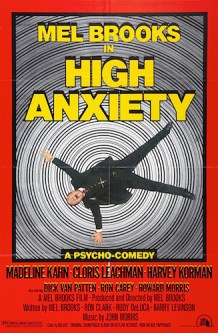
High AnxietyMel Brooks pays comedic tribute to Alfred Hitchcock — in case you can’t tell, the second credit is a prominent dedication — but those unfamiliar with the Master of Suspense’s output need not apply.

Brooks presents a largely Hitchcockian plot, though the clearest references come in a couple of sketches and one-liners. To be fair, there are several significant Hitchcock films I’ve still not seen, leaving the nagging sensation that some allusions and gags simply passed me by. On the other hand, maybe they just weren’t funny — I can’t remember many laughs that didn’t spring from a Hitchcock reference of some kind.

Indeed, whole chunks pass by without a laugh. At other times, bits that are clearly meant to be funny just don’t hit home (though I’m aware that, inevitably, they will for some people), while some gags are almost reassuringly familiar: a dramatic piece of music kicks in, causing characters to look around until they see a band in full swing has appeared nearby, for just one example.

Things pick up considerably in the second half, which is also more obviously Hitchcockian to my mind. Some scenes offer very good, though specific, riffs on famous Hitchcock moments — a version of Psycho’s shower scene is particularly memorable, though a scatological take on The Birds will please some — but these are almost exclusively asides to the story, little sketches inserted wherever Brooks can find space to squeeze them in. They provide welcome amusement, but are far from integrated into the plot.

At this point I’m beginning to suspect Brooks’ humour just doesn’t gel with me. I enjoyed Spaceballs when I was younger, but watching it a couple of years ago I found it more embarrassing than entertaining. Even the widely praised Blazing Saddles raised little more than the occasional smile. High Anxiety, unfortunately, now joins this line-up.

2 out of 5

The Apartment (1960)

2009 #36
Billy Wilder | 125 mins | download | PG

The ApartmentAn article I once read (but have long since misplaced, unfortunately) asserted that Billy Wilder once said (and I paraphrase heavily here, I’m sure) that, contrary to expectations, when he was feeling happy he’d make a serious picture, and when feeling down he’d make a comedy. Goodness only knows what kind of mood he was in when he chose to make The Apartment, then, because it flits between the two with gay abandon.
It begins almost as a farce, with Jack Lemmon playing up the near-misses inherent in lending your apartment to adulterous men; and though this comedic vein never goes away, the film also develops a dark side. Alongside the affairs and underhand dealings — in which our hero is closely involved — there’s an attempted overdose, discussion of other suicide methods, and respectable men getting divorced. It all seems quite shocking for a film made under the Hays Code, though that was on its last legs (Wilder’s own Some Like It Hot had been released without code approval the year before and still been a huge hit), and Mad Men and its ilk suggest such goings-on by businessmen may not have been so surprising to contemporary viewers either.

On the technical side, Wilder employs long scenes and long takes, but Lemmon never stops bustling through them, always doing something, keeping the film active and moving even when Wilder declines to follow. It’s the latter that makes the former so effective, rendering Lemmon’s character the odd one in an otherwise static world, the one still turning to humour in the face of all life’s bleakness.

Real life always serves up humour alongside tragedy, yet despite that it takes skilled filmmakers to do the same without one lessening the other. Wilder and Lemmon are, of course, among them, and one can imagine few finer examples of such a blend than The Apartment.

5 out of 5

For Your Consideration (2006)

2009 #57
Christopher Guest | 79 mins | TV | 12 / PG-13

For Your ConsiderationThe makers of This is Spinal Tap and Best in Show — along with all their usual cast members — swing their satirical sights from others’ work to their own industry. Unfortunately, it’s not a patch on their previous efforts.

The biggest problem is that most of the gags feel a little familiar. It’s not that they’re unfunny, just that they don’t feel very original. Worst off are the numerous jokes about the internet, mobile phones and other technology, which feel more 1996 than 2006. It’s all lacking in subtlety, taking a broad swipe at the whole filmmaking industry rather than incisively mining its constituent parts for something insightful.

The best bits come in the second half, when the cast and crew (of the fictional film-within-a-film, that is) hit the campaign trail to promote their movie. The styles of TV shows that various people appear on — the different levels awarded to the leads, other cast members, the writers, and so on — has some decent satire, the closest For Your Consideration comes to being truly revealing.

Most disappointing is that this should have been so good. The team who basically invented the spoof documentary finally taking on their own industry? Brilliant! But it feels like they felt the same way and rushed into production without properly thinking it through. Which, in its own way, is rather ironic.

3 out of 5

High Society (1956)

2009 #54
Charles Walters | 107 mins | DVD | U

High SocietyCole Porter-scored musical remake of The Philadelphia Story, which is probably most famous for featuring Who Wants to Be a Millionaire? and being star Grace Kelly’s final film before becoming a princess.

Despite rarely singing, Kelly is by far the film’s standout element — it’s easy to believe three different men would be vying for her affection, but she also gets the chance to show the greatest range of any cast member. Admittedly it’s shades of comedy rather than a full awards-worthy display of ability, but she carries the film beautifully. It’s no wonder her husband-to-be, Prince Rainier of Monaco, objected to her appearing in movies when she played roles such as this: a divorcee who at one point allegedly sleeps with another man on the eve of her wedding to a third is surely no role for a princess. (Turns out she didn’t sleep with him, mind.)

Bing Crosby and Frank Sinatra are more-or-less themselves as the male leads, though the sole song they perform together, Well, Did You Evah!, is one of the film’s best — despite being a late addition from a previous Cole Porter musical after it was realised Crosby and Sinatra didn’t have a number together. Louis Armstrong also plays himself, literally, and brightens up the screen whenever he appears. His band’s duet with Crosby, Now You Has Jazz, is another of the film’s highlights.

Despite being adapted from an acclaimed play and film, the plot feels like a relatively slight contrivance to link together a couple of songs — alternately of the Romantic and Comedic variety — and some farcical humour with a romance-based thread. That the right people end up together is no surprise — so little surprise, in fact, that the story doesn’t even bother with such trivial things as making the final entanglements come together believably.

No matter. It’s the journey to the inevitable conclusion, through a few comical scenes and a few decent tunes, that makes High Society a perfectly pleasant dose of entertainment.

4 out of 5

High Society is on TCM UK today, Saturday 4th April 2015, at 4:15pm, and on Sunday at 9:35am.

The Knack …and How to Get It (1965)

2009 #34
Richard Lester | 85 mins | download | 15

The Knack …and How to Get ItI’ve never actually seen a Richard Lester film before, and so spectacularly failed to put two-and-two together about who the director was and what else he’d done before I watched this. If I had, recent (at the time of viewing) reviews of the BFI’s release of Lester’s later The Bed Sitting Room (such as John Hodson’s or Clydefro Jones’) might’ve prepared me for what was to come.
As it was, all I had to go on was the DVD art (as used by iTunes — this was another 99p Film of the Week), the bright and breezy title, and that it stars Frank Spencer. From that you’d be forgiven (I hope) for thinking The Knack was a colourful Swinging Sixties sex-com romp. Upon watching it, however, it’s immediately clear it’s nothing of the sort: it begins with a dream/nightmare sequence, complete with horror-esque music, before settling into a style and rhythm more reminiscent of Breathless than Confessions of a Window Cleaner.

At least, it does for a bit. In fact, it does a lot of things for a bit: Carry On-level double entendres, intense thriller-like scenes, slapstick sequences, an occasional New Wave-esque light jazz score… If it were an American schoolchild The Knack would surely be diagnosed with ADD, flitting around from one style to another with no immediately obvious rhyme nor reason, except perhaps a desire to try out interesting things and see where they lead. This will undoubtedly put some people off — on another day, I might be included among them — but instead I found it quite intriguing.

Stuck in the middle of what could have been a slew of directorial flourishes, the cast are allowed to surprise with some layered performances. Michael Crawford more or less does an early version of Frank Spencer (in fairness, that’s perfect for the role), leaving him overshadowed by Ray Brooks as lothario Tolen and Donal Donnelly as the slightly kooky Tom. Both subvert their initial impressions: Donnelly’s oddness hides a perceptive intelligence, while Brooks’ suave lover hides a subtly unnerving, menacing, dominating sexual predator. Some of the time, anyway.

There’s no doubt that I’m severely under-qualified to pass any kind of serious judgement on The Knack (some would say any film, but there you go). I’ve not even mentioned Rita Tushingham (apparently something of a ’60s icon), or Ray McBride (who or what is he, and what is his relevance?), or that it won the Palme d’Or at Cannes in 1965 (I do know what that is at least). A proper, informed judgement is therefore best left to those with a greater familiarity with Lester’s films (or at least his early work, before he went on to the likes of The Four Musketeers and Superman III). But to those equally as uninitiated as I, The Knack can be recommended as an unusual but surprising piece of work, full of things to pique one’s interest.

4 out of 5

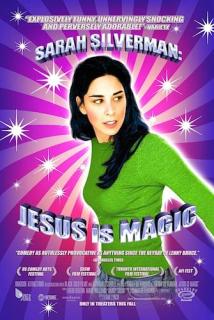
Sarah Silverman: Jesus is Magic [TV edit] (2005)

2009 #45
Liam Lynch | 50 mins | TV | 15

Sarah Silverman: Jesus is MagicStand-up concert films are an awkward business (as are rock concert films), raising questions that are oft pondered on this blog about what constitutes a “film”. After all, if this were just shown on TV or released direct to DVD rather than released in cinemas, no one would be considering it a feature. Indeed, Channel 4’s TV showing cut the 70-minute (PAL) version down to just 50, much as they do for the TV showing of any other direct-to-DVD stand-up gig. But the fact remains that this was released in cinemas (albeit not many) as a feature film. Though if it’s worthy of review under this blog’s remit, and direct-to-DVD movies are worthy of review too, surely direct-to-DVD comedy gigs should be? It’s enough to make your head hurt — something Jesus is Magic might also do, if it hasn’t sent you to sleep.

All comedy is an acquired taste, of course, but what Silverman offers here must take some acquiring. I mostly like what I’ve seen of her work in the past — I’ll admit to having I’m F***ing Matt Damon circling round in my head for weeks after first hearing it — but the lack of laughs here is enough to put me off bothering with her in future. Most of her material seems to be an excuse to say extremely rude or controversial things, and in fact often relies on these things being so rude as to provoke laughter just for that. The audience seem happy to go along, but there’s nothing inherently funny about a rude sentence — it needs a point, be it satire or surrealism (which she tries, but fails at) or something else. I have no problem with edgy or ‘offensive’ comedy, but this isn’t it.

Occasionally Silverman hits on something worthwhile amongst all the dross. Some of her comments on 9/11, the Holocaust and a handful of other edgy (and, indeed, ‘edgy’) areas raised a smile, maybe even a chuckle, proof (were it needed) that difficult topics can be covered as comedy. Even then, however, it’s only one or two gags among a raft of blabbing on those topics. At other times there are lines that desperately want to be funny, and if she’d managed to build up a head of comedic steam they’d garner a laugh as they passed, but in isolation they’re just not enough.

On a related note, the whole thing is bizarrely slow-paced. I don’t know if that’s an American thing or if British comedians are exceptional in their rapid-fire delivery — or just “relatively rapid-fire delivery”, because even the slowest joketeller you’d encounter on something like Live at the Apollo can spit them out twice as fast as Silverman — but she seems to take forever to get anywhere. Anywhere at all, that is, never mind to an actual joke. Few, if any, British comedians would survive at this pace.

Directorially, it’s a simple concert film, perhaps an over-edited one. Lynch splashes out during a couple of musical numbers, producing the occasional background gags this way — the people Silverman passes during I Love You More, for example — though at other points he’s just as guilty of spending too long on something that’s either not funny or that becomes humourless through exhaustion, such as the black people she encounters at the end of the same song.

Based on comments in online reviews, it seems Channel 4 mostly cut documentary material for their abbreviated TV showing. Whether these insights add some weight to proceedings or just slow the film down further I don’t know, but I’m thankful I didn’t have to suffer through another 20 minutes of this. As noted at the start, this editing (just like other stand-up DVDs transferring to TV) lends credence to the idea that this isn’t really a film. Whether it is or not ultimately doesn’t matter, other than if you’ve paid to see a comedy it would be nice to hear some gags — why go to the cinema for a humour-free evening you could stay at home with Michael McIntyre’s Comedy Roadshow and actually have a laugh?

1 out of 5

Also see Eamonn McCusker’s review at DVD Times for a similar perspective. I’d especially echo his final paragraph: “Or the everyday conversations that you can hear up and down the country, which [would] leave Silverman blushing. Compared to all that, Silverman seems safe.” It’s great to be British.

Sarah Silverman: Jesus is Magic featured on my list of The Five Worst Films I Saw in 2009, which can be read in full here.

Do You Wanna Date James Cameron’s Avatar?

It’s always fun to mush news stories together for potentially comedic effect.*

So when I heard, on the same day, of the expected success of the trailer for James Cameron’s Avatar (or, as I’ve taken to calling it, Phantom Menace 2: This Time Everyone’s Jar Jar) and the surprising success of The Guild’s music video for (Do You Wanna Date My) Avatar… well, I couldn’t help seeing what would happen were the two to collide…


* I’ll leave it to you to decide if this example is successful.