The Quay Brothers in 35mm (2015)

2016 #159
Quay Brothers + Christopher Nolan | 68 mins | Blu-ray | 2.35:1 + 1.85:1 + 1.33:1 | UK & USA / English | 12*
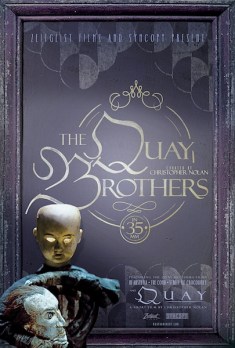
The Quay Brothers in 35mmChristopher Nolan made a few headlines last year when his first post-Interstellar film was announced for near-immediate release. Not Dunkirk, of course, but an eight-minute short documentary, Quay, about British-based American-born identical-twin animators the Quay brothers. The short was screened theatrically as part of a programme of animated shorts directed by the brothers, curated by Nolan to accompany his documentary, all from 35mm prints — because it’s Nolan, so of course. One critic reckoned it “will always be one of [Nolan]’s most important contributions to cinema.”

Today, the BFI release a Blu-ray set of the Quay brothers’ short animations, containing 24 of their works plus special features, among which is Nolan’s short. As a complete neophyte to the Quays’ work, I thought the best way to begin approaching it might be via the selection Nolan programmed, which was at least partly minded as an introduction to the brothers’ oeuvre. (Now, obviously I’m not watching this on 35mm, nor in its intended form (i.e. in a cinema), and it’s technically a selection of short films, so can I really count it towards my list? We’ll leave that to my conscience.)

Though if it is a beginner’s course, it’s the kind that throws you in at the deep end. In Absentia (2000) was, remarkably, made for the BBC as part of a season about sound on film — you can’t imagine them commissioning anything like this today. Maybe for BBC Four. Maybe. It’s an inscrutable 20-minute nightmare of a film, with sci-fi landscapes, a demonic puppet, sentient pencil leads, and the graphite-stained fingers of too many hands. It’s clear from the outset that these are films more about mood, atmosphere, and feeling than they are strictly concerned with plot or character, and to an extent one needs to be open to just going along with it in the hope that meaning or significance reveals itself.
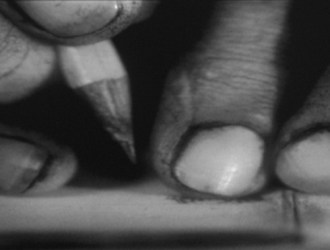
In AbsentiaFor all that In Absentia initially feels like flailing in deep water without armbands, accompanied with “what have I got myself into?!” thoughts, in retrospect I found it to be the most accessible of the three animations. It’s abstract and confusing for most of its running time, but by the end you can decipher some meaning; you can understand the relevance of the feelings it aims to generate — and if you haven’t got there yourself, or if you’re unsure, there’s a dedication to point you in the right direction. I didn’t get that with the next two; not so easily, anyway, which is why I say they’re less accessible rather than less good per se.

Nolan follows this opening salvo with his documentary, Quay. It provides a sliver of insight into the brothers’ methods and thought processes; the merest glimpse into how they do what they do, with little or no explanation for why or what it means. I suppose Nolan wasn’t aiming for enlightenment or explanation, but to instead acknowledge the craftsmanship of the animators. Rather than the kooky outré bohemians you might imagine from their bizarre films, the brothers seem quiet, calm, and, for want of a better word, ordinary. By placing his documentary here, Nolan gives you an idea of the people whose hands you’re in, before diving back inside their imagination…

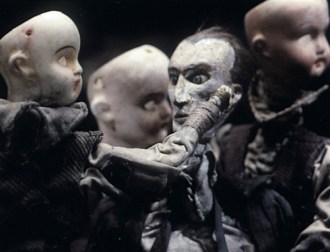
The Comb (1990) professes to be adapted from something and has immediately obvious characters, both human and puppet. “Ah,” you may think, “a clearer narrative.” No chance! I came away with even less of an idea what this was about than I did In Absentia, and certainly no clue what a comb has to do with most of it — the exception being the bits where there is a comb, because then there is a comb there. In a piece on the film at BFI Screenonline, The CombMichael Brooke notes that it is “setting out to wrong-foot the viewer at every turn, and the result wilfully defies verbal analysis.” What can be easily discerned is that it’s about a dream, and it probably shouldn’t be a surprise that there’s some dream-logic involved. As to what else is to be gleaned, your guess is as good as mine.

Last up is the film that’s reckoned to be the Quays’ masterpiece, Street of Crocodiles (1986) — Terry Gilliam picked it as one of the ten best animated films ever, while critic Jonathan Romney has twice nominated it in Sight & Sound’s famous “greatest films of all time” poll. Once again, I was left initially floundering for significance. There’s some fascinating imagery, and the implication again that parts function though dream-logic, but as to an overall story or message… Reading various sources before writing this, a theme emerges: that to search a Quay Brothers film for direct meaning is futile; it’s more about somehow accessing the same otherworldly psychological and/or emotional space that’s peculiar to these filmmakers. Even when the Quays themselves describe what’s going on in Street of Crocodiles, you’ll notice there’s nary a nod to meaning — though even an outline of the plot as they conceived it is illuminating, unlocking something you sort of already knew, but providing a kind of clarity that felt absent before. A bit like that title card at the end of In Absentia, I suppose.

It’s true what they say: watching Quay Brothers shorts is like being given a glimpse into another world, connected to our own but also other to it — hiding in the cracks or around the corner, perhaps; or only in our dreams and nightmares; on the other side of the mirror, were we able to pass though it. Their work is our conduit to this otherness, which is Street of Crocodilessometimes informative about the world the rest of us live in (In Absentia), sometimes a twisted analogy for it (Street of Crocodiles), and sometimes just fascinatingly unknowable (The Comb). All the films are teasingly oblique, and by all rights that should make them frustrating to the point of irritation, even abandonment… yet they’re kind of compelling nonetheless.
Oh, and do I need to throw in a “they’re not for everyone” at this point? I imagine that’s implicit.

4 out of 5

The aforementioned Blu-ray collection, Inner Sanctums – Quay Brothers: The Collected Animation Films 1979-2013, is released by the BFI today. The genuine Quay Brothers in 35mm is screening at London’s Prince Charles Cinema in November.

Further Reading

* Although this particular presentation hasn’t been certified by the BBFC, a collection of Quays shorts featuring these is rated 12, and Nolan’s short is classified U. ^
Legend of the Guardians: The Owls of Ga’Hoole (2010)

2016 #104
Zack Snyder | 93 mins | streaming (HD) | 16:9 | USA & Australia / English | PG / PG

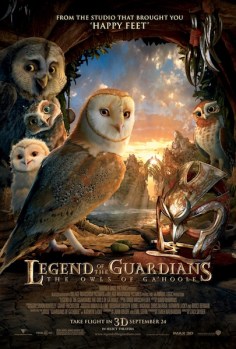
Legend of the GuardiansLegend of the Guardians is pretty odd.

It’s an action-fantasy movie… starring owls. It’s animated, but in a dark, realistic way (think Rango with less cartoonishness and less light). It’s based on a kids’ book series… but directed by Zack Snyder, clearly reining in his R-rated impulses (violence occurs just off screen, leading to “did that happen?” confusion). The story has been relocated to Australia, the cast filled with well-known antipodean actors and their accents.

The cumulative effect is kind of surreal, retaining too much Snyderness to function properly as the kind of movie it wants to — perhaps should — be.

3 out of 5

Grave of the Fireflies (1988)

aka Hotaru no haka

2016 #67
Isao Takahata | 90 mins | DVD | 16:9 | Japan / Japanese | 12

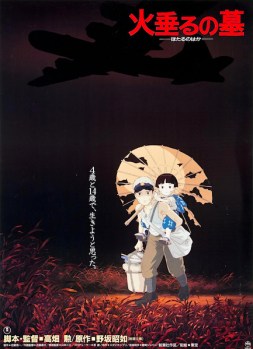
Grave of the FirefliesOne of the most praised animated films of all time, this Studio Ghibli feature tackles grim subject matter: it’s the story of Seita and his little sister Setsuko, a pair of Japanese children who are orphaned and eventually left to fend for themselves in the closing months of World War 2. It begins with Seita dying of starvation and joining the spirit of his dead sister, so you know it’s not going to end well. A Disney movie this is not.
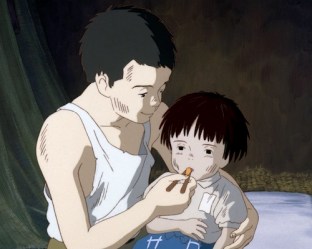
It’s kind of hard to avoid the praise Grave of the Fireflies has attracted, which is why it ended up on my Blindspot list this year. It’s the third highest-rated animation on IMDb (behind Spirited Away and The Lion King), which also places it in the top 25% of the Top 250, not to mention various other “best animated” and “great movie” lists. I mention all this because I fear the weight of expectation somewhat hampered the film for me. It’s by no means a bad film, but, despite the subject matter, it didn’t touch me to the same degree as, say, My Neighbour Totoro (which, coincidentally, it was initially released with).

So where did it go wrong for me? Perhaps my biggest issue was with Seita and the choices he made. I guess part of the point is that he is still a child and so unable to adequately care for himself and Setsuko, but I don’t get why he resorts to stealing, looting, and allowing them to starve when, as it eventually turns out, they still have 3,000 yen in the bank — enough to buy plenty of hearty food when it comes down to it. Why didn’t he turn to that money much sooner? Why did it take a doctor telling him his sister was malnourished and refusing to help before he thought, “you know what, I could always use that money we have saved up in the bank to feed us so I don’t have to steal and nonetheless be short of food”? When he does eventually withdraw that cash and buy some decent supplies, it’s a very literal case of doing too little too late.

Another thing is that the film is often cited as a powerful anti-war movie, because it depicts the ravaging effects on innocents. However, director Isao Takahata insists it isn’t, saying it’s about “the brother and sister living a failed life due to isolation from society”. I’m inclined to believe him, because, from what we actually see on screen, these two kids are the only ones to be so badly affected! Okay, we do see people have died, and we’re told that food is running out… but there’s a gaggle of kids who seem to be having a fun day out when they stumble across the siblings’ makeshift shelter; or, right at the end, people who merrily arrive home and pop their music on. The film doesn’t try to claim that only these two kids suffered, but — aside from a few other destitutes at the start, and the bodies we see after the first bombing (later bombings don’t make any casualties explicit) — we don’t really see anyone else suffering. I’m not arguing that Takahata is saying no one else suffered, nor that these observations make it pro-war (I mean, any children dying, even if others are surviving, is not a good thing), but I didn’t get an anti-war message that was as powerful or as overwhelming as other viewers seem to have.
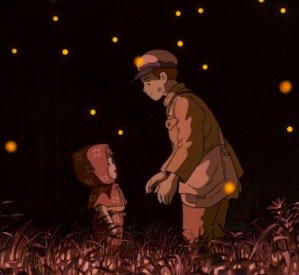
I’m an advocate of animation as a form (which must sound like a ridiculous position to have to take in some countries, but in the West “quality animation” begins and ends with Disney musicals and Pixar’s kid-friendly comedy adventures), but I think the fact this particular story is being told with moving drawings is detrimental. I’ve seen online reviews that say it makes the film more bearable because it creates a kind of disconnect from the real world — and, really, this story shouldn’t be “bearable”. That’s not to say you can’t feel an emotional connection to animated characters, but, as a medium, animation regularly deals in fantastical subjects, so with material this gruelling it does make it seem less real.
Despite these issues, Grave of the Fireflies does still pack a punch, but I wasn’t as bowled over as I’d expected to be.

4 out of 5

Grave of the Fireflies was viewed as part of my What Do You Mean You Haven’t Seen…? 2016 project, which you can read more about here.

Batman: The Killing Joke (2016)

2016 #129
Sam Liu | 77 mins | Blu-ray | 1.78:1 | USA / English | 15 / R

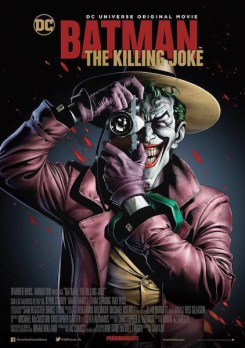
Batman: The Killing JokeAlan Moore and Brian Bolland’s 1988 graphic novel The Killing Joke is one of the seminal works of superhero comic books’ move into seriousness in the ’80s, sitting just behind the likes of Watchmen, The Dark Knight Returns, and Batman: Year One in terms of significance. It’s also seen by many as the definitive story about Batman’s nemesis, the Joker, and has influenced the live-action interpretations of both Jack Nicholson & Tim Burton and Heath Ledger & Christopher Nolan. It is not without controversy, however, thanks in large part to its treatment of Barbara Gordon / Batgirl; and Moore has since semi-disowned it, saying it has no intrinsic value because it has nothing to say about real human beings, only commenting on the comic-book-y relationship between Batman and the Joker.

Now, it finally makes its way to our screens in animated form. What took so long? Well, it’s dark, and to do it justice the makers needed the potential to make it R-rated. Given permission to do so by Warner, they’ve done just that. So here we have a very faithful adaptation of the graphic novel… but it’s a bit short, so there’s a 28-minute prologue stuck on the front. Designed to ameliorate some of the issues people have with the original book, it’s actually only made things worse, containing brand-new controversial elements all of its own. Oh dear.

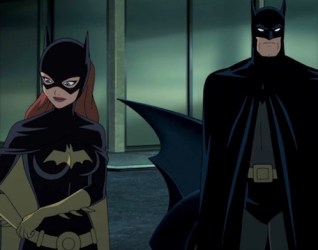
In this new segment, Batgirl (Tara Strong) and Batman (Kevin Conroy) find themselves on the trail of Paris Franz (say it aloud… or don’t), a young upstart who wants to take control of his uncle’s organised crime operation. Once that business is dealt with, we get to the familiar meat of the story, where the Joker (Mark Hamill) decides to prove a point — in a violent and twisted fashion, naturally.
To really discuss where this adaptation of The Killing Joke goes awry, I’m going to have to stop being coy about spoiling a 28-year-old comic book that had lasting ramifications for Barbara Gordon’s place in the DC universe. Also, spoilers for this new film, too. You have been warned.

So, for those not in the know or who would like a recap, the Joker’s plan is to prove we’re all just one bad day away from going insane like him. The target of his experiment is Commissioner Gordon (Ray Wise), and he begins by shooting his daughter Barbara in the spine, paralysing her, then taking photos of her naked to torment the Commissioner with later. (The actual photo-taking isn’t depicted in the comic or this film, but the images are hinted at later on.) This is problematic for a number of reasons, not least Barbara’s lack of presence in the story as anything more than a pawn to torture her father.

The film’s solution is to begin with a standalone Batgirl adventure. Not an inherently bad idea — it could make her a more rounded character; someone we care about for herself, not just a minor victim in some other game. However, screenwriter Brian Azzarello (and, presumably, director Sam Liu and executive producer Bruce Timm) have tried to do this by making her horny for Batman, and have that infatuation actually consummated in an al fresco rooftop sex scene (not graphically shown, but the film is unequivocal about what happened). To say the least, this doesn’t seem like the best way to go about making her an independent, rounded human being — it comes off like fan service. No, worse: fan fiction. A scene earlier on where she explains her Bat-infatuation to her gay best friend is presumably meant to suggest a genuine motivation for the eventual sexy times, but it all comes across as a great big excuse.
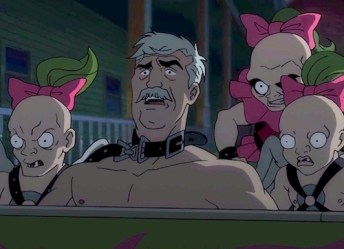
To top it off, it in no way informs the adaptation of The Killing Joke that follows. It makes nods towards some of the thematic concerns of the main story, but, structurally, it’s not part of the same film at all — there’s a fade to black & fade back in that really signals the end of one production and the start of a new one; the end of an opening short film and the start of the feature presentation. Only the ‘feature’ is far too short (44 minutes before credits), so that ‘short’ is clearly there to bulk up the running time.

The titular adaptation that follows is arguably faithful to a fault. If you’re seeking to make it feature-length, would it not have been better to expand the story out and examine some of its points more fully, even if the points you illuminated were about plot logic rather than themes — the original comic is very short and arguably a little rushed in places, so I think there’s definite room for expansion. In fact, while it might make sense to expand the role of Barbara Gordon for reasons of taste and social mores that have (not wrongly) since been projected onto the comic, from a purely narrative point of view the character who needs expanding is Commissioner Gordon. In the comics he’s a regular cast member, so it can afford to take as read his status as an “ordinary man” — or perhaps even a paragon of virtue, which brings its own problems to the story. But while he is a familiar figure in the Batman mythology, and so by extension to anyone who’s likely to watch this film, it’s also a standalone movie, not part of a series, and so it would be beneficial to establish his character somewhat before the Joker’s plan for him gets underway.
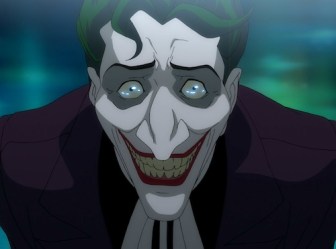
Heck, the film’s own special features even feature a psychologist talking about how it’s Jim Gordon’s story! While the Joker and Batman are the same characters at the beginning and the end, it’s Gordon who goes through a terrible ordeal and then has a choice to make. Yet in spite of that he’s treated as the fourth lead, at best, with the Joker and Batman taking precedence in the main adaptation and Barbara gaining masses of focus thanks to her half-hour preamble. It’s probably the twin desires to put the graphic novel on screen as-is and to in some way justify Barbara Gordon’s role in it that have led to this point. A less literal adaptation — one prepared to expand and elucidate the story, rather than just tack on an extra part at the start — could have found room to deepen both the Gordons.

Still, I suppose the literal faithfulness of the story adaptation will please purists. And reuniting the key voice acting cast from Batman: The Animated Series, arguably the all-time definitive screen interpretations of Batman and the Joker, is always fan-pleasing. Hamill, in particular, is fantastic, even when having to deliver Alan Moore’s typically verbose dialogue. However, one of the reasons the graphic novel is so beloved is Brian Bolland’s detailed, realistic, dynamic artwork. His draftsmanship transcends the actual narrative of Moore’s writing so that, however distasteful the tale being told, it looks incredible. Naturally, this animated adaptation loses that entirely, employing the standard “Saturday morning cartoon +” aesthetic of these DC direct-to-video movies. There are sound budgetary reasons for that, but it means the focus falls even more squarely on the narrative rather than the images. (It’s somewhat ironic, then, that (as ever) Alan Moore doesn’t receive an onscreen credit while Bolland does.) There are a handful of effective visuals here (the Joker’s gleeful face as he turns on the amusement park, its lights twinkling in his eyes), but they’re the exception to work which is adequate — good for what it is, even — but unremarkable.
For such a long-awaited adaptation, it’s difficult to conclude The Killing Joke is anything other than a disappointment. It didn’t have to be that way: I thought Warner made a good hash of adapting Year One, and an even better one of The Dark Knight Returns. While this adaptation does allow some of the book’s inherent quality to carry through, The Killing Joke was always going to be more problematic due to its content, and the filmmakers’ clumsy attempts to fix that have only made it worse. Shame.

3 out of 5

Batman: The Killing Joke is out on DVD and Blu-ray in the UK today.

Zootropolis (2016)

aka Zootopia

2016 #116
Byron Howard & Rich Moore | 109 mins | Blu-ray | 2.39:1 | USA / English | PG / PG

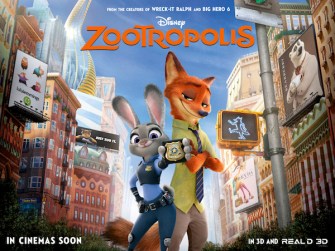
ZootropolisDisney’s 55th Animated Classic is their second highest-grossing ever, the 25th film to take over $1 billion at the worldwide box office, which makes it a hit of Frozen-sized proportions (at least financially — parents must be glad there’s no Let It Go-esque earworm involved). That said, I’d perhaps argue it’s a Disney movie aimed as much (perhaps even more) at the studio’s adult fans as its child ones. But I’ll come to that in a bit.

Set in a world of anthropomorphised animals, Zootropolis introduces us to Judy Hopps (Ginnifer Goodwin), a small-town bunny who joins the police force in the titular big city,* the first rabbit to do so. Despite there being a spate of mysterious disappearances across the city, Judy gets lumped with traffic duty, where she soon encounters small-time con artist fox Nick Wilde (Jason Bateman). That association comes in handy when she manages to get assigned one of the missing person animal cases and notices that Nick may have been a witness to the abduction. Soon, the mismatched pair begin to uncover an aggressive conspiracy…

Disney animations may be best known as musicals based on fairytales, but they certainly don’t make up 100% of their Classics line, especially in recent years. I think Zootropolis may be the first time they’ve attempted a neo-noir crime thriller, though. And I bet no one ever thought they’d see a Disney film with a sequence set at a nudist resort. Or in a drugs lab, for that matter. Or one with a substantial parody of The Godfather and clear references to Breaking Bad. And you thought Inside Out was clever for having one line from Chinatown

Once you factor in the many references to discussions that currently dominate social discourse — there are abundant riffs on the language of real-life concerns about race, gender, and sexuality — you begin to see how Zootropolis could be seen as a Disney film that’s primarily aimed at adults. Those concerns ultimately become thematic points so large that they cross the line from being subtextual “one for the adults” asides into being textual “vital to the plot” tenets of the film. So given the genre trappings, nudist resorts, drugs labs, parodies of 18-rated media, and very grown-up thematic points, you do have to wonder if Zootropolis functions better for adults who like Disney films than it does for kids who like Disney films. That sounds like a criticism, but it’s only one to an extent, because the kind of adult this notion supposes the film is aimed at is… well, me.

However, that’s not to say kids can’t get enjoyment out of it: there are plenty of colourful characters and locations, relatable situations, cross generational humour, and a moral lesson young’uns will understand. There’s the DMV sequence, for instance, which is grounded in an adult experience but so funny it must cross over. Considering all the praise I’ve heard for that one scene, it’s also a feat it lives up to the hype. It’s gorgeously animated throughout, bolstered by a world that has been magnificently realised, with all the different themed districts of the city. (After all the Disney movies that have had contrived TV series spin-offs, this is a film that actually feels like it deserves one. The setup is obvious — a police procedural — and the world the film suggests is big enough to warrant it. Heck, it practically demands it — there’s so much more of this world, you want to see it explored.) Michael Giacchino’s score is different too: memorable and fun, in part thanks to using a cornucopia of unusual instruments to provide a ‘world music’ sound that’s in-keeping with the movie.
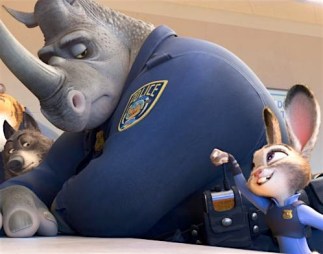
If I had any problem it’d be that the story takes a little while to warm up, really coming alive (at least for me) once it gets stuck into the main investigation. That’s not to say the first act is without its merits (there are both amusing and awe-inspiring sequences there, plus some moments that are nicely paid off later), but the film’s need/desire to establish the familiar “you can be whatever you dream if you just try” moral message makes it take a little longer than might be ideal. Adults will probably guess whodunnit well before the reveal, too, but that doesn’t mean the journey getting there is any less fun.
There’s a quote on the cover of Zootropolis’ US Blu-ray that calls it the best Disney movie in 20 years. As much as I liked Bolt and Tangled,** and Mulan and The Princess and the Frog, and, yes, even Frozen, I think Zootropolis is at the very least a contender for that crown.

4 out of 5

Zootropolis is released on DVD and Blu-ray in the UK today.

It placed 15th on my list of The 20 Best Films I Saw For the First Time in 2016, which can be read in full here.

* I watched a US copy of the film, so I have a question for anyone who watched it in the UK: we all know they changed the title from Zootopia to Zootropolis, but did they actually change the name of the city in the film too? That’s a lot of redubbing if they did… ^

** Both co-directed by Zootropolis’ Byron Howard. Developing a pretty good track record, that man. ^

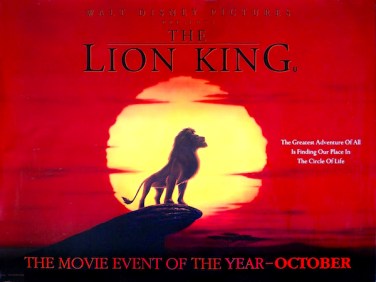
The Lion King (1994)

100 Films’ 100 Favourites #52

The greatest adventure of all is
finding our place in the circle of life.

Country: USA
Language: English
Runtime: 88 minutes
BBFC: U
MPAA: G

Original Release: 15th June 1994
UK Release: 7th October 1994
First Seen: VHS, c.1995

Stars
Matthew Broderick (Ferris Bueller’s Day Off, Election)
James Earl Jones (Star Wars, Conan the Barbarian)
Jeremy Irons (The French Lieutenant’s Woman, Die Hard with a Vengeance)
Rowan Atkinson (Bean, Johnny English)

Directors
Roger Allers (Open Season, The Prophet)
Rob Minkoff (Stuart Little, Mr. Peabody & Sherman)

Screenwriters
Irene Mecchi (Brave, Strange Magic)
Jonathan Roberts (James and the Giant Peach, Jack Frost)
Linda Woolverton (Beauty and the Beast, Alice Through the Looking Glass)

Story by
Deep breath… Burny Mattinson, Barry Johnson, Lorna Cook, Thom Enriquez, Andy Gaskill, Gary Trousdale, Jim Capobianco, Kevin Harkey, Jorgen Klubien, Chris Sanders, Tom Sito, Larry Leker, Joe Ranft, Rick Maki, Ed Gombert, Francis Glebas & Mark Kausler; with additional story by J.T. Allen, George Scribner, Miguel Tejada-Flores, Jenny Tripp, Bob Tzudiker, Chris Vogler, Kirk Wise & Noni White; and the story supervisor was Brenda Chapman.

Sort of based on
Hamlet, a play by William Shakespeare.

Songs by
Elton John (The Muse, Gnomeo & Juliet)
Tim Rice (Jesus Christ Superstar, Aladdin)

The Story
The savannahs of Africa are ruled by the lion Mufasa, a kindly king who is struggling to instil some sense of life’s importance in his reckless young son and heir, Simba. But Mufasa’s brother, Scar, lusts for power, and manipulates Mufasa and Simba to gain it…

Our Hero
Lion cub Simba is heir to his father’s throne as ruler of the Pride Lands, and a naughty, unruly prince who just can’t wait to be king. All that changes when he winds up outcast, and has to learn to grow up before returning to save his kingdom.

Our Villain
King Mufasa’s jealous brother, Scar, who also just can’t wait to be king. Obviously that’s not going to happen under the regular rules of succession, but Scar is a cunning and conniving sort. Well, he is the villain.

Best Supporting Characters
After running away, Simba falls in with meerkat Timon (voiced by Nathan Lane) and warthog Pumbaa (voiced by Ernie Sabella), who have a laid-back attitude to life, and raise the lion cub to have the same. So successful they had their own spin-off series and were the stars of a sequel, too.

Memorable Quote
Mufasa: “Everything you see exists together in a delicate balance. As king, you need to understand that balance and respect all the creatures, from the crawling ant to the leaping antelope.”
Simba: “But, Dad, don’t we eat the antelope?”
Mufasa: “Yes, Simba, but let me explain. When we die, our bodies become the grass, and the antelope eat the grass, and so we are all connected in the great circle of life.”

Quote Most Likely To Be Used in Everyday Conversation
“Hakuna matata” — a wonderful phrase, it means no worries for the rest of your days.

Memorable Scene
The opening sequence, in which all the animals gather to celebrate the birth of Simba, scored to Circle of Life, is a majestic sequence — so impressive, in fact, that Disney used it, uncut and unadorned, as the film’s trailer.

Best Song
Big romantic number Can You Feel the Love Tonight won the Oscar, and there were nominations for epic opener Circle of Life and quotable comedy hit Hakuna Matata, and you shouldn’t overlook the fun and impressive choreography of I Just Can’t Wait to Be King, but for me the best number is Scar’s Be Prepared. I do love a good villain’s song.

Technical Wizardry
The Lion King continues Disney’s integration of CGI into their animated features, this time using it to create the pivotal wildebeest stampede. A new program had to be written for the sequence, which allowed hundreds of computer generated animals to run without colliding into each other. It took the CG department three years to animate the scene.

Making of
Voice actor Frank Welker (who has over 760 credits to his name on IMDb, including originating Fred in Scooby-Doo and voicing Megatron in the Transformers animated series) provided all of the film’s lion roars. No recordings of actual lions were used.

Next time…
As one of the biggest successes of the Disney Renaissance, The Lion King has naturally had more than its share of follow-ups. The headline has to be the stage musical adaptation of the film, which opened in 1997. It’s the third longest-running show in Broadway history, and is “the highest-earning entertainment property in history in any medium”. In 1998, direct-to-video sequel The Lion King II: Simba’s Pride was released. Apparently its plot is influenced by Romeo and Juliet. A second direct-to-DVD sequel, The Lion King 1½ (known as The Lion King 3 in some countries, including the UK), was released in 2004. It’s based on Rosencrantz and Guildenstern are Dead, re-telling the first movie from Timon and Pumbaa’s perspective. I watched it years ago and really enjoyed it, an opinion supported by its strong 76% on Rotten Tomatoes. On television, spin-off series The Lion King’s Timon & Pumbaa ran for three seasons from 1995, and just last year TV ‘movie’ (it’s only 45 minutes) The Lion Guard: Return of the Roar heralded the start of a new series, The Lion Guard. It’s been renewed for a second season.

Awards
2 Oscars (Song (Can You Feel the Love Tonight), Score)
2 Oscar nominations (Song (both Circle of Life and Hakuna Matata))
2 BAFTA nominations (Music, Sound)
3 Annie Awards (Film, Voice Acting (Jeremy Irons), Individual Achievement for Story Contribution)
3 Annie nominations (Individual Achievement for Artistic Excellence (x3))
2 Saturn nominations (Fantasy Film, Performance by a Younger Actor (Jonathan Taylor Thomas))

What the Critics Said
“Even the inescapable hype cannot diminish the fact that this is one great film. Consider that this movie delivers strong characters, a sophisticated story, good music, captivating visuals and loads of emotion — all within the confines of a G-rated cartoon. […] The most exhilarating part of The Lion King is that it’s not just great animation, but superior filmmaking. Outstanding character animation is a given at Disney, which handles the nuances of movement better than anyone. But the last few animated features show an increasing mastery of cinematography techniques. In The Lion King, the eye of the camera ranges from point of view to overhead to moving with the scene. The opening sequence where the plains animals trek to see the newborn cub and the wildebeest stampede scene are breathtaking.” — Bill Wedo, Philadelphia Daily News

Score: 92%

What the Public Say
“Timone and Pumba [sic] are two of the more interesting comic relief characters in Disney films. I’d argue that they’re one of the most wonderful depictions of a same-sex parenting couple that I have ever seen. I don’t want to get drawn into a debate over their sexuality, but the pair are partners in the truest sense of the word, sharing a life. They sleep together, for crying out loud. I don’t care about their sexuality or anything like that, because we’ll never get an answer on that and it’s immaterial. All that matters is that they complete one another, and it’s sweet. […] Even when Simba arrives, it’s very clear that the dynamic is different – Simba isn’t an equal partner in the relationship like Timone and Pumba. They’re a family, but Timone and Pumba are more of a couple.” — Darren Mooney, the m0vie blog

Verdict

My third Disney pick is consecutive to my previous two (Aladdin and Beauty and the Beast) in Disney’s history of animated classics, which goes to show how successful their ’90s Renaissance was. (Also, when my childhood was.) The Lion King succeeds by combining a selection of memorable, hummable songs with an epic tale of royal politicking — but, y’know, in a Disney way. Unafraid to include plot twists that place it alongside Bambi in the company’s canon, but with some well-performed comedy characters to lighten the mood, it manages to be one of Disney’s most entertaining but also most philosophical (in its way) films.

#53 has… my sword, and my bow, and my axe.

Bambi Meets Godzilla (1969)

2016 #107a
Marv Newland | 2 mins | streaming | 1.37:1 | USA / English | U

At the risk of my blog becoming some kind of film-watching Inception, with a host of viewing goals within viewing goals (the titular one; “What Do You Mean You Haven’t Seen” / Blindspot; all those ones I mentioned in my review of Home on the Range), here’s something new I’m setting out to do (in a vague, loose, ‘will get there one day’ kind of way):

Regular readers will surely remember iCheckMovies, the movie list website where you can check off films you’ve watched and see how many you’ve seen on particular lists, like the IMDb Top 250, or They Shoot Pictures’ 1,000 Greatest, or 179 other ‘official’ lists (or 8,603 user-added ones — seriously). Obviously you can use this as an empty-headed list-completing exercise (and some people do), but it’s also a way to motivate watching well-regarded movies, and to discover new ones.

(What does this have to do with Disney’s dear deer meeting Tokyo’s greatest monster? I’m getting to that.)

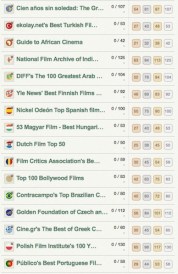
There are several lists in particular I have my eye on, for one reason or another. Getting around to some more films on those lists was part of the motivation behind my selections for this year’s WDYMYHS, for example (most of the motivation, if I remember rightly). However, even while I’m a decent way through completing some lists, I happened to notice last night that there are a handful of those 181 official lists on which I have precisely zero checks. 26, to be precise, which in some ways sounds like a lot, but in others is only 14%. Naturally, this inspired one particular thought: to endeavour to get at least one check on every single list.

(The bereaved fawn and gigantic lizard are coming up imminently.)

There are pretty obvious reasons why I’ve never seen any films on many of those lists — quite a lot are country or continent specific, and as Western film viewers we’re notoriously poor at having seen movies from, say, Africa. The lack of acclaimed films I’ve seen from the likes of Belgium, Finland, Holland, Hungary, Norway, Poland, Portugal, and Spain is my own fault though, I guess. Anyway, this is something I intend to rectify in the coming days / weeks / months / years / decades — however obscure some of my missing lists may seem, there’s at least one film I’ve heard of on all but one or two of them, so there’s that.
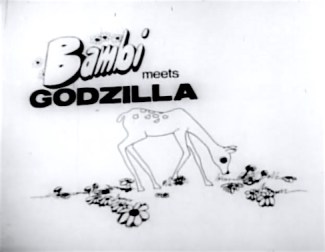
Anyway, I started with the easiest list of all lists: Best Cartoons Ever – A Gift List From Jerry Beck. This list contains “the 50 greatest cartoons of all time, from a poll of 1,000 animation professionals conducted by author/film historian Jerry Beck for the 1994 book The 50 Greatest Cartoons: As Selected by 1,000 Animation Professionals.” There’s all sorts of famous stuff on there, from 1914’s Gertie the Dinosaur, to Mickey Mouse’s debut in Steamboat Willie, to acclaimed classics that appear on multiple other lists, like Duck Amuck and What’s Opera, Doc? But I started with possibly the shortest of the lot: 92-second one-gag short Bambi Meets Godzilla.

I say “one-gag” — there’s one headline gag, but I’d argue there are at least five jokes slipped into the film’s minute-and-a-half running time. Describing the ‘plot’ would be pointless, especially when it would be almost as quick for you to watch it yourself on YouTube; or, if you really want, a couple of years back a fan restored/remade it in 4K with 5.1 surround sound (seriously), which you can watch here. It loses a lot of its charm in that form, if you ask me. Either way, there are less amusing ways to spend 90 seconds of your time.

Why is this film notable? In fact, is it notable? Well, it was voted in to The 50 Greatest Cartoons by some of 1,000 animation professionals, so there’s clearly something there. It was created by animator Marv Newland while he was a film student in L.A., after a live-action project he’d been planning to submit was scuppered (according to Wikipedia, uncited, that was due to the loss of “an essential magic hour shot”). Newland created the short animated gag in his room and submitted that instead. It’s a pretty straightforward piece of animation — black-and-white line drawings, some text, few moving elements — with a couple of music tracks on top (Call to the Dairy Cows from Rossini’s William Tell, which you might not know by name but will certainly recognise, and the final chord from the Beatles’ A Day in the Life).
Maybe it’s the subversiveness that makes it significant? It comes from an era when that must have been a factor, surely — there’s a certain Monty Python-ness to it, and it was made the same year Flying Circus first aired. Perhaps it just has some familiarity — I’ve seen comments by people saying it was regularly screened at sci-fi conventions throughout the ’70s, and it was attached to film prints and VHS releases of Godzilla 1985. There are even two sequels, Son of Bambi Meets Godzilla and Bambi’s Revenge, which weren’t made by Newland and are apparently hard to come by. I suppose Beck’s book must explain its inclusion, but if anyone has a copy of that to hand then they’ve not bothered to quote its entry online.

Anyway, for what it is it’s very effective, but it is slight, so I shall give it:

3 out of 5

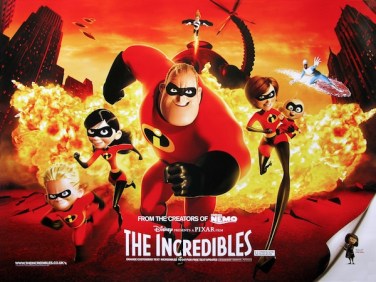
The Incredibles (2004)

100 Films’ 100 Favourites #44

Expect the incredible.

Country: USA
Language: English
Runtime: 115 minutes
BBFC: U
MPAA: PG

Original Release: 5th November 2004 (USA)
UK Release: 26th November 2004
First Seen: DVD, 2005

Stars
Craig T. Nelson (Poltergeist, Action Jackson)
Holly Hunter (Raising Arizona, The Piano)
Samuel L. Jackson (Pulp Fiction, Snakes on a Plane)
Jason Lee (Mallrats, Alvin and the Chipmunks)

Director
Brad Bird (The Iron Giant, Mission: Impossible – Ghost Protocol)

Screenwriter
Brad Bird (*batteries not included, Ratatouille)
(I bet you could count on one hand the number of Western animated movies written by one person.)

The Story
After public opinion forced superheroes into a civilian relocation programme, Bob and Helen Parr — formerly Mr Incredible and Elastigirl — live a quiet domestic life with their three children. Bob is dissatisfied, however, and easily tempted back to heroic ways by a call to defeat an evil robot. When it emerges this is part of a plan to kill retired superheroes and give powers to everyone in the world, Bob’s wife and superpowered kids must enter the fray to save the world.

Our Heroes
The fantastic four titular heroes: Bob Parr, aka Mr Incredible, who has super strength and limited invulnerability; his wife Helen, aka Elastigirl, who can stretch her body like rubber; their daughter Violet, who can become invisible and generate a force shield; and her younger brother Dash, who has super-speed (name/power coincidencetastic!) There’s also their chum Lucius Best, aka Frozone, who can form ice from the air. He’s very cool, hence casting Samuel L. Jackson.

Our Villain
Disillusioned superhero fanboy Buddy Pine, who grew up and used technology to give himself powers, dubbing himself Syndrome. Wants to give everyone in the world powers, because when everyone’s super, no one will be.

Best Supporting Character
Fashion designer Edna Mode, who makes the superheroes’ costumes. Inspired by Hollywood costume designer Edith Head, Bird wanted Lily Tomlin to voice her, and provided an example of how she should sound. Tomlin thought it was perfect, so she instead persuaded Bird to play the role himself.

Memorable Quote
“No matter how many times you save the world, it always manages to get back in jeopardy again. Sometimes I just want it to stay saved! You know, for a little bit? I feel like the maid — ‘I just cleaned up this mess! Can we keep it clean for ten minutes?!’” — Mr. Incredible

Memorable Scene
After tearing his old costume, Bob visits Edna for a new one. He wants a cape. Cue montage of why capes are a bad idea.

Technical Wizardry
The film presented a whole host of new technical challenges for Pixar, not least fully animating a whole cast of humans for the first time — they had to develop new technology to animate detailed anatomy, clothing, skin, and hair. The latter was a particular challenge. On Monsters, Inc., the animators persuaded director Pete Docter to give Boo pigtails to make her hair easier to animate, but Brad Bird accepted no such compromises, particularly as Violet’s long, face-covering hair was integral to her character — and it had to be depicted underwater and blowing in the wind, too. Ultimately, Violet’s hair was only successfully animated toward the end of production.

Next time…
One of the few Pixar sequels people actually wanted, The Incredibles 2 is in development for a 2019 release. That’s only a 15-year wait.

Awards
2 Oscars (Animated Film, Sound Editing)
2 Oscar nominations (Original Screenplay, Sound Mixing)
1 BAFTA Children’s Award (Best Film)
10 Annie Awards (Feature, Directing, Writing, Voice Acting (Brad Bird), Music, Production Design, Animated Effects, Character Animation, Character Design, Storyboarding)
6 Annie nominations (Voice Acting (Samuel L. Jackson), Character Animation (again, x3), Character Design (again), Storyboarding (again))
1 Saturn Award (Animated Film)
2 Saturn nominations (Writer, Music)
Won the Hugo for Best Dramatic Presentation Long Form

What the Critics Said
“what really makes The Incredibles work is the wit of Bird [though] much of it will be over the heads of very young viewers who account for so much repeat business. Bird’s satiric take on suburbia, conformity and forced notions of equality is surprisingly sophisticated and biting for an animated feature, matched by a visual panache that is often breathtaking.” — Kevin Lally, Film Journal International

Score: 97%

What the Public Say
“Most Disney films are about people meeting and falling in love. Incredibles is one of the only ones I can think of about how important marriage is. It shows a couple fighting, getting along, and working together.” — Rachel Wagner, Reviewing All 54 Disney Animated Films and More!

Verdict

Even before the present glut of big-screen super-heroics, Pixar were in on the game with this affectionate genre entry. Writer-director Brad Bird mixes together classical superhero antics with elements of 1960s spy-fi to create a retro world of optimistic heroics and larger-than-life villainy — at odds with the dark-and-serious tone of so many superhero movies of the past 17+ years, but all the more memorable for it. It’s also great at the kinds of things Pixar is known for. The combination means it transcends both the kids’ animation and superhero subgenres.

#45 will be… keeping up with the Joneses.

Ghost in the Shell (1995)

100 Films’ 100 Favourites #36

It’s found its voice…
now it needs a body.

Original Title: Kôkaku Kidôtai
Also Known As: Mobile Armored Riot Police: Ghost in the Shell (Japan)

Country: Japan
Language: Japanese
Runtime: 83 minutes
BBFC: 15

Original Release: 18th November 1995 (Japan)
UK Release: 8th December 1995
First Seen: DVD, 2000

Stars
Atsuko Tanaka (Ghost in the Shell 2: Innocence, Bayonetta: Bloody Fate)
Akio Ôtsuka (Black Jack, Paprika)
Kôichi Yamadera (Ninja Scroll, Cowboy Bebop: The Movie)
Yutaka Nakano (Cowboy Bebop: The Movie, Ghost in the Shell 2: Innocence)
Tamio Ôki (Journey to Agartha, Wolf Children)

Director
Mamoru Oshii (Patlabor: The Movie, Ghost in the Shell 2: Innocence)

Screenwriter
Kazunori Itō (Patlabor: The Movie, .hack//SIGN)

Based on
The Ghost in the Shell (攻殻機動隊 Kōkaku Kidōtai, literally Mobile Armoured Riot Police), a manga by Masamune Shirow.

The Story
Japan, 2029: Public Security officer Major Motoko Kusanagi and her team are assigned to track down and capture a dangerous hacker known as the Puppet Master, but they soon find themselves embroiled in a far-reaching conspiracy…

Our Hero
In a future world where humans can undergo varying degrees of cyberisation, Major Motoko Kusanagi is a “full-body prosthesis augmented-cybernetic human” — only her brain is organic. Her body is a generic mass production model, so she can blend in while being a kick-ass law enforcement officer.

Our Villain
The Puppet Master, a cyber criminal who hacks into people’s brains and gives them false memories. But is there something even worse going on behind the hacker?

Best Supporting Character
Kusanagi’s second-in-command Batou is stoic to the point of brusqueness — apparently quite a different characterisation to his portrayal in other Ghost in the Shell media.

Memorable Quote
“If we all reacted the same way, we’d be predictable, and there’s always more than one way to view a situation. What’s true for the group is also true for the individual. It’s simple: overspecialise, and you breed in weakness. It’s slow death.” — Major Kusanagi

Memorable Scene
Pursuing the Puppet Master, Kusanagi comes face to face with a six-legged tank. After a blazing gun battle, she tries to physically rip it open, her cybernetic body straining to breaking point — and beyond…

Technical Wizardry
Ghost in the Shell was groundbreaking in its skilful combination of traditional 2D animation with CGI additions. It used a process called “digitally generated animation” (DGA), which combined cel animation with computer graphics to create lens effects that simulated depth, motion, and unusual lightning techniques, as well as mixing in 3D CGI and digital audio.

Letting the Side Down
In 2008, Oshii revisited the film to create Ghost in the Shell 2.0, which regraded the colour, replaced some of the original animation with new CGI, omitted several scenes, and featured a remixed and re-recorded soundtrack. (More details here.) As is almost always the case when directors fiddle with their creations decades later, it wasn’t well received by fans.

Next time…
As befalls many a popular anime franchise, Ghost in the Shell has spawned a raft of sequels and reboots. The only direct sequel, Innocence, was released in 2004. TV series Ghost in the Shell: Stand Alone Complex ran for two seasons between 2002 and 2005, with the first run compiled into movie The Laughing Man and the second into Individual Eleven, all of which were followed by a final film, Solid State Society. Another reboot came in 2013 with direct-to-video series Ghost in the Shell: Arise, which so far totals five episodes and, last year, continuation film Ghost in the Shell: The New Movie. (Only four episodes have so far been released in the West, but the movie — which continues the story from the fifth episode — came out on Monday in the UK. Just to make things more complicated.) A live-action American remake is currently shooting for release in March 2017 — you’ve probably heard about it.

Awards
5 Annie Awards nominations (Animated Feature, Directing, Producing, Writing, Production Design)

What the Critics Said
“When Akira first blasted out of Japan back in 1991 it looked like the Western concept of widescreen animation would be changed forever. […] Unfortunately, it was not to be. Sure, on video, the Manga scene has gone from strength to strength, but as far as theatrical releases are concerned, nothing has really come along to match Akira’s sheer retina-scalding magnificence. Until now. […] From its baddie-eviscerating opening sequence through innumerable car chases, shoot outs and tongue-in-cheek dialogue exchanges, this is exactly the kind of film that James Cameron would make if they ever let him through the Disney front gates.” — Clark Collis, Empire

Score: 95%

What the Public Say
“both the film and Oshii have fallen into a kind of disrepute among the anime community. The common line on GITS is that it’s wordy, masturbatory, and pretentious with nothing going on intellectually and that the (plainly inferior but more easily accessible) GITS: SAC is a better alternative. I wanted to write this article to respond to that notion. GITS is a highly thoughtful film and worthy of comparison to virtually any scifi feature you could name. ” — tamerlane, too long for twitlonger

Verdict

Ghost in the Shell was the first anime I consciously saw, which maybe helps it earn a place here. It’s an initially accessible movie that’s also very complicated — there are pulse-pounding action scenes and a thriller storyline to keep things exciting, but also a lot of deep philosophical discussions, touching on themes of gender and identity. I think for some viewers the latter are a negative, while for others they’re the entire point. (I imagine the forthcoming Hollywood remake will either ditch or seriously curtail them, but you never know.) The combination makes for a stimulating (in multiple senses) sci-fi actioner.

Next… who ya gonna call? #37 !

The Book of Life (2014)

2016 #50
Jorge R. Gutierrez | 92 mins | streaming (HD) | 2.35:1 | USA / English | U / PG

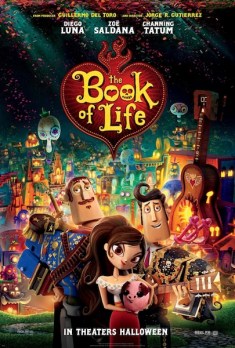
A myth-like animated musical adventure based around Mexico’s Day of the Dead, most notable for its unique art style that presents gorgeous visuals throughout.

Otherwise, it has the right ingredients but in disappointing proportions. The story is good, but too long in the telling. The humour isn’t consistently amusing. The songs are mostly re-appropriated pop tracks, plus two new compositions. The latter are more effective, though shoehorning a rendition of Radiohead’s Creep into a kids’ movie is memorable for the wrong reasons.

Some viewers may lose patience with it, but I thought enough was likeable to keep it ticking over.

3 out of 5

For more quick reviews like this, look here.