Deadpool (2016)

2016 #107
Tim Miller | 108 mins | Blu-ray | 2.40:1 | USA / English | 15 / R

In the US Deadpool was, famously, rated R — which (for those not up on their international film certificates) ostensibly means you have to be over 17 to see it. In the UK it was rated 15, which is much more appropriate, because if Deadpool had a mind it would be that of a 15-year-old boy. Of course, plenty of grown men also have the mind of a 15-year-old boy, and that’s why it’s the highest-grossing R-rated movie (worldwide) ever. And I guess I must still have the mind of someone half my age too, because I loved it.

Spinning off from the X-Men series (more on that later), Deadpool is the story of Wade Wilson (Ryan Reynolds), a former mercenary who falls in love with Manic Pixie Geek Wet Dream Girl Vanessa (Morena Baccarin) before being diagnosed with aggressive cancer. He agrees to radical treatment in an attempt to cure it and be with Vanessa forever ‘n’ that. The treatment drives him pretty much insane, but also ignites his mutant genes, which give him the power of self-healing (like that other mutant whose name rhymes with Polverine…) Permanently scarred and feeling like he can’t return to Vanessa, Mr Pool sets out for revenge.

Yeah, it’s a pretty standard superhero origin plot. But the devil is in the details, and it’s how Deadpool tells its story that matters — the narrative is just a framework on which to hang the gags. The immediate point of comparison on a superhero comedy is surely Kick-Ass, and it doesn’t take deep analysis to see that Deadpool isn’t as subversive as that movie. Where Kick-Ass comments on, at times even deconstructs, the superhero genre, Deadpool takes its rules as a given and throws a shedload of humour on top of it. Is that a problem? It depends what you’re looking for. I think Deadpool’s makers set out to make a superhero film that was genre-aware and prepared to take the piss out of that, but I don’t think they were aiming to deconstruct superhero narratives. It might make Deadpool a less ‘intelligent’ movie than Kick-Ass, but it doesn’t stop it being entertaining.

That doesn’t mean Deadpool’s makers are short on cleverness, though. The film’s structure is particularly nifty: it gets right into the action, then mixes the back story in as it goes on. This avoids either, (a) boring stretches while we wait for the hero to turn up, or (b) shoehorning in fight sequences where they don’t belong just so that the action quotient is met upfront. Plus it allows for a few transitioning gags and flashback humour, which I’m not sure we’ve seen since Fight Club. It’s well-paced too, the story positively flying by. This may be somewhere else the familiar shape of the story works in its favour — we know where this is all going, so it doesn’t need to dwell on plot details. No one’s really here for the plot, so why not?

The jokey opening credits say that the writers are “the real heroes here”, the joke being they wrote the credits so of course they’d call themselves the heroes. But it’s also true. I mean no disservice to the producers who persuaded the studio to greenlight it, or director Tim Miller’s handling of the material, or Reynolds embodying the character so well — they’ve all undoubtedly contributed enormously to the film’s success (and I’m sure there’s a ton of improvisation in the final cut, so even more so) — but a lot of what makes the film really work, in a way that goes beyond just “it had some funny bits and some cool action”, is that structure, that pace, those gags… which, as just discussed, can well have come from the cast and director, and editors and stuff, too. So what I’m basically saying is: everyone’s a winner! Yay!

So what of that humour? It’s an R-rated action-comedy, you know what to expect: Swearing! Crudeness! Nudity! Throwing in four-letter words and assuming that counts as a joke! Well, Deadpool does have swearing and crudeness, but it’s not so completely mindless about it. It has violence and nudity, too, just like the good old days of R-rated action movies. But it doesn’t resort to throwing any of those in for cheap humour — they’re there because they are there and can be there, not as a get-out-of-actually-coming-up-with-gags card. Most R-rated comedies these days factor somewhere on a scale of “saying a rude word just to get a laugh”, that scale stretching from “just doing it once or twice” to “all the ‘humour’ in the film”. Such words are thrown around liberally here, but if there was an occasion where that was substituted for an actual gag then it didn’t stick in my mind. That doesn’t mean it isn’t crude, or using Rude Things for laughs, but it’s not just going, “I said the F word, at a time when I shouldn’t say the F word — isn’t that funny?!”

There’s one particular type of humour that Deadpool is most famous for, of course. From the self-parodying, Honest Trailer-inspired opening credits, to the Ferris Bueller-referencing, Marvel pillorying post-credits scene, Deadpool less breaks the fourth wall, more obliterates it, then stomps on the rubble until it’s in little tiny pieces, then grinds those under its shoe until they are dust, then snorts that dust and digests it, then… well, y’know. The film handles this really well: it’s not a non-stop commentary, but it’s also not isolated off in little clumps, like, “this had to be here but it’s kinda awkward to have him always talking to the audience”. It’s often used for irreverence, and I like a bit of irreverence. There are clearly some rules and/or considered choices with this fourth-wall breaking, though. In his commentary on the deleted scenes, Miller says that Reynolds kept wanting to pull the boom mic down from out of frame and use it to batter one of the villains, or something along those lines, but Miller thought this would be breaking the film’s rules. That’s a pretty fine line to tread — knowing he’s in a film, but not, like, using the fact he’s in a film… I guess it’s more of a “what feels right” set of choices than a little rulebook.

One of my favourite little fourth-wall breaks is Deadpool’s one-liner when he’s dragged off to meet Professor X, which brings me somewhat neatly to the film’s relationship to its franchise mothership. I think I’d assumed it would be kind of subtle about the fact it’s technically an X-Men movie, even though everyone knows Deadpool was in X-Men Origins and this co-stars Colossus who’s been in several X-Mens at this point. That expectation was cemented by the number of reviews/blog posts/etc that have continued to refer to Apocalypse as the 8th X-movie. But no: within ten minutes we have a scene explicitly set at Xavier’s School, and Colossus has dialogue about Deadpool refusing to join the X-Men. References and connections to the X-Men are too numerous to count from then on out. This isn’t a movie hiding away its connections as a technicality only comic book fans will know about, which is something the main X-franchise has arguably done at times (though Apocalypse marks a distinct change in that, explicitly making Cyclops and Havok brothers, and stating that Magneto is Quicksilver’s dad… but I digress).

One of the film’s best bits comes courtesy of that X-connection: stroppy teenage goth mutant Negasonic Teenage Warhead (excellent newcomer Brianna Hildebrand), and her immensely comic-faithful costume. Ironically, it’s not at all faithful to how NTW is portrayed in the comics (and you can find dozens of think-pieces about how the film changed her character and how that’s more than OK, if you’re so inclined), but it is generally like X-Men comic costumes, certainly ones that cropped up in the early ’00s. (I swear there was a Frank Quitely New X-Men cover showing a bald female in a costume really like NTW’s yellow-and-black X-Men uniform, but I can’t find it now. Maybe I imagined it.) Comic-faithful costumes are very much the MO of Marvel movies nowadays, but because the X-Men film franchise sprung from the “how do we make superheroes acceptable in movies?” period of the genre, the X-movies have never really done that before (though they do sort of, in passing, at the end of Apocalypse — I’m beginning to think we’re one day going to look back at that as a transition movie, assuming the next one goes super comic-book-y). I mean, this doesn’t really signify anything about Deadpool, I’ve just gone off on a geeky tangent.

Deadpool does have flaws, and other reviews have certainly pointed them out: it’s not always hilarious (well, how many comedies are?), it’s another origin story (I believe I mentioned this one), it mocks superhero tropes but ticks most of the same boxes (ooh, I did that one too!), it has a somewhat low-rent feel… which, actually, I don’t get. I mean, it cost $58 million — a sliver of the budget of most blockbusters nowadays, but only slightly less than Jurassic Park cost (20 years ago), and 33% more than Serenity cost (10 years ago). It actually looked bigger-budgeted than I was expecting. The action sequences are really good, for one thing. If it feels small compared to other blockbusters, that’s just a complaint brought about by too much money being spent on movies nowadays — go watch a Big Budget Blockbuster from the ’80s or ’90s and you might be surprised how low-key half of them are. Tsk, young(er-than-me) people.

Speaking of which, I do feel like I should be mature enough to have grown out of loving Deadpool… buuuut tough. It’s fantastic fun. Though, it’ll be interesting to see how it holds up to re-watches. I’ve read reviews which point out it doesn’t have the substance underneath the jokes that Kick-Ass does (did I mention that already? I didn’t steal that point from someone else, nope, noooo sir), so while Matthew Vaughn’s film is completely enjoyable on multiple go-rounds, any enjoyment to be found in Deadpool will ultimately fade once the novelty has gone. I mean, that’s possible — literally, only time will tell — but there’s not necessarily anything wrong with a “first time is definitely the best” movie, if that first time is good enough. Heck, The Game made it into my 100 Favourites with exactly that experience.

Anyway, until I do re-watch it, I really enjoyed it. How much?

5 out of 5

That much.

Deadpool is released on DVD and Blu-ray in the UK today.

It placed 8th on my list of The 20 Best Films I Saw For the First Time in 2016, which can be read in full here.
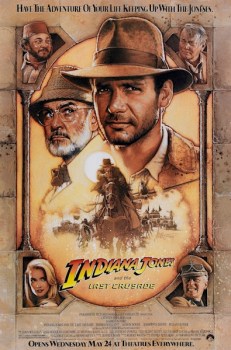
Indiana Jones and the Last Crusade (1989)

100 Films’ 100 Favourites #45

The man with the hat is back.
And this time he’s bringing his dad.

Country: USA
Language: English, German & Greek
Runtime: 127 minutes
BBFC: PG
MPAA: PG-13

Original Release: 24th May 1989 (USA)
UK Release: 30th June 1989
First Seen: VHS, c.1991

Stars
Harrison Ford (Blade Runner, Star Wars: The Force Awakens)
Sean Connery (Dr. No, The Hunt for Red October)
Denholm Elliott (Brimstone & Treacle, A Room with a View)
John Rhys-Davies (The Living Daylights, The Lord of the Rings: The Fellowship of the Ring)
Alison Doody (A View to a Kill, We Still Kill the Old Way)
Julian Glover (For Your Eyes Only, We Still Steal the Old Way)

Director
Steven Spielberg (The Lost World: Jurassic Park, Indiana Jones and the Kingdom of the Crystal Skull)

Screenwriter
Jeffrey Boam (The Dead Zone, Lethal Weapon 2)

Story by
George Lucas (Ewoks: The Battle for Endor, Strange Magic)
Menno Meyjes (The Color Purple, Max)

“Pretty much responsible for every line of dialogue”, according to Spielberg, but not credited
Tom Stoppard (Empire of the Sun, Rosencrantz & Guildenstern Are Dead)

The Story
When an old professor goes missing while searching for the Holy Grail, there’s only one man to track him down: his son, Indiana Jones. With his father’s cryptic diary as a guide, Indy embarks on a race against the Nazis to be the first to find the Grail.

Our Heroes
Indiana Jones, the fedora-wearing, whip-wielding, quip-delivering, snake-fearing, Nazi-fighting archeologist adventurer. This time joined by his dad, Henry — who still has it with the ladies, apparently.

Our Villains
A pair of deceptive deceivers: respectable American businessman Walter Donovan sets both Indy and his father in search of the Holy Grail, but he’s secretly working with the Nazis because he wants the prize for his own selfish ends. Then there’s Dr Elsa Schneider, who seduces both Joneses (bit creepy) and is also secretly working with the Nazis. But might she come good in the end…?

Best Supporting Character
Indy’s dad, Henry Sr, is along for the ride this time. Sean Connery was always Spielberg’s first choice for the role, as an inside joke that Indy’s father is James Bond. (Not literally, obviously.) The father-son sparring is one of the highlights of the film.

Memorable Quote
Prof. Henry Jones: “I’ve got to tell you something.”
Indiana Jones: “Don’t get sentimental now, dad. Save it ’til we get out of here.”
Prof. Henry Jones: “The floor’s on fire, see? And the chair.”

Quote Most Likely To Be Used in Everyday Conversation #1
“He chose… poorly.” — Grail Knight

Quote Most Likely To Be Used in Everyday Conversation #2
“Nazis. I hate these guys.” — Indiana Jones

Memorable Scene
Any time you get Ford and Connery playing off each other is fantastic, but the scene where they’re tied back-to-back to be interrogated by the Nazis, then have to escape the burning fortress (see: memorable quote) is one of the best and (importantly, for this category) most memorable.

Technical Wizardry
In previous films, computer-generated effects elements had been printed onto film and composited into final shots the old fashioned way, using optical printers. For Donovan’s death scene in Last Crusade, several states of the character’s decay were created with make-up and puppets, filmed, then ILM scanned the footage and morphed the takes together digitally. This was the first time film had been scanned, digitally manipulated, and then output back to film as a finished shot.

Truly Special Effect
The “leap of faith” trial — a bridge rendered ‘invisible’ with the help of false perspective — doesn’t make a great deal of sense if you stop and think about it, but is a very effective special effect nonetheless. It’s actually a model bridge in front of a painted background (because it was cheaper than building a full-size set), with Harrison Ford shot on bluescreen and composited in. (More details on how it was done can be found in this article about the film’s post-production.)

Letting the Side Down
Conversely, some of the other special effects have aged pretty badly — see-through planes and that kind of thing. On the bright side, Lucas never tried to Special Edition it.

Making of
According to Robert Watts, who was a producer on the first three Indys, “The Last Crusade was the toughest Indiana Jones picture to do because of its scope. First of all, we had virtually every form of transportation people used during that period, planes, trains, boats, cars, horses, zeppelins, bicycles, motorbikes with sidecars, everything except skis. Also, we shot the movie in Spain, London, Venice, Jordan, Austria, Germany, Colorado, New Mexico, Utah, California and, finally, Texas. So it was quite a world tour.”

Previously on…
Indiana Jones made his debut in Best Picture nominee Raiders of the Lost Ark. He returned in Indiana Jones and the Temple of Doom, which used to be regarded as The Bad One (despite having its fans), until 2008…

Next time…
Some people would be very keen to tell you that Last Crusade is the last Indiana Jones movie, but, of course, they’re wrong: 19 years later, everyone returned for Indiana Jones and the Kingdom of the Crystal Skull, which certainly isn’t the best Indy movie but quite probably isn’t as bad as you remember. They’ll be doing the same again in a couple of years for a fifth adventure. There are further adventures of Indy in the three-season TV series The Young Indiana Jones Chronicles (I don’t know what the consensus on it is, but I used to love it). In print, Indy is the star of 13 adult novels, plus eight German novels that have never been translated into English, 11 “choose your own adventure”-style books, 33 Young Indiana Jones novels, and numerous comic books. There have been eight computer games based on the films, two Lego Indiana Jones games, and nine games with original storylines, at least one of which, Indiana Jones and the Fate of Atlantis, is a classic (which I’ve just discovered is available on Steam. It might be re-play time…)

Awards
1 Oscar (Sound Effects Editing)
2 Oscar nominations (Score, Sound)
3 BAFTA nominations (Supporting Actor (Sean Connery), Sound, Special Effects)
4 Saturn nominations (Fantasy Film, Actor (Harrison Ford), Writing, Costumes)
Won the Hugo for Best Dramatic Presentation

What the Critics Said
“Take a good look at this movie. In fact, go back four or five times and take four or five good looks. In this imperfect world, you’re not likely to see many manmade objects come this close to perfection. Director Steven Spielberg has taken all the best elements of Raiders of the Lost Ark (with little of the mystical mumbo jumbo) and Indiana Jones and the Temple of Doom (without the gratuitous violence and child abuse) and combined them into an adventure film that is fast, muscular, playful, warmhearted and sheer pleasure.” — Ralph Novak, People

Score: 88%

What the Public Say
Raiders is lots of fun but it didn’t have the depth of characterization that The Last Crusade brings to Indy (in my opinion) and Steven Spielberg himself said that he enjoyed having the opportunity to do a real character study in the third movie. […] it’s just amazing to see [Sean Connery] and Harrison Ford play off one another. I love the subtle softening of their relationship […] There’s a depth to their father-son relationship that goes beyond mere banter and friendly insults” — Eva, Coffee, Classics, & Craziness

Verdict

I know we’re all supposed to love Raiders most, but I think Last Crusade is actually my favourite Indy movie. After the darkness of Temple of Doom, and the resultant criticism, Spielberg and co set out to make a lighter adventure more in the vein of Raiders. It’s possibly the funniest Indy movie because of that, but without tipping over into all-out comedy, thanks to plenty of the requisite derring-do, an almost Bondian globetrotting storyline, and a high-stakes climax, complete with gruesome death for the villain. Spielberg once said it was his favourite Indy movie too, so I’m in good company.

#46 will be… the first of two films whose title begins with “J”, only one of which is directed by Steven Spielberg…

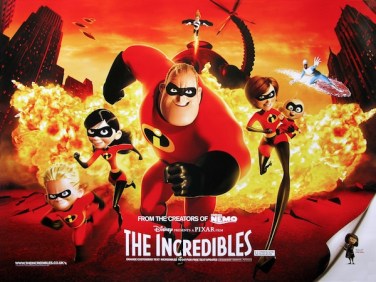
The Incredibles (2004)

100 Films’ 100 Favourites #44

Expect the incredible.

Country: USA
Language: English
Runtime: 115 minutes
BBFC: U
MPAA: PG

Original Release: 5th November 2004 (USA)
UK Release: 26th November 2004
First Seen: DVD, 2005

Stars
Craig T. Nelson (Poltergeist, Action Jackson)
Holly Hunter (Raising Arizona, The Piano)
Samuel L. Jackson (Pulp Fiction, Snakes on a Plane)
Jason Lee (Mallrats, Alvin and the Chipmunks)

Director
Brad Bird (The Iron Giant, Mission: Impossible – Ghost Protocol)

Screenwriter
Brad Bird (*batteries not included, Ratatouille)
(I bet you could count on one hand the number of Western animated movies written by one person.)

The Story
After public opinion forced superheroes into a civilian relocation programme, Bob and Helen Parr — formerly Mr Incredible and Elastigirl — live a quiet domestic life with their three children. Bob is dissatisfied, however, and easily tempted back to heroic ways by a call to defeat an evil robot. When it emerges this is part of a plan to kill retired superheroes and give powers to everyone in the world, Bob’s wife and superpowered kids must enter the fray to save the world.

Our Heroes
The fantastic four titular heroes: Bob Parr, aka Mr Incredible, who has super strength and limited invulnerability; his wife Helen, aka Elastigirl, who can stretch her body like rubber; their daughter Violet, who can become invisible and generate a force shield; and her younger brother Dash, who has super-speed (name/power coincidencetastic!) There’s also their chum Lucius Best, aka Frozone, who can form ice from the air. He’s very cool, hence casting Samuel L. Jackson.

Our Villain
Disillusioned superhero fanboy Buddy Pine, who grew up and used technology to give himself powers, dubbing himself Syndrome. Wants to give everyone in the world powers, because when everyone’s super, no one will be.

Best Supporting Character
Fashion designer Edna Mode, who makes the superheroes’ costumes. Inspired by Hollywood costume designer Edith Head, Bird wanted Lily Tomlin to voice her, and provided an example of how she should sound. Tomlin thought it was perfect, so she instead persuaded Bird to play the role himself.

Memorable Quote
“No matter how many times you save the world, it always manages to get back in jeopardy again. Sometimes I just want it to stay saved! You know, for a little bit? I feel like the maid — ‘I just cleaned up this mess! Can we keep it clean for ten minutes?!’” — Mr. Incredible

Memorable Scene
After tearing his old costume, Bob visits Edna for a new one. He wants a cape. Cue montage of why capes are a bad idea.

Technical Wizardry
The film presented a whole host of new technical challenges for Pixar, not least fully animating a whole cast of humans for the first time — they had to develop new technology to animate detailed anatomy, clothing, skin, and hair. The latter was a particular challenge. On Monsters, Inc., the animators persuaded director Pete Docter to give Boo pigtails to make her hair easier to animate, but Brad Bird accepted no such compromises, particularly as Violet’s long, face-covering hair was integral to her character — and it had to be depicted underwater and blowing in the wind, too. Ultimately, Violet’s hair was only successfully animated toward the end of production.

Next time…
One of the few Pixar sequels people actually wanted, The Incredibles 2 is in development for a 2019 release. That’s only a 15-year wait.

Awards
2 Oscars (Animated Film, Sound Editing)
2 Oscar nominations (Original Screenplay, Sound Mixing)
1 BAFTA Children’s Award (Best Film)
10 Annie Awards (Feature, Directing, Writing, Voice Acting (Brad Bird), Music, Production Design, Animated Effects, Character Animation, Character Design, Storyboarding)
6 Annie nominations (Voice Acting (Samuel L. Jackson), Character Animation (again, x3), Character Design (again), Storyboarding (again))
1 Saturn Award (Animated Film)
2 Saturn nominations (Writer, Music)
Won the Hugo for Best Dramatic Presentation Long Form

What the Critics Said
“what really makes The Incredibles work is the wit of Bird [though] much of it will be over the heads of very young viewers who account for so much repeat business. Bird’s satiric take on suburbia, conformity and forced notions of equality is surprisingly sophisticated and biting for an animated feature, matched by a visual panache that is often breathtaking.” — Kevin Lally, Film Journal International

Score: 97%

What the Public Say
“Most Disney films are about people meeting and falling in love. Incredibles is one of the only ones I can think of about how important marriage is. It shows a couple fighting, getting along, and working together.” — Rachel Wagner, Reviewing All 54 Disney Animated Films and More!

Verdict

Even before the present glut of big-screen super-heroics, Pixar were in on the game with this affectionate genre entry. Writer-director Brad Bird mixes together classical superhero antics with elements of 1960s spy-fi to create a retro world of optimistic heroics and larger-than-life villainy — at odds with the dark-and-serious tone of so many superhero movies of the past 17+ years, but all the more memorable for it. It’s also great at the kinds of things Pixar is known for. The combination means it transcends both the kids’ animation and superhero subgenres.

#45 will be… keeping up with the Joneses.

The Revenant (2015)

2016 #103
Alejandro G. Iñárritu | 156 mins | Blu-ray | 2.40:1 | USA, Hong Kong, Taiwan & Canada / English, Pawnee & French | 15 / R

Oscar statue2016 Academy Awards
12 nominations — 3 wins

Winner: Best Actor, Best Director, Best Cinematography.
Nominated: Best Picture, Best Supporting Actor, Best Film Editing, Best Costume Design, Best Makeup and Hairstyling, Best Sound Mixing, Best Sound Editing, Best Visual Effects, Best Production Design.

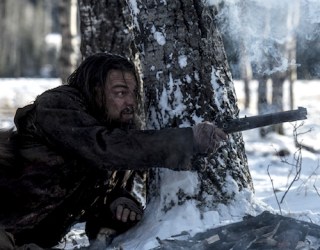
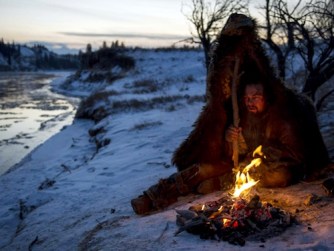
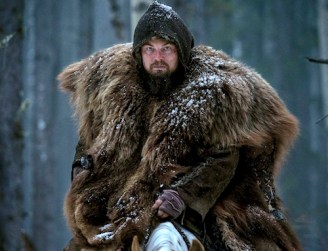
The Revenant is the Oscar-winning, acclaim-gathering story of Hugh Glass, the expert guide for a pelt-collecting group (is that what they are? Is that a thing?) in the Old West, who’s mauled by a bear to within an inch of his life. Eventually betrayed and left for dead by the members of the group who’d vowed to stay with him to the end, Glass somehow survives, and crawls across the wintery wilderness in search of his revenge! And it’s all the more remarkable for being based on a true story… though this retelling contains approximately as many “historical events that actually occurred” as does Game of Thrones.

The main talking point of The Revenant has been Leonardo DiCaprio’s performance, which finally bagged him an Oscar after four unsuccessful nominations (and I’m sure plenty of other roles that he thought might snag him some Academy recognition but didn’t). How much is it acting and how much was it just an endurance test that director Alejandro González Iñárritu subjected him to? Is there a difference? If you have to suffer for great art, Leo certainly did that. In some ways it’s testament to the Academy being able to look past delivery of dialogue as an indication of performance quality, because Glass doesn’t speak much — not when he’s in the company of others, and certainly not when he’s trying to get by on his lonesome, which he is for much of the film. Nonetheless, Leo conveys thoughts and emotions — which do go beyond, “I can’t believe Iñárritu is making me eat this raw liver” — effectively through expression and action.

In some respects it’s a shame the rest of the cast were consequently overshadowed — Leo may spend a huge chunk of the film on his own, but there are frequent cutaways to what everyone else is up to. Tom Hardy is the obvious standout as selfish bastard Fitzgerald, a perfectly detestable but completely believable villain — I’m not saying we’d all sink to his depths, but I’m not convinced most of us are above some of the choices he makes, either. Will Poulter steps outside the comedy roles he’s mostly taken since his Son of Rambow debut to give an effective turn as the group’s youngest, most conflicted member, while Domhnall Gleeson is commanding as the group’s leader. Gleeson was something of a lucky charm last awards season, appearing in no fewer than four Oscar-nominated films, including two that were up for Best Picture. Not only that, but look at his turn here (as an honourable, disaster-struck Captain) alongside his appearances in those other films (a small town nice guy in Brooklyn; an inexperienced evil military commander in Star Wars; a naive, selfish, sort-of-moral, easily-led programmer in Ex Machina) and you can see the kid’s got range.

Far from just an acting showcase, The Revenant is a film of thematic weight. In fact, it’s like an old-fashioned blockbuster — the kind of thing you’d’ve seen in the 1950s (epic revenge Western) or 1970s (bleak revenge Western) as among the year’s biggest movies — crossed with a slow-paced, scenery-loving, meditative arthouse piece. If it’s about anything (beyond, y’know, the plot), it’s surely about nature — both the amazing vastness of natural spaces, but also the brutality of survival. And not just humans, either, which is the go-to simplistic message (“isn’t nature good? aren’t humans bad?”) of such cod-thoughtful fare. Like the rest of nature, humanity is varied: there are some very harsh, cruel acts herein, but also acts of kindness — sometimes perpetrated by the same people.

The avoidance of pat depictions extends to its portrayal of Native Americans, too. They’re neither simplistic Evil Foreigners, nor a “we’re so sorry for how we’ve treated them before, they’re great really” apologia. Instead, they’re just as brutal and as human as the rest of us, and made up of varied groups who behave differently, or even slaughter among themselves. The main band of Indians we see do serve as the film’s villains (as if Fitzgerald wasn’t bad enough), a hunting party acting out an inverted Searchers as they hunt for a kidnapped daughter. In The Searchers the group hunting and killing in search of a girl are the heroes; here, they’re the villains. Makes you think, don’t it? I’m not accusing Iñárritu of casual racism — I imagine that’s exactly their point.

And speaking of Iñárritu, I wonder if this is his first genuine masterpiece. I didn’t care for 21 Grams or Babble, and Birdman was good but overrated. (In fairness, I’ve not seen Biutiful, which people seem to disregard nowadays, or Amores Perros, which is a rare foreign language film in the IMDb Top 250.) It seems like he was a nightmare during production — the budget was set at $60 million, but ultimately more than doubled to $135 million due to delays thanks to his production choices. In hindsight it looks like genius — “I knew it would be amazing so we kept going” — but if it had flopped, I’m sure an awful lot more would’ve been made of Inarritu’s excessively picky directorial style and fractious treatment of the crew, which apparently led Tom Hardy to try to strangle him…

At the Oscars, I was pulling for Roger Deakins to make it 13th time lucky, or for Mad Max to do a technical sweep and take cinematography with it (not undeservedly); but having now actually seen Lubezki’s work on The Revenant, it’s hard to deny it’s an immensely deserving winner. His mastery of all elements of the form is on regular display: the use of light (all natural!), perspective, lenses, focus; the single-shot techniques he and Iñárritu learnt for Birdman are put to superior use here, creating some stunning sequences (rather than taking over the entire movie). It looks incredible on Blu-ray, too — so detailed, crisp, epic. If anything was going to convince me 4K was an idea worth investing in, it’s material like this. (The cost of a new TV, new Blu-ray player, re-buying films, and the real estate needed in the lounge for a screen big enough to appreciate it puts the other half me off again.)

The film’s biggest flaw is that it goes on a bit too long in the middle. I’m not saying it needs to be a fast-paced thrill-ride, I just think it lingers a little longer than it needs to in places. Individual shots are beautiful, but the sheer volume of them stretches the centre part thin. There’s probably one too many action sequences where Indians attack and our hero has to escape, not least the one that ends in a too-obviously-CGI dive off a cliff. Equally, for every one of those there’s an incredible sequence, like the opening Indian attack. For a film that could easily be described as arthouse-y and thematically-driven, there are some truly stunning action scenes. The long middle means you couldn’t really call it “an action movie”, but focus on the first and last acts and it absolutely is.

I slipped in the word “masterpiece” a few paragraphs back, and I’d wager that’s what The Revenant is. It’s not perfect, and I don’t know that I’d say it’s the best film of last year either; but it is magnificently made, telling its story in a way only cinema can truly manage.

5 out of 5

The Revenant is out on DVD and Blu-ray in the UK as of yesterday.

It placed 4th on my list of The 20 Best Films I Saw For the First Time in 2016, which can be read in full here.

Highlander (1986)

100 Films’ 100 Favourites #43

There can be only one.

Country: UK
Language: English
Runtime: 116 minutes | 111 minutes (US theatrical cut)
BBFC: 15
MPAA: R

Original Release: 7th March 1986 (USA)
UK Release: 29th August 1986
First Seen: TV, 6th October 2000 (probably)

Stars
Christopher Lambert (Greystoke: The Legend of Tarzan, Lord of the Apes, Mortal Kombat)
Sean Connery (Goldfinger, The Rock)
Roxanne Hart (The Verdict, Pulse)
Clancy Brown (The Shawshank Redemption, The SpongeBob SquarePants Movie)

Director
Russell Mulcahy (The Shadow, Resident Evil: Extinction)

Screenwriters
Peter Bellwood (St. Helens, Highlander II: The Quickening)
Larry Ferguson (Beverly Hills Cop II, The Hunt for Red October)
Gregory Widen (Backdraft, The Prophecy)

Story by
Gregory Widen (see above)

The Story
Connor MacLeod is an immortal, a race of men living in secret among the rest of us, who must one day come together for the Gathering, after which there can be only one immortal left standing. That time comes in New York, 1985, as hulking savage the Kurgan hunts down the remaining immortals so that he can be the only one, and use the power that imbues to dominate the world. MacLeod is the only man in his way. Who will win? After all, there can be only— yeah, okay, you get it.

Our Hero
There can be only one Connor MacLeod, the 16th Century Scotsman with a suspiciously European accent who can live forever (who wants to live forever, anyway?)… unless someone lops his head off. That tends to do for most people, to be fair.

Our Villain
The strong and silent type, the Kurgan is certainly a physically imposing menace. Also immortal except for the decapitation thing. Wants MacLeod’s head, literally.

Best Supporting Character
Juan Sanchez Villa-Lobos Ramirez — the perpetually Scottish-accented Sean Connery as an Egyptian from Spain. It’s that kind of movie.

Memorable Quote
Connor MacLeod: “I’ve been alive for four and a half centuries, and I cannot die.”
Brenda: “Well, everyone has got their problems.”

Quote Most Likely To Be Used in Everyday Conversation
“There can be only one!” — everyone

Memorable Scene
(Spoilers!) As Connor talks with his assistant Rachel, an old woman, the film flashes back to World War 2: fleeing from Nazi soldiers, Connor runs into a barn, where he discovers a little girl hiding — Rachel. When a German officer turns up, Connor takes a bullet for her… then gets up and kills the officer, of course. This scene wasn’t even in the truncated US theatrical cut (it’s the largest single deletion, as detailed here), but has always stuck in my mind. It’s one of the best executions of the concept of the immortal: his only friend, an old woman, is someone he rescued as a little girl. (Short-lived half-decent US procedural crime series Forever explored this same concept more thoroughly over its single season a couple of years ago.)

Memorable Song
Who Wants to Live Forever is one of Queen’s best songs — and it was written by Brian May on the cab ride home after watching some rough footage from the movie! The band had only intended to record one song for the film, but after enjoying that footage they were inspired to compose more. The exact number of tracks they produced varies depending which source you listen to — they’re all on the A Kind of Magic album, but not all the tracks on that album were for Highlander. The exception is their recording of New York, New York for the film, which has never been released.

Technical Wizardry
Before CGI, filmmakers had to find other ways to do things like make swords spark when they clash. Animation was one method, of course. Not in Highlander, though. No, they attached a wire to each sword that then went down the arms of the actors to a car battery. One wire was connected to the positive terminal, the other to the negative terminal, so that when the blades touched there was an arc of electricity. Sounds super safe. Imagine the insurance costs of possibly electrocuting two lead actors…

Letting the Side Down
You might say the accents, but I think they’re part of the charm.

Making of
The opening scene was scripted to take place during a hockey match, emphasising the violence of the sport in contrast to the flashbacks of Connor warring in Scotland. The NHL weren’t impressed and refused permission. It was replaced with a wrestling match, which is presumably less violent than hockey.

Next time…
There should be only one! No one pays much attention to anything Highlander-related beyond the first film anymore, it feels like, but there’s a whopping great franchise lurking underneath that surface. It begins with much-maligned sequel Highlander II: The Quickening, also directed by Mulcahy and starring Lambert and Connery, which is set in the future and explains away the immortals as being aliens, or something. In spite of the minor improvement in the form of a “Renegade Version” director’s cut, the rest of the franchise ignores it. Spin-off TV series Highlander: The Series began in 1992, following the adventures of Duncan MacLeod (Adrian Paul), another immortal from the same clan. It ran for six seasons, begetting a spin-off of its own, Highlander: The Raven, which only lasted one. An animated series set in a post-apocalyptic future began in 1994, titled Highlander: The Animated Series (imaginative with their names, weren’t they?), which followed “the last of the MacLeods”, Quentin. It lasted for 40 episodes across two seasons. Also in 1994, second sequel Highlander III: The Sorcerer (aka Highlander: The Final Dimension) returned to the story of Connor MacLeod, ignoring both The Quickening and the TV series. Apparently it’s just a rehash of the first movie. After the TV series ended, fourth film Highlander: Endgame attempted to merge the two branches of the franchise, with a movie that followed Duncan MacLeod and led him to encounter Connor. It’s been shown on the BBC with surprising regularity. For some reason they made an anime movie in 2007, Highlander: The Search for Vengeance, which pits Colin MacLeod (yes, another one) against an immortal Roman general in a post-apocalyptic future. What is it with animation and post-apocalyptic futures? The whole shebang ultimately ground to a halt with Highlander: The Source, a post-Endgame continuation that was supposed to be the first of a trilogy but didn’t go down very well (plus ça change). It’s also been shown on the BBC with surprising regularity. There are also novels, a Flash-animated webseries, a handful of comic books released in the mid-’00s, and a couple of series of audio dramas from Big Finish that continue the TV series. A remake/reboot has been in development since 2008.

What the Critics Said
“Film starts out with a fantastic sword-fighting scene in the garage of Madison Square Garden and then jumps to a medieval battle between the clans set in 16th-century Scotland. Adding to the confusion in time, director Russell Mulcahy can’t seem to decide from one scene to the next whether he’s making a sci-fi, thriller, horror, music video or romance – end result is a mishmash.” — Variety (they say that as if it’s a bad thing!)

Score: 68%

What the Public Say
“I hear this won the Oscar for Best Movie Ever Made.” — Jope @ Blu-ray.com

Verdict

Highlander is a cult favourite — many reviews will tell you as much. I guess I’m in that cult, then, because I bloody love it. Of course it’s preposterous, of course the screenplay and performances are ridiculous, and of course it’s directed as much like an ’80s music video as it is a film… but it’s also a fantastic fantasy concept, so rich for further exploration that they keep trying to do just that (even though they keep messing it up). Also, it’s about men who have sword fights — excitingly choreographed sword fights — so, yeah, it’s right up my alley in that, too. Highlander may not be a “great film” in the artistic history-of-the-medium sense, but my goodness is it a great film.

A 30th anniversary restoration of Highlander is released on DVD and Blu-ray next month.

#44 will be… the best Fantastic Four movie.

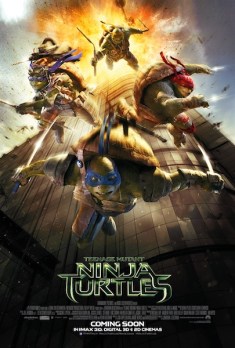
Teenage Mutant Ninja Turtles (2014)

2016 #48
Jonathan Liebesman | 97 mins | streaming (HD) | 2.35:1 | USA / English & Japanese | 12 / PG-13

While I was killing time waiting for my coffee to brew before I sat down to watch Teenage Mutant Ninja Turtles, 2014 edition, I drafted the introductory paragraphs to this review. Yes, before I’d even started the movie, so sure was I that I would dislike it. Naturally they took an appropriately condemnatory tone, talking about how it was a product and not a movie, designed primarily to sell tie-in plastic to grown men who wish they were still children, etc etc. Unfortunately writing those paragraphs was a waste of my time, because I can’t use them, because — shock of shocks — I actually quite liked this movie.
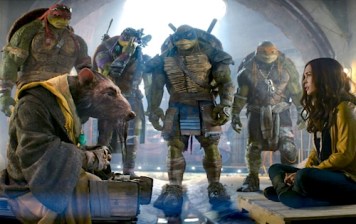
Now, let’s immediately throw some caveats on that, because it’s clearly riddled with flaws. The story is slight and so filled with over-familiar tropes that it barely bothers to play them out in full. On the bright side, that does mean it rattles along. However, the grand plan/climax is lifted straight from The Amazing Spider-Man. The action is often poorly directed, a too-close whirlwind of pixels. That said, there’s one sequence so OTT crazy that — if you ignore that the film is supposed to be live action and embrace the wild camerawork, physically impossible antics, and mind-boggling speed — it’s almost impressive. The CGI is variable: the Turtles themselves actually look alright, maybe even good, but Splinter is piss poor.

Megan Fox is miscast, not that she can act anyway. She’s clearly only there because producer Michael Bay thinks she’s hot (bit too plastic for my taste). Shredder is Bay-ed to the max, essentially becoming a Transformer made of knives. The Turtles’ personalities are pretty one-note, but not unfaithful to the original — the franchise started life as a spoof of things like Daredevil, after all, not a realistic character drama. That said, turning Mike into basically a turtle version of Michael Bay — i.e. he’s focused on lusting after Megan Fox and occasionally causing explosions — is a little cringe-y. Quite a few bits are a little cringe-y, actually; but they’re tempered by a few comedic bits that hit home, and a general veneer of “well, it could’ve been worse”.
“Well, it could’ve been worse” is pretty much the definition of “damning with faint praise”, but for all those many problems, I actually enjoyed myself while watching the film. It was funny enough, it was exciting enough, it was almost well-made enough. It’s not a good movie, but I did think it was an “entertaining enough for a couple of hours on a particularly lazy evening” kind of movie. And, despite the weak reviews it’s been receiving, the trailers for the second movie make it look better. I’m not going to fork out cinema prices to see it anytime soon, but on the strength of this first one, I will eventually. Which may not please the plastic-pedlars, exactly, but is a better result than I’d expected.

3 out of 5

Teenage Mutant Ninja Turtles: Out of the Shadows is in cinemas worldwide now.

Quigley Down Under (1990)

2016 #27
Simon Wincer | 120 mins | streaming (HD) | 2.35:1 | Australia & USA / English | 15* / PG-13

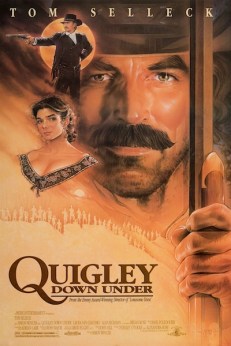
Tom Selleck is Quigley, who has the ability to shoot things at implausibly long distances, and whose hair has the ability to stay implausibly coiffed even after days abandoned in the outback. He’s been employed by Alan Rickman, who we know is the villain because this was released in 1990. Alan Rickman has brought Quigley to Australia on the pretence that he’s to kill dingoes, but he actually wants Quigley to kill Aborigines. Quigley doesn’t take kindly to this, because he’s the hero, and so pretty much as soon as he turns up he’s left to die in the outback. The end.

No, not really! Quigley manages to acquire his gun and becomes some kind of mythical saviour of the Aborigines. (Let’s not get into the whole race politics of that, okay?)

Despite how the title sounds, it isn’t a sequel to a film called Quigley. It kinda feels like it is, though — you know, those sequels they used to do where you just send your hero off to a new place (often a different country) for essentially more of the same, but because it’s a churned-out cash-in it’s not as fine-tuned as the first film and so never quite as good? If I didn’t know better, I’d believe this was one of those.

It also has a very odd tone. Daft comedic bits rub up against brutal tragedies, like the mass slaughter of Aborigines, or the random death of innocent bystanders, or Crazy Cora’s backstory. It’s like someone wrote a very serious Western, then someone else came along and attempted to zhoosh it up so it could star Tom Selleck and The Funny Villain From Die Hard. And it has very cheesy, derivative, generic Western music, as if they felt it really needed ramming home that, yeah, it’s set in Australia, but actually it’s a Western.

I only heard about Quigley Down Under after Alan Rickman passed away, when a few blogs flagged it up as a great forgotten performance of his. He does bring some of his Die Hard / Prince of Thieves-era skills to the piece, but it’s a paler imitation of those roles. The rest of the film has things to commend it: Selleck is a decent, square-jawed, old-fashioned leading man; Laura San Giacomo finds surprising nuances in Cora, who could’ve just been crazy; leaving the dated politics aside, it’s a decent narrative. The end result is a solid, if ultimately unremarkable, Oz-set Western.
3 out of 5

* Rated 12 in cinemas in 1991, but rated 15 on video in 1991 and 2003. ^

X-Men: Apocalypse (2016)

2016 #98
Bryan Singer | 144 mins | cinema | 2.35:1 | USA / English, German, Arabic, Polish & Ancient Egyptian | 12A / PG-13

This review contains major spoilers.

Despite fathering the modern superhero movie genre, the X-Men series always seems to punch under its weight at the box office (a point the recent Deadpool Honest Trailer makes succinctly, if blink-and-you’ll-miss-it-ly). They’re always movies of massive anticipation for me, though, because it’s a franchise I have particular fondness for. The ’90s animated series was a ‘key text’ of my childhood, and the tie-in magazine was the first comic book I consciously bought (as opposed to all the Ghostbusters / ThunderCats / Thunderbirds / etc ones I had when I was wee). The first X-Men movie was the first movie I bothered to see twice at the cinema, and remains one of only a handful to have provoked that added expense from me. So even in a summer full to bursting with ensemble superhero (and supervillain) dramatics, a new X-Men movie is easily one of my most anticipated.

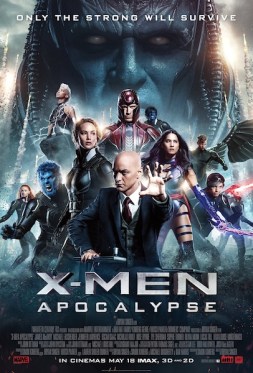
Following on from the excellent double bill of First Class and Days of Future Past, Age of Apocalypse picks up in the 1980s. It’s a decade on from Magneto (Michael Fassbender) almost killing the President — and, in the process, revealing the existence of mutants to the world. Mystique (Jennifer Lawrence) is hailed as a hero for stopping him, so travels the world incognito, helping other mutants. Xavier (James McAvoy) has properly established his School for Gifted Youngsters (aka Mutants), with Hank McCoy (Nicholas Hoult) as a teacher. And Magneto is living under an assumed name in Poland, a quiet domestic life complete with wife and daughter. When CIA agent Moira MacTaggert (Rose Byrne, returning after sitting out Days of Future Past) accidentally helps a cult resurrect the centuries-dead mutant Apocalypse (Oscar Isaac), who believes he’s a god, it sets in motion a chain of events that will bring our disparate compatriots back together — and possibly bring about the end of the world.

That’s only the half of it, though. This is an X-Men movie, which not only means there’s an ensemble cast, but that it’s dedicated to constantly adding new members to it. This time around, we’re re-introduced to the ‘original’ team as teenagers: Scott Summers (Tye Sheridan) is the viewer’s “way in” to Xavier’s school after he suddenly starts shooting laser beams from his eyes; there he meets Jean Grey (Sophie Turner), a powerful telepath the other students are scared of because sometimes her dreams shake the school at night; Mystique rescues blue-skinned German teleporter Nightcrawler (Kodi Smit-McPhee) from a cage fight in Berlin, where he was up against Angel (Ben Hardy), who becomes one of Apocalypse’s Four Horsemen, alongside weather controlling street kid Storm (Alexandra Shipp) and Psylocke (Olivia Munn), who can create blades of energy with her hands. And there’s also Jubilee (Lana Condor), who has bugger all to do. Jubilee was a major character in the animated series, and the filmmakers seem obsessed with getting her into the movies (she had cameos in the first trilogy) without ever actually giving her anything to do.
With so many characters to deal with, the film becomes a little overburdened with subplots. It’s trying to be a trilogy-former for the remnants of the First Class cast, resolving the fractured relationship between Charles, Erik, and Raven before those three actors fulfil their contracts and decide they don’t want to do a fourth movie; but it’s also trying to introduce the new-old gang of X-Men, and establish their characters to head-up future movies; and it also has to deal with establishing its villain and his plans. It’s a big ask, and while director Bryan Singer and screenwriter Simon Kinberg do manage to keep all the plates spinning and achieve something with most of them — helped no end by actors of McAvoy and Fassbender’s quality being able to flesh out their underwritten parts — some plot threads do feel perfunctory, their events and resolutions a bit skin-deep.

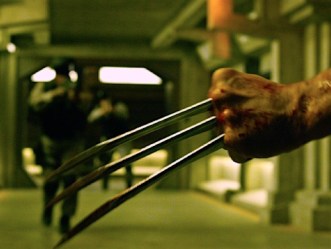
It doesn’t help that they feel the need to shoehorn a Wolverine cameo in there, an underwhelming action sequence that becomes a massive aside from the main storyline. It feels like setup for something more next time, but Hugh Jackman has stated the next Wolverine solo film will be his last outing as the character, so presumably it isn’t. That said, the post-credits scene, showing some Essex Corp suits collecting Weapon X blood, suggests a possibility for how they’ll recast Jackman without Logan magically getting a new face. For those not in the know, Essex Corp is the company of villain Nathaniel Essex, aka Mr Sinister, a cloner who created female Wolverine clone X-23. Naturally commenters are predicting she might turn up in the next X-film, which is not illogical, but I wonder if Sinister might instead use Wolverine’s blood to create a new, younger Wolverine — played by a new, younger actor, of course. We’ll see.
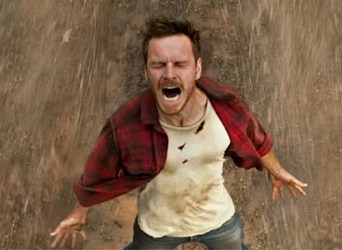
The one thing the Wolverine sequence does do is place him broadly in the right place (i.e. freed from the Weapon X programme) to link back up with the first X-Men movie. That’s a connection Singer also attempts to make elsewhere (Charles and Erik’s final dialogue is very similar to their final exchange in the first X-Men), even though we’re now in a new timeline that doesn’t perfectly marry up to the first three movies. Indeed, depending how you count it, Apocalypse can be seen as a second, third, fourth, sixth, or ninth X-Men movie. Yes, really. It’s the second for director Bryan Singer since he took back the reins with Days of Future Past; it’s the third in a prequel trilogy that can began with First Class; it’s Singer’s fourth X-film overall; overall, it’s the the sixth in the X-Men series; and it’s the ninth movie in the X-Men universe (which also encompasses two Wolverine spin-offs and this year’s primary comic book movie success story, Deadpool). Some of these have greater relevance than others, but they all inform the film in one way or another. For example, it’s the second second-Singer movie to introduce Nightcrawler and not know quite what to do with him outside of action sequences.

Another element lost in the mix is the real-world resonance contained in the best X-films. There’s a lot of to be said for the spectacle that’s present in all the movies, but Days of Future Past (for the most recent example) anchored it in the human conflicts between the heroes, and in their relation to the rest of the world. Apocalypse nods in that direction, with Mystique invoking Magneto’s metaphorical family to get him to stop destroying the world, but it’s not as well integrated, not as effective as previous outings. Said destruction is on a massive scale, but it’s too massive — the film doesn’t sell it; it’s just another city being destroyed somehow, emotionless computer-generated effects that are overfamiliar in these megablockbusters now (and not helped when you’ve seen similar sights two or three times right before the film in trailers for the likes of Teenage Mutant Ninja Turtles 2 and Independence Day 2).

Elsewhere, sacrificial character deaths have little weight — one of the main ones is Havok (Lucas Till), whose presence in the movie I haven’t even felt the need to mention up to this point. There’s a new Quicksilver sequence, but it feels like an attempt to recreate the last film’s magic. It’s a fun scene, no doubt, and it does have some new ideas within it, but it’s primarily a variation on a theme and feels shoehorned in to the movie, rather than an organic or wholly original element. Immediately before this, a trip to the mall for a single joke (the Return of the Jedi one you’ll have heard about if you’ve read any other review) screams “deleted scenes!”, even without having seen Sophie Turner tweet a Dazzler-referencing photo. Will we be seeing X-Men: Apocalypse – The Dazzler Cut on Blu-ray this time next year? Well, I doubt it’ll actually be named that (more’s the pity), but maybe we will. I’d certainly expect a chunky selection of deleted scenes (some of which have already been teased).

In fact, the film as a whole feels a draft or two away from being truly ready. Some of the dialogue clunks hard, especially when characters speak in exposition to one another. The plot needs streamlining and focusing, especially early on, and some events need appropriate weight added to them. Other things just need smoothing out — that trip to the mall happens Just Because, with no real sense of why the characters are doing it (other than some handwaving dialogue about needing to get out of the school for a change), and, as I said, in the final cut only leads to one single joke. Yet for all that, some things do work beautifully: Storm’s hero-worship of Mystique comes up almost in passing early in the film, establishing/emphasising Mystique’s place in the mutant world now; but then it becomes a key point in the climax without the need for any explanatory dialogue, as Storm wordlessly realises that her hero is fighting on the other side. It is, in a way, the best bit of the movie.
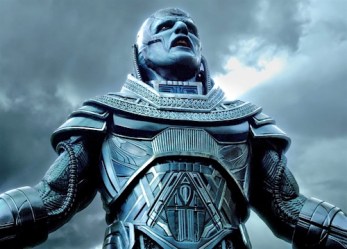
The other very best bit is a great title sequence, which almost makes me wish I’d seen the film in 3D. It’s best seen rather than described, but do pay attention because it swirls a lot of detail into a very short space of time. It also uses the title theme that Singer’s regular composer John Ottman wrote for X2, which Singer revived for Days of Future Past (I’m pretty sure it wasn’t used in The Last Stand or First Class, to their shame), and seems intent on making the series’ regular main theme. He’ll hear no objection from me, because I think it’s a fantastic piece, almost as good as the classic one from the ’90s animated series (see: the animated series’ Honest Trailer).

Despite being a negative nelly for much of this review (like so many others, which has given it a lowly 47% on Rotten Tomatoes, which is ridiculous), I actually enjoyed Apocalypse a great deal; it’s just that these critical observations flow forth when you think about and analyse it afterwards. In spite of them, I think the film does enough right to be an entertaining action-adventure sci-fi blockbuster. It’s not the epitome of the X-franchise — there are at least four movies in the franchise better than it, in my estimation — but I’d still argue it’s closer to those better films (all of which I’d number among my favourite movies, incidentally) than it is to the doldrums of The Last Stand or X-Men Origins: Wolverine. The X-Men movies will continue (a brand-new young cast and a post-credits tease confirm that much), and a minor blip in quality should do nothing to derail that train.

4 out of 5

X-Men: Apocalypse is released in the US and Canada today, and is still playing everywhere else that it’s still playing.

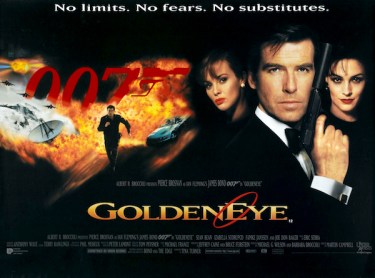
GoldenEye (1995)

100 Films’ 100 Favourites #40

You know the name.
You know the number.

Country: UK & USA
Language: English, Russian & Spanish
Runtime: 130 minutes
BBFC: 12 (cut, 1995) | 15 (uncut, 2006)
MPAA: PG-13

Original Release: 16th November 1995 (Canada)
US Release: 17th November 1995
UK Release: 24th November 1995
First Seen: VHS, 1996

Stars
Pierce Brosnan (Mrs. Doubtfire, Mamma Mia)
Sean Bean (Patriot Games, The Lord of the Rings: The Fellowship of the Ring)
Izabella Scorupco (Reign of Fire, Exorcist: The Beginning)
Famke Janssen (X-Men, Taken)
Judi Dench (A Room with a View, Notes on a Scandal)

Director
Martin Campbell (The Mask of Zorro, Casino Royale)

Screenwriters
Jeffrey Caine (The Constant Gardner, Exodus: Gods and Kings)
Bruce Feirstein (Tomorrow Never Dies, The World is Not Enough)

Story by
Michael France (Cliffhanger, The Punisher)

Based on
James Bond, a character created by Ian Fleming.

The Story
When Russian crime syndicate Janus steal the activation codes for a new satellite weapons system called “Goldeneye”, there’s only one man who can stop them using it for nefarious ends: Jack Bauer. Only kidding — it’s Jason Bourne. No, ‘course not — it’s Bond, James Bond.

Our Hero
Pierce Brosnan is Bond, James Bond, for the first time. After the almost-franchise-killing seriousness of Timothy Dalton, Brosnan nails Bond for the nostalgic ’90s: a dash of Sean Connery’s grit, a dash of Roger Moore’s raised-eyebrow humour, a whole lot of suaveness. For a while, the old “Connery or Moore?” question became “Connery, Moore or Brosnan?”

Our Villain
The mysterious Janus, who (spoiler alert!) turns out to be former MI6 agent and Bond’s chum Alec Trevelyan, out for revenge against the British Empire for betraying his family after World War 2, and against Bond for setting the bombs’ timers for three minutes instead of six.

Best Supporting Character
It was a bold choice to cast a woman as M back in 1995, even though she was inspired by the real director of MI6 at the time. Fortunately they cast the inestimable Dame Judi Dench, who naturally made the role her own — so much so that she survived the otherwise series-wide reboot in 2006, and having a male in the part now feels kinda odd.

Memorable Quote
“I think you’re a sexist, misogynist dinosaur. A relic of the Cold War” — M
(If a single line saved the Bond series, it’s this. In one fell swoop Dame Judi proves that a female M will work, and that this is a franchise aware of the need to drag itself into the present day.)

Memorable Scene
The villains are driving off with the kidnapped love interest. There’s no Aston Martin in sight. Does Bond take another car? Of course not — he takes a bloody tank.

Write the Theme Tune…
Bono and The Edge of U2, hired after…

Sing the Theme Tune…
Tina Turner. According to Wikipedia, “the producers did not collaborate with Bono or The Edge,” hence why (unlike previous Bonds) there’s nothing in the main score that references the title theme. That would rather become the Bond M.O. as the ’90s went on.

Truly Special Effect
The bungee jump off the damn — because it’s not a special effect, it’s real. The Bond series’ legacy of incredible, groundbreaking stunts continues with considerable style.

Letting the Side Down
Éric Serra’s score. Hiring someone to write a very modern (for the early ’90s) score for the newly-relaunched Bond must’ve seemed like a good idea at the time… but it wasn’t. It hasn’t improved any with age, either. Tellingly, after the score was finished the producers had someone else re-score the film’s big action sequence, the St. Petersburg tank chase, with music that sounds far more classically Bondian. Bonus problem: if you had an N64 (like I did), chances are you played GoldenEye the game far more than you watched the film. It too used Serra’s score, meaning I can’t hear it without being transported back to an idyllic adolescence playing blocky video games.

Making of
Pierce Brosnan was originally cast as Bond in 1986, but was forced to pull out when his TV series, Remington Steele, was unexpectedly renewed (according to one telling, that was purely to prevent him playing Bond — they only made six more episodes). Previously, Timothy Dalton had almost been cast when Roger Moore became Bond, and Moore had almost been cast before Sean Connery. Don’t be too surprised if Henry “Superman” Cavill — who was almost cast before the producers settled on Daniel Craig — is taking his martinis shaken not stirred in a few years’ time.

Previously on…
16 previous Bond films (which are all technically in the same continuity). The last was six years earlier, and the least financially successful for 15 years in the US (did alright worldwide, though).

Next time…
Brosnan played Bond thrice more, to increasing box office (if not critical) acclaim. He was due to do a fifth, but then the producers won back the rights to Casino Royale and the rest is history.

Awards
2 BAFTA nominations (Special Effects, Sound)
2 Saturn nominations (Action/Adventure Film, Best Actor (Pierce Brosnan))
2 MTV Movie Awards nominations (including Best Sandwich in a Movie for the submarine sandwich with tomatoes and provolone. It lost to the ham and cheese sandwich in Smoke).

What the Critics Said
“James Bond, the British spy with a taste for the high life and a licen[c]e to kill, comes back in surprisingly hardy and supple form. Gadgets firing, quips racing, libido unfurling, surrounded by a top-notch supporting crew of actors, designers and demolition experts, the new Agent 007 (now played by Pierce Brosnan) delivers whatever Bond devotees could reasonably want, or what newcomers anticipate. […] So much familiarity may lead to contempt in some quarters. But Bond, like Sherlock Holmes, Jeeves, Tarzan, Frankenstein or Dracula, is one of those mythical British pop figures who seem ageless, infinitely adaptable. […] Perhaps the reason is that Bond — as his detractors have always noted — is an adolescent fantasy figure, a Peter Pan popped onto the stage of international espionage. Like Peter, he can’t — won’t — grow up. [He has] caught the world’s imagination because he played out its darker dreams with fairy-tale lightness.” — Michael Wilmington, Chicago Tribune

Score: 78%

What the Public Say
“Rarely in the Bond franchise have directing, acting, cinematography, action, and music come together to create such a stylishly sublime experience. GoldenEye has undeniably earned its now-solidified status as a classic.” — Lukas, Lukas + Film

Verdict

After diminishing box office in the Dalton years, a long gap forced by legal battles, and the Cold War ending in the interim, bringing Bond back for the ’90s was perhaps a bit of a long shot. Fortunately, this fact didn’t escape the makers: there are numerous nods to Bond’s somewhat old-fashioned values (see also: memorable quote), and a whole heap of effort was expended on large-scale action sequences and stunts. Couple that with a solid storyline, several memorable villains, and a “greatest hits”-style leading performance from Brosnan, and you have a series that wasn’t just revived but was set to reach new heights (of box office, if nothing else).

Frankly my dear, #41 doesn’t give… a damn.

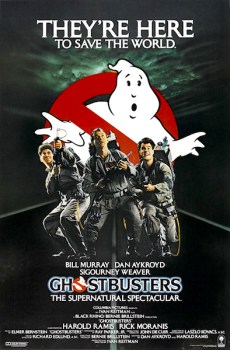
Ghostbusters (1984)

100 Films’ 100 Favourites #37

They’re here to save the world.

Also Known As: Ghost Busters, technically.

Country: USA
Language: English
Runtime: 105 minutes
BBFC: PG (1984) | 12A (2011)
MPAA: PG

Original Release: 8th June 1984
UK Release: 7th December 1984
First Seen: VHS, c.1990

Stars
Bill Murray (Groundhog Day, Lost in Translation)
Dan Aykroyd (The Blues Brothers, Trading Places)
Harold Ramis (Stripes, The Last Kiss)
Ernie Hudson (The Crow, Congo)
Sigourney Weaver (The Year of Living Dangerously, Gorillas in the Mist)
Rick Moranis (Little Shop of Horrors, Honey, I Shrunk the Kids)

Director
Ivan Reitman (Stripes, Kindergarten Cop)

Screenwriters
Dan Aykroyd (The Blues Brothers, Dragnet)
Harold Ramis (Animal House, Groundhog Day)

The Story
After losing their university jobs, a trio of paranormal researchers set up a ghost extermination business. They’re soon hired by Dana Barrett, who believes her apartment is haunted. Turns out it is, by an evil demigod who posses Dana and sets about bringing the world to an end…

Our Heroes
They ain’t afraid of no ghosts! Discredited parapsychologists Peter Venkman, Ray Stantz and Egon Spengler set up the Ghostbusters to combat the increasing problem of paranormal activity in New York City, and later recruit Winston Zeddemore to cope with demand.

Our Villain
Gozer the Gozerian, a Sumerian god of destruction. Likes to turn his servants into supernatural hounds and allow the good guys to choose the form of their ‘destructor’ — which is how you end up having to fight a 112½-foot marshmallow man.

Best Supporting Character
Among a strong cast of memorable characters, one has to feel for William Atherton as antagonistic EPA agent Walter Peck. Peck is so unlikeable that, according to director Ivan Reitman, it “ruined” Atherton’s life: people confronted him as if he were the character, including starting fights in bars. He’s just too good at being a slimy little so-and-so, I guess.

Memorable Quote
“Don’t cross the streams.” — Dr. Egon Spengler

Quote Most Likely To Be Used in Everyday Conversation
“Dogs and cats, living together!” — Dr. Peter Venkman (well, we used it a lot…)

Memorable Scene
The Ghostbusters fail to stop the coming of Gozer, who shortly declares that the destructor will follow, in a physical form chosen by the team. Although three of them manage to clear their minds, something pops into Ray’s head — “the most harmless thing. Something I loved from my childhood. Something that could never, ever possibly destroy us.” Unless it was eleven storeys tall and motivated by evil, of course.

Sing the Theme Tune…
“If there’s something strange in you neighbourhood, who you gonna call?” Ray Parker Jr.’s theme song is as iconic as the movie itself. It lost the Oscar to Stevie Wonder’s I Just Called to Say I Love You. Won the BAFTA, though.

Truly Special Effect
The film is full of excellent effects work — all done practically, of course, in those pre-CGI days. That also means an abundance of techniques were used, from simple stuff like hanging things on wires or using wind blowers to make library cards fly around, to miniatures with a Godzilla-style man in a suit, to full animation for things like the proton packs’ streams. And it was all produced on such a tight schedule that, according to the film’s effects mastermind, 70-80% of the work was achieved in the first take.

Making of
Dan Aykroyd wrote the part of Winston with Eddie Murphy in mind, having just worked with him on Trading Places. When Murphy was unavailable due to working on Beverly Hills Cop, Ernie Hudson was cast. He was so excited by the part that he agreed to do it for half his usual salary, only to then receive a revised script in which Winston had a greatly reduced role. In 2015, Hudson commented, “I love the character and he’s got some great lines, but I felt the guy was just kind of there. I love the movie, I love the guys. I’m very thankful to Ivan for casting me. I’m very thankful that fans appreciate the Winston character. But it’s always been very frustrating — kind of a love/hate thing, I guess.”

Next time…
First came The Real Ghostbusters, an animated series that ran from 1986 to 1991 and produced 140 episodes (the addition of The Real to the title being due to another series from the ’70s). Due to its success, the cast and crew were cajoled into making a film sequel, Ghostbusters II, which scared the life out of me when I was about 4. In 2009, Ghostbusters: The Video Game used the likenesses and voices of many of the original cast, and Dan Aykroyd described it as “essentially the third movie.” Rumours and/or plans for a genuine second sequel persisted for a very, very long time (there’s a mass of details here, if you’re interested), though finally seem to have been abandoned in favour of this summer’s all-female reboot.

Awards
2 Oscar nominations (Visual Effects, Original Song)
1 BAFTA (Original Song)
1 BAFTA nomination (Visual Effects)
1 Saturn Award (Fantasy Film)
Nominated for the Hugo for Best Dramatic Presentation.

What the Critics Said
“The cast could not be better. Although his role is too small, Aykroyd is endearingly serious as a diehard, but easily scared, ghost-hunter. Harold Ramis, the co-writer of the script, is extremely funny as a hopeless egghead […] But Ghostbusters is primarily a showcase for Murray, who slinks through the movie muttering his lines in his usual cheeky fashion and getting off an occasionally hilarious crack that proves he’s thoroughly enjoying himself.” — Kathleen Carroll, New York Daily News

Score: 97%

What the Public Say
“the use of special effects, specifically practical effect, shines as well. The ghosts may not be perfectly rendered, but they are so interesting in design and they have so much energy onscreen that you don’t mind it. The practical effects, like having the ground open up or drawers being opened by unseen ghosts are done very well. In a time where many effects-heavy films rely solely on CGI, it’s nice to look back to a time when practical effects were still commonplace in movies and done well in movies.” — Joey Sack, Reel Reactions

Verdict

Along with Teenage Mutant Ninja Turtles and ThunderCats, I loved Ghostbusters when I was a kid — I had a dressing up set, with a jumpsuit and a proton pack with a yellow foam whatsit for the stream, and one of the traps, and an Ecto-1, and the firehouse playset, and one time I got my fingers caught in the grill on the roof (which was there to pour goo through, because toys) and I’m sure I panicked until liberal application of butter freed me… Good times. I guess back then my love for it was more to do with the animated series than the movie, but the film itself is a work of blockbuster comedy art. The characters are a joy to be around, the dialogue is hilarious and quotable, multiple sequences lodge themselves indelibly in the memory, the special effects are exemplary, and the dramatic stakes can be surprisingly effective for what’s primarily a comedy.

All together now: “bustin’ makes me feel good!

#38 will have its revenge… in this post or the next.