RoboCop 2 (1990)

2012 #82
Irvin Kershner | 116 mins | streaming | 1.85:1 | USA / English | 18 / R
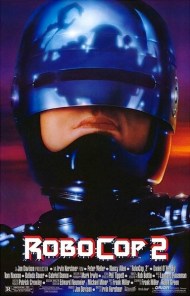
RoboCop 2The consensus opinion seems to be that the RoboCop films exist on a steep downward trajectory of quality, starting with the pretty-good first film and ending with the nadir-of-humanity third. In this equation the second lands, naturally, somewhere in the middle — not that good, but not so bad. Personally, I enjoyed it more than the first.

As future-Detroit’s police strike over something to do with evil megacorporation OCP, ever-popular officer RoboCop fights a war on drugs, while OCP plot his replacement… Such is the barebones of a plot on which hang some solid stabs at satire and some nice boundary-pushing plot points, which at times left the film feeling still relevant today — something I felt the first RoboCop no longer was. Take the gun-toting pre-teen wannabe-drugs-baron, for instance, one of the film’s best characters who (spoiler alert!) they’re not afraid to deal a bloody death to. I’m not revelling in the death of children here, and I don’t think the film does either; instead, it demonstrates a kind of ballsiness and not backing down from the story and world they’ve created.

The satire is one of the most praised elements of the original film, but with new writers and a new director on board it would’ve been easy to ignore that in favour of a film in which a robot cop shoots lots of criminals. That is, obviously, not the case, and while at times some of the sequel’s jabs at society may be more on-the-nose even than the first film’s efforts, they’re not unwelcome or inaccurate. The screenplay was in part written by objectionably-right-wing comic book author Frank Miller, RoboCop tooand though it was reportedly massively re-written after his work was done (to the extent that, decades later, there was a comic book miniseries that adapted his original version) I think his touch can still be felt at times.
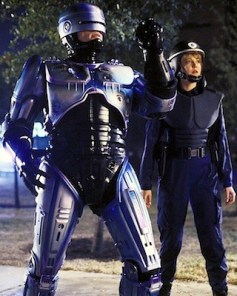
I also criticised the franchise opener for poor special effects, and I think RoboCop 2 improves in that regard too. There’s still moderately obvious modelwork on display, but it doesn’t seem as cartoonish or juddery as the previous film’s. The climactic villain is a more genuine threat (it’s responsible for at least one massacre at any rate) and the battle with RoboCop, a mix of life-size props and stop-motion, makes for an exciting, well-matched finale, something the first film’s falling-down-the-stairs moment didn’t quite achieve.

I can’t say I’m overly enamoured with either of the RoboCop films I’ve watched to date. As a character and franchise it seems to have slipped from the consciousness a bit in the last decade or so, and I can’t say I find huge fault with that status. Plus, it’ll be interesting to see if the forthcoming remake can do anything to boost the franchise’s fortunes. Nonetheless, this sequel is a solid example of R-rated late-’80s action entertainment that, as noted on more than one occasion, I certainly liked better than its predecessor.

4 out of 5

This review is part of the 100 Films Advent Calendar 2012. Read more here.

RoboCop (1987)

2012 #80
Paul Verhoeven | 103 mins | streaming | 1.85:1 | USA / English | 18 / R

RoboCopIn a crime-addled future Detroit, cop Alex Murphy is gunned down by a gang of crooks, only to be resurrected by evil megacorporation OCP as the future of law enforcement: RoboCop. Obviously — that’s the title.
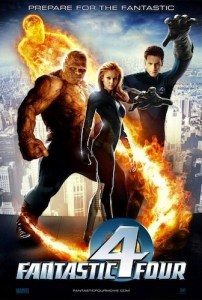
Hailed by those who love it as some kind of satirical masterpiece, RoboCop does manage to raise itself above other mindless ’80s action fare, at least to some degree. Equally, should you choose to watch it brain-off then I doubt you’ll be too troubled by its criticisms of corporate greed or the privatisation of public services (at least, I assume those are the targets — this is an American film and don’t Americans love privatisation? But then, Verhoeven is European, so who knows). There’s gory action and the odd one-liner to enjoy, as well as Murphy’s battle with identity once he becomes the robotic enforcer.

At this point, I think RoboCop has become a film you had to be there for. Viewed now, 25 years after release, it looks dated. The stop-motion rendering of big bad robot ED-209 appears jerky and cartoonish now, like something from a kids’ action/adventure film rather than an 18-rated satirical thriller. RoboCop beats it by making it fall down some stairs, after which it can’t get up, wiggling its legs in the air comically. Maybe that was Verhoeven’s intent, to make it laughable, but I’m not sure. I’m loath to criticise old-fashioned effects because, a) that’s all they had access to at the time, and b) they can often look better than today’s CGI-obsessed major movies; but where the likes of Back to the Future or Star Wars still stand up to scrutiny, I don’t believe RoboCop cuts the mustard.

There’s a remake coming soon which has seen a lot of criticism levelled at it by fans, especially over leaked photos of the new costume. I’m not exactly looking forward to it, but nor am I dreading it — the concept’s a good’un and could withstand a refresh. Plus the version of RoboCop presented here, all stompy and bulky and slow, wouldn’t cut the mustard in an era that’s decades on from the T-1000 and can see small, streamlined technology every way we turn.

In the meantime, there’s this, but I do think it’s rather had its day.

3 out of 5

This review is part of the 100 Films Advent Calendar 2012. Read more here.

Fantastic Four (2005)

2012 #77
Tim Story | 106 mins | Blu-ray | 2.35:1 | Germany & USA / English | PG / PG-13

Fantastic FourIn the wake of highly successful franchise launches for X-Men and Spider-Man, the next Marvel superheroes to be afforded the big-screen treatment were the Fantastic Four, a kind of family imbued with superpowers after a space accident. “Kind of family” translated to “family movie” for Fox executives, and they produced this dross.

“Family movie” does not automatically equal bad superhero film. Indeed, The Incredibles is one of the sub-genre’s best offerings. I don’t know much about the Fantastic Four comics, but it strikes me that Pixar more successfully hit the tone and style that the makers of this film were aiming for.

The problem I felt is that this incarnation of the FF doesn’t really have a story. They kind of meander through a few things that Happen, then a villain finally emerges and they defeat him. It leaves the film bereft of narrative drive; a series of scenes strung together without a common goal. When those scenes are populated with middling acting, unengaging characters, lacklustre humour, stalled drama, and both practical and computer-generated special effects that look about twice as old as the film is, then the experience you’re left with isn’t entertaining on almost any level.

An interesting footnote about this film is the list of weird, minor regional differences, which don’t bear repeating but are at that link if you’re interested. It also received a surely-unasked-for extended cut on DVD in the US, Fantastic spatswhich included completely different (longer) opening credits; both promenade & planetarium scenes from the regional variations; and mostly new character scenes, as if the film didn’t have enough of those already, or plot extensions that help make more sense of stuff that, actually, more-or-less scanned OK anyway. I can’t imagine anyone wanting an even longer version of this, but it takes all sorts, eh.

They’re re-booting Fantastic Four soon (an unusual summer-season-dodging Spring 2015 release date was recently announced) and I wish them well — the characters have run in comics for over 50 years; there must be something to them. Hopefully those in charge can learn from this film’s mistakes, and the successes of family-friendly efforts like The Incredibles, and give us something so good we can forget this ’00s incarnation ever happened.

2 out of 5

This review is part of the 100 Films Advent Calendar 2012. Read more here.

Drive Angry (2011)

2012 #39
Patrick Lussier | 104 mins | Blu-ray | 1.78:1 | USA / English | 18 / R

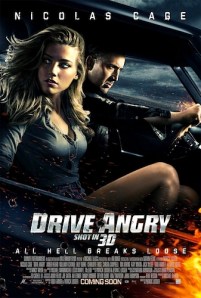
Drive AngryNic Cage does the Taken thing with added CGI and supernatural posturing in this grindhouse-y actioner from the director of such inspiring films as The Prophecy 3, Dracula 2001 and the My Bloody Valentine remake.

The grindhouse style works for it. It’s got a crazy plot, crazy action, gratuitous violence, gratuitous nudity, rough production values, variable acting, loopy bad guys — the highlight is definitely the latter, with William Fichtner channelling Christopher Walken. The whole thing could do with being punchier and pacier, and shorter, but the out-there action, some bits of dialogue, and Fichtner make it almost worthwhile. None of it is especially memorable, but while it lasts it’s appreciably trashy.

That said, the sex scene fight is a steal from Shoot ‘Em Up, and not a very good steal. Slow-mo saps it of all tension or excitement. Other action scenes fare better, but by no means all of them. Edited by the director and his brother, I think they need to learn some new tricks to punch these scenes up a bit. It gets better as the film goes on and they have crazier material, but some of the early stuff is remarkably pedestrian.

The film’s promotion made a big point of being shot in 3D (instead of the usual style of “Drive Angry 3D”, the posters call it “Drive Angry Shot in 3D”), but most of the in-your-face “look it’s 3D!” stuff is CGI anyway. So would it benefit from being seen in 3D? The best thing in the filmOnly in that stuff flies at the camera and whatnot. You can indeed tell it was made for 3D, but that doesn’t mean it needs it. Indeed, the poke-the-audience stuff aside, none of it suggests it would look great in 3D — for all the pointlessness of cinema’s new money-spinning format, it can add something to the vistas in a film like Avatar. Drive Angry has nothing vaguely on that level.

These days your big blockbusters won’t get you change from $200m, so at $50m Drive Angry is a cheapy – which at least explains some of its low-rent looks. But it’s not that cheap, and the CGI is appalling. Some of it was of the level I’d expect from a direct-to-DVD mockbuster, and those are made for closer to $50 than $50m. In spite of the low cost, it did spectacularly badly at the box office. Even though it sold itself as “Starring Film Star Nicolas Cage” and “look there’s action!” and “look there’s a sexy girl!” (these are the three main things you get from the poster, and I imagine the trailers also), it opened a paltry 9th at the US box office and took just $28.9m… worldwide. Total. That’s only about 60% of its budget. Its poor performance makes it “the lowest-grossing opening of a 3D film released in over 2,000 US theatres”. Unlike some low-budget flops (Dredd 3D, I’m looking at you), this commercial failure doesn’t really bother me.

This is what happens when you drive angrilyAs noted, director Lussier does not have an inspiring CV: he started with numerous straight-to-video sequels, then a big screen sequel-no-one-wanted (even with Nathan Fillion in it) in White Noise: The Light, before what I guess must’ve been a modicum of success with My Bloody Valentine, which I seem to remember a (relatively) big fuss being made about because it was one of the first live-action things in true 3D or somesuch. Perhaps the massive flopping of Drive Angry will kill his career back off — his next project is apparently re-make threequel Halloween III, which I don’t imagine anyone anywhere is eagerly anticipating.
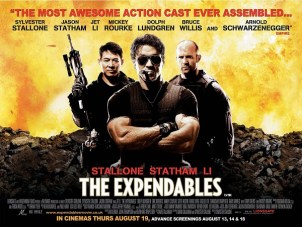
Drive Angry isn’t completely without merit, but it’s the kind of film where you have to hunt for the good stuff among the dross. Even as brain-off actioners go, you can do better.

2 out of 5

This review is part of the 100 Films Advent Calendar 2012. Read more here.

The Expendables (2010)

2012 #94
Sylvester Stallone | 103 mins | Blu-ray | 2.40:1 | USA / English | 18 / R

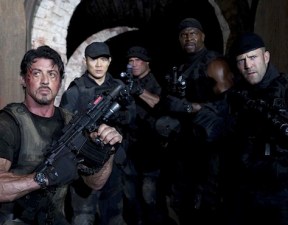
The ExpendablesAs The Avengers is to superhero movies, so The Expendables is to ’80s action films. More or less. I mean, this isn’t a character team-up, just an actor one… but these actors played essentially the same characters all the time anyway.

It’s also the kind of film that uses The Boys Are Back In Town on its end credits in a non-ironic way.

Set very much Now (it begins with a fight against Somali pirates), with no acknowledgement of the fact these guys might be a bit past it, the story concerns Sylvester Stallone’s gang of mercenaries being hired by a mysterious chap to overthrow the dictator of a small island somewhere that speaks Spanish. That’s about all you need to know, because the point of The Expendables is to have people shoot, punch, kick, stab and blow each other up. And that’s fine.

You see, this isn’t a reconstructed action movie, or a revisionist one, or an attempt to progress the genre in any other way. There’s an attempt to inject some kind of heart or introspectiveness into the characters, but nothing much out of the norm for the genre, and certainly nothing significant in the “I’m too old for this” department. (There’s an extended cut that adds even more of this, which sounds frankly unnecessary.) I think that annoyed some viewers, but maybe they should’ve more carefully considered what they were watching. This is a film that headlines Stallone and his modern-day equivalent Jason Statham, The titular teamwith a main cast fleshed out by ‘names’ like Randy Couture and Terry Crews. Hardly Al Pacino, or even Bourne-level Matt Damon.

What you do get is a film that revels in its action-movie-ness. I mean, most of the characters have great (read: daft) action movie names: Barney Ross, Lee Christmas, Yin Yang, Toll Road, Hale Caesar, Paine… How is that not a film aware of its own absurdity? How can you not enjoy that, even a little? Then there’s all the homoeroticism. Stallone goes for the full on camp look: bulging muscles, collagened lips, perma-tanned mahogany, little goatee, beret… Statham gets an early subplot with a love interest; Mickey Rourke is said to have a string of totty; Stallone almost has a love interest, but kind of rejects her at every turn. I’m sure you could easily entertain yourself by reading the film as him being in the closet — pair up his references to previous hurtful relationships with his animosity towards Schwarzenegger, for instance. Makes you wonder what Barney and Lee get up to on those long autopilot flights to and from the island…

Everyone gets their chance to shine, including those lesser names in supporting roles like Couture (pulling off something Stallone’s character can’t), Crews (with a wonderfully loud gun) and Steve Austin (kicking Sly’s ass). There are cameos from Bruce Willis (watch the gag reel — it seems he could barely be bothered to learn his lines) and Arnie (I know he was never a great actor, but was he always that bad?) They’re fun though, and help contribute a couple of memorable lines.

How cool is that?The main joy of the film is, of course, the action. There are plentiful big explosions, blood-spurting deaths, highly choreographed one-on-one punch-ups… It takes a bit of time to get going in this regard, too concerned with trying to give us a plot where we don’t need one and shadows of character development where we don’t want it, but when it kicks in it’s entertainingly bombastic. Particular stand-outs include a plane-based attack on a pier and the crazy climax, an everyone-on-everyone brawl that features a whole building exploding as just one small part.
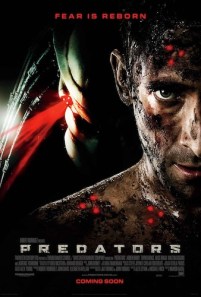
And in traditional violent action movie style, it was even cut for UK cinemas. How thoughtful. Said edit was two seconds to get a 15; the BD (and DVD? I don’t know) is uncut. The edited moment was a stabbing, of which there are many, many examples in the film; but this one was deemed sufficiently worse than the others. Can’t say I blame the distributor making that cut — a tiny omission no one would notice, which gains three years’ worth of action-hungry teens with plentiful disposable income, your precise target market.

The Expendables, with its name-packed cast and throwback values, aims to be the action movie to end all action movies. It’s not quite that, but for those who enjoy the genre it ticks enough of the right boxes. It’s not reinventing the wheel, it’s not modern or cutting edge, but I don’t think it was ever truly aiming to be. It’s straightforward brain-in-neutral entertainment for Blokes, and as that it delivers suitably.

3 out of 5

The UK TV premiere of The Expendables is on Channel 5 tonight at 9pm. It’s repeated on Wednesday 12th at 10pm.

This review is part of the 100 Films Advent Calendar 2012. Read more here.

Predators (2010)

2012 #93
Nimród Antal | 107 mins | Blu-ray | 2.35:1 | USA / English | 15 / R

PredatorsIt’s two-and-a-half years since this was released? Never! If it didn’t say so on multiple websites, I’d never believe it. Where does the time go?!
But anyway…

Predators is writer-director-producer-editor-composer-etc Robert Rodriguez’s attempt to relaunch the Predator franchise, after the mediocre Predator 2 killed it in 1990 and the utterly appalling Aliens vs Predator 2 killed it again in 2007. Based on the fact we’re two years on and there’s been no word of a sequel, I guess he didn’t succeed. Which is a shame, because the original film is fun action/sci-fi entertainment and this is very much in its spirit.

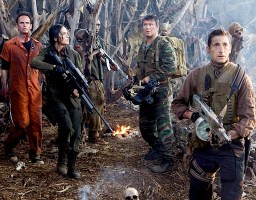
Based on a screenplay Rodriguez wrote in the mid ’90s (deemed too expensive at the time, and since re-written thanks to other films doing some of the stuff in it (chiefly Avatar, apparently)), Predators sees a bunch of unconnected people dropped into a mysterious jungle. All of them have some skill in the field of death-dealing — except, that is, for a doctor — and most are armed to the teeth. Where are they? Why are they there? And what’s that coming after them?

I’ve left my plot description vaguer than most you’ll find, including on the film’s own DVD/BD releases, because the more you know the more the early part of the movie drags. Most blurbs give away the revelations contained within the first act, which makes it an almost gratingly slow start. I reckon it would probably work well in isolation, but I’m not sure how many people are going to see this without having heard more of the premise than I’ve let on. When you know where it’s going, it seems to plod a little; equally, if all you know is that a group of people face a gang of Predators in a jungle then it works fine (it still takes the aliens a while to show up, but then so does the original).

group of people face a gang of PredatorsIt’s a similar story elsewhere in the film. If you haven’t already accurately guessed what the ‘twist’ is with the doctor just from me even mentioning him, then I’ll be surprised. You may also be aware that Laurence Fishburne is in the film — he’s in the trailer and, naturally, one of the top-billed names. If you weren’t aware, sorry; but if you are (as, indeed, you now are), then his lack of appearance early on will likely clue you in to the circumstance under which he’ll be found. But if you’re not expecting him, that’s all fine and dandy. But now you are. Sorry.
In fairness, the story does manage to pull out a few mysteries. There’s a fair share of action sequences too, naturally, but it’s not an entirely stock plot merely peppered with gunfights. Rodriguez and co have made the effort to push the mythology in new directions; ones which seem to build naturally out of other Predator media, even though those aren’t specifically mentioned. Indeed, although there’s a direct reference to the original film (plus a smattering of callbacks in dialogue), the production team were told to avoid looking at the other films, games and comics for inspiration. You’ve no need to suffer anything else to enjoy this. Indeed, it works even without seeing the original film.

In the special features Rodriguez comments that the film could function even if the Predators didn’t turn up, because you’ve got a gang of characters who might be quite happy to turn on each other if need arose. There’s nothing revelatory amongst the gang of humans, but they’re more characterised than the simple canon fodder of the original film, and the relative dearth of big names will keep you guessing as to the order of their inevitable dispatch.

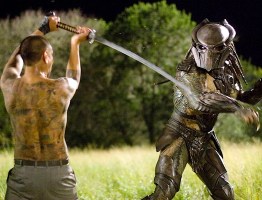
Sword fight!The main draw is still the action, which is suitably exciting on the whole. Best of all is a sword fight between a Yakuza and a Predator. Who’d’ve thought of engaging a Predator in a sword fight, eh? I love a sword fight, and while this is of course an atypical example, it shows the film’s level of creativeness with its inherited elements. It’s also a beautifully shot segment, making it one of the stand-out parts of the film.
Most of the direction is as good, though I have to mention it because of one unfortunate trope it develops: there’s an awful lot of lingering shots of the cast Looking At Something behind the camera, before we get to see it. Once you notice this — and you may well, like me, notice it pretty early on — it quickly becomes unintentionally comical, because it just. Keeps. Happening. And even when you think it’s gone, it makes a last-minute resurgence at an inopportune moment. I’m certain this wasn’t a deliberate comic device — it was probably employed to add tension and mystery and all that — but, for me, it just became a bit of a joke.

Then there’s the awful atmosphere-ruining end credits song. Honest to God, there’s weird artistic flourishes, and there’s immediately trashing the mood you’ve just strived to create. I know why it’s there — it’s another reference to the original — but it’s a glaring clash of styles that shatters the very particular ending the film has. On the commentary, Rodriguez asserts that it “deflates the tension in a great fun way.” Hm. Hmmm. What a misstep.

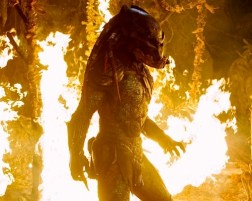
Ooh-oh-oh your camp is on fireAnd the ending itself… is it sequel bait? It’s not as bad as Prometheus — an unintentionally resonant parallel given the franchises’ shared history, but not an inappropriate comparison. But where Ridley Scott’s confusing picture leaves glaring unanswered questions that demand a Part 2, Predators’ conclusion is both open-ended but also somehow fitting. Which is lucky, because I don’t think a follow-up is forthcoming.
For all the criticism, or gentle ribbing, I’ve levelled at the film throughout this review, it’s an enjoyable experience. There’s nothing deep or meaningful, and nothing that will enliven or revolutionise the genre, but as a sci-fi/action movie it’s at least as good as its blokey-classic predecessor.

4 out of 5

The UK TV premiere of Predators is on Channel 4 tonight at 9pm.

This review is part of the 100 Films Advent Calendar 2012. Read more here.

The Last Airbender (2010)

2012 #31
M. Night Shyamalan | 99 mins | TV | 2.35:1 | USA / English | PG / PG

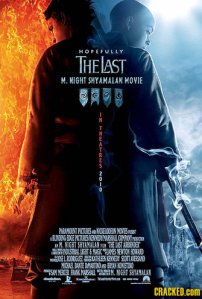
The Last AirbenderConsensus holds that the work of once-acclaimed director M. Night Shyamalan has managed a near-perfect trajectory of decreasing returns. I’m not talking about box office — I have no idea (or much interest) in how that’s gone for him — but quality, starting with supernatural chiller The Sixth Sense and sliding gradually to the nadir of The Happening. I’m not as convinced (I quite liked some of his efforts along the way), but it’s fair to say The Happening was pretty awful and certainly his worst… until this.
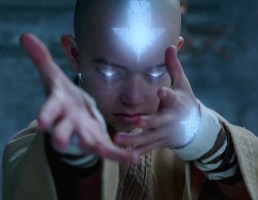
Adapted from a US animated series (but having to drop the series’ Avatar prefix thanks to a certain other 3D blockbuster), Shyamalan’s live-action rendition condenses the storyline of the first season into a 90-something-minute movie. You can immediately see some problems are going to arise just from the maths involved. I should say, I’ve never seen the original series, so I have no idea how Shyamalan succeeds in translating it. There was plenty of controversy in his casting, which included Caucasians in the roles of apparently-Asian characters in the original, but happily using them for the villains. I don’t know that that bothers me so much, but it seemed to be a watershed moment for some.

Even ignoring the inevitable prejudice of an adaptation not living up to fans’ expectations, however, The Last Airbender is a mess. You don’t even need to see it in the notoriously too-dark post-production 3D to find yourself confused about what’s going on. The plot pings back and forth between locations and characters, basing itself in a heavy mythology that isn’t adequately explained. The Glow-in-the-Dark AirbenderChunks of it seem to be missing, conveyed through clunky voiceover rather than on-screen action. The first rule of screenwriting — literally, the first — is Show Don’t Tell, but Shyamalan does exactly the opposite.
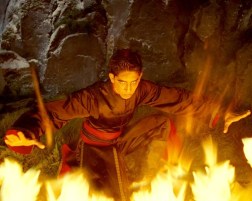
In fairness to him, there’s some defence to be found in the trivia section of IMDb: “Almost 30 minutes of footage was cut from the theatrical release because Paramount Pictures wanted the film converted to 3D as quickly as possible, in an effort to save money.” That certainly might explain some of the awkward jumps in plot, and at times we can see a conversation taking place but only get to hear a narrated summary. Still, I don’t think these edits cover all of the film’s flaws — not even close — but it explains some of them.

About the only good thing I can recall is the CGI, which is fine. But you get good CGI everywhere these days, so it’s far from a reason to watch. The action sequences it’s employed for are largely uninspiring, their style stolen from 300 or other equally familiar sources. The acting is routinely appalling too — Dev Patel, for instance, is more like his lacklustre first role in Skins than his BAFTA-nominated, worldwide-attention-grabbing turn in Slumdog Millionaire.

Dev Patel, not on fireI wouldn’t call myself a Shyamalan apologist, but I think he has at times suffered harshly at the hands of critics and audiences disappointed that he’s never re-reached the heights of The Sixth Sense (though, personally, I prefer Unbreakable anyway). Unfortunately, The Last Airbender is more fuel to the fire. It’s not only Shyamalan’s worst film, it’s a plain bad film by any reasonable measure. Laughably awful, even.

1 out of 5

This review is part of the 100 Films Advent Calendar 2012. Read more here.

The Last Airbender featured on my list of The Five Worst Films I Saw in 2012, which can be read in full here.

2 Fast 2 Furious (2003)

2012 #28
John Singleton | 103 mins | TV | 2.35:1 | Germany & USA / English | 12 / PG-13

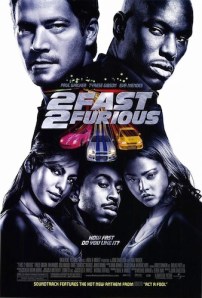
2 Fast 2 FuriousI never thought I’d watch, and certainly not enjoy, the Fast and the Furious series, but a few years ago (after the second film hit cinemas, I think — which would be almost a decade!) the first seemed to pick up a bit of praise from movie magazines and/or websites that were generally to my taste, so I gave it a go. I quite liked it, in the mode it was intended — a brain-off good-time action-y movie. I thought I was done there though, thanks to the much-maligned sequel — mainly because of its ridiculous title, which is still great fodder for a quick joke whenever a sequel is announced and people speculate on what it might be called. But sometimes, something compels you to give something a go…
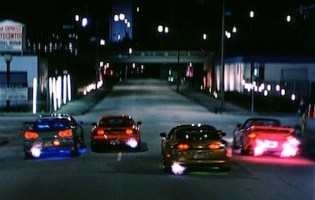
Here, then, we find poor acting, a plot done by the numbers, and a style that sometimes feels like a rap video writ into a film. Oh dear. Yet the chases and other car-based action sequences are pretty coolly done, and there’s more of them than I remember there being in the first film. That’s a definite plus — really, it’s all you want from a film like this.

The drivers do a lot of trash talking… usually when they’re in cars by themselves. Oh dear. Then again, I regularly talk to myself when I’m driving alone, so either the film’s fine or I’m appearing in a trashy B-movie. Or just think I am. In a way, these poorer qualities — the dialogue, the acting, and so on — are part of the experience of the film, and somehow manage to endear it. So bad it’s good? At points, yes.

Driving too fastIt’s worth noting it was directed by John Singleton, who started out with the acclaimed social drama Boyz n the Hood. How he’s fallen: via stuff you’ve never heard of to the Shaft remake, this, and most recently the poorly-reviewed Taylor Lautner From Twilight-starring Abduction. Well, each to their own.
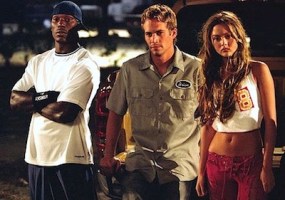
Talking of crew, the music (well, the score) is by David Arnold, the recently-deposed Bond maestro. It was somewhat pleasing to see his name appear in the credits because I thought I could hear Bondian bits creeping in; I thought they’d just nabbed bits of the score from Die Another Day or something (such borrowing is not unheard of these days: I didn’t mention it in my review in the end, but I noticed during the credits that Unstoppable borrowed three cues from AVP, of all things).

In the UK, the film was cut by 11 seconds to reduce some violence and get a 12 certificate; later, it was re-rated uncut at 15. This is the kind of thing that really bugs some people — cue rants about the controlling nature of the BBFC — but, in instances like this, I couldn’t care less. For one thing it’s the distributor’s choice, not the BBFC’s. That’s not always wholly placating — see Casino Royale — but, sometimes, why care? So we lose “3 kicks, a stamp and a spit, all delivered to a prone man” — so what? The scene’s still in the film, there’s just less of it. I agree with people’s frustration when cuts are major, but in cases like this, perspective is needed.

Looking too furiousUltimately, 2 Fast 2 Furious is like cheap fast food: you know it’s made of trash, high in fat and sugar, liable to rot something in your head — and just really bad for you fullstop… yet it’s an enjoyable guilty pleasure once in a while. If you don’t identify with that feeling then you’re a better man than me, and you’ll probably never like this film.

By rights I should give 2F2F 2 stars — it would even provide the opportunity for some kind of gag connected to its title. But, no. I don’t know if it just caught me in the right mood or if it has something surprising under the hood, but I wound up rather enjoying it. It’s junk food, but sometimes that hits the spot.

3 out of 5

2 Fast 2 Furious is on ITV2 tonight at 10:50pm, and again on Friday 7th at 10pm, and probably regularly after that too.

This review is part of the 100 Films Advent Calendar 2012. Read more here.

Batman: The Dark Knight Returns, Part I (2012)

2012 #90
Jay Oliva | 76 mins | Blu-ray | 1.78:1 | USA / English | 15 / PG-13

Batman: The Dark Knight Returns, Part IMainstream US superhero comics underwent something of a revolution — or an evolution, if you prefer — in the ’80s, moving from simplistic good vs evil tales-of-the-week to deeper, thematic- and character-driven stories that in some cases took months or even years to relate in full. It’s a change that’s still felt today (some would contend that they’ve been stuck for decades in a rut these developments ultimately led to). It’s generally considered that there were three works at the forefront of this wave of more adult-orientated comics, all of which still rotationally top Best Graphic Novel Ever polls today: Alan Moore and Dave Gibson’s Watchmen (filmed in 2009 by Zack Snyder); Frank Miller and David Mazzucchelli’s Batman: Year One (a significant contributor to Chris Nolan’s Batman Begins in 2005, and animated in its own right last year); and Frank Miller’s The Dark Knight Returns — a definite influence on Nolan’s The Dark Knight Rises, and currently in the middle of being adapted as a two-part animation. This is, obviously, the first half; the second is out in the US at the end of January 2013.

Set in a near-future Gotham City, Batman has been retired for ten years and the crime levels in the city have risen. Bruce Wayne seeks thrills — and possibly death — while an aged Alfred does his best to rein him in. As Commissioner Gordon nears retirement, a new threat on the city rises, inspiring Bruce to don the cowl once again…

Batman returnsLike Year One before it, the team behind these direct-to-DVD DC animated movies have taken a reverent route to bringing DKR to the screen. It’s in two parts because the original story is too long to faithfully adapt in their limited-length movies (it’ll work out at about two-and-a-half hours all told, which isn’t commercially viable for a direct-to-disc animation), but that also works out OK from a storytelling point of view: this first half ends with a major threat wrapped up and a great cliffhanger to kick off the second half. Those with less appreciation for the economics of film production have slated DC/Warner for splitting the film in two like this, but in some ways it works to its benefit artistically as well as commercially.
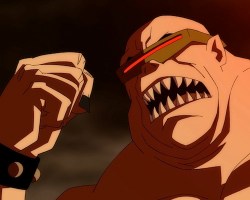
Others question the need for adapting it at all, if they’re just going to plonk what we’ve read on the page directly onto the screen. They do have something of a point, and it’s hard to argue DKR is any better off for having been animated. The obsession with faithfulness is borderline problematic at points, in fact: despite near-future tropes like gigantic tanks and mutant gangs, this is clearly a vision of the ’80s, with fashions, comic books glimpsed on shelves and references to Pearl Harbor that lock it fairly firmly some 25 years before now, never mind the future. At another point, a reveal at the climax of Two-Face’s part in the story, which works marvellously on the page, is a dud on screen when copied so precisely. It needs a little re-imagining to make it properly filmic.

Gang-mutie styleStylistically, the film retains Miller’s designs, albeit a bit smartened up to work consistently as animation. Some will bemoan that homogenising but others may delight in it — Miller’s art is generally a bit on the scruffy side, I think. Is it an appropriate mark of respect that they’ve translated it so literally from page to screen, or would it have been more interesting for the filmmakers to have taken Miller’s plot and situated it in a world drawn from their own designs? I’m not going to argue that they could have improved on Miller’s work, but it might have been interesting to see the story given a spin in a different artistic style.
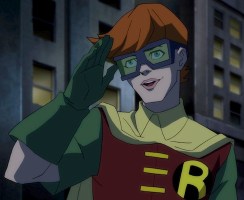
A benefit of being animated (well, arguably) is that action sequences get fleshed out. With a verve typical of these DC original movies, these sequences benefit from a fluidity and real punch imbued by animators who clearly relish this opportunity. There’s variety too, from an opening car chase, to shadowy stalking around a building site, to a silhouette-ish smoke-covered takedown of a gang of henchmen, to a mud-drenched single-take (ish) final smack-down. These sequences aren’t overplayed, but pack the necessary weight to back themselves up. They’re ably supported by Christopher Drake’s score, which betrays the influence of Hans Zimmer’s work on Nolan’s films but is too good to just be a straight-up copy.

Rockin RobinVoice work — the other major addition of an animated re-telling, of course — ranges from solid to very good. I wasn’t convinced by the casting of former RoboCop Peter Weller as Bruce Wayne/Batman, but he’s pretty darn good, carrying exactly the right kind of aged gruffness. It’s unique, I think, to see an active Batman this old on screen — sure, Nolan forwarded things eight years for Rises, but he’s still played by a relatively young and fit Christian Bale, whereas this Batman is grey, in his mid 50s and looking even older. I don’t recall a significant weak link in the rest of the cast, with Modern Family’s Ariel Winter’s performance as the new teenaged Robin perhaps being the most memorable of the supporting roles.
Reviews and commentary on the ‘net seem to swing between finding this a pointless, Saturday-morning-ised version of Miller’s seminal work, and an engrossing and exciting adaptation of it. I side more with the latter. It was never going to replace the original, and in surer hands — ones more prepared to change stuff, essentially — there’s an even better film lurking within (and it isn’t Nolan’s Rises, which only takes elements to construct its own new narrative). But on its own merits, I think this is a solidly entertaining Batman film. And I can’t wait for Part Two, which is surely a recommendation in itself.

4 out of 5

Batman: The Dark Knight Returns, Part I is released on Blu-ray and HMV-exclusive DVD today in the UK. The second part is available in the US on DVD and Blu-ray from 29th January 2013.

16 Blocks (2006)

2012 #54
Richard Donner | 98 mins | DVD | 2.35:1 | Germany & USA / English | 12 / PG-13

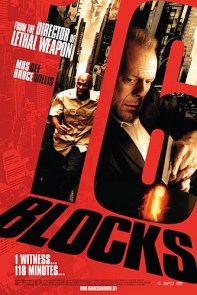
16 BlocksA Bruce Willis action movie? You know what you’re in for here, don’t you? Well, not quite. 16 Blocks casts Willis as less John McClane and more John McCane: old, fat, drunk, limping. He’s a copper still, but the kind of detective whose primary duties are being left to watch over an apartment full of bodies until uniform can show up.
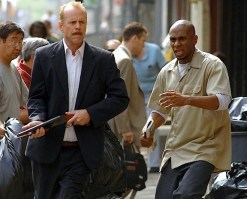
The conceit of the film is that this man is assigned to transport a witness the mere 16 blocks from the police station to the courthouse. Some corrupt cops don’t want him to. Normally Willis would just fold and let them… but, for whatever reason, he decides enough is enough, and it becomes a battle against time and said former-friends to get Mos Def’s witness to testify.

I love a real-time thriller; I don’t know what it is about that concept, but I love it. (I was in heaven for years thanks to 24, until they seemed to stop caring about anything approaching realism.) For that reason, I wish 16 Blocks had hewn closer to its premise. Having to traverse precisely 16 blocks in real-time? There’s a precision in that the film could have exploited. Instead it pretty quickly abandons the notion that they’re traversing exactly 16 blocks — they go up, down, sideways, possibly even backwards; no one actually keeps count, despite it being the bloody title! And it’s sort of in real-time because, well, it can’t really avoid it. But I think it could have played on both of these factors more, and I think it would’ve been better for it.

Dyed hair?For me, it really lost its way just over an hour in, when our heroes (spoilers!) end up in a hostage situation on a bus. It’s not bad, but it feels like writer Richard Wenk (who’s gone on to co-write heights of culture like The Mechanic and The Expendables 2) ran out of ways to keep the setup going, so jumped on a new one. Plus in many respects the characters that populate the high-concept are just stereotypes. There’s the useless drunk cop who suddenly steps up; the wisecracking career small-time crook who wants to turn good; David Morse playing the kind of role he always plays (well, he is good at it). At least casting action-man Willis as the drunk copper gives it a different flavour, and Mos Def gives his usual surprisingly-good turn as the crook.

For fans of an action-thriller (something which I most definitely am), 16 Blocks is a very solid entry in the genre. It doesn’t pay out too heavily in twists (though I get the impression the makers think it does), but there’s still an occasional mild unpredictability and a certain speed to proceedings that keep it engaging. Still, I can’t help but feel a more high-concept rendering of the opening conceit would’ve yielded stronger results.

3 out of 5