aka Shichinin no samurai
2013 #110
Akira Kurosawa | 207 mins | Blu-ray | 1.33:1 | Japan / Japanese | PG
 Seven Samurai used to be a striking anomaly amongst the top ten of IMDb’s user-voted Top 250: it’s a three-and-a-half-hour subtitled black-and-white movie. These days it sits at #21, presumably through a mixture of IMDb tweaking the voting rules and it being rated lowly by people keen to see all of the Top 250 but who don’t typically like three-and-a-half-hour subtitled black-and-white films. Nonetheless, it has a claim to wide popularity (alongside its critical renown) that is rarely achieved by three-and-a-half-hour subtitled black-and-white movies.
In 16th Century Japan, rural communities are terrorised by gangs of bandits stealing their crops, raping their women, and all that other nasty to-do. One village has had enough and, knowing they can’t defend themselves, sets out to employ a band of samurai to defend them when the bandits come again the next year. Samurai aren’t cheap, but the villagers have no money, so they’ll have to make do with what they can get. Managing to snag Kambei (Takashi Shimura) to lead the defenders, he assembles a team, including wannabe Kikuchiyuo (Toshiro Mifune) and five others (Daisuke Katō, Isao Kimura, Minoru Chiaki, Seiji Miyaguchi, and Yoshio Inaba), who then set about preparing the villagers for battle…
Despite its epic running time, Seven Samurai isn’t really an epic film — this isn’t the story of a war, or even a battle, but of a skirmish to defend one village. How does it merit such length, then? By going into immense detail, by having plenty of characters to fuel its narrative and its subplots (and if you think there’d be plenty of time to explore seven characters in over three hours, turns out you’d be wrong), and by using the time to familiarise us with these people, so that when the final fight comes — and that’s a fair old chunk of the film too — we care what happens. Plenty of other films make us care in a shorter period of time, of course, but here we feel truly invested in the outcome.
 It’s also unhurried. As Kenneth Turan explains in his essay “The Hours and Times: Kurosawa and the Art of Epic Storytelling” (in the booklet for Criterion’s DVD and Blu-ray releases of the film, and available online here), the film “unrolls naturally and pleasurably… luxuriating in its elongation — it takes an entire hour just for the basic task of choosing the titular seven.” As a viewer, I think you have to be mentally prepared for that pace, in a way. Most other films would use a snappy montage to collate the team, with key scenes or moments later on being used to highlight their personalities — witness any number of Hollywood (and Hollywood-esque) ‘men on a mission’ movies that do exactly that. Kurosawa’s expanded version makes the film more a marathon than a sprint, with only some of the negative connotations describing something as “a marathon” entails.
In truth, this is not the most fascinating portion of the film, but nor is it without merit. As discussed, it’s establishing these characters in full so that we are more attached to them later, but it’s also commenting on, perhaps even deconstructing, the image and role of the samurai. In “A Time of Honor: Seven Samurai and Sixteenth-Century Japan” (again in Criterion’s booklet, and available online here), Philip Kemp explains how Kurosawa’s depiction of the samurai overthrows some simplistic ideals that had become associated with them, and shows them instead as normal human beings, more likely to run away to save their own skin than pointlessly fight to their death. The villagers have indeed managed to employ professional combatants, but they’re not so different to the villagers themselves, just better trained.
 The length ensures our investment in the village, too, just as it does for the samurai. They’re not being paid a fortune — in fact, they’re just being paid food and lodging — so why do they care? Well, food and lodging are better than no food and lodging, for starters; and then, having been in the village so long in preparation, they care for it too. It is, at least for the time being, their home. You can tell an audience this, of course, but one of the few ways to make them feel it is to put them there too — and that’s what the length does. To quote from Turan again,
The film’s length works in its favor in ways both big and small: It allows the samurai leader, whose head is shaved in an opening scene, to gradually grow his hair back. It allows the eternally uneasy bond between the samurai and the villagers, as well as the villagers’ martial confidence, to grow believably over time. … When the bandits finally do attack, our hearts are in our throats — we know the defenders so well, and we can sense that not everyone will survive.
It can seem like a blind alley to go on about a film’s length — many an epic is long just because it has a long, or large, story to tell — but in Seven Samurai, the sheer size, and the way it uses that, are almost part of the point.
The film ends with a melancholic note. That “eternally uneasy bond between the samurai and the villagers” comes to an end — with victory won, the surviving samurai are no longer required. The farmers return to farming, the samurai return to… what? They are not really at home in the village, they were just guests; nor are they rich, because there was no pay — so what have they got out of the conflict? As Alain Silver notes in “The Rains Came: Kurosawa’s Pictorial Approach to Seven Samurai” (in Criterion’s booklet, of course, but not online),  the final scene, the way it’s edited and framed, ties the remaining samurai to their deceased comrades, the living and thriving farmers a distant and separate group. Fighting is the way of the past, perhaps, and peaceful farming the future. Or is the samurai’s only purpose to be found in death, because other than that they are redundant?
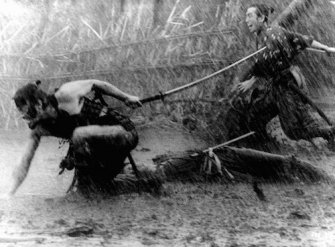
Even if you don’t want to get into the film’s philosophical underpinnings, there are plenty of other, more visceral thrills to enjoy. The characters provide humour as well as emotional depth; there are scattered “action sequences” throughout; and the big climax may technically only be a skirmish, but it’s one played out in detail, to epic effect. There’s not the choreography that viewers used to modern blockbusters or Hong Kong fisticuffs might expect, but that doesn’t meant the rough and realistic fighting isn’t exciting or well-constructed. Drenched in rain and covered in mud, it’s messy and, in its own way, beautiful. The whole film is visually stunning, as you’d expect from a Kurosawa picture. You may not realise it at the time, but many a familiar type of shot actually originated here, and then was copied down the ages.
It might seem difficult to credit now, but Seven Samurai was only fairly well received in Japan on its initial release: as Stuart Galbraith IV reveals in “A Magnificent Year” (also in Criterion’s booklet (where else?)), most of the awards for Best Picture went elsewhere, and at the box office it was comedies and romances that were the big crowd-pleasers.  And it wasn’t as if it was overseas viewers who hit on the magic: as Turan reveals, “Toho Studios cut fifty minutes before so much as showing the film to American distributors, fearful that no Westerner would have the stamina for its original length.” The more things change the more they stay the same, I suppose — how many Great Films from Hollywood are ignored by awards bodies and audiences, only to endure in other ways?
Seven Samurai is definitely a case of the latter. Its standing on the IMDb list may have slipped with time (and rule changes, no doubt), but it’s still a trend-bucker — a three-and-a-half-hour subtitled black-and-white film that can appeal, if not to the masses, then to some people who wouldn’t normally go in for that kind of thing. A marathon but not a slog, requiring investment rather than passive absorption, Kurosawa’s epic rewards the viewer with one of cinema’s most enthralling, gorgeous, and vital experiences.
Seven Samurai placed 1st on my list of The Ten Best Films I Saw For the First Time in 2013, which can be read in full here.
It was viewed as part of my What Do You Mean You Haven’t Seen…? 12 for 2013 project, which you can read more about here.
This review is also part of the 100 Films Advent Calendar 2014. Read more here.

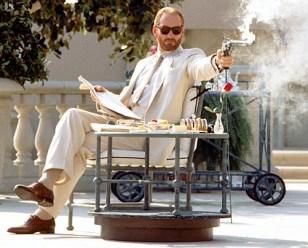
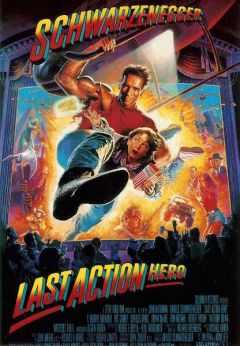 The first film to be advertised in space (no, really) sees movie-obsessed schoolboy Danny (Austin O’Brien) acquire a golden ticket that transports him into the latest movie staring his favourite action hero, Jack Slater (Arnold Schwarzenegger). With Danny’s knowledge of the genre’s clichés, Slater can solve the murder of his favourite second cousin and stop the machinations of sharpshooting henchman Benedict (Charles Dance).
 That said, it’s probably a good thing this isn’t a whole movie of “fictional characters in the real world” — you can imagine how that would play out; all the predictable “fish out of water” hijinks. However, at just over two hours, this isn’t a short film, and cutting out some of the middle wouldn’t have hurt.
 25 years before Jennifer Lawrence had to
 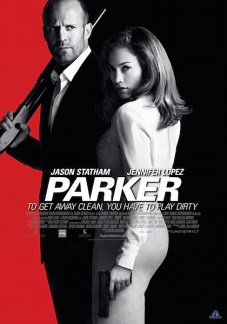 Parker trailed well — funny lines, promising action, solid setup — but doesn’t deliver.
 Jackie Chan’s breakout hit sees him as Chien Fu, the floor-scrubber-cum-punch-bag at a martial arts school where he bumps into Pai Cheng Tien (Yuen Siu Tien), one of the last two proponents of the Snake Fist style after its other students were murdered by their old enemies, the Eagle Claw clan. The old man trains Chan so he can overcome his bullying schoolmasters, while the Eagle Claw grand master (Hwang Jang Lee) hunts for his last remaining rival…
 Also striking is the music score, a strange mix of weird, cheap, dated, electronic stuff… and yet, it’s so odd I kind of warmed to it. It’s all poached from elsewhere, which was apparently the way things were done in Hong Kong at the time. Stand-out tracks are Magic Fly by Space and Oxygene Part II by Jean Michel Jarre, though bits of famous scores are in there too, most recognisably (for me)
 1981: Steven Spielberg reads a French review of his movie
  Apparently some Tintin purists weren’t so keen on the actual adaptation — elements of The Crab with the Golden Claws have been mixed in to a plot primarily taken from The Secret of the Unicorn, the sequel/second half of which, Red Rackham’s Treasure, is reportedly used sparingly. Plus, in the original tale Sakharine is a minor character who wasn’t responsible for much, apparently. As someone who’s only read one of those three volumes, and even then not since I was young, such things didn’t trouble me. What superstar screenwriters Steven “
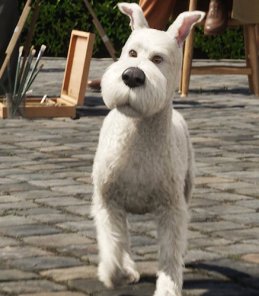 The slapstick is mainly hoisted by Simon Pegg and Nick Frost as the physically-identical Thomson and Thompson — a true advantage of animation, that. I imagine some find their parts tiresome because of their inherently comic role, but they’re likeable versions of the characters. Even more joyous is Snowy, though. Well, I would like him, wouldn’t I? His internal monologue, such a memorable part of Hergé’s books, is omitted (as it is from every film version to date, I believe), but he’s full of character nonetheless. Some of the best sequences involve Snowy running in to save the day. I don’t think they quite got the animation model right (the one glimpsed in test footage included in behind-the-scenes featurettes looks better, for my money), but his characterisation overcomes that.
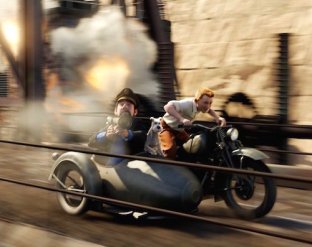 Of course, one very important person is neither British nor Belgian: Spielberg. The screenplay’s balance between peril and comedy is spotlessly enhanced by his peerless direction. In a world stuffed to the gills with lesser blockbusters that palely imitate the groundwork Spielberg and co laid in the ’70s and ’80s, work like this should remind people why he’s still the master of the form. The film is shot with an eye for realism (so much so that some viewers have been convinced it was filmed on real locations with real actors, with some CG augmentation for the cartoonish faces, of course), which helps lend a sense of plausibility and also genuine jeopardy. It’s easy to get carried away when working in CG animation, but often the most impressive works are ones that behave as if they’ve been shot largely within the limitations of real-world filmmaking technology.
 The tone on the whole is resolutely PG — actually, like many an action-adventure blockbuster used to be before everything went slightly darker and PG-13. So, for example, Tintin wields a gun on occasion, but never at another human being. The focus is on the story, which happens to lead to some adrenaline-pumping sequences, rather than a lightweight excuse to link together a bunch of punch-ups and chases. Ironically (though, for anyone who knows what they’re talking about, entirely expectedly) this makes the action all the more exciting. It also mean there’s a lighter touch than many current blockbusters offer; a greater presence for humour, including among the action. I guess that’s not fashionable these days, when everyone’s become so po-faced about their big-budget entertainment. However, with the likes of
  but some viewers would have seen it (even subconsciously) as more of a “real movie”.
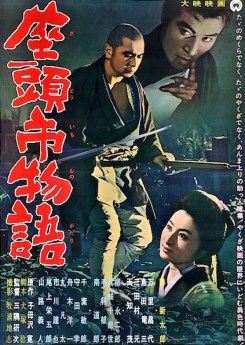 Adapted from a short story by Kan Shimozawa, The Tale of Zatoichi was a low-key release for its studio, Daiei: despite being helmed by “a topflight director”
 But enough hyperbole — what about The Tale itself? The story sees blind masseuse Zatoichi accepting an old invitation to visit an acquaintance, Sukegorô (Eijirô Yanagi). But Sukegorô is a yakuza boss, and he presses Zatoichi to join his side in a brewing war with rival Shigezô (Ryûzô Shimada) — because although he’s blind, the masseuse has legendary sword skills. On Shigezô’s side is a hired samurai, Hirate (Amachi), who Zatoichi encounters by chance. Despite the mutual respect between these two coerced warriors, the eventual gang battle comes down to a duel between them…
 Those prepared for a calmer, more considered film may find much to like, however. Katsu’s understated style holds your attention and makes you want to learn more about the character; not his past, necessarily, but his qualities as a man. The same is true of Amachi, in some ways even more appealing as the doomed ronin. You get a genuine sense that Zatoichi and Hirate would have had a great, long-lasting friendship if they’d met under better circumstances, which makes the manner of their encounter all the more tragic. For all the bluster about a big gang war on the horizon, it’s the relationship between these two men that forms the heart of the film.
 Reportedly this opener is “not the best of [the] series”, but remains “a grand introduction to the character and a touchstone for many of the themes and gags presented in the later films”.
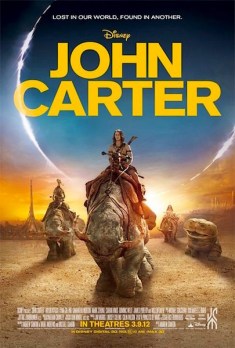 A box office flop (it made a once-astonishing $284 million worldwide, but that was off a $250 million production budget and a ginormous bungled marketing campaign), John Carter has gained something of a following among those who did enjoy it or caught it later — see
  not because it’s so famous (among Normal People, I don’t think it is), but because its influence means its imagery and concepts have already been plundered (
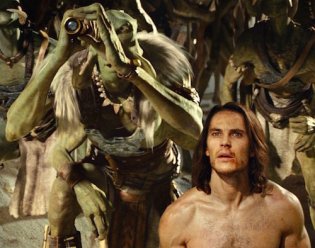 It doesn’t help that the film is structurally muddled at the offset. It begins on Mars, a voiceover detailing the conflict — an instant bombardment of names and concepts. I don’t mind things that challenge you to keep up, but it still feels a bit much. Then we jump to New York in the 1880s, where Carter is running away from someone in the streets. Then to his house, where his nephew has just turned up to be told he’s dead. You what? We just saw him in the telegraph office! And then we jump back to the 1860s, where he’s searching for gold and getting arrested (or something) by Bryan Cranston in a wig as some form of army officer. Then it gets a bit more straightforward. If being transported to Mars and meeting four-armed CG aliens who speak in subtitles is what you call “straightforward”, anyway.
 It feels a bit facile to criticise the quality of CGI these days, but that doesn’t stop John Carter from being over-ambitious in this regard. In fact, it’s not really the sometimes-half-assed green screen or occasional plastic-ness that’s the problem, but the design: those four-armed aliens are just a little too cartoony. Perhaps it’s a hangover from Stanton’s Pixar days, perhaps something just went a little awry during the process, but their design doesn’t look quite ‘real’ enough; a little like someone’s taken a real-life creature and then lightly caricatured it. I think it’s the eyes, which are perhaps a little too big and round and ‘cute’, but there’s something else indefinable there, or not there. These aliens aren’t just set dressing but proper motion-captured characters, played by the likes of Samantha Morton, Willem Dafoe, Thomas Haden Church and Polly Walker, so the lack of connection is regrettable.
 I was expecting, or perhaps hoping, to like it; to find a misunderstood old-style adventure full of entertainment value. It may be an old-style adventure, but that’s beside the point, because whatever it is, I just felt it wasn’t particularly well made: poorly constructed, weakly performed, lazily (and wrongly) assumptive of the audience’s familiarity with the material. Disappointing.
 Marvel Studios takes its boldest step yet, moving away from the present-day superhero milieu of its previous movies to a galaxy far, far away for a space opera epic. Its success, both critically and commercially, has cemented the Marvel Cinematic Universe as an infallible force in the current movie world. But, really, how good is it?
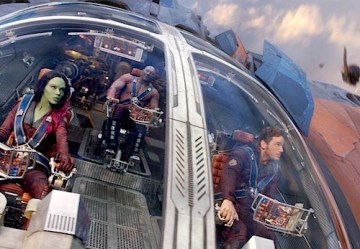
 The worst offender is the pod chase through Knowhere, a several-minutes-long sequence that registers as little more than a blur. There’s a shocking lack of clarity to its images, even by today’s standards. Maybe it’s better in 3D, when I guess the backgrounds would sink into the distance and important elements would be foregrounded; but in 2D, you can’t see what’s meant to be going on for all the fast-moving colour and split-second cuts. Almost as bad, though for different reasons, is the climax. It takes up an overlong chunk of the movie and at times feels repetitive of too many other Marvel climaxes — oh look, a giant spaceship crashing into a city! If anything, the film gets ‘worse’ as it goes on. Perhaps not in a very literal sense, but as the blustering action climax takes over, it moves further away from the stuff that makes it unique and interesting.
 It isn’t even called Nova City, but I don’t have the foggiest what it is called because the film didn’t make me feel I should be learning it. Some more effort making sure we knew why that place mattered, even if it was just a clearer depiction of all the planning for its defence, might have sold the entire climax better.
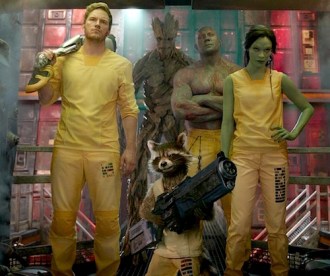 especially the overlong climax. Joss Whedon commented of his own Avengers film (as I quoted in
 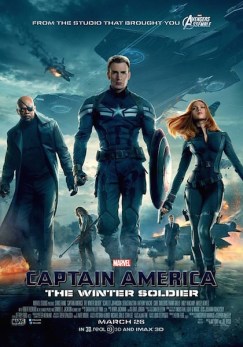 After the
 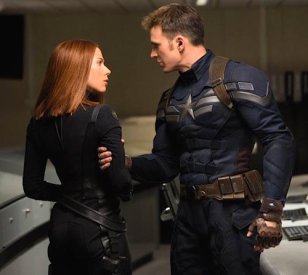 everybody moved on to being more excited about Marvel’s end-of-summer new-franchise-launcher,
 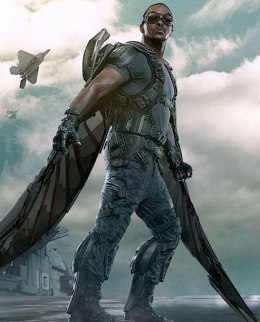 Also introduced is sidekick hero the Falcon (Anthony Mackie), who I have little to say about directly. He’s a sidekick who’s introduced fully-formed — he’s been using his ‘superpower’ for years as just part of the military; it’s not new or exciting to him, which lessens some of its power for the viewer too. “Origin story” may be the most over-used of all the superhero stock stories, but there’s a reason for that. If you skip it then you cut to the chase, that’s true, but does it also lessen the impact of characters to not see how they started? Maybe storytellers just need to come up with fresh ways of giving origins, rather than skipping them altogether.
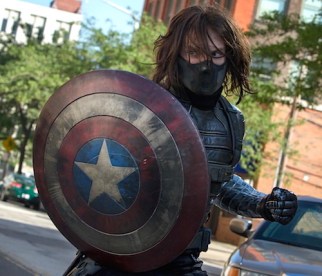 and then it refuses to wrap everything up, putting certain things in place ready for
 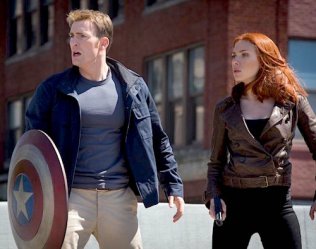 what’s left? There is strong action, albeit undermined by muddled character investment; and there is an interesting thriller/conspiracy story, albeit undermined by a feeling of “once you know it, you know it” — it’s not all that complicated or all that surprising, including the revelation that the one character significant enough to be behind it all is behind it all (gasp!)
 100Films.co.uk