Baby Driver (2017)

2017 #89
Edgar Wright | 113 mins | cinema | 2.35:1 | UK & USA / English & American Sign Language | 15 / R
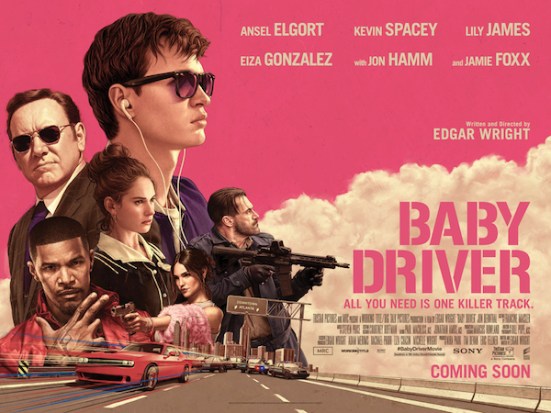
Baby Driver

It felt like half (at least) of the film-loving internet had somehow had a chance to see Baby Driver before its release on Wednesday, but I’m going to throw my two cents into the ring anyhow. Not that it makes a great deal of difference because, like most other folks, I bloody loved it.

Written and directed by Edgar Wright, director of the Cornetto trilogy and not of Ant-Man, the story focuses on getaway driver Baby (Ansel Elgort), a fundamentally good kid who has ended up suckered into a life of crime, working for robbery kingpin Doc (Kevin Spacey) and a rotating array of criminal compadres. An accident as a kid left Baby with “a hum in the drum” — tinnitus, if you want to get medical about it — meaning he listens to music all the time to drown it out, and also choreographs his daring drives (not to mention his walks down the street, etc) to the music he hears. One day he bumps into Debbie (Lily James) and falls in love, which happily coincides with his “one last job” for Doc. But once you’re in it’s hard to get out, and Baby again finds himself doing one more “one last job”, with a particularly volatile crew…

Baby Driver is a movie about three things: driving, music, and love. As Guillermo del Toro put it, it’s a kind of fable, or fairytale, with Baby as the prince and Debbie as the princess. In this respect it’s a change of pace for Wright, ditching the almost-spoof comedy of his previous successful movies for something more emotionally earnest. Not in a bad way, but in a kind of pure way, like a fairytale. This fairytale world isn’t all castles and dragons, of course — instead it’s full of violent criminals and fast cars; but it’s also a world where you can synchronise your getaway driving to the music on your iPod, so it’s hardly mired in gritty realism.

No little green bags here

There’s a definite edge of Wright’s buddy Quentin Tarantino to this world: a cast of crooks delivering snappy, quotable dialogue to a near-constant soundtrack of deep cuts selected from the director’s music collection (plus a few familiar tunes for good measure) — the style of QT comes to mind more than once while watching. Fortunately Baby Driver’s style is more than homage or copycatting. Although it’s not a straight-up comedy, Wright does bring his own comedic touch (there are several big laughs), and the purity of emotion — that fairytaleness again — isn’t from Tarantino’s wheelhouse either. Plus, visually it presents a brighter and more colourful space than Tarantino normally inhabits. Most of the action takes place in the golden daylight of Atlanta and is filled with popping primary colours. There’s much great work by DP Bill Pope.

Though the soundtrack may have a Tarantino feel in its construction, that’s less prevalent in its usage. Characters communicate through song — not by singing them (most of the time — Baby first notices Debbie because she’s singing “B-A-B-Y”), but by connecting through them (that singing is followed by a discussion of songs featuring her name — both of them). The songs Baby chooses for boogieing around his small apartment, or for dancing down the street on a coffee run (in a title sequence that is marvellously choreographed, with dozens of small details timed perfectly to the track), help illuminate his true character — sweet and romantic — which is hidden by the sullen silence he adopts whenever around criminals.
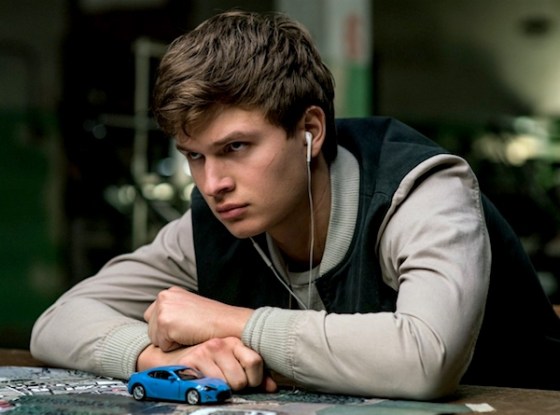
B-A-B-Y Baby

Some have criticised the film for a lack of character, reckoning Baby’s silence distances him from the viewer so we never build a connection and don’t root for him. Frankly, I’m not sure what film they were watching. No spoilers, but Baby first opens up with something endearing and ingratiating in scene one. Right at the start. It could barely be any closer to the studio logos (and it kinda wouldn’t work if it were). I’m not arguing he’s the most charismatic lead ever to grace the silver screen, but Elgort makes fine fist of selling Baby as both a quiet, focused driver and a sweet, likeable, cheer-on-able hero.

And if you want character in general, the rest of the cast has it in spades, with an array of supporting roles that are as colourful as the cinematography. Recognisable faces like Spacey, Jon Hamm, Jamie Foxx, and John Bernthal get to cut loose as crooks who each have their own kooks, while lesser-known names like CJ Jones (as Baby’s foster father) and Eiza González (as the Bonnie to Hamm’s Clyde) make a mark too. Lily James may be placed in a dream-figure damsel role, but that doesn’t mean she can’t hold her own at times too. She’s not Wonder Woman, but she’s not a Manic Pixie Whatever That Phrase Was either.

Mozart in a go-kart

So, the one major thing I’ve only touched on fleetingly thus far is the main thing the film has attracted attention for: the driving. Done for real by stunt drivers with not a lick of CGI, that knowledge means it packs a viscerally real punch. But it’s not just snobbery: this is genuinely breathtaking action, slickly planned, masterfully performed, magnificently shot and edited. It’s this year’s Fury Road — a kinetic action spectacle made with skill rather than hand-waiving fast-cuts. Even more impressively, it’s been choreographed to music, but not in a draw-attention-to-itself dance-routine-y way. Perhaps saying it’s been synced to the music would be more accurate. Either way, it only heightens the effect. This extends beyond the car chases, too, including one marvellously musical shootout, the gunfire serving as percussion. The sound design throughout is exemplary. This is a movie that deserves to be remembered come awards season. Perhaps, again like Fury Road, some love will extend beyond the technical categories, too. Wright seems deserving of Best Director recognition, just like George Miller was.

But such back-patting is for much later in the year. For now, just revel in the gleeful moviemaking verve of a flick that already seems destined to be remembered as one of the greatest car chase movies ever produced.

5 out of 5

Baby Driver is in cinemas many places right now, but not everywhere. It’ll be worth the wait, guys.

It placed 2nd on my list of The 17 Best Films I Saw For the First Time in 2017, which can be read in full here.
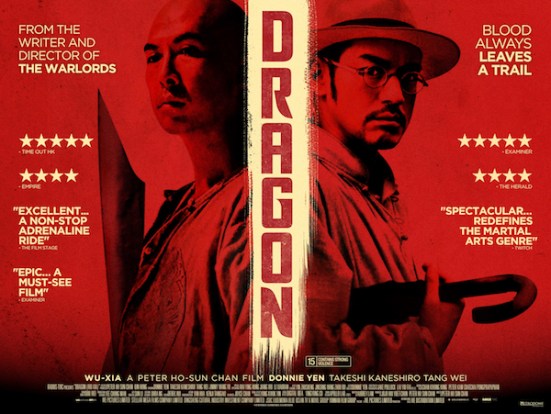
Dragon (2011)

aka Wu xia

2016 #190
Peter Ho-sun Chan | 94 mins | TV (HD) | 2.35:1 | Hong Kong & China / Mandarin | 15 / R

Dragon (Wu Xia)

Donnie Yen is small town paper-maker Jinxi, who incidentally encounters and accidentally defeats two most-wanted criminals. While his village thanks him, detective Baijiu is suspicious — does Jinxi’s story add up? Is he hiding some dark past?

Takeshi Kaneshiro is expert detective Xu Baijiu, who adheres slavishly to the law after a past mistake cost him dearly. But is he delusional, inventing connections and powers for Jinxi that just aren’t there? Or are his delusions allowing him to see the truth?

As a Hong Kong production starring Donnie Yen, of course Dragon is an action movie, but there’s more to it than fisticuffs. It engages with themes of justice and redemption, and what it means not only to take the right action, but to have to find the right action to take. Apparently it began life as a remake of One-Armed Swordsman, and while obvious superficial resemblances remain (the Big Bad Boss Man is played by Jimmy Wang Yu, and Yen has to (spoilers!) lop off his own arm), you can definitely see familiar plot points in both films too. But it’s also certainly not a remake anymore. Funny how these things go.

Can I Baijiu a Jinxi?

Naturally, when the action does kick in, it’s fantastic. With the combat directed by Yen, these sequences are expertly and inventively choreographed dust-ups. It’s stylishly directed by Peter Chan — classy, but also thrilling, exciting, and sometimes innovative; and the whole is majestically shot by DP Lai Yiu-Fai (who also shot Infernal Affairs, which I still haven’t seen).

On the downside, at a couple of points I thought the story leapt a little bit or fudged a detail, which is a shame because I don’t think it needed to. This is possibly the effect of watching the international version, which is cut by around 17 minutes (full details here). While it’s a shame, it’s certainly not enough to ruin an excellent martial arts drama.

4 out of 5

Fantastic Beasts and Where to Find Them (2016)

2016 #182
David Yates | 133 mins | cinema | 2.35:1 | UK & USA / English | 12A / PG-13

Fantastic Beasts and Where to Find Them

When J.K. Rowling wrote the seven-book Harry Potter series, she didn’t just make it all up as she went along — it was well planned in advance. And she didn’t just envisage a seven-book story, either — she built a whole world, including a massive history that is only fleetingly referred to in Potter itself. It’s part of that history that the five-film Fantastic Beasts series is setting out to explore. (Despite sharing a title with a short tie-in book Rowling once wrote, Fantastic Beasts isn’t somehow an adaptation of that tiny tome, despite what some pithily moronic internet commenters who think they’re funny would believe.)

Set many decades before Potter, Fantastic Beasts introduces us to Newt Scamander (Eddie Redmayne), a British wizard who’s travelled to New York while researching his book on magical creatures — or “fantastic beasts”. There, he finds himself embroiled in a conflict between the local magic council and a puritanical group who want to destroy all wizards, while some creature or force is terrorising the city.

Although labelled by some as a prequel, that’s only technically true — it is set before the Potter stories, but it’s a new story in that universe rather than a tale that leads directly into the existing narrative. As such, it’s pretty newbie friendly. It reuses familiar iconography from Potter, but it does so in neat ways — there are things that are instantly recognisable to fans, but their function is not reliant on familiarity for the sake of newcomers or the less well-versed. It’s also opening up new parts of the Potterverse — or, as they want us to call it now, J.K. Rowling’s Wizarding World — primarily, taking us to the USA for the first time.

Fantastic Americans and where to find them

As a new story, it develops its own particular tone and style, distinct from that of the previous movies. That partly comes from the characters we’re following: Potter is about schoolchildren, this is about adults. It’s still a 12A/PG-13, of course, but there’s a lot of wiggle-room within that category. Perhaps this is why some have found it tonally inconsistent, but I enjoyed the mix of whimsy with darkness. The overall effect was good fun, with strong action scenes and some really good — even magical — visuals. The story is bolstered by a couple of well-constructed final act twists. I found at least one to be pretty guessable, but that doesn’t detract from it being put together neatly throughout the film.

As for the widely discussed fact that this is to be the first of five movies, that fortunately doesn’t define this opening instalment. Seeds for future films are obvious because we recognise actors and, as movie-literate viewers, know how films establish things for future use; but leaving that extra-textual knowledge aside, there’s no reason this doesn’t work as a standalone adventure. People who’ve said otherwise are talking poppycock. Even stuff that initially looks like it’s purely franchise-setup has a purpose within this individual movie.

Fantastic Beasts has been dismissed in some quarters as no more than a cash-grab attempt to extend a franchise, but I thought it was one of the most enjoyable blockbusters of 2016.

4 out of 5

Review Roundup

In today’s round-up:

  • Snoopy and Charlie Brown: The Peanuts Movie (2015)
  • 13 Hours: The Secret Soldiers of Benghazi (2016)
  • Young Frankenstein (1974)


    Snoopy and Charlie Brown:
    The Peanuts Movie

    (2015)

    aka The Peanuts Movie

    2017 #25
    Steve Martino | 84 mins | streaming (HD) | 1.85:1 | USA / English | U / G

    Snoopy and Charlie Brown: The Peanuts Movie

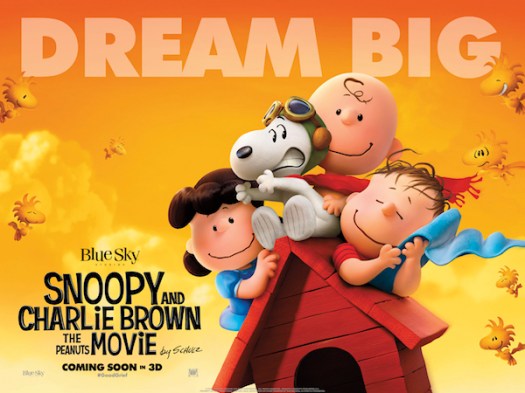
    Charles M. Schulz’s popular comic strip hits the big screen in this likeable but hardly Pixar-level movie. Much of it plays like a series of shorts or sketches with a connected theme rather than a feature-length narrative — kind of like binge-watching a cartoon series — but they’re pleasant enough. There are some good gags (“Leo’s Toy Store by Warren Piece”), though the saccharine ending is a bit much and the pop songs are terrible. One review described Snoopy as “Peanuts’ Tyler Durden”, which is a thought that entertained me even more than the film.

    The most notable aspect is the animation style. Schulz’s strips have a distinct 2D style, but the movie is animated in 3D, presumably because you’re not allowed to make a Western kids’ movie with 2D animation anymore. Nonetheless, most of The Peanuts Movie is composed to emulate Schulz’s original strips, i.e. quite flatly — like, you know, 2D. And yet, somehow… Well, The Telegraph’s Robbie Collin summarised it well in his review: “Written down, [the animation style] just sounds chaotic, like a four-way mash-up of South Park, The Clangers, Wallace & Gromit and a flip book. But in motion, it’s a thing of serious, faux-artisanal beauty”. That might be going a bit far, but I did end up kinda liking the visuals. It’s quite a clever style for 3D, mixing in many 2D-ish touches. It should probably be a mess, but it weirdly works.

    3 out of 5

    13 Hours:
    The Secret Soldiers of Benghazi

    (2016)

    2017 #40
    Michael Bay | 139 mins | streaming (HD) | 2.35:1 | USA / English | 15 / R

    13 Hours: The Secret Soldiers of Benghazi

    The not-at-all-controversial events in the Libyan town of Benghazi on 11th September 2012 are here dramatised by that master of subtlety and understated reality, director Michael Bay, so you know you’re going to get a considered and truthful account of events.

    Yeah, most of that opening paragraph is completely facetious. Bay takes a real-life gunfight, in which a secret mercenary security team went against orders (possibly) to defend an American diplomatic compound that was under assault, and turns it into a blazing action movie that may as well be scored with the theme from Team America: World Police. If it was Bay’s goal to convey the sheer confusion on the ground in the midst of the situation, I guess he’s done a bang-up job. The problem is, that confusion extends to bits where the characters seem to have some idea what’s going on, but we’re left half in the dark.

    Having Bay be reined in after the excess of his Transformers movies is no bad thing, but being completely constrained by reality is not his strong suit either — the heightened reality of something like The Rock is where he excels.

    If you’re interested in a longer read on the film’s adherence (or otherwise) to reality, this article at Vox is interesting.

    3 out of 5

    Young Frankenstein
    (1974)

    2017 #46
    Mel Brooks | 106 mins | streaming (HD) | 16:9 | USA / English | PG* / PG

    Young Frankenstein

    I have mixed feelings about the work of Mel Brooks. I reviewed his Hitchcock spoof, High Anxiety, back in 2009 and found it wanting. I reviewed his Robin Hood spoof, Men in Tights, earlier this year and found it uncomplicated but enjoyable. When I was a kid I liked his Star Wars spoof, Spaceballs, but on a slightly-more-adult rewatch I enjoyed it less. And as for Blazing Saddles, regarded by some as one of the pinnacles of screen comedy… no, I didn’t like it. At all. I so didn’t like it that I really must rewatch it to see if I can see what I didn’t see.

    Young Frankenstein was released the same year as Blazing Saddles, and is placed on a similar pedestal by many — slightly higher, on the whole (Frankenstein edges it by a few points on IMDb, Rotten Tomatoes, and Metacritic). It’s quite remarkable that Brooks managed to produce two such esteemed movies within the same year. At least I liked one of them.

    Young Frankenstein has many funny lines and moments, including a lot of familiar Brooksisms (“walk this way”) and, in the Puttin’ on the Ritz number, perhaps one of the funniest sequences ever committed to film. The films being spoofed (Universal’s classic monster movies) are evoked well, in particular with the potent black and white cinematography, but Brooks also lets things spiral off in their own direction when warranted. On the downside, I’d say it’s a little too long.

    Don’t take that criticism too seriously, though. I enjoyed it very much.

    4 out of 5

    * Hilariously, in 1987 the BBFC thought it should be rated 15. It wasn’t downgraded to the much more sensible PG until 2000. ^

  • New Tale of Zatoichi (1963)

    aka Shin Zatôichi monogatari

    2017 #75
    Tokuzô Tanaka | 92 mins | Blu-ray | 2.35:1 | Japan / Japanese

    New Tale of Zatoichi

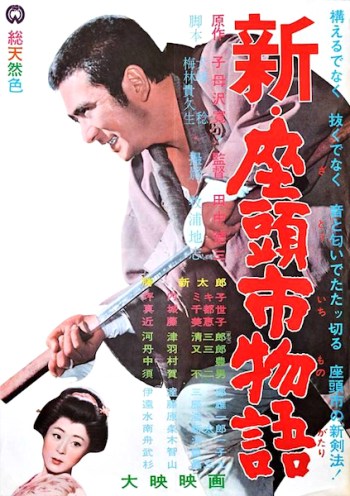
    With studio Daiei apparently realising they had a potential long-running series on their hands, blind masseur cum roving wrong-righter Ichi (Shintarô Katsu) makes his colour debut in this third film. Despite the obvious visual change, New Tale picks up on plot threads from the previous film, concluding a trilogy of sorts that spans the series’ first three instalments.

    Two strands from Ichi’s past come forth to challenge him this time: as he’s hunted by the brother of a villain he killed in the previous film, Ichi runs into the master who trained him to be a sword fighter, Banno (Seizaburô Kawazu). Desperate for money, Banno has fallen in with a criminal gang, while also trying to marry his younger sister, Yayoi (Mikiko Tsubouchi), to a respectable samurai — but Yayoi has feelings for Ichi.

    Where the first Zatoichi sequel was faster and more action orientated, New Tale takes a slower, character-driven tone. Ichi is pulled in multiple emotional directions, most of which he keeps stoically buried, but we can still interpret them from Katsu’s nuanced performance. The most forefront theme is violence and the honour of it: Ichi vows to renounce those ways to marry Yayoi, while Banno is betraying them with his greedy actions — and naturally those two are going to come into conflict. It makes for a sombre film, that doesn’t come to a happy conclusion.

    Family dynamics

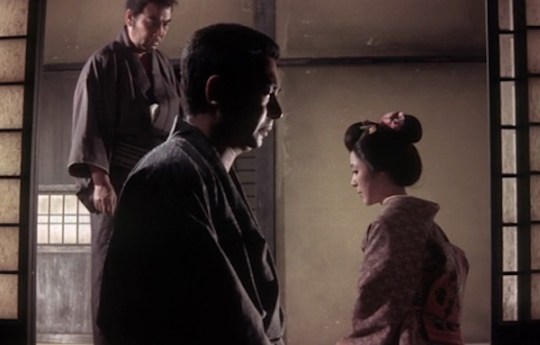
    Although this is the first colour Zatoichi, director Tokuzô Tanaka keeps the palette muted throughout, but this is particularly obvious at the end: after Ichi gives in to his old ways, the final shot is practically in black and white, like the previous two films — perhaps a visual indicator of our hero’s return to, or acceptance of, his previous position. Although this dull colour scheme means New Tale isn’t the most vibrantly exciting film visually, it’s compositionally strong, making appropriate use of the wide frame. It’s interesting to note that Tanaka was previously an assistant director on such acclaimed masterpieces as Rashomon, Ugetsu Monogatari, and Sanshô Dayû, so I guess he picked up a thing or two.

    As Ichi hits the road again at the end (I don’t think it counts as a spoiler that he doesn’t ultimately settle down), it feels a little like an origin story has been completed, setting Ichi off on a path ready for standalone adventures. That said, according to the liner notes that accompany Criterion’s Blu-ray release, audiences “became increasingly starved” for details of Ichi’s past as the series went on, so I guess some people weren’t satiated.

    I don’t think New Tale is quite the equal of the first film, which seems the purest execution of the character as yet, but its thoughtfulness in engaging with the emotional effects of a violent life mark it out as a step above the second movie.

    4 out of 5

    Underworld: Blood Wars (2016)

    2017 #72
    Anna Foerster | 91 mins | Blu-ray (3D) | 2.40:1 | USA / English | 15 / R

    Underworld: Blood Wars

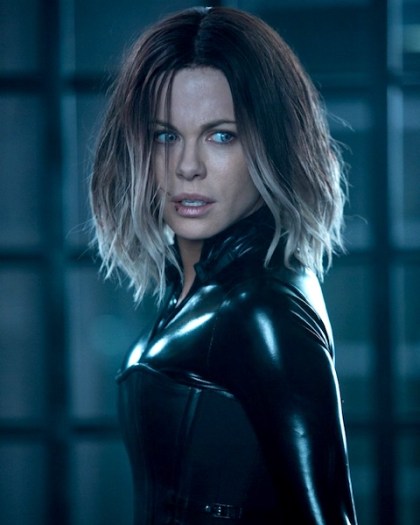
    Kate Beckinsale is back in skintight leather for……

    I’m sorry, my mind wandered off then. As I was saying: Kate Beckinsale is back in… skintight leather……

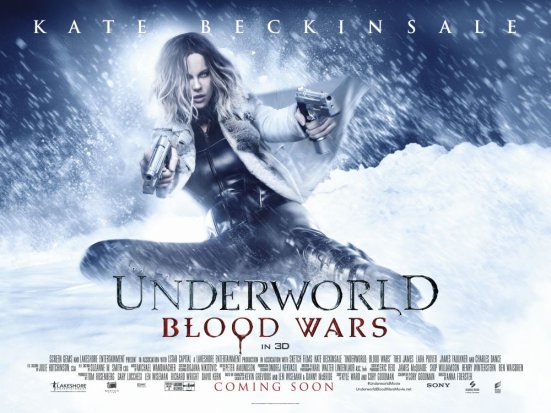
    Sorry, happened again. As I was saying: Kate Beckinsale is back in… her role as a werewolf-killing vampire for the fifth entry in the Underworld series, which seems to be as undying as its star creatures.

    Picking up a little while after the last one left off, the war between vampires and Lycans (aka werewolves) is now back in full swing, and both sides are hunting Selene (Beckinsale). Her own kind want her for previous crimes (see: the first two films), while the Lycans are after her daughter (see: the last film) to give them an advantage in the war. Fearing for their safety, the vampires invite Selene back into the fold to train a new generation of combatants, but there are sneakier plans afoot…

    Kate Beckinsale in leather. Nuff said.

    The first Underworld marked out somewhat-new territory when it hit screens in 2003 by taking fantasy/horror elements like vampire covens and werewolves and placing them in a modern urban environment, fighting more with guns than swords and teeth. It certainly wasn’t wholly original — Blade had already done a similar concept and visually it owed a lot to The Matrix — but it was fresh enough. Since then the series has increasingly strayed away from that: the second film brought more traditional-style Eastern European countryside, the third was a medieval prequel, and the fourth was… kind of nothing-y, really.

    Now, they seem to have made something of an effort to get back to the ‘world’ of the first film, with extravagant vampire covens and underground Lycan forces, while also growing the series’ mythology by introducing us to new areas of vampiredom, primarily a Nordic coven. This move also brings with it a degree of politicking among the vampires, which is kind of what I imagine a millennia-old secret society would be like. I mean, don’t expect House of Cards — it’s done at the level of the action B-movie this series is — but it’s kinda fun. To achieve this it’s had to ignore an awful lot of the last film — not entirely, by any means, as it’s quite heavily based in some leftover plot points — but other parts have been completely glossed over. This lax attitude to continuity could be irritating, but a counterargument might go that isn’t it better to ditch stuff that isn’t really working in favour of stuff that’s more entertaining?

    Vampire politics

    Part of the entertainment comes from characters talking rather than just fighting, and we’re treated to some magnificently cheesy, overworked dialogue. Some of these scenes are edited within an inch of their life, lines almost tripping over each other as they’re rushed on to the screen. By rights that should be a problem, yet in something as fabulously trashy as Underworld it feels more expedient — they’re getting on with it, rather than being ponderous about the mythology, like much fantasy is wont to do. I kinda like it for that. Alternatively, there’s one bit where the main characters seem to express themselves in a quick-cut series of heavy breaths and grunts. It’s either terrible or genius, or possibly both.

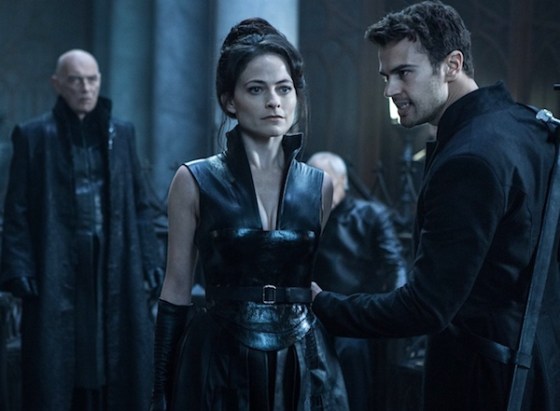
    This tone is supported by some superbly hammy acting from a cast filled with faces from British TV. Sherlock’s Irene Adler, Lara Pulver, seems to be having a whale of a time as the scheming head of a vampire coven, while giving Miss Beckinsale a run for her money in the kinky outfit department. She’s accompanied by Merlin’s Arthur, Bradley James, pouting around as her frequently-insulted boy toy. Tobias Menzies (take your pick of what you consider him best-known for) does his best as the Lycan’s cunning new leader, who’s most threatening in his CGI-powered transformed state. And Charles Dance is back, exuding pure class as always, completely convincing you that he believes in all the high-fantasy drivel he has to spout.

    Irene and Arthur

    Similarly, we all know Kate Beckinsale is better than this — and if you’d forgotten, Love & Friendship should’ve reasserted it. Even here she’s called on to be more than just a shapely pair of buttocks, getting to inject Selene with some rare emotion on several occasions. She also once again kicks ass left, right, and centre. The film’s action on the whole is fairly entertaining. There’s little impressive choreography or particularly original combat concepts, but it passes muster. Even Charles Dance gets to do some swashbuckling (as he terms it in the making-of), which is only brief but also as awesome as it sounds. Another part amusingly sees two bulletproof adversaries walk slowly towards one another while emptying their guns into each other. It’s, again, simultaneously close to being both terrible and genius.

    Despite being renowned as a visually gloomy series, I thought it looked pretty nice in 3D — better than Awakening did, at any rate. Awakening was genuinely shot in 3D, whereas (based on what I could see in behind-the-scenes footage from the special features) Blood Wars appears to have been post-converted. It shows how far that technology has come that even a modestly budgeted movie like this (just $35 million) can afford post-conversion that often looks very good indeed.

    The only major disappointment I had with the film was that, thanks to it being in a rush every time it had some plot to get through, parts of it don’t quite make sense. The ending, in particular, where a voiceover monologue mentions a load of stuff we haven’t just seen happen and doesn’t quite flow. Surely they could’ve afforded an extra two minutes to connect the dots? Apparently the ending was designed to both brings things full circle and, perhaps, leave it open for a sixth instalment. Well, I would say it shortchanges the wrapping-up bit — this could be a place to conclude the series, but by not giving that sufficient weight (i.e. by rushing it), it implies a kind of “tune in next time”-ness.

    Kate Beckinsale. Leather. Nuff. Said.

    That aside, I actually massively enjoyed Blood Wars; much more than the negative reception led me to expect. Of course, the Underworld films are a fan-only experience at this point — not because of diminishing quality, as most reviews would cite, but because of how much the story is based in events from three of the previous four films. If you’ve watched any of those previous movies and not enjoyed them, it’s not worth catching up for this — it’s fundamentally “more of the same”, just done better than it’s been since the first movie.

    These days franchises can revive themselves for new viewers later in their runs — Fast Five being the best Fast & Furious movie is a case in point — but Blood Wars isn’t a Fast Five. However, as someone who would, at this point, I guess, count myself as a fan of the series, Blood Wars delivered.

    4 out of 5

    Underworld: Blood Wars is released on DVD and Blu-ray (in regular, 3D, and UHD flavours) in the UK today.

    Pirates of the Caribbean: Salazar’s Revenge (2017)

    aka Pirates of the Caribbean: Dead Men Tell No Tales

    2017 #71
    Joachim Rønning & Espen Sandberg | 129 mins | cinema | 2.35:1 | USA / English | 12A / PG-13

    Pirates of the Caribbean: Salazar's Revenge

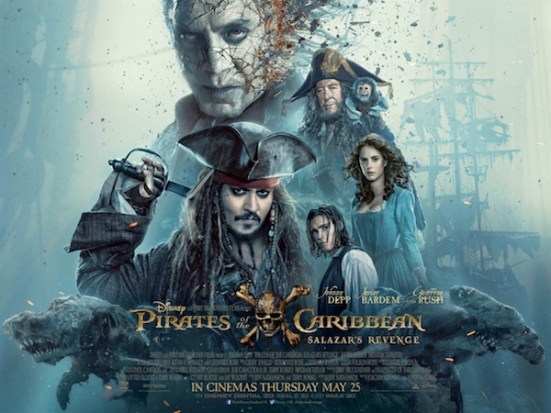
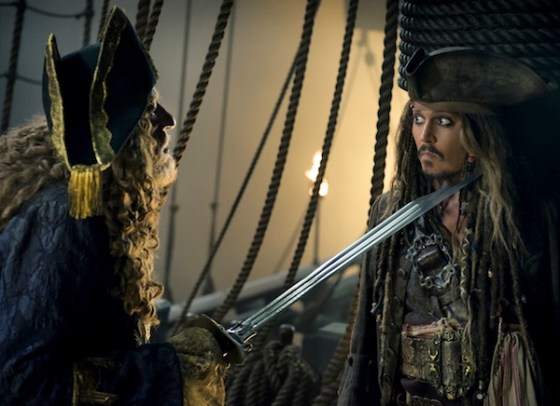
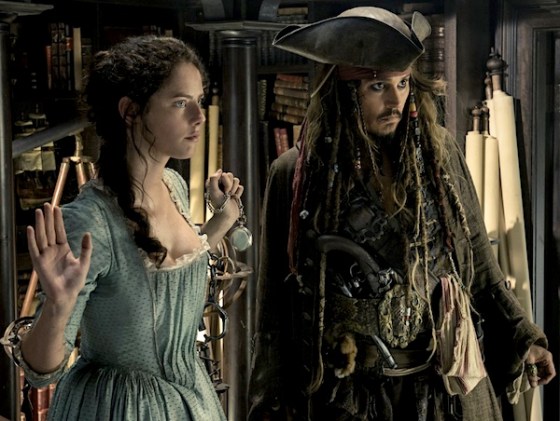
    Dead men may tell no tales, but lucrative franchises never die, so Disney’s Pirates of the Caribbean has taken to the high seas once again. Johnny Depp is back in the role that once netted him an Oscar nomination (remember that?), the drunken pirate Captain Jack Sparrow, this time teaming up with the child of some old friends (Brenton Thwaites) and a bright young astronomer (Kaya Scodelario) for another MacGuffin hunt adventure, while again being pursued by some cursed seafarer (Javier Bardem) and a member of the British Navy (David Wenham).

    Yes, despite the unusually-long six-year gap since the previous film, and all the promotional talk of this being a fresh start for the series that tonally harks back to the standalone fun of the first movie, Salazar’s Revenge (or, if you prefer, Dead Men Tell No Tales) seems doomed to repeat bits and bobs from the series’ other instalments. It’s not a complete wash-out, however, because it at least executes some of those bits quite well. Sadly, other bits are beginning to look a little tired. Perhaps the best single adjective to describe the film’s attitude would be “muddled”. Beware, me hearties: spoilers follow.

    It seems likely that Disney do want this to be a soft reboot of the franchise — a reboot to combat the increasingly poor critical receptions that greeted the previous sequels, but a soft one so that Depp’s popular turn can continue being a part of things. This revivalist plan presumably included looking back in time, beyond the last movie (the least popular one) to the series’ heyday. However, rather than just try to replicate the tone of the earlier movies, storyliners Jeff Nathanson and franchise veteran Terry Rossio have revived some of the old plots too. So we have a film that attempts to move forward with new young leads and a new villain, all hunting for a new MacGuffin, but with motivations bedded in plots that were ostensibly wrapped up a decade ago. They can’t even bring themselves to ignore the previous movie, despite its lack of popularity, continuing narrative threads from there as well. So much for “reboot”.

    Cutthroat, without the island

    And yet, despite that, its consistency with previous films is sometimes poor. For example, Salazar is freed because Jack gives away his magic compass — but didn’t he do that in film two and/or three, with no such ill effects? Also, why does the compass now suddenly have the power to make you face things you dread? And how does that even work, considering other characters have had it and given it away and never had such issues? Maybe they were just hoping viewers wouldn’t remember the ins-and-outs of the plots of previous movies… though, if that’s the case, why is the story based on them?

    Unfortunately, its internal consistency isn’t much better. Like, why do ghost pirates own zombie sharks? How come Salazar can suddenly possess someone when it becomes necessary for the plot? That ability is never mentioned, it just turns up. When Carina’s navigating them to the map-island, how do they end up at a completely different place (before later just setting off again)? Maybe I missed something…

    This abundance of niggles stems from the film being overstuffed with ideas that it doesn’t invest in fully — just like the last film, which it was supposed to have learnt lessons from! One of the things that made the original Pirates movie work was its relative simplicity, which kept the story focused and driving forward. The sequels all throw in too much random stuff — see my previous paragraph, which isn’t even the half of it: I haven’t mentioned the witch, or the ruby-powered star map, or the nonsensical post-credits scene.

    Salazar, out for revenge

    It probably doesn’t help, then, that Salazar’s Revenge is the shortest Pirates film (though it doesn’t feel like it). The dearth of screen time may be why both Bardem and Wenham are ultimately wasted as the villains — they’re not working together, so the time typically afforded to the antagonist ends up split between them. Geoffrey Rush’s Captain Barbossa is back too, as much a series regular as Captain Jack now. He gets an emotional storyline that surfaces out of the blue just before the last act. It’s a nice idea, but appears too late in the game to have time to develop properly.

    And how about the flashback showing Jack defeating Salazar, which seems to stop the film dead halfway through. Why not put that sequence at the start? Then cut straight to the existing opening scene of the naval ship accidentally sailing into the Devil’s Triangle. It’d work — the viewer thinking, “oh, the navy ship is going to sink, just like Salazar did all those years ago,” but then it doesn’t and Salazar attacks. (Hey, Hollywood — employ me!) Okay, fair enough, that structure would make it awkward to place Orlando Bloom’s opening cameo, but—

    Oh, wait, that’s another thing! So, we know why Orlando Bloom only appears in bookend scenes and why Keira Knightley is reduced to a dialogue-less cameo — because Disney want this to be a fresh start with new stars — but it feels like, to do this particular story properly (trying to break the curse that’s imprisoning Bloom), they both should’ve been in it more. I mean, why isn’t the formerly strong and capable Elizabeth working with her son to free the love of her life? At least explain that, film, don’t just ignore it! Heck, tossing in even one line from Henry (“my mum’s given up hope, but I haven’t”) would’ve solved it.

    A clever woman? What is the world coming to

    As for the rest of the cast, Johnny Depp feels like he’s forgotten how to play Sparrow — it’s a pretty good imitation rather than the real thing. Kaya Scodelario plays Carina with an earnest intelligence, a trait which is exhibited dependably throughout the screenplay. That shouldn’t need to be worthy of note, but, for a female character, it is. Thwaites, on the other hand, is perfectly bland as Henry Turner, rarely even managing the enthusiasm or charming naivety suggested by that good line from the trailers (“I think I saw her ankles!”)

    On the action-adventure front, there are some good set pieces, mainly early on — the bank robbery and the halted executions, particularly the spinning guillotine, are inventively handled. Sadly, later efforts are obscured by gloomy lighting and too much whizzing around of CGI — and, once again, the overabundance of out-of-nowhere ideas (why does the ship’s figurehead suddenly come to life?!) Geoff Zanelli’s score primarily recycles Hans Zimmer’s familiar themes, which I don’t mind too much because I like them. At least it does so in a less slapdash fashion than On Stranger Tides, where the music felt plonked on at random.

    That's the second biggest pirate ship I've ever seen

    So, I’ve moaned throughout this review, and here’s the main reason for that: there’s a decent action-adventure movie hidden in Salazar’s Revenge — probably not something that would equal the first Pirates, but a good effort — but all the times when plot necessities seem to have been filled with “invent something new!” rather than “make what we’ve got work”, plus all the little inconsistencies (both internally and with previous films), really get in the way. Maybe, now that all of the leftover business from previous films is well and truly resolved, and if this makes a lot of money, we’ll get a sixth film that finally does return to the joys of the first.

    Hey, Disney: you own Lucasfilm now — how about Pirates of the Caribbean: The Secret of Monkey Island?

    3 out of 5

    Pirates of the Caribbean: Salazar’s Revenge is in some cinemas now. Pirates of the Caribbean: Dead Men Tell No Tales is in the others.

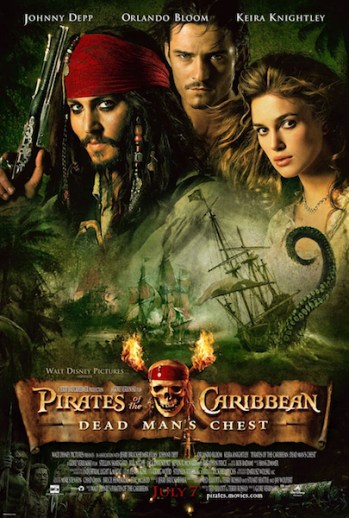
    Pirates of the Caribbean: Dead Man’s Chest (2006)

    The 100 Films Guide to…

    Captain Jack is back

    Here’s the first in a sporadic new series of posts, inspired by my 100 Favourites entries, which I’ll be using to plug some of the gaps in my review archive. As a good starting example, this is the only Pirates of the Caribbean film I haven’t covered before.

    Country: USA
    Language: English
    Runtime: 151 minutes
    BBFC: 12A
    MPAA: PG-13

    Original Release: 6th July 2006 (UK & others)
    US Release: 7th July 2006
    Budget: $225 million
    Worldwide Gross: $1.066 billion

    Stars
    Johnny Depp (Edward Scissorhands, Alice in Wonderland)
    Orlando Bloom (The Lord of the Rings, Kingdom of Heaven)
    Keira Knightley (Pride & Prejudice, The Imitation Game)
    Bill Nighy (Love Actually, The Best Exotic Marigold Hotel)

    Director
    Gore Verbinski (The Ring, Rango)

    Screenwriters
    Ted Elliott (The Mask of Zorro, The Lone Ranger)
    Terry Rossio (Shrek, Godzilla vs. Kong)

    Based on
    Pirates of the Caribbean, a theme park ride at Disneyland.


    The Story
    On their wedding day, Will Turner and Elizabeth Swann are arrested for piracy. To secure a pardon, all they have to do is bring in Captain Jack Sparrow. Meanwhile, the aforementioned pirate captain is hunting for a key that he can use to unlock a chest that contains leverage he may be able to use to escape a debt to the horrifying Davy Jones…

    Our Heroes
    Jack Sparrow (or, as half the characters pronounce it, Jack Sparrah), the pirate captain who looks like a drunken fool but is actually in possession of a sharp mind. Also Will Turner, the swashbuckling ex-blacksmith determined to prevent the execution of himself and his beloved. That would be Elizabeth Swann, the governor’s daughter who is altogether more capable than would be expected of a woman from this era.

    Our Villains
    The pirate-hating East India Company is represented by the scheming Cutler Beckett, who seeks to rid the seas of pirates. To do so, he intends to control Davy Jones, captain of the Flying Dutchman. A tentacled terror, Jones seeks primarily to add more damned souls to his crew — including one Jack Sparrow…

    Best Supporting Character
    Will Turner’s father, Bootstrap Bill, was condemned to the ocean’s depths, where he ended up committing himself to servitude on Davy Jones’ ship. Well, unless Will can find a way to set him free…

    Memorable Quote
    Elizabeth Swann: “There will come a time when you have a chance to do the right thing.”
    Jack Sparrow: “I love those moments. I like to wave at them as they pass by.”

    Memorable Scene
    A large chunk of the climax is a set of interconnected sword fights that most famously include three men duelling each other inside a runaway waterwheel. And while that’s good, my favourite bit has always been Elizabeth, Pintel and Ragetti fighting off Davy Jones’ crew while sharing two swords (and a chest) between the three of them.

    Truly Special Effect
    Davy Jones is an incredible creation, the writing mass of CGI tentacles that make up his face conveying a slimy physicality that remains impressive even as some of the film’s other computer-generated effects begin to show their age.

    Previously on…
    Inspired by a Disney theme park ride, nobody expected much of Pirates of the Caribbean — or, as it was hastily subtitled once someone at Disney realised this could be the start of a franchise, The Curse of the Black Pearl. As that someone knew, it turned out to be something very special. Dead Man’s Chest retrofits it into being the first part of a trilogy.

    Next time…
    The aforementioned trilogy concludes with At World’s End, which was shot back-to-back with Dead Man’s Chest and so wraps up its many dangling plot threads. The series continued with standalone instalment On Stranger Tides, while this year’s Dead Men Tell No Tales, aka Salazar’s Revenge, looks as if it seeks to tie the whole shebang together.

    Awards
    1 Oscar (Visual Effects)
    3 Oscar nominations (Art Direction, Sound Mixing, Sound Editing)
    1 BAFTA (Special Visual Effects)
    4 BAFTA nominations (Production Design, Costume Design, Sound, Make Up & Hair)
    1 Saturn award (Special Effects)
    4 Saturn nominations (Fantasy Film, Supporting Actor (Bill Nighy), Costume, Make-Up)
    1 World Stunt Award (Best Fight — see “Memorable Scene”)

    Verdict

    The Pirates sequels have all come in for a lot of criticism ever since their first release. It was inevitable, really: the first is basically a perfect blockbuster action-adventure movie, something any follow-up would struggle to live up to. However, I think Dead Man’s Chest has improved with age. It lacks the freshness and elegant simplicity of its forebear, true, but it still has inventive sequences, memorable characters, impressive effects, and a generally fun tone, even as it’s setting up masses of mythology that will only be fully paid off in the next instalment. That also means it doesn’t quite function as a standalone adventure. But if you readjust your focus slightly, so that the film isn’t about beating Davy Jones, but instead about finding the chest and settling Jack’s debt to Jones, it’s more self-contained than it appears.

    The fifth Pirates of the Caribbean movie, under whichever subtitle they’ve chosen for your country, is in cinemas from today.

    Alien: Covenant (2017)

    2017 #69
    Ridley Scott | 122 mins | cinema | 2.35:1 | USA, Australia, New Zealand & UK / English | 15 / R

    Alien: Covenant

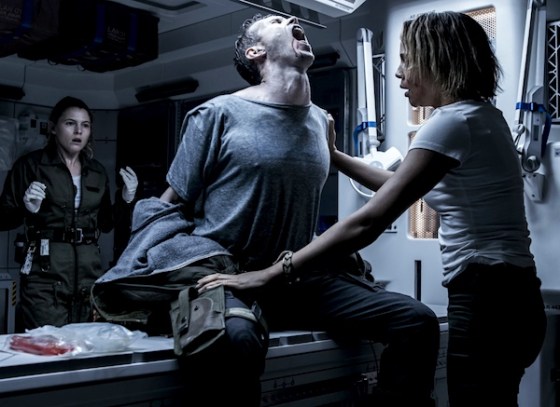
    Following in the footsteps of half the other Alien movies (and “following in the footsteps” is definitely a theme when it comes to this movie), Alien: Covenant introduces us to a group of people who are the crew of a spaceship. This particular lot are on their way to establish a colony when a mid-flight disaster awakens them to deal with the damage. At the same time they detect a distress call from a nearby planet — a planet that looks even more suited to supporting human life than the one they were headed for. Changing course, they find suspiciously human vegetation growing on the planet, but are soon beset by terrible things. Well, it’s an Alien movie — I’m sure you can guess where most of this is going.

    I say it’s an Alien movie, but really it’s a Prometheus movie. I don’t think that counts as a spoiler, does it? It’s no secret that Michael Fassbender is back. Sure, he starts the film playing a new robot, but did anyone really think that meant his old character wouldn’t be rocking up too? Sorry if I’ve spoiled it for anyone, but, c’mon. Besides, it’s clear that — despite the initial set dressing — Ridley Scott is far more interested in the concepts that launched Prometheus than he is in creating another Alien movie. The franchise-friendly stuff powers the slow-burn opening and the final act adrenaline rushes, but in between Scott reconnects to themes leftover from the apparently-aborted Prometheus trilogy.

    Fit to burst

    Now, I’ve already professed to be avoiding spoilers, but suffice to say that if you put Prometheus, Aliens (as opposed to Alien), Blade Runner (yep), and Frankenstein into a blender, then poured the resulting mixture into a novelty tie-in glass from the Star Wars prequels, you’d get Alien: Covenant. Weirdly, it’s the Prometheus stuff in that blend that tastes finer than the Aliens stuff. In fairness, that’s because it’s complemented by the notes of Blade Runner and Frankenstein.

    Still, it’s a mixed bag. The scenes of characters chatting hold more interest than the action sequences, which feel a little perfunctory, remixing bits of previous movies with little impact, and are too dark to really appreciate (though I should withhold judgement on that last point, because they looked gloomier in the film than they did in the trailer, so perhaps it was just my cinema?) There’d be no shame in Covenant working as just an action and/or horror movie, if well made — that’s what the films that originated this franchise are, after all — but Scott is interested in exploring something more profound. The problem is that the attempted profundity comes from characters standing around and explaining the plot and/or themes to each other. It’s further undermined by slightly sloppy construction, one that places a key flashback at entirely the wrong moment (coming much earlier than it should, thereby spoiling a later reveal), and a last-minute twist that will be easily guessable to anyone who’s ever seen another movie.

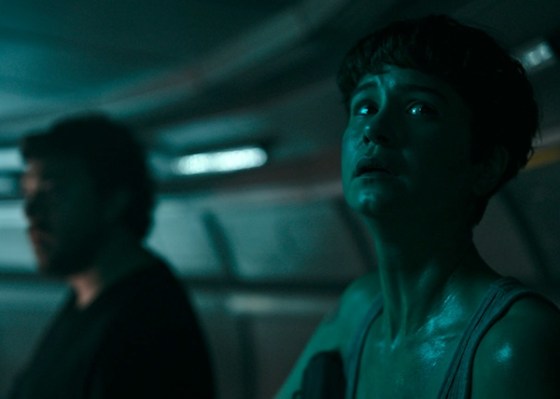
    In space, no one can see you look worried...

    Worst of all, however, is that this film just didn’t need to be made. As with Prometheus before it, do we want to know where the eponymous beasties come from? It ruins some of their mystique, especially as the answers feel oddly mundane. This is not something further films are going to fix, either; though at this point they may as well keep going until things join up properly to the original Alien, because hey, why not?

    Alien: Covenant is better than Prometheus because at least the characters don’t act like total imbeciles who should know better. On the other hand, it’s worse than Prometheus because it scrubs out any ambiguity that film left about the Xenomorphs’ origins. Sometimes a mystery is better than an answer.

    3 out of 5

    Alien: Covenant is out in the half the world (including the UK) now, and is released in the other half (including the US) from tomorrow.

    Independence Day: Resurgence (2016)

    2017 #64
    Roland Emmerich | 120 mins | Blu-ray | 2.39:1 | USA / English & Mandarin | 12 / PG-13

    Independence Day: Resurgence

    With nostalgia-driven reboots and belated sequels all the rage these days, it was inevitable someone would eventually get round to Independence Day, the highest grossing film of 1996. Back then it took $817 million, a total most producers would be happy with even today… especially those behind Resurgence, which managed a comparatively paltry $389.6 million, leaving it in 21st place on 2016’s chart.* I guess nostalgia doesn’t win everything.

    One thing the two-decade delay has given us is an interesting setup for a sequel. Reflecting real life, the film begins 20 years after “The War of ’96” (i.e. the original movie). Humanity has rebuilt, integrating alien technology with our own to create more advanced aircraft and weaponry, including a moon base and defensive satellite system, all on the assumption that the aliens will come back. But they don’t and everyone lives happily ever after.

    Not really! The actual mechanics of the plot are far too fiddly to bother getting into here, but suffice to say the aliens do return, and, in typical sequel fashion, they’re bigger and badder. Facing them on humanity’s side are returning faces (Jeff Goldblum, Bill Pullman), returning characters with new faces (Maika Monroe, Jessie T. Usher), some surprising new faces (Charlotte Gainsbourg?!), and Liam Hemsworth, who somehow merits top billing. No Will Smith, because he died. Well, his character died, because Will Smith was busy doing Suicide Squad, which is basically the same thing.

    The cast who DID come back

    I jest at the Squad’s expense, but I actually enjoyed DC’s notoriously messy movie more than this. I think. (I intend to review it next week, when it’s also on Sky, so we’ll see what I say then.) You see, although from the outside it may look like Resurgence is just a rehash of the first movie, but with bigger spaceships, there are actually good ideas in here: how the world has developed since the last film, where the characters are, some new facets to our understanding of the alien race. Unfortunately, the film is in such a hurry to churn through Plot that it doesn’t take time to let any of the potentially-interesting stuff settle; doesn’t allow the space for it to be developed or appreciated. It feels wrong to complain that a blockbuster isn’t long enough, especially in this day and age, but you wish Resurgence had just given itself a little time to breathe; to properly explain why characters were doing certain things, rather than throwing in a speedy line of dialogue that there’s no time to process; to allow its set pieces to show off their scale, rather than racing from one to the next as if having as many as possible is better than making the most out of… well, any of them.

    Despite the unwavering focus on plot over everything else (it even sidelines spectacle at times, which is what big-budget disaster movies like this should be about), the headlong rush to get through the narrative means its storytelling is really sloppy. For instance, we’re reintroduced to Goldblum’s father (Judd Hirsch) trying to hawk his book to a room of uninterested pensioners; then we next see him on a boat, just in time to get caught up in the giant spaceship’s arrival. So, does he live on this boat? It doesn’t look big enough for that. So is he just hanging out there? Why? I mean, he was just at a book reading. And why does he have a boat anyway? Yet for all this rushing, the film begins to waste time on a bunch of random kids in a car, or some salvage sailors performing a job that (in story terms) doesn’t actually need doing. Clearly the script needed a good going-over by someone with an objective eye.

    Independence Day: The Next Generation

    Maybe it’s daft to focus on the quality of the screenplay in a film like Independence Day — as I said just now, its genre dictates it should be all about spectacle. But it’s the poor screenplay that undercuts those things. Not just because it has iffy dialogue or muddled character motivation (which it does), but because they’ve made the story more complicated than it needed to be and the film is desperate to tell us it as quickly as possible. I suspect it’s not a coincidence that it runs exactly two hours, because it feels like it’s been sliced as thin as possible on an individual scene level, as if they were trimming frames here and there to have it run no longer than 120 minutes.

    The big show-off scenes are further marred by variable effects. Much of the really grand stuff is decent, if hurried past, but the film is flooded with green screen work that is consistently atrocious. Like, “it was better 20 years ago”-level bad. The deleted scenes may hold the key to why this is: there’s one where a character is picked up from a bus stop on an ordinary street, except it’s been filmed on a green screen instead of on, y’know, a street. If you’re making your effects team waste time generating something you could’ve filmed by popping down the road, no wonder they don’t have time to do the tricky stuff properly.

    And, quite bizarrely, there are a couple of action bits that mirror sequences from, of all things, San Andreas. They happen back to back — intercut, in fact — which just emphasises the parallel. This signifies nothing, really, it’s just… strange.

    We're gonna need a bigger spaceship

    I really wanted to enjoy Independence Day: Resurgence, because I thought the “20 years later” ideas had promise, and also I have a soft spot for the original. Sure, it’s cheesy as hell, but mostly the cheese works thanks to an earnestness and the evocation of some degree of emotion. Plus, it achieves what it sets out to be — that is, an entertaining disaster movie cum alien invasion actioner. This follow-up wants to do the same thing on a bigger scale, and it is indeed even cheesier at times, but not in the same likeable way. If the first is a tasty chunk of mature cheddar (which, for the purposes of this analogy, we’re going to say it is) then the second is a thin slice of processed burger cheese. And, also like fake cheese, it fails to achieve even the straightforward thrills it sets out to create.

    2 out of 5

    Independence Day: Resurgence is on Sky Cinema from today.

    * For what it’s worth, if it had equalled the $817 million then it would’ve been 8th on 2016’s chart, beating the likes of Fantastic Beasts and Deadpool. ^